1
Chapter 8
Natural and Step Responses of
RLC Circuits
8.1-2 The Natural Response of a Parallel RLC
Circuit
8.3 The Step Response of a Parallel RLC
Circuit
8.4 The Natural and Step Response of a
Series RLC Circuit
2
Key points
 What do the response curves of over-, under-,
and critically-damped circuits look like? How to
choose R, L, C values to achieve fast switching
or to prevent overshooting damage?
 What are the initial conditions in an RLC circuit?
How to use them to determine the expansion
coefficients of the complete solution?
 Comparisons between: (1) natural & step
responses, (2) parallel, series, or general RLC.
3
Section 8.1, 8.2
The Natural Response of a
Parallel RLC Circuit
1. ODE, ICs, general solution of parallel
voltage
2. Over-damped response
3. Under-damped response
4. Critically-damped response
4
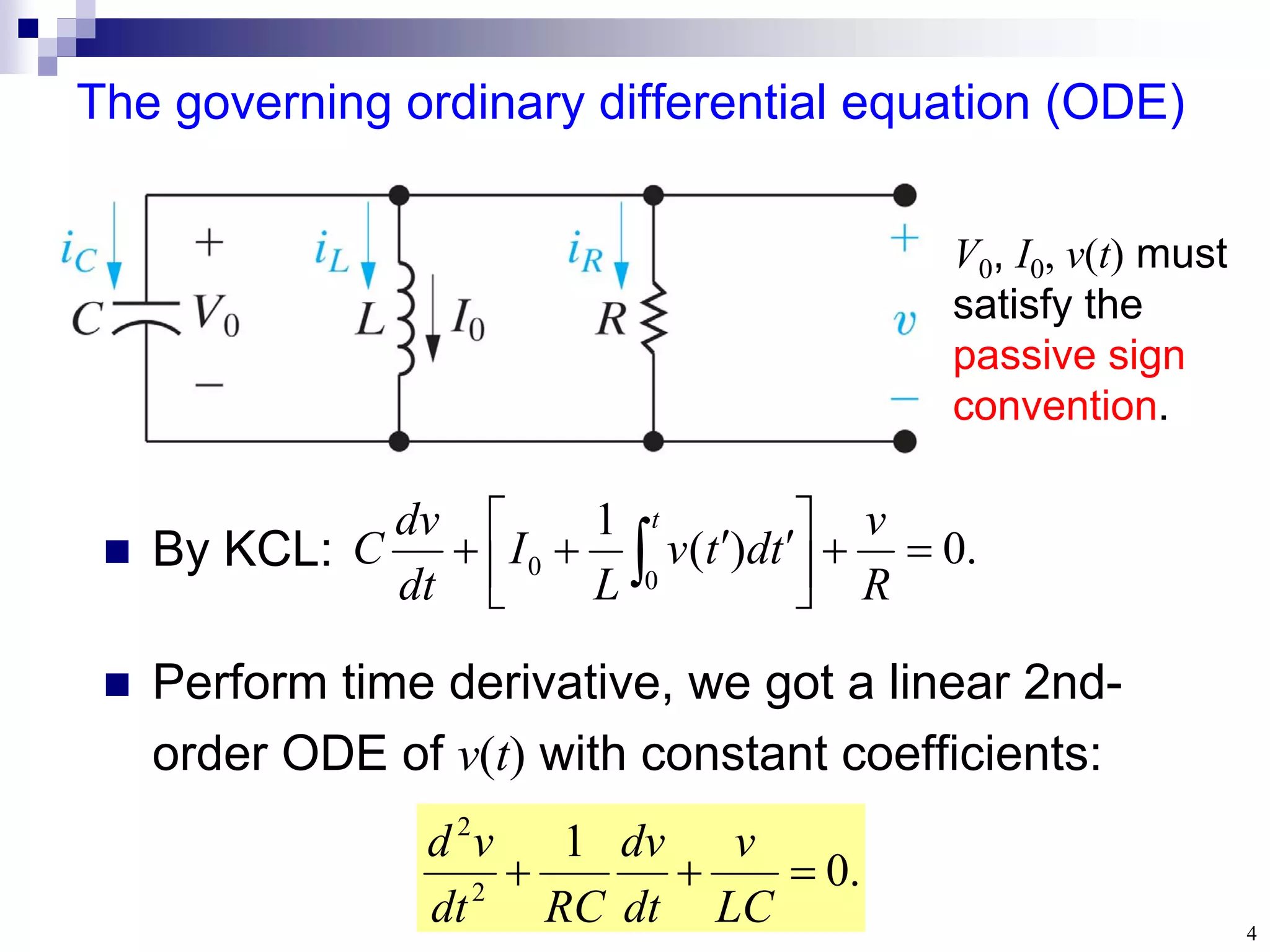
The governing ordinary differential equation (ODE)
.
0
)
(
1
0
0 






 


  R
v
t
d
t
v
L
I
dt
dv
C
t
 By KCL:
.
0
1
2
2



LC
v
dt
dv
RC
dt
v
d
 Perform time derivative, we got a linear 2nd-
order ODE of v(t) with constant coefficients:
V0, I0, v(t) must
satisfy the
passive sign
convention.
5
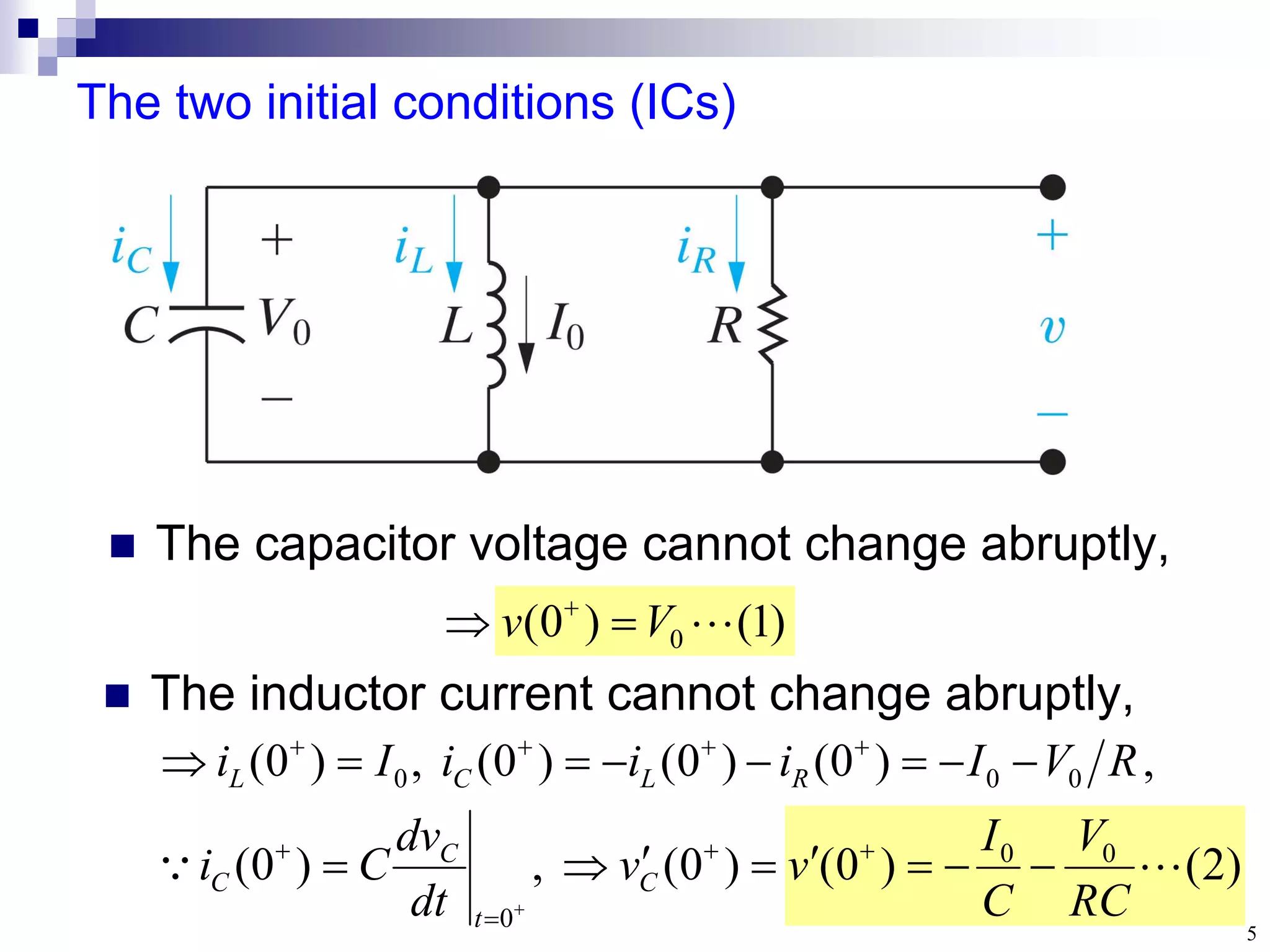
The two initial conditions (ICs)
 The capacitor voltage cannot change abruptly,
)
2
(
)
0
(
)
0
(
,
)
0
(
,
)
0
(
)
0
(
)
0
(
,
)
0
(
0
0
0
0
0
0


RC
V
C
I
v
v
dt
dv
C
i
R
V
I
i
i
i
I
i
C
t
C
C
R
L
C
L

























)
1
(
)
0
( 0 
V
v 
 
 The inductor current cannot change abruptly,
6
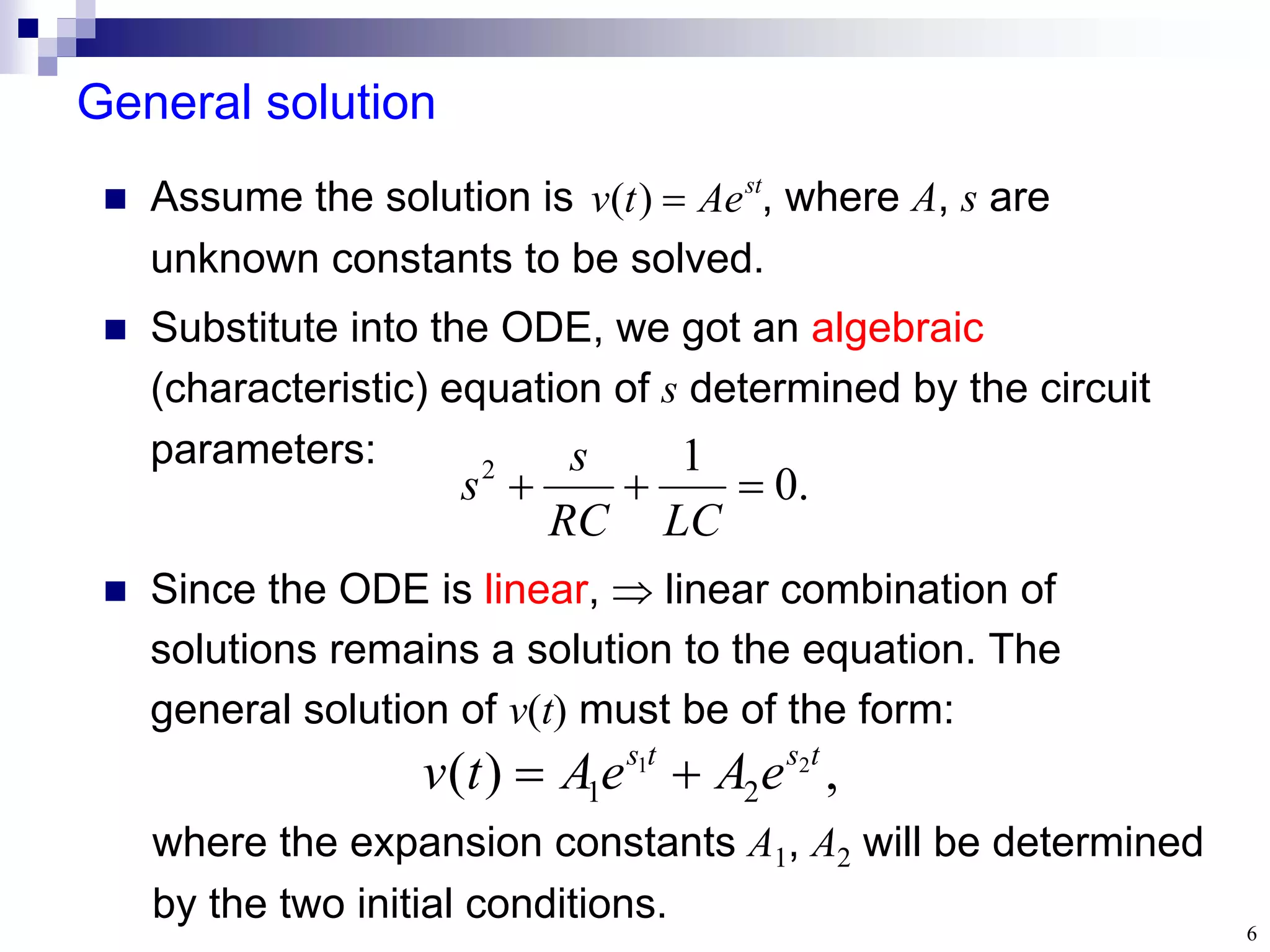
General solution
.
0
1
2



LC
RC
s
s
 Assume the solution is , where A, s are
unknown constants to be solved.
 Substitute into the ODE, we got an algebraic
(characteristic) equation of s determined by the circuit
parameters:
st
Ae
t
v 
)
(
where the expansion constants A1, A2 will be determined
by the two initial conditions.
,
)
( 2
1
2
1
t
s
t
s
e
A
e
A
t
v 

 Since the ODE is linear,  linear combination of
solutions remains a solution to the equation. The
general solution of v(t) must be of the form:
7
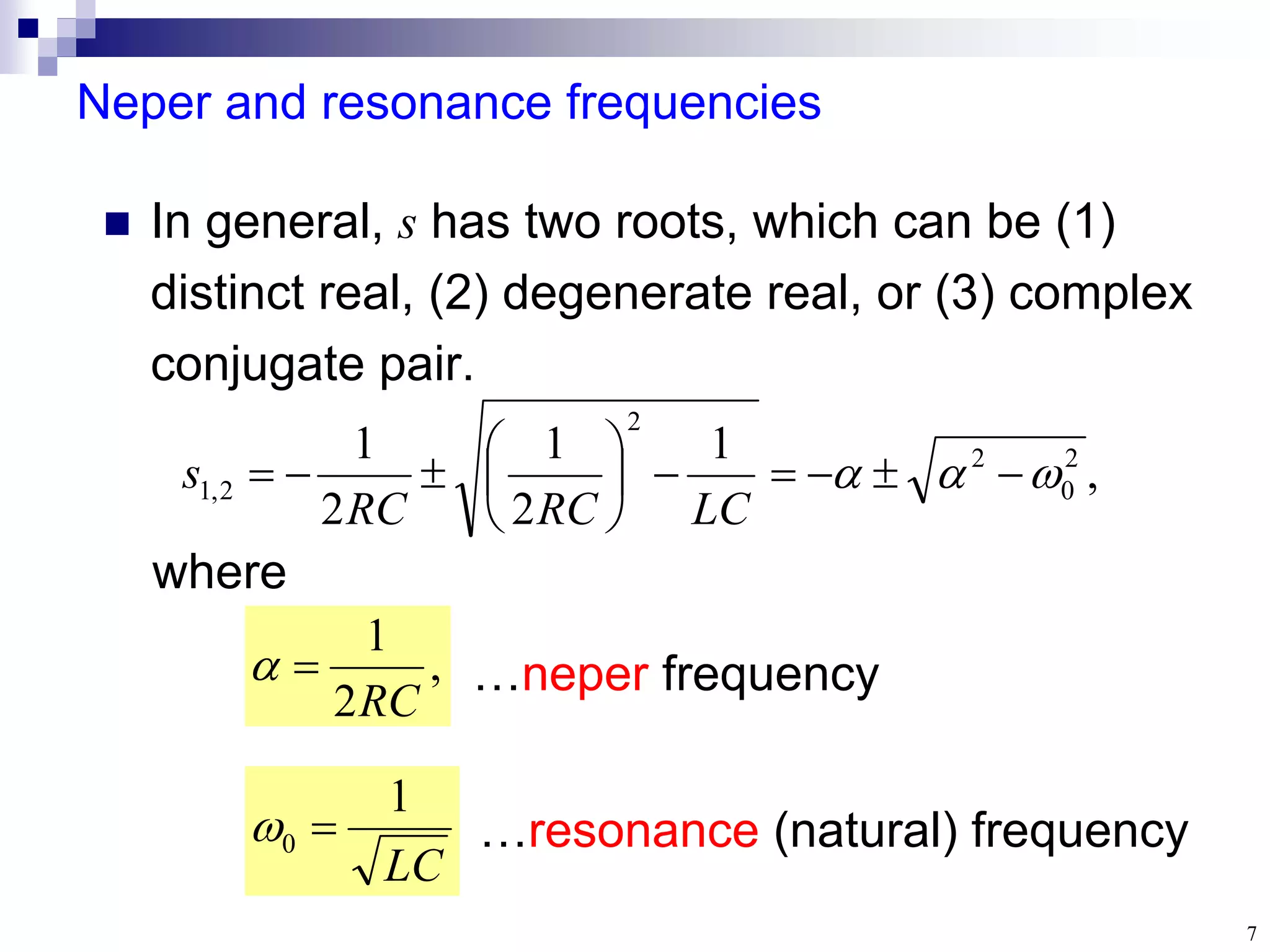
Neper and resonance frequencies
 In general, s has two roots, which can be (1)
distinct real, (2) degenerate real, or (3) complex
conjugate pair.
,
1
2
1
2
1 2
0
2
2
2
,
1 

 













LC
RC
RC
s
LC
1
0 

,
2
1
RC


where
…resonance (natural) frequency
…neper frequency
8
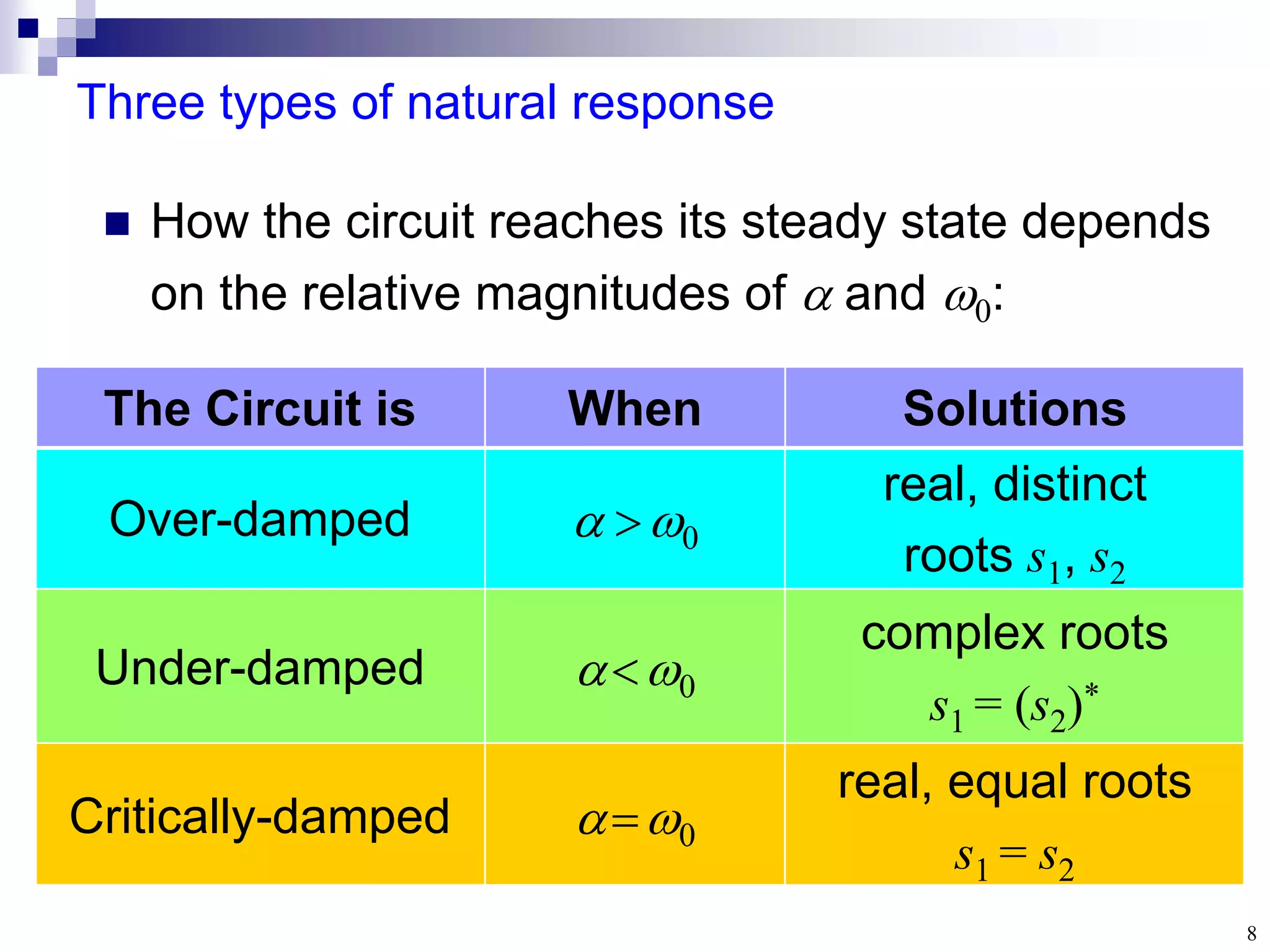
Three types of natural response
Over-damped  
real, distinct
roots s1, s2
Under-damped 
complex roots
s1 = (s2)*
Critically-damped 
real, equal roots
s1 = s2
The Circuit is When Solutions
 How the circuit reaches its steady state depends
on the relative magnitudes of  and 0:
9
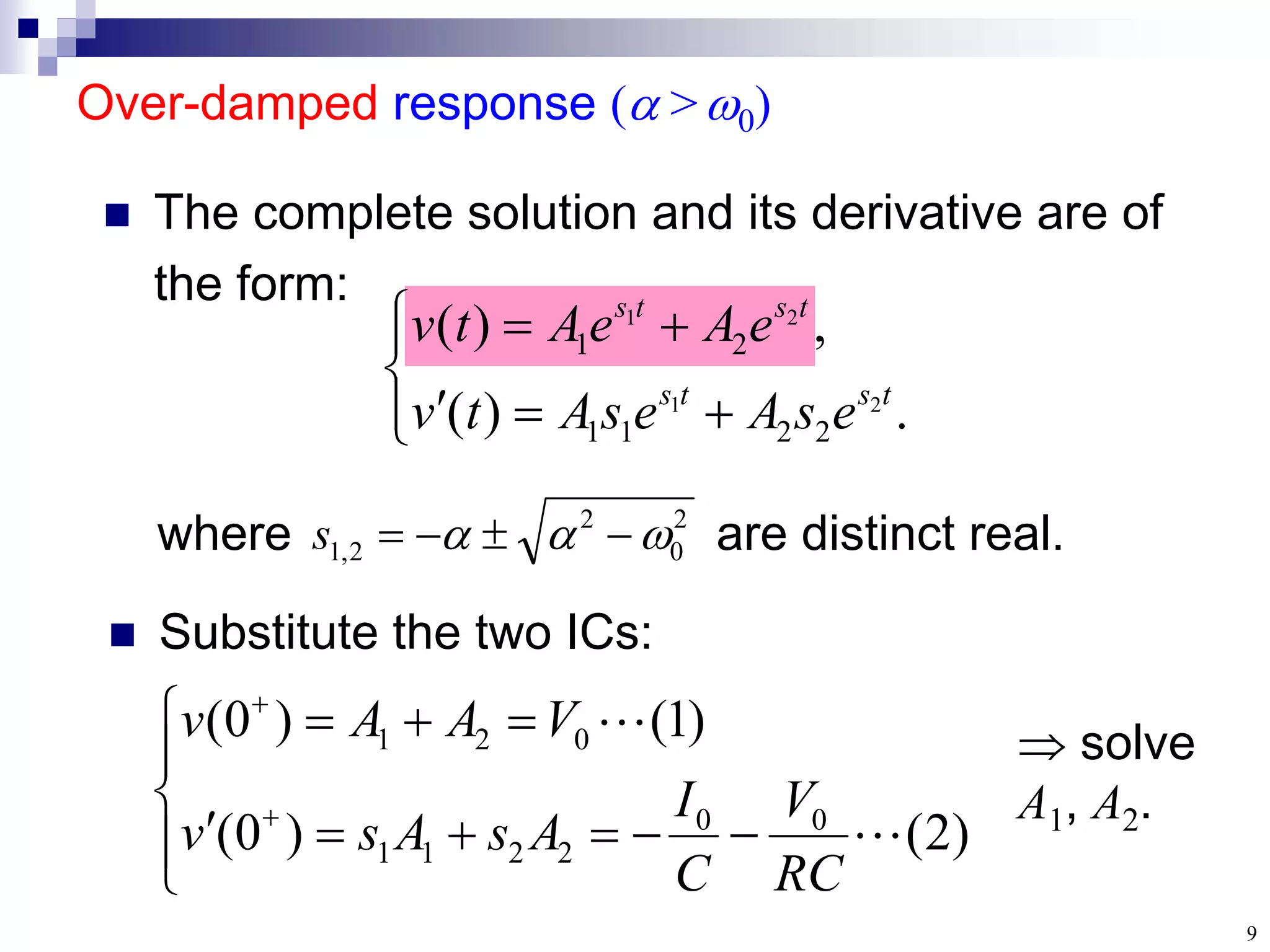
where are distinct real.
Over-damped response ( >0)
 The complete solution and its derivative are of
the form:










.
)
(
,
)
(
2
1
2
1
2
2
1
1
2
1
t
s
t
s
t
s
t
s
e
s
A
e
s
A
t
v
e
A
e
A
t
v
2
0
2
2
,
1 

 



s
 Substitute the two ICs:
















)
2
(
)
0
(
)
1
(
)
0
(
0
0
2
2
1
1
0
2
1


RC
V
C
I
A
s
A
s
v
V
A
A
v  solve
A1, A2.
10
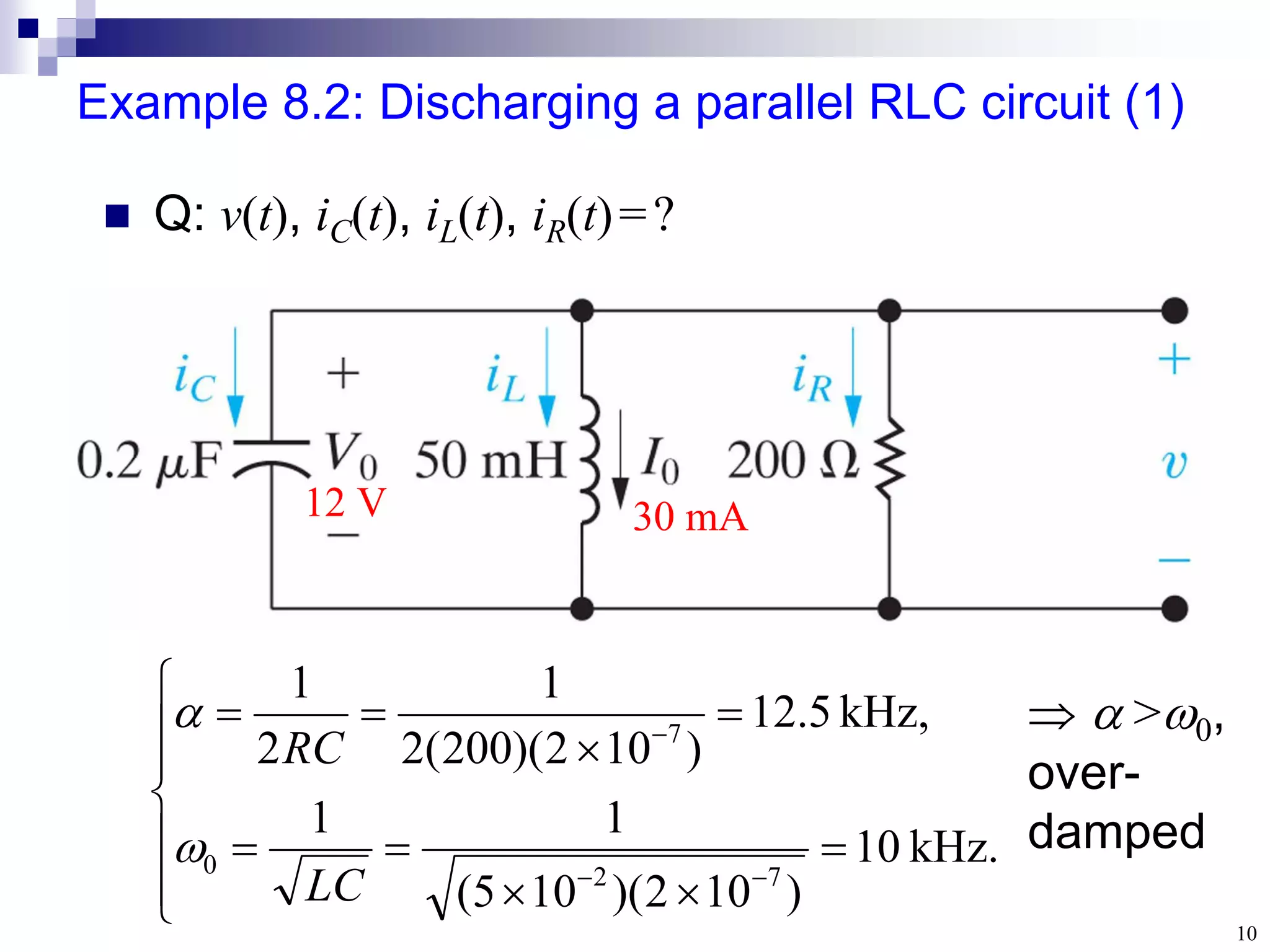
Example 8.2: Discharging a parallel RLC circuit (1)
12 V 30 mA
 Q: v(t), iC(t), iL(t), iR(t)=?



















kHz.
10
)
10
2
)(
10
5
(
1
1
,
kHz
5
.
12
)
10
2
)(
200
(
2
1
2
1
7
2
0
7
LC
RC

  >0,
over-
damped
11
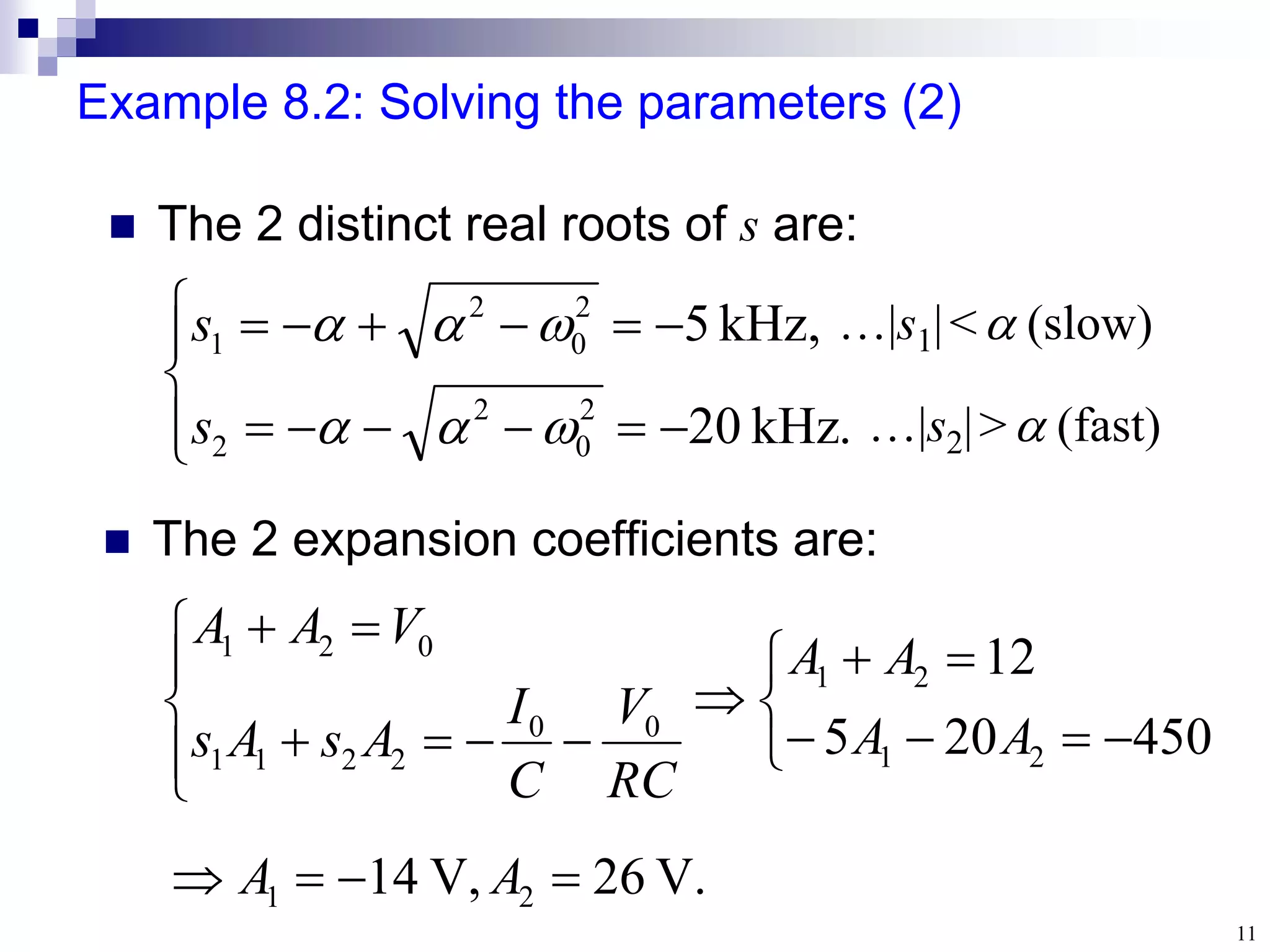
Example 8.2: Solving the parameters (2)
 The 2 distinct real roots of s are:

















.
kHz
20
,
kHz
5
2
0
2
2
2
0
2
1






s
s
…|s2|>(fast)
…|s1|<(slow)





















450
20
5
12
2
1
2
1
0
0
2
2
1
1
0
2
1
A
A
A
A
RC
V
C
I
A
s
A
s
V
A
A
 The 2 expansion coefficients are:
V.
26
,
V
14 2
1 


 A
A
12
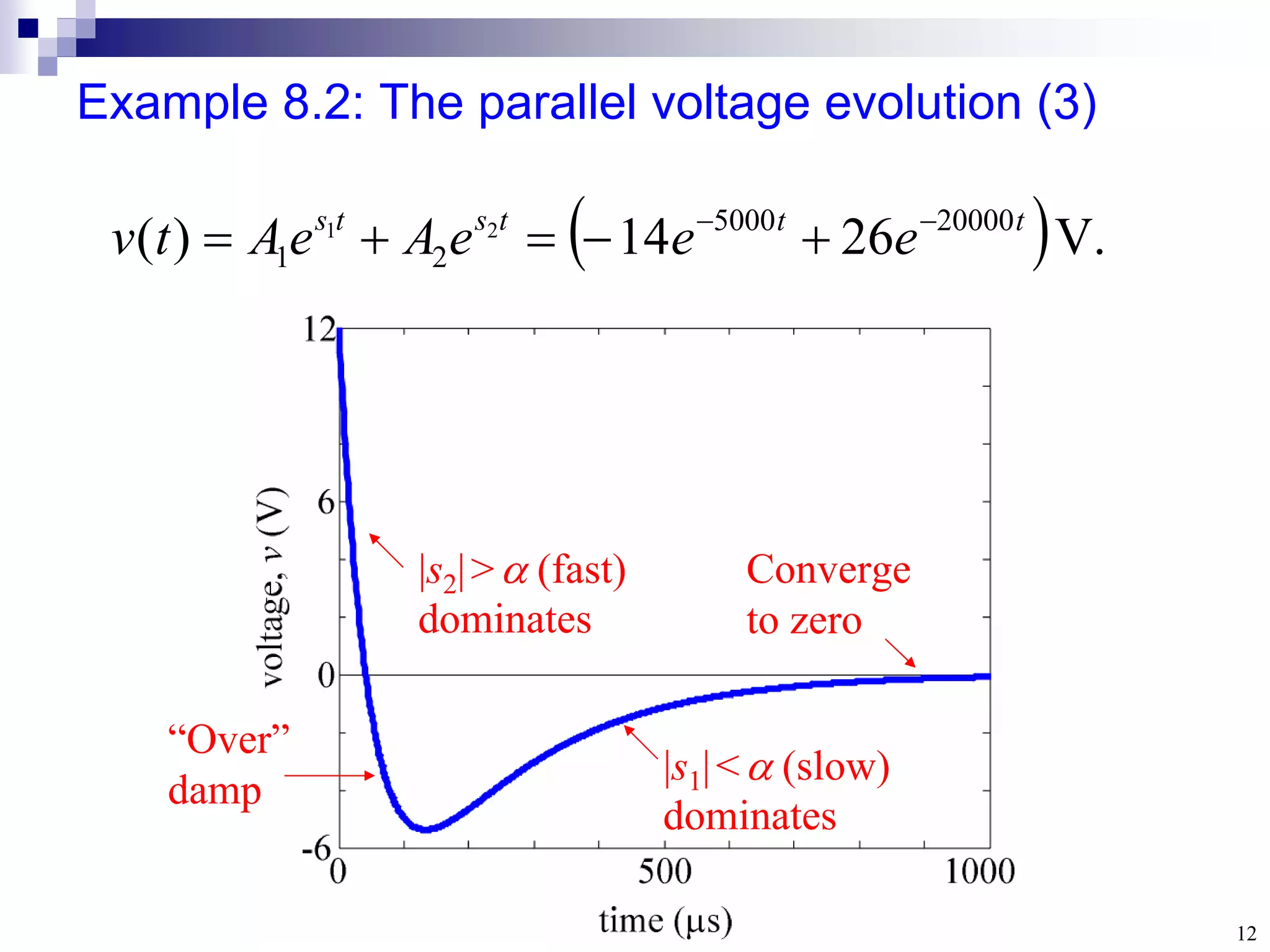
Example 8.2: The parallel voltage evolution (3)
Converge
to zero
|s1|<(slow)
dominates
|s2|>(fast)
dominates
 V.
26
14
)
( 20000
5000
2
1
2
1 t
t
t
s
t
s
e
e
e
A
e
A
t
v 






“Over”
damp
13
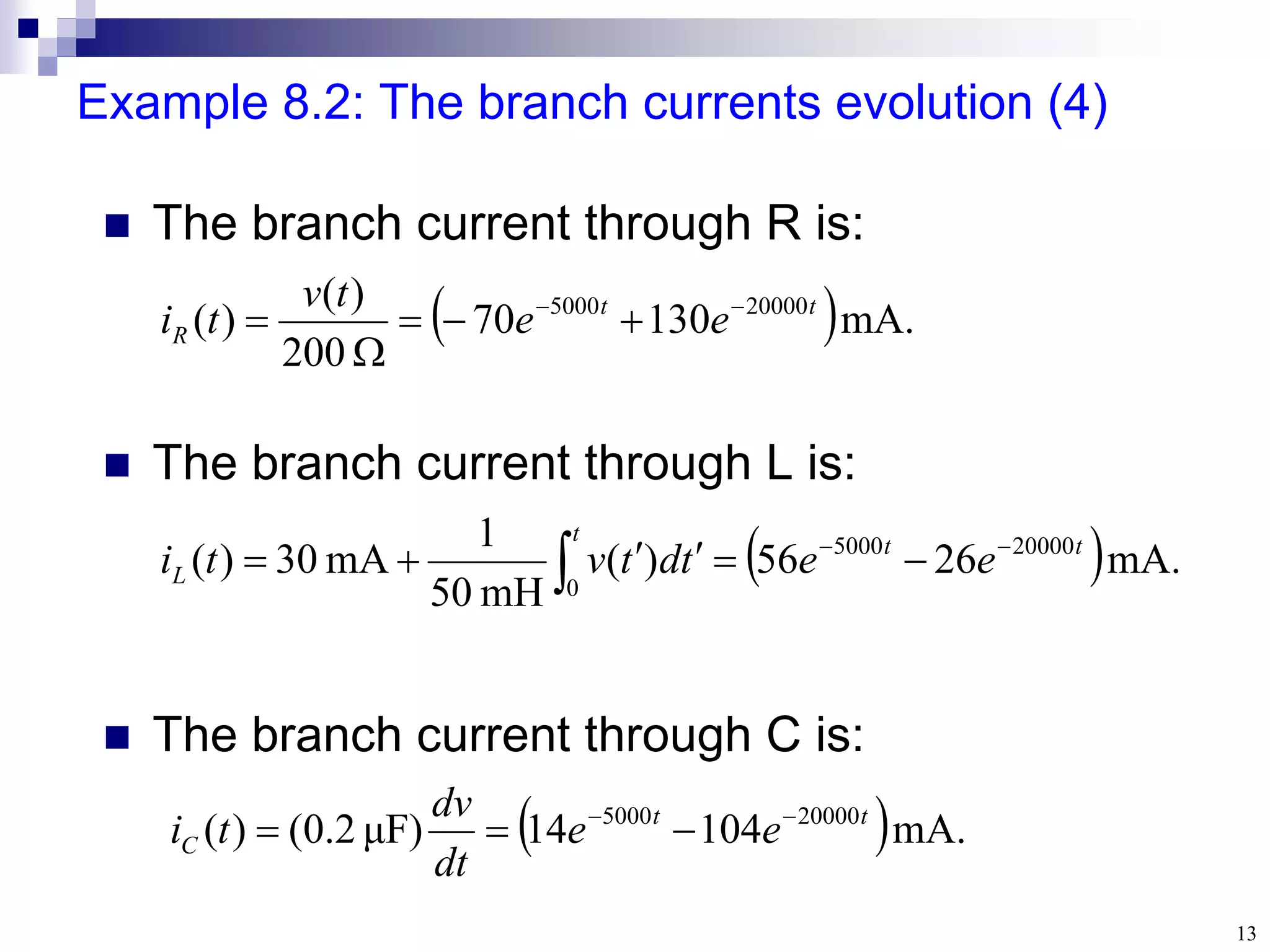
Example 8.2: The branch currents evolution (4)
 The branch current through R is:
 mA.
130
70
200
)
(
)
( 20000
5000 t
t
R e
e
t
v
t
i 






 The branch current through L is:
 mA.
26
56
)
(
mH
0
5
1
mA
30
)
( 20000
5000
0
t
t
t
L e
e
t
d
t
v
t
i 






 
 The branch current through C is:
 mA.
104
14
μF)
2
.
0
(
)
( 20000
5000 t
t
C e
e
dt
dv
t
i 




14
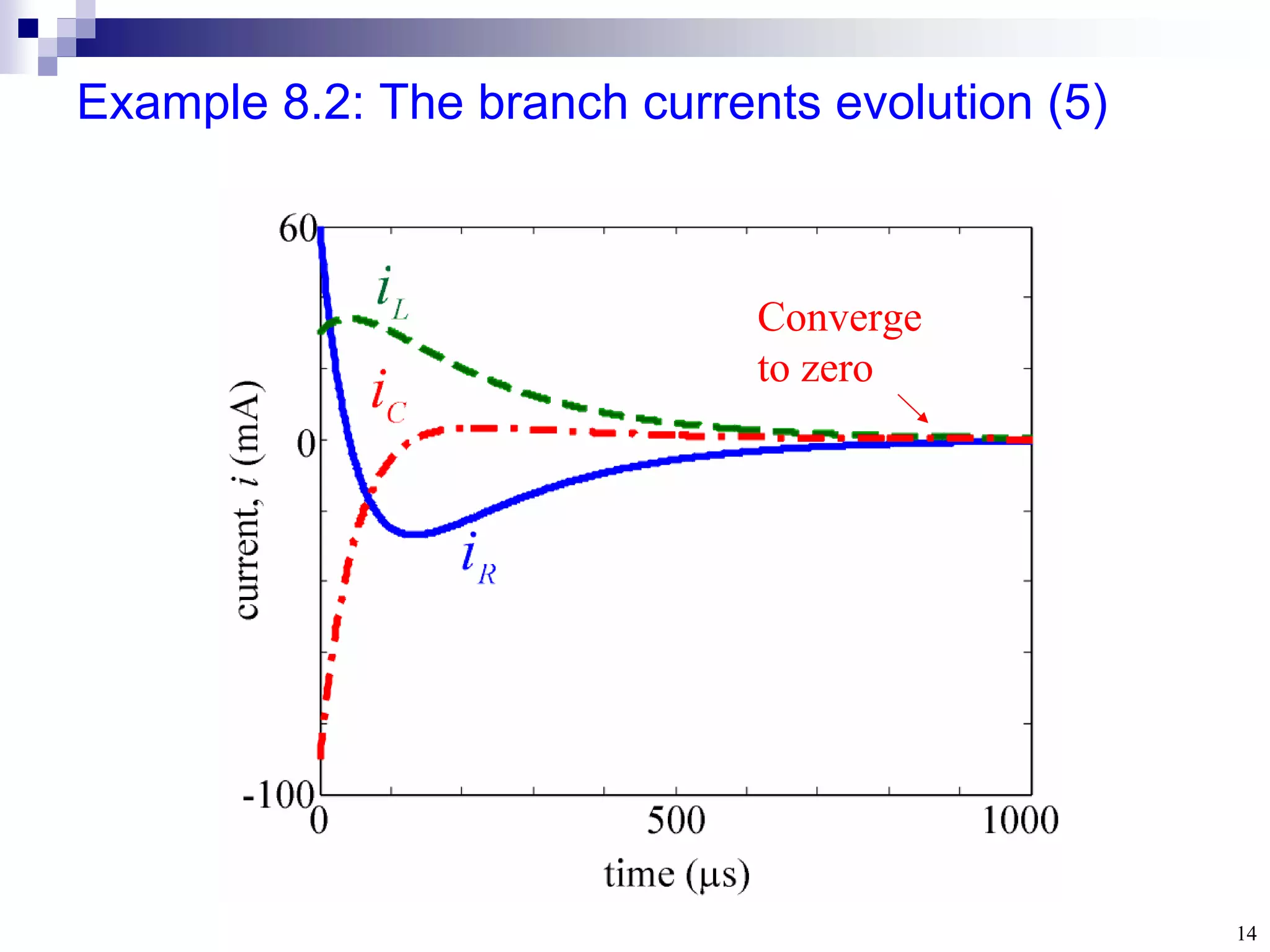
Example 8.2: The branch currents evolution (5)
Converge
to zero
15
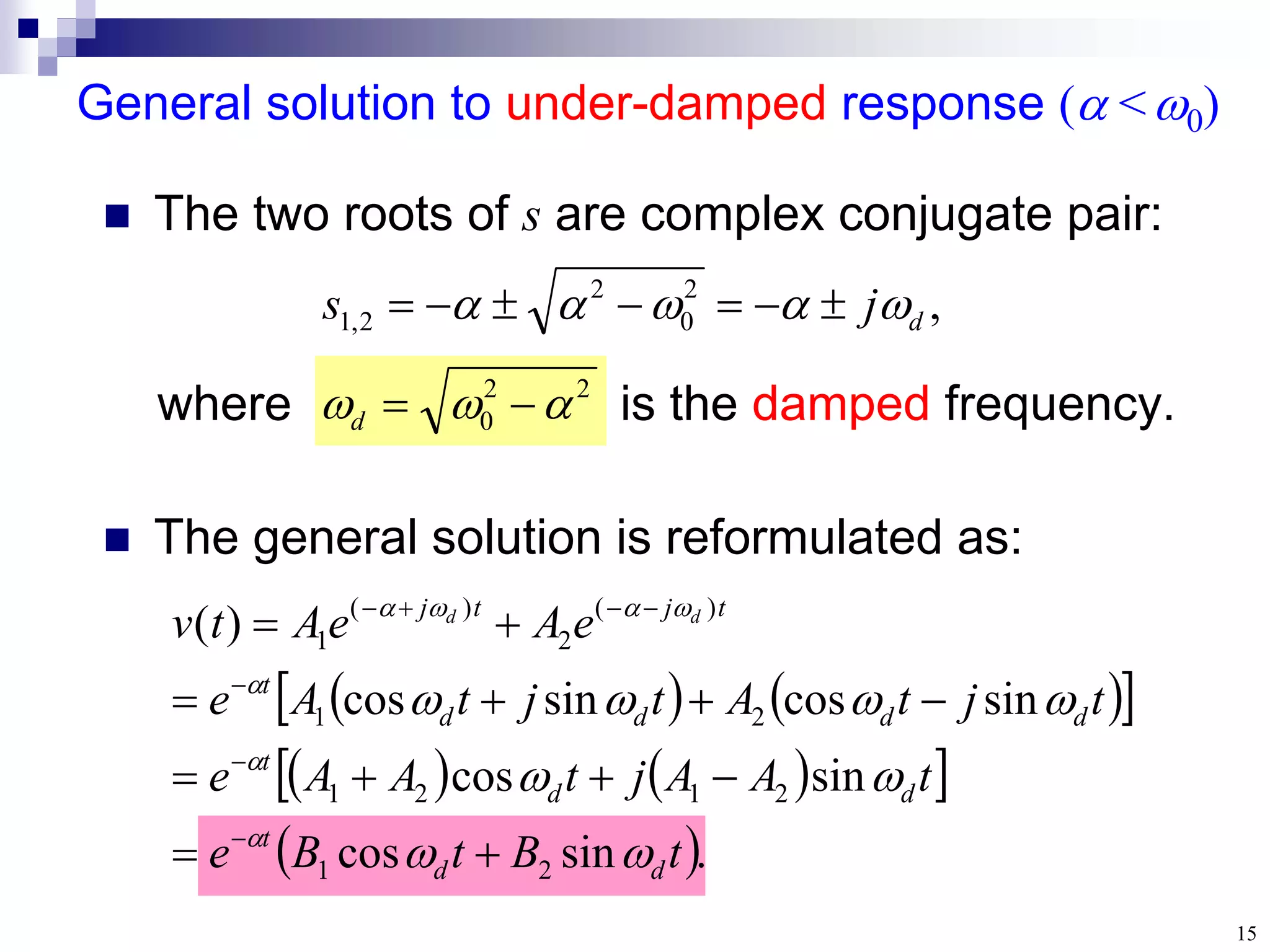
where is the damped frequency.
General solution to under-damped response ( <0)
 The two roots of s are complex conjugate pair:
2
2
0 

 

d
,
2
0
2
2
,
1 d
j
s 



 






   
 
   
 
 .
sin
cos
sin
cos
sin
cos
sin
cos
)
(
2
1
2
1
2
1
2
1
)
(
2
)
(
1
t
B
t
B
e
t
A
A
j
t
A
A
e
t
j
t
A
t
j
t
A
e
e
A
e
A
t
v
d
d
t
d
d
t
d
d
d
d
t
t
j
t
j d
d


































 The general solution is reformulated as:
16
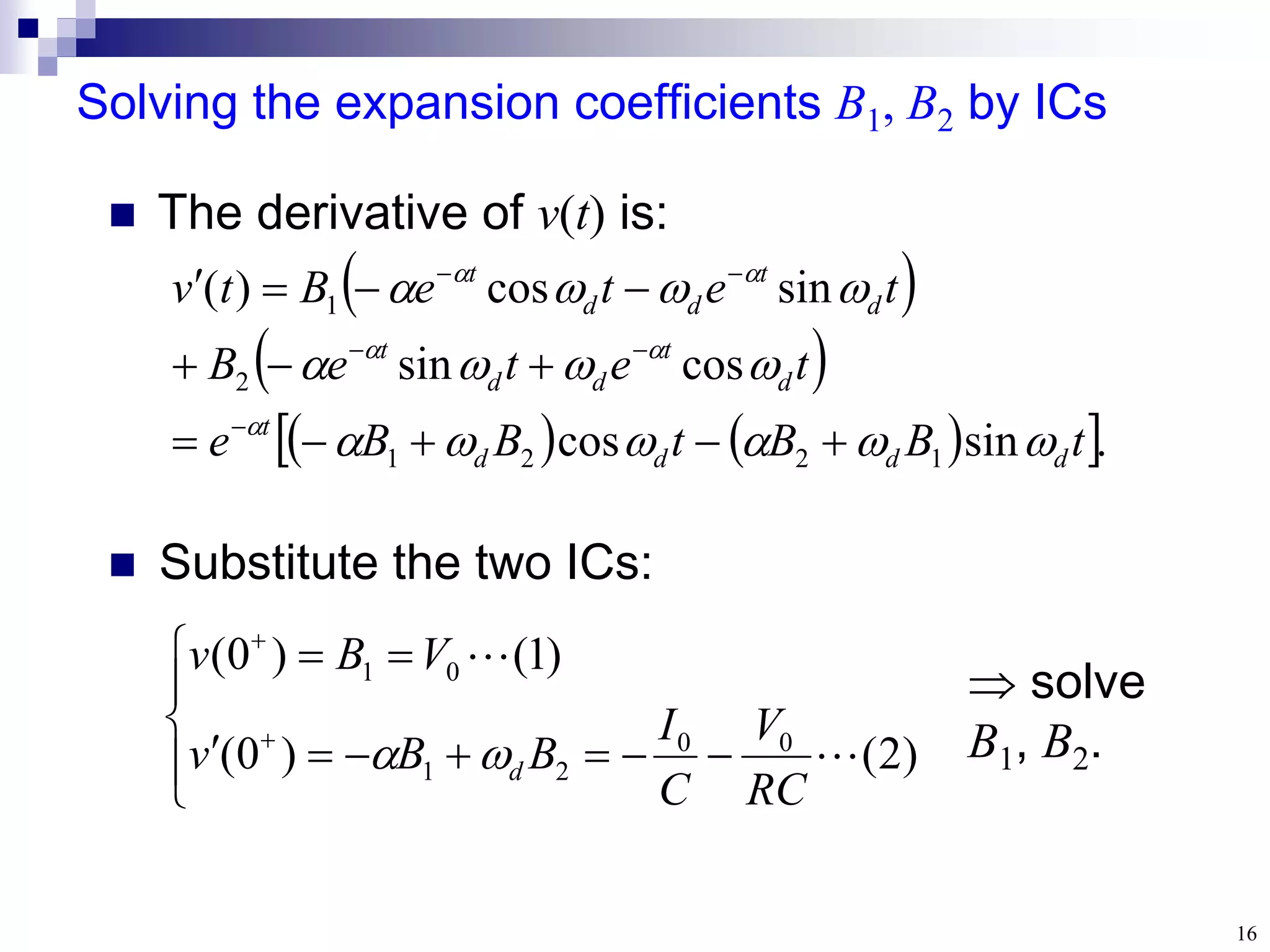
Solving the expansion coefficients B1, B2 by ICs
 Substitute the two ICs:
















)
2
(
)
0
(
)
1
(
)
0
(
0
0
2
1
0
1


RC
V
C
I
B
B
v
V
B
v
d


 solve
B1, B2.
 
 
   
 .
sin
cos
cos
sin
sin
cos
)
(
1
2
2
1
2
1
t
B
B
t
B
B
e
t
e
t
e
B
t
e
t
e
B
t
v
d
d
d
d
t
d
t
d
d
t
d
t
d
d
t




































 The derivative of v(t) is:
17
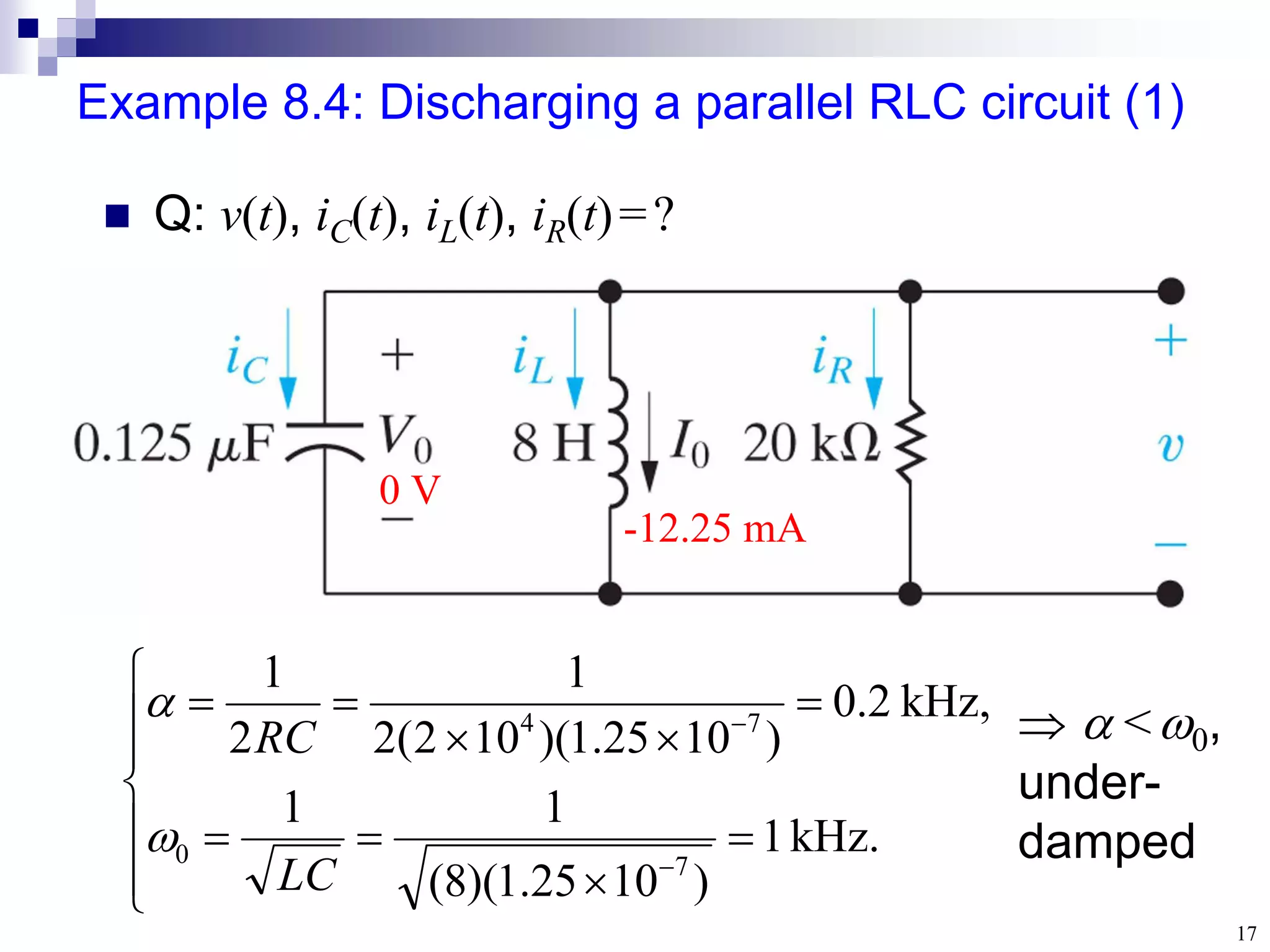
Example 8.4: Discharging a parallel RLC circuit (1)
0 V
-12.25 mA
 Q: v(t), iC(t), iL(t), iR(t)=?


















kHz.
1
)
10
25
.
1
)(
8
(
1
1
,
kHz
2
.
0
)
10
25
.
1
)(
10
2
(
2
1
2
1
7
0
7
4
LC
RC

  <0,
under-
damped
18
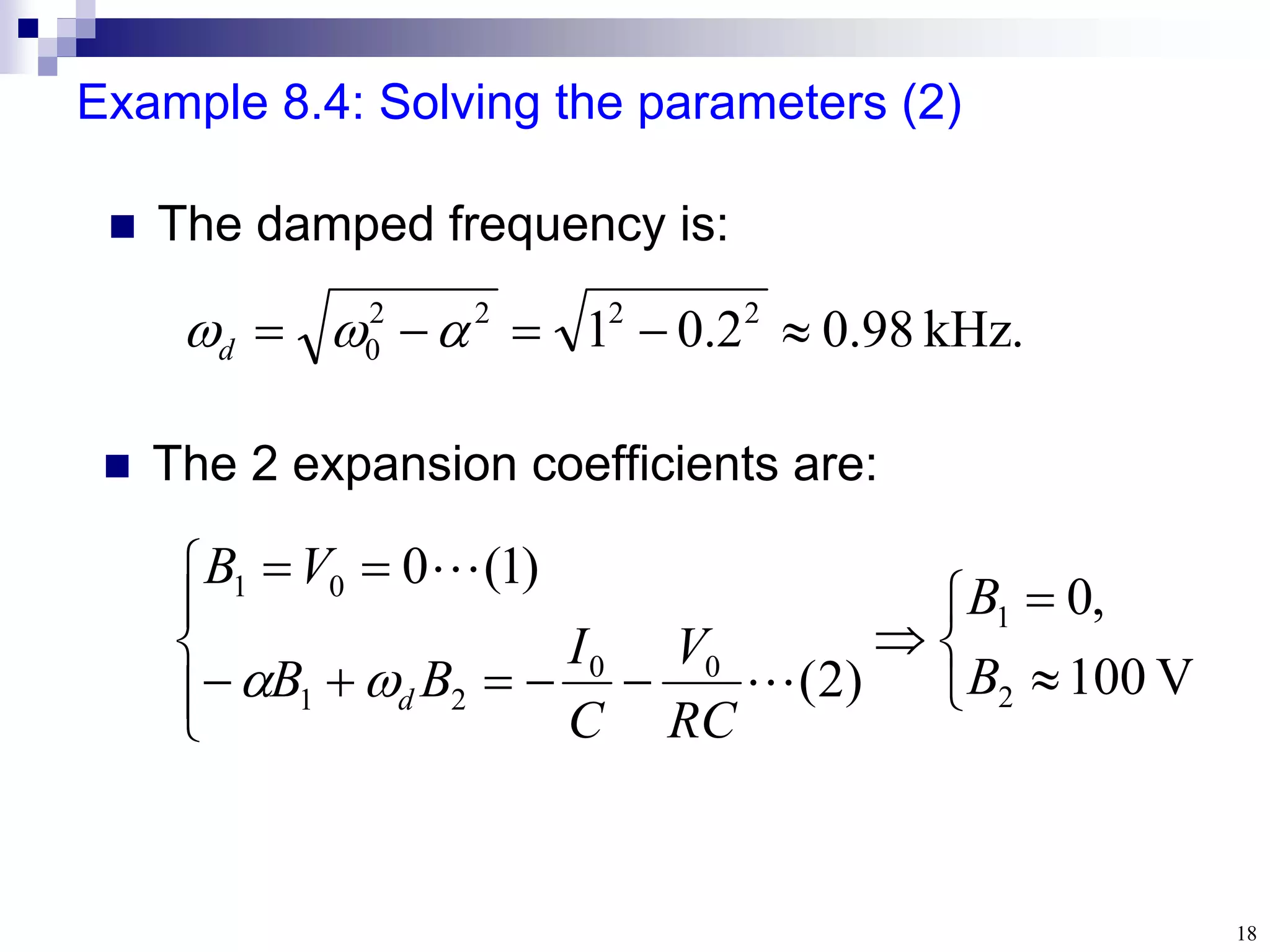
Example 8.4: Solving the parameters (2)
.
kHz
98
.
0
2
.
0
1 2
2
2
2
0 



 

d
 The damped frequency is:
 The 2 expansion coefficients are:


















V
100
,
0
)
2
(
)
1
(
0
2
1
0
0
2
1
0
1
B
B
RC
V
C
I
B
B
V
B
d 



19
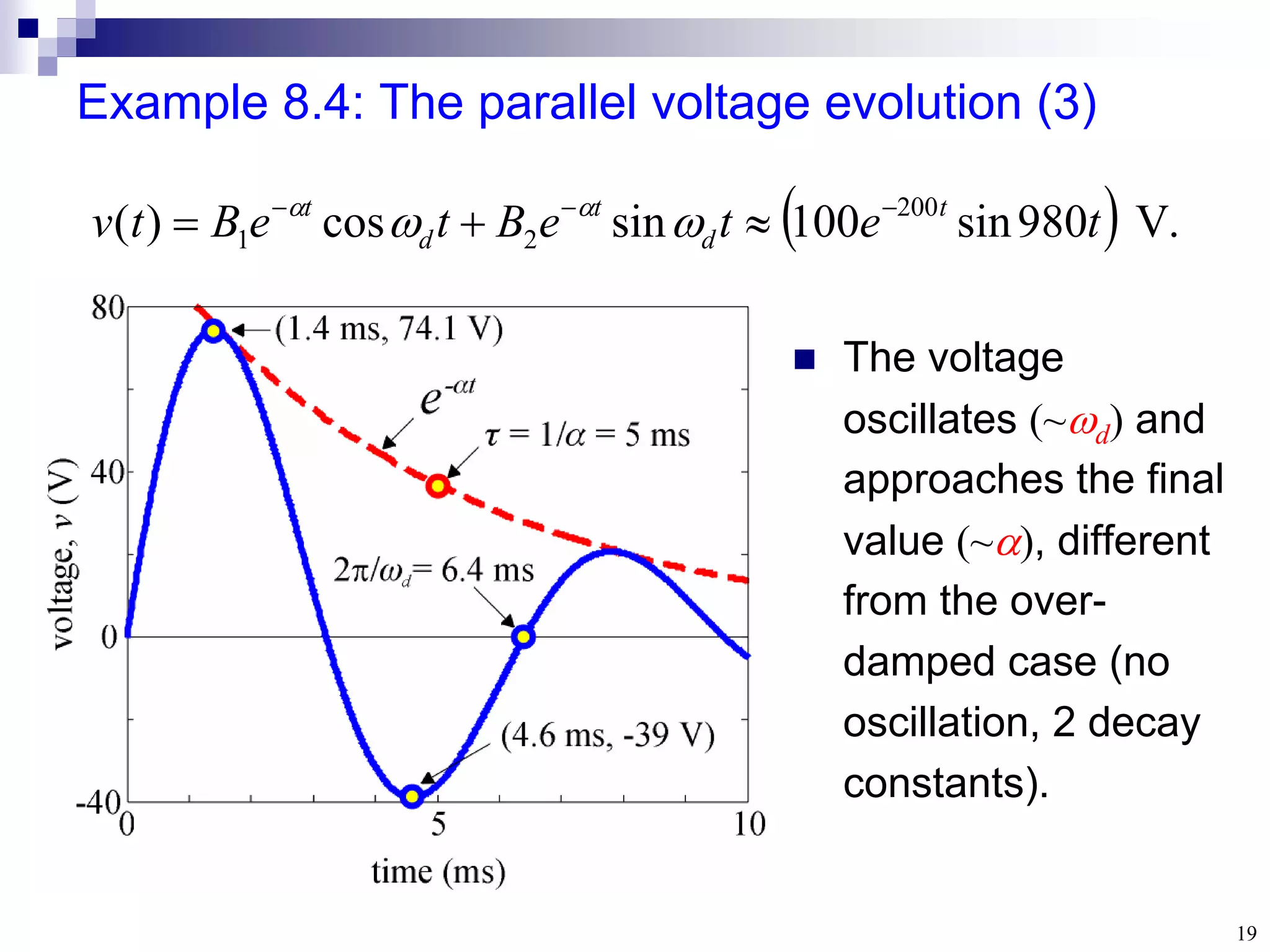
Example 8.4: The parallel voltage evolution (3)
  .
V
980
sin
100
sin
cos
)
( 200
2
1 t
e
t
e
B
t
e
B
t
v t
d
t
d
t 




 
 

 The voltage
oscillates (~d) and
approaches the final
value (~), different
from the over-
damped case (no
oscillation, 2 decay
constants).
20
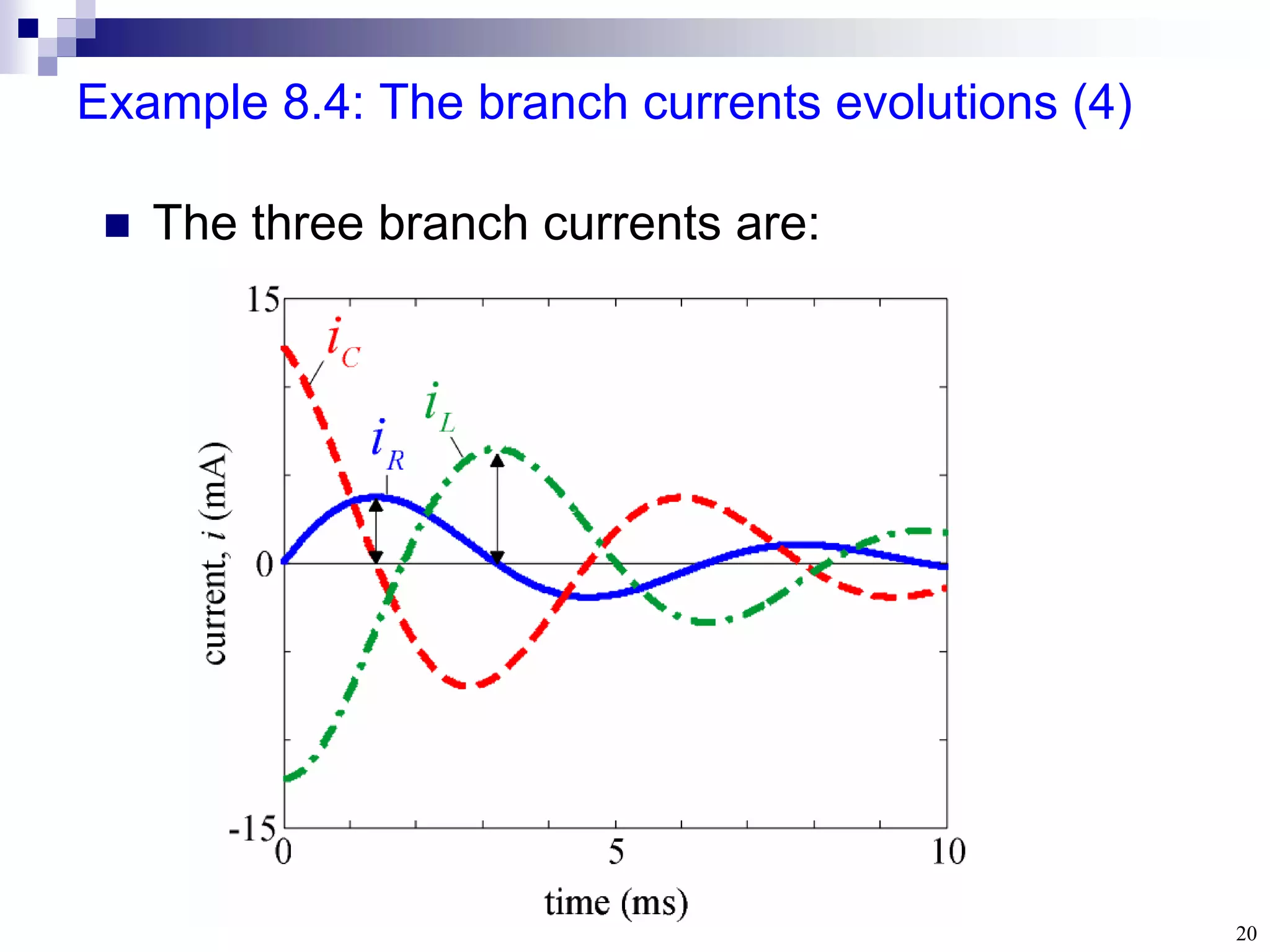
Example 8.4: The branch currents evolutions (4)
 The three branch currents are:
21
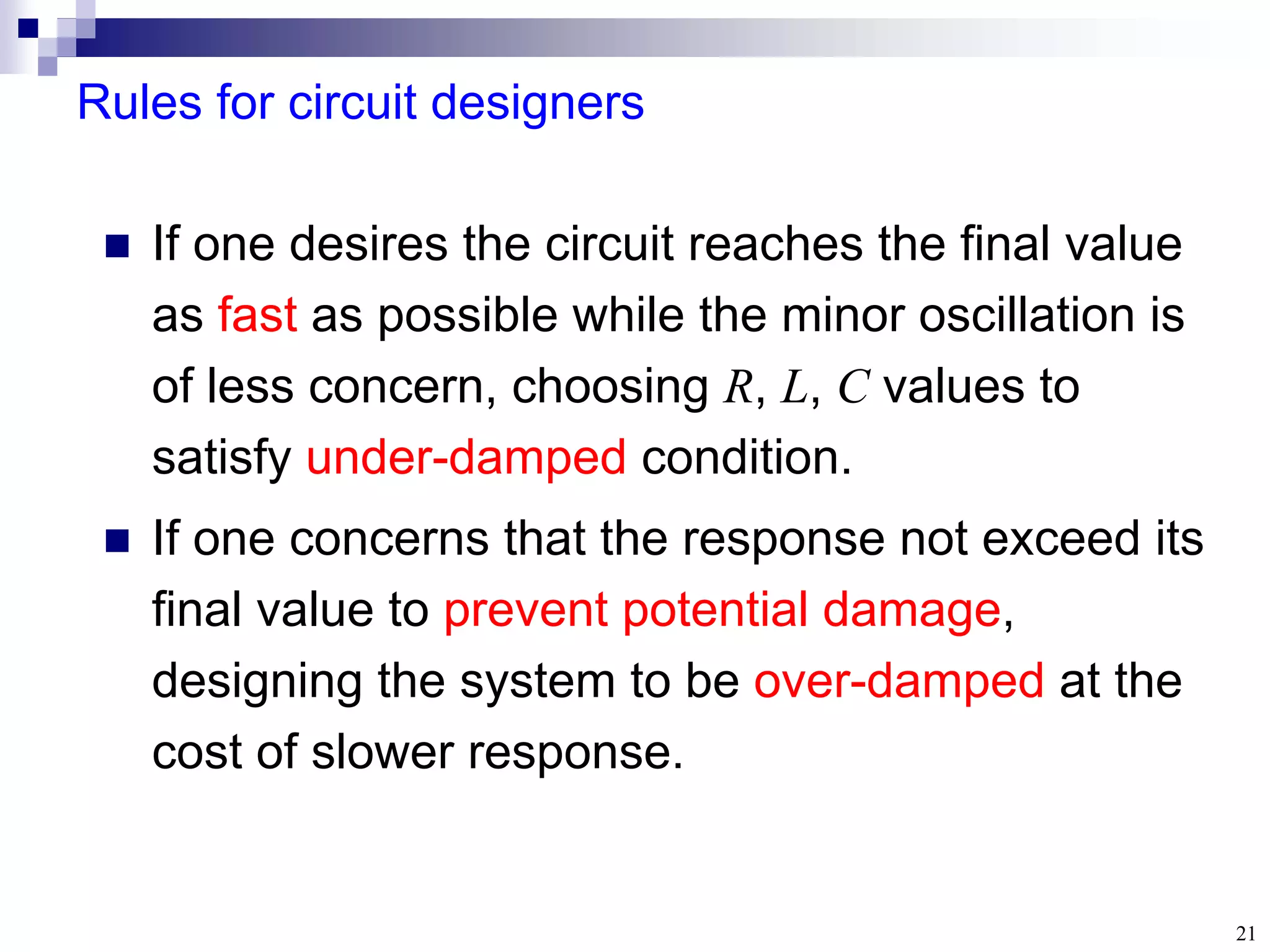
Rules for circuit designers
 If one desires the circuit reaches the final value
as fast as possible while the minor oscillation is
of less concern, choosing R, L, C values to
satisfy under-damped condition.
 If one concerns that the response not exceed its
final value to prevent potential damage,
designing the system to be over-damped at the
cost of slower response.
22
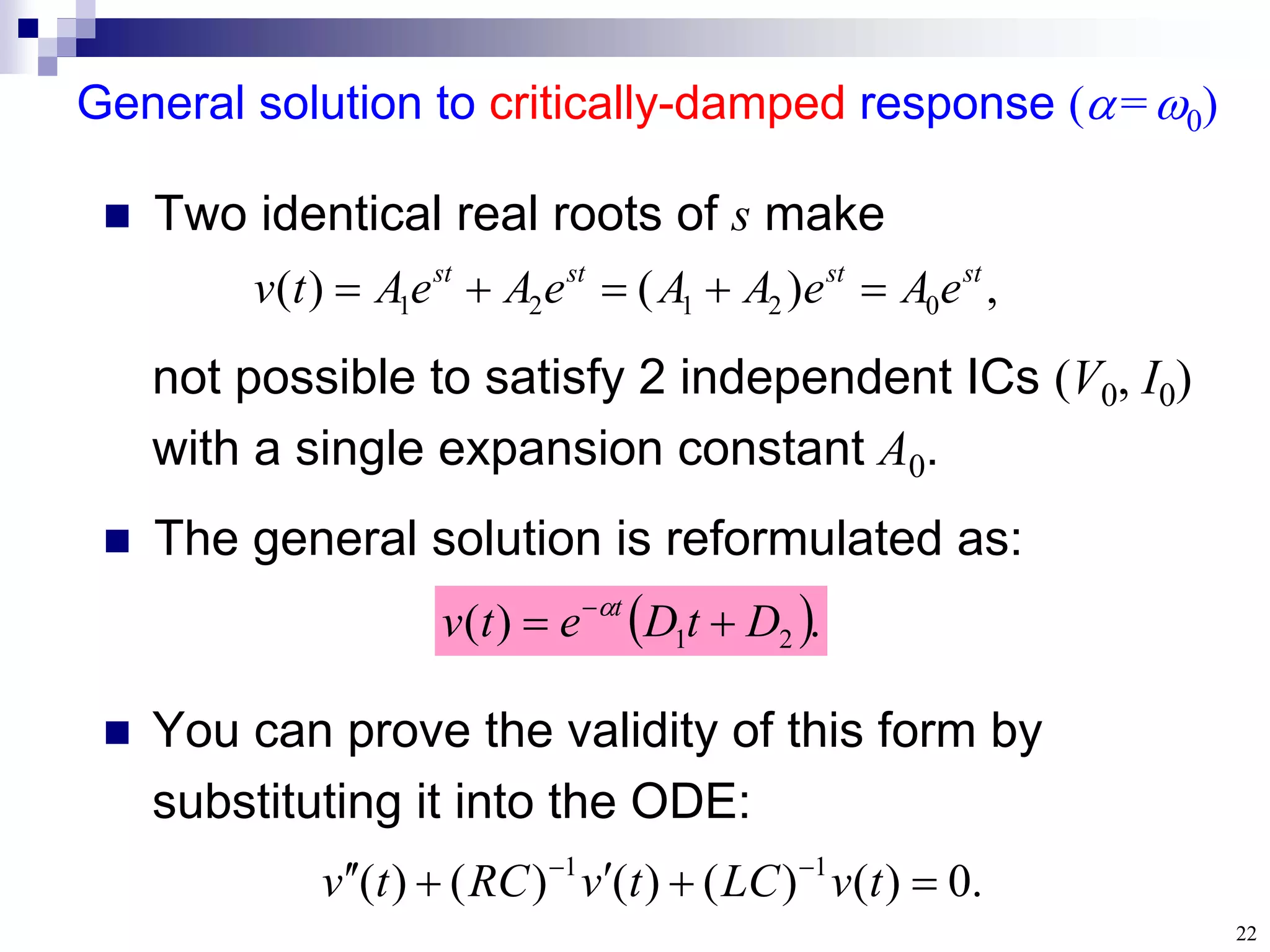
General solution to critically-damped response (=0)
 Two identical real roots of s make
 The general solution is reformulated as:
,
)
(
)
( 0
2
1
2
1
st
st
st
st
e
A
e
A
A
e
A
e
A
t
v 




not possible to satisfy 2 independent ICs (V0, I0)
with a single expansion constant A0.
 .
)
( 2
1 D
t
D
e
t
v t

 
 You can prove the validity of this form by
substituting it into the ODE:
.
0
)
(
)
(
)
(
)
(
)
( 1
1





 

t
v
LC
t
v
RC
t
v
23
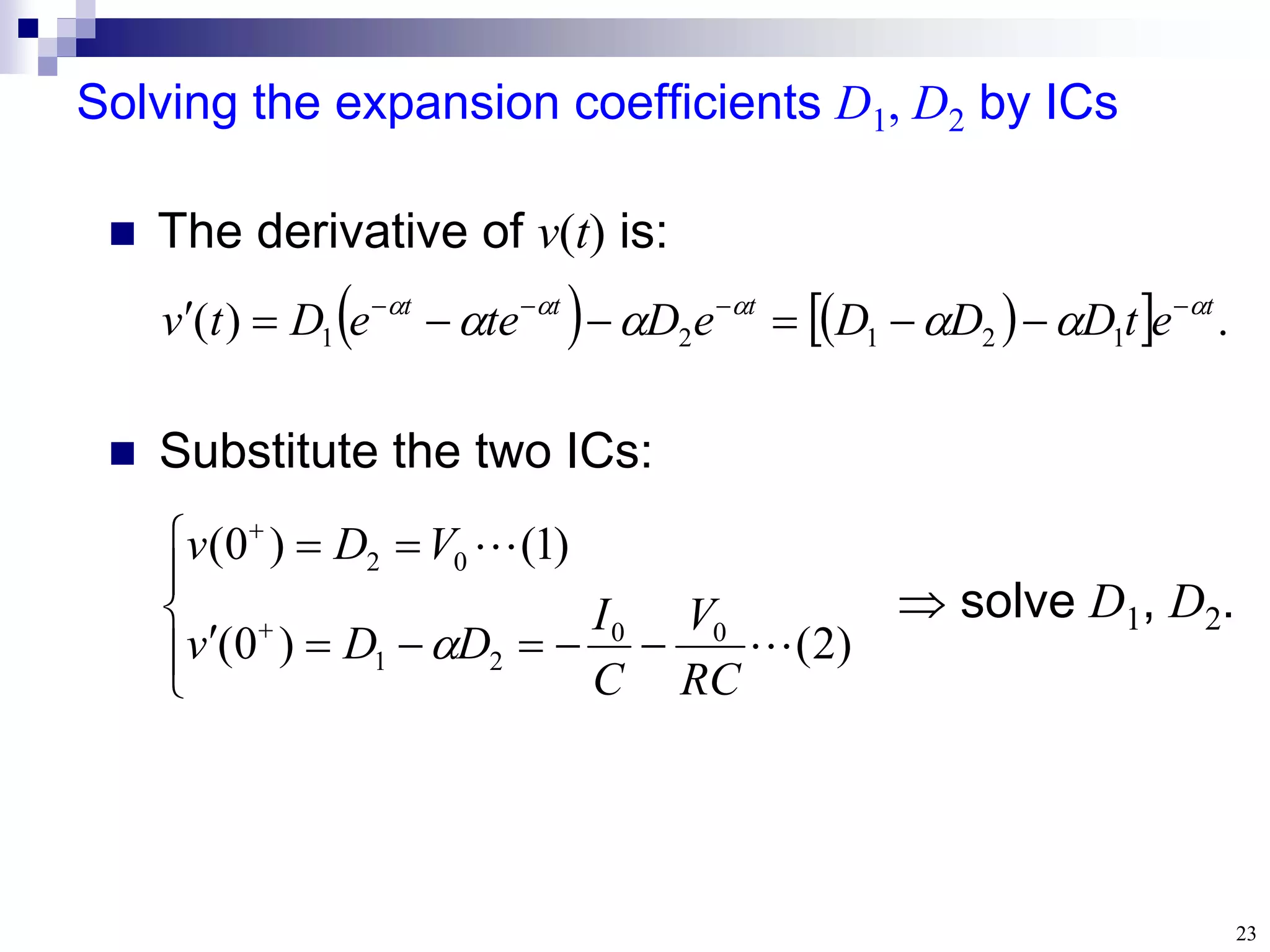
Solving the expansion coefficients D1, D2 by ICs
 Substitute the two ICs:















)
2
(
)
0
(
)
1
(
)
0
(
0
0
2
1
0
2


RC
V
C
I
D
D
v
V
D
v

 solve D1, D2.
   
  .
)
( 1
2
1
2
1
t
t
t
t
e
t
D
D
D
e
D
te
e
D
t
v 






 










 The derivative of v(t) is:
24
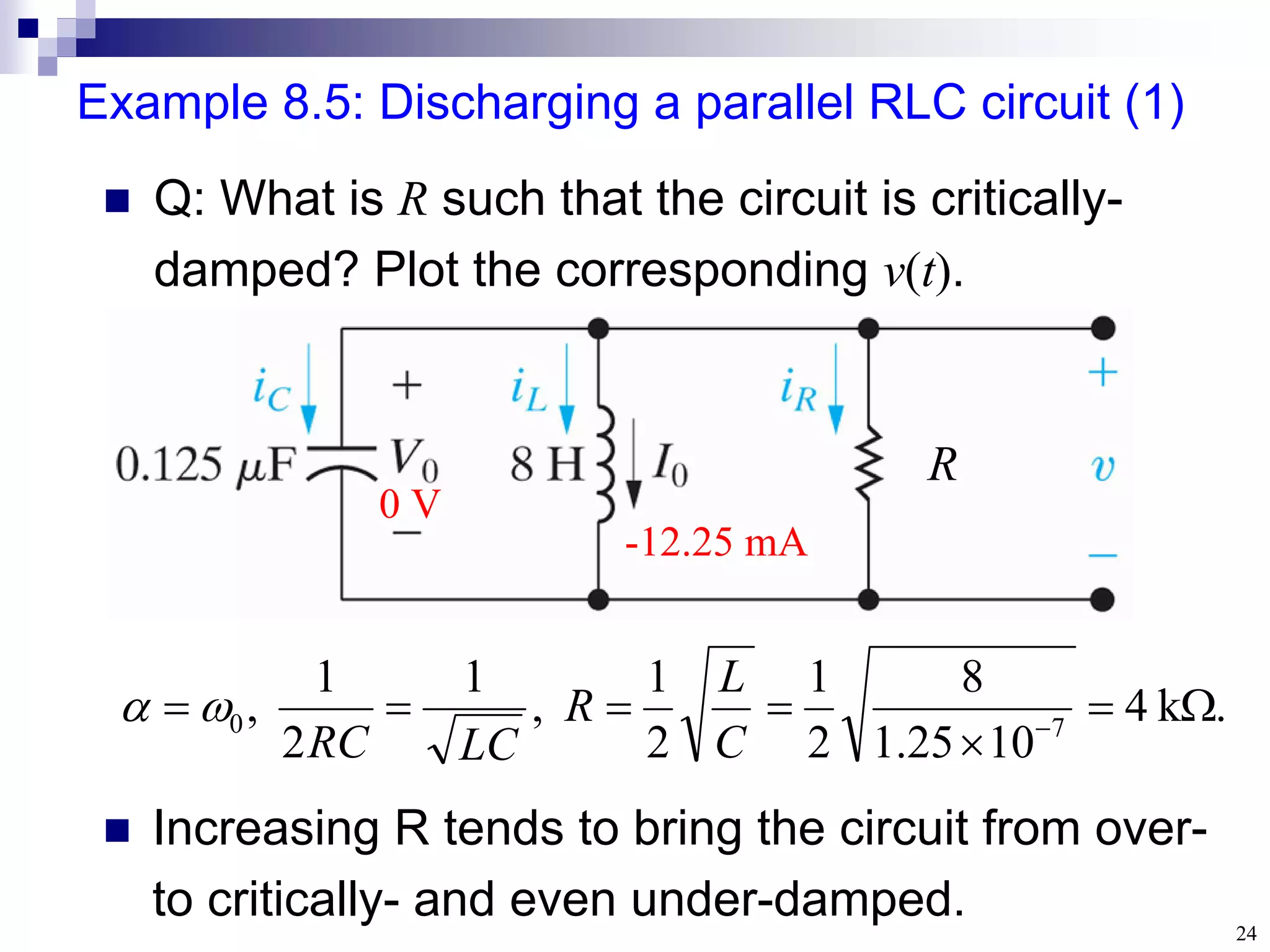
Example 8.5: Discharging a parallel RLC circuit (1)
0 V
-12.25 mA
R
 Q: What is R such that the circuit is critically-
damped? Plot the corresponding v(t).
.
k
4
10
25
.
1
8
2
1
2
1
,
1
2
1
, 7
0 





 
C
L
R
LC
RC


 Increasing R tends to bring the circuit from over-
to critically- and even under-damped.
25
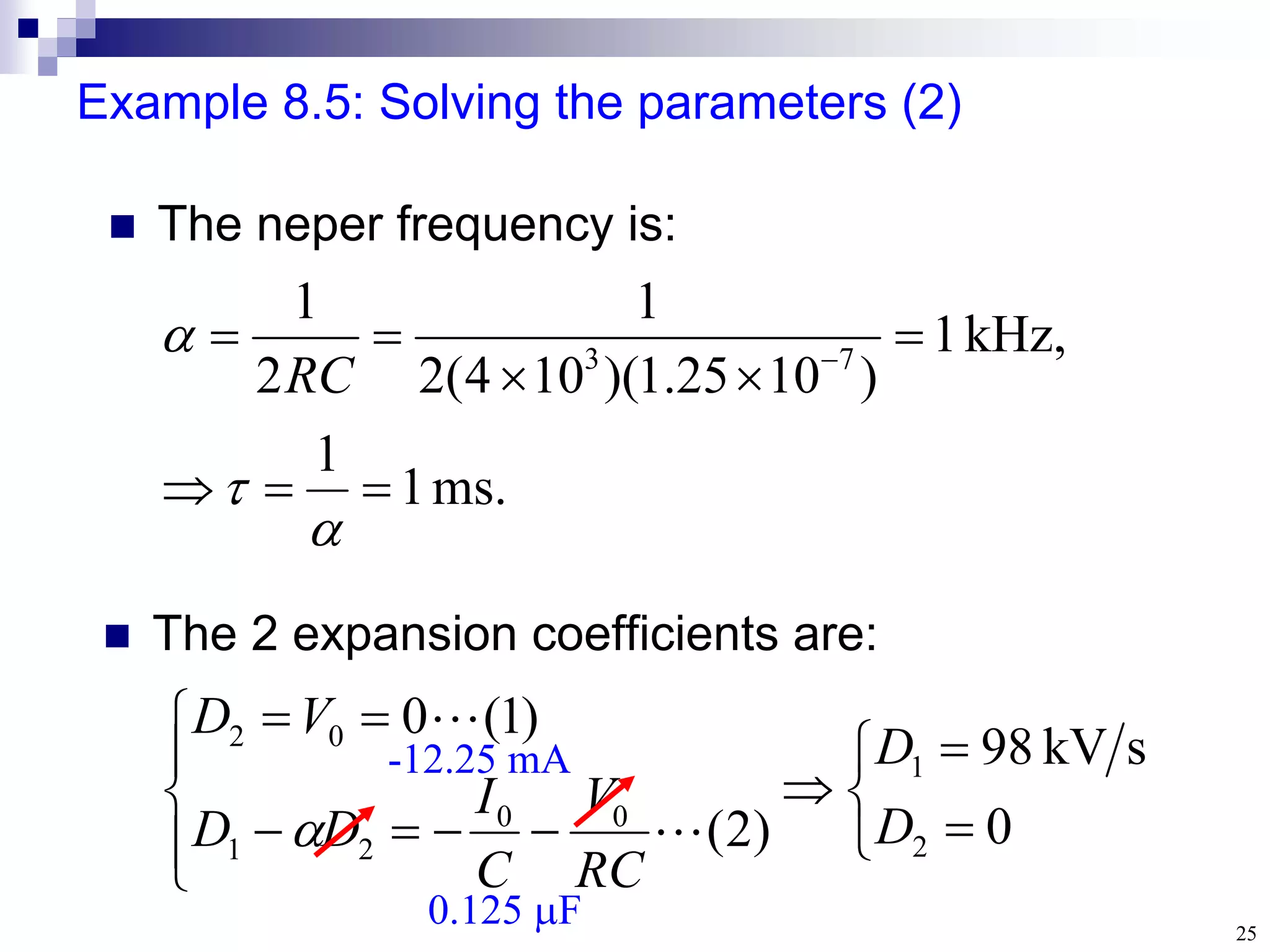
Example 8.5: Solving the parameters (2)
 The neper frequency is:
 The 2 expansion coefficients are:
ms.
1
1
,
kHz
1
)
10
25
.
1
)(
10
4
(
2
1
2
1
7
3







 



RC

















0
s
kV
98
)
2
(
)
1
(
0
2
1
0
0
2
1
0
2
D
D
RC
V
C
I
D
D
V
D



-12.25 mA
0.125 F
26
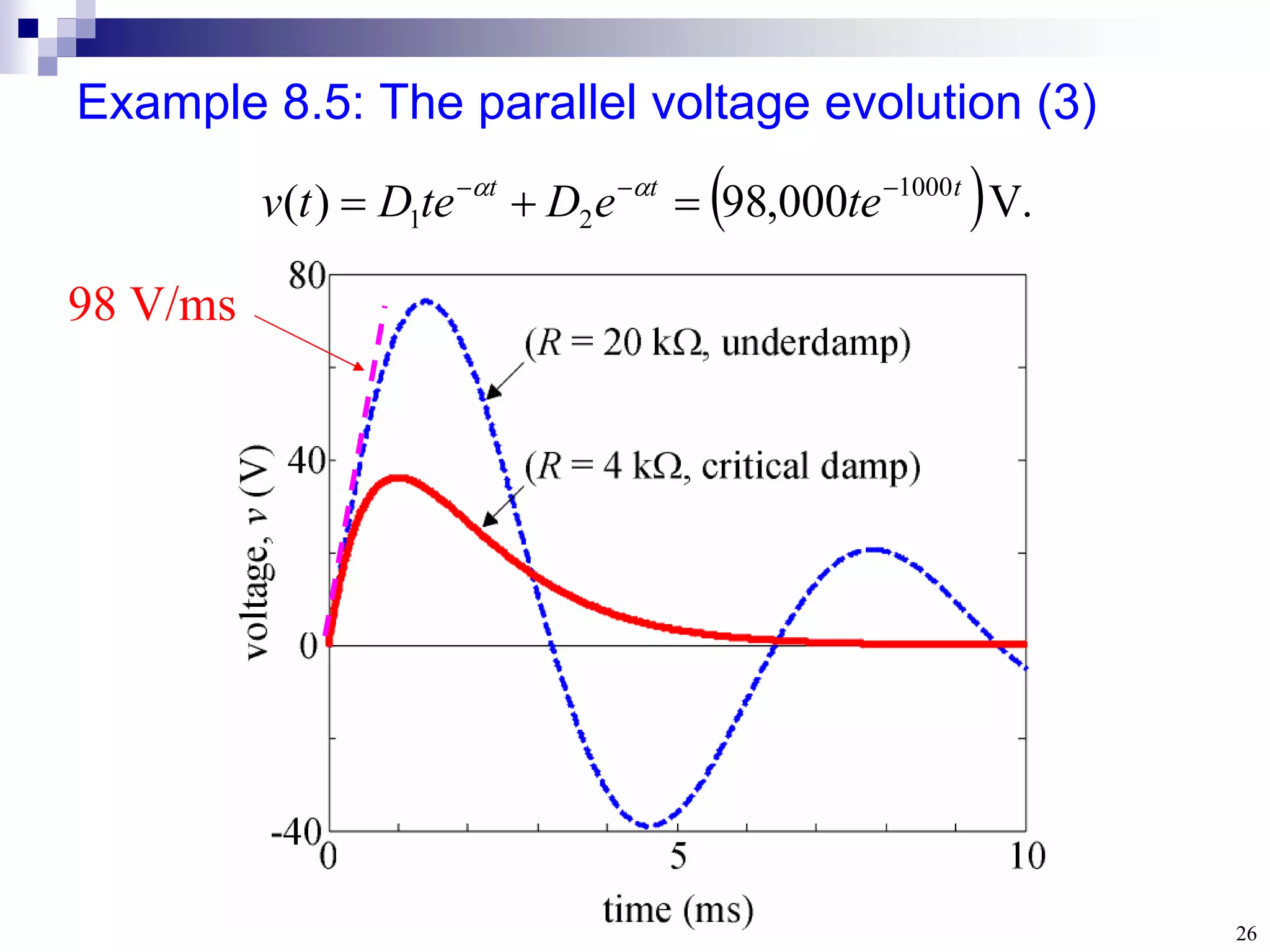
Example 8.5: The parallel voltage evolution (3)
98 V/ms
  .
V
000
,
98
)
( 1000
2
1
t
t
t
te
e
D
te
D
t
v 




 

27
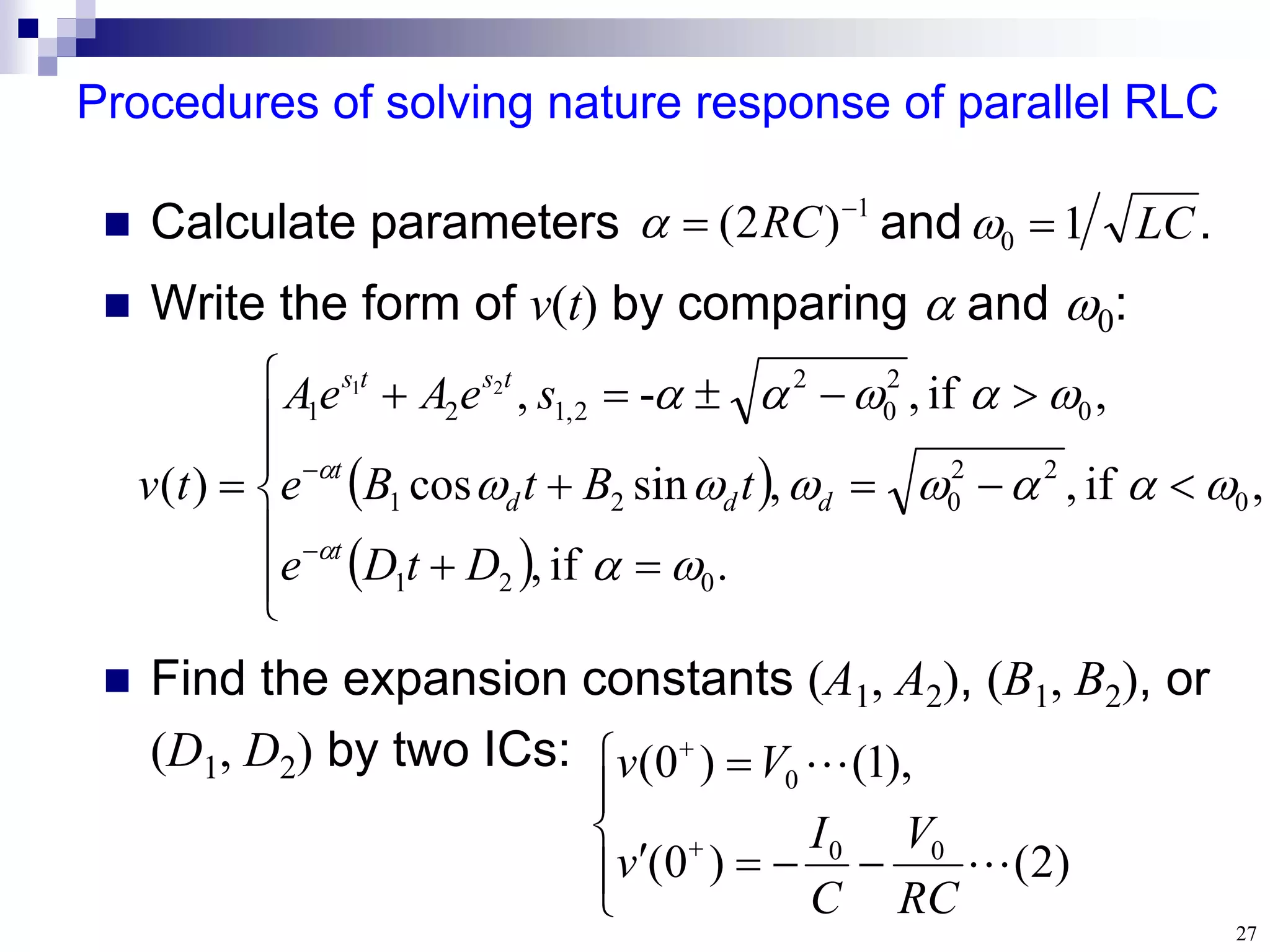
Procedures of solving nature response of parallel RLC
 Calculate parameters and .
 Write the form of v(t) by comparing  and :
 Find the expansion constants (A1, A2), (B1, B2), or
(D1, D2) by two ICs:
LC
1
0 

1
)
2
( 
 RC













)
2
(
)
0
(
),
1
(
)
0
(
0
0
0


RC
V
C
I
v
V
v
 
 





















.
if
,
,
if
,
,
sin
cos
,
if
,
-
,
)
(
0
2
1
0
2
2
0
2
1
0
2
0
2
2
,
1
2
1
2
1
















D
t
D
e
t
B
t
B
e
s
e
A
e
A
t
v
t
d
d
d
t
t
s
t
s
28
Section 8.3
The Step Response of
a Parallel RLC Circuit
1. Inhomogeneous ODE, ICs, and general
solution
29
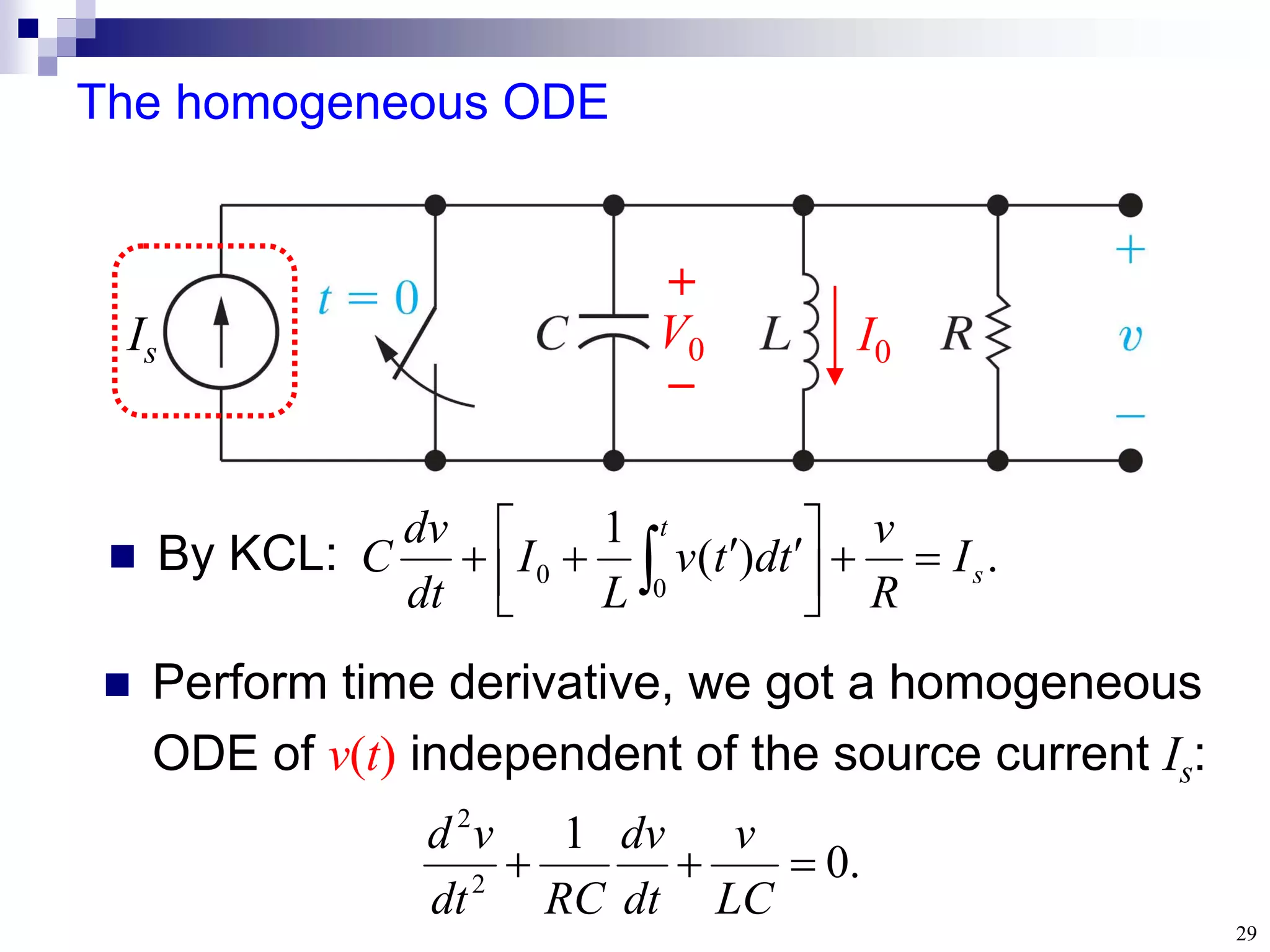
The homogeneous ODE
.
)
(
1
0
0 s
t
I
R
v
t
d
t
v
L
I
dt
dv
C 






 


 
 By KCL:
.
0
1
2
2



LC
v
dt
dv
RC
dt
v
d
 Perform time derivative, we got a homogeneous
ODE of v(t) independent of the source current Is:
V0 I0
Is
+

30
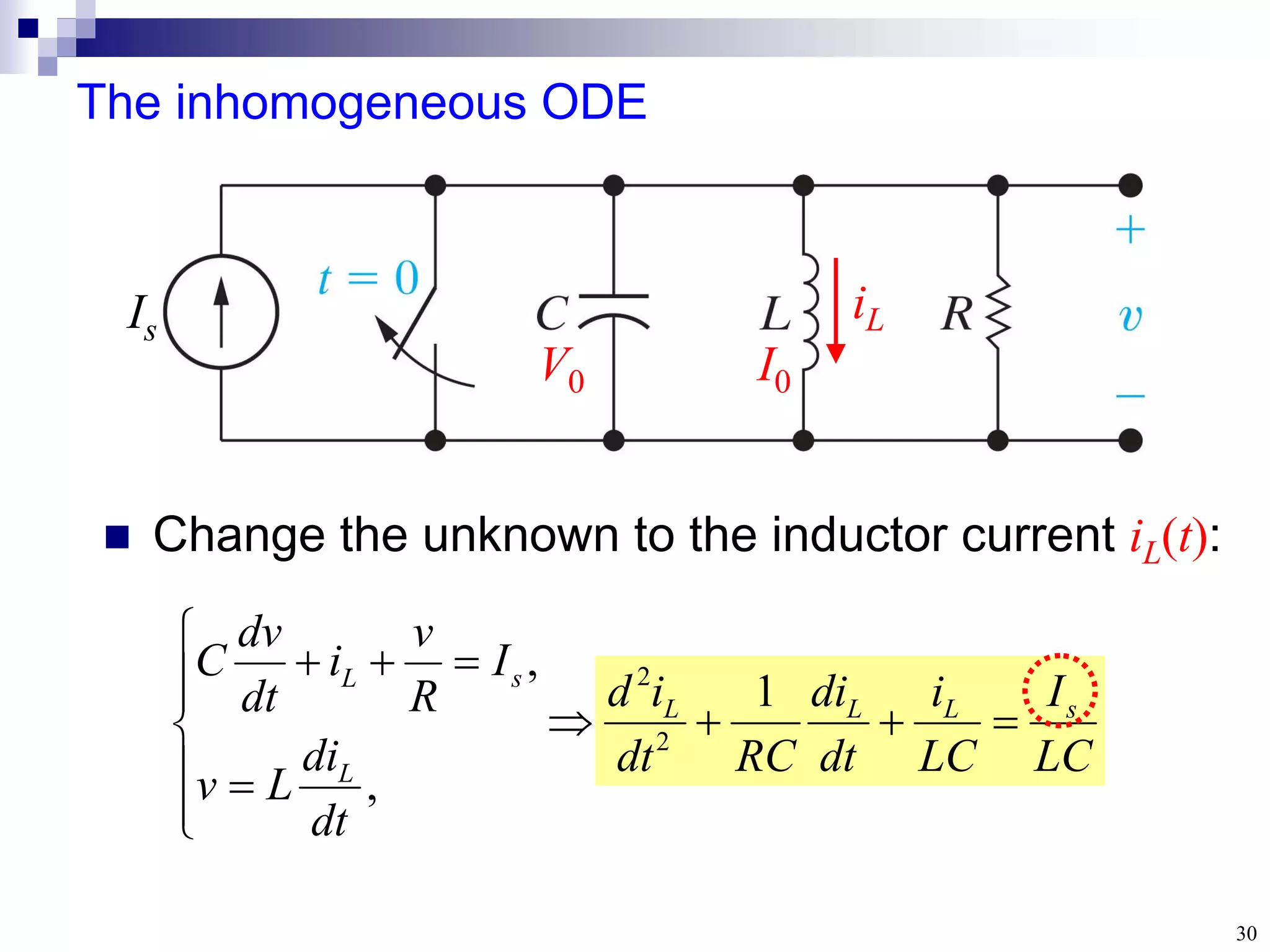
The inhomogeneous ODE
LC
I
LC
i
dt
di
RC
dt
i
d
dt
di
L
v
I
R
v
i
dt
dv
C
s
L
L
L
L
s
L















1
,
,
2
2
 Change the unknown to the inductor current iL(t):
iL
V0 I0
Is
31
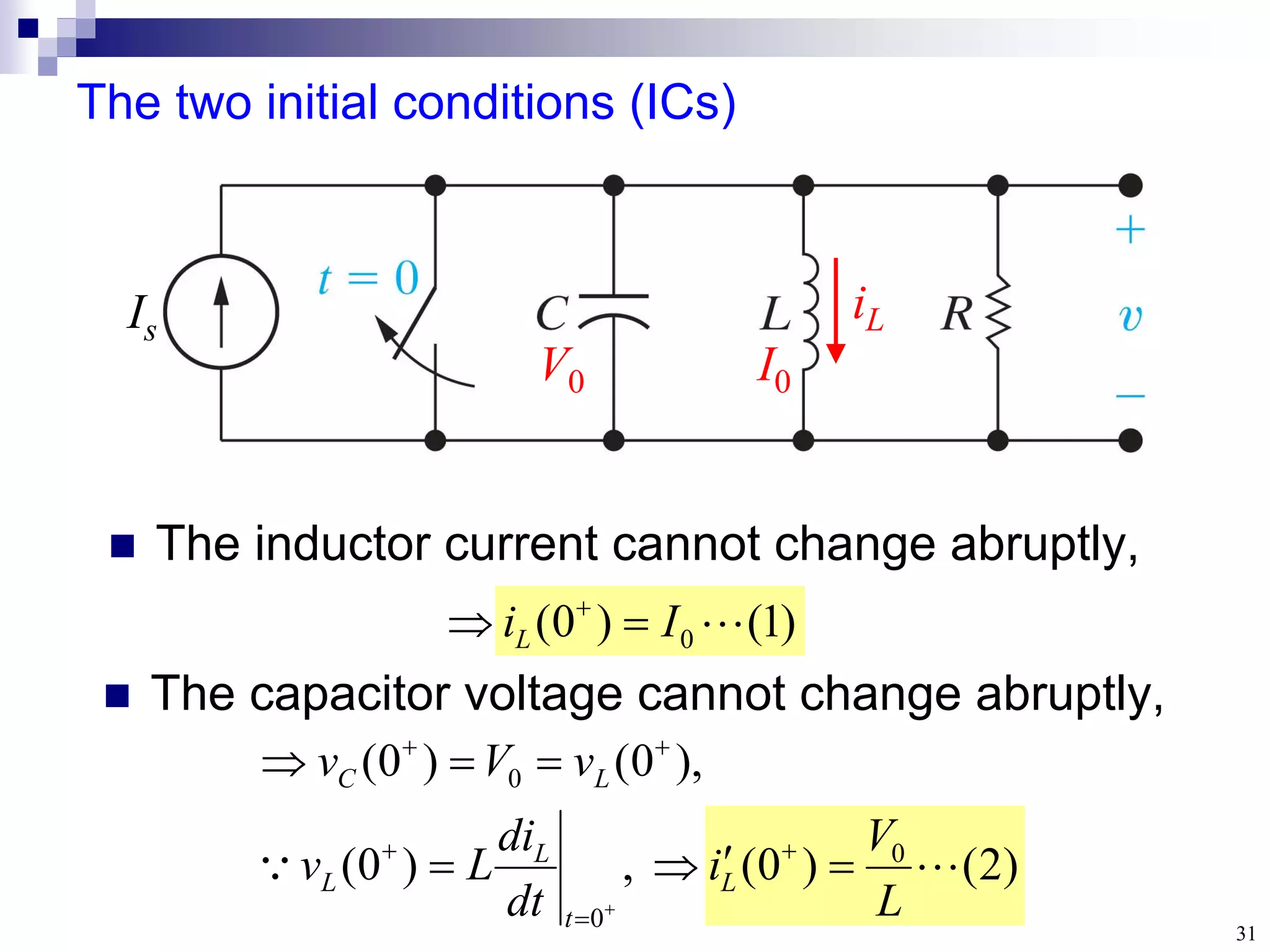
The two initial conditions (ICs)
 The inductor current cannot change abruptly,
)
2
(
)
0
(
,
)
0
(
),
0
(
)
0
(
0
0
0


L
V
i
dt
di
L
v
v
V
v
L
t
L
L
L
C













)
1
(
)
0
( 0 
I
iL 
 
 The capacitor voltage cannot change abruptly,
Is
iL
V0 I0
32
General solution
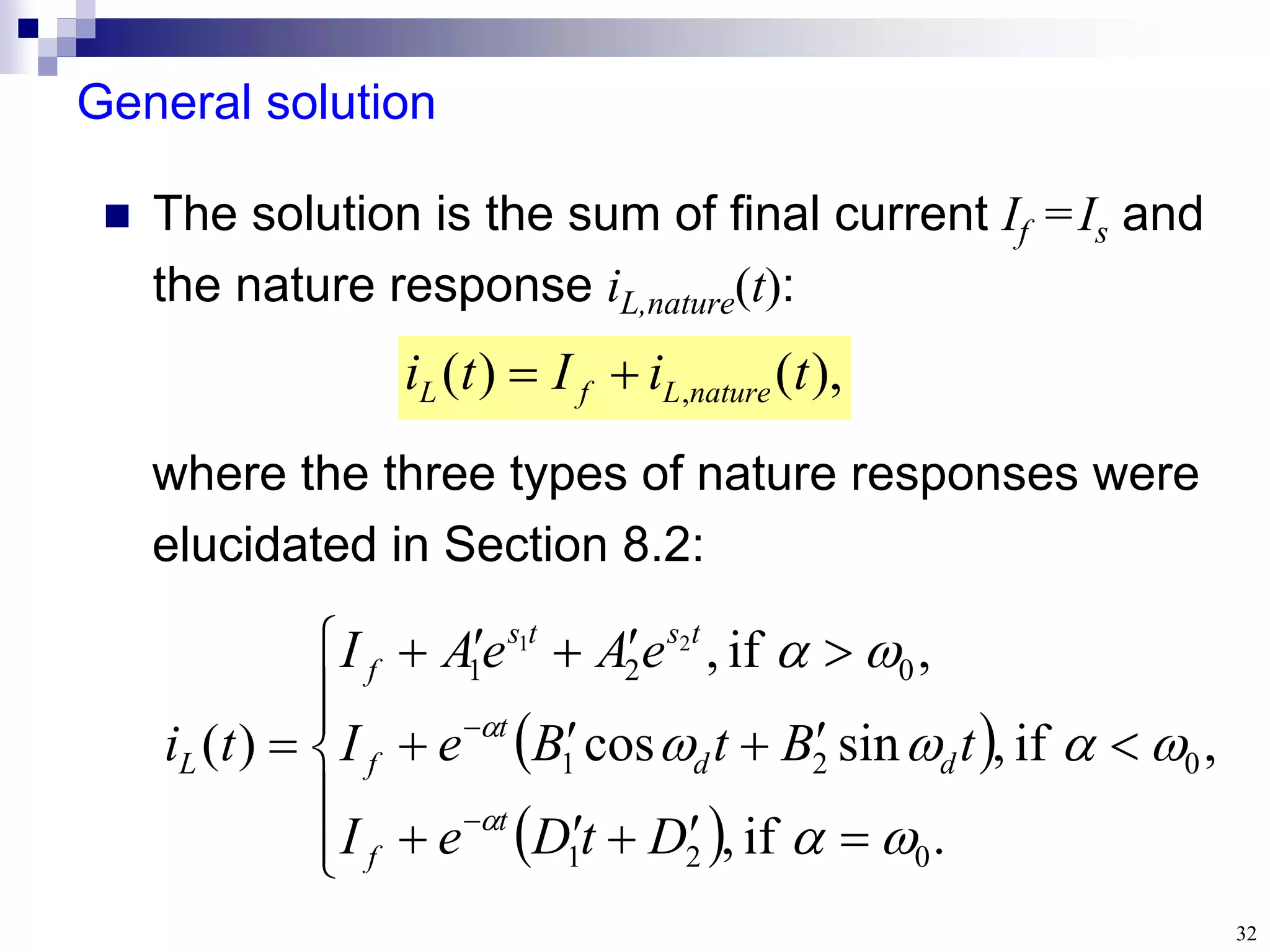
where the three types of nature responses were
elucidated in Section 8.2:
 The solution is the sum of final current If =Is and
the nature response iL,nature(t):
),
(
)
( , t
i
I
t
i nature
L
f
L 

 
 

























.
if
,
,
if
,
sin
cos
,
if
,
)
(
0
2
1
0
2
1
0
2
1
2
1










D
t
D
e
I
t
B
t
B
e
I
e
A
e
A
I
t
i
t
f
d
d
t
f
t
s
t
s
f
L
33
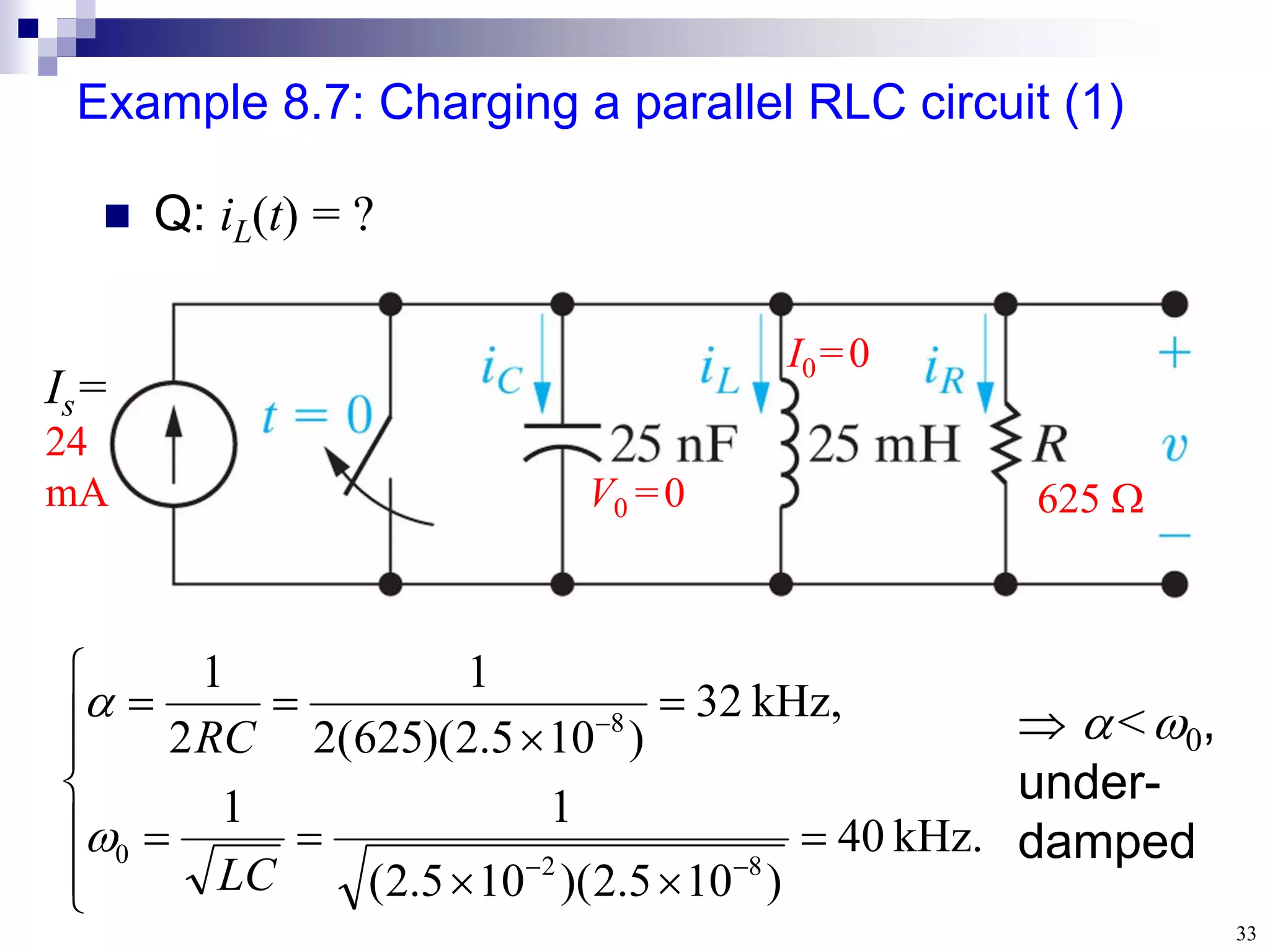
Example 8.7: Charging a parallel RLC circuit (1)
625 
Is=
24
mA V0 =0
I0=0
 Q: iL(t) = ?



















kHz.
40
)
10
5
.
2
)(
10
5
.
2
(
1
1
,
kHz
32
)
10
5
.
2
)(
625
(
2
1
2
1
8
2
0
8
LC
RC

  <0,
under-
damped
34
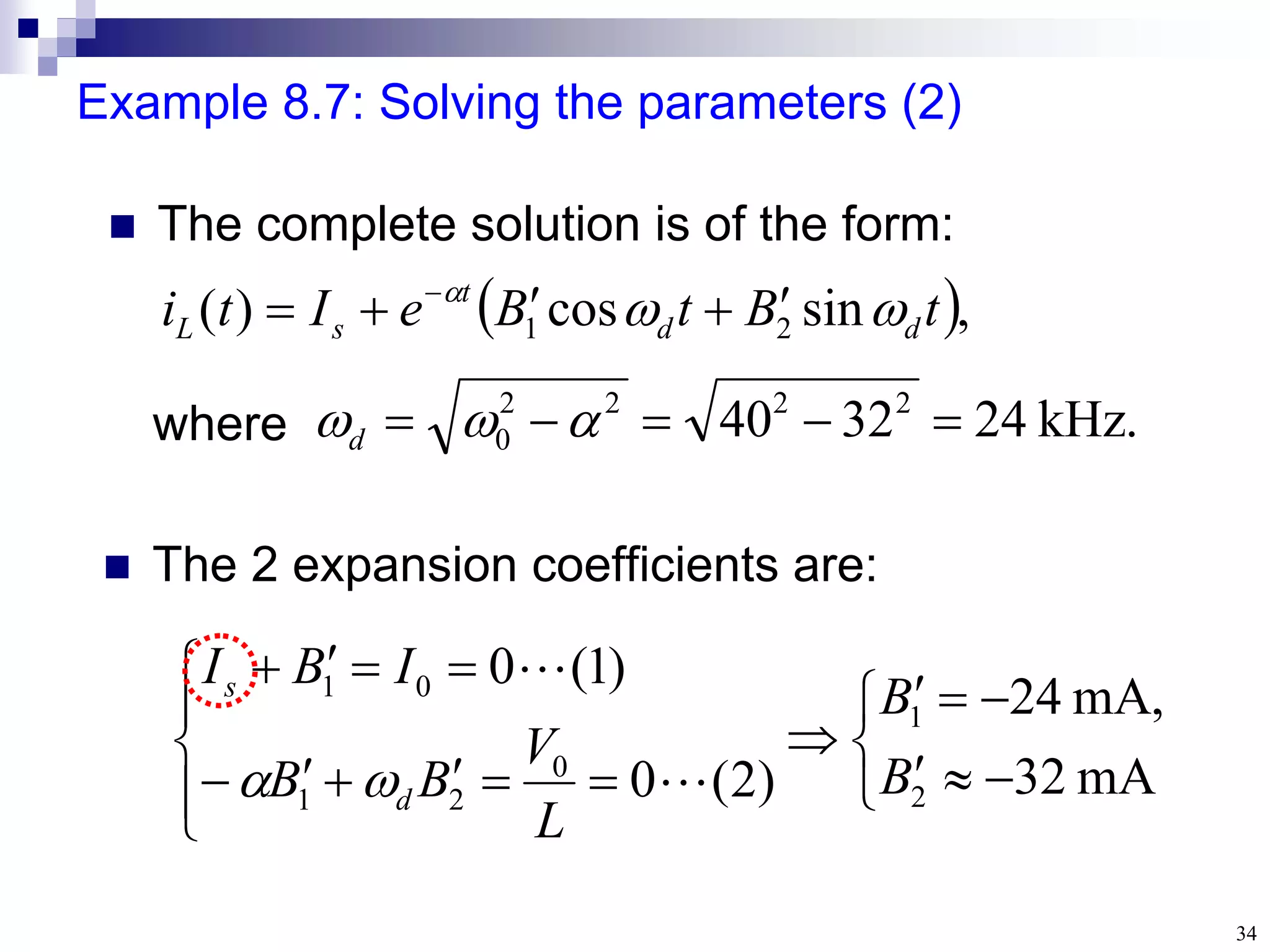
Example 8.7: Solving the parameters (2)
.
kHz
24
32
40 2
2
2
2
0 



 

d
 The complete solution is of the form:
 The 2 expansion coefficients are:

























mA
32
,
mA
24
)
2
(
0
)
1
(
0
2
1
0
2
1
0
1
B
B
L
V
B
B
I
B
I
d
s




 ,
sin
cos
)
( 2
1 t
B
t
B
e
I
t
i d
d
t
s
L 






 
where
35
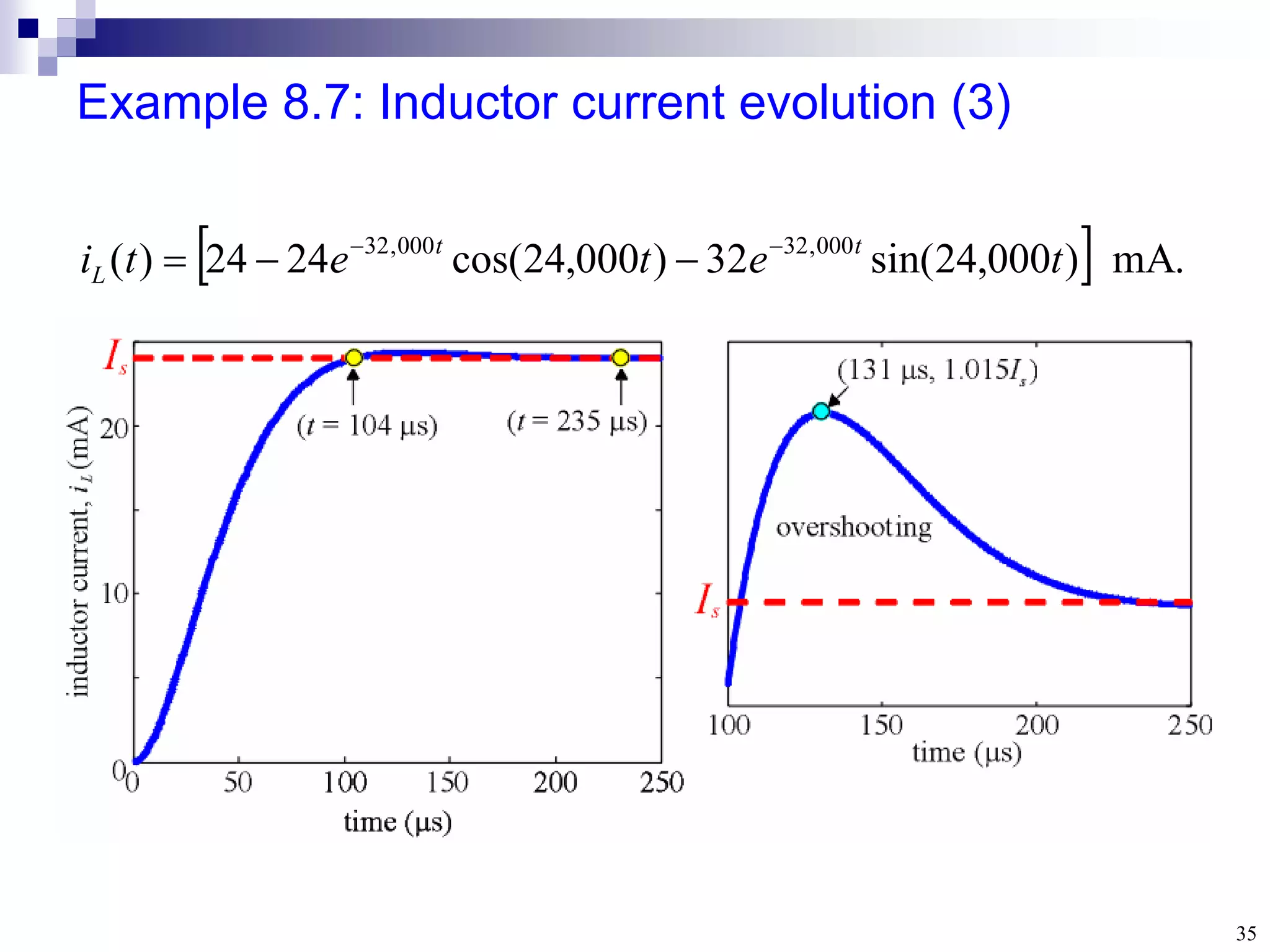
Example 8.7: Inductor current evolution (3)
  .
mA
)
000
,
24
sin(
32
)
000
,
24
cos(
24
24
)
( 000
,
32
000
,
32
t
e
t
e
t
i t
t
L





36
Example 8.9: Charging of parallel RLC circuits (1)
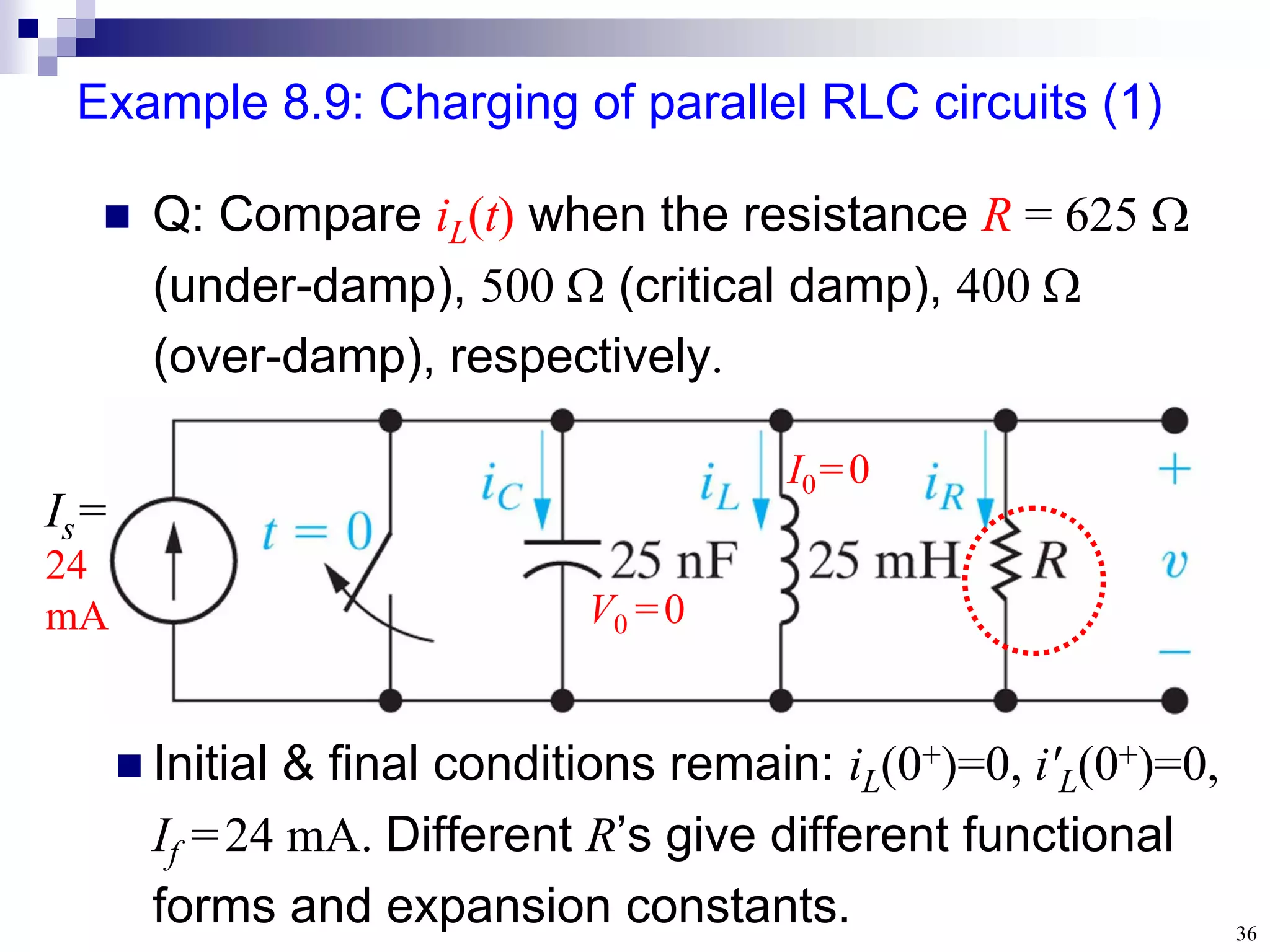
 Q: Compare iL(t) when the resistance R = 625 
(under-damp), 500  (critical damp), 400 
(over-damp), respectively.
Is=
24
mA
 Initial & final conditions remain: iL(0+)=0, i'L(0+)=0,
If =24 mA. Different R’s give different functional
forms and expansion constants.
V0 =0
I0=0
37
Example 8.9: Comparison of rise times (2)
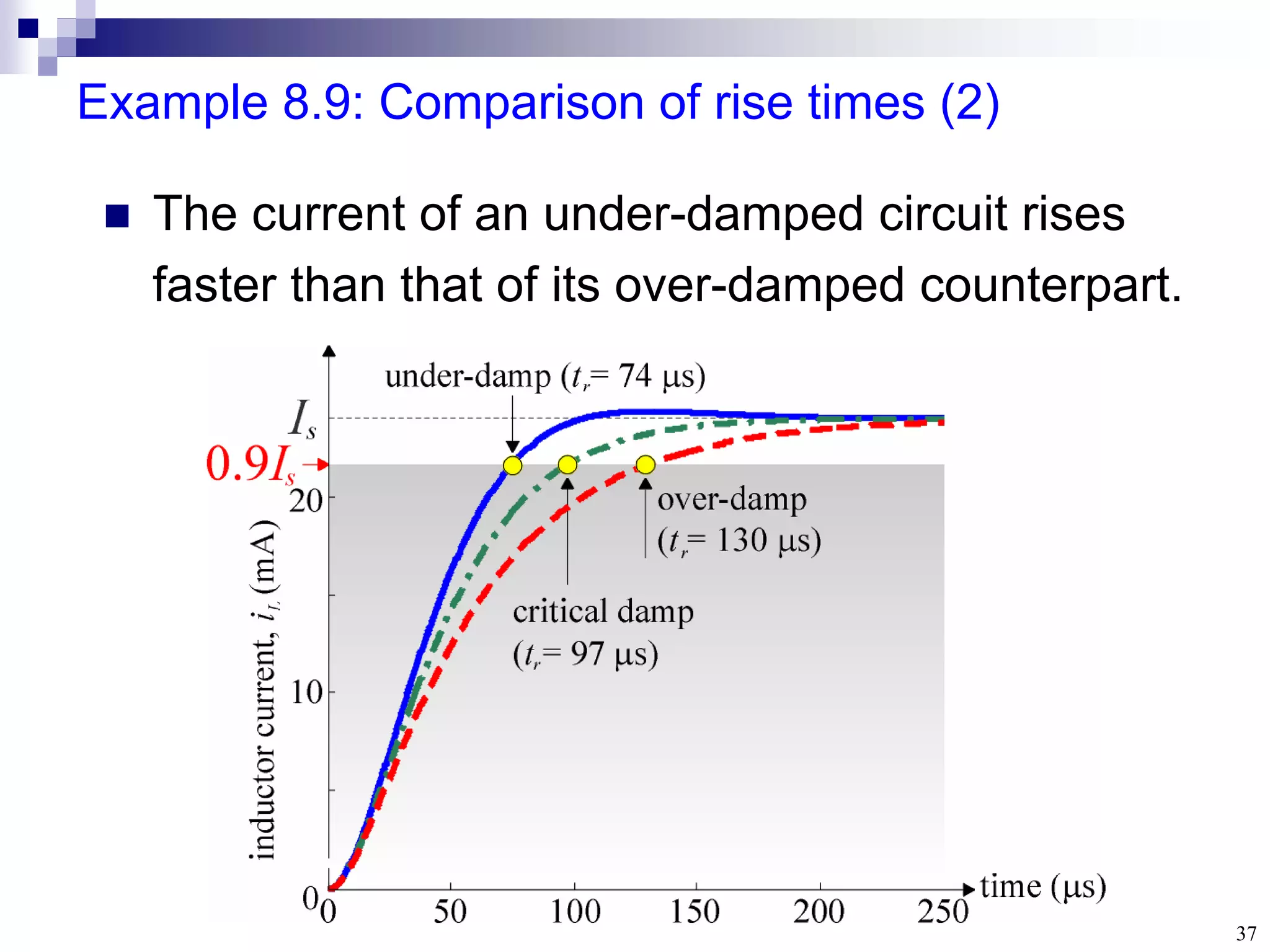
 The current of an under-damped circuit rises
faster than that of its over-damped counterpart.
38
Section 8.4
The Natural and Step
Response of a Series RLC
Circuit
1. Modifications of time constant, neper
frequency
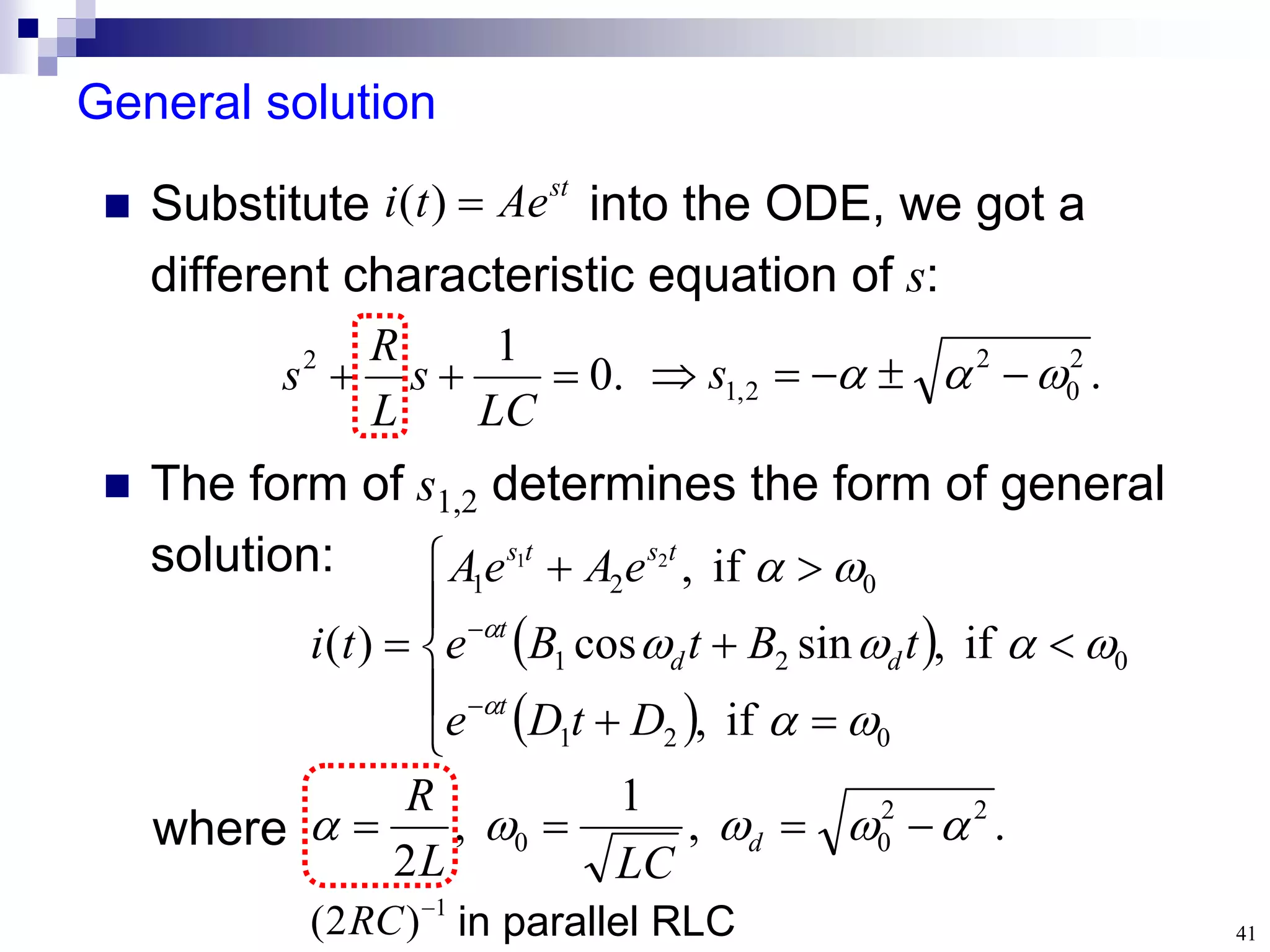
39
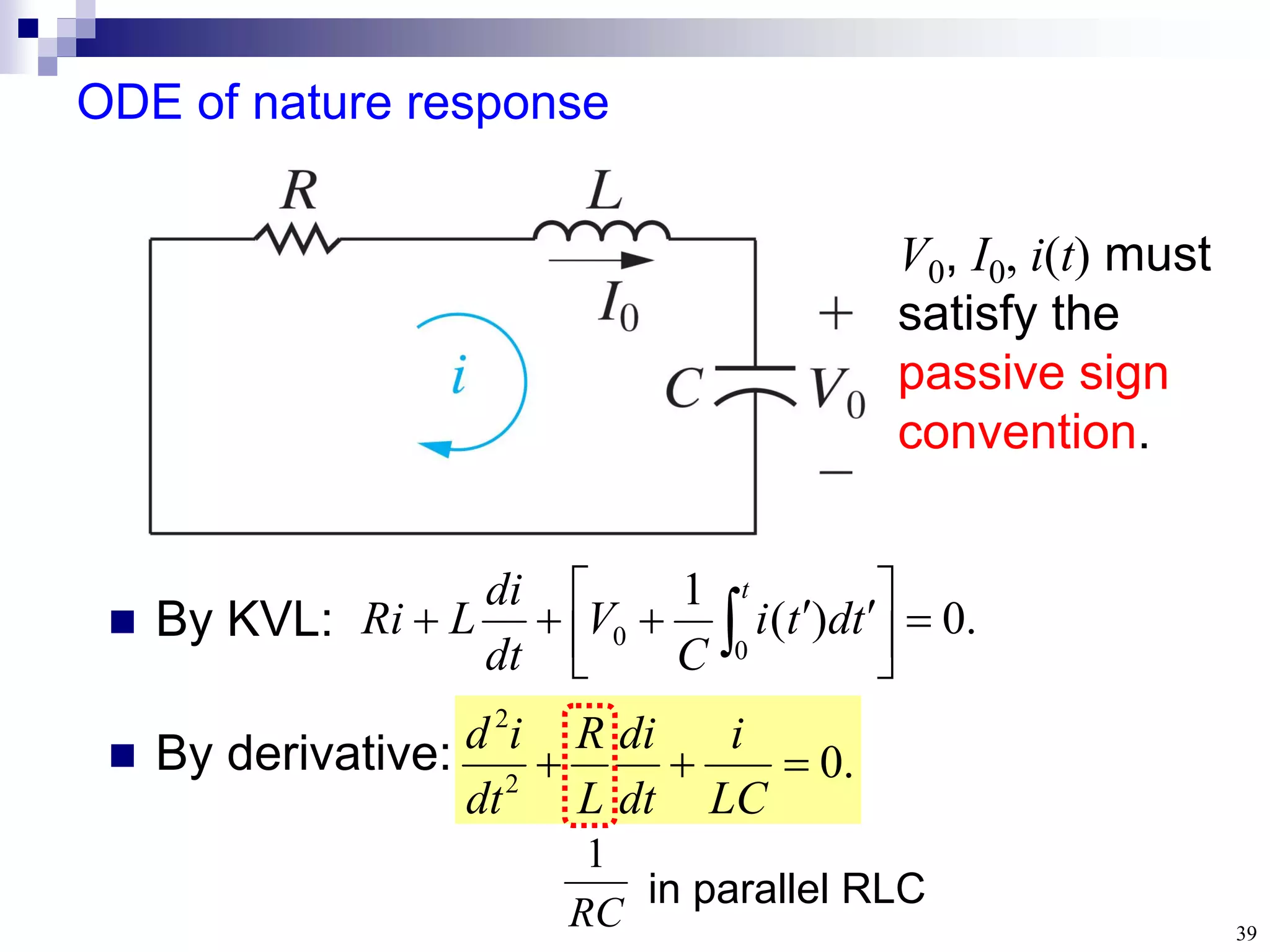
ODE of nature response
.
0
)
(
1
0
0 





 



 
t
t
d
t
i
C
V
dt
di
L
Ri
.
0
2
2



LC
i
dt
di
L
R
dt
i
d
RC
1
in parallel RLC
 By KVL:
 By derivative:
V0, I0, i(t) must
satisfy the
passive sign
convention.
40
The two initial conditions (ICs)
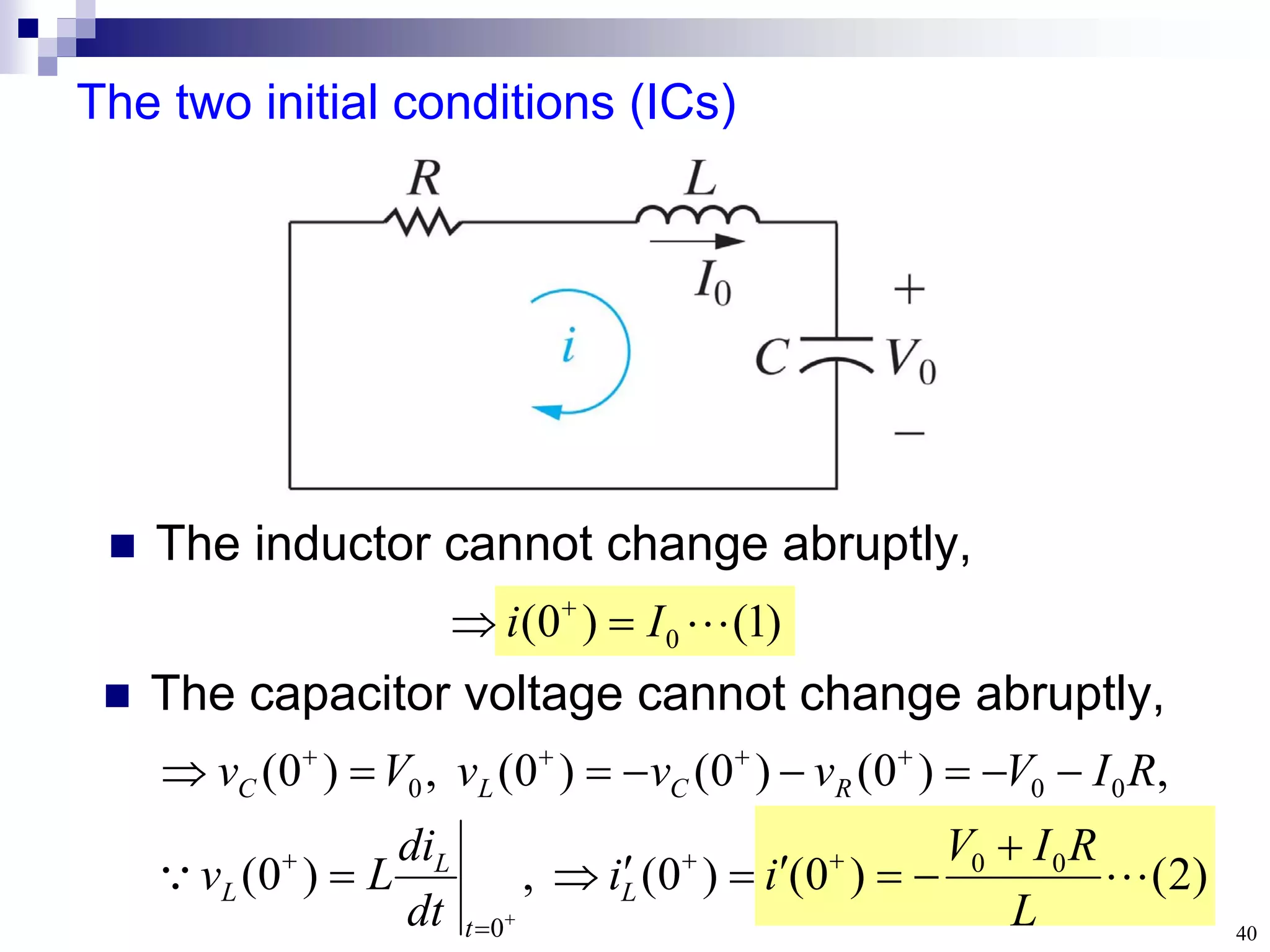
 The inductor cannot change abruptly,
)
2
(
)
0
(
)
0
(
,
)
0
(
,
)
0
(
)
0
(
)
0
(
,
)
0
(
0
0
0
0
0
0


L
R
I
V
i
i
dt
di
L
v
R
I
V
v
v
v
V
v
L
t
L
L
R
C
L
C

























)
1
(
)
0
( 0 
I
i 
 
 The capacitor voltage cannot change abruptly,
41
General solution
.
0
1
2



LC
s
L
R
s
 Substitute into the ODE, we got a
different characteristic equation of s:
st
Ae
t
i 
)
(
 
 














0
2
1
0
2
1
0
2
1
if
,
if
,
sin
cos
if
,
)
(
2
1










D
t
D
e
t
B
t
B
e
e
A
e
A
t
i
t
d
d
t
t
s
t
s
 The form of s1,2 determines the form of general
solution:
.
2
0
2
2
,
1 

 



 s
.
,
1
,
2
2
2
0
0 



 


 d
LC
L
R
where
1
)
2
( 
RC in parallel RLC
42
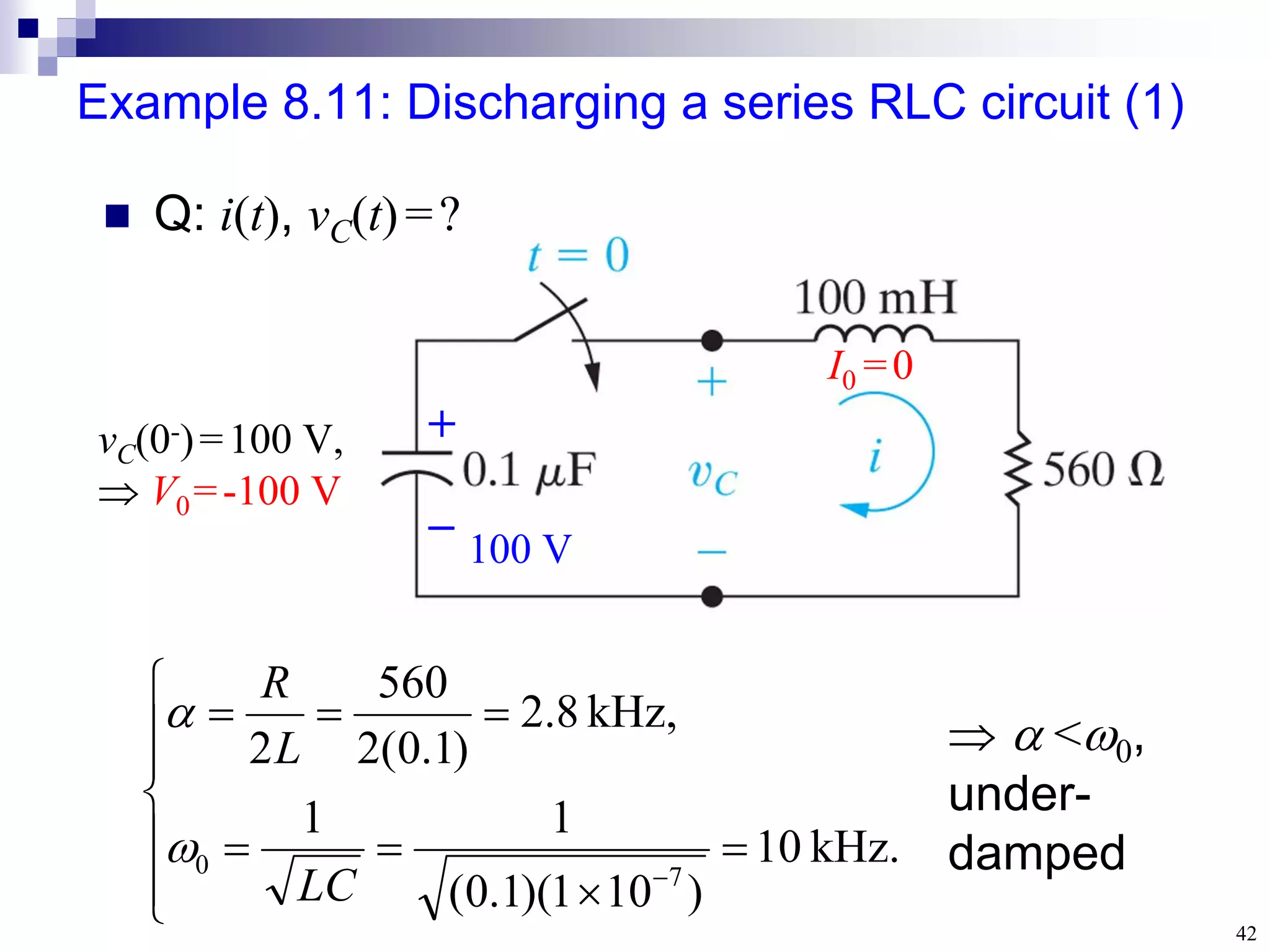
Example 8.11: Discharging a series RLC circuit (1)
vC(0-)=100 V,
 V0=-100 V
I0 =0















kHz.
10
)
10
1
)(
1
.
0
(
1
1
,
kHz
8
.
2
)
1
.
0
(
2
560
2
7
0
LC
L
R

  <0,
under-
damped
 Q: i(t), vC(t)=?
+
 100 V
43
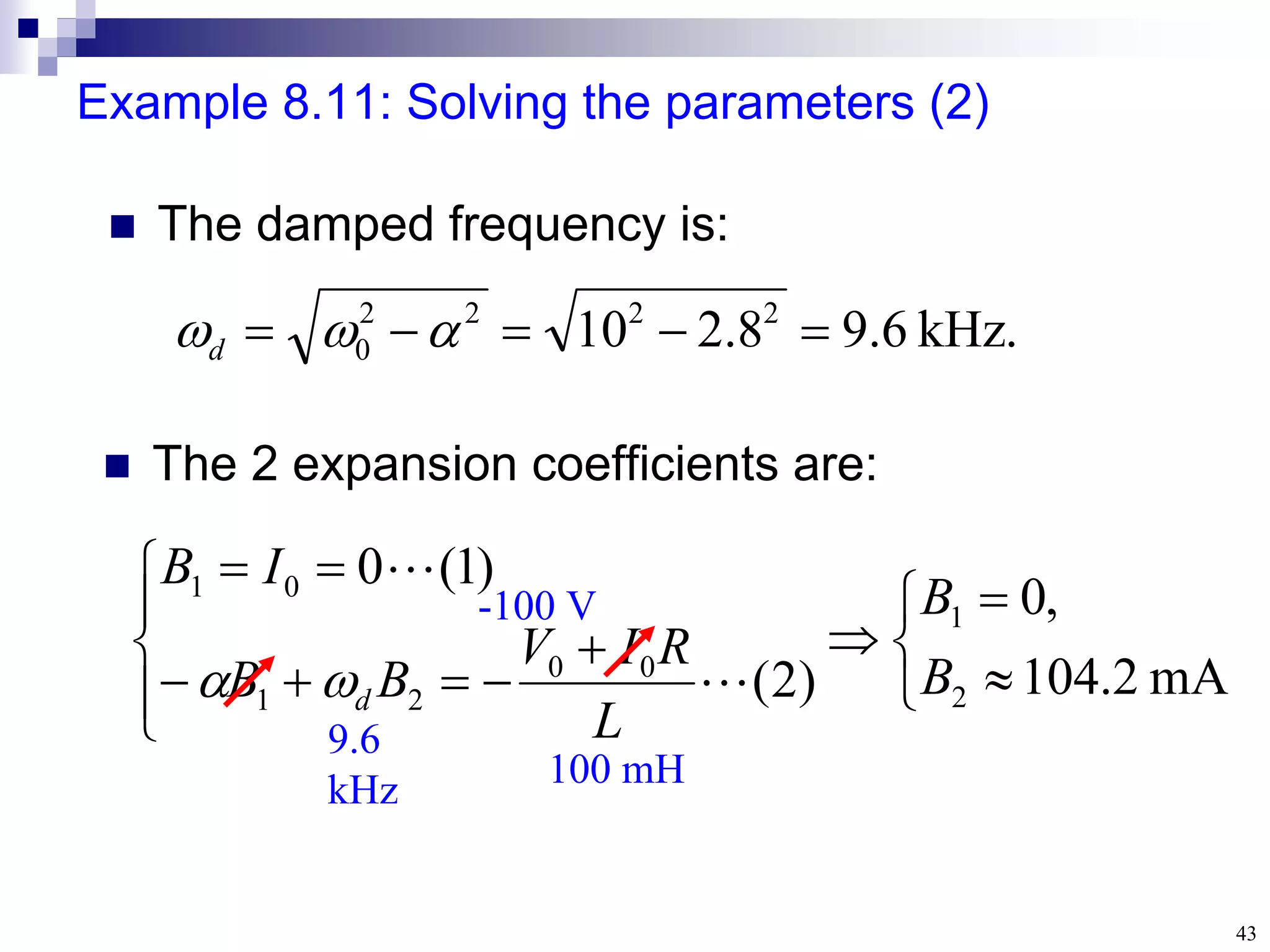
Example 8.11: Solving the parameters (2)
.
kHz
6
.
9
8
.
2
10 2
2
2
2
0 



 

d
 The damped frequency is:
 The 2 expansion coefficients are:


















mA
2
.
104
,
0
)
2
(
)
1
(
0
2
1
0
0
2
1
0
1
B
B
L
R
I
V
B
B
I
B
d 



9.6
kHz 100 mH
-100 V
44
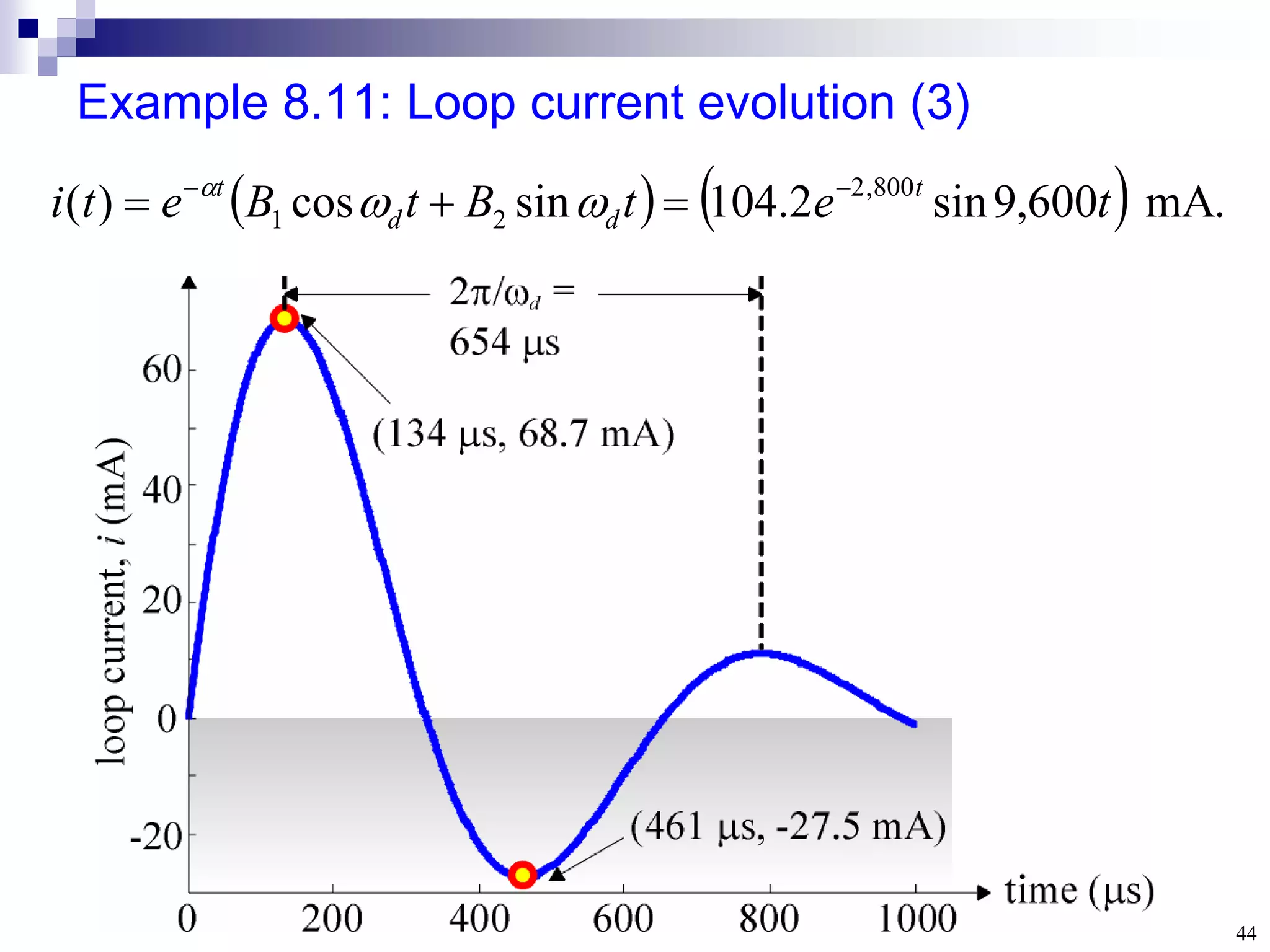
Example 8.11: Loop current evolution (3)
    .
mA
600
,
9
sin
2
.
104
sin
cos
)
( 800
,
2
2
1 t
e
t
B
t
B
e
t
i t
d
d
t 



 


45
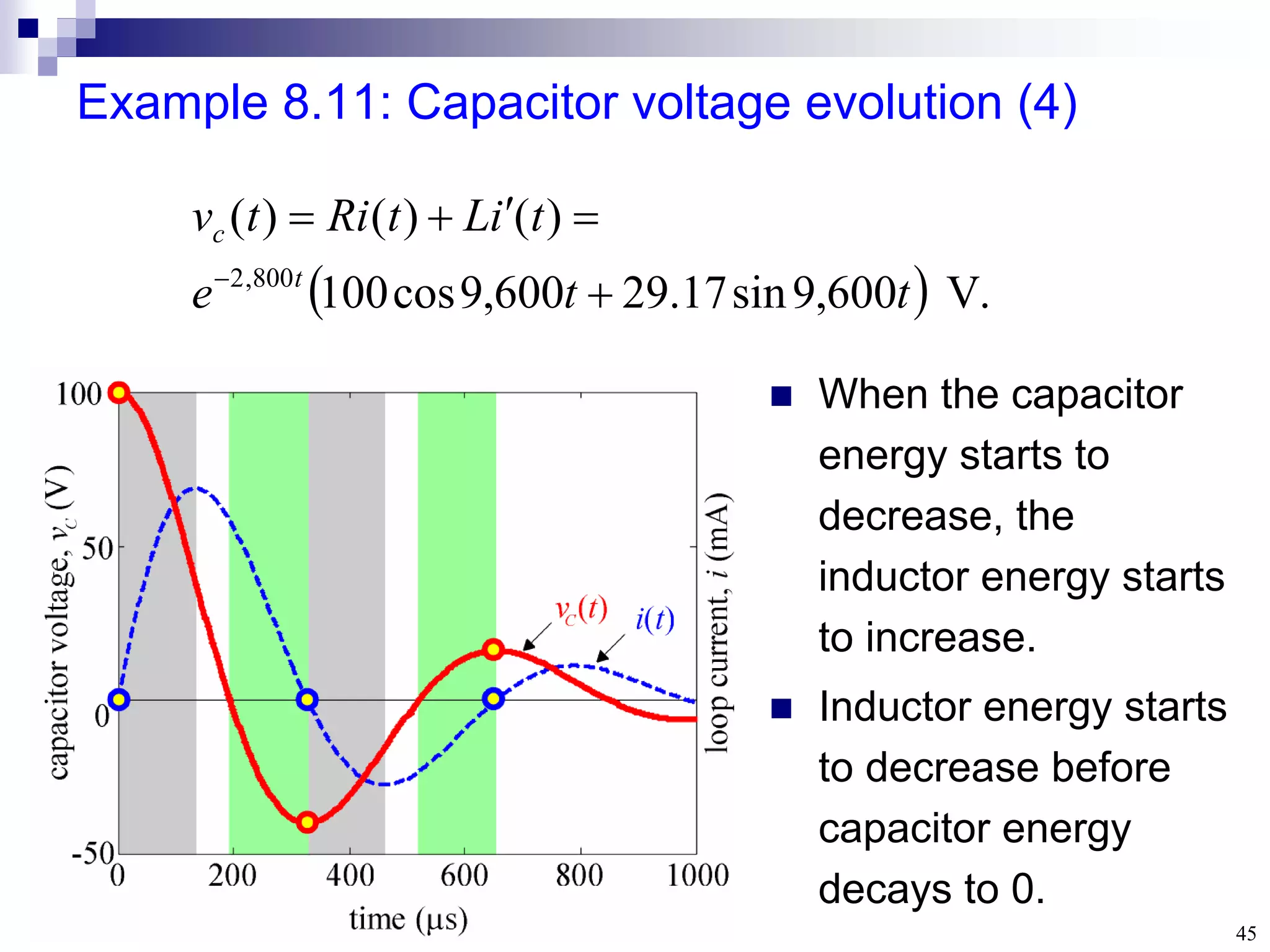
Example 8.11: Capacitor voltage evolution (4)
  .
V
600
,
9
sin
17
.
29
600
,
9
cos
100
)
(
)
(
)
(
800
,
2
t
t
e
t
i
L
t
Ri
t
v
t
c






 When the capacitor
energy starts to
decrease, the
inductor energy starts
to increase.
 Inductor energy starts
to decrease before
capacitor energy
decays to 0.
46
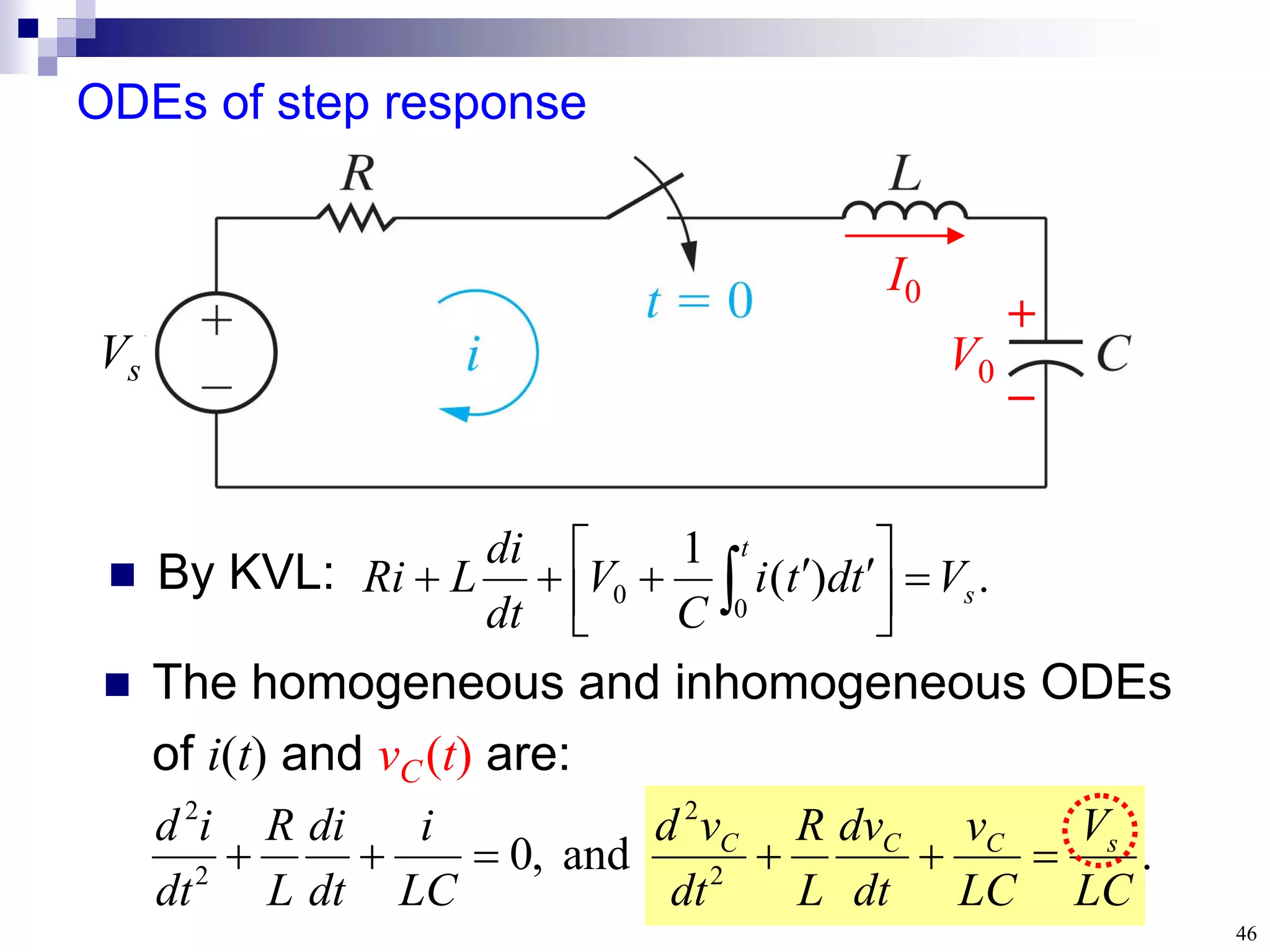
ODEs of step response
 By KVL:
 The homogeneous and inhomogeneous ODEs
of i(t) and vC(t) are:
V0
I0
Vs
+

.
)
(
1
0
0 s
t
V
t
d
t
i
C
V
dt
di
L
Ri 





 



 
.
and
,
0 2
2
2
2
LC
V
LC
v
dt
dv
L
R
dt
v
d
LC
i
dt
di
L
R
dt
i
d s
C
C
C






47
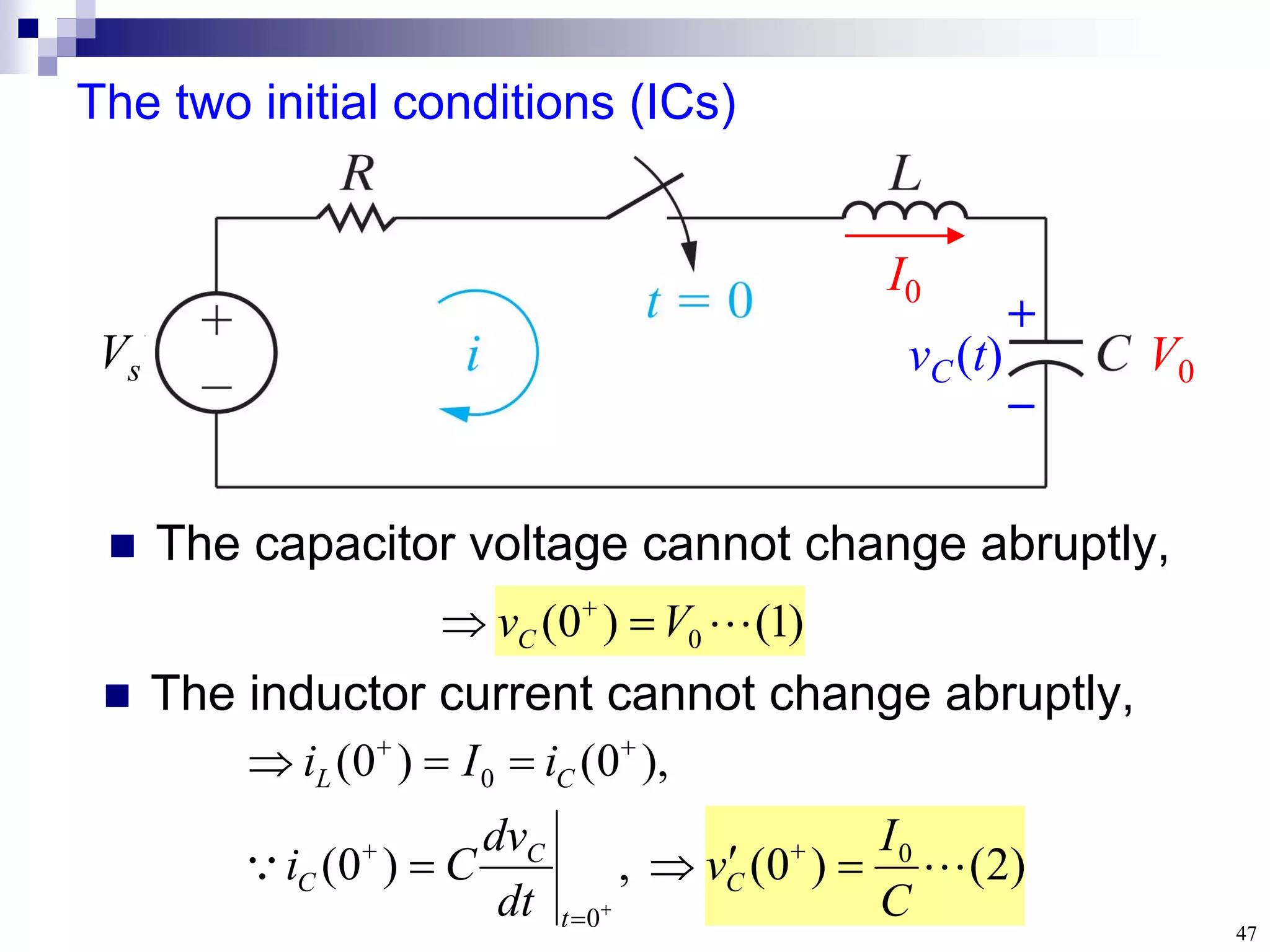
The two initial conditions (ICs)
 The capacitor voltage cannot change abruptly,
)
2
(
)
0
(
,
)
0
(
),
0
(
)
0
(
0
0
0


C
I
v
dt
dv
C
i
i
I
i
C
t
C
C
C
L













)
1
(
)
0
( 0 
V
vC 
 
 The inductor current cannot change abruptly,
V0
I0
Vs
+

vC(t)
48
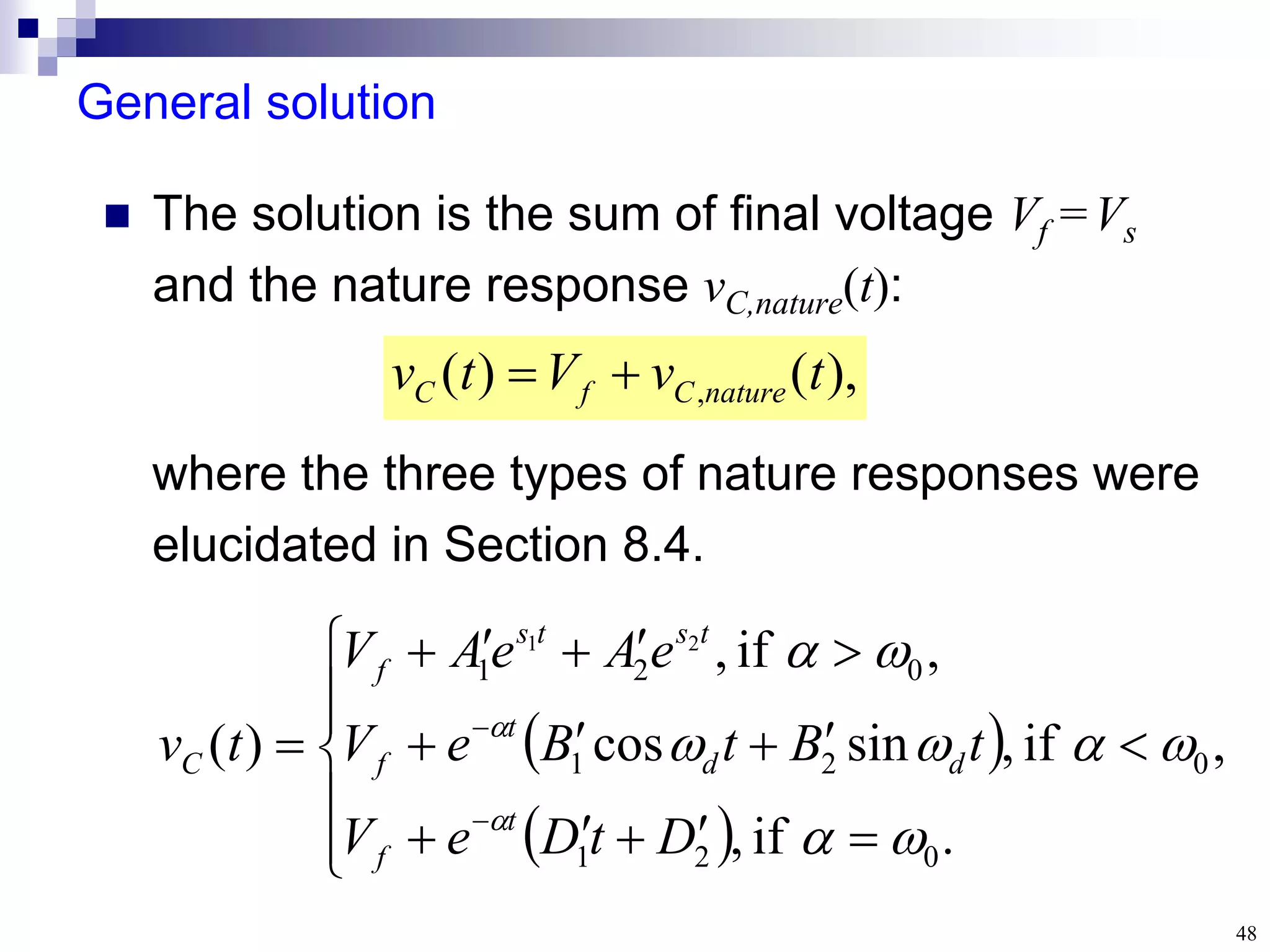
General solution
where the three types of nature responses were
elucidated in Section 8.4.
 The solution is the sum of final voltage Vf =Vs
and the nature response vC,nature(t):
),
(
)
( , t
v
V
t
v nature
C
f
C 

 
 

























.
if
,
,
if
,
sin
cos
,
if
,
)
(
0
2
1
0
2
1
0
2
1
2
1










D
t
D
e
V
t
B
t
B
e
V
e
A
e
A
V
t
v
t
f
d
d
t
f
t
s
t
s
f
C
49
Key points
 What do the response curves of over-, under-,
and critically-damped circuits look like? How to
choose R, L, C values to achieve fast switching
or to prevent overshooting damage?
 What are the initial conditions in an RLC circuit?
How to use them to determine the expansion
coefficients of the complete solution?
 Comparisons between: (1) natural & step
responses, (2) parallel, series, or general RLC.
RLC circuits.pdf

  • 1.
    1 Chapter 8 Natural andStep Responses of RLC Circuits 8.1-2 The Natural Response of a Parallel RLC Circuit 8.3 The Step Response of a Parallel RLC Circuit 8.4 The Natural and Step Response of a Series RLC Circuit
  • 2.
    2 Key points  Whatdo the response curves of over-, under-, and critically-damped circuits look like? How to choose R, L, C values to achieve fast switching or to prevent overshooting damage?  What are the initial conditions in an RLC circuit? How to use them to determine the expansion coefficients of the complete solution?  Comparisons between: (1) natural & step responses, (2) parallel, series, or general RLC.
  • 3.
    3 Section 8.1, 8.2 TheNatural Response of a Parallel RLC Circuit 1. ODE, ICs, general solution of parallel voltage 2. Over-damped response 3. Under-damped response 4. Critically-damped response
  • 4.
    4 The governing ordinarydifferential equation (ODE) . 0 ) ( 1 0 0              R v t d t v L I dt dv C t  By KCL: . 0 1 2 2    LC v dt dv RC dt v d  Perform time derivative, we got a linear 2nd- order ODE of v(t) with constant coefficients: V0, I0, v(t) must satisfy the passive sign convention.
  • 5.
    5 The two initialconditions (ICs)  The capacitor voltage cannot change abruptly, ) 2 ( ) 0 ( ) 0 ( , ) 0 ( , ) 0 ( ) 0 ( ) 0 ( , ) 0 ( 0 0 0 0 0 0   RC V C I v v dt dv C i R V I i i i I i C t C C R L C L                          ) 1 ( ) 0 ( 0  V v     The inductor current cannot change abruptly,
  • 6.
    6 General solution . 0 1 2    LC RC s s  Assumethe solution is , where A, s are unknown constants to be solved.  Substitute into the ODE, we got an algebraic (characteristic) equation of s determined by the circuit parameters: st Ae t v  ) ( where the expansion constants A1, A2 will be determined by the two initial conditions. , ) ( 2 1 2 1 t s t s e A e A t v    Since the ODE is linear,  linear combination of solutions remains a solution to the equation. The general solution of v(t) must be of the form:
  • 7.
    7 Neper and resonancefrequencies  In general, s has two roots, which can be (1) distinct real, (2) degenerate real, or (3) complex conjugate pair. , 1 2 1 2 1 2 0 2 2 2 , 1                  LC RC RC s LC 1 0   , 2 1 RC   where …resonance (natural) frequency …neper frequency
  • 8.
    8 Three types ofnatural response Over-damped   real, distinct roots s1, s2 Under-damped  complex roots s1 = (s2)* Critically-damped  real, equal roots s1 = s2 The Circuit is When Solutions  How the circuit reaches its steady state depends on the relative magnitudes of  and 0:
  • 9.
    9 where are distinctreal. Over-damped response ( >0)  The complete solution and its derivative are of the form:           . ) ( , ) ( 2 1 2 1 2 2 1 1 2 1 t s t s t s t s e s A e s A t v e A e A t v 2 0 2 2 , 1        s  Substitute the two ICs:                 ) 2 ( ) 0 ( ) 1 ( ) 0 ( 0 0 2 2 1 1 0 2 1   RC V C I A s A s v V A A v  solve A1, A2.
  • 10.
    10 Example 8.2: Discharginga parallel RLC circuit (1) 12 V 30 mA  Q: v(t), iC(t), iL(t), iR(t)=?                    kHz. 10 ) 10 2 )( 10 5 ( 1 1 , kHz 5 . 12 ) 10 2 )( 200 ( 2 1 2 1 7 2 0 7 LC RC    >0, over- damped
  • 11.
    11 Example 8.2: Solvingthe parameters (2)  The 2 distinct real roots of s are:                  . kHz 20 , kHz 5 2 0 2 2 2 0 2 1       s s …|s2|>(fast) …|s1|<(slow)                      450 20 5 12 2 1 2 1 0 0 2 2 1 1 0 2 1 A A A A RC V C I A s A s V A A  The 2 expansion coefficients are: V. 26 , V 14 2 1     A A
  • 12.
    12 Example 8.2: Theparallel voltage evolution (3) Converge to zero |s1|<(slow) dominates |s2|>(fast) dominates  V. 26 14 ) ( 20000 5000 2 1 2 1 t t t s t s e e e A e A t v        “Over” damp
  • 13.
    13 Example 8.2: Thebranch currents evolution (4)  The branch current through R is:  mA. 130 70 200 ) ( ) ( 20000 5000 t t R e e t v t i         The branch current through L is:  mA. 26 56 ) ( mH 0 5 1 mA 30 ) ( 20000 5000 0 t t t L e e t d t v t i           The branch current through C is:  mA. 104 14 μF) 2 . 0 ( ) ( 20000 5000 t t C e e dt dv t i     
  • 14.
    14 Example 8.2: Thebranch currents evolution (5) Converge to zero
  • 15.
    15 where is thedamped frequency. General solution to under-damped response ( <0)  The two roots of s are complex conjugate pair: 2 2 0      d , 2 0 2 2 , 1 d j s                          . sin cos sin cos sin cos sin cos ) ( 2 1 2 1 2 1 2 1 ) ( 2 ) ( 1 t B t B e t A A j t A A e t j t A t j t A e e A e A t v d d t d d t d d d d t t j t j d d                                    The general solution is reformulated as:
  • 16.
    16 Solving the expansioncoefficients B1, B2 by ICs  Substitute the two ICs:                 ) 2 ( ) 0 ( ) 1 ( ) 0 ( 0 0 2 1 0 1   RC V C I B B v V B v d    solve B1, B2.          . sin cos cos sin sin cos ) ( 1 2 2 1 2 1 t B B t B B e t e t e B t e t e B t v d d d d t d t d d t d t d d t                                      The derivative of v(t) is:
  • 17.
    17 Example 8.4: Discharginga parallel RLC circuit (1) 0 V -12.25 mA  Q: v(t), iC(t), iL(t), iR(t)=?                   kHz. 1 ) 10 25 . 1 )( 8 ( 1 1 , kHz 2 . 0 ) 10 25 . 1 )( 10 2 ( 2 1 2 1 7 0 7 4 LC RC    <0, under- damped
  • 18.
    18 Example 8.4: Solvingthe parameters (2) . kHz 98 . 0 2 . 0 1 2 2 2 2 0        d  The damped frequency is:  The 2 expansion coefficients are:                   V 100 , 0 ) 2 ( ) 1 ( 0 2 1 0 0 2 1 0 1 B B RC V C I B B V B d    
  • 19.
    19 Example 8.4: Theparallel voltage evolution (3)   . V 980 sin 100 sin cos ) ( 200 2 1 t e t e B t e B t v t d t d t            The voltage oscillates (~d) and approaches the final value (~), different from the over- damped case (no oscillation, 2 decay constants).
  • 20.
    20 Example 8.4: Thebranch currents evolutions (4)  The three branch currents are:
  • 21.
    21 Rules for circuitdesigners  If one desires the circuit reaches the final value as fast as possible while the minor oscillation is of less concern, choosing R, L, C values to satisfy under-damped condition.  If one concerns that the response not exceed its final value to prevent potential damage, designing the system to be over-damped at the cost of slower response.
  • 22.
    22 General solution tocritically-damped response (=0)  Two identical real roots of s make  The general solution is reformulated as: , ) ( ) ( 0 2 1 2 1 st st st st e A e A A e A e A t v      not possible to satisfy 2 independent ICs (V0, I0) with a single expansion constant A0.  . ) ( 2 1 D t D e t v t     You can prove the validity of this form by substituting it into the ODE: . 0 ) ( ) ( ) ( ) ( ) ( 1 1         t v LC t v RC t v
  • 23.
    23 Solving the expansioncoefficients D1, D2 by ICs  Substitute the two ICs:                ) 2 ( ) 0 ( ) 1 ( ) 0 ( 0 0 2 1 0 2   RC V C I D D v V D v   solve D1, D2.       . ) ( 1 2 1 2 1 t t t t e t D D D e D te e D t v                     The derivative of v(t) is:
  • 24.
    24 Example 8.5: Discharginga parallel RLC circuit (1) 0 V -12.25 mA R  Q: What is R such that the circuit is critically- damped? Plot the corresponding v(t). . k 4 10 25 . 1 8 2 1 2 1 , 1 2 1 , 7 0         C L R LC RC    Increasing R tends to bring the circuit from over- to critically- and even under-damped.
  • 25.
    25 Example 8.5: Solvingthe parameters (2)  The neper frequency is:  The 2 expansion coefficients are: ms. 1 1 , kHz 1 ) 10 25 . 1 )( 10 4 ( 2 1 2 1 7 3             RC                  0 s kV 98 ) 2 ( ) 1 ( 0 2 1 0 0 2 1 0 2 D D RC V C I D D V D    -12.25 mA 0.125 F
  • 26.
    26 Example 8.5: Theparallel voltage evolution (3) 98 V/ms   . V 000 , 98 ) ( 1000 2 1 t t t te e D te D t v        
  • 27.
    27 Procedures of solvingnature response of parallel RLC  Calculate parameters and .  Write the form of v(t) by comparing  and :  Find the expansion constants (A1, A2), (B1, B2), or (D1, D2) by two ICs: LC 1 0   1 ) 2 (   RC              ) 2 ( ) 0 ( ), 1 ( ) 0 ( 0 0 0   RC V C I v V v                          . if , , if , , sin cos , if , - , ) ( 0 2 1 0 2 2 0 2 1 0 2 0 2 2 , 1 2 1 2 1                 D t D e t B t B e s e A e A t v t d d d t t s t s
  • 28.
    28 Section 8.3 The StepResponse of a Parallel RLC Circuit 1. Inhomogeneous ODE, ICs, and general solution
  • 29.
    29 The homogeneous ODE . ) ( 1 0 0s t I R v t d t v L I dt dv C               By KCL: . 0 1 2 2    LC v dt dv RC dt v d  Perform time derivative, we got a homogeneous ODE of v(t) independent of the source current Is: V0 I0 Is + 
  • 30.
  • 31.
    31 The two initialconditions (ICs)  The inductor current cannot change abruptly, ) 2 ( ) 0 ( , ) 0 ( ), 0 ( ) 0 ( 0 0 0   L V i dt di L v v V v L t L L L C              ) 1 ( ) 0 ( 0  I iL     The capacitor voltage cannot change abruptly, Is iL V0 I0
  • 32.
    32 General solution where thethree types of nature responses were elucidated in Section 8.2:  The solution is the sum of final current If =Is and the nature response iL,nature(t): ), ( ) ( , t i I t i nature L f L                                . if , , if , sin cos , if , ) ( 0 2 1 0 2 1 0 2 1 2 1           D t D e I t B t B e I e A e A I t i t f d d t f t s t s f L
  • 33.
    33 Example 8.7: Charginga parallel RLC circuit (1) 625  Is= 24 mA V0 =0 I0=0  Q: iL(t) = ?                    kHz. 40 ) 10 5 . 2 )( 10 5 . 2 ( 1 1 , kHz 32 ) 10 5 . 2 )( 625 ( 2 1 2 1 8 2 0 8 LC RC    <0, under- damped
  • 34.
    34 Example 8.7: Solvingthe parameters (2) . kHz 24 32 40 2 2 2 2 0        d  The complete solution is of the form:  The 2 expansion coefficients are:                          mA 32 , mA 24 ) 2 ( 0 ) 1 ( 0 2 1 0 2 1 0 1 B B L V B B I B I d s      , sin cos ) ( 2 1 t B t B e I t i d d t s L          where
  • 35.
    35 Example 8.7: Inductorcurrent evolution (3)   . mA ) 000 , 24 sin( 32 ) 000 , 24 cos( 24 24 ) ( 000 , 32 000 , 32 t e t e t i t t L     
  • 36.
    36 Example 8.9: Chargingof parallel RLC circuits (1)  Q: Compare iL(t) when the resistance R = 625  (under-damp), 500  (critical damp), 400  (over-damp), respectively. Is= 24 mA  Initial & final conditions remain: iL(0+)=0, i'L(0+)=0, If =24 mA. Different R’s give different functional forms and expansion constants. V0 =0 I0=0
  • 37.
    37 Example 8.9: Comparisonof rise times (2)  The current of an under-damped circuit rises faster than that of its over-damped counterpart.
  • 38.
    38 Section 8.4 The Naturaland Step Response of a Series RLC Circuit 1. Modifications of time constant, neper frequency
  • 39.
    39 ODE of natureresponse . 0 ) ( 1 0 0              t t d t i C V dt di L Ri . 0 2 2    LC i dt di L R dt i d RC 1 in parallel RLC  By KVL:  By derivative: V0, I0, i(t) must satisfy the passive sign convention.
  • 40.
    40 The two initialconditions (ICs)  The inductor cannot change abruptly, ) 2 ( ) 0 ( ) 0 ( , ) 0 ( , ) 0 ( ) 0 ( ) 0 ( , ) 0 ( 0 0 0 0 0 0   L R I V i i dt di L v R I V v v v V v L t L L R C L C                          ) 1 ( ) 0 ( 0  I i     The capacitor voltage cannot change abruptly,
  • 41.
    41 General solution . 0 1 2    LC s L R s  Substituteinto the ODE, we got a different characteristic equation of s: st Ae t i  ) (                   0 2 1 0 2 1 0 2 1 if , if , sin cos if , ) ( 2 1           D t D e t B t B e e A e A t i t d d t t s t s  The form of s1,2 determines the form of general solution: . 2 0 2 2 , 1         s . , 1 , 2 2 2 0 0          d LC L R where 1 ) 2 (  RC in parallel RLC
  • 42.
    42 Example 8.11: Discharginga series RLC circuit (1) vC(0-)=100 V,  V0=-100 V I0 =0                kHz. 10 ) 10 1 )( 1 . 0 ( 1 1 , kHz 8 . 2 ) 1 . 0 ( 2 560 2 7 0 LC L R    <0, under- damped  Q: i(t), vC(t)=? +  100 V
  • 43.
    43 Example 8.11: Solvingthe parameters (2) . kHz 6 . 9 8 . 2 10 2 2 2 2 0        d  The damped frequency is:  The 2 expansion coefficients are:                   mA 2 . 104 , 0 ) 2 ( ) 1 ( 0 2 1 0 0 2 1 0 1 B B L R I V B B I B d     9.6 kHz 100 mH -100 V
  • 44.
    44 Example 8.11: Loopcurrent evolution (3)     . mA 600 , 9 sin 2 . 104 sin cos ) ( 800 , 2 2 1 t e t B t B e t i t d d t        
  • 45.
    45 Example 8.11: Capacitorvoltage evolution (4)   . V 600 , 9 sin 17 . 29 600 , 9 cos 100 ) ( ) ( ) ( 800 , 2 t t e t i L t Ri t v t c        When the capacitor energy starts to decrease, the inductor energy starts to increase.  Inductor energy starts to decrease before capacitor energy decays to 0.
  • 46.
    46 ODEs of stepresponse  By KVL:  The homogeneous and inhomogeneous ODEs of i(t) and vC(t) are: V0 I0 Vs +  . ) ( 1 0 0 s t V t d t i C V dt di L Ri              . and , 0 2 2 2 2 LC V LC v dt dv L R dt v d LC i dt di L R dt i d s C C C      
  • 47.
    47 The two initialconditions (ICs)  The capacitor voltage cannot change abruptly, ) 2 ( ) 0 ( , ) 0 ( ), 0 ( ) 0 ( 0 0 0   C I v dt dv C i i I i C t C C C L              ) 1 ( ) 0 ( 0  V vC     The inductor current cannot change abruptly, V0 I0 Vs +  vC(t)
  • 48.
    48 General solution where thethree types of nature responses were elucidated in Section 8.4.  The solution is the sum of final voltage Vf =Vs and the nature response vC,nature(t): ), ( ) ( , t v V t v nature C f C                                . if , , if , sin cos , if , ) ( 0 2 1 0 2 1 0 2 1 2 1           D t D e V t B t B e V e A e A V t v t f d d t f t s t s f C
  • 49.
    49 Key points  Whatdo the response curves of over-, under-, and critically-damped circuits look like? How to choose R, L, C values to achieve fast switching or to prevent overshooting damage?  What are the initial conditions in an RLC circuit? How to use them to determine the expansion coefficients of the complete solution?  Comparisons between: (1) natural & step responses, (2) parallel, series, or general RLC.