1
RUNGTA COLLEGE OF ENGINEERING AND TECHNOLOGY, RAIPUR
DEPARTMENT OF MECHANICAL ENGINEERING
Dr. Ritesh Dewangan
Associate Professor & HOD
Department of Mechanical engineering
Course : B.E. 5th
Semester
Subject : Machine Design - I
2
Dr. Ritesh Dewangan
HOD, DEPARTMENT OF MECHANICAL ENGINEERING
3
Dr. Ritesh Dewangan
HOD, DEPARTMENT OF MECHANICAL ENGINEERING
4
Dr. Ritesh Dewangan
HOD, DEPARTMENT OF MECHANICAL ENGINEERING
Stress & Strain (Tensile & Compressive )
5
Dr. Ritesh Dewangan
HOD, DEPARTMENT OF MECHANICAL ENGINEERING
Shear Stress (Simple & Torsional )
6
Dr. Ritesh Dewangan
HOD, DEPARTMENT OF MECHANICAL ENGINEERING
7
Dr. Ritesh Dewangan
HOD, DEPARTMENT OF MECHANICAL ENGINEERING
Bending Stress
8
Dr. Ritesh Dewangan
HOD, DEPARTMENT OF MECHANICAL ENGINEERING
9
Dr. Ritesh Dewangan
HOD, DEPARTMENT OF MECHANICAL ENGINEERING
10
Dr. Ritesh Dewangan
HOD, DEPARTMENT OF MECHANICAL ENGINEERING
11
Dr. Ritesh Dewangan
HOD, DEPARTMENT OF MECHANICAL ENGINEERING
12
Dr. Ritesh Dewangan
HOD, DEPARTMENT OF MECHANICAL ENGINEERING
13
Dr. Ritesh Dewangan
HOD, DEPARTMENT OF MECHANICAL ENGINEERING
14
Dr. Ritesh Dewangan
HOD, DEPARTMENT OF MECHANICAL ENGINEERING
15
Dr. Ritesh Dewangan
HOD, DEPARTMENT OF MECHANICAL ENGINEERING
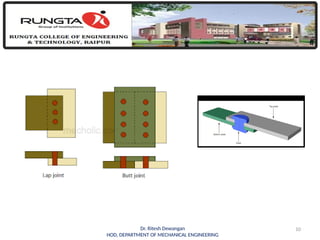
The following terms are used in the terminology of riveted joints:
(i) Pitch (p) The pitch of the rivet is defined
as the distance between the centre of one rivet to the centre of the
adjacent rivet in the same row. Usually,
p = 3d
where d is shank diameter of the rivet.
(ii) Margin (m) The margin is the distance
between the edge of the plate to the centre line of rivets in the nearest
row. Usually,
m = 1.5d
16
Dr. Ritesh Dewangan
HOD, DEPARTMENT OF MECHANICAL ENGINEERING
(iii) Transverse Pitch (pt) Transverse pitch,
also called back pitch or row pitch, is the distance between two consecutive
rows of rivets in the same plate. Usually,
pt = 0.8p (for chain riveting)
= 0.6p (for zig-zag riveting)
(iv) Diagonal Pitch (pd) Diagonal pitch is the
distance between the centre of one rivet to the centre of the adjacent rivet
located in the adjacent row.
17
Dr. Ritesh Dewangan
HOD, DEPARTMENT OF MECHANICAL ENGINEERING
18
Dr. Ritesh Dewangan
HOD, DEPARTMENT OF MECHANICAL ENGINEERING
19
Dr. Ritesh Dewangan
HOD, DEPARTMENT OF MECHANICAL ENGINEERING
20
Dr. Ritesh Dewangan
HOD, DEPARTMENT OF MECHANICAL ENGINEERING
21
Dr. Ritesh Dewangan
HOD, DEPARTMENT OF MECHANICAL ENGINEERING
Rivet material:
 Usually rivet is made up of wrought iron or soft steel due to lower
hardness which is necessary to have easy deformation during riveting.
 Sometimes copper, aluminum are used in corrosive environment. Only
material requirements are ductility, toughness and hardness.
 IS-2100-1962 gives the steel rivet specifications which are used in boilers.
22
Dr. Ritesh Dewangan
HOD, DEPARTMENT OF MECHANICAL ENGINEERING
Advantages of riveted joints:
 Cheaper fabrication cost
 Low maintenance cost
 Dissimilar metals can also be joined, even non-metallic joints are possible with
riveted joints.
 Ease of riveting process.
Disadvantages of riveted joints:
 Skilled workers required
 Leakage may be a problem for this type of joints, but this is overcome by special
techniques.
Applications of riveted joints:
 Boiler shells
 Structures members and bridges parts
 Railway wagons and coaches
 Buses and trucks
23
Dr. Ritesh Dewangan
HOD, DEPARTMENT OF MECHANICAL ENGINEERING
TYPES OF FAILURE
The types of failure in riveted joints are illustrated in Figure According to
conventional theory, the failure of the riveted joint may occur in any one or
more of the following ways:
a) shear failure of the rivet;
b) tensile failure of the plate between two consecutive rivets;
c) crushing failure of the plate;
d) shear failure of the plate in the margin area
e) tearing of the plate in the margin area.
Based upon the above-mentioned criteria of failure, strength equations are
written for riveted joints.
24
Dr. Ritesh Dewangan
HOD, DEPARTMENT OF MECHANICAL ENGINEERING
25
Dr. Ritesh Dewangan
HOD, DEPARTMENT OF MECHANICAL ENGINEERING
STRENGTH EQUATIONS
The strength of riveted joint is defined as the force that the joint can withstand
without causing failure.
In analysis of riveted joints, mainly three types of failure are considered. They
are as follows:
(i) shear failure of the rivet;
(ii) tensile failure of the plate between rivets;
(iii) crushing failure of the plate.
Based on the above criteria of failure, the strength equations are derived.
26
Dr. Ritesh Dewangan
HOD, DEPARTMENT OF MECHANICAL ENGINEERING
(i) Shear Strength of Rivet The shear failure in
the rivet of a single-riveted lap joint is illustrated in Fig. (a). In this case, the rivet
is in single shear. The strength equation is written in the following way,
27
Dr. Ritesh Dewangan
HOD, DEPARTMENT OF MECHANICAL ENGINEERING
In case of double or triple riveted lap joints, there are number of rivets and the
above equation is modified and written in the following way:
28
Dr. Ritesh Dewangan
HOD, DEPARTMENT OF MECHANICAL ENGINEERING
In case of double-strap single-riveted butt joint, the rivets are subjected to
double shear as shown in Fig. (b). The area that resists shear failure is twice
the cross-sectional area of the rivet.
29
Dr. Ritesh Dewangan
HOD, DEPARTMENT OF MECHANICAL ENGINEERING
The tensile failure of the plate between two consecutive rivets in a row is
illustrated in Fig. 8.56. The width of plate between the two points A and B is (p –
d/2 – d/2) or (p – d) and the thickness is t. Therefore, tensile resistance of the
plate between two rivets is given by,
30
Dr. Ritesh Dewangan
HOD, DEPARTMENT OF MECHANICAL ENGINEERING
(iii) Crushing Strength of Plate The crushing
failure of the plate is illustrated in Figure. This type of failure occurs when the
compressive stress between the shank of the rivet and the plate exceeds the
yield stress in compression. The failure results in elongating the rivet hole in the
plate and loosening of the joint. The crushing resistance of the plate is given by,
31
Dr. Ritesh Dewangan
HOD, DEPARTMENT OF MECHANICAL ENGINEERING
EFFICIENCY OF JOINT
The efficiency of the riveted joint is defined as the ratio of the strength of riveted
joint to the strength of un-riveted solid plate. The strength of the riveted joint is the
lowest value of Ps, Pt and Pc. The strength of solid plate of width, equal to the pitch
p and thickness t, subjected to tensile stress st is given by,
32
Dr. Ritesh Dewangan
HOD, DEPARTMENT OF MECHANICAL ENGINEERING
33
Dr. Ritesh Dewangan
HOD, DEPARTMENT OF MECHANICAL ENGINEERING
34
Dr. Ritesh Dewangan
HOD, DEPARTMENT OF MECHANICAL ENGINEERING
35
Dr. Ritesh Dewangan
HOD, DEPARTMENT OF MECHANICAL ENGINEERING
36
Dr. Ritesh Dewangan
HOD, DEPARTMENT OF MECHANICAL ENGINEERING
37
Dr. Ritesh Dewangan
HOD, DEPARTMENT OF MECHANICAL ENGINEERING
38
Dr. Ritesh Dewangan
HOD, DEPARTMENT OF MECHANICAL ENGINEERING
39
Dr. Ritesh Dewangan
HOD, DEPARTMENT OF MECHANICAL ENGINEERING
40
Dr. Ritesh Dewangan
HOD, DEPARTMENT OF MECHANICAL ENGINEERING
41
Dr. Ritesh Dewangan
HOD, DEPARTMENT OF MECHANICAL ENGINEERING
42
Dr. Ritesh Dewangan
HOD, DEPARTMENT OF MECHANICAL ENGINEERING
43
Dr. Ritesh Dewangan
HOD, DEPARTMENT OF MECHANICAL ENGINEERING
44
Dr. Ritesh Dewangan
HOD, DEPARTMENT OF MECHANICAL ENGINEERING
45
Dr. Ritesh Dewangan
HOD, DEPARTMENT OF MECHANICAL ENGINEERING
46
Dr. Ritesh Dewangan
HOD, DEPARTMENT OF MECHANICAL ENGINEERING
47
Dr. Ritesh Dewangan
HOD, DEPARTMENT OF MECHANICAL ENGINEERING
48
Dr. Ritesh Dewangan
HOD, DEPARTMENT OF MECHANICAL ENGINEERING
49
Dr. Ritesh Dewangan
HOD, DEPARTMENT OF MECHANICAL ENGINEERING
50
Dr. Ritesh Dewangan
HOD, DEPARTMENT OF MECHANICAL ENGINEERING
51
Dr. Ritesh Dewangan
HOD, DEPARTMENT OF MECHANICAL ENGINEERING
52
Thank You

MACHINE ENGINEERING PRESENTATION BY RUNGTA ENGINEERNIG COLLEGE

  • 1.
    1 RUNGTA COLLEGE OFENGINEERING AND TECHNOLOGY, RAIPUR DEPARTMENT OF MECHANICAL ENGINEERING Dr. Ritesh Dewangan Associate Professor & HOD Department of Mechanical engineering Course : B.E. 5th Semester Subject : Machine Design - I
  • 2.
    2 Dr. Ritesh Dewangan HOD,DEPARTMENT OF MECHANICAL ENGINEERING
  • 3.
    3 Dr. Ritesh Dewangan HOD,DEPARTMENT OF MECHANICAL ENGINEERING
  • 4.
    4 Dr. Ritesh Dewangan HOD,DEPARTMENT OF MECHANICAL ENGINEERING Stress & Strain (Tensile & Compressive )
  • 5.
    5 Dr. Ritesh Dewangan HOD,DEPARTMENT OF MECHANICAL ENGINEERING Shear Stress (Simple & Torsional )
  • 6.
    6 Dr. Ritesh Dewangan HOD,DEPARTMENT OF MECHANICAL ENGINEERING
  • 7.
    7 Dr. Ritesh Dewangan HOD,DEPARTMENT OF MECHANICAL ENGINEERING Bending Stress
  • 8.
    8 Dr. Ritesh Dewangan HOD,DEPARTMENT OF MECHANICAL ENGINEERING
  • 9.
    9 Dr. Ritesh Dewangan HOD,DEPARTMENT OF MECHANICAL ENGINEERING
  • 10.
    10 Dr. Ritesh Dewangan HOD,DEPARTMENT OF MECHANICAL ENGINEERING
  • 11.
    11 Dr. Ritesh Dewangan HOD,DEPARTMENT OF MECHANICAL ENGINEERING
  • 12.
    12 Dr. Ritesh Dewangan HOD,DEPARTMENT OF MECHANICAL ENGINEERING
  • 13.
    13 Dr. Ritesh Dewangan HOD,DEPARTMENT OF MECHANICAL ENGINEERING
  • 14.
    14 Dr. Ritesh Dewangan HOD,DEPARTMENT OF MECHANICAL ENGINEERING
  • 15.
    15 Dr. Ritesh Dewangan HOD,DEPARTMENT OF MECHANICAL ENGINEERING The following terms are used in the terminology of riveted joints: (i) Pitch (p) The pitch of the rivet is defined as the distance between the centre of one rivet to the centre of the adjacent rivet in the same row. Usually, p = 3d where d is shank diameter of the rivet. (ii) Margin (m) The margin is the distance between the edge of the plate to the centre line of rivets in the nearest row. Usually, m = 1.5d
  • 16.
    16 Dr. Ritesh Dewangan HOD,DEPARTMENT OF MECHANICAL ENGINEERING (iii) Transverse Pitch (pt) Transverse pitch, also called back pitch or row pitch, is the distance between two consecutive rows of rivets in the same plate. Usually, pt = 0.8p (for chain riveting) = 0.6p (for zig-zag riveting) (iv) Diagonal Pitch (pd) Diagonal pitch is the distance between the centre of one rivet to the centre of the adjacent rivet located in the adjacent row.
  • 17.
    17 Dr. Ritesh Dewangan HOD,DEPARTMENT OF MECHANICAL ENGINEERING
  • 18.
    18 Dr. Ritesh Dewangan HOD,DEPARTMENT OF MECHANICAL ENGINEERING
  • 19.
    19 Dr. Ritesh Dewangan HOD,DEPARTMENT OF MECHANICAL ENGINEERING
  • 20.
    20 Dr. Ritesh Dewangan HOD,DEPARTMENT OF MECHANICAL ENGINEERING
  • 21.
    21 Dr. Ritesh Dewangan HOD,DEPARTMENT OF MECHANICAL ENGINEERING Rivet material:  Usually rivet is made up of wrought iron or soft steel due to lower hardness which is necessary to have easy deformation during riveting.  Sometimes copper, aluminum are used in corrosive environment. Only material requirements are ductility, toughness and hardness.  IS-2100-1962 gives the steel rivet specifications which are used in boilers.
  • 22.
    22 Dr. Ritesh Dewangan HOD,DEPARTMENT OF MECHANICAL ENGINEERING Advantages of riveted joints:  Cheaper fabrication cost  Low maintenance cost  Dissimilar metals can also be joined, even non-metallic joints are possible with riveted joints.  Ease of riveting process. Disadvantages of riveted joints:  Skilled workers required  Leakage may be a problem for this type of joints, but this is overcome by special techniques. Applications of riveted joints:  Boiler shells  Structures members and bridges parts  Railway wagons and coaches  Buses and trucks
  • 23.
    23 Dr. Ritesh Dewangan HOD,DEPARTMENT OF MECHANICAL ENGINEERING TYPES OF FAILURE The types of failure in riveted joints are illustrated in Figure According to conventional theory, the failure of the riveted joint may occur in any one or more of the following ways: a) shear failure of the rivet; b) tensile failure of the plate between two consecutive rivets; c) crushing failure of the plate; d) shear failure of the plate in the margin area e) tearing of the plate in the margin area. Based upon the above-mentioned criteria of failure, strength equations are written for riveted joints.
  • 24.
    24 Dr. Ritesh Dewangan HOD,DEPARTMENT OF MECHANICAL ENGINEERING
  • 25.
    25 Dr. Ritesh Dewangan HOD,DEPARTMENT OF MECHANICAL ENGINEERING STRENGTH EQUATIONS The strength of riveted joint is defined as the force that the joint can withstand without causing failure. In analysis of riveted joints, mainly three types of failure are considered. They are as follows: (i) shear failure of the rivet; (ii) tensile failure of the plate between rivets; (iii) crushing failure of the plate. Based on the above criteria of failure, the strength equations are derived.
  • 26.
    26 Dr. Ritesh Dewangan HOD,DEPARTMENT OF MECHANICAL ENGINEERING (i) Shear Strength of Rivet The shear failure in the rivet of a single-riveted lap joint is illustrated in Fig. (a). In this case, the rivet is in single shear. The strength equation is written in the following way,
  • 27.
    27 Dr. Ritesh Dewangan HOD,DEPARTMENT OF MECHANICAL ENGINEERING In case of double or triple riveted lap joints, there are number of rivets and the above equation is modified and written in the following way:
  • 28.
    28 Dr. Ritesh Dewangan HOD,DEPARTMENT OF MECHANICAL ENGINEERING In case of double-strap single-riveted butt joint, the rivets are subjected to double shear as shown in Fig. (b). The area that resists shear failure is twice the cross-sectional area of the rivet.
  • 29.
    29 Dr. Ritesh Dewangan HOD,DEPARTMENT OF MECHANICAL ENGINEERING The tensile failure of the plate between two consecutive rivets in a row is illustrated in Fig. 8.56. The width of plate between the two points A and B is (p – d/2 – d/2) or (p – d) and the thickness is t. Therefore, tensile resistance of the plate between two rivets is given by,
  • 30.
    30 Dr. Ritesh Dewangan HOD,DEPARTMENT OF MECHANICAL ENGINEERING (iii) Crushing Strength of Plate The crushing failure of the plate is illustrated in Figure. This type of failure occurs when the compressive stress between the shank of the rivet and the plate exceeds the yield stress in compression. The failure results in elongating the rivet hole in the plate and loosening of the joint. The crushing resistance of the plate is given by,
  • 31.
    31 Dr. Ritesh Dewangan HOD,DEPARTMENT OF MECHANICAL ENGINEERING EFFICIENCY OF JOINT The efficiency of the riveted joint is defined as the ratio of the strength of riveted joint to the strength of un-riveted solid plate. The strength of the riveted joint is the lowest value of Ps, Pt and Pc. The strength of solid plate of width, equal to the pitch p and thickness t, subjected to tensile stress st is given by,
  • 32.
    32 Dr. Ritesh Dewangan HOD,DEPARTMENT OF MECHANICAL ENGINEERING
  • 33.
    33 Dr. Ritesh Dewangan HOD,DEPARTMENT OF MECHANICAL ENGINEERING
  • 34.
    34 Dr. Ritesh Dewangan HOD,DEPARTMENT OF MECHANICAL ENGINEERING
  • 35.
    35 Dr. Ritesh Dewangan HOD,DEPARTMENT OF MECHANICAL ENGINEERING
  • 36.
    36 Dr. Ritesh Dewangan HOD,DEPARTMENT OF MECHANICAL ENGINEERING
  • 37.
    37 Dr. Ritesh Dewangan HOD,DEPARTMENT OF MECHANICAL ENGINEERING
  • 38.
    38 Dr. Ritesh Dewangan HOD,DEPARTMENT OF MECHANICAL ENGINEERING
  • 39.
    39 Dr. Ritesh Dewangan HOD,DEPARTMENT OF MECHANICAL ENGINEERING
  • 40.
    40 Dr. Ritesh Dewangan HOD,DEPARTMENT OF MECHANICAL ENGINEERING
  • 41.
    41 Dr. Ritesh Dewangan HOD,DEPARTMENT OF MECHANICAL ENGINEERING
  • 42.
    42 Dr. Ritesh Dewangan HOD,DEPARTMENT OF MECHANICAL ENGINEERING
  • 43.
    43 Dr. Ritesh Dewangan HOD,DEPARTMENT OF MECHANICAL ENGINEERING
  • 44.
    44 Dr. Ritesh Dewangan HOD,DEPARTMENT OF MECHANICAL ENGINEERING
  • 45.
    45 Dr. Ritesh Dewangan HOD,DEPARTMENT OF MECHANICAL ENGINEERING
  • 46.
    46 Dr. Ritesh Dewangan HOD,DEPARTMENT OF MECHANICAL ENGINEERING
  • 47.
    47 Dr. Ritesh Dewangan HOD,DEPARTMENT OF MECHANICAL ENGINEERING
  • 48.
    48 Dr. Ritesh Dewangan HOD,DEPARTMENT OF MECHANICAL ENGINEERING
  • 49.
    49 Dr. Ritesh Dewangan HOD,DEPARTMENT OF MECHANICAL ENGINEERING
  • 50.
    50 Dr. Ritesh Dewangan HOD,DEPARTMENT OF MECHANICAL ENGINEERING
  • 51.
    51 Dr. Ritesh Dewangan HOD,DEPARTMENT OF MECHANICAL ENGINEERING
  • 52.