1
Risk Management for Project
Sponsors
June 2011
2
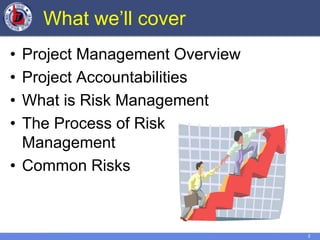
What we’ll cover
• Project Management Overview
• Project Accountabilities
• What is Risk Management
• The Process of Risk
Management
• Common Risks
3
What is Project Management?
• Project Definition: A project is a
temporary endeavor undertaken to
create a unique product of service
• Project Management: The disciple of
planning, organizing and managing
resources to achieve the successful
completion of specific project goals and
objectives
4
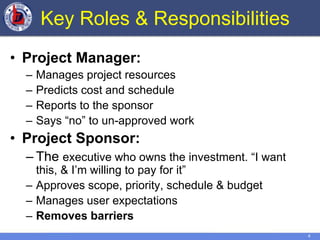
Key Roles & Responsibilities
• Project Manager:
– Manages project resources
– Predicts cost and schedule
– Reports to the sponsor
– Says “no” to un-approved work
• Project Sponsor:
– The executive who owns the investment. “I want
this, & I’m willing to pay for it”
– Approves scope, priority, schedule & budget
– Manages user expectations
– Removes barriers
5
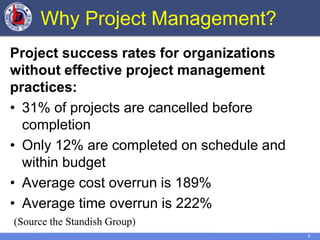
Why Project Management?
Project success rates for organizations
without effective project management
practices:
• 31% of projects are cancelled before
completion
• Only 12% are completed on schedule and
within budget
• Average cost overrun is 189%
• Average time overrun is 222%
(Source the Standish Group)
6
Have You Ever Heard This?
• How could we have spent $500k and have
nothing but a couple of deliverables from a
vendor?
• How did the project “all of the sudden”
become over budget when my weekly reports
said we were fine?
• The users designed this system and were in
on every decision. Now they hate the system
and are blaming IT
7
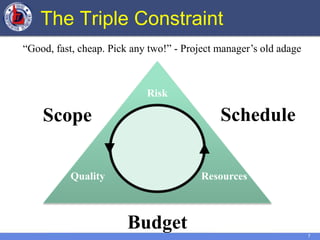
The Triple Constraint
Scope
Budget
Schedule
ResourcesQuality
Risk
“Good, fast, cheap. Pick any two!” - Project manager’s old adage
8
Remember - Always
Scope, schedule &
budget
are linked.
If one changes,
one or both of the
others
must change
9
Sponsor Sets Priority
Pick one
• Project must be delivered
on time or
• Project must be within
budget or
• Scope is fixed
10
What is Risk Management?
The process involved with
identifying, analyzing &
responding to risk
• Maximize positive events &
minimize consequences of
adverse events
• Identify problems early -
focus on prevention
11
The Process of Risk Management
Sponsors must manage their investments:
• Create a safe environment - problems will happen
• Solicit feedback from users & other external sources
• Meet routinely with project manager to review
performance
Review summary of quantitative performance
measures
Expect results of routine risk assessments
Follow-up on mitigating actions
Require consistent and routine performance reports
• On high risk projects request independent reviews
12
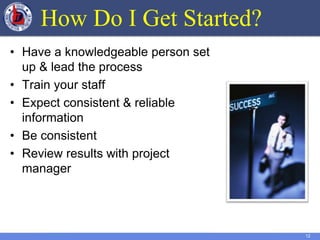
How Do I Get Started?
• Have a knowledgeable person set
up & lead the process
• Train your staff
• Expect consistent & reliable
information
• Be consistent
• Review results with project
manager
13
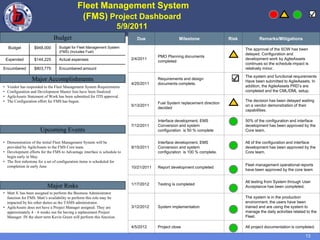
Fleet Management System
(FMS) Project Dashboard
5/9/2011
Budget
Budget $948,000 Budget for Fleet Management System
(FMS) (Includes Fuel)
Expended $144,225 Actual expenses
Encumbered $803,775 Encumbered amount
Upcoming Events
• Vendor has responded to the Fleet Management System Requirements
• Configuration and Development Master lists have been finalized
• AgileAssets Statement of Work has been submitted for ITD approval.
• The Configuration effort for FMS has begun.
Major Accomplishments
• Demonstration of the initial Fleet Management System will be
provided by AgileAssets to the FMS Core team.
• Development efforts for the FMS to Advantage interface is schedule to
begin early in May.
• The first milestone for a set of configuration items is scheduled for
completion in early June
Major Risks
• Matt S. has been assigned to perform the Business Administrator
function for FMS. Matt’s availability to perform this role may be
impacted by his other duties as the TAMS administrator.
• AgileAssets does not have a Project Manager assigned. They are
approximately 4 – 6 weeks out for having a replacement Project
Manager. IN the short term Kevin Green will perform this function.
Due Milestone Risk Remarks/Mitigations
2/4/2011
PMO Planning documents
completed
The approval of the SOW has been
delayed. Configuration and
development work by AglieAssets
continues so the schedule impact is
relatively minor.
4/25/2011
Requirements and design
documents complete.
The system and functional requirements
Have been submitted to AgileAssets. In
addition, the AgileAssets PRD’s are
completed and the CML/DML setup.
5/13/2011
Fuel System replacement direction
decided
The decision has been delayed waiting
on a vendor demonstration of their
capabilities.
7/12/2011
Interface development, EMS
Conversion and system
configuration is 50 % complete
50% of the configuration and interface
development has been approved by the
Core team.
9/15/2011
Interface development, EMS
Conversion and system
configuration is 100 % complete.
All of the configuration and interface
development has been approved by the
Core team.
10/21/2011 Report development completed
Fleet management operational reports
have been approved by the core team
1/17/2012 Testing is completed
All testing from System through User
Acceptance has been completed.
3/12/2012 System implementation
The system is in the production
environment, the users have been
trained and are using the system to
manage the daily activities related to the
Fleet.
4/5/2012 Project close All project documentation is completed.
14
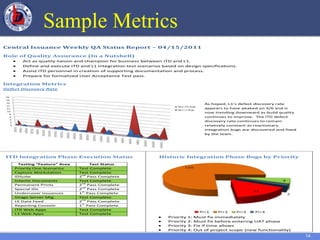
Central Issuance Weekly QA Status Report – 04/15/2011
Role of Quality Assurance (In a Nutshell)
 Act as quality liaison and champion for business between ITD and L1.
 Define and execute ITD and L1 Integration test scenarios based on design specifications.
 Assist ITD personnel in creation of supporting documentation and process.
 Prepare for formalized User Acceptance Test pass.
Integration Metrics
Defect Discovery Rate
As hoped, L1’s defect discovery rate
appears to have peaked on 4/6 and is
now trending downward as build quality
continues to improve. The ITD defect
discovery rate continues to remain
relatively constant as reactionary
integration bugs are discovered and fixed
by the team.
ITD Integration Phase Execution Status
Testing “Feature” Area Test Status
Priority One Scenarios Test Complete
Capture Workstation Test Complete
IDSuite 2nd
Pass Complete
Interim Documents Test Complete
Permanent Prints 2
nd
Pass Complete
Special IDs 2nd
Pass Complete
Undercover Issuances 1
st
Pass Complete
Image Server Mig. Test Complete
LE Data Feed 2
nd
Pass Complete
Reporting Console 1st
Pass Complete
ITD Web Apps Test Complete
L1 Web Apps Test Complete
Historic Integration Phase Bugs by Priority
 Priority 1: Must fix immediately
 Priority 2: Must fix before entering UAT phase
 Priority 3: Fix if time allows
 Priority 4: Out of project scope (new functionality)
Sample Metrics
15
The Process of Risk Management
16
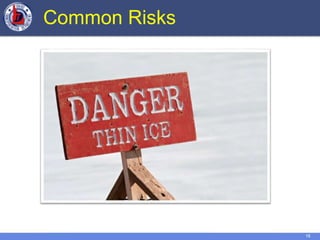
Common Risks
17
Schedule & Budget Slippage
Symptoms:
• Schedule slips but you are assured it will
made up
• Lack of quantitative basis for schedule –
“Feeling good about how we’re doing”
• Schedule and budget never change
• Scope increases but there is no change to
budget or schedule
18
Schedule & Budget Slippage
Consequences:
• Projects delivered late and over budget
• Lack of user satisfaction
• Inadequate funding
• Credibility
• Resource conflicts
19
Schedule & Budget Slippage
Mitigating actions:
• Approve scope, schedule & budget estimates
BEFORE you start
• Insist on quantitative basis for schedule &
budget projections
• Focus on the future, not the past
• Predict schedule & cost routinely
• Always have a contingency fund
20
No Definition of Done
Symptoms:
• No time to plan- “we have to get started”
• Resistance – “We know what we want!”
• Repeated surfacing of unexpected additional work
• No understanding of expected benefits
• Disagreement among stakeholders about what
they are getting
• Insist on exit criteria for major milestones - If there
are no Exit Criteria, how will you know you’re
done?
21
No Definition of Done
Consequences:
• Needed work is not visible or adequately
planned
• User dissatisfaction- “They didn’t give me
anything I asked for”
• The project just keeps going
and going and going
22
No Definition of Done
Mitigating actions:
• “Done” must be documented and approved
before the schedule and budget are set
• Should include:
– Product Description
– Expected benefits
– Proof of success
• Define what the project is NOT going to do
23
Ineffective Sponsor & Project Manager
Symptoms:
• Priorities are vague and the project lacks focus
• Resource needs are unclear or don’t they
participate
• Project schedule & budget either do
not exist or are not based on quantitative
information
• Scope is undefined, unclear & unpredictable
• Critical decisions pend for a long time
24
Ineffective Sponsor & Project Manager
Consequences:
• Schedule slippage
• Unnecessary work performed
• Cost overruns
• Users have not updated their business
practices & are not prepared for the new
product
• Poor staff morale
• Reputations are harmed
25
Ineffective Sponsor & Project Manager
Mitigating actions:
• Ensure sponsor has an interest in the
project’s success - fiscal & program
responsibility
• Skilled project manager – not operations
manager
• Require & review metrics to measure
quality, budget & schedule
• Don’t just hope things will get better- take
action
26
Incomplete Requirements
Symptoms:
• There aren’t any 
• Non-measurable, vague – can’t
be tested
• Are not aligned with project
objectives or definition of done
• Vendor cost estimates are not
consistent
27
Incomplete Requirements
Consequences
• Low quality product that does not meet the
user’s needs
• Numerous change order requests resulting in
schedule slippage & budget overages
• Constant conflict between state & vendor
• Blame game
28
Incomplete Requirements
Mitigating Actions
• Take time to Plan, Define Done, Set one priority -
scope, schedule or budget
• Utilize skilled staff/contractor- This is HARD!
• Process maps, use cases etc.
• Utilize templates – Requirements traceability
matrix
• Ensure final product satisfies the requirements
29
Shannon Barnes
PMO Manager
Idaho Transportation
Department

Risk managementforsponsors barnes

  • 1.
    1 Risk Management forProject Sponsors June 2011
  • 2.
    2 What we’ll cover •Project Management Overview • Project Accountabilities • What is Risk Management • The Process of Risk Management • Common Risks
  • 3.
    3 What is ProjectManagement? • Project Definition: A project is a temporary endeavor undertaken to create a unique product of service • Project Management: The disciple of planning, organizing and managing resources to achieve the successful completion of specific project goals and objectives
  • 4.
    4 Key Roles &Responsibilities • Project Manager: – Manages project resources – Predicts cost and schedule – Reports to the sponsor – Says “no” to un-approved work • Project Sponsor: – The executive who owns the investment. “I want this, & I’m willing to pay for it” – Approves scope, priority, schedule & budget – Manages user expectations – Removes barriers
  • 5.
    5 Why Project Management? Projectsuccess rates for organizations without effective project management practices: • 31% of projects are cancelled before completion • Only 12% are completed on schedule and within budget • Average cost overrun is 189% • Average time overrun is 222% (Source the Standish Group)
  • 6.
    6 Have You EverHeard This? • How could we have spent $500k and have nothing but a couple of deliverables from a vendor? • How did the project “all of the sudden” become over budget when my weekly reports said we were fine? • The users designed this system and were in on every decision. Now they hate the system and are blaming IT
  • 7.
    7 The Triple Constraint Scope Budget Schedule ResourcesQuality Risk “Good,fast, cheap. Pick any two!” - Project manager’s old adage
  • 8.
    8 Remember - Always Scope,schedule & budget are linked. If one changes, one or both of the others must change
  • 9.
    9 Sponsor Sets Priority Pickone • Project must be delivered on time or • Project must be within budget or • Scope is fixed
  • 10.
    10 What is RiskManagement? The process involved with identifying, analyzing & responding to risk • Maximize positive events & minimize consequences of adverse events • Identify problems early - focus on prevention
  • 11.
    11 The Process ofRisk Management Sponsors must manage their investments: • Create a safe environment - problems will happen • Solicit feedback from users & other external sources • Meet routinely with project manager to review performance Review summary of quantitative performance measures Expect results of routine risk assessments Follow-up on mitigating actions Require consistent and routine performance reports • On high risk projects request independent reviews
  • 12.
    12 How Do IGet Started? • Have a knowledgeable person set up & lead the process • Train your staff • Expect consistent & reliable information • Be consistent • Review results with project manager
  • 13.
    13 Fleet Management System (FMS)Project Dashboard 5/9/2011 Budget Budget $948,000 Budget for Fleet Management System (FMS) (Includes Fuel) Expended $144,225 Actual expenses Encumbered $803,775 Encumbered amount Upcoming Events • Vendor has responded to the Fleet Management System Requirements • Configuration and Development Master lists have been finalized • AgileAssets Statement of Work has been submitted for ITD approval. • The Configuration effort for FMS has begun. Major Accomplishments • Demonstration of the initial Fleet Management System will be provided by AgileAssets to the FMS Core team. • Development efforts for the FMS to Advantage interface is schedule to begin early in May. • The first milestone for a set of configuration items is scheduled for completion in early June Major Risks • Matt S. has been assigned to perform the Business Administrator function for FMS. Matt’s availability to perform this role may be impacted by his other duties as the TAMS administrator. • AgileAssets does not have a Project Manager assigned. They are approximately 4 – 6 weeks out for having a replacement Project Manager. IN the short term Kevin Green will perform this function. Due Milestone Risk Remarks/Mitigations 2/4/2011 PMO Planning documents completed The approval of the SOW has been delayed. Configuration and development work by AglieAssets continues so the schedule impact is relatively minor. 4/25/2011 Requirements and design documents complete. The system and functional requirements Have been submitted to AgileAssets. In addition, the AgileAssets PRD’s are completed and the CML/DML setup. 5/13/2011 Fuel System replacement direction decided The decision has been delayed waiting on a vendor demonstration of their capabilities. 7/12/2011 Interface development, EMS Conversion and system configuration is 50 % complete 50% of the configuration and interface development has been approved by the Core team. 9/15/2011 Interface development, EMS Conversion and system configuration is 100 % complete. All of the configuration and interface development has been approved by the Core team. 10/21/2011 Report development completed Fleet management operational reports have been approved by the core team 1/17/2012 Testing is completed All testing from System through User Acceptance has been completed. 3/12/2012 System implementation The system is in the production environment, the users have been trained and are using the system to manage the daily activities related to the Fleet. 4/5/2012 Project close All project documentation is completed.
  • 14.
    14 Central Issuance WeeklyQA Status Report – 04/15/2011 Role of Quality Assurance (In a Nutshell)  Act as quality liaison and champion for business between ITD and L1.  Define and execute ITD and L1 Integration test scenarios based on design specifications.  Assist ITD personnel in creation of supporting documentation and process.  Prepare for formalized User Acceptance Test pass. Integration Metrics Defect Discovery Rate As hoped, L1’s defect discovery rate appears to have peaked on 4/6 and is now trending downward as build quality continues to improve. The ITD defect discovery rate continues to remain relatively constant as reactionary integration bugs are discovered and fixed by the team. ITD Integration Phase Execution Status Testing “Feature” Area Test Status Priority One Scenarios Test Complete Capture Workstation Test Complete IDSuite 2nd Pass Complete Interim Documents Test Complete Permanent Prints 2 nd Pass Complete Special IDs 2nd Pass Complete Undercover Issuances 1 st Pass Complete Image Server Mig. Test Complete LE Data Feed 2 nd Pass Complete Reporting Console 1st Pass Complete ITD Web Apps Test Complete L1 Web Apps Test Complete Historic Integration Phase Bugs by Priority  Priority 1: Must fix immediately  Priority 2: Must fix before entering UAT phase  Priority 3: Fix if time allows  Priority 4: Out of project scope (new functionality) Sample Metrics
  • 15.
    15 The Process ofRisk Management
  • 16.
  • 17.
    17 Schedule & BudgetSlippage Symptoms: • Schedule slips but you are assured it will made up • Lack of quantitative basis for schedule – “Feeling good about how we’re doing” • Schedule and budget never change • Scope increases but there is no change to budget or schedule
  • 18.
    18 Schedule & BudgetSlippage Consequences: • Projects delivered late and over budget • Lack of user satisfaction • Inadequate funding • Credibility • Resource conflicts
  • 19.
    19 Schedule & BudgetSlippage Mitigating actions: • Approve scope, schedule & budget estimates BEFORE you start • Insist on quantitative basis for schedule & budget projections • Focus on the future, not the past • Predict schedule & cost routinely • Always have a contingency fund
  • 20.
    20 No Definition ofDone Symptoms: • No time to plan- “we have to get started” • Resistance – “We know what we want!” • Repeated surfacing of unexpected additional work • No understanding of expected benefits • Disagreement among stakeholders about what they are getting • Insist on exit criteria for major milestones - If there are no Exit Criteria, how will you know you’re done?
  • 21.
    21 No Definition ofDone Consequences: • Needed work is not visible or adequately planned • User dissatisfaction- “They didn’t give me anything I asked for” • The project just keeps going and going and going
  • 22.
    22 No Definition ofDone Mitigating actions: • “Done” must be documented and approved before the schedule and budget are set • Should include: – Product Description – Expected benefits – Proof of success • Define what the project is NOT going to do
  • 23.
    23 Ineffective Sponsor &Project Manager Symptoms: • Priorities are vague and the project lacks focus • Resource needs are unclear or don’t they participate • Project schedule & budget either do not exist or are not based on quantitative information • Scope is undefined, unclear & unpredictable • Critical decisions pend for a long time
  • 24.
    24 Ineffective Sponsor &Project Manager Consequences: • Schedule slippage • Unnecessary work performed • Cost overruns • Users have not updated their business practices & are not prepared for the new product • Poor staff morale • Reputations are harmed
  • 25.
    25 Ineffective Sponsor &Project Manager Mitigating actions: • Ensure sponsor has an interest in the project’s success - fiscal & program responsibility • Skilled project manager – not operations manager • Require & review metrics to measure quality, budget & schedule • Don’t just hope things will get better- take action
  • 26.
    26 Incomplete Requirements Symptoms: • Therearen’t any  • Non-measurable, vague – can’t be tested • Are not aligned with project objectives or definition of done • Vendor cost estimates are not consistent
  • 27.
    27 Incomplete Requirements Consequences • Lowquality product that does not meet the user’s needs • Numerous change order requests resulting in schedule slippage & budget overages • Constant conflict between state & vendor • Blame game
  • 28.
    28 Incomplete Requirements Mitigating Actions •Take time to Plan, Define Done, Set one priority - scope, schedule or budget • Utilize skilled staff/contractor- This is HARD! • Process maps, use cases etc. • Utilize templates – Requirements traceability matrix • Ensure final product satisfies the requirements
  • 29.
    29 Shannon Barnes PMO Manager IdahoTransportation Department

Editor's Notes

  • #18 If you don’t know how much work there is, you can’t estimate the cost and schedule
  • #21 Wizard of Oz story