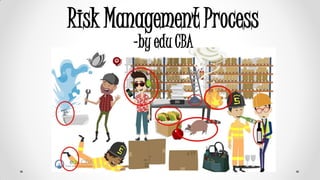
Risk Management Process
-by edu CBA
• context definition
• risk identification
• risk assessment
• risk control
• communication
• planning
• checking and supervision
• process review
Phases of Risk Management Process
• The first and the foremost thing is identifying the areas of
risk. Risks may arise due to specific combination of
market, product or service, manufacturing or distribution
process as well as other external factors.
• Next thing is to identify and define an assessment activity
schedule.
• Based on that it becomes necessary to organize resources,
and also defining duties and responsibilities.
Context definition
• In this next phase of Risk Identification Process, it is
important to identify the potential risks and then
give their detailed description. Hence all possible
sources of risk such as, the positions of the
stakeholders, market changes, manufacturing errors
or work accidents should be thoroughly analyzed.
• The process of identifying potential risks must include:
 Objectives that the organization has set.
 Scenarios that the organization may face in carrying
out its business.
 Procedures that the organization adopts for its
management and operational purposes.
Risk Identification
Risk Control
In this phase of risk management process the decision
making process becomes particularly important. It
includes one or more of the following conditions:
• Transfer of the risk
• Exclusion of the risk
• Reduction of the risk
• Acceptance of the risk or an amount of the risk
Communication of risk is another important step in
the risk management process. In this step the
following things must be properly documented in
detail in a Risk Management Report:
• The profile
• The matrix
• The risk treatment
• The control planning
Planning
The Planning step defines the risk control methods, that is:
• Interpretation, sending or storing of incoming data for the
control process.
• Appropriate level and localization for the decisions and
actions the operative procedures and/or practice.
• Control instruments
• Interpretation, sending or storing of output data from the
control process.
Knowledge is like a line
With no ends…
So To know in detail about this
article click on the link
below
http://www.educorporatebridge.com/risk-
management/risk-management-process/
https://www.facebook.com/CorporateBridgeGroup
Be a part of edu CBA Family!!!
Visit our website
For Free Resources
Like us on Facebook
Follow us on Twitter
https://www.educorporatebridge.com/
https://www.educorporatebridge.com/free-courses/
https://twitter.com/corporatebridge
Thank
You!!!
If you have found this Presentation
to be useful, kindly
Like
Share
Follow us!!!
+

Risk management process

  • 1.
  • 2.
    • context definition •risk identification • risk assessment • risk control • communication • planning • checking and supervision • process review Phases of Risk Management Process
  • 3.
    • The firstand the foremost thing is identifying the areas of risk. Risks may arise due to specific combination of market, product or service, manufacturing or distribution process as well as other external factors. • Next thing is to identify and define an assessment activity schedule. • Based on that it becomes necessary to organize resources, and also defining duties and responsibilities. Context definition
  • 4.
    • In thisnext phase of Risk Identification Process, it is important to identify the potential risks and then give their detailed description. Hence all possible sources of risk such as, the positions of the stakeholders, market changes, manufacturing errors or work accidents should be thoroughly analyzed. • The process of identifying potential risks must include:  Objectives that the organization has set.  Scenarios that the organization may face in carrying out its business.  Procedures that the organization adopts for its management and operational purposes. Risk Identification
  • 6.
    Risk Control In thisphase of risk management process the decision making process becomes particularly important. It includes one or more of the following conditions: • Transfer of the risk • Exclusion of the risk • Reduction of the risk • Acceptance of the risk or an amount of the risk
  • 7.
    Communication of riskis another important step in the risk management process. In this step the following things must be properly documented in detail in a Risk Management Report: • The profile • The matrix • The risk treatment • The control planning
  • 8.
    Planning The Planning stepdefines the risk control methods, that is: • Interpretation, sending or storing of incoming data for the control process. • Appropriate level and localization for the decisions and actions the operative procedures and/or practice. • Control instruments • Interpretation, sending or storing of output data from the control process.
  • 9.
    Knowledge is likea line With no ends… So To know in detail about this article click on the link below http://www.educorporatebridge.com/risk- management/risk-management-process/
  • 10.
    https://www.facebook.com/CorporateBridgeGroup Be a partof edu CBA Family!!! Visit our website For Free Resources Like us on Facebook Follow us on Twitter https://www.educorporatebridge.com/ https://www.educorporatebridge.com/free-courses/ https://twitter.com/corporatebridge
  • 11.
    Thank You!!! If you havefound this Presentation to be useful, kindly Like Share Follow us!!! +