


3
Risk management
Principles and
guidelines
 Foreword
 Introduction
1. Scope
2. Terms and definitions
3. Principles
4. Framework
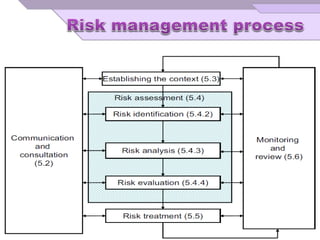
5. Process
 Annex A
 Principles and generic guidelines on risk
management
 Any public, private or community enterprise,
association
 Throughout the life of an organization, and to a
wide range of activities, including strategies and
decisions, operations, processes, functions,
projects, products, services and assets.
 Any type of risk
 2.1 Risk
Effect of uncertainty on objectives
 Coordinated activities to direct and control an
organization with regard to risk
 Set of components that provide the foundations
and organizational arrangements for designing,
implementing, monitoring , reviewing and
continually improving risk management
throughout the organization
 Statement of the overall intentions and
direction of an organization related to risk
management
 Organization's approach to assess and
eventually pursue, retain, take or turn away
from risk
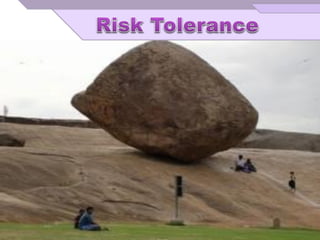
 Amount and type of risk that an organization is
prepared to pursue, retain or take
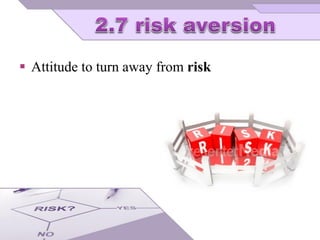
 Attitude to turn away from risk
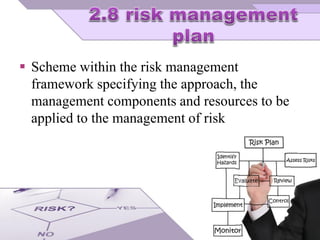
 Scheme within the risk management
framework specifying the approach, the
management components and resources to be
applied to the management of risk
 Person or entity with the accountability and
authority to manage the risk
 Systematic application of management
policies, procedures and practices to the
activities of communicating, consulting,
establishing the context, and identifying,
analyzing, evaluating, treating, monitoring
and reviewing risk
 Defining the external and internal parameters
to be taken into account when managing risk,
and setting the scope and risk criteria for the
risk management policy
 External environment in which the
organization seeks to achieve its objectives
 Internal environment in which the organization
seeks to achieve its objectives
 Continual and iterative processes that an
organization conducts to provide, share or
obtain information and to engage in dialogue
with stakeholders and others regarding the
management of risk
 Person or organization that can affect, be
affected by, or perceive themselves to be
affected by a decision or activity
 Overall process of risk identification , risk
analysis and risk evaluation
 process of finding, recognizing and describing
risks
 Element which alone or in combination has the
intrinsic potential to give rise to risk
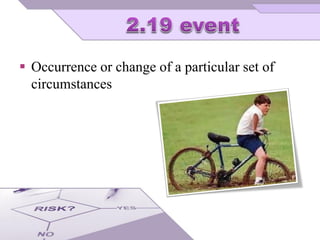
 Occurrence or change of a particular set of
circumstances
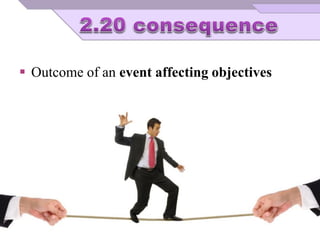
 Outcome of an event affecting objectives
 Chance of something happening
2.22 risk profile
 Description of any set of risks
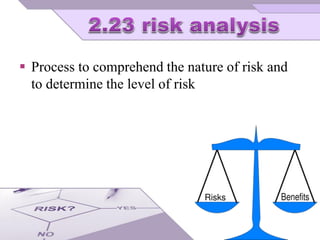
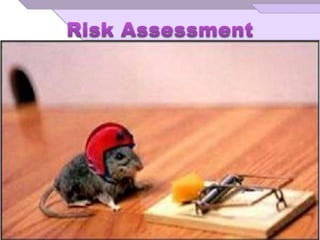
 Process to comprehend the nature of risk and
to determine the level of risk
 Terms of reference against which the
significance of a risk is evaluated
 Magnitude of a risk , expressed in terms of the
combination of consequences and their
likelihood
 Process of comparing the results of risk
analysis with risk criteria to determine whether
the risk and/or its magnitude is acceptable or
tolerable
 Process to modify risk
 measure that is modifying risk
 Risk remaining after risk treatment
 continual checking, supervising, critically
observing or determining the status in order to
identify change from the performance level
required or expected
2.31 review
• activity undertaken to determine the suitability,
adequacy and effectiveness of the subject
matter to achieve
• established objectives
Internal Context
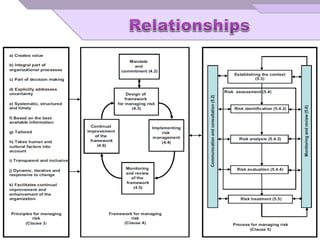
a) Risk management creates and protects
value.
b) Risk management is an integral part of all
organizational processes.
c) Risk management is part of decision
making.
d) Risk management explicitly addresses
uncertainty.
e) Risk management is systematic, structured
and timely.
f) Risk management is based on the best
available information.
g) Risk management is tailored.
h) Risk management takes human and
cultural factors into account.
j) Risk management is transparent and
inclusive.
k) Risk management is dynamic, iterative and
responsive to change.
l) Risk management facilitates continual
improvement of the organization.
 4.1 General
 The success of risk management will depend
on the effectiveness of the management
framework providing
 the foundations and arrangements that will
embed it throughout the organization at all
levels.
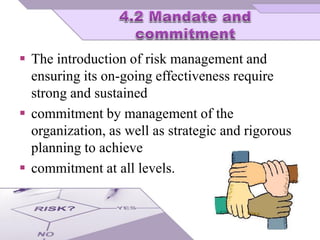
 The introduction of risk management and
ensuring its on-going effectiveness require
strong and sustained
 commitment by management of the
organization, as well as strategic and rigorous
planning to achieve
 commitment at all levels.
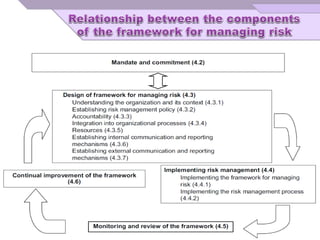
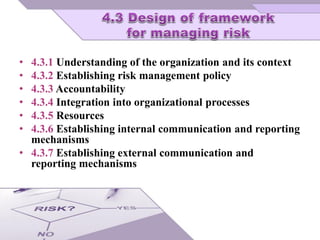
• 4.3.1 Understanding of the organization and its context
• 4.3.2 Establishing risk management policy
• 4.3.3 Accountability
• 4.3.4 Integration into organizational processes
• 4.3.5 Resources
• 4.3.6 Establishing internal communication and reporting
mechanisms
• 4.3.7 Establishing external communication and
reporting mechanisms
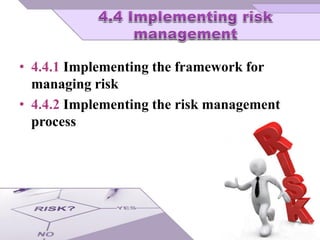
• 4.4.1 Implementing the framework for
managing risk
• 4.4.2 Implementing the risk management
process
 measure risk management performance against
indicators
 periodically measure progress against, and deviation
from, the risk management plan
 periodically review whether the risk management
framework, policy and plan are still appropriate
 report on risk, progress with the risk management plan
 review the effectiveness of the risk management
framework
 Based on results of monitoring and reviews,
decisions should be made on how the risk
management framework, policy and plan can
be improved.
 These decisions should lead to improvements
in the organization's management of risk and
its risk management culture.
5.1 General
The risk management process should be
⎯ an integral part of management,
⎯ embedded in the culture and practices, and
⎯ tailored to the business processes of the
organization.
 Communication and consultation with external
and internal stakeholders should take place
during all stages of the risk management
process.
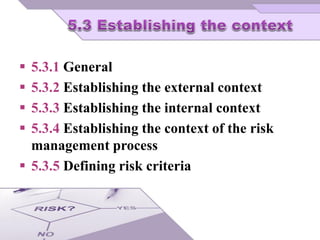
 5.3.1 General
 5.3.2 Establishing the external context
 5.3.3 Establishing the internal context
 5.3.4 Establishing the context of the risk
management process
 5.3.5 Defining risk criteria
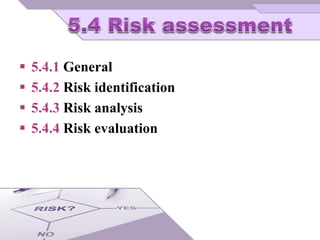
 5.4.1 General
 5.4.2 Risk identification
 5.4.3 Risk analysis
 5.4.4 Risk evaluation
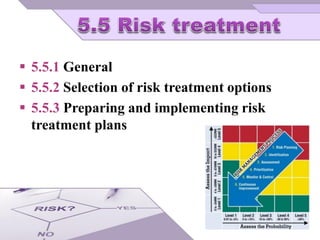
 5.5.1 General
 5.5.2 Selection of risk treatment options
 5.5.3 Preparing and implementing risk
treatment plans
 Both monitoring and review should be a
planned part of the risk management process
and involve regular checking or surveillance. It
can be periodic or ad hoc.
 Risk management activities should be
traceable. In the risk management process,
records provide the foundation for
improvement in methods and tools, as well as
in the overall process.
 Attributes of enhanced risk management
 [1] ISO Guide 73:2009, Risk management —
Vocabulary
 [2] IEC 31010, Risk management — Risk
assessment guidelines
• BS 31100:2008 -BSI British Standards- Risk
management- Code of practice
Iso 31000 Risk management Principles and guidelines

Iso 31000 Risk management Principles and guidelines

  • 3.
  • 4.
     Foreword  Introduction 1.Scope 2. Terms and definitions 3. Principles 4. Framework 5. Process  Annex A
  • 6.
     Principles andgeneric guidelines on risk management  Any public, private or community enterprise, association  Throughout the life of an organization, and to a wide range of activities, including strategies and decisions, operations, processes, functions, projects, products, services and assets.  Any type of risk
  • 7.
     2.1 Risk Effectof uncertainty on objectives
  • 8.
     Coordinated activitiesto direct and control an organization with regard to risk
  • 9.
     Set ofcomponents that provide the foundations and organizational arrangements for designing, implementing, monitoring , reviewing and continually improving risk management throughout the organization
  • 10.
     Statement ofthe overall intentions and direction of an organization related to risk management
  • 11.
     Organization's approachto assess and eventually pursue, retain, take or turn away from risk
  • 12.
     Amount andtype of risk that an organization is prepared to pursue, retain or take
  • 13.
     Attitude toturn away from risk
  • 14.
     Scheme withinthe risk management framework specifying the approach, the management components and resources to be applied to the management of risk
  • 15.
     Person orentity with the accountability and authority to manage the risk
  • 16.
     Systematic applicationof management policies, procedures and practices to the activities of communicating, consulting, establishing the context, and identifying, analyzing, evaluating, treating, monitoring and reviewing risk
  • 17.
     Defining theexternal and internal parameters to be taken into account when managing risk, and setting the scope and risk criteria for the risk management policy
  • 18.
     External environmentin which the organization seeks to achieve its objectives
  • 19.
     Internal environmentin which the organization seeks to achieve its objectives
  • 20.
     Continual anditerative processes that an organization conducts to provide, share or obtain information and to engage in dialogue with stakeholders and others regarding the management of risk
  • 21.
     Person ororganization that can affect, be affected by, or perceive themselves to be affected by a decision or activity
  • 22.
     Overall processof risk identification , risk analysis and risk evaluation
  • 23.
     process offinding, recognizing and describing risks
  • 24.
     Element whichalone or in combination has the intrinsic potential to give rise to risk
  • 25.
     Occurrence orchange of a particular set of circumstances
  • 26.
     Outcome ofan event affecting objectives
  • 27.
     Chance ofsomething happening
  • 28.
    2.22 risk profile Description of any set of risks
  • 29.
     Process tocomprehend the nature of risk and to determine the level of risk
  • 30.
     Terms ofreference against which the significance of a risk is evaluated
  • 31.
     Magnitude ofa risk , expressed in terms of the combination of consequences and their likelihood
  • 32.
     Process ofcomparing the results of risk analysis with risk criteria to determine whether the risk and/or its magnitude is acceptable or tolerable
  • 33.
     Process tomodify risk
  • 34.
     measure thatis modifying risk
  • 35.
     Risk remainingafter risk treatment
  • 36.
     continual checking,supervising, critically observing or determining the status in order to identify change from the performance level required or expected
  • 37.
    2.31 review • activityundertaken to determine the suitability, adequacy and effectiveness of the subject matter to achieve • established objectives
  • 44.
  • 45.
    a) Risk managementcreates and protects value. b) Risk management is an integral part of all organizational processes. c) Risk management is part of decision making. d) Risk management explicitly addresses uncertainty.
  • 46.
    e) Risk managementis systematic, structured and timely. f) Risk management is based on the best available information. g) Risk management is tailored. h) Risk management takes human and cultural factors into account.
  • 47.
    j) Risk managementis transparent and inclusive. k) Risk management is dynamic, iterative and responsive to change. l) Risk management facilitates continual improvement of the organization.
  • 48.
     4.1 General The success of risk management will depend on the effectiveness of the management framework providing  the foundations and arrangements that will embed it throughout the organization at all levels.
  • 50.
     The introductionof risk management and ensuring its on-going effectiveness require strong and sustained  commitment by management of the organization, as well as strategic and rigorous planning to achieve  commitment at all levels.
  • 51.
    • 4.3.1 Understandingof the organization and its context • 4.3.2 Establishing risk management policy • 4.3.3 Accountability • 4.3.4 Integration into organizational processes • 4.3.5 Resources • 4.3.6 Establishing internal communication and reporting mechanisms • 4.3.7 Establishing external communication and reporting mechanisms
  • 52.
    • 4.4.1 Implementingthe framework for managing risk • 4.4.2 Implementing the risk management process
  • 53.
     measure riskmanagement performance against indicators  periodically measure progress against, and deviation from, the risk management plan  periodically review whether the risk management framework, policy and plan are still appropriate  report on risk, progress with the risk management plan  review the effectiveness of the risk management framework
  • 54.
     Based onresults of monitoring and reviews, decisions should be made on how the risk management framework, policy and plan can be improved.  These decisions should lead to improvements in the organization's management of risk and its risk management culture.
  • 66.
    5.1 General The riskmanagement process should be ⎯ an integral part of management, ⎯ embedded in the culture and practices, and ⎯ tailored to the business processes of the organization.
  • 68.
     Communication andconsultation with external and internal stakeholders should take place during all stages of the risk management process.
  • 69.
     5.3.1 General 5.3.2 Establishing the external context  5.3.3 Establishing the internal context  5.3.4 Establishing the context of the risk management process  5.3.5 Defining risk criteria
  • 70.
     5.4.1 General 5.4.2 Risk identification  5.4.3 Risk analysis  5.4.4 Risk evaluation
  • 71.
     5.5.1 General 5.5.2 Selection of risk treatment options  5.5.3 Preparing and implementing risk treatment plans
  • 72.
     Both monitoringand review should be a planned part of the risk management process and involve regular checking or surveillance. It can be periodic or ad hoc.
  • 73.
     Risk managementactivities should be traceable. In the risk management process, records provide the foundation for improvement in methods and tools, as well as in the overall process.
  • 74.
     Attributes ofenhanced risk management
  • 76.
     [1] ISOGuide 73:2009, Risk management — Vocabulary  [2] IEC 31010, Risk management — Risk assessment guidelines
  • 77.
    • BS 31100:2008-BSI British Standards- Risk management- Code of practice