


RISK MANAGEMENT
Graduation project 2017
Under Supervision of:
Dr. Mohamed Anwar El-Dardiry.
WHAT IS RISK?
Uncertain event which affects the
achievement of the objectives.
RISK & UNCERTINITY
All risks are uncertain but not all
uncertainties are risks.
POSITIVE & NEGATIVE RISKS
Risk types
Business Risk
Operational
Risk
Strategic Risk Legal Risk
RISK MANAGEMENT
It is the process of identifying, analyzing and
treating risks which affect the objectives.
PRINCIPLES OF RISK
MANAGEMENT
1. Risk management adds value.
2. Risk management is part of decision making.
3. Risk management is integral part of the
organization.
4. Risk management is a continuous process.
BENEFITS OF RISK MANAGEMENT
1. Increase the likelihood of achieving objectives.
2. Encourage proactive management.
3. Improve voluntary reporting.
4. Minimize losses.
IMPELEMENTATION OF RISK
MANAGEMENT
1. Establishing the context
To ensure that all significant risks are captured it is
necessary to know the objectives of the organization.
ESTABLISHING THE EXTERNAL CONTEXT
It is the external environment in which the
organization seeks to achieve its objectives.
ESTABLISHING THE INTERNAL CONTEXT
It is the internal environment in which the
organization seeks to achieve its objectives.
RISK IDENTIFICATION
This step includes identifying risks that may occur and
affect the achievement of the organization’s
objectives.
Also identifies causes and consequences of risks and
the area of impact.
RISK IDENTIFICATION
CHALLENGES
1. Identifying all risks
2. When a risk is not a risk
TECHNIQUES OF RISK
IDENTIFICATION
1. Brainstorming
 It is an interactive technique.
 Suitable for the initial identification of risks particularly for
large and unique projects.
 No judgements.
2. Checklist
 A Technique to simplify the identification of risks.
 Checklist of standard risks from previous projects that are
known to arise.
 Suitable for projects that are standard or routine in nature.
3. Interviews
WHAT IS RISK ANALYSIS?
 Determining the consequences and their probabilities
for identified risk events.
 Consequence determines the nature and type of
impact which could occur assuming that a particular
event situation or circumstance has occurred.
 The probability is that those consequences can occur.
METHODS USED IN ANALYZING
RISK
 Qualitative Analysis: the description of each risk and its
impacts or a subjective labelling of each risk (e.g. high/low) in
terms of both its impact and its probability of occurrence.
 Quantitative Analysis: Practical values for consequences and
their probabilities.
RISK ANALYSIS TECHNIQUES
 Failure modes and effects analysis (FMEA)
FMEA is a technique used to identify failure modes of the various
parts of a system and mechanisms, and their effects on
outcomes.
Event tree analysis (ETA)
 representing the sequences of events (out comes) due
to initiating event of the system that was designed to
reduce the initiating event consequences
Fault tree analysis (FTA)
 starts with the undesired event (top event) and
determines all the ways in which it could occur.
Risk evaluation
 Compares the identified and analyzed risk against given risk
criteria.
 Risk criteria represent the level of risk that the organization
sets out as acceptable or non-acceptable.
 Decisions:
1. whether a risk needs treatment.
2. priorities for treatment.
RISK TREATMENT
Determining what will be done in response to the
risks that have been identified.
SELECTING OF RISK TREATMENT
OPTIONS
 Selecting the most appropriate risk treatment option involves
balancing the costs and efforts of implementation against the
benefits derived.
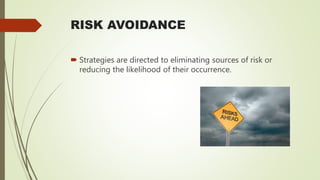
RISK AVOIDANCE
 Strategies are directed to eliminating sources of risk or
reducing the likelihood of their occurrence.
RISK MITIGATION
 Minimizing the consequences of risks.
 Risk will take place and can not be avoided.
 The likelihoods of other risks may be reduced by risk
prevention strategies.
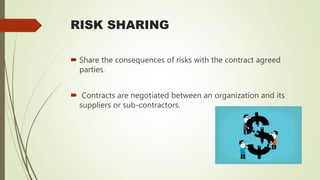
RISK SHARING
 Share the consequences of risks with the contract agreed
parties.
 Contracts are negotiated between an organization and its
suppliers or sub-contractors.
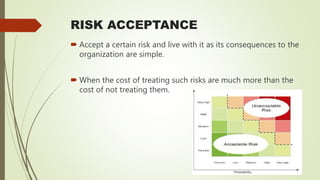
RISK ACCEPTANCE
 Accept a certain risk and live with it as its consequences to the
organization are simple.
 When the cost of treating such risks are much more than the
cost of not treating them.
INSURANCE
 Is a well-known risk sharing strategy.
 Used for physical assets and a limited range of commercial
risks.
 Purchasing organizations frequently require their suppliers to
have insurance policies These policies cover specific physical
risks, such as damage to goods in transit.
MONITORING & REVIEW
Continuous monitoring and review of risks is an
important part of implementation. It ensures that
new risks are detected and managed.
REGULAR MONITORING PROCESS
Regular meetings should be held to ensure that all
the important risks are examined.
UPDATING THE RISK REGISTER
 The risk register database is the main risk management
tool for monitoring the risk management process within
the project. It lists the ranked risks and references the
associated risk action plans.
Keeping the risk register up to date is very important.
New risks will be identified and will be entered into the
risk register. Risks that have been managed, avoided or
are no longer relevant can be removed from the risk
register.
COMMUNICATION & REPORTING
Reasons for communication:
Communication within the project team
Communication with an owner or client
REPORTS
 Formal reporting may be required for large or particularly
risky projects.
 What is large or risky depends very much on the organization
and its own policies and procedures. For example, some
companies undertake and report on formal risk analyses only
on very large projects, while others perform them routinely on
relatively small activities.
CASE STUDY: SYNTHETIC
APERATURE RADAR (SAR)
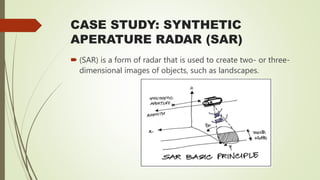
 (SAR) is a form of radar that is used to create two- or three-
dimensional images of objects, such as landscapes.
BACKGROUND
 The project of this case study is the development of an
experimental Synthetic Aperture Radar (SAR).
 Due to the high costs of test flights, the synthetic aperture is
obtained by operating the radar on a rail on a building roof.
 The project has been running at Defencetek over a number of
years. The objective for 2001 was to obtain the first images.
 At the point that the risk management process was started,
the outstanding work for the year, that was considered risky,
was as follows:
Work Breakdown Structure (WBS) of the
RoofSAR work included in the risk process.
RISK MANAGEMENT PROCESS
DEFINE PHASE
This phase involved the definition of project
stakeholders, documenting project objectives,
documenting of the design as well as the updating of
the WBS and schedule.
FOCUS PHASE
 This phase involved the identification of the risk management
stakeholders and also documented the risk management
process to be followed. The corporate level risks were also
identified as well as the resources and schedule for the risk
management process.
IDENTIFY PHASE
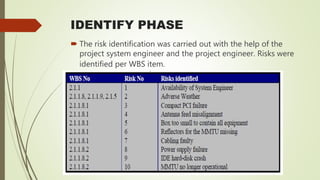
 The risk identification was carried out with the help of the
project system engineer and the project engineer. Risks were
identified per WBS item.
 For each identified risk a risk response was decided upon,
written on another Post-it and attached to the risk identified.
STRUCTURE PHASE
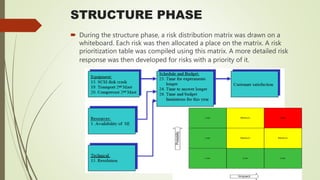
 During the structure phase, a risk distribution matrix was drawn on a
whiteboard. Each risk was then allocated a place on the matrix. A risk
prioritization table was compiled using this matrix. A more detailed risk
response was then developed for risks with a priority of it.
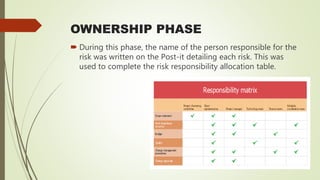
OWNERSHIP PHASE
 During this phase, the name of the person responsible for the
risk was written on the Post-it detailing each risk. This was
used to complete the risk responsibility allocation table.
ESTIMATE PHASE
EATIMATION OF LIKELIHOOD TABLE
Impact of risk determination table (Estimation of impact)
Task level risk impact determination
Risk likelihood and impact determination
EVALUATE PHASE
 During the evaluate phase the likelihood and impact
determined during the estimate phase were used to
determine a risk value both for the high-level tasks and then
at the level of each risk as follows:
Risk = Likelihood*Impact
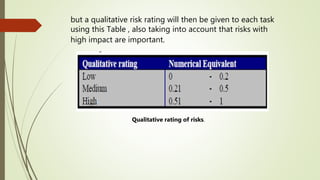
but a qualitative risk rating will then be given to each task
using this Table , also taking into account that risks with
high impact are important.
Qualitative rating of risks.
High-level tasks risk ratings.
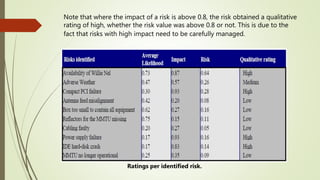
Note that where the impact of a risk is above 0.8, the risk obtained a qualitative
rating of high, whether the risk value was above 0.8 or not. This is due to the
fact that risks with high impact need to be carefully managed.
Ratings per identified risk.
PLAN PHASE (TREATMENT)
 During the plan phase the detailed risk responses developed
during the structure phase were updated. Thereafter the
project WBS, detailed activity level statements of work and
schedule were also updated.
MANAGE PHASE (MONITORING)
 All the risks identified during the risk management plan
compilation were monitored in a weekly progress meeting.
Each risk was assigned a status of: In process, Completed or
Pending. Where a risk was in process an indication was given
of what the required action was in order to overcome the risk.
Where a risk was completed a completion, date was indicated.
Pending only applied to risks that were not expected to affect
the project in the next two weeks.
CONCLUSION
 The risk management process added a lot of value to the
RoofSAR project. The main benefit was that the project team
was aware of the risks which could then be managed.
 Several of the risks originally identified materialized and due
to the risk analysis did not negatively affect the success of the
project.
Risk management

Risk management

  • 1.
    RISK MANAGEMENT Graduation project2017 Under Supervision of: Dr. Mohamed Anwar El-Dardiry.
  • 2.
    WHAT IS RISK? Uncertainevent which affects the achievement of the objectives.
  • 4.
    RISK & UNCERTINITY Allrisks are uncertain but not all uncertainties are risks.
  • 5.
  • 6.
  • 7.
    RISK MANAGEMENT It isthe process of identifying, analyzing and treating risks which affect the objectives.
  • 8.
    PRINCIPLES OF RISK MANAGEMENT 1.Risk management adds value. 2. Risk management is part of decision making. 3. Risk management is integral part of the organization. 4. Risk management is a continuous process.
  • 9.
    BENEFITS OF RISKMANAGEMENT 1. Increase the likelihood of achieving objectives. 2. Encourage proactive management. 3. Improve voluntary reporting. 4. Minimize losses.
  • 10.
    IMPELEMENTATION OF RISK MANAGEMENT 1.Establishing the context To ensure that all significant risks are captured it is necessary to know the objectives of the organization.
  • 11.
    ESTABLISHING THE EXTERNALCONTEXT It is the external environment in which the organization seeks to achieve its objectives. ESTABLISHING THE INTERNAL CONTEXT It is the internal environment in which the organization seeks to achieve its objectives.
  • 12.
    RISK IDENTIFICATION This stepincludes identifying risks that may occur and affect the achievement of the organization’s objectives. Also identifies causes and consequences of risks and the area of impact.
  • 13.
    RISK IDENTIFICATION CHALLENGES 1. Identifyingall risks 2. When a risk is not a risk
  • 14.
    TECHNIQUES OF RISK IDENTIFICATION 1.Brainstorming  It is an interactive technique.  Suitable for the initial identification of risks particularly for large and unique projects.  No judgements.
  • 16.
    2. Checklist  ATechnique to simplify the identification of risks.  Checklist of standard risks from previous projects that are known to arise.  Suitable for projects that are standard or routine in nature.
  • 17.
  • 18.
    WHAT IS RISKANALYSIS?  Determining the consequences and their probabilities for identified risk events.  Consequence determines the nature and type of impact which could occur assuming that a particular event situation or circumstance has occurred.  The probability is that those consequences can occur.
  • 19.
    METHODS USED INANALYZING RISK  Qualitative Analysis: the description of each risk and its impacts or a subjective labelling of each risk (e.g. high/low) in terms of both its impact and its probability of occurrence.  Quantitative Analysis: Practical values for consequences and their probabilities.
  • 20.
    RISK ANALYSIS TECHNIQUES Failure modes and effects analysis (FMEA) FMEA is a technique used to identify failure modes of the various parts of a system and mechanisms, and their effects on outcomes.
  • 21.
    Event tree analysis(ETA)  representing the sequences of events (out comes) due to initiating event of the system that was designed to reduce the initiating event consequences
  • 22.
    Fault tree analysis(FTA)  starts with the undesired event (top event) and determines all the ways in which it could occur.
  • 23.
    Risk evaluation  Comparesthe identified and analyzed risk against given risk criteria.  Risk criteria represent the level of risk that the organization sets out as acceptable or non-acceptable.  Decisions: 1. whether a risk needs treatment. 2. priorities for treatment.
  • 24.
    RISK TREATMENT Determining whatwill be done in response to the risks that have been identified.
  • 25.
    SELECTING OF RISKTREATMENT OPTIONS  Selecting the most appropriate risk treatment option involves balancing the costs and efforts of implementation against the benefits derived.
  • 26.
    RISK AVOIDANCE  Strategiesare directed to eliminating sources of risk or reducing the likelihood of their occurrence.
  • 27.
    RISK MITIGATION  Minimizingthe consequences of risks.  Risk will take place and can not be avoided.  The likelihoods of other risks may be reduced by risk prevention strategies.
  • 28.
    RISK SHARING  Sharethe consequences of risks with the contract agreed parties.  Contracts are negotiated between an organization and its suppliers or sub-contractors.
  • 29.
    RISK ACCEPTANCE  Accepta certain risk and live with it as its consequences to the organization are simple.  When the cost of treating such risks are much more than the cost of not treating them.
  • 30.
    INSURANCE  Is awell-known risk sharing strategy.  Used for physical assets and a limited range of commercial risks.  Purchasing organizations frequently require their suppliers to have insurance policies These policies cover specific physical risks, such as damage to goods in transit.
  • 31.
    MONITORING & REVIEW Continuousmonitoring and review of risks is an important part of implementation. It ensures that new risks are detected and managed.
  • 32.
    REGULAR MONITORING PROCESS Regularmeetings should be held to ensure that all the important risks are examined.
  • 33.
    UPDATING THE RISKREGISTER  The risk register database is the main risk management tool for monitoring the risk management process within the project. It lists the ranked risks and references the associated risk action plans. Keeping the risk register up to date is very important. New risks will be identified and will be entered into the risk register. Risks that have been managed, avoided or are no longer relevant can be removed from the risk register.
  • 34.
    COMMUNICATION & REPORTING Reasonsfor communication: Communication within the project team Communication with an owner or client
  • 35.
    REPORTS  Formal reportingmay be required for large or particularly risky projects.  What is large or risky depends very much on the organization and its own policies and procedures. For example, some companies undertake and report on formal risk analyses only on very large projects, while others perform them routinely on relatively small activities.
  • 36.
    CASE STUDY: SYNTHETIC APERATURERADAR (SAR)  (SAR) is a form of radar that is used to create two- or three- dimensional images of objects, such as landscapes.
  • 37.
    BACKGROUND  The projectof this case study is the development of an experimental Synthetic Aperture Radar (SAR).  Due to the high costs of test flights, the synthetic aperture is obtained by operating the radar on a rail on a building roof.  The project has been running at Defencetek over a number of years. The objective for 2001 was to obtain the first images.  At the point that the risk management process was started, the outstanding work for the year, that was considered risky, was as follows:
  • 38.
    Work Breakdown Structure(WBS) of the RoofSAR work included in the risk process.
  • 39.
  • 40.
    DEFINE PHASE This phaseinvolved the definition of project stakeholders, documenting project objectives, documenting of the design as well as the updating of the WBS and schedule.
  • 41.
    FOCUS PHASE  Thisphase involved the identification of the risk management stakeholders and also documented the risk management process to be followed. The corporate level risks were also identified as well as the resources and schedule for the risk management process.
  • 42.
    IDENTIFY PHASE  Therisk identification was carried out with the help of the project system engineer and the project engineer. Risks were identified per WBS item.
  • 43.
     For eachidentified risk a risk response was decided upon, written on another Post-it and attached to the risk identified.
  • 44.
    STRUCTURE PHASE  Duringthe structure phase, a risk distribution matrix was drawn on a whiteboard. Each risk was then allocated a place on the matrix. A risk prioritization table was compiled using this matrix. A more detailed risk response was then developed for risks with a priority of it.
  • 45.
    OWNERSHIP PHASE  Duringthis phase, the name of the person responsible for the risk was written on the Post-it detailing each risk. This was used to complete the risk responsibility allocation table.
  • 46.
  • 47.
    Impact of riskdetermination table (Estimation of impact) Task level risk impact determination
  • 48.
    Risk likelihood andimpact determination
  • 49.
    EVALUATE PHASE  Duringthe evaluate phase the likelihood and impact determined during the estimate phase were used to determine a risk value both for the high-level tasks and then at the level of each risk as follows: Risk = Likelihood*Impact
  • 50.
    but a qualitativerisk rating will then be given to each task using this Table , also taking into account that risks with high impact are important. Qualitative rating of risks.
  • 51.
  • 52.
    Note that wherethe impact of a risk is above 0.8, the risk obtained a qualitative rating of high, whether the risk value was above 0.8 or not. This is due to the fact that risks with high impact need to be carefully managed. Ratings per identified risk.
  • 53.
    PLAN PHASE (TREATMENT) During the plan phase the detailed risk responses developed during the structure phase were updated. Thereafter the project WBS, detailed activity level statements of work and schedule were also updated.
  • 54.
    MANAGE PHASE (MONITORING) All the risks identified during the risk management plan compilation were monitored in a weekly progress meeting. Each risk was assigned a status of: In process, Completed or Pending. Where a risk was in process an indication was given of what the required action was in order to overcome the risk. Where a risk was completed a completion, date was indicated. Pending only applied to risks that were not expected to affect the project in the next two weeks.
  • 56.
    CONCLUSION  The riskmanagement process added a lot of value to the RoofSAR project. The main benefit was that the project team was aware of the risks which could then be managed.  Several of the risks originally identified materialized and due to the risk analysis did not negatively affect the success of the project.

Editor's Notes

  • #49 دي بقي الريسكس الي بتأثر علي الديليفرابلز ....بيتم حساب الليكلي هود والايمباكت تقديريا من المسؤلين وبيتاخد ليها افريج
  • #50 بعد الاستيميت فيز ...بستخدمه عشان اعرف مستويات الريسك في كل تاسك عندي
  • #51 كواليتاتيف رانج ..عن طريق قيم الريسك الي بتطلعلي بحدد الراتينج بتاع كل ريسك فيهم
  • #54 هنا الريسبونس الي جبناها في الاستركشر فيز بيتعملها تحديث ...والبروسيديورس بتاعتها بتتحط في البلان بتاع المشروع ...وبيكون ليها سكيدول وبادجت ...الريسك مانجمنت هنا بتتضاف للبلان والاستيتمنتس بتاع للمشروع
  • #55 كل الريسكات الي تم دراستها بيتم مراقبتها اسبوعيا ...كل ريسك فيهم بيكون ليها ستيتس او انيديكيشنز معينة وهما In process ,completed or pending