Risk Management
“Life is all about taking risks. If you
never take a risk, you will never
achieve your dreams”
What is risk?
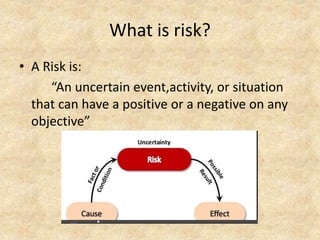
• A Risk is:
“An uncertain event,activity, or situation
that can have a positive or a negative on any
objective”
Opportunity:
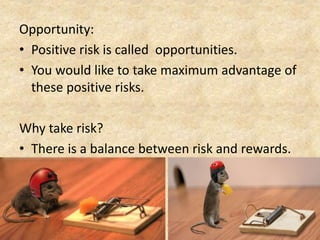
• Positive risk is called opportunities.
• You would like to take maximum advantage of
these positive risks.
Why take risk?
• There is a balance between risk and rewards.
What is Risk Management?
• In the financial world, risk management is the
process of identification, analysis and
acceptance or mitigation of uncertainty in
investment decisions.
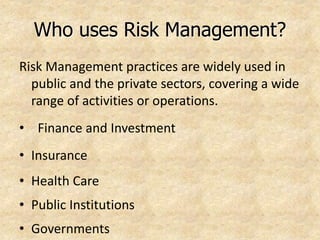
Who uses Risk Management?
Risk Management practices are widely used in
public and the private sectors, covering a wide
range of activities or operations.
• Finance and Investment
• Insurance
• Health Care
• Public Institutions
• Governments
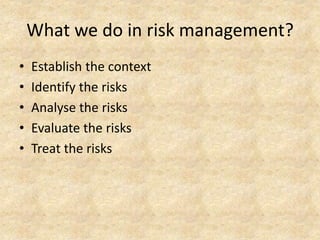
What we do in risk management?
• Establish the context
• Identify the risks
• Analyse the risks
• Evaluate the risks
• Treat the risks
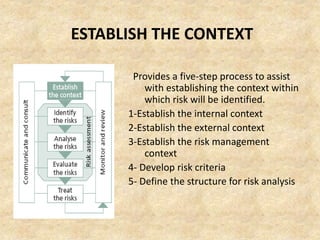
ESTABLISH THE CONTEXT
Provides a five-step process to assist
with establishing the context within
which risk will be identified.
1-Establish the internal context
2-Establish the external context
3-Establish the risk management
context
4- Develop risk criteria
5- Define the structure for risk analysis
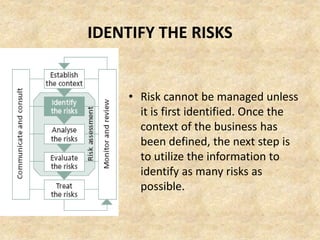
IDENTIFY THE RISKS
• Risk cannot be managed unless
it is first identified. Once the
context of the business has
been defined, the next step is
to utilize the information to
identify as many risks as
possible.
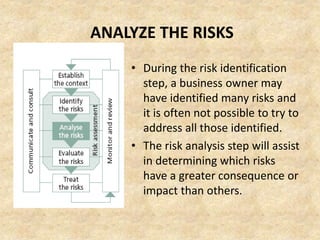
ANALYZE THE RISKS
• During the risk identification
step, a business owner may
have identified many risks and
it is often not possible to try to
address all those identified.
• The risk analysis step will assist
in determining which risks
have a greater consequence or
impact than others.
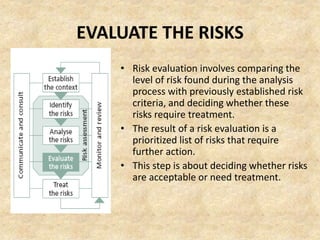
EVALUATE THE RISKS
• Risk evaluation involves comparing the
level of risk found during the analysis
process with previously established risk
criteria, and deciding whether these
risks require treatment.
• The result of a risk evaluation is a
prioritized list of risks that require
further action.
• This step is about deciding whether risks
are acceptable or need treatment.
TREAT THE RISKS
Develop and implement a plan with specific counter-measures to
address the identified risks.
Consider:
• Priorities (Strategic and operational)
• Resources (human, financial and technical)
• Risk acceptance, (i.e., low risks)
Document your risk management plan and describe the reasons
behind selecting the risk and for the treatment chosen.
Record allocated responsibilities, monitoring or evaluation
processes, and assumptions on residual risk.
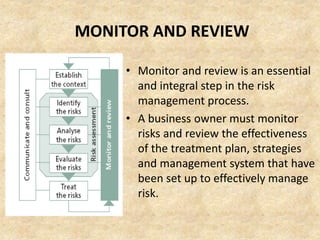
MONITOR AND REVIEW
• Monitor and review is an essential
and integral step in the risk
management process.
• A business owner must monitor
risks and review the effectiveness
of the treatment plan, strategies
and management system that have
been set up to effectively manage
risk.
• Risks need to be monitored periodically to ensure
changing circumstances do not alter the risk
priorities. Very few risks will remain static, therefore
the risk management process needs to be regularly
repeated, so that new risks are captured in the
process and effectively managed.
• A risk management plan at a business level should be
reviewed at least on an annual basis. An effective
way to ensure that this occurs is to combine risk
planning or risk review with annual business
planning.
Risk management

Risk management

  • 1.
    Risk Management “Life isall about taking risks. If you never take a risk, you will never achieve your dreams”
  • 2.
    What is risk? •A Risk is: “An uncertain event,activity, or situation that can have a positive or a negative on any objective”
  • 3.
    Opportunity: • Positive riskis called opportunities. • You would like to take maximum advantage of these positive risks. Why take risk? • There is a balance between risk and rewards.
  • 4.
    What is RiskManagement? • In the financial world, risk management is the process of identification, analysis and acceptance or mitigation of uncertainty in investment decisions.
  • 5.
    Who uses RiskManagement? Risk Management practices are widely used in public and the private sectors, covering a wide range of activities or operations. • Finance and Investment • Insurance • Health Care • Public Institutions • Governments
  • 6.
    What we doin risk management? • Establish the context • Identify the risks • Analyse the risks • Evaluate the risks • Treat the risks
  • 7.
    ESTABLISH THE CONTEXT Providesa five-step process to assist with establishing the context within which risk will be identified. 1-Establish the internal context 2-Establish the external context 3-Establish the risk management context 4- Develop risk criteria 5- Define the structure for risk analysis
  • 8.
    IDENTIFY THE RISKS •Risk cannot be managed unless it is first identified. Once the context of the business has been defined, the next step is to utilize the information to identify as many risks as possible.
  • 9.
    ANALYZE THE RISKS •During the risk identification step, a business owner may have identified many risks and it is often not possible to try to address all those identified. • The risk analysis step will assist in determining which risks have a greater consequence or impact than others.
  • 10.
    EVALUATE THE RISKS •Risk evaluation involves comparing the level of risk found during the analysis process with previously established risk criteria, and deciding whether these risks require treatment. • The result of a risk evaluation is a prioritized list of risks that require further action. • This step is about deciding whether risks are acceptable or need treatment.
  • 11.
    TREAT THE RISKS Developand implement a plan with specific counter-measures to address the identified risks. Consider: • Priorities (Strategic and operational) • Resources (human, financial and technical) • Risk acceptance, (i.e., low risks) Document your risk management plan and describe the reasons behind selecting the risk and for the treatment chosen. Record allocated responsibilities, monitoring or evaluation processes, and assumptions on residual risk.
  • 12.
    MONITOR AND REVIEW •Monitor and review is an essential and integral step in the risk management process. • A business owner must monitor risks and review the effectiveness of the treatment plan, strategies and management system that have been set up to effectively manage risk.
  • 13.
    • Risks needto be monitored periodically to ensure changing circumstances do not alter the risk priorities. Very few risks will remain static, therefore the risk management process needs to be regularly repeated, so that new risks are captured in the process and effectively managed. • A risk management plan at a business level should be reviewed at least on an annual basis. An effective way to ensure that this occurs is to combine risk planning or risk review with annual business planning.