Bachelors Degree –
Agricultural Sciences
The Pennsylvania State University
Masters Degree –
Poultry Science
Texas A & M University
20 years of industry experience including regulatory, meat and
poultry slaughter and processing, frozen food, bakeries, grain
mills, pet food, distribution and retail
Formed in 1977
10,000 employees
Inspection services for meat, poultry, eggs
produced at approximately 6,200 facilities
Formed in 1906
9,300 employees
Inspection services for fruit, vegetables, grains,
milk, tobacco, dietary supplements,
pharmaceuticals and veterinary products
produced at approximately 52,000 facilities
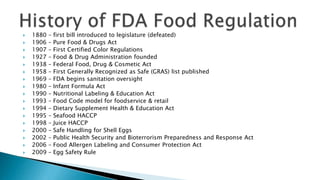
 1880 – first bill introduced to legislature (defeated)
 1906 – Pure Food & Drugs Act
 1907 – First Certified Color Regulations
 1927 – Food & Drug Administration founded
 1938 – Federal Food, Drug & Cosmetic Act
 1958 – First Generally Recognized as Safe (GRAS) list published
 1969 – FDA begins sanitation oversight
 1980 – Infant Formula Act
 1990 – Nutritional Labeling & Education Act
 1993 – Food Code model for foodservice & retail
 1994 – Dietary Supplement Health & Education Act
 1995 – Seafood HACCP
 1998 – Juice HACCP
 2000 – Safe Handling for Shell Eggs
 2002 – Public Health Security and Bioterrorism Preparedness and Response Act
 2006 – Food Allergen Labeling and Consumer Protection Act
 2009 – Egg Safety Rule
10/2009 - Food Safety Modernization Act introduced
1/6/2011 – President Obama signs into law
1/16/2013 – First Rules Published
The Food Safety Modernization Act (FSMA)
incorporates a prevention-based philosophy
stressing Hazard Analysis & Critical Control
Point principles
 Do you feel the Food Safety Modernization
Act will have a big impact on how you
conduct business?
 Globalization
◦ 15 percent of U.S. food supply is imported
 Food supply more high-tech and complex
◦ More foods in the marketplace
◦ New hazards in foods not previously seen
 Shifting demographics
◦ Growing population (about 30%) of individuals are especially “at risk” for foodborne
illness
Involves creation of a new food safety system
Broad prevention mandate and accountability
New system of import oversight
Emphasizes partnerships
Emphasizes farm-to-table responsibility
Developed through broad coalition
Prevention
Inspections,
Compliance,
and Response
Import Safety
Enhanced
Partnerships
 Importers now responsible for ensuring that their foreign
suppliers have adequate preventive controls in place
 FDA can rely on third parties to certify that foreign food
facilities meet U.S. requirements
 Can require mandatory certification for high-risk foods
 Can deny entry if FDA access for inspection is denied
 Requires food from abroad to be as safe as domestic
The Food and Drug Administration (FDA) is proposing to amend its regulation for Current
Good Manufacturing Practice In Manufacturing, Packing, or Holding Human Food (CGMPs)
to modernize it and to add requirements for domestic and foreign facilities that are required
to register under the Federal Food, Drug, and Cosmetic Act (the FD&C Act) to establish and
implement hazard analysis and risk-based preventive controls for human food. FDA also is
proposing to revise certain definitions in FDA's current regulation for Registration of Food
Facilities to clarify the scope of the exemption from registration requirements provided by
the FD&C Act for “farms.” FDA is taking this action as part of its announced initiative to
revisit the CGMPs since they were last revised in 1986 and to implement new statutory
provisions in the FD&C Act. The proposed rule is intended to build a food safety system for
the future that makes modern, science-, and risk-based preventive controls the norm across
all sectors of the food system.
August 2012 14
• Creating a food safety culture starts with
every one of us
• As leaders, we must take accountability
for engaging our employees and
enhancing the food safety culture
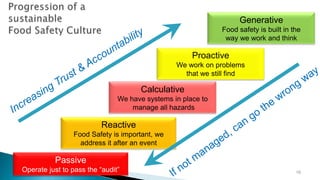
How would you describe the Food Safety Culture
in your work environment?
16
Passive
Operate just to pass the “audit”
Reactive
Food Safety is important, we
address it after an event
Calculative
We have systems in place to
manage all hazards
Proactive
We work on problems
that we still find
Generative
Food safety is built in the
way we work and think
Where is your facility / work environment
based upon the previous slide?
What steps need to be taken to continue to
evolve?
Mandatory Food Safety Programs (HACCP) for each
facility
FDA Authority for Recall
Implementation cost of $701 mil, annualized $472 mil
Still largely unknown due to delays in rulemaking
What do you think will be the biggest impact as
the law stands today?
Where would you focus your rule making?
Do you have a HACCP plan for your facility?
Do your customers already expect that you
do?
Risk management is defined for the purposes of the
Codex Alimentarius Commission as "The process,
distinct from risk assessment, of weighing policy
alternatives, in consultation with all interested
parties, considering risk assessment and other
factors relevant for the health protection of
consumers and for the promotion of fair trade
practices, and, if needed, selecting appropriate
prevention and control options.
Please give current examples of active risk
management within your organization.
The interactive exchange of information and
opinions throughout the risk analysis process
concerning risk, risk-related factors and risk
perceptions, among risk assessors, risk
managers, consumers, industry, the academic
community and other interested parties, including
the explanation of risk assessment findings and
the basis of risk management decisions.
Risk assessment is defined for the purposes of
the Codex Alimentarius Commission as "A
scientifically based process consisting of the
following steps: (i) hazard identification, (ii)
hazard characterization, (iii) exposure
assessment, and (iv) risk characterization."
 "The identification of biological, chemical,
and physical agents capable of causing
adverse health effects and which may be
present in a particular food or group of
foods."
 "The qualitative and/or quantitative evaluation of
the nature of the adverse health effects
associated with biological, chemical and physical
agents which may be present in food. For
chemical agents, a dose-response assessment
should be performed. For biological or physical
agents, a dose-response assessment should be
performed if the data are obtainable."
 "The qualitative and/or quantitative
evaluation of the likely intake of biological,
chemical, and physical agents via food as well
as exposures from other sources if relevant."
 "The qualitative and/or quantitative
estimation, including attendant uncertainties,
of the probability of occurrence and severity
of known or potential adverse health effects
in a given population based on hazard
identification, hazard characterization and
exposure assessment."
 Biological
◦ Bacteria
◦ Mold
◦ Viruses
◦ Prions
 Chemical
◦ Toxins
◦ Pesticides
◦ Drug Residues
◦ Allergens
 Physical
◦ Metal
◦ Stones
◦ Jewelry
◦ Glass
 Break in small groups
 Identify 2 instances where it may be
beneficial to perform a risk assessment
 Why
Introduction to risk analysis

Introduction to risk analysis

  • 2.
    Bachelors Degree – AgriculturalSciences The Pennsylvania State University Masters Degree – Poultry Science Texas A & M University 20 years of industry experience including regulatory, meat and poultry slaughter and processing, frozen food, bakeries, grain mills, pet food, distribution and retail
  • 3.
    Formed in 1977 10,000employees Inspection services for meat, poultry, eggs produced at approximately 6,200 facilities
  • 4.
    Formed in 1906 9,300employees Inspection services for fruit, vegetables, grains, milk, tobacco, dietary supplements, pharmaceuticals and veterinary products produced at approximately 52,000 facilities
  • 5.
     1880 –first bill introduced to legislature (defeated)  1906 – Pure Food & Drugs Act  1907 – First Certified Color Regulations  1927 – Food & Drug Administration founded  1938 – Federal Food, Drug & Cosmetic Act  1958 – First Generally Recognized as Safe (GRAS) list published  1969 – FDA begins sanitation oversight  1980 – Infant Formula Act  1990 – Nutritional Labeling & Education Act  1993 – Food Code model for foodservice & retail  1994 – Dietary Supplement Health & Education Act  1995 – Seafood HACCP  1998 – Juice HACCP  2000 – Safe Handling for Shell Eggs  2002 – Public Health Security and Bioterrorism Preparedness and Response Act  2006 – Food Allergen Labeling and Consumer Protection Act  2009 – Egg Safety Rule
  • 6.
    10/2009 - FoodSafety Modernization Act introduced 1/6/2011 – President Obama signs into law 1/16/2013 – First Rules Published
  • 7.
    The Food SafetyModernization Act (FSMA) incorporates a prevention-based philosophy stressing Hazard Analysis & Critical Control Point principles
  • 8.
     Do youfeel the Food Safety Modernization Act will have a big impact on how you conduct business?
  • 9.
     Globalization ◦ 15percent of U.S. food supply is imported  Food supply more high-tech and complex ◦ More foods in the marketplace ◦ New hazards in foods not previously seen  Shifting demographics ◦ Growing population (about 30%) of individuals are especially “at risk” for foodborne illness
  • 10.
    Involves creation ofa new food safety system Broad prevention mandate and accountability New system of import oversight Emphasizes partnerships Emphasizes farm-to-table responsibility Developed through broad coalition
  • 11.
  • 12.
     Importers nowresponsible for ensuring that their foreign suppliers have adequate preventive controls in place  FDA can rely on third parties to certify that foreign food facilities meet U.S. requirements  Can require mandatory certification for high-risk foods  Can deny entry if FDA access for inspection is denied  Requires food from abroad to be as safe as domestic
  • 13.
    The Food andDrug Administration (FDA) is proposing to amend its regulation for Current Good Manufacturing Practice In Manufacturing, Packing, or Holding Human Food (CGMPs) to modernize it and to add requirements for domestic and foreign facilities that are required to register under the Federal Food, Drug, and Cosmetic Act (the FD&C Act) to establish and implement hazard analysis and risk-based preventive controls for human food. FDA also is proposing to revise certain definitions in FDA's current regulation for Registration of Food Facilities to clarify the scope of the exemption from registration requirements provided by the FD&C Act for “farms.” FDA is taking this action as part of its announced initiative to revisit the CGMPs since they were last revised in 1986 and to implement new statutory provisions in the FD&C Act. The proposed rule is intended to build a food safety system for the future that makes modern, science-, and risk-based preventive controls the norm across all sectors of the food system.
  • 14.
    August 2012 14 •Creating a food safety culture starts with every one of us • As leaders, we must take accountability for engaging our employees and enhancing the food safety culture
  • 15.
    How would youdescribe the Food Safety Culture in your work environment?
  • 16.
    16 Passive Operate just topass the “audit” Reactive Food Safety is important, we address it after an event Calculative We have systems in place to manage all hazards Proactive We work on problems that we still find Generative Food safety is built in the way we work and think
  • 17.
    Where is yourfacility / work environment based upon the previous slide? What steps need to be taken to continue to evolve?
  • 18.
    Mandatory Food SafetyPrograms (HACCP) for each facility FDA Authority for Recall Implementation cost of $701 mil, annualized $472 mil Still largely unknown due to delays in rulemaking
  • 19.
    What do youthink will be the biggest impact as the law stands today? Where would you focus your rule making?
  • 22.
    Do you havea HACCP plan for your facility? Do your customers already expect that you do?
  • 25.
    Risk management isdefined for the purposes of the Codex Alimentarius Commission as "The process, distinct from risk assessment, of weighing policy alternatives, in consultation with all interested parties, considering risk assessment and other factors relevant for the health protection of consumers and for the promotion of fair trade practices, and, if needed, selecting appropriate prevention and control options.
  • 26.
    Please give currentexamples of active risk management within your organization.
  • 27.
    The interactive exchangeof information and opinions throughout the risk analysis process concerning risk, risk-related factors and risk perceptions, among risk assessors, risk managers, consumers, industry, the academic community and other interested parties, including the explanation of risk assessment findings and the basis of risk management decisions.
  • 28.
    Risk assessment isdefined for the purposes of the Codex Alimentarius Commission as "A scientifically based process consisting of the following steps: (i) hazard identification, (ii) hazard characterization, (iii) exposure assessment, and (iv) risk characterization."
  • 29.
     "The identificationof biological, chemical, and physical agents capable of causing adverse health effects and which may be present in a particular food or group of foods."
  • 30.
     "The qualitativeand/or quantitative evaluation of the nature of the adverse health effects associated with biological, chemical and physical agents which may be present in food. For chemical agents, a dose-response assessment should be performed. For biological or physical agents, a dose-response assessment should be performed if the data are obtainable."
  • 31.
     "The qualitativeand/or quantitative evaluation of the likely intake of biological, chemical, and physical agents via food as well as exposures from other sources if relevant."
  • 32.
     "The qualitativeand/or quantitative estimation, including attendant uncertainties, of the probability of occurrence and severity of known or potential adverse health effects in a given population based on hazard identification, hazard characterization and exposure assessment."
  • 33.
     Biological ◦ Bacteria ◦Mold ◦ Viruses ◦ Prions  Chemical ◦ Toxins ◦ Pesticides ◦ Drug Residues ◦ Allergens  Physical ◦ Metal ◦ Stones ◦ Jewelry ◦ Glass
  • 34.
     Break insmall groups  Identify 2 instances where it may be beneficial to perform a risk assessment  Why