Microbiological risk
assessment
Atia Ali
Contents
 Risk assessment
 Risk management
 Risk communication
 Challenges to microbial control of food
 International approaches to maintain food safety
What is MRA?
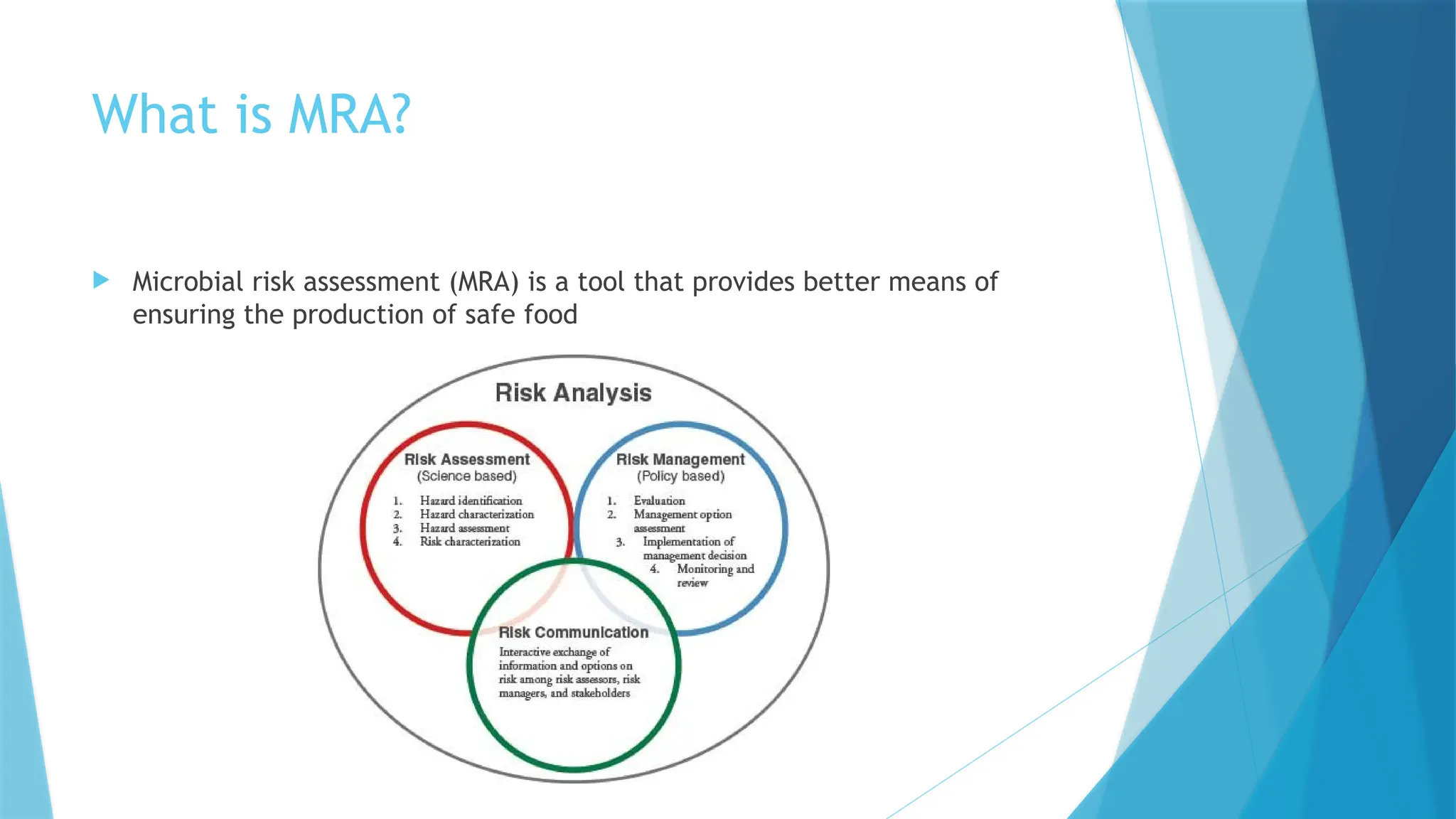
 Microbial risk assessment (MRA) is a tool that provides better means of
ensuring the production of safe food
Risk analysis
Risk analysis is a process comprising:
 Risk assessment – the scientific evaluation of known or potential adverse
health effects
 Risk management – evaluating, selecting and implementing policy alternatives
 Risk communication – exchange of information amongst all interested parties
Risk assessment
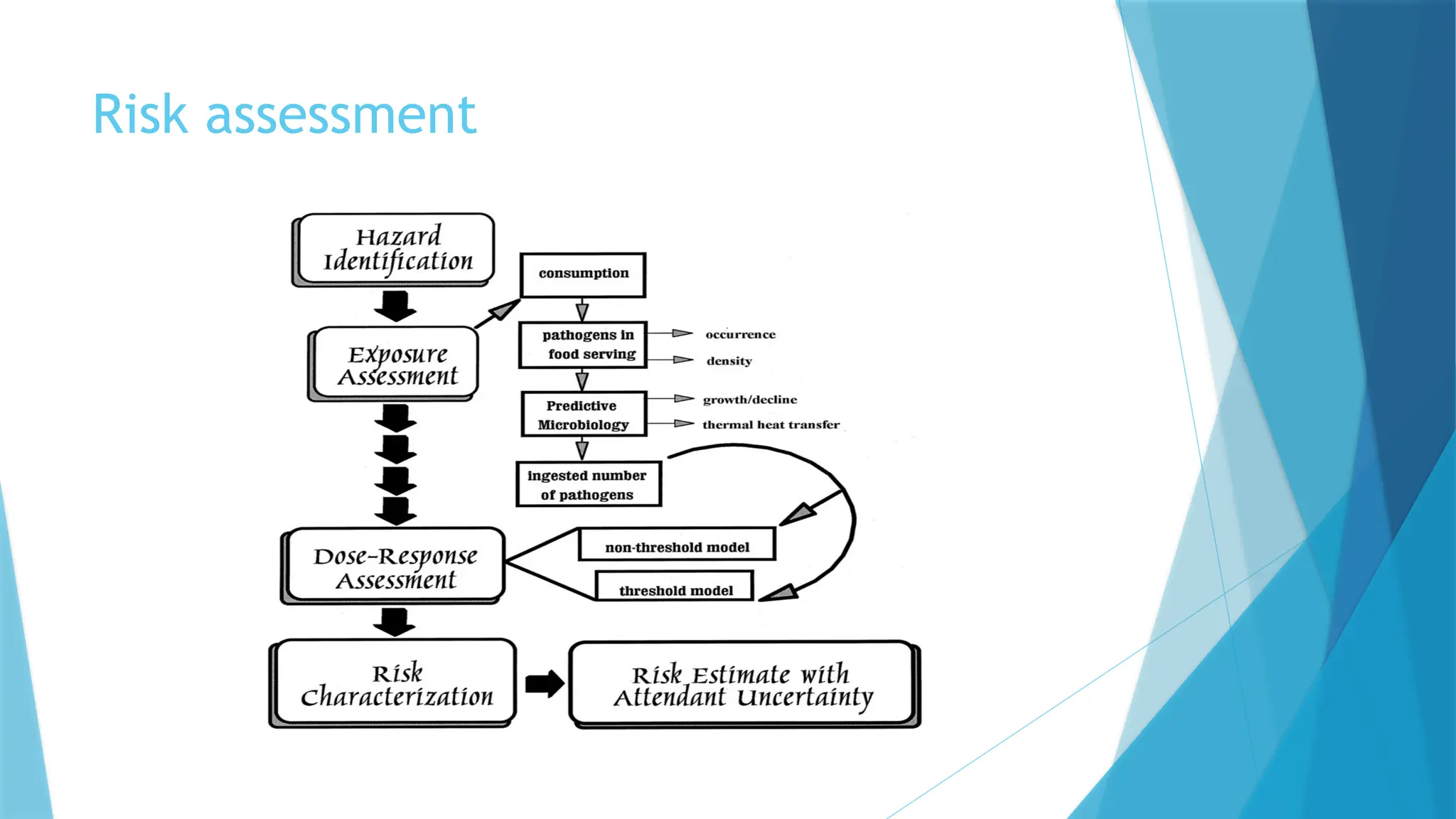
Risk assessment for microbiological hazards in foods is defined by the Codex
Alimentarius Commission (CAC) as a scientifically based process consisting of four
components:
• Hazard identification
• Exposure assessment
• Hazard characterization
• Risk characterization.
Hazard identification
Hazard identification is predominantly a qualitative process intended to identify
microorganisms or microbial toxins of concern in food or water. It can include
information on the hazard of concern as well as relevant related data, such as
clinical and surveillance data.
Exposure assessment
Exposure assessment should provide an estimate, with associated uncertainty, of
the occurrence and level of the pathogen in a specified portion of food at the
time of consumption, or in a specified volume of water using a production-to
consumption approach.
Hazard characterization
Hazard characterization provides a description of the adverse health effects that
may result from ingestion of a microorganism. When data are available, the
hazard characterization should present quantitative information in terms of a
dose response relationship and the probability of adverse out
Risk characterization
Risk characterization is the integration of the three previous steps to obtain a
risk estimate (i.e. an estimate of the likelihood and severity of the adverse
health effects that would occur in a given population, with associated
uncertainties
Risk assessment
Risk management
It is the process of deciding and implementing mitigation methods for the
appropriate level of safety. There is usually no “0” risk. Risk managements have
following elements:
 Risk evaluation
 Risk management option assessment
 Implementation of management decision
 Monitoring and review
Cont..
Risk evaluation
 Identification of a food safety problem.
 Establishment of a risk profile
 Ranking of the hazard for risk assessment and risk management priority.
 Establishment of risk assessment policy for conduct of risk assessment.
 Commissioning of risk assessment.
 Consideration of risk assessment result
Cont..
Risk management option assessment
 Identification of available management options
 Selection of preferred management option, including consideration of an
appropriate safety standard
 Final management decision
Monitoring and review
 Assessment of effectiveness of measures taken
 Review risk management and/or assessment as necessary.
Microbiological examination of food
 Microbiological testing of food is limited because the routine examination of
foods for a multiplicity of pathogens and toxins was impractical
 Enumeration of the organisms was performed and were termed as ‘indicator
organisms’ that reflect microbiological safety and quality of foods
 A criteria was set for every organism on the basis of their pathogenicity e.g.
Salmonella should be absent from food because very low numbers are known
to be capable of causing illness while Staphylococcus aureus, may be
acceptable at levels that are well below those causing food to become
hazardous
 The limitation of testing for pathogenic organisms that may be infrequent,
low in number and unevenly distributed throughout the test batch
Factors contributing to risk analysis
 Stability: Microbial contaminants may die-off or even multiply during storage
depending on the conditions.
 Behaviour: The storage behavior of microorganisms in foods is affected by
various intrinsic and extrinsic factors, and can vary considerably from food to
food and from one organism to another.
 Origin: Microorganisms occur naturally, especially in raw foods, and their
presence cannot be avoided.
Cont..
End-product criteria: Less useful for microorganisms due to changes in
microbial counts with time and the difficulty of detecting low number pathogens
Exposure assessment: The value of counts obtained for the purposes of
exposure assessment will depend upon the timing of the tests and the
subsequent storage history of the food.
Assessment of dose–response relationship: The necessary information for
microbial pathogens must be taken from feeding trials involving human
volunteers.
International approach for food safety
 Predictive modelling is a valuable tool, which has helped to make possible
the introduction of quantitative risk assessment (QRA)
 QRA has been used for many years in other disciplines and its use in food
microbiology has been stimulated by the decision of the World Trade
Organisation (WTO) to promote free trade in safe food
 Good manufacturing practice (GMP) concept which helps to minimize
microbial contamination of food from personnel and the production
environment. It provides standardize requirements for plant layout, hygienic
design of equipment and control of operational procedures.
HACCP
 In 1972, the hazard analysis critical control point (HACCP) system was
developed by Department of Health, Education and Welfare in which GMP
plays an important part.
 The HACCP concept is a systematic approach to the identification, assessment
and control of hazards in a particular food operation
 It aims to identify problems before they occur and establish measures for
their control at stages in production
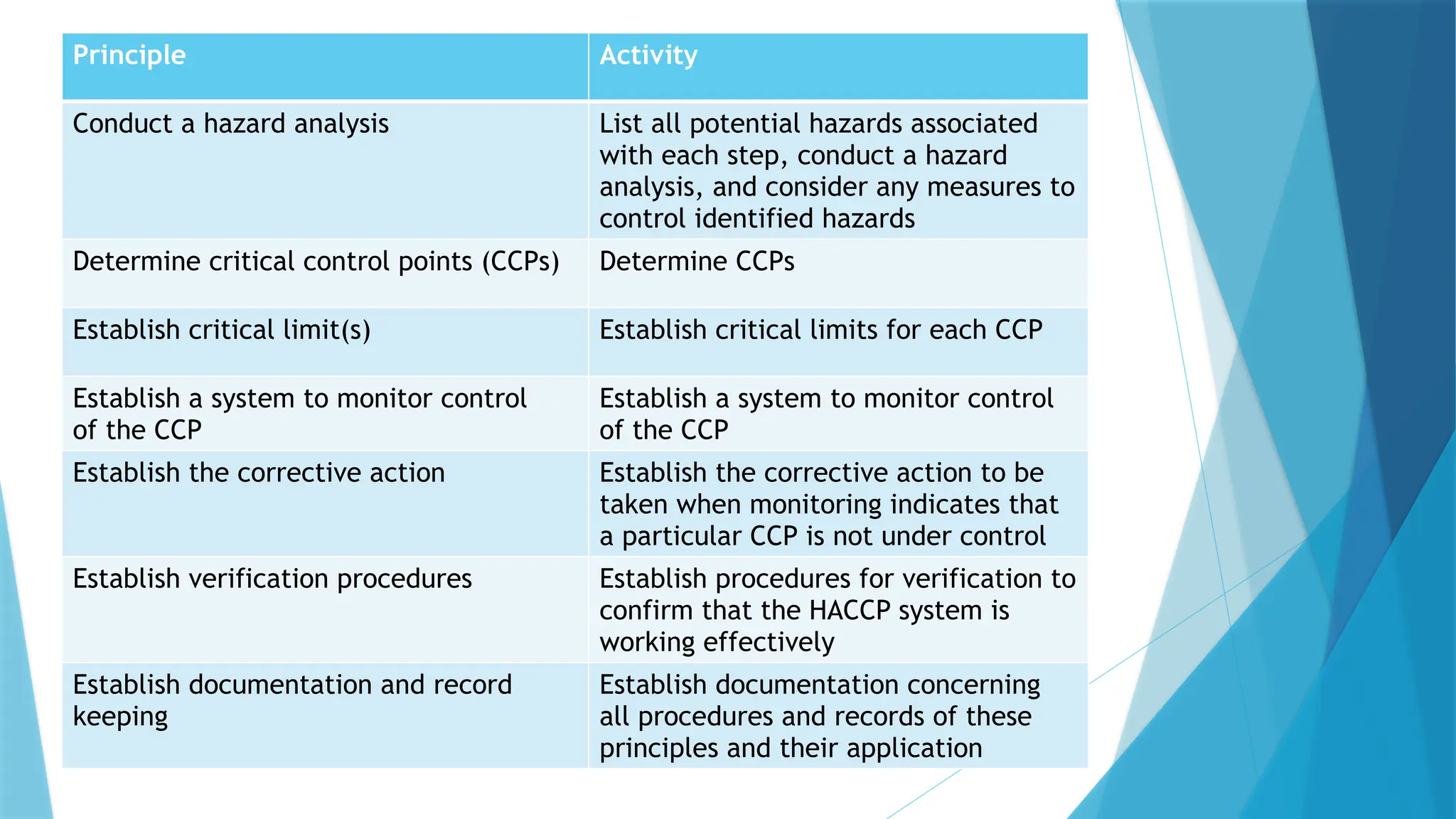
 It has 7 principles and pre defined activity is documented for each principle
Principle Activity
Conduct a hazard analysis List all potential hazards associated
with each step, conduct a hazard
analysis, and consider any measures to
control identified hazards
Determine critical control points (CCPs) Determine CCPs
Establish critical limit(s) Establish critical limits for each CCP
Establish a system to monitor control
of the CCP
Establish a system to monitor control
of the CCP
Establish the corrective action Establish the corrective action to be
taken when monitoring indicates that
a particular CCP is not under control
Establish verification procedures Establish procedures for verification to
confirm that the HACCP system is
working effectively
Establish documentation and record
keeping
Establish documentation concerning
all procedures and records of these
principles and their application
THANK YOU

Risk assessment in microbiological procedures

  • 1.
  • 2.
    Contents  Risk assessment Risk management  Risk communication  Challenges to microbial control of food  International approaches to maintain food safety
  • 3.
    What is MRA? Microbial risk assessment (MRA) is a tool that provides better means of ensuring the production of safe food
  • 4.
    Risk analysis Risk analysisis a process comprising:  Risk assessment – the scientific evaluation of known or potential adverse health effects  Risk management – evaluating, selecting and implementing policy alternatives  Risk communication – exchange of information amongst all interested parties
  • 5.
    Risk assessment Risk assessmentfor microbiological hazards in foods is defined by the Codex Alimentarius Commission (CAC) as a scientifically based process consisting of four components: • Hazard identification • Exposure assessment • Hazard characterization • Risk characterization.
  • 6.
    Hazard identification Hazard identificationis predominantly a qualitative process intended to identify microorganisms or microbial toxins of concern in food or water. It can include information on the hazard of concern as well as relevant related data, such as clinical and surveillance data.
  • 7.
    Exposure assessment Exposure assessmentshould provide an estimate, with associated uncertainty, of the occurrence and level of the pathogen in a specified portion of food at the time of consumption, or in a specified volume of water using a production-to consumption approach.
  • 8.
    Hazard characterization Hazard characterizationprovides a description of the adverse health effects that may result from ingestion of a microorganism. When data are available, the hazard characterization should present quantitative information in terms of a dose response relationship and the probability of adverse out
  • 9.
    Risk characterization Risk characterizationis the integration of the three previous steps to obtain a risk estimate (i.e. an estimate of the likelihood and severity of the adverse health effects that would occur in a given population, with associated uncertainties
  • 10.
  • 11.
    Risk management It isthe process of deciding and implementing mitigation methods for the appropriate level of safety. There is usually no “0” risk. Risk managements have following elements:  Risk evaluation  Risk management option assessment  Implementation of management decision  Monitoring and review
  • 12.
    Cont.. Risk evaluation  Identificationof a food safety problem.  Establishment of a risk profile  Ranking of the hazard for risk assessment and risk management priority.  Establishment of risk assessment policy for conduct of risk assessment.  Commissioning of risk assessment.  Consideration of risk assessment result
  • 13.
    Cont.. Risk management optionassessment  Identification of available management options  Selection of preferred management option, including consideration of an appropriate safety standard  Final management decision Monitoring and review  Assessment of effectiveness of measures taken  Review risk management and/or assessment as necessary.
  • 14.
    Microbiological examination offood  Microbiological testing of food is limited because the routine examination of foods for a multiplicity of pathogens and toxins was impractical  Enumeration of the organisms was performed and were termed as ‘indicator organisms’ that reflect microbiological safety and quality of foods  A criteria was set for every organism on the basis of their pathogenicity e.g. Salmonella should be absent from food because very low numbers are known to be capable of causing illness while Staphylococcus aureus, may be acceptable at levels that are well below those causing food to become hazardous  The limitation of testing for pathogenic organisms that may be infrequent, low in number and unevenly distributed throughout the test batch
  • 15.
    Factors contributing torisk analysis  Stability: Microbial contaminants may die-off or even multiply during storage depending on the conditions.  Behaviour: The storage behavior of microorganisms in foods is affected by various intrinsic and extrinsic factors, and can vary considerably from food to food and from one organism to another.  Origin: Microorganisms occur naturally, especially in raw foods, and their presence cannot be avoided.
  • 16.
    Cont.. End-product criteria: Lessuseful for microorganisms due to changes in microbial counts with time and the difficulty of detecting low number pathogens Exposure assessment: The value of counts obtained for the purposes of exposure assessment will depend upon the timing of the tests and the subsequent storage history of the food. Assessment of dose–response relationship: The necessary information for microbial pathogens must be taken from feeding trials involving human volunteers.
  • 17.
    International approach forfood safety  Predictive modelling is a valuable tool, which has helped to make possible the introduction of quantitative risk assessment (QRA)  QRA has been used for many years in other disciplines and its use in food microbiology has been stimulated by the decision of the World Trade Organisation (WTO) to promote free trade in safe food  Good manufacturing practice (GMP) concept which helps to minimize microbial contamination of food from personnel and the production environment. It provides standardize requirements for plant layout, hygienic design of equipment and control of operational procedures.
  • 18.
    HACCP  In 1972,the hazard analysis critical control point (HACCP) system was developed by Department of Health, Education and Welfare in which GMP plays an important part.  The HACCP concept is a systematic approach to the identification, assessment and control of hazards in a particular food operation  It aims to identify problems before they occur and establish measures for their control at stages in production  It has 7 principles and pre defined activity is documented for each principle
  • 19.
    Principle Activity Conduct ahazard analysis List all potential hazards associated with each step, conduct a hazard analysis, and consider any measures to control identified hazards Determine critical control points (CCPs) Determine CCPs Establish critical limit(s) Establish critical limits for each CCP Establish a system to monitor control of the CCP Establish a system to monitor control of the CCP Establish the corrective action Establish the corrective action to be taken when monitoring indicates that a particular CCP is not under control Establish verification procedures Establish procedures for verification to confirm that the HACCP system is working effectively Establish documentation and record keeping Establish documentation concerning all procedures and records of these principles and their application
  • 20.