HACCP
         HACCP

        What is it?
What is HACCP?


                  HACCP
   Hazard Analysis Critical Control
                Points
• A powerful safety management technique

• Structured preventative system

• Promotes safety through hazard identification and
  control
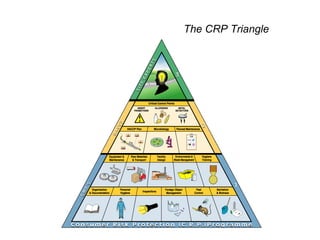
The CRP Triangle
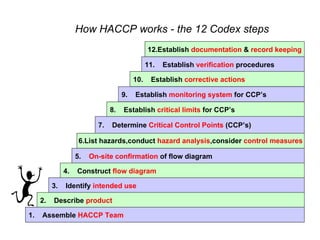
How HACCP works - the 12 Codex steps
                                                12.Establish documentation & record keeping

                                                11.   Establish verification procedures

                                          10.    Establish corrective actions

                                     9.   Establish monitoring system for CCP’s

                                8.   Establish critical limits for CCP’s

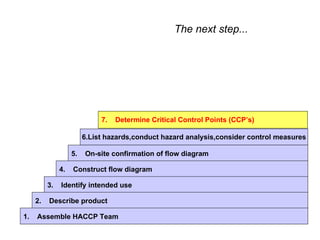
                           7.   Determine Critical Control Points (CCP’s)

                     6.List hazards,conduct hazard analysis,consider control measures

                    5.   On-site confirmation of flow diagram

               4.   Construct flow diagram

          3.   Identify intended use

     2.   Describe product

1.   Assemble HACCP Team
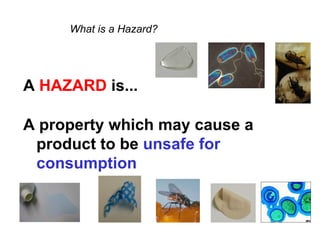
What is a Hazard?


A HAZARD is...

A property which may cause a
 product to be unsafe for
 consumption
Benefits of HACCP...


5 Systematic approach
5 Preventative system
5 Resources are used effectively
5 Documentary system builds and continually
  refreshes ‘due diligence’ in plant
5 Internationally accepted system
5 Strengthens Quality Management systems
5 Demonstrates and reinforces management
  commitment and involvement
The HACCP team
• Process line representative(s) (e.g. Specialist/
  SET)
• Packaging representative (e.g. Specialist/SET)
• Support services
• Production management representative (e.g.
  FLM)
• CRP Project Leader
  (site Food Safety Manager or Food Safety
  SET)
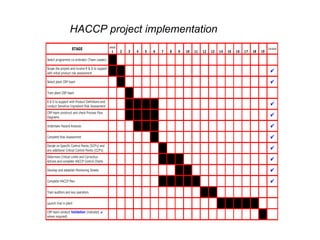
HACCP project implementation
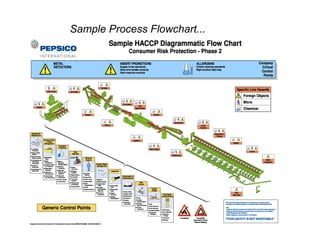
Sample Process Flowchart...
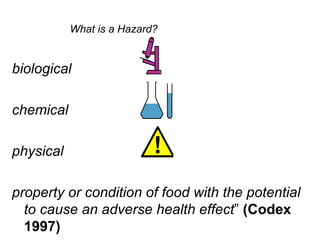
What is a Hazard?


biological

chemical

physical

property or condition of food with the potential
  to cause an adverse health effect” (Codex
  1997)
Step 1


         What does Codex say
        about hazard analysis ?
“The process of collecting and evaluating
  information on hazards and conditions leading
  to their presence to decide which are
  significant for food safety and therefore should
  be addressed in the HACCP plan”
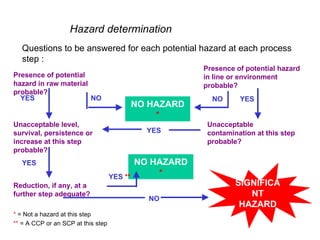
Hazard determination
   Questions to be answered for each potential hazard at each process
   step :
                                                       Presence of potential hazard
Presence of potential                                  in line or environment
hazard in raw material                                 probable?
probable?
  YES                  NO                                NO      YES
                                        NO HAZARD
                                            *
Unacceptable level,                                     Unacceptable
survival, persistence or                   YES          contamination at this step
increase at this step                                   probable?
probable?
   YES                                     NO HAZARD
                                    YES **     *
Reduction, if any, at a                                         SIGNIFICA
further step adequate?                                             NT
                                            NO
                                                                 HAZARD
* = Not a hazard at this step
** = A CCP or an SCP at this step
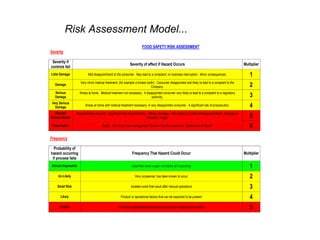
Risk Assessment Model...
                                                                       FOOD SAFETY RISK ASSESSMENT
Severity

 Severity if
                                                             Severity of affect if Hazard Occurs                                                    Multiplier
controls fail
Little Damage              Mild disappointment to the consumer. May lead to a complaint, no business interruption. Minor consequences.                  1
                     Very minor medical treatment, (for example a broken tooth). Consumer disappointed and likely to lead to a complaint to the
   Damage
                                                                            Company.                                                                    2
   Serious           Illness at home. Medical treatment not necessary. A disappointed consumer very likely to lead to a complaint to a regulatory
   Damage                                                                    authority.                                                                 3
 Very Serious
   Damage
                         Illness at home with medical treatment necessary. A very disappointed consumer. A significant risk of proscecution.            4
   Disaster       Hospitalization required. Significant risk of proscecution. Media coverage. Intervention by ‘Crisis management team’. Damage to
Serious Illness                                                             ‘branded ‘ image.                                                           5
 Catastrophic                          Death. Top level ‘crisis management’ Certain risk of proscecution. Destruction of ‘brand’                        6
Frequency

  Probability of
hazard occurring                                               Frequency That Hazard Could Occur                                                    Multiplier
 if process fails
 Almost Impossible                                            Less than once a year, no history of it occurring                                         1
     Un-Likely                                                   Very occasional, has been known to occur                                               2
     Small Risk                                               Isolated event that result after manual operations                                        3
       Likely                                        Product or operational factors that can be expected to be present                                  4
      Certain                                       Product or operational factors that the process is expected to control                              5
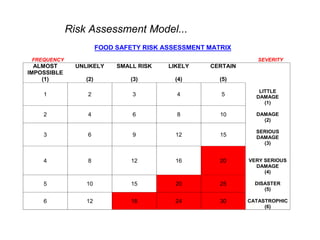
Risk Assessment Model...
                        FOOD SAFETY RISK ASSESSMENT MATRIX
 FREQUENCY                                                       SEVERITY
  ALMOST       UNLIKELY      SMALL RISK   LIKELY    CERTAIN
IMPOSSIBLE
    (1)           (2)            (3)        (4)        (5)

                                                                 LITTLE
    1             2              3          4          5        DAMAGE
                                                                   (1)

    2             4              6          8          10       DAMAGE
                                                                  (2)

                                                                SERIOUS
    3             6              9          12         15       DAMAGE
                                                                  (3)


    4             8              12         16         20     VERY SERIOUS
                                                                DAMAGE
                                                                   (4)

    5             10             15         20         25       DISASTER
                                                                   (5)

    6             12             18         24         30     CATASTROPHIC
                                                                   (6)
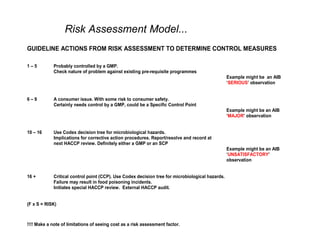
Risk Assessment Model...
GUIDELINE ACTIONS FROM RISK ASSESSMENT TO DETERMINE CONTROL MEASURES

1–5          Probably controlled by a GMP.
             Check nature of problem against existing pre-requisite programmes
                                                                                                  Example might be an AIB
                                                                                                  ‘SERIOUS’ observation


6–9          A consumer issue. With some risk to consumer safety.
             Certainly needs control by a GMP, could be a Specific Control Point
                                                                                                  Example might be an AIB
                                                                                                  ‘MAJOR’ observation


10 – 16      Use Codex decision tree for microbiological hazards.
             Implications for corrective action procedures. Report/resolve and record at
             next HACCP review. Definitely either a GMP or an SCP
                                                                                                  Example might be an AIB
                                                                                                  ‘UNSATISFACTORY’
                                                                                                  observation


16 +         Critical control point (CCP). Use Codex decision tree for microbiological hazards.
             Failure may result in food poisoning incidents.
             Initiates special HACCP review. External HACCP audit.


(F x S = RISK)


!!!! Make a note of limitations of seeing cost as a risk assessment factor.
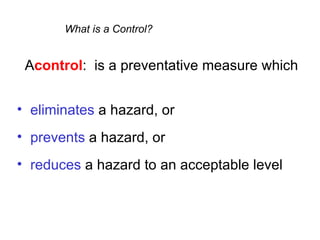
What is a Control?


 Acontrol: is a preventative measure which


• eliminates a hazard, or
• prevents a hazard, or
• reduces a hazard to an acceptable level
The next step...


                              7.   Determine Critical Control Points (CCP’s)

                         6.List hazards,conduct hazard analysis,consider control measures

                    5.   On-site confirmation of flow diagram

               4.   Construct flow diagram

          3.   Identify intended use

     2.   Describe product

1.   Assemble HACCP Team
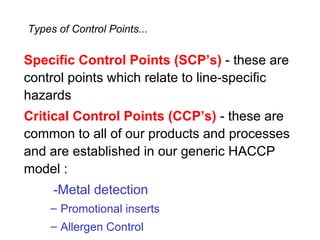
Types of Control Points...

Specific Control Points (SCP’s) - these are
control points which relate to line-specific
hazards
Critical Control Points (CCP’s) - these are
common to all of our products and processes
and are established in our generic HACCP
model :
     -Metal detection
    – Promotional inserts
    – Allergen Control
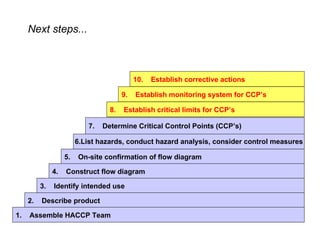
Next steps...


                                             10.   Establish corrective actions

                                        9.   Establish monitoring system for CCP’s

                                   8.   Establish critical limits for CCP’s

                            7.   Determine Critical Control Points (CCP’s)

                         6.List hazards, conduct hazard analysis, consider control measures

                    5.   On-site confirmation of flow diagram

               4.   Construct flow diagram

          3.   Identify intended use

     2.   Describe product

1.   Assemble HACCP Team
Critical limits


• Maximum values should never be exceeded, so
  often target values are established

• The limits must relate to the control measures
  identified

• Decisions on what constitutes a harmful level
  requires technical food safety knowledge and
  sometimes may be a current legal requirement
Critical limits

• Critical limits must be exact and monitorable
• A numerical limit is not necessarily required in
  every case
• Flexibility should not compromise food safety
• It is often appropriate to set an ‘acceptable range’
  rather than a fixed limit
• Sometimes a green (acceptable), yellow (caution),
  red (unacceptable) rating system
Monitoring controls - specify...


• How is the control monitored?           - method

• When is the control monitored ? - frequency

• How is it recorded?                - documentation
Monitoring controls - specify...


All monitoring and corrective action must be
signed off by a trained person.
The resulting records must be retained and be
available for inspection :
     – during verification
     – during HACCP audits
     – during AIB audits
     – during regulatory visits
The formal HACCP documentation...


Documentation to be produced :

• Completed Process Flowchart for each
  product line on site

• Site HACCP Plan

• Record sheets for the monitoring
  programmes specified
Recent revisions to CCPs

• The removal of the requirement for Certificates of
  Analysis (CoAs) from seasoning companies
• VA programme became a HACCP pre-requisite
  programme
• Metal Detectors became a CCP by definition
• The growth and development of promotions within the
  business has brought additional and significant new
  consumer and business risk
• Scientific advances in relating to food allergens have
  led to Pepsico to develop allergen control practices in
  plant
• Forthcoming legislative requirements for labelling of
  allergens prompted Pepsico to enlarge its allergen
  programme and broaden its scope of allergen CCP
Checking the HACCP Programme


Validation

 Verification

 Review
Validation


• The assessment of the HACCP plan before
  implementation to provide confirmation that it is :
   – valid
   – accurate
   – and complete

• Codex says : “obtaining evidence that the elements of
  the HACCP Plan are effective”

• Ask yourself these questions :
   – “is it true? is it right?”
   – “will it deliver safe food?”
Validation - summary

Remember - validation is the process for checking :

   HACCP plan is complete and accurate - a true reflection
   of the site, its products and processes and the hazards
   associated with them
   HACCP system, if operated correctly, will deliver safe
   food - that it would work
   that it is a VALID system

" It is not a process for checking whether it is being
  correctly carried out
" Is the system at fault and in need of amendment, or
  would the system work if correctly operated and
  communicated?
Verification


• To make sure that what is laid down in the
  HACCP plan accurately operated in reality

• More ‘hands-on’

• Confirms that everything is OK
Verification information


HACCP team should consider two key sets of data :

• Feedback from the AIB audit
• Food safety monitoring data :
   ~ Data on the monitoring of pre-requisite programmes, e.g.
     Pest Control records, Foreign Object trawls, glass and hard
     plastic audits, etc.
   ~ Data from HACCP monitoring sheets which record the
     checks on CCPs and SCP's
HACCP Annual Review
• Conducted by the HACCP team
• Comprises :
   – Re-validation of the HACCP system
      ~ Check the HACCP plan
      ~ Update the plan in response to changes
   – HACCP audit
      ~ Ideally, this audit should include an SET from another
        site!
   – Verification of the HACCP system as previously described
   – Review training needs for HACCP team and other plant
     personnel (possibly utilising a skills needs assessment)
     and relay outcome to HR personnel
   – Recommendations to improve food safety on site
   – Recommendations to improve AIB audit performance

Haccp training

  • 1.
    HACCP HACCP What is it?
  • 2.
    What is HACCP? HACCP Hazard Analysis Critical Control Points • A powerful safety management technique • Structured preventative system • Promotes safety through hazard identification and control
  • 3.
  • 4.
    How HACCP works- the 12 Codex steps 12.Establish documentation & record keeping 11. Establish verification procedures 10. Establish corrective actions 9. Establish monitoring system for CCP’s 8. Establish critical limits for CCP’s 7. Determine Critical Control Points (CCP’s) 6.List hazards,conduct hazard analysis,consider control measures 5. On-site confirmation of flow diagram 4. Construct flow diagram 3. Identify intended use 2. Describe product 1. Assemble HACCP Team
  • 5.
    What is aHazard? A HAZARD is... A property which may cause a product to be unsafe for consumption
  • 6.
    Benefits of HACCP... 5Systematic approach 5 Preventative system 5 Resources are used effectively 5 Documentary system builds and continually refreshes ‘due diligence’ in plant 5 Internationally accepted system 5 Strengthens Quality Management systems 5 Demonstrates and reinforces management commitment and involvement
  • 7.
    The HACCP team •Process line representative(s) (e.g. Specialist/ SET) • Packaging representative (e.g. Specialist/SET) • Support services • Production management representative (e.g. FLM) • CRP Project Leader (site Food Safety Manager or Food Safety SET)
  • 8.
  • 9.
  • 10.
    What is aHazard? biological chemical physical property or condition of food with the potential to cause an adverse health effect” (Codex 1997)
  • 11.
    Step 1 What does Codex say about hazard analysis ? “The process of collecting and evaluating information on hazards and conditions leading to their presence to decide which are significant for food safety and therefore should be addressed in the HACCP plan”
  • 12.
    Hazard determination Questions to be answered for each potential hazard at each process step : Presence of potential hazard Presence of potential in line or environment hazard in raw material probable? probable? YES NO NO YES NO HAZARD * Unacceptable level, Unacceptable survival, persistence or YES contamination at this step increase at this step probable? probable? YES NO HAZARD YES ** * Reduction, if any, at a SIGNIFICA further step adequate? NT NO HAZARD * = Not a hazard at this step ** = A CCP or an SCP at this step
  • 13.
    Risk Assessment Model... FOOD SAFETY RISK ASSESSMENT Severity Severity if Severity of affect if Hazard Occurs Multiplier controls fail Little Damage Mild disappointment to the consumer. May lead to a complaint, no business interruption. Minor consequences. 1 Very minor medical treatment, (for example a broken tooth). Consumer disappointed and likely to lead to a complaint to the Damage Company. 2 Serious Illness at home. Medical treatment not necessary. A disappointed consumer very likely to lead to a complaint to a regulatory Damage authority. 3 Very Serious Damage Illness at home with medical treatment necessary. A very disappointed consumer. A significant risk of proscecution. 4 Disaster Hospitalization required. Significant risk of proscecution. Media coverage. Intervention by ‘Crisis management team’. Damage to Serious Illness ‘branded ‘ image. 5 Catastrophic Death. Top level ‘crisis management’ Certain risk of proscecution. Destruction of ‘brand’ 6 Frequency Probability of hazard occurring Frequency That Hazard Could Occur Multiplier if process fails Almost Impossible Less than once a year, no history of it occurring 1 Un-Likely Very occasional, has been known to occur 2 Small Risk Isolated event that result after manual operations 3 Likely Product or operational factors that can be expected to be present 4 Certain Product or operational factors that the process is expected to control 5
  • 14.
    Risk Assessment Model... FOOD SAFETY RISK ASSESSMENT MATRIX FREQUENCY SEVERITY ALMOST UNLIKELY SMALL RISK LIKELY CERTAIN IMPOSSIBLE (1) (2) (3) (4) (5) LITTLE 1 2 3 4 5 DAMAGE (1) 2 4 6 8 10 DAMAGE (2) SERIOUS 3 6 9 12 15 DAMAGE (3) 4 8 12 16 20 VERY SERIOUS DAMAGE (4) 5 10 15 20 25 DISASTER (5) 6 12 18 24 30 CATASTROPHIC (6)
  • 15.
    Risk Assessment Model... GUIDELINEACTIONS FROM RISK ASSESSMENT TO DETERMINE CONTROL MEASURES 1–5 Probably controlled by a GMP. Check nature of problem against existing pre-requisite programmes Example might be an AIB ‘SERIOUS’ observation 6–9 A consumer issue. With some risk to consumer safety. Certainly needs control by a GMP, could be a Specific Control Point Example might be an AIB ‘MAJOR’ observation 10 – 16 Use Codex decision tree for microbiological hazards. Implications for corrective action procedures. Report/resolve and record at next HACCP review. Definitely either a GMP or an SCP Example might be an AIB ‘UNSATISFACTORY’ observation 16 + Critical control point (CCP). Use Codex decision tree for microbiological hazards. Failure may result in food poisoning incidents. Initiates special HACCP review. External HACCP audit. (F x S = RISK) !!!! Make a note of limitations of seeing cost as a risk assessment factor.
  • 16.
    What is aControl? Acontrol: is a preventative measure which • eliminates a hazard, or • prevents a hazard, or • reduces a hazard to an acceptable level
  • 17.
    The next step... 7. Determine Critical Control Points (CCP’s) 6.List hazards,conduct hazard analysis,consider control measures 5. On-site confirmation of flow diagram 4. Construct flow diagram 3. Identify intended use 2. Describe product 1. Assemble HACCP Team
  • 18.
    Types of ControlPoints... Specific Control Points (SCP’s) - these are control points which relate to line-specific hazards Critical Control Points (CCP’s) - these are common to all of our products and processes and are established in our generic HACCP model : -Metal detection – Promotional inserts – Allergen Control
  • 19.
    Next steps... 10. Establish corrective actions 9. Establish monitoring system for CCP’s 8. Establish critical limits for CCP’s 7. Determine Critical Control Points (CCP’s) 6.List hazards, conduct hazard analysis, consider control measures 5. On-site confirmation of flow diagram 4. Construct flow diagram 3. Identify intended use 2. Describe product 1. Assemble HACCP Team
  • 20.
    Critical limits • Maximumvalues should never be exceeded, so often target values are established • The limits must relate to the control measures identified • Decisions on what constitutes a harmful level requires technical food safety knowledge and sometimes may be a current legal requirement
  • 21.
    Critical limits • Criticallimits must be exact and monitorable • A numerical limit is not necessarily required in every case • Flexibility should not compromise food safety • It is often appropriate to set an ‘acceptable range’ rather than a fixed limit • Sometimes a green (acceptable), yellow (caution), red (unacceptable) rating system
  • 22.
    Monitoring controls -specify... • How is the control monitored? - method • When is the control monitored ? - frequency • How is it recorded? - documentation
  • 23.
    Monitoring controls -specify... All monitoring and corrective action must be signed off by a trained person. The resulting records must be retained and be available for inspection : – during verification – during HACCP audits – during AIB audits – during regulatory visits
  • 24.
    The formal HACCPdocumentation... Documentation to be produced : • Completed Process Flowchart for each product line on site • Site HACCP Plan • Record sheets for the monitoring programmes specified
  • 25.
    Recent revisions toCCPs • The removal of the requirement for Certificates of Analysis (CoAs) from seasoning companies • VA programme became a HACCP pre-requisite programme • Metal Detectors became a CCP by definition • The growth and development of promotions within the business has brought additional and significant new consumer and business risk • Scientific advances in relating to food allergens have led to Pepsico to develop allergen control practices in plant • Forthcoming legislative requirements for labelling of allergens prompted Pepsico to enlarge its allergen programme and broaden its scope of allergen CCP
  • 26.
    Checking the HACCPProgramme Validation Verification Review
  • 27.
    Validation • The assessmentof the HACCP plan before implementation to provide confirmation that it is : – valid – accurate – and complete • Codex says : “obtaining evidence that the elements of the HACCP Plan are effective” • Ask yourself these questions : – “is it true? is it right?” – “will it deliver safe food?”
  • 28.
    Validation - summary Remember- validation is the process for checking : HACCP plan is complete and accurate - a true reflection of the site, its products and processes and the hazards associated with them HACCP system, if operated correctly, will deliver safe food - that it would work that it is a VALID system " It is not a process for checking whether it is being correctly carried out " Is the system at fault and in need of amendment, or would the system work if correctly operated and communicated?
  • 29.
    Verification • To makesure that what is laid down in the HACCP plan accurately operated in reality • More ‘hands-on’ • Confirms that everything is OK
  • 30.
    Verification information HACCP teamshould consider two key sets of data : • Feedback from the AIB audit • Food safety monitoring data : ~ Data on the monitoring of pre-requisite programmes, e.g. Pest Control records, Foreign Object trawls, glass and hard plastic audits, etc. ~ Data from HACCP monitoring sheets which record the checks on CCPs and SCP's
  • 31.
    HACCP Annual Review •Conducted by the HACCP team • Comprises : – Re-validation of the HACCP system ~ Check the HACCP plan ~ Update the plan in response to changes – HACCP audit ~ Ideally, this audit should include an SET from another site! – Verification of the HACCP system as previously described – Review training needs for HACCP team and other plant personnel (possibly utilising a skills needs assessment) and relay outcome to HR personnel – Recommendations to improve food safety on site – Recommendations to improve AIB audit performance