Vivek Kumar
Email Id:-vivek.it@live.com
Notes:
 If you see any mistake on my PowerPoint
slides or if you have any questions about the
materials, please feel free to email me at
vivek.it@live.com
Thanks
Vivek Kumar
TechnicalTrainer
Objectives
 Encounter and describe the limitations of
RIPv1’s limitations.
 Apply the basic Routing Information Protocol
Version 2 (RIPv2) configuration commands
and evaluate RIPv2 classless routing updates.
 Analyze router output to see RIPv2 support for
VLSM and CIDR
 Identify RIPv2 verification commands and
common RIPv2 issues.
 Configure, verify, and troubleshoot RIPv2 in
“hands-on” labs
Introduction
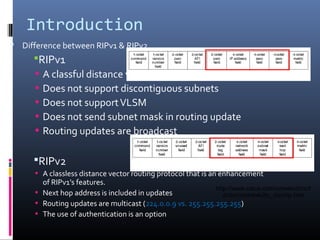
 Difference between RIPv1 & RIPv2
RIPv1
• A classful distance vector routing protocol
• Does not support discontiguous subnets
• Does not supportVLSM
• Does not send subnet mask in routing update
• Routing updates are broadcast
RIPv2
• A classless distance vector routing protocol that is an enhancement
of RIPv1’s features.
• Next hop address is included in updates
• Routing updates are multicast (224.0.0.9 vs. 255.255.255.255)
• The use of authentication is an option
http://www.cisco.com/univercd/cc/t
d/doc/cisintwk/ito_doc/rip.htm
Introduction
 Similarities between RIPv1 & RIPv2
– Use of timers to prevent routing loops
– Use of split horizon or split horizon with poison
reverse to also help prevent routing loops.
– Use of triggered updates when there is a change in the
topology for faster convergence.
– Maximum hop count of 15, with the hop count of 16
signifying an unreachable network.
RIPv1 Limitations
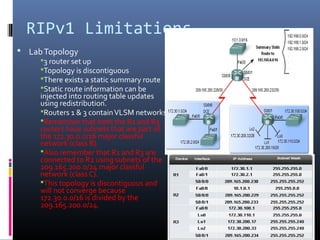
 LabTopology
3 router set up
Topology is discontiguous
There exists a static summary route
Static route information can be
injected into routing table updates
using redistribution.
Routers 1 & 3 containVLSM networks
Remember that both the R1 and R3
routers have subnets that are part of
the 172.30.0.0/16 major classful
network (class B).
Also remember that R1 and R3 are
connected to R2 using subnets of the
209.165.200.0/24 major classful
network (class C).
This topology is discontiguous and
will not converge because
172.30.0.0/16 is divided by the
209.165.200.0/24.
RIPv1 Limitations
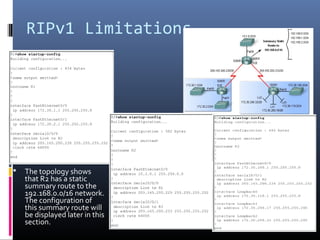
 The topology shows
that R2 has a static
summary route to the
192.168.0.0/16 network.
The configuration of
this summary route will
be displayed later in this
section.
RIPv1 Limitations
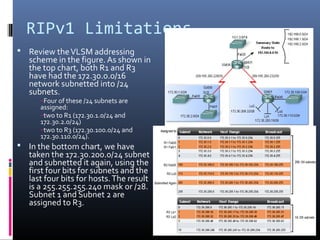
 Review theVLSM addressing
scheme in the figure. As shown in
the top chart, both R1 and R3
have had the 172.30.0.0/16
network subnetted into /24
subnets.
–Four of these /24 subnets are
assigned:
–two to R1 (172.30.1.0/24 and
172.30.2.0/24)
–two to R3 (172.30.100.0/24 and
172.30.110.0/24).
 In the bottom chart, we have
taken the 172.30.200.0/24 subnet
and subnetted it again, using the
first four bits for subnets and the
last four bits for hosts.The result
is a 255.255.255.240 mask or /28.
Subnet 1 and Subnet 2 are
assigned to R3.
RIPv1 Limitations
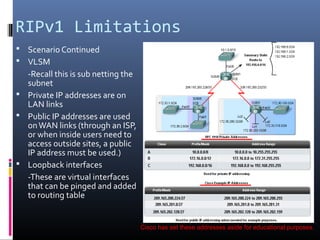
 Scenario Continued
 VLSM
-Recall this is sub netting the
subnet
 Private IP addresses are on
LAN links
 Public IP addresses are used
onWAN links (through an ISP,
or when inside users need to
access outside sites, a public
IP address must be used.)
 Loopback interfaces
-These are virtual interfaces
that can be pinged and added
to routing table
Cisco has set these addresses aside for educational purposes.
RIPv1 Limitations
 Loopback interfaces
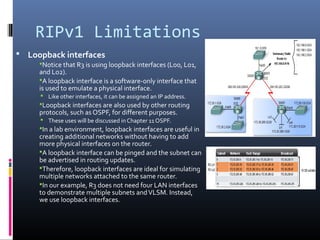
Notice that R3 is using loopback interfaces (Lo0, Lo1,
and Lo2).
A loopback interface is a software-only interface that
is used to emulate a physical interface.
 Like other interfaces, it can be assigned an IP address.
Loopback interfaces are also used by other routing
protocols, such as OSPF, for different purposes.
 These uses will be discussed in Chapter 11 OSPF.
In a lab environment, loopback interfaces are useful in
creating additional networks without having to add
more physical interfaces on the router.
A loopback interface can be pinged and the subnet can
be advertised in routing updates.
Therefore, loopback interfaces are ideal for simulating
multiple networks attached to the same router.
In our example, R3 does not need four LAN interfaces
to demonstrate multiple subnets andVLSM. Instead,
we use loopback interfaces.
RIPv1 Limitations
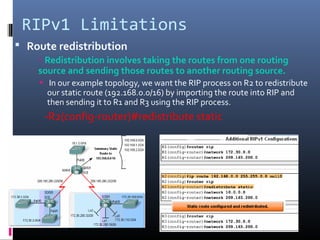
 Route redistribution
– Redistribution involves taking the routes from one routing
source and sending those routes to another routing source.
• In our example topology, we want the RIP process on R2 to redistribute
our static route (192.168.0.0/16) by importing the route into RIP and
then sending it to R1 and R3 using the RIP process.
-R2(config-router)#redistribute static
RIPv1 Limitations
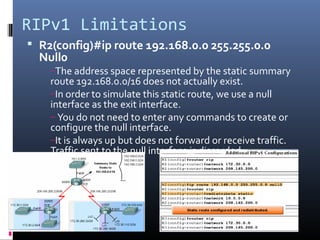
 R2(config)#ip route 192.168.0.0 255.255.0.0
Null0
–The address space represented by the static summary
route 192.168.0.0/16 does not actually exist.
–In order to simulate this static route, we use a null
interface as the exit interface.
– You do not need to enter any commands to create or
configure the null interface.
–It is always up but does not forward or receive traffic.
Traffic sent to the null interface is discarded.
Static routes and null
interfaces Static routes and null interfaces
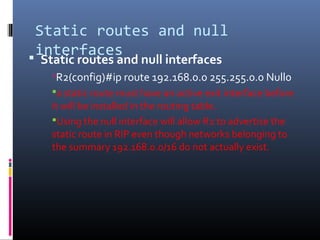
R2(config)#ip route 192.168.0.0 255.255.0.0 Null0
a static route must have an active exit interface before
it will be installed in the routing table.
Using the null interface will allow R2 to advertise the
static route in RIP even though networks belonging to
the summary 192.168.0.0/16 do not actually exist.
Verifying and Testing
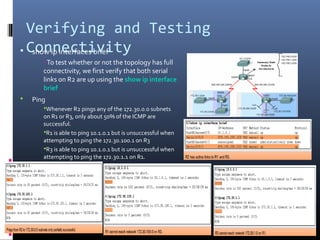
Connectivity show ip interfaces brief
–To test whether or not the topology has full
connectivity, we first verify that both serial
links on R2 are up using the show ip interface
brief
 Ping
Whenever R2 pings any of the 172.30.0.0 subnets
on R1 or R3, only about 50% of the ICMP are
successful.
R1 is able to ping 10.1.0.1 but is unsuccessful when
attempting to ping the 172.30.100.1 on R3
R3 is able to ping 10.1.0.1 but is unsuccessful when
attempting to ping the 172.30.1.1 on R1.
RIPv1 Limitations
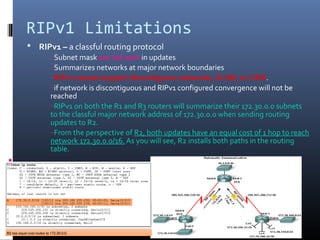
 RIPv1 – a classful routing protocol
–Subnet mask are not sent in updates
–Summarizes networks at major network boundaries
–RIPv1 cannot support discontiguous networks,VLSM, or CIDR.
–if network is discontiguous and RIPv1 configured convergence will not be
reached
–RIPv1 on both the R1 and R3 routers will summarize their 172.30.0.0 subnets
to the classful major network address of 172.30.0.0 when sending routing
updates to R2.
–From the perspective of R2, both updates have an equal cost of 1 hop to reach
network 172.30.0.0/16. As you will see, R2 installs both paths in the routing
table.
RIPv1 Limitations
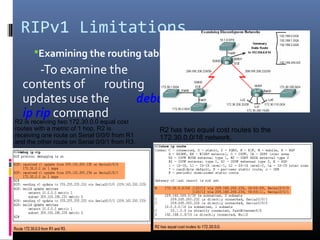
Examining the routing tables
-To examine the
contents of routing
updates use the debug
ip rip command
R2 is receiving two 172.30.0.0 equal cost
routes with a metric of 1 hop. R2 is
receiving one route on Serial 0/0/0 from R1
and the other route on Serial 0/0/1 from R3.
R2 has two equal cost routes to the
172.30.0.0/16 network.
RIPv1 Limitations
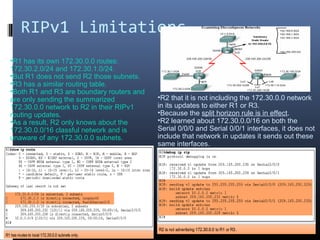
•R1 has its own 172.30.0.0 routes:
172.30.2.0/24 and 172.30.1.0/24.
•But R1 does not send R2 those subnets.
•R3 has a similar routing table.
•Both R1 and R3 are boundary routers and
are only sending the summarized
172.30.0.0 network to R2 in their RIPv1
routing updates.
•As a result, R2 only knows about the
172.30.0.0/16 classful network and is
unaware of any 172.30.0.0 subnets.
•R2 that it is not including the 172.30.0.0 network
in its updates to either R1 or R3.
•Because the split horizon rule is in effect.
•R2 learned about 172.30.0.0/16 on both the
Serial 0/0/0 and Serial 0/0/1 interfaces, it does not
include that network in updates it sends out these
same interfaces.
RIPv1 Limitations
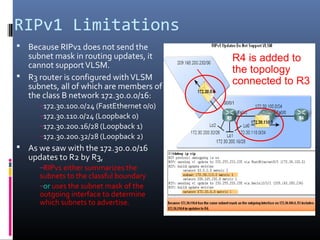
 Because RIPv1 does not send the
subnet mask in routing updates, it
cannot supportVLSM.
 R3 router is configured withVLSM
subnets, all of which are members of
the class B network 172.30.0.0/16:
–172.30.100.0/24 (FastEthernet 0/0)
–172.30.110.0/24 (Loopback 0)
–172.30.200.16/28 (Loopback 1)
–172.30.200.32/28 (Loopback 2)
 As we saw with the 172.30.0.0/16
updates to R2 by R3,
–RIPv1 either summarizes the
subnets to the classful boundary
–or uses the subnet mask of the
outgoing interface to determine
which subnets to advertise.
R4 is added to
the topology
connected to R3
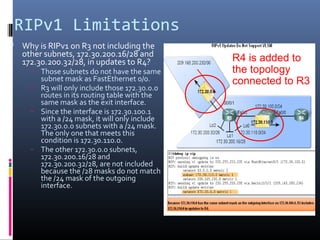
RIPv1 Limitations
 Why is RIPv1 on R3 not including the
other subnets, 172.30.200.16/28 and
172.30.200.32/28, in updates to R4?
– Those subnets do not have the same
subnet mask as FastEthernet 0/0.
– R3 will only include those 172.30.0.0
routes in its routing table with the
same mask as the exit interface.
– Since the interface is 172.30.100.1
with a /24 mask, it will only include
172.30.0.0 subnets with a /24 mask.
The only one that meets this
condition is 172.30.110.0.
– The other 172.30.0.0 subnets,
172.30.200.16/28 and
172.30.200.32/28, are not included
because the /28 masks do not match
the /24 mask of the outgoing
interface.
R4 is added to
the topology
connected to R3
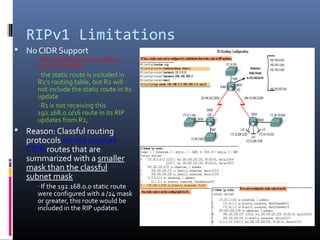
RIPv1 Limitations
 No CIDR Support
R2(config)#ip route 192.168.0.0
255.255.0.0 Null0
–the static route is included in
R2's routing table, but R2 will
not include the static route in its
update
–R1 is not receiving this
192.168.0.0/16 route in its RIP
updates from R2,
 Reason: Classful routing
protocols do not support
CIDR routes that are
summarized with a smaller
mask than the classful
subnet mask
–If the 192.168.0.0 static route
were configured with a /24 mask
or greater, this route would be
included in the RIP updates.
Configuring RIPv2
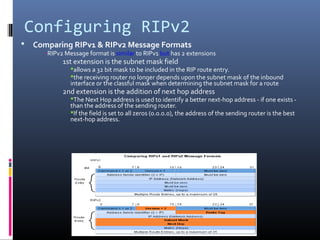
 Comparing RIPv1 & RIPv2 Message Formats
–RIPv2 Message format is similar to RIPv1 but has 2 extensions
1st extension is the subnet mask field
allows a 32 bit mask to be included in the RIP route entry.
the receiving router no longer depends upon the subnet mask of the inbound
interface or the classful mask when determining the subnet mask for a route
2nd extension is the addition of next hop address
The Next Hop address is used to identify a better next-hop address - if one exists -
than the address of the sending router.
If the field is set to all zeros (0.0.0.0), the address of the sending router is the best
next-hop address.
Configuring RIPv2
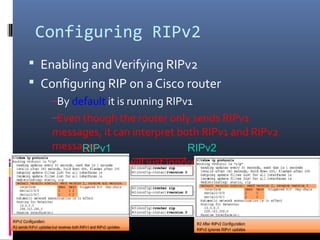
 Enabling andVerifying RIPv2
 Configuring RIP on a Cisco router
–By default it is running RIPv1
–Even though the router only sends RIPv1
messages, it can interpret both RIPv1 and RIPv2
messages.
–A RIPv1 router will just ignore the RIPv2 fields in
the route entry.
RIPv1 RIPv2
Configuring RIPv2
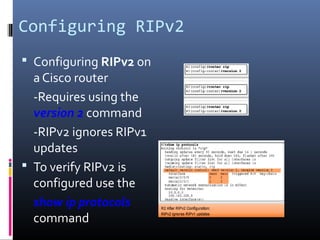
 Configuring RIPv2 on
a Cisco router
-Requires using the
version 2 command
-RIPv2 ignores RIPv1
updates
 To verify RIPv2 is
configured use the
show ip protocols
command
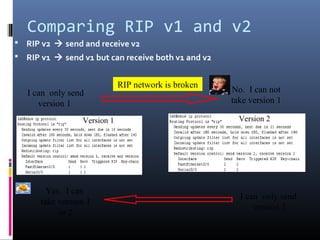
Comparing RIP v1 and v2
 RIP v2  send and receive v2
 RIP v1  send v1 but can receive both v1 and v2
Version 1 Version 2
No. I can not
take version 1
Yes. I can
take version 1
or 2
I can only send
version 1
I can only send
version 2
RIP network is broken
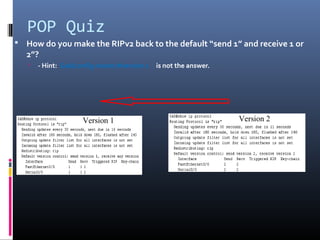
POP Quiz
 How do you make the RIPv2 back to the default “send 1” and receive 1 or
2”?
 - Hint: Gad(config-router)#version 1 is not the answer.
Version 1 Version 2
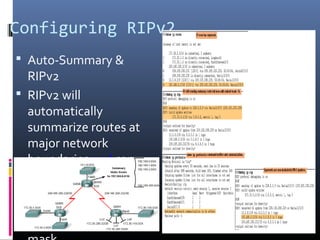
Configuring RIPv2
 Auto-Summary &
RIPv2
 RIPv2 will
automatically
summarize routes at
major network
boundaries and can
also summarize routes
with a subnet mask
that is smaller than
the classful subnet
Configuring RIPv2
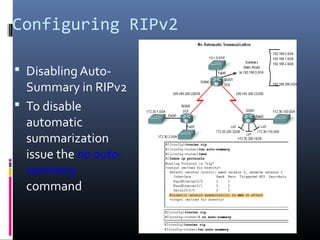
 Disabling Auto-
Summary in RIPv2
 To disable
automatic
summarization
issue the no auto-
summary
command
Configuring RIPv2
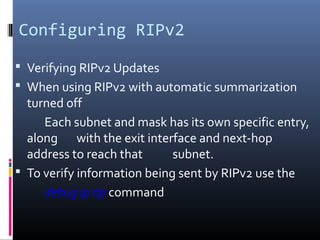
 Verifying RIPv2 Updates
 When using RIPv2 with automatic summarization
turned off
Each subnet and mask has its own specific entry,
along with the exit interface and next-hop
address to reach that subnet.
 To verify information being sent by RIPv2 use the
debug ip rip command
VLSM & CIDR
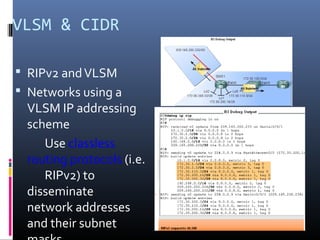
 RIPv2 andVLSM
 Networks using a
VLSM IP addressing
scheme
Use classless
routing protocols (i.e.
RIPv2) to
disseminate
network addresses
and their subnet
VLSM & CIDR
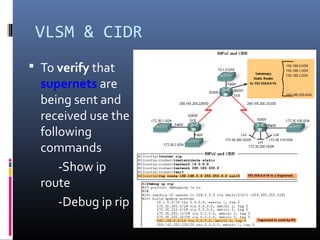
 CIDR uses Supernetting
Supernetting is a bunch of contiguous
classful networks that is addressed as
a single network.
VLSM & CIDR
 To verify that
supernets are
being sent and
received use the
following
commands
-Show ip
route
-Debug ip rip
Verifying & Troubleshooting
RIPv2 BasicTroubleshooting steps
-Check the status of all links
-Check cabling
-Check IP address & subnet mask
configuration
-Remove any unneeded configuration
commands
 Commands used to verify proper operation of
RIPv2
–Show ip interfaces brief
–Show ip protocols
Verifying & Troubleshooting
RIPv2 Common RIPv2 Issues
 When trouble shooting RIPv2 examine the following issues:
 Version
Check to make sure you are using version 2
 Network statements
Network statements may be incorrectly typed
or missing
 Automatic summarization
If summarized routes are not needed then disable
automatic summarization
Verifying & Troubleshooting
RIPv2 Reasons why it’s good to authenticate routing information
-Prevent the possibility of accepting invalid routing updates
-Contents of routing updates are encrypted
 Types of routing protocols that can use authentication
-RIPv2
-EIGRP
-OSPF
-IS-IS
-BGP
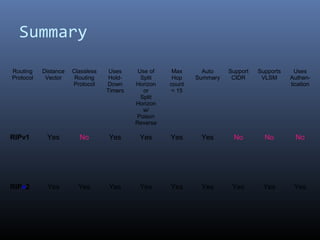
Summary
Routing
Protocol
Distance
Vector
Classless
Routing
Protocol
Uses
Hold-
Down
Timers
Use of
Split
Horizon
or
Split
Horizon
w/
Poison
Reverse
Max
Hop
count
= 15
Auto
Summary
Support
CIDR
Supports
VLSM
Uses
Authen-
tication
RIPv1 Yes No Yes Yes Yes Yes No No No
RIPv2 Yes Yes Yes Yes Yes Yes Yes Yes Yes
Ripv2

Ripv2

  • 1.
  • 2.
    Notes:  If yousee any mistake on my PowerPoint slides or if you have any questions about the materials, please feel free to email me at vivek.it@live.com Thanks Vivek Kumar TechnicalTrainer
  • 3.
    Objectives  Encounter anddescribe the limitations of RIPv1’s limitations.  Apply the basic Routing Information Protocol Version 2 (RIPv2) configuration commands and evaluate RIPv2 classless routing updates.  Analyze router output to see RIPv2 support for VLSM and CIDR  Identify RIPv2 verification commands and common RIPv2 issues.  Configure, verify, and troubleshoot RIPv2 in “hands-on” labs
  • 4.
    Introduction  Difference betweenRIPv1 & RIPv2 RIPv1 • A classful distance vector routing protocol • Does not support discontiguous subnets • Does not supportVLSM • Does not send subnet mask in routing update • Routing updates are broadcast RIPv2 • A classless distance vector routing protocol that is an enhancement of RIPv1’s features. • Next hop address is included in updates • Routing updates are multicast (224.0.0.9 vs. 255.255.255.255) • The use of authentication is an option http://www.cisco.com/univercd/cc/t d/doc/cisintwk/ito_doc/rip.htm
  • 5.
    Introduction  Similarities betweenRIPv1 & RIPv2 – Use of timers to prevent routing loops – Use of split horizon or split horizon with poison reverse to also help prevent routing loops. – Use of triggered updates when there is a change in the topology for faster convergence. – Maximum hop count of 15, with the hop count of 16 signifying an unreachable network.
  • 6.
    RIPv1 Limitations  LabTopology 3router set up Topology is discontiguous There exists a static summary route Static route information can be injected into routing table updates using redistribution. Routers 1 & 3 containVLSM networks Remember that both the R1 and R3 routers have subnets that are part of the 172.30.0.0/16 major classful network (class B). Also remember that R1 and R3 are connected to R2 using subnets of the 209.165.200.0/24 major classful network (class C). This topology is discontiguous and will not converge because 172.30.0.0/16 is divided by the 209.165.200.0/24.
  • 7.
    RIPv1 Limitations  Thetopology shows that R2 has a static summary route to the 192.168.0.0/16 network. The configuration of this summary route will be displayed later in this section.
  • 8.
    RIPv1 Limitations  ReviewtheVLSM addressing scheme in the figure. As shown in the top chart, both R1 and R3 have had the 172.30.0.0/16 network subnetted into /24 subnets. –Four of these /24 subnets are assigned: –two to R1 (172.30.1.0/24 and 172.30.2.0/24) –two to R3 (172.30.100.0/24 and 172.30.110.0/24).  In the bottom chart, we have taken the 172.30.200.0/24 subnet and subnetted it again, using the first four bits for subnets and the last four bits for hosts.The result is a 255.255.255.240 mask or /28. Subnet 1 and Subnet 2 are assigned to R3.
  • 9.
    RIPv1 Limitations  ScenarioContinued  VLSM -Recall this is sub netting the subnet  Private IP addresses are on LAN links  Public IP addresses are used onWAN links (through an ISP, or when inside users need to access outside sites, a public IP address must be used.)  Loopback interfaces -These are virtual interfaces that can be pinged and added to routing table Cisco has set these addresses aside for educational purposes.
  • 10.
    RIPv1 Limitations  Loopbackinterfaces Notice that R3 is using loopback interfaces (Lo0, Lo1, and Lo2). A loopback interface is a software-only interface that is used to emulate a physical interface.  Like other interfaces, it can be assigned an IP address. Loopback interfaces are also used by other routing protocols, such as OSPF, for different purposes.  These uses will be discussed in Chapter 11 OSPF. In a lab environment, loopback interfaces are useful in creating additional networks without having to add more physical interfaces on the router. A loopback interface can be pinged and the subnet can be advertised in routing updates. Therefore, loopback interfaces are ideal for simulating multiple networks attached to the same router. In our example, R3 does not need four LAN interfaces to demonstrate multiple subnets andVLSM. Instead, we use loopback interfaces.
  • 11.
    RIPv1 Limitations  Routeredistribution – Redistribution involves taking the routes from one routing source and sending those routes to another routing source. • In our example topology, we want the RIP process on R2 to redistribute our static route (192.168.0.0/16) by importing the route into RIP and then sending it to R1 and R3 using the RIP process. -R2(config-router)#redistribute static
  • 12.
    RIPv1 Limitations  R2(config)#iproute 192.168.0.0 255.255.0.0 Null0 –The address space represented by the static summary route 192.168.0.0/16 does not actually exist. –In order to simulate this static route, we use a null interface as the exit interface. – You do not need to enter any commands to create or configure the null interface. –It is always up but does not forward or receive traffic. Traffic sent to the null interface is discarded.
  • 13.
    Static routes andnull interfaces Static routes and null interfaces R2(config)#ip route 192.168.0.0 255.255.0.0 Null0 a static route must have an active exit interface before it will be installed in the routing table. Using the null interface will allow R2 to advertise the static route in RIP even though networks belonging to the summary 192.168.0.0/16 do not actually exist.
  • 14.
    Verifying and Testing Connectivityshow ip interfaces brief –To test whether or not the topology has full connectivity, we first verify that both serial links on R2 are up using the show ip interface brief  Ping Whenever R2 pings any of the 172.30.0.0 subnets on R1 or R3, only about 50% of the ICMP are successful. R1 is able to ping 10.1.0.1 but is unsuccessful when attempting to ping the 172.30.100.1 on R3 R3 is able to ping 10.1.0.1 but is unsuccessful when attempting to ping the 172.30.1.1 on R1.
  • 15.
    RIPv1 Limitations  RIPv1– a classful routing protocol –Subnet mask are not sent in updates –Summarizes networks at major network boundaries –RIPv1 cannot support discontiguous networks,VLSM, or CIDR. –if network is discontiguous and RIPv1 configured convergence will not be reached –RIPv1 on both the R1 and R3 routers will summarize their 172.30.0.0 subnets to the classful major network address of 172.30.0.0 when sending routing updates to R2. –From the perspective of R2, both updates have an equal cost of 1 hop to reach network 172.30.0.0/16. As you will see, R2 installs both paths in the routing table.
  • 16.
    RIPv1 Limitations Examining therouting tables -To examine the contents of routing updates use the debug ip rip command R2 is receiving two 172.30.0.0 equal cost routes with a metric of 1 hop. R2 is receiving one route on Serial 0/0/0 from R1 and the other route on Serial 0/0/1 from R3. R2 has two equal cost routes to the 172.30.0.0/16 network.
  • 17.
    RIPv1 Limitations •R1 hasits own 172.30.0.0 routes: 172.30.2.0/24 and 172.30.1.0/24. •But R1 does not send R2 those subnets. •R3 has a similar routing table. •Both R1 and R3 are boundary routers and are only sending the summarized 172.30.0.0 network to R2 in their RIPv1 routing updates. •As a result, R2 only knows about the 172.30.0.0/16 classful network and is unaware of any 172.30.0.0 subnets. •R2 that it is not including the 172.30.0.0 network in its updates to either R1 or R3. •Because the split horizon rule is in effect. •R2 learned about 172.30.0.0/16 on both the Serial 0/0/0 and Serial 0/0/1 interfaces, it does not include that network in updates it sends out these same interfaces.
  • 18.
    RIPv1 Limitations  BecauseRIPv1 does not send the subnet mask in routing updates, it cannot supportVLSM.  R3 router is configured withVLSM subnets, all of which are members of the class B network 172.30.0.0/16: –172.30.100.0/24 (FastEthernet 0/0) –172.30.110.0/24 (Loopback 0) –172.30.200.16/28 (Loopback 1) –172.30.200.32/28 (Loopback 2)  As we saw with the 172.30.0.0/16 updates to R2 by R3, –RIPv1 either summarizes the subnets to the classful boundary –or uses the subnet mask of the outgoing interface to determine which subnets to advertise. R4 is added to the topology connected to R3
  • 19.
    RIPv1 Limitations  Whyis RIPv1 on R3 not including the other subnets, 172.30.200.16/28 and 172.30.200.32/28, in updates to R4? – Those subnets do not have the same subnet mask as FastEthernet 0/0. – R3 will only include those 172.30.0.0 routes in its routing table with the same mask as the exit interface. – Since the interface is 172.30.100.1 with a /24 mask, it will only include 172.30.0.0 subnets with a /24 mask. The only one that meets this condition is 172.30.110.0. – The other 172.30.0.0 subnets, 172.30.200.16/28 and 172.30.200.32/28, are not included because the /28 masks do not match the /24 mask of the outgoing interface. R4 is added to the topology connected to R3
  • 20.
    RIPv1 Limitations  NoCIDR Support R2(config)#ip route 192.168.0.0 255.255.0.0 Null0 –the static route is included in R2's routing table, but R2 will not include the static route in its update –R1 is not receiving this 192.168.0.0/16 route in its RIP updates from R2,  Reason: Classful routing protocols do not support CIDR routes that are summarized with a smaller mask than the classful subnet mask –If the 192.168.0.0 static route were configured with a /24 mask or greater, this route would be included in the RIP updates.
  • 21.
    Configuring RIPv2  ComparingRIPv1 & RIPv2 Message Formats –RIPv2 Message format is similar to RIPv1 but has 2 extensions 1st extension is the subnet mask field allows a 32 bit mask to be included in the RIP route entry. the receiving router no longer depends upon the subnet mask of the inbound interface or the classful mask when determining the subnet mask for a route 2nd extension is the addition of next hop address The Next Hop address is used to identify a better next-hop address - if one exists - than the address of the sending router. If the field is set to all zeros (0.0.0.0), the address of the sending router is the best next-hop address.
  • 22.
    Configuring RIPv2  EnablingandVerifying RIPv2  Configuring RIP on a Cisco router –By default it is running RIPv1 –Even though the router only sends RIPv1 messages, it can interpret both RIPv1 and RIPv2 messages. –A RIPv1 router will just ignore the RIPv2 fields in the route entry. RIPv1 RIPv2
  • 23.
    Configuring RIPv2  ConfiguringRIPv2 on a Cisco router -Requires using the version 2 command -RIPv2 ignores RIPv1 updates  To verify RIPv2 is configured use the show ip protocols command
  • 24.
    Comparing RIP v1and v2  RIP v2  send and receive v2  RIP v1  send v1 but can receive both v1 and v2 Version 1 Version 2 No. I can not take version 1 Yes. I can take version 1 or 2 I can only send version 1 I can only send version 2 RIP network is broken
  • 25.
    POP Quiz  Howdo you make the RIPv2 back to the default “send 1” and receive 1 or 2”?  - Hint: Gad(config-router)#version 1 is not the answer. Version 1 Version 2
  • 26.
    Configuring RIPv2  Auto-Summary& RIPv2  RIPv2 will automatically summarize routes at major network boundaries and can also summarize routes with a subnet mask that is smaller than the classful subnet
  • 27.
    Configuring RIPv2  DisablingAuto- Summary in RIPv2  To disable automatic summarization issue the no auto- summary command
  • 28.
    Configuring RIPv2  VerifyingRIPv2 Updates  When using RIPv2 with automatic summarization turned off Each subnet and mask has its own specific entry, along with the exit interface and next-hop address to reach that subnet.  To verify information being sent by RIPv2 use the debug ip rip command
  • 29.
    VLSM & CIDR RIPv2 andVLSM  Networks using a VLSM IP addressing scheme Use classless routing protocols (i.e. RIPv2) to disseminate network addresses and their subnet
  • 30.
    VLSM & CIDR CIDR uses Supernetting Supernetting is a bunch of contiguous classful networks that is addressed as a single network.
  • 31.
    VLSM & CIDR To verify that supernets are being sent and received use the following commands -Show ip route -Debug ip rip
  • 32.
    Verifying & Troubleshooting RIPv2BasicTroubleshooting steps -Check the status of all links -Check cabling -Check IP address & subnet mask configuration -Remove any unneeded configuration commands  Commands used to verify proper operation of RIPv2 –Show ip interfaces brief –Show ip protocols
  • 33.
    Verifying & Troubleshooting RIPv2Common RIPv2 Issues  When trouble shooting RIPv2 examine the following issues:  Version Check to make sure you are using version 2  Network statements Network statements may be incorrectly typed or missing  Automatic summarization If summarized routes are not needed then disable automatic summarization
  • 34.
    Verifying & Troubleshooting RIPv2Reasons why it’s good to authenticate routing information -Prevent the possibility of accepting invalid routing updates -Contents of routing updates are encrypted  Types of routing protocols that can use authentication -RIPv2 -EIGRP -OSPF -IS-IS -BGP
  • 35.