Rashid Mahmood
Plant Manager
Dyson Research Laboratories (Pvt.) Limited
Mistake
 Derived from word “mistaka” (“to take in error,
to miscarry”); equivalent to mis-take
 “an act or judgement that is misguided or
wrong.”
Mistake
”Something wrong, but not intentional”
 “Essay is full of mistakes”
 “Sorry, I’ve made a mistake.”
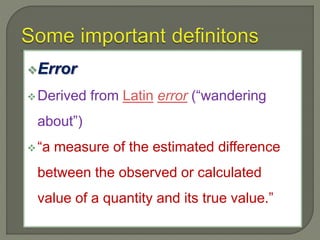
Error
Derived from Latin error (“wandering
about”)
“a measure of the estimated difference
between the observed or calculated
value of a quantity and its true value.”
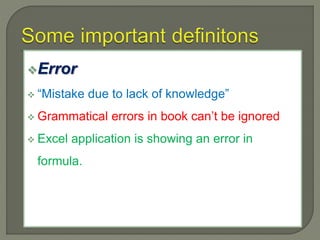
Error
 “Mistake due to lack of knowledge”
 Grammatical errors in book can’t be ignored
 Excel application is showing an error in
formula.
Fault
Fallere (Latin)….Faute meaning
“deceive”
“an unattractive or unsatisfactory feature,
especially in a piece of work or in a
person's character.”
Fault
“Generally used to communicate the idea
that wrong action was done with intention
& possibly malice”
 It was the fault of operator that machine part
got damaged
Blunder
 Different etymologies:
 Blonder (“disturbance, strife”),
 Blanden (“to mix; mix up”), corresponding to blend + -
er
 From old Norse “blunda” (“to shut the eyes; doze”).
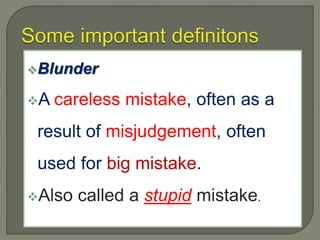
Blunder
A careless mistake, often as a
result of misjudgement, often
used for big mistake.
Also called a stupid mistake.
Blunder
Last minute blunder of full back
resulted in penalty stroke to
opponent team and hockey
match was lost.
Mistake Error
Informal Formal
Non systematic Systematic
Non technical Technical
Lack of performance Lack of competence
Mistake Error
Not serious Serious
Native/Non native Native only
Non technical Technical
Non significant Significant
Easier to correct Difficult to correct
"Machines never make
mistakes, but rather they
make errors. People can
make both."
False “True” or false
“False” results
Defective products
Damaged tools/equipment
Operator injury
Excessive wastage
Legal Notices
Loss of data integrity
Loss of business
Annoyed customer
Lower morale
Loss of job
Damage to end user
Rework/reprocess
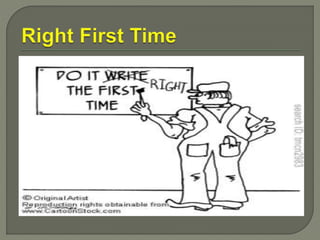
Right First Time…
No repetitions
“Performing the given
task without failure
leading to process repeat
or regeneration of
documents” i.e; no
mistakes
Time
Money
Resources
Loss of reputation
Professionalism
Why Fail to be Right First
Time?
How to be Right First
Time?
Faith System
Knowledge
Training
Management System
Mistakes are……inevitable
Many other things to prove
human become secondary
No mistake, no learning
Do there exit other ways of
learning also?
Double standards
Would we expect/accept physician give us
wrong medication by mistake??
Would we expect/accept to go home to
wrong house periodically??
Would we expect/accept any short
changed amount in our monthly salary??
NO
It does not bother us to make
a few errors, and in-fact we
plan to accommodate these
errors to occur
We don’t maintain the same
thinking when it comes to our
personal matters
We need to adopt
“First Time, First Right” attitude
that means….. Getting rid
of this “Double Standard” by
making personal commitment to
not accept any errors or deviation
We need to develop a culture of
“Responsibility”
“Ownership”
What matters the most after a
mistake is made???
“Personal Response”
Admit mistakes with no delay
Maintain a culture of truth
Give up “So what…!!” attitude
Don’t decide yourself grade of your own
mistakes.
Customer (internal/external) is the best
judge
“Big sins” are those committed as “little”
(Hazrat Ali R.A)
Don’t compare with others’ mistakes
‫خراب‬ ‫نئیں‬ ‫کلے‬ ‫اسی‬
‫جناب‬ ‫نیں‬ ‫سارے‬ ‫ایتھے‬
‫حساب‬ ‫گا‬ ‫ھووے‬ ‫جدوں‬
‫گے‬ ‫الں‬ ‫ویکھ‬ ‫اودوں‬
People with appropriate
education, knowledge &
experience should only
perform the jobs
Get thorough knowledge about
your job, your machine, your
instrument etc.
Study your processes, SOPs,
instructions and directives &
keep updated.
Say “NO” to jobs you don’t
know or at least till you don’t
know.
Saying “NO” on right occasions
increases your credibility.
Solve a problem:
In a school 20% of the boys
wear spectacles and 20% of
the girls wear spectacles. There
are 40 boys and 60 girls. How
many of the children wear
spectacles?
Lack of training leads to
commitment of mistakes.
Training on the importance of
“Right First Time” should be the
most important content of
training material.
Don’t assume your workers are
trained; create tangible evidence
of training.
Don’t let workers work
independently until trained well.
Training must be something
beyond “lecture” and training
sessions.
Create a strong reason for making
training successful
Attitude
Process
Adherence
Quality
Work
Attitude Training
Knowled
ge
Right
First
Time
Analysis of mistakes & reasons
thereof are not evaluated
systematically
SOPs & work instruction don’t
explain way out to avoid
mistakes.
Data on number of mistakes/
errors is not compiled &
analyzed.
Preventive measures to
anticipate & control errors are
usually weaker.
Weak administrative control
does not exert enough pressure
to feel people accountability on
their mistakes.
Weak administrative control
does not exert enough pressure
to feel people accountability on
their mistakes.
Providing comfortable work
environment
Imbalanced work load
Non systematic control (Lacking
scheduled checks)
Lack of self and counter
verification & reviews
Types of errors in data entry
Transcription errors: Typos,
repetitions and deletions
Transposition errors: where
information are input in wrong
place or order e.g 213 instead
of 123
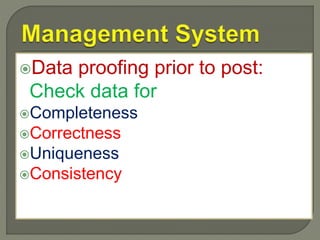
Data proofing prior to post:
Check data for
Completeness
Correctness
Uniqueness
Consistency
Zero defect quality control
Total quality management
(TQM)
Poka Yoke
Kaizen
Kaizen with 5-S
Poka Yoke
Means “Fail Safing” or “Mistake
proofing”
YOKE’ To avoid
POKA’ Inadvertent mistake
Developed by Dr. Shigeo
Shingo
Poka Yoke
Poka Yoke
Level 3: Can not produce
 USB Slots
 Assembly fixtures
Level 2: Can not process (also
called warning level)
 Gives notification
 Light, sound etc
Level 1: Can not accept
or pass
Keeps defect not passing to the next
step, stage or person
Checklists
End line inspections
Feel awful..
Keep things in perspective
Balance your regret
Apologize if required-Don’t over do
Plan to avoid recurrence
Take care of your health
Regain your Trust
1. Give full attention to your work
2. Adhere to procedures
3. Avoid distractions
4. Take breaks
5. Ask Questions
6. Create checklist
7. Be clear about your role
8. Review your work
8. Learn from mistakes
Questions/Discussion is
Welcome

Right first time, every time