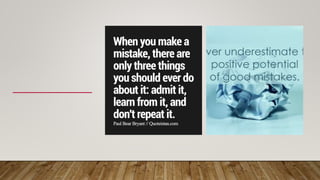
SEE MISTAKES AS ANEW LEARNING OPPORTUNITY
MONA NAFEA
M.D
INTELLIGENT QUOTES
• A smart man makes a mistake,
learns from it, and never makes
that mistake again." – Roy H.
Williams (1958-), U.S. author and
marketing expert
NEVER MIND
BUT TO LEARN
• No one is immune to making mistakes – we are
human, after all! But if we simply apologize and
carry on as before, we're in danger of repeating
the same errors.
RISK BENEFIT
• When we don't learn from our mistakes, we inflict
unnecessary stress on ourselves and on others,
and we risk losing people's confidence and trust in
us.
HOW TO STOP
REPEATING
MISTAKES
• Here are five steps to help you to learn from your
mistakes, and to put what you discover into
practice.
• 1. Own Your Mistakes
• You can't learn anything from a mistake until you admit
that you've made it. So, take a deep breath and admit to
yours, and then take ownership of it. Inform those who
need to know, apologize, and tell them that you're
working on a solution.
• Saying "sorry" takes courage, but it's far better to come
clean than to hide your error or, worse, to blame others
for it. In the long run, people will remember your
courage and integrity long after they've forgotten the
original mistake.
STOP BEATING YOURSELF UP, PAUSE FOR A MOMENT TO REFLECT, AND START
THINKING ABOUT HOW YOU CAN GAIN FROM THE SITUATION.
• 2. Reframe the Error
• How you view your mistakes determines the way that you react to them, and what you
do next.
• Chances are, you'll view your error in a purely negative light for as long as any initial
shock and discomfort about it persists. But, if you can reframe your mistake as an
opportunity to learn, you will motivate yourself to become more knowledgeable and
resilient.
• When you've acknowledged your mistake, think about what you could do to prevent it
from happening again. For example, if you didn't follow a process properly, consider
introducing a more robust checklist or a clearer process document.
3. ANALYZE
YOUR MISTAKE
• Next, you need to analyze your mistake honestly
and objectively. Ask yourself the following
questions:
• What was I trying to do?
• What went wrong?
• When did it go wrong?
• Why did it go wrong?
HOW IT GO
• 5 Whys, describes a straightforward yet powerful tool for identifying the causes of
simple or moderately difficult problems. To use it, start with the error and keep
asking "Why?" until you get to the root cause.
• For complex or more critical issues, a more in-depth tool, such as Causal Factor
Charting, may be more appropriate.
• Conducting this "postmortem" should reveal what led to the mistake and
highlight what needs to change in order to avoid a repeat.
4-PUT LESSONS LEARNED INTO PRACTICE
• The danger at this stage is that work pressures force you back to your routine
tasks and habitual behaviors. The lessons that you identified in Step 3 could
languish, unfulfillled, as mere good intentions. In other words, learning lessons
is one thing, but putting them into practice is quite another!
• Chances are, acting on what you've learned will require the discipline and
motivation to change your habits, or to change the way that your team works.
Doing so will help you to avoid self-sabotage in the future, and will allow you to
reap the rewards and benefits of implementing better work practices.
• Here, you need to identify the skills, knowledge, resources, or tools that will
keep you from repeating the error.
• Do so with care, though, because "quick fixes" will likely lead to further
mistakes. Any actions that you take to implement your learning need to be
enduring, and something that you can commit to.
PERSONAL VERSUS OTHER TYPES
• If your mistake was a minor or a personal one, personal goals and action
plans will lay the groundwork for implementing the lessons you've learned. They
can give you a timescale to work to, and a list of the tasks that you'll need to
complete.
• The specific tools that you use from there on will depend on the lessons that you
need to put into practice.
• For example, if you learned that a mistake occurred because of your
forgetfulness, aides-mémoire or greater attention to detail could help. If you
found that your organizational skills were below par, digital planners and
spreadsheets would be useful.
COMMUNICATE
EFFECTIVELY
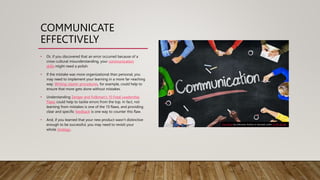
• Or, if you discovered that an error occurred because of a
cross-cultural misunderstanding, your communication
skills might need a polish.
• If the mistake was more organizational than personal, you
may need to implement your learning in a more far-reaching
way. Writing clearer procedures, for example, could help to
ensure that more gets done without mistakes.
• Understanding Zenger and Folkman's 10 Fatal Leadership
Flaws could help to tackle errors from the top. In fact, not
learning from mistakes is one of the 10 flaws, and providing
clear and specific feedback is one way to counter this flaw.
• And, if you learned that your new product wasn't distinctive
enough to be successful, you may need to revisit your
whole strategy.
This Photo by Unknown Author is licensed under CC BY-SA-NC
5-REVIEW YOUR
PROGRESS
• You may have to try out several ways to put your
learning into practice before you find one that
successfully prevents you from repeating past
errors. The Plan-Do-Check-Act cycle is a great tool
for pinpointing the most effective solutions.
• From there, monitor the efficacy of your chosen
tactic by reviewing the number and nature of
mistakes that do – or don't! – still get made.
Asking someone to hold you accountable can help
you to stay committed to your new course of
action.
THANK YOU

learning moments.pptx

  • 1.
    SEE MISTAKES ASANEW LEARNING OPPORTUNITY MONA NAFEA M.D
  • 2.
    INTELLIGENT QUOTES • Asmart man makes a mistake, learns from it, and never makes that mistake again." – Roy H. Williams (1958-), U.S. author and marketing expert
  • 4.
    NEVER MIND BUT TOLEARN • No one is immune to making mistakes – we are human, after all! But if we simply apologize and carry on as before, we're in danger of repeating the same errors.
  • 5.
    RISK BENEFIT • Whenwe don't learn from our mistakes, we inflict unnecessary stress on ourselves and on others, and we risk losing people's confidence and trust in us.
  • 6.
    HOW TO STOP REPEATING MISTAKES •Here are five steps to help you to learn from your mistakes, and to put what you discover into practice.
  • 7.
    • 1. OwnYour Mistakes • You can't learn anything from a mistake until you admit that you've made it. So, take a deep breath and admit to yours, and then take ownership of it. Inform those who need to know, apologize, and tell them that you're working on a solution. • Saying "sorry" takes courage, but it's far better to come clean than to hide your error or, worse, to blame others for it. In the long run, people will remember your courage and integrity long after they've forgotten the original mistake.
  • 8.
    STOP BEATING YOURSELFUP, PAUSE FOR A MOMENT TO REFLECT, AND START THINKING ABOUT HOW YOU CAN GAIN FROM THE SITUATION. • 2. Reframe the Error • How you view your mistakes determines the way that you react to them, and what you do next. • Chances are, you'll view your error in a purely negative light for as long as any initial shock and discomfort about it persists. But, if you can reframe your mistake as an opportunity to learn, you will motivate yourself to become more knowledgeable and resilient. • When you've acknowledged your mistake, think about what you could do to prevent it from happening again. For example, if you didn't follow a process properly, consider introducing a more robust checklist or a clearer process document.
  • 9.
    3. ANALYZE YOUR MISTAKE •Next, you need to analyze your mistake honestly and objectively. Ask yourself the following questions: • What was I trying to do? • What went wrong? • When did it go wrong? • Why did it go wrong?
  • 10.
    HOW IT GO •5 Whys, describes a straightforward yet powerful tool for identifying the causes of simple or moderately difficult problems. To use it, start with the error and keep asking "Why?" until you get to the root cause. • For complex or more critical issues, a more in-depth tool, such as Causal Factor Charting, may be more appropriate. • Conducting this "postmortem" should reveal what led to the mistake and highlight what needs to change in order to avoid a repeat.
  • 11.
    4-PUT LESSONS LEARNEDINTO PRACTICE • The danger at this stage is that work pressures force you back to your routine tasks and habitual behaviors. The lessons that you identified in Step 3 could languish, unfulfillled, as mere good intentions. In other words, learning lessons is one thing, but putting them into practice is quite another! • Chances are, acting on what you've learned will require the discipline and motivation to change your habits, or to change the way that your team works. Doing so will help you to avoid self-sabotage in the future, and will allow you to reap the rewards and benefits of implementing better work practices. • Here, you need to identify the skills, knowledge, resources, or tools that will keep you from repeating the error. • Do so with care, though, because "quick fixes" will likely lead to further mistakes. Any actions that you take to implement your learning need to be enduring, and something that you can commit to.
  • 12.
    PERSONAL VERSUS OTHERTYPES • If your mistake was a minor or a personal one, personal goals and action plans will lay the groundwork for implementing the lessons you've learned. They can give you a timescale to work to, and a list of the tasks that you'll need to complete. • The specific tools that you use from there on will depend on the lessons that you need to put into practice. • For example, if you learned that a mistake occurred because of your forgetfulness, aides-mémoire or greater attention to detail could help. If you found that your organizational skills were below par, digital planners and spreadsheets would be useful.
  • 13.
    COMMUNICATE EFFECTIVELY • Or, ifyou discovered that an error occurred because of a cross-cultural misunderstanding, your communication skills might need a polish. • If the mistake was more organizational than personal, you may need to implement your learning in a more far-reaching way. Writing clearer procedures, for example, could help to ensure that more gets done without mistakes. • Understanding Zenger and Folkman's 10 Fatal Leadership Flaws could help to tackle errors from the top. In fact, not learning from mistakes is one of the 10 flaws, and providing clear and specific feedback is one way to counter this flaw. • And, if you learned that your new product wasn't distinctive enough to be successful, you may need to revisit your whole strategy. This Photo by Unknown Author is licensed under CC BY-SA-NC
  • 14.
    5-REVIEW YOUR PROGRESS • Youmay have to try out several ways to put your learning into practice before you find one that successfully prevents you from repeating past errors. The Plan-Do-Check-Act cycle is a great tool for pinpointing the most effective solutions. • From there, monitor the efficacy of your chosen tactic by reviewing the number and nature of mistakes that do – or don't! – still get made. Asking someone to hold you accountable can help you to stay committed to your new course of action.
  • 15.