RICE HUSK ASH
Rice husk
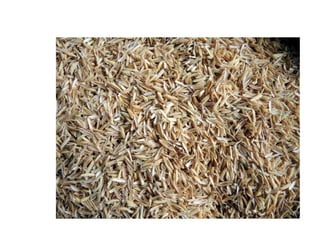
• They are the hard protecting coverings of grains of rice.
• It is used as fuel in the boilers for processing of paddy producing energy
through direct combustion and / or by gasification .
• for every 1000 kgs of paddy milled , about 220 kgs ( 22 %) of husk is
produced.
Rice hull ash/Rice husk ash
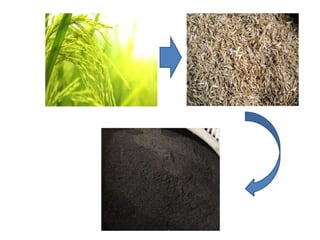
• Combustion of rice hulls affords rice husk ash (RHA).
• Concrete made with RHA as a partial cement substitute to levels of 10% to
20% by weight of cement has superior performance characteristics
compared to normal concrete.
• The fineness of the ash also makes it a very good candidate for sealing fine
cracks in civil structures, where it can penetrate deeper than the
conventional cement sand mixture.
• When burnt completely, the ash can have a Blaine no. of as much as 3,600
compared to the Blaine no. of cement between 2,800 to 3,000, meaning it is finer
than cement.
• RHA is about 25% by weight of rice husk when burnt in boilers. It is estimated
that about 70 million tones of RHA is produced annually worldwide.
• So for every 1000 kgs of paddy milled , about 220 kgs ( 22 % ) of husk is produced
, and when this husk is burnt in the boilers , about 55 kgs ( 25 % ) of RHA is
generated.
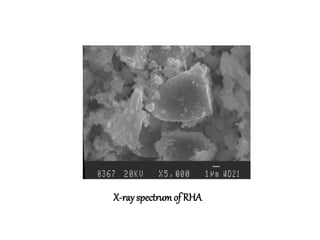
X-rayspectrumof RHA
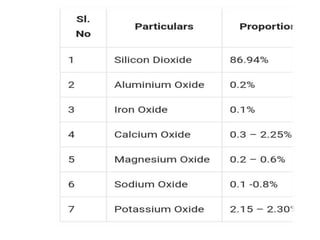
Chemical composition
The rice husk ash possesses a chemical composition similar to many of the
organic fibre.
 Cellulose
 Lignin
 Hemi cellulose
 SiO2
 holocellulose
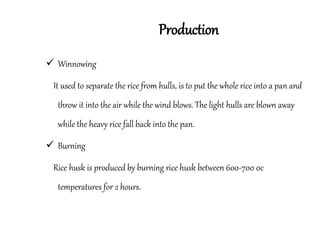
Production
 Winnowing
It used to separate the rice from hulls, is to put the whole rice into a pan and
throw it into the air while the wind blows. The light hulls are blown away
while the heavy rice fall back into the pan.
 Burning
Rice husk is produced by burning rice husk between 600-700 0c
temperatures for 2 hours.
Winnowing Procedure
Types of burning process
 On field burning
Produce poor quality of rice hush ash and also it has low reactivity.
 Fluidized -bed furnace burning
 This is a controlled method of burning the rice husk.
 The combustion heat of rice husk is used for the generation of electricity.
 Industrial furnace
 This is more environmental and economical method of burning
 The efficient combustion will give a silica content of 90-95%.
When Mixed with concrete…
 The heat of hydration is reduced this results in drying shrinkage and durability of
concrete.
 Reduction in permeability of concrete results in the disintegration of concrete
structure.
 Resistance against chloride and sulphate attack.
 Reduce the failure of RCC beam.
Applications
 High performance concrete
 Insulator
 Green concrete
 Bathroom floors
 Industrial factory flooring
 Concreting the foundation
 Swimming pools
 Water proofing and rehabilitation
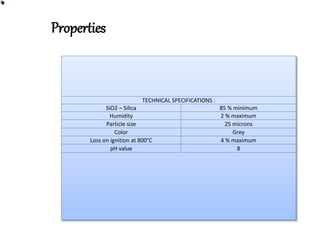
TECHNICAL SPECIFICATIONS :
SiO2 – Silica 85 % minimum
Humidity 2 % maximum
Particle size 25 microns
Color Grey
Loss on ignition at 800°C 4 % maximum
pH value 8
Properties
Advantages
 Improves compressive strength ,flexural strength and split tensile strength
of concrete when mixed with RHA.
 RHA mixed with concrete shows better bond strength as compared to
OPC concrete.
• RHA makes a role to increase resistance to chemical reactions.
• RHA would result in a reduction of the cost of concrete construction,
• Reduction of the environmental greenhouse effects.
Disadvantages
• Suitable incinerator /Furner as well as grinding method is required for burning
and grding rice husk in order to obtain good quality ash
• Transportation problem
• Unburnt RHA is not suitable for concrete production.
THANK YOU

Rice husk ash

  • 1.
  • 2.
    Rice husk • Theyare the hard protecting coverings of grains of rice. • It is used as fuel in the boilers for processing of paddy producing energy through direct combustion and / or by gasification . • for every 1000 kgs of paddy milled , about 220 kgs ( 22 %) of husk is produced.
  • 4.
    Rice hull ash/Ricehusk ash • Combustion of rice hulls affords rice husk ash (RHA). • Concrete made with RHA as a partial cement substitute to levels of 10% to 20% by weight of cement has superior performance characteristics compared to normal concrete. • The fineness of the ash also makes it a very good candidate for sealing fine cracks in civil structures, where it can penetrate deeper than the conventional cement sand mixture.
  • 5.
    • When burntcompletely, the ash can have a Blaine no. of as much as 3,600 compared to the Blaine no. of cement between 2,800 to 3,000, meaning it is finer than cement. • RHA is about 25% by weight of rice husk when burnt in boilers. It is estimated that about 70 million tones of RHA is produced annually worldwide. • So for every 1000 kgs of paddy milled , about 220 kgs ( 22 % ) of husk is produced , and when this husk is burnt in the boilers , about 55 kgs ( 25 % ) of RHA is generated.
  • 6.
  • 7.
    Chemical composition The ricehusk ash possesses a chemical composition similar to many of the organic fibre.  Cellulose  Lignin  Hemi cellulose  SiO2  holocellulose
  • 9.
    Production  Winnowing It usedto separate the rice from hulls, is to put the whole rice into a pan and throw it into the air while the wind blows. The light hulls are blown away while the heavy rice fall back into the pan.  Burning Rice husk is produced by burning rice husk between 600-700 0c temperatures for 2 hours.
  • 10.
  • 12.
    Types of burningprocess  On field burning Produce poor quality of rice hush ash and also it has low reactivity.  Fluidized -bed furnace burning  This is a controlled method of burning the rice husk.  The combustion heat of rice husk is used for the generation of electricity.
  • 13.
     Industrial furnace This is more environmental and economical method of burning  The efficient combustion will give a silica content of 90-95%.
  • 14.
    When Mixed withconcrete…  The heat of hydration is reduced this results in drying shrinkage and durability of concrete.  Reduction in permeability of concrete results in the disintegration of concrete structure.  Resistance against chloride and sulphate attack.  Reduce the failure of RCC beam.
  • 15.
    Applications  High performanceconcrete  Insulator  Green concrete  Bathroom floors  Industrial factory flooring  Concreting the foundation  Swimming pools  Water proofing and rehabilitation
  • 16.
    TECHNICAL SPECIFICATIONS : SiO2– Silica 85 % minimum Humidity 2 % maximum Particle size 25 microns Color Grey Loss on ignition at 800°C 4 % maximum pH value 8 Properties
  • 17.
    Advantages  Improves compressivestrength ,flexural strength and split tensile strength of concrete when mixed with RHA.  RHA mixed with concrete shows better bond strength as compared to OPC concrete. • RHA makes a role to increase resistance to chemical reactions. • RHA would result in a reduction of the cost of concrete construction, • Reduction of the environmental greenhouse effects.
  • 18.
    Disadvantages • Suitable incinerator/Furner as well as grinding method is required for burning and grding rice husk in order to obtain good quality ash • Transportation problem • Unburnt RHA is not suitable for concrete production.
  • 19.