Rice Production Technology For Sustainability
Mohammad Irshad
Entomology
A.M.U Aligarh
 Rice is the most broadly used staple food in large part of the world population, especially in Asia.
 As the world population is expected to increase to 9.2 billion by 2050, there is a dare need to increase
global food production to overcome the demand of world population.
 The two major rice varieties grown world wide today are Oryza sativa indica and Oryza sativa
japonica. The two cultivated rice species, Oryza sativa L. and O. glaberrima Steud., belong to a
species group called Oryza sativa complex.
 It’s the commodity with the maximum global wide production after sugarcane and maize.
 Rice adds up to 780 and 689 kcal/capita/day of the food supply in Asia and India, respectively
 Rice being a tropical and sub-tropical plant, requires a fairly high temperature, ranging from 20° to
30°C.
 Clay loam soil (27- 40% clay content) in monsoon land and pH range of 5.5 - 6.5 is considered to be
the best for rice cultivation.
Introduction
Nutritional value of Rice
Prod
uct
Moist
ure
Prote
in
Fat Crud
e
fibre
Carboh
ydrate
Ash Calories Ca Fe Thia
mine
Ribof
lavin
Niaci
n
Brow
n
Rice
12 7.5 1.9 0.9 76.5 1.2 360 32 1.6 0.54 0.05 4.7
White
Rice
12 6.7 0.4 0.3 80.1 0.5 363 24 2.9 0.07 0.03 1.6
Parbo
iled
Rice
10 7.4 0.3 0.2 81.1 0.7 369 60 2.9 0.44 - 3.5
 Most of the nutrient and minerals are concentrated in the outer brown layers known as husk and germs.
 Brown rice a type of rice from which only husk has been removed, is the most nutritious type of rice.
Rice Growing Regions
 The rice growing areas in the country can be broadly grouped into five regions as given below:
 North-Eastern Region: This region comprises of Assam and North eastern states. In Assam rice is grown in
the Basin of Brahmnaputra River. This region receives very heavy rainfall and rice is grown under rain fed
condition.
 Eastern Region: It region comprises of Bihar, Chhattisgarh, Jharkhand, Madhya Pradesh, Orissa, Eastern
Uttar Pradesh and West Bengal. In this region rice is grown in the basins of Ganga and Mahanadi rivers and
has the highest intensity of rice cultivation in the country. This region receives heavy rainfall and rice is
grown mainly under rainfed conditions.
 Northern Region: This region comprises of Haryana, Punjab, Western Uttar Pradesh, Uttarakhand,
Himachal Pradesh and Jammu & Kashmir. The region experiences low winter temperature and single crop
of rice from May-July to September-December is grown.
 Western Region: This region comprises of Gujarat, Maharashtra and Rajasthan. Rice is largely grown under
rainfed condition during June-August to October - December.
 Southern Region: This region comprises of Andhra Pradesh, Karnataka, Kerala and Tamil Nadu. Rice is
mainly grown in deltaic tracts of Godavari, Krishna and Cauvery rivers and the non-deltaic rainfed area of
Tamil Nadu and Andhra Pradesh. Rice is grown under irrigated condition in deltaic tracts.
Rice ecosystems in India
 In India, rice is grown under highly diverse conditions with area stretching from 79° to 90°E
longitude and 16° to 28° N latitude under varying Agro-ecological zones.
 It is cultivated mostly in wet season with unpredictable rainfall distribution.
 Rice is primarily grown under four major ecosystems broadly classified as
 (i) irrigated, (ii) rainfed lowland, (iii) rainfed upland
 Irrigated rice eco-system: Total area under irrigated rice in the country is about 26.0 mha
accounting for about 60% of the total area under the crop. It includes the areas in Punjab,
Haryana, Uttar Pradesh, Jammu & Kashmir, Andhra Pradesh, Telangana, Tamil Nadu,
Karnataka, Himachal Pradesh and Gujarat
 Rainfed lowland rice ecosystem: In India, lowland rice covers an area of about 12.0 mha,
which accounts for about 27% of the total area, located mainly in eastern India. The area is
characterized by poor soil quality and frequent occurrence of drought/flood due to erratic rains.
 Rainfed upland rice ecosystem: Total area under rainfed upland rice in the country is about
4.8 mha, which accounts for 11% of total area, located mainly in Eastern Zone i.e., Assam,
Bihar, Chhattisgarh, Eastern Uttar Pradesh, Jharkhand, Madhya Pradesh, Odisha, West Bengal,
and North East Hill Region. The rainfed upland ecosystem is drought prone.
Rice based Cropping Pattern
Irrigated Condition Upland condition Rice under integrated farming system
Rice-Rice-Rice Rice-Chickpea Rice-Fish-Poultry
Rice-Rice-Cereal Rice-Lentil Rice-Fish-Duckery
Rice-Rice-Pulses Rice-Mustard/Linseed
Rice-Wheat-Pulse Rice-Barley
Rice-Toria-Wheat Rice-Wheat
Rice-Wheat Rice-Pea
Rice-Mustard
Variety Ecology Year Duration (Days) Grain type Released by
cvrc/svrc
Reaction to insect pests and Average
Grain Yield t/ha
Grain yield (t/ha)
CR Dhan 313 Irrigated 2020 130-135 MS CVRC
(Chattisgarh and
Maharashtra)
highly tolerant to biotype 5 of gall
midge and also rice whorl maggot,
leaf folder and rice thrips, moderately
tolerant to stem borer (both DH and
WEH)
4.8 t/ha.
CR Dhan 602 Boro 2020 155
(Boro)
125 (Non-
boro)
LS CVRC (Assam
and Tripura)
resistance to plant hopper
(predominantly WBPH) and
moderately resistant to stem borer
(DH), Long slender grains
6.0 t/ha.
Santha Bhima
(CR Dhan 102)
Upland 2020 105-110 SB Odisha Moderately resistant to stem borer,
leaf folder and whorl maggot,
3.9 t/ha
Sarumina
(CR Dhan 210)
Aerobic 2020 110-115 LS Odisha Moderately resistant to stem borer,
leaf folder and green leaf hopper
7.8 t/ha
CR Dhan 308 Irrigated 2020 135 MS CVRC
(Chattisgarh and
Maharashtra)
Tolerant to Stem Borer (both dead hearts
and white ear heads), leaf folder, whorl
maggot and rice hispa
5.0 t/ha
CR Dhan 314
(Identified by VIC,
2020)
Irrigated 2020 130-135 LB CVRC (Odisha &
Bihar)
Resistant to leaf folder and moderately
resistant to stem borer (Dead heart)
5.0 t/ha
CR Dhan 318
(Identified by VIC,
2021)
Irrigated 2021 118-120 LS CVRC (Bihar,
West Bengal,
Uttarakhand and
Haryana)
Highly tolerant to leaf folder, stem borer
(dead heart), and whorl maggot insect
pests. Moderately tolerant to gall midge
(Biotype 1) and stem borer (white ear
heads)
5.4-6 t/ha
CR Dhan 319
(Identified by VIC,
2021)
Irrigated 2021 130 -135 SB CVRC (Bihar and
Odisha)
highly tolerant to stem borer (DH and
WEH),leaf folder, whorl maggot and rice
thrips, moderate tolerance to BPH and
other plant hopper
6.0 t/ha
*Grain: LS – Long Slender MB -Medium Bold, MS -Medium Slender, SB-Short Bold, MB-Medium Bold, BPH – Brown Plant Hopper, BS -Brown Spot, GB -Gundhi
Bug, GM -Gall Midge, GLH – Green Leaf Hopper
Varieties Released from Central Rice Research Institute, Cuttack Odisha
Rice Research Station, Tirur (Tamilnadu)- Varieties releases
Varieties Pedigree/parentage Duration Suitable season Special characters
TKM 1 Pure line selection from local
variety Pisini
130 Samba (July-Aug sowing) Coarse grain, red rice suitable for rainfed
sowing
TKM 2 Pure line selection from local
variety Sembalai
125 Samba (July-Aug sowing) Medium grain, white rice suitable for
rainfed sowing
TKM 3 Pure line selection from local
variety Sornavari
105-110 Sornavari (May-June sowing) Coarse grain, white rice Suitable for
irrigated
TKM 4 Pure line selection from Yerra
sannavadu
115 Samba (July-Aug) Navarai(Dec-
Jan)
Fine grain, Suitable for both irrigated and
rainfed conditions
TKM 5 Pure line selection from local
Manakkattai
105-115 Navarai Sornavari Red rice (Puttu rice) withstands drought
TKM 6 CO 18/GEB 24 115 Navarai, Sornavari
Fine grain,white rice, resistant to SB and
GLH. IRRI identified this as universal
donor for stem borer resistance
TKM 7
Pure line selection from local
Kullakar 105-110 Samba Navarai
Bold grain, red rice, suitable for both
irrigated and rainfed conditions, comes up
well in alkaline soils
Integrated nutrient management (INM): at a glance
 Optimum soil health management is the key to success in any crop production.
 A healthy and vibrant soil can withstand drought/other problems better compared to a sick/ poorly
managed soil.
 Apply FYM/Compost/other manure at 5t/ha
 Recycle at least 1/3rd rice straw and all the weed biomass into the field.
 Use biofertilizer (Azolla, Azotobacter, PSB, Azospirillum etc), bio-organics and green manures.
 Azolla should be incorporated into the soil before transplanting or it can be taken as dual crop i.e.,
inoculation of fresh Azolla @ 2 t/ha, at 7-10 days after transplanting (DAT) in standing water (5
cm) with 20 kg Phosphorus/ha
 Follow crop rotation with leguminous crop/pulses (Rice bean, groundnut, soybean, pea, lentil etc).
 Under INM on-farm resources are efficiently utilized and dependence on external resources and
fertilizer is minimized.
 pest management has a neutral or positive effect on soil quality
 soil nutrient management has a neutral or positive effect on pest levels
Examples of using fertilizer to help manage pests
 N applications decrease thrips populations
 Phosphorous (P) improves tolerance for root pests
 Potassium (K) tends to suppress pests
 Silicon increases resistance to blast, bacterial blight, planthoppers
and stem borers
 Zinc reduces stem borer damage
 Raise pest levels
 Lower pest levels
 Raise the levels of some pests and lower the levels of others
 Have no effect on pest levels
 WHAT IS KNOWN?
Nitrogen & insects
 Increase insect tolerance to stress
 Greater insect fecundity (e.g. sucking insects)
 Increases insect feeding rate
 More abundant, e.g. brown planthopper
 Less abundant, e.g. thrips and whorl maggot
 Rice attracts more pest
 Promotes recovery from pest damage
Fertilizer applications can:
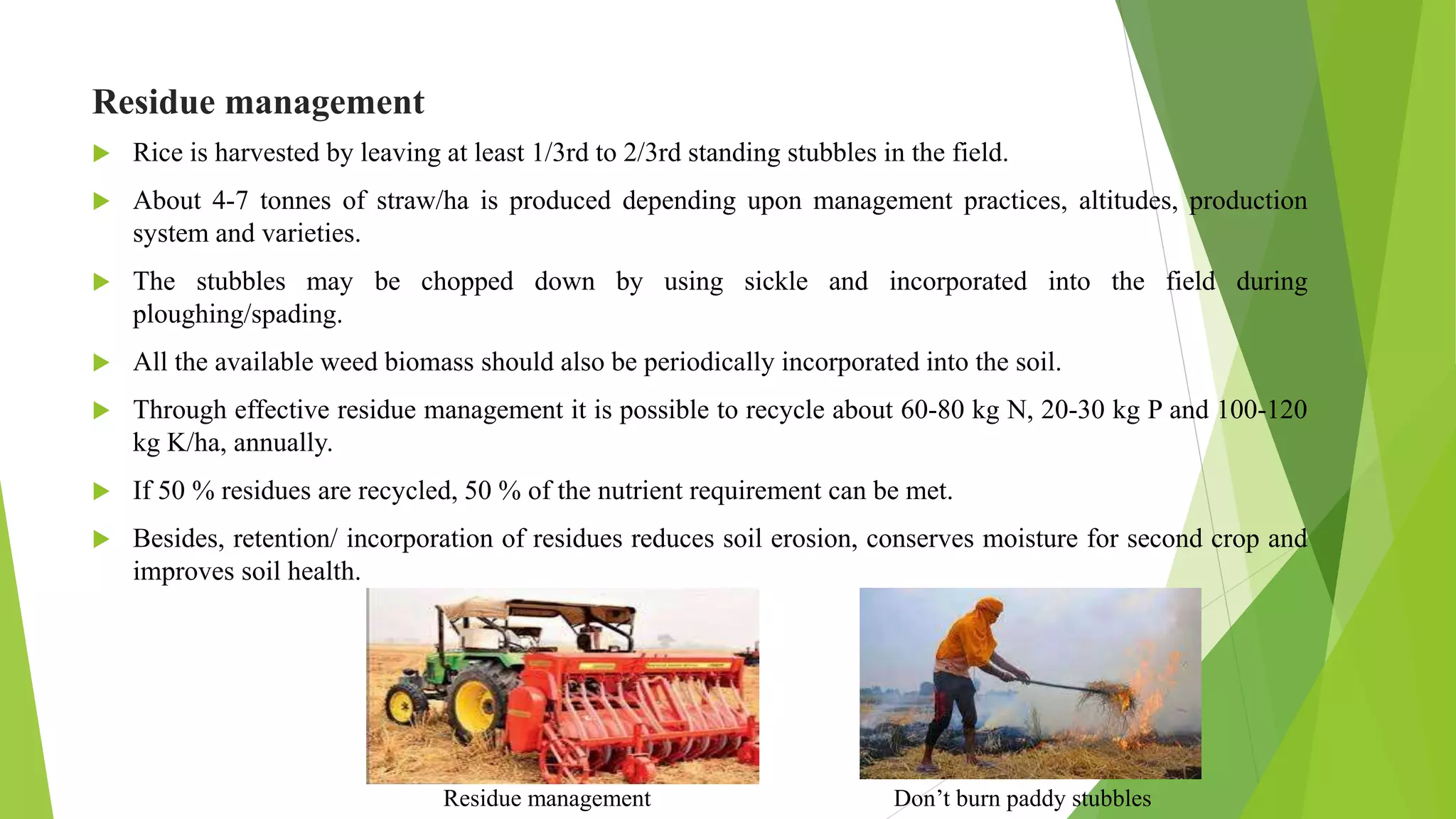
Residue management
 Rice is harvested by leaving at least 1/3rd to 2/3rd standing stubbles in the field.
 About 4-7 tonnes of straw/ha is produced depending upon management practices, altitudes, production
system and varieties.
 The stubbles may be chopped down by using sickle and incorporated into the field during
ploughing/spading.
 All the available weed biomass should also be periodically incorporated into the soil.
 Through effective residue management it is possible to recycle about 60-80 kg N, 20-30 kg P and 100-120
kg K/ha, annually.
 If 50 % residues are recycled, 50 % of the nutrient requirement can be met.
 Besides, retention/ incorporation of residues reduces soil erosion, conserves moisture for second crop and
improves soil health.
Don’t burn paddy stubbles
Residue management
Weed management
 In north east India mostly hand weeding is practiced
 However, in the absence of manpower, herbicides like Butachlor (Machete)
5 % granule @ 30 kg/ha in 3-4 cm standing water within 2-4 days after
transplanting (DAT) is applied to control grassy weeds
 If granules not available, Butachlor in liquid form may be applied @ 1.5 kg
a.i./ ha mixed with 400 litre water or Pendimethalin (Stomp) @ 1.0 kg
a.i./ha in 400 litre water
 To control sedges (Cyperus spp.) and broad leaved weeds, apply 2, 4-DEE
4 % granules @ 20 kg/ha at 4-5 DAT.
 Rotary paddy weeder (Cono weeder or Japanese paddy weeder) can be
used for weeding by running the weeder in between the rows.
 It also helps in simultaneous incorporation of weed biomass into the soil
and improves soil aeration and root respiration. Manual Cono Weeder
Water management
 Rice is a water loving plant and requires about 3000 to 5000 litre of water to produce a
kilogram of rice grain.
 However, it is experimentally proved that by modifying management practices, adopting
water efficient varieties, enhancing irrigation efficiency, reducing conveyance losses, etc. the
water requirement of rice could be reduced substantially without reducing the productivity.
 Draining field 1-2 days suppresses:
1. Whorl maggots,
2. root feeding midges,
3. water weevils,
4. caseworms
 Alternate draining and flooding for 5-7 days helps control black bugs, planthoppers, gall
midge, hispa, and stem borers
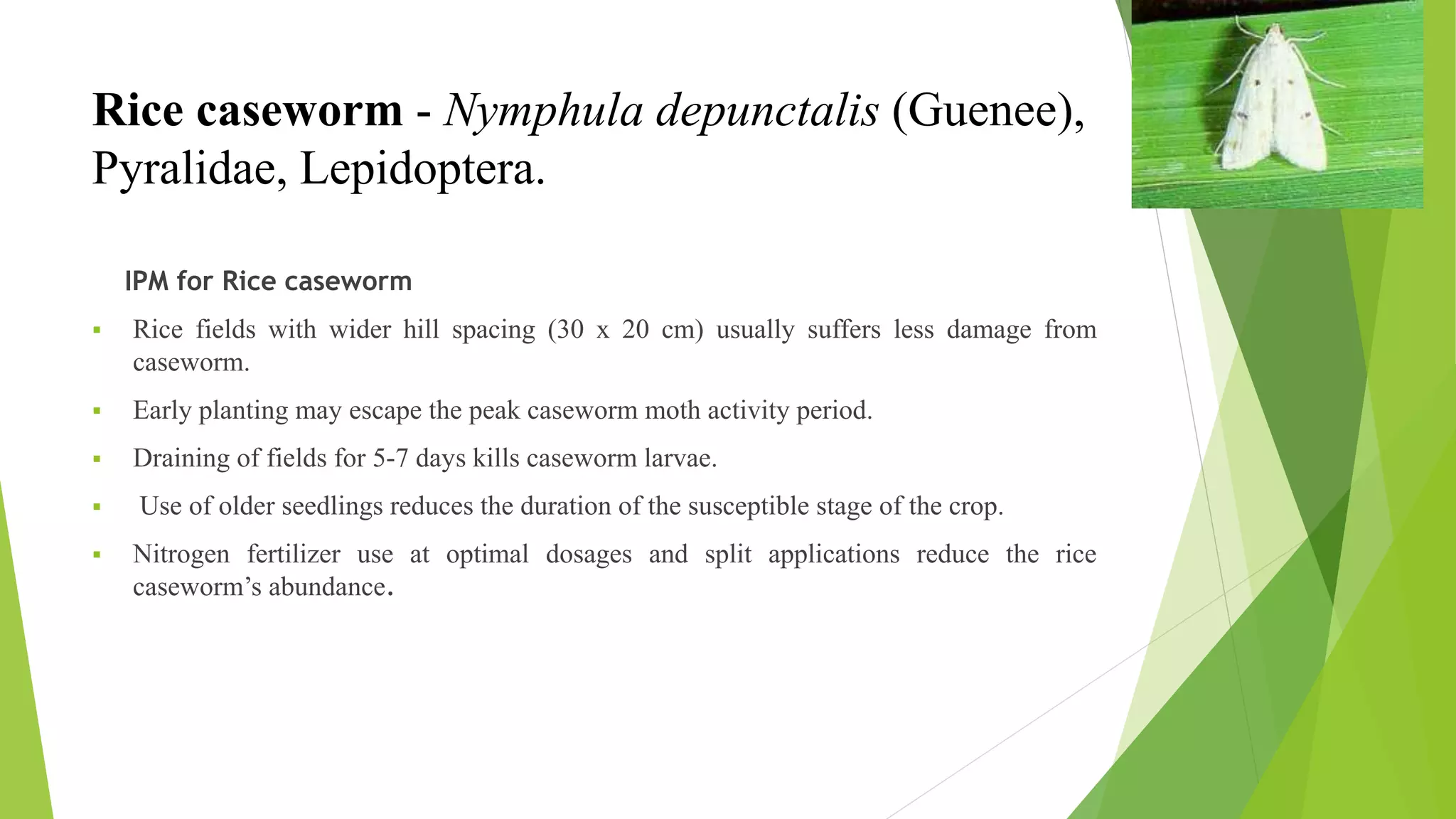
Rice caseworm - Nymphula depunctalis (Guenee),
Pyralidae, Lepidoptera.
IPM for Rice caseworm
 Rice fields with wider hill spacing (30 x 20 cm) usually suffers less damage from
caseworm.
 Early planting may escape the peak caseworm moth activity period.
 Draining of fields for 5-7 days kills caseworm larvae.
 Use of older seedlings reduces the duration of the susceptible stage of the crop.
 Nitrogen fertilizer use at optimal dosages and split applications reduce the rice
caseworm’s abundance.
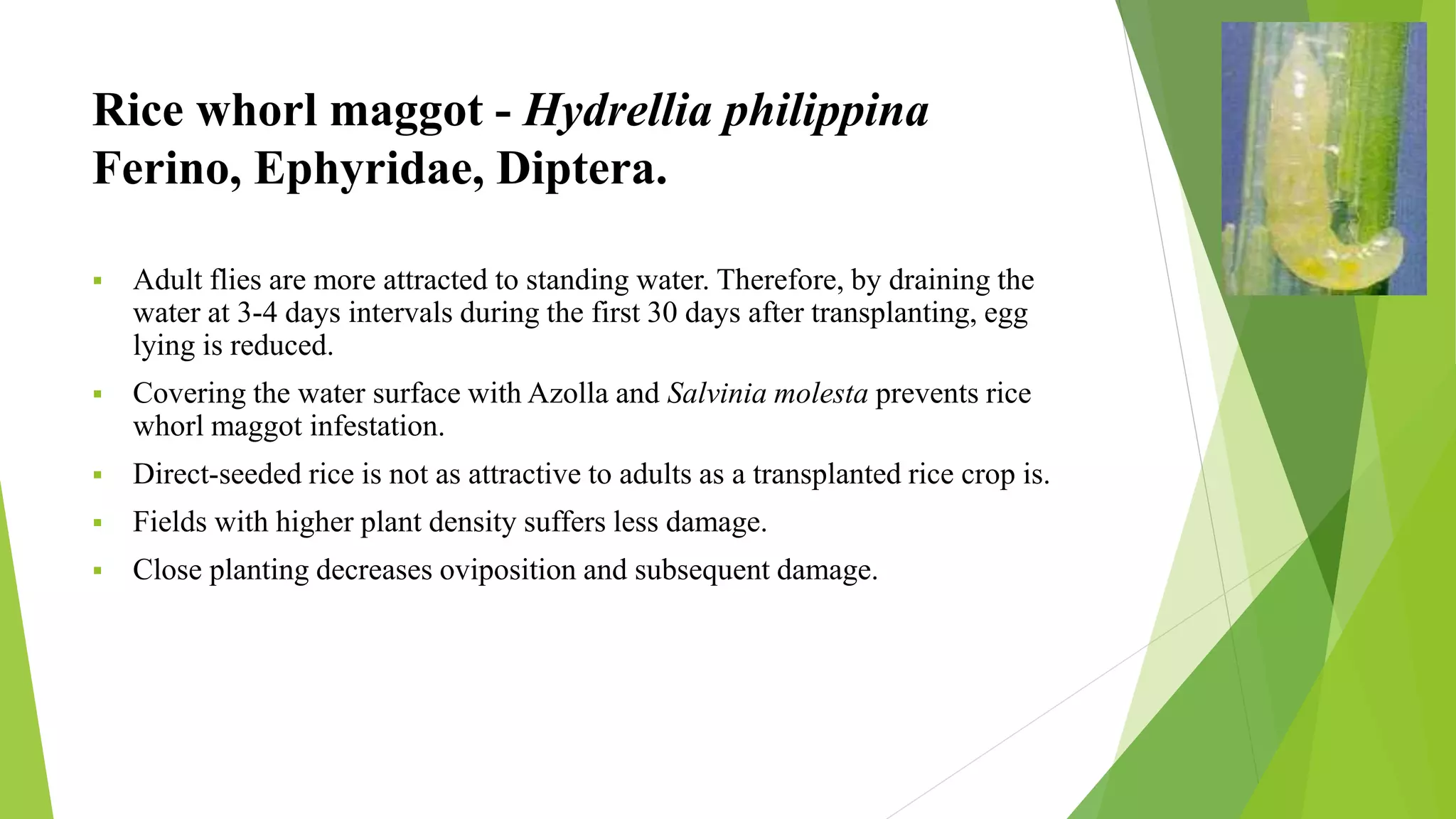
 Adult flies are more attracted to standing water. Therefore, by draining the
water at 3-4 days intervals during the first 30 days after transplanting, egg
lying is reduced.
 Covering the water surface with Azolla and Salvinia molesta prevents rice
whorl maggot infestation.
 Direct-seeded rice is not as attractive to adults as a transplanted rice crop is.
 Fields with higher plant density suffers less damage.
 Close planting decreases oviposition and subsequent damage.
Rice whorl maggot - Hydrellia philippina
Ferino, Ephyridae, Diptera.
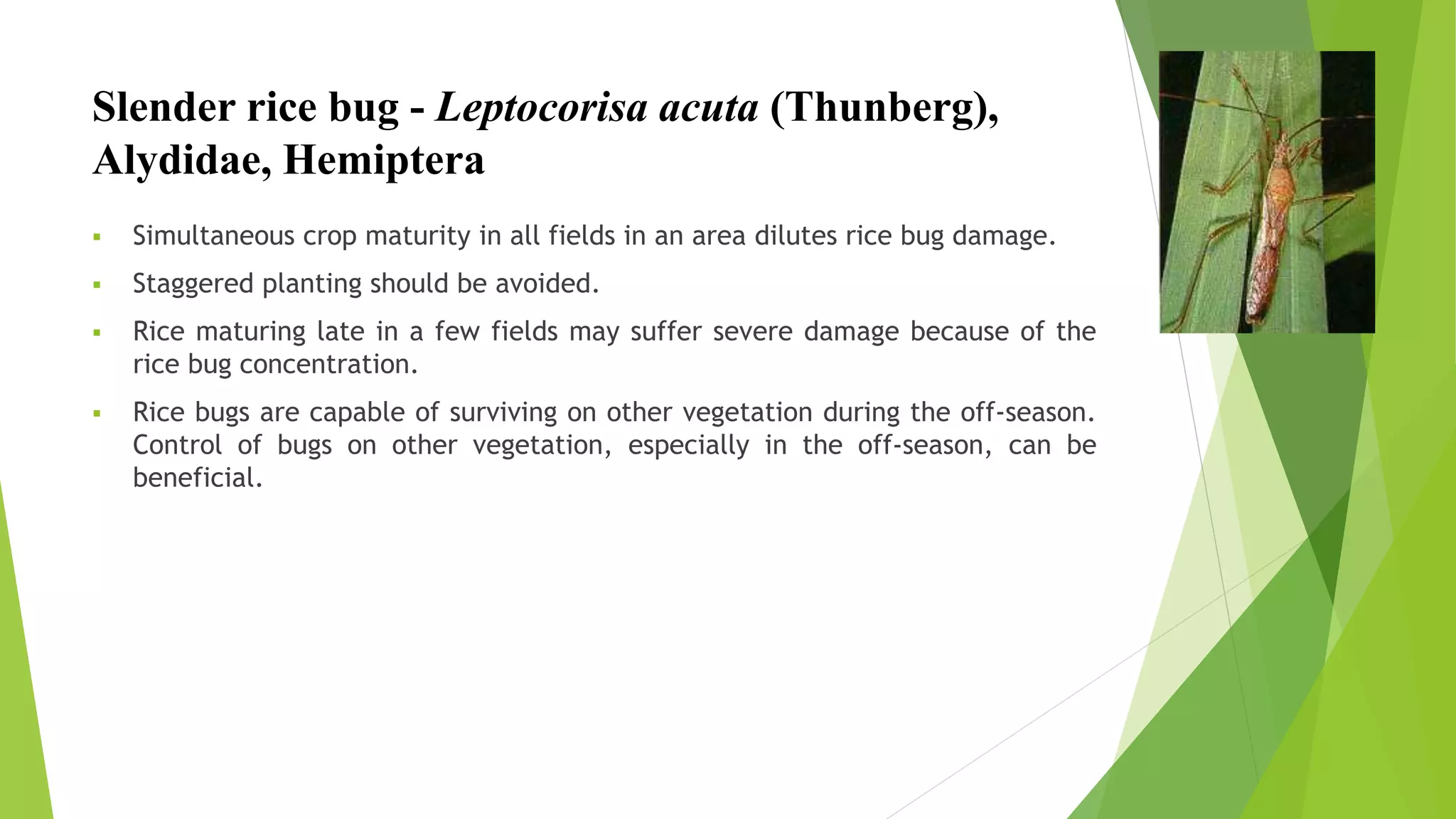
Slender rice bug - Leptocorisa acuta (Thunberg),
Alydidae, Hemiptera
 Simultaneous crop maturity in all fields in an area dilutes rice bug damage.
 Staggered planting should be avoided.
 Rice maturing late in a few fields may suffer severe damage because of the
rice bug concentration.
 Rice bugs are capable of surviving on other vegetation during the off-season.
Control of bugs on other vegetation, especially in the off-season, can be
beneficial.
Strategies for enhancing productivity and profitability of rice production
The following strategies should be adopted for increasing
productivity and profitability of rice farming in the suitable
zones:
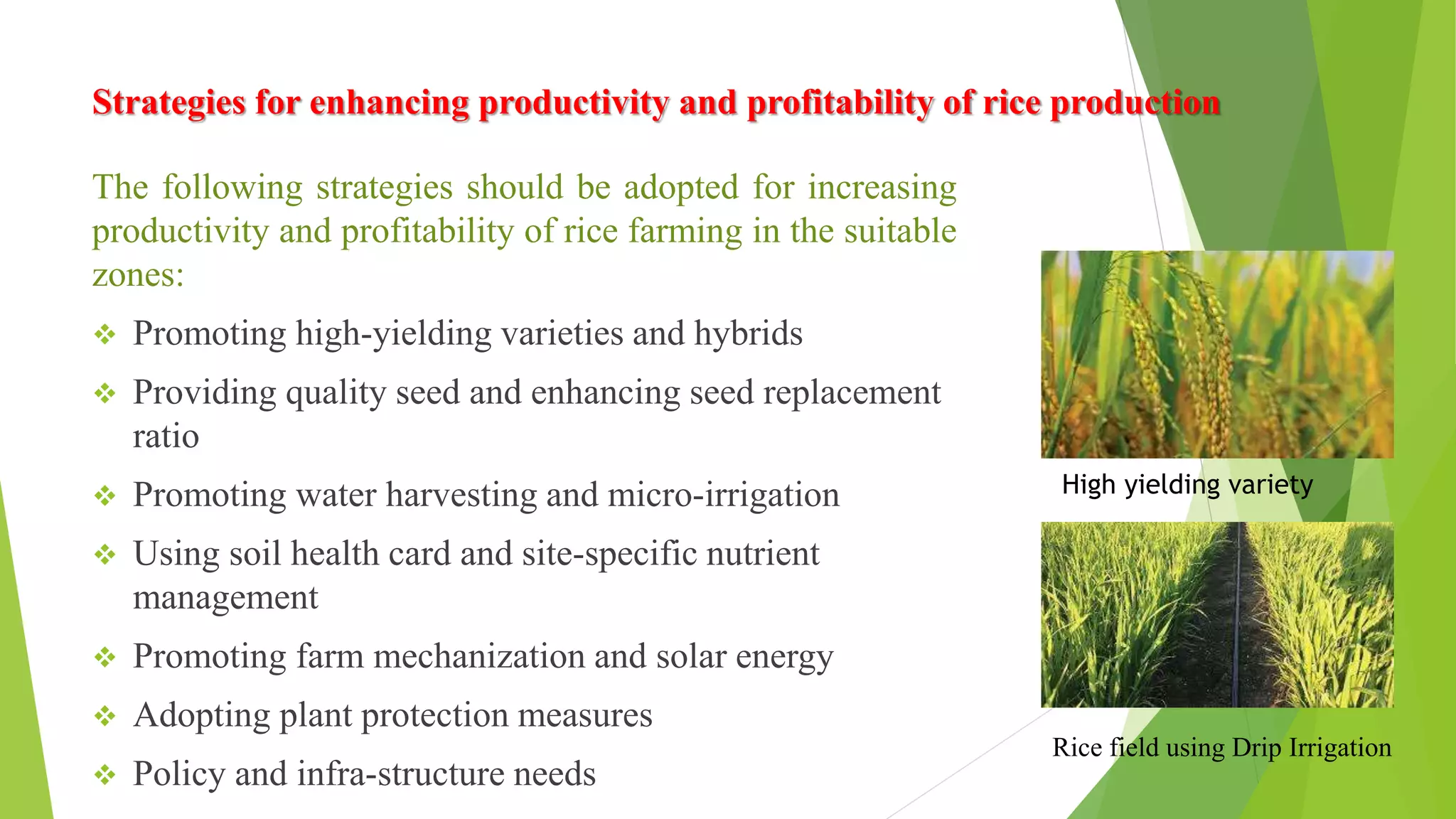
 Promoting high-yielding varieties and hybrids
 Providing quality seed and enhancing seed replacement
ratio
 Promoting water harvesting and micro-irrigation
 Using soil health card and site-specific nutrient
management
 Promoting farm mechanization and solar energy
 Adopting plant protection measures
 Policy and infra-structure needs
Rice field using Drip Irrigation
High yielding variety
Conclusion
 The goal of rice research should be in developing profitable and resilient
rainfed rice farming system with a vision of enhancing productivity,
profitability and resilience for ever-green rice farming with high-quality
research, partnership and leadership in rice science
Thrust areas research should include:
A. Genetic enhancement for improving productivity, quality and climate
resilience of rice
B. Ecosystem management for higher input-efficiency and lower environmental
footprints;
C. Value-addition with improved quality, co-farming, processing and marketing
D. Crop protection approaches should be based on IPM for effective outcome.
E. Accelerating technology delivery, capacity building and policy formulation
Summary
 Sustainable rice production is the key to achieving Sustainable Development Goals (SDGs),
particularly for country like India.
 Growing rice in non-conventional and unsuitable ecoregions, however, has generated several
environmental problems such as depletion of ground water, pollution of air, degradation of soil
and aggravation of climate change.
 To achieve sustainable and environment-friendly rice farming, the crop should be cultivated in
the region where its environmental footprint is the minimum.
 Rainfall, temperature and soil are the three most important biophysical factors determining
ecoregions for growing rice.
 Rice is a water-loving crop. Therefore, its cultivation should be done in the areas where
average annual rainfall is more than 1000 mm. Temperature is another key factor influencing
growth, development and yield of rice.
 The suitable ecoregions of rice farming have been delineated and site-specific improved
technologies have been identified for enhancing productivity, profitability, climate resilience
and sustainability of rice farming in the country.
THANK YOU

Rice cultivation.pptx.......

  • 1.
    Rice Production TechnologyFor Sustainability Mohammad Irshad Entomology A.M.U Aligarh
  • 2.
     Rice isthe most broadly used staple food in large part of the world population, especially in Asia.  As the world population is expected to increase to 9.2 billion by 2050, there is a dare need to increase global food production to overcome the demand of world population.  The two major rice varieties grown world wide today are Oryza sativa indica and Oryza sativa japonica. The two cultivated rice species, Oryza sativa L. and O. glaberrima Steud., belong to a species group called Oryza sativa complex.  It’s the commodity with the maximum global wide production after sugarcane and maize.  Rice adds up to 780 and 689 kcal/capita/day of the food supply in Asia and India, respectively  Rice being a tropical and sub-tropical plant, requires a fairly high temperature, ranging from 20° to 30°C.  Clay loam soil (27- 40% clay content) in monsoon land and pH range of 5.5 - 6.5 is considered to be the best for rice cultivation. Introduction
  • 3.
    Nutritional value ofRice Prod uct Moist ure Prote in Fat Crud e fibre Carboh ydrate Ash Calories Ca Fe Thia mine Ribof lavin Niaci n Brow n Rice 12 7.5 1.9 0.9 76.5 1.2 360 32 1.6 0.54 0.05 4.7 White Rice 12 6.7 0.4 0.3 80.1 0.5 363 24 2.9 0.07 0.03 1.6 Parbo iled Rice 10 7.4 0.3 0.2 81.1 0.7 369 60 2.9 0.44 - 3.5  Most of the nutrient and minerals are concentrated in the outer brown layers known as husk and germs.  Brown rice a type of rice from which only husk has been removed, is the most nutritious type of rice.
  • 4.
    Rice Growing Regions The rice growing areas in the country can be broadly grouped into five regions as given below:  North-Eastern Region: This region comprises of Assam and North eastern states. In Assam rice is grown in the Basin of Brahmnaputra River. This region receives very heavy rainfall and rice is grown under rain fed condition.  Eastern Region: It region comprises of Bihar, Chhattisgarh, Jharkhand, Madhya Pradesh, Orissa, Eastern Uttar Pradesh and West Bengal. In this region rice is grown in the basins of Ganga and Mahanadi rivers and has the highest intensity of rice cultivation in the country. This region receives heavy rainfall and rice is grown mainly under rainfed conditions.  Northern Region: This region comprises of Haryana, Punjab, Western Uttar Pradesh, Uttarakhand, Himachal Pradesh and Jammu & Kashmir. The region experiences low winter temperature and single crop of rice from May-July to September-December is grown.  Western Region: This region comprises of Gujarat, Maharashtra and Rajasthan. Rice is largely grown under rainfed condition during June-August to October - December.  Southern Region: This region comprises of Andhra Pradesh, Karnataka, Kerala and Tamil Nadu. Rice is mainly grown in deltaic tracts of Godavari, Krishna and Cauvery rivers and the non-deltaic rainfed area of Tamil Nadu and Andhra Pradesh. Rice is grown under irrigated condition in deltaic tracts.
  • 5.
    Rice ecosystems inIndia  In India, rice is grown under highly diverse conditions with area stretching from 79° to 90°E longitude and 16° to 28° N latitude under varying Agro-ecological zones.  It is cultivated mostly in wet season with unpredictable rainfall distribution.  Rice is primarily grown under four major ecosystems broadly classified as  (i) irrigated, (ii) rainfed lowland, (iii) rainfed upland  Irrigated rice eco-system: Total area under irrigated rice in the country is about 26.0 mha accounting for about 60% of the total area under the crop. It includes the areas in Punjab, Haryana, Uttar Pradesh, Jammu & Kashmir, Andhra Pradesh, Telangana, Tamil Nadu, Karnataka, Himachal Pradesh and Gujarat  Rainfed lowland rice ecosystem: In India, lowland rice covers an area of about 12.0 mha, which accounts for about 27% of the total area, located mainly in eastern India. The area is characterized by poor soil quality and frequent occurrence of drought/flood due to erratic rains.  Rainfed upland rice ecosystem: Total area under rainfed upland rice in the country is about 4.8 mha, which accounts for 11% of total area, located mainly in Eastern Zone i.e., Assam, Bihar, Chhattisgarh, Eastern Uttar Pradesh, Jharkhand, Madhya Pradesh, Odisha, West Bengal, and North East Hill Region. The rainfed upland ecosystem is drought prone.
  • 6.
    Rice based CroppingPattern Irrigated Condition Upland condition Rice under integrated farming system Rice-Rice-Rice Rice-Chickpea Rice-Fish-Poultry Rice-Rice-Cereal Rice-Lentil Rice-Fish-Duckery Rice-Rice-Pulses Rice-Mustard/Linseed Rice-Wheat-Pulse Rice-Barley Rice-Toria-Wheat Rice-Wheat Rice-Wheat Rice-Pea Rice-Mustard
  • 7.
    Variety Ecology YearDuration (Days) Grain type Released by cvrc/svrc Reaction to insect pests and Average Grain Yield t/ha Grain yield (t/ha) CR Dhan 313 Irrigated 2020 130-135 MS CVRC (Chattisgarh and Maharashtra) highly tolerant to biotype 5 of gall midge and also rice whorl maggot, leaf folder and rice thrips, moderately tolerant to stem borer (both DH and WEH) 4.8 t/ha. CR Dhan 602 Boro 2020 155 (Boro) 125 (Non- boro) LS CVRC (Assam and Tripura) resistance to plant hopper (predominantly WBPH) and moderately resistant to stem borer (DH), Long slender grains 6.0 t/ha. Santha Bhima (CR Dhan 102) Upland 2020 105-110 SB Odisha Moderately resistant to stem borer, leaf folder and whorl maggot, 3.9 t/ha Sarumina (CR Dhan 210) Aerobic 2020 110-115 LS Odisha Moderately resistant to stem borer, leaf folder and green leaf hopper 7.8 t/ha CR Dhan 308 Irrigated 2020 135 MS CVRC (Chattisgarh and Maharashtra) Tolerant to Stem Borer (both dead hearts and white ear heads), leaf folder, whorl maggot and rice hispa 5.0 t/ha CR Dhan 314 (Identified by VIC, 2020) Irrigated 2020 130-135 LB CVRC (Odisha & Bihar) Resistant to leaf folder and moderately resistant to stem borer (Dead heart) 5.0 t/ha CR Dhan 318 (Identified by VIC, 2021) Irrigated 2021 118-120 LS CVRC (Bihar, West Bengal, Uttarakhand and Haryana) Highly tolerant to leaf folder, stem borer (dead heart), and whorl maggot insect pests. Moderately tolerant to gall midge (Biotype 1) and stem borer (white ear heads) 5.4-6 t/ha CR Dhan 319 (Identified by VIC, 2021) Irrigated 2021 130 -135 SB CVRC (Bihar and Odisha) highly tolerant to stem borer (DH and WEH),leaf folder, whorl maggot and rice thrips, moderate tolerance to BPH and other plant hopper 6.0 t/ha *Grain: LS – Long Slender MB -Medium Bold, MS -Medium Slender, SB-Short Bold, MB-Medium Bold, BPH – Brown Plant Hopper, BS -Brown Spot, GB -Gundhi Bug, GM -Gall Midge, GLH – Green Leaf Hopper Varieties Released from Central Rice Research Institute, Cuttack Odisha
  • 8.
    Rice Research Station,Tirur (Tamilnadu)- Varieties releases Varieties Pedigree/parentage Duration Suitable season Special characters TKM 1 Pure line selection from local variety Pisini 130 Samba (July-Aug sowing) Coarse grain, red rice suitable for rainfed sowing TKM 2 Pure line selection from local variety Sembalai 125 Samba (July-Aug sowing) Medium grain, white rice suitable for rainfed sowing TKM 3 Pure line selection from local variety Sornavari 105-110 Sornavari (May-June sowing) Coarse grain, white rice Suitable for irrigated TKM 4 Pure line selection from Yerra sannavadu 115 Samba (July-Aug) Navarai(Dec- Jan) Fine grain, Suitable for both irrigated and rainfed conditions TKM 5 Pure line selection from local Manakkattai 105-115 Navarai Sornavari Red rice (Puttu rice) withstands drought TKM 6 CO 18/GEB 24 115 Navarai, Sornavari Fine grain,white rice, resistant to SB and GLH. IRRI identified this as universal donor for stem borer resistance TKM 7 Pure line selection from local Kullakar 105-110 Samba Navarai Bold grain, red rice, suitable for both irrigated and rainfed conditions, comes up well in alkaline soils
  • 9.
    Integrated nutrient management(INM): at a glance  Optimum soil health management is the key to success in any crop production.  A healthy and vibrant soil can withstand drought/other problems better compared to a sick/ poorly managed soil.  Apply FYM/Compost/other manure at 5t/ha  Recycle at least 1/3rd rice straw and all the weed biomass into the field.  Use biofertilizer (Azolla, Azotobacter, PSB, Azospirillum etc), bio-organics and green manures.  Azolla should be incorporated into the soil before transplanting or it can be taken as dual crop i.e., inoculation of fresh Azolla @ 2 t/ha, at 7-10 days after transplanting (DAT) in standing water (5 cm) with 20 kg Phosphorus/ha  Follow crop rotation with leguminous crop/pulses (Rice bean, groundnut, soybean, pea, lentil etc).  Under INM on-farm resources are efficiently utilized and dependence on external resources and fertilizer is minimized.  pest management has a neutral or positive effect on soil quality  soil nutrient management has a neutral or positive effect on pest levels
  • 10.
    Examples of usingfertilizer to help manage pests  N applications decrease thrips populations  Phosphorous (P) improves tolerance for root pests  Potassium (K) tends to suppress pests  Silicon increases resistance to blast, bacterial blight, planthoppers and stem borers  Zinc reduces stem borer damage
  • 11.
     Raise pestlevels  Lower pest levels  Raise the levels of some pests and lower the levels of others  Have no effect on pest levels  WHAT IS KNOWN? Nitrogen & insects  Increase insect tolerance to stress  Greater insect fecundity (e.g. sucking insects)  Increases insect feeding rate  More abundant, e.g. brown planthopper  Less abundant, e.g. thrips and whorl maggot  Rice attracts more pest  Promotes recovery from pest damage Fertilizer applications can:
  • 12.
    Residue management  Riceis harvested by leaving at least 1/3rd to 2/3rd standing stubbles in the field.  About 4-7 tonnes of straw/ha is produced depending upon management practices, altitudes, production system and varieties.  The stubbles may be chopped down by using sickle and incorporated into the field during ploughing/spading.  All the available weed biomass should also be periodically incorporated into the soil.  Through effective residue management it is possible to recycle about 60-80 kg N, 20-30 kg P and 100-120 kg K/ha, annually.  If 50 % residues are recycled, 50 % of the nutrient requirement can be met.  Besides, retention/ incorporation of residues reduces soil erosion, conserves moisture for second crop and improves soil health. Don’t burn paddy stubbles Residue management
  • 13.
    Weed management  Innorth east India mostly hand weeding is practiced  However, in the absence of manpower, herbicides like Butachlor (Machete) 5 % granule @ 30 kg/ha in 3-4 cm standing water within 2-4 days after transplanting (DAT) is applied to control grassy weeds  If granules not available, Butachlor in liquid form may be applied @ 1.5 kg a.i./ ha mixed with 400 litre water or Pendimethalin (Stomp) @ 1.0 kg a.i./ha in 400 litre water  To control sedges (Cyperus spp.) and broad leaved weeds, apply 2, 4-DEE 4 % granules @ 20 kg/ha at 4-5 DAT.  Rotary paddy weeder (Cono weeder or Japanese paddy weeder) can be used for weeding by running the weeder in between the rows.  It also helps in simultaneous incorporation of weed biomass into the soil and improves soil aeration and root respiration. Manual Cono Weeder
  • 14.
    Water management  Riceis a water loving plant and requires about 3000 to 5000 litre of water to produce a kilogram of rice grain.  However, it is experimentally proved that by modifying management practices, adopting water efficient varieties, enhancing irrigation efficiency, reducing conveyance losses, etc. the water requirement of rice could be reduced substantially without reducing the productivity.  Draining field 1-2 days suppresses: 1. Whorl maggots, 2. root feeding midges, 3. water weevils, 4. caseworms  Alternate draining and flooding for 5-7 days helps control black bugs, planthoppers, gall midge, hispa, and stem borers
  • 15.
    Rice caseworm -Nymphula depunctalis (Guenee), Pyralidae, Lepidoptera. IPM for Rice caseworm  Rice fields with wider hill spacing (30 x 20 cm) usually suffers less damage from caseworm.  Early planting may escape the peak caseworm moth activity period.  Draining of fields for 5-7 days kills caseworm larvae.  Use of older seedlings reduces the duration of the susceptible stage of the crop.  Nitrogen fertilizer use at optimal dosages and split applications reduce the rice caseworm’s abundance.
  • 16.
     Adult fliesare more attracted to standing water. Therefore, by draining the water at 3-4 days intervals during the first 30 days after transplanting, egg lying is reduced.  Covering the water surface with Azolla and Salvinia molesta prevents rice whorl maggot infestation.  Direct-seeded rice is not as attractive to adults as a transplanted rice crop is.  Fields with higher plant density suffers less damage.  Close planting decreases oviposition and subsequent damage. Rice whorl maggot - Hydrellia philippina Ferino, Ephyridae, Diptera.
  • 17.
    Slender rice bug- Leptocorisa acuta (Thunberg), Alydidae, Hemiptera  Simultaneous crop maturity in all fields in an area dilutes rice bug damage.  Staggered planting should be avoided.  Rice maturing late in a few fields may suffer severe damage because of the rice bug concentration.  Rice bugs are capable of surviving on other vegetation during the off-season. Control of bugs on other vegetation, especially in the off-season, can be beneficial.
  • 18.
    Strategies for enhancingproductivity and profitability of rice production The following strategies should be adopted for increasing productivity and profitability of rice farming in the suitable zones:  Promoting high-yielding varieties and hybrids  Providing quality seed and enhancing seed replacement ratio  Promoting water harvesting and micro-irrigation  Using soil health card and site-specific nutrient management  Promoting farm mechanization and solar energy  Adopting plant protection measures  Policy and infra-structure needs Rice field using Drip Irrigation High yielding variety
  • 19.
    Conclusion  The goalof rice research should be in developing profitable and resilient rainfed rice farming system with a vision of enhancing productivity, profitability and resilience for ever-green rice farming with high-quality research, partnership and leadership in rice science Thrust areas research should include: A. Genetic enhancement for improving productivity, quality and climate resilience of rice B. Ecosystem management for higher input-efficiency and lower environmental footprints; C. Value-addition with improved quality, co-farming, processing and marketing D. Crop protection approaches should be based on IPM for effective outcome. E. Accelerating technology delivery, capacity building and policy formulation
  • 20.
    Summary  Sustainable riceproduction is the key to achieving Sustainable Development Goals (SDGs), particularly for country like India.  Growing rice in non-conventional and unsuitable ecoregions, however, has generated several environmental problems such as depletion of ground water, pollution of air, degradation of soil and aggravation of climate change.  To achieve sustainable and environment-friendly rice farming, the crop should be cultivated in the region where its environmental footprint is the minimum.  Rainfall, temperature and soil are the three most important biophysical factors determining ecoregions for growing rice.  Rice is a water-loving crop. Therefore, its cultivation should be done in the areas where average annual rainfall is more than 1000 mm. Temperature is another key factor influencing growth, development and yield of rice.  The suitable ecoregions of rice farming have been delineated and site-specific improved technologies have been identified for enhancing productivity, profitability, climate resilience and sustainability of rice farming in the country.
  • 21.