Physiological Disorders Of Raddish
. Submittedby:
MUsamaSabir
Submittedto:
ProfHassanSardar
Rollno:
10
Section:
Morning
Coursetitle:
PrincipalOfVegetativeProduction
Title:
PhysiologicalDisordersOfRaddish
DepartmentofHorticulture
Bahauddinzakariyauniversitymultan
Physiological Disorder of
Reddish
The physiological disorder can be
defined as:
Any kind of abnormality in an economically important part of
vegetables or other parts that contribute to the yield and quality of
vegetables is termed a physiological disorder.
The reasons for physiological disorders are
environmental /abiotic factors. Physiological
disorders are caused because of:
Deficiency of micronutrients
Sudden fluctuation in temper
Poor soil conditions and
Improper moisture availability during cultivation
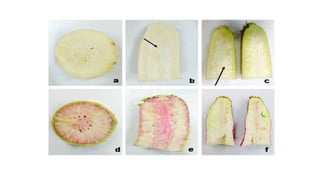
1 - Name of disorder:
Pore extent, Pore development, or Pithiness
Crop:
Radish
Damage: Symptoms:
 Pores are formed in the root. The quality of radish is reduced, destroying its commercial
value.
 It is caused by excessive root growth in comparison with the corresponding assimilation
ability of leaf tissue. Physiologically, parenchymatous cells in root tissue collapse. Pore
development is a sign of senescence and its degree varies from variety to variety. Varieties
forming early pores have larger parenchymatous cells in roots, more tender basal tissue, and
lower starch content.
 Varieties showing early maturity, earlier enlargement of the root, and rapid reduction in T/R
ratio (ratio of the root weight R to the top weight T) have a tendency to form large pores
Reasons:
 When harvesting is delayed, this disorder is more pronounced.
 There is no particular gene identified that directly controls pore development,
but genes indirectly influence these physiological characteristics.
Control:
 To avoid the pore extent, harvesting should be done at the appropriate time.
 As long-term strategy, it is suggested that a variety with early root
enlargement and late pore development might be bred by crossing between
varieties that had high assimilation ability and early growth.
2-Name of disorder:
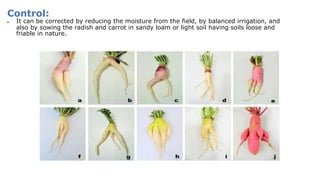
Elongated root or Forking
Crop:
Radish
Damage: Symptoms:
There is secondary elongating growth in the roots that gives a look of fork fork-lecture to the
root
Reasons:
. Inter-varietal varivariations being considered to result from the degree of secondary elongating
growth. Elongated root relates closely to soil adaptation. Varieties with vigorously elongated
rootrootsort root or round roots have been selected in areas of shallow arable soil and varieties
with poorly elongated roots, long roots, and, huge roots have been cultivated in areas with deep
soil conditions.
.The disorder is due to the excess moisture during the root development of reddish.
.It also occurs in heavy soil due to compactness.
.Un-decomposed organic manure favors elongated roots in radish.
Control:
 It can be corrected by reducing the moisture from the field, by balanced irrigation, and
also by sowing the radish and carrot in sandy loam or light soil having soils loose and
friable in nature.
3-Name of disorder: Bolting
Crop: Radish
Symptom:
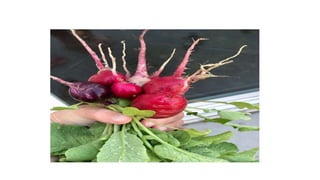
Development of seed stalk without proper development of economically
important/edible vegetative part is termed as bolting.
Radish is a seed vernalizing crop in response to low temperatures.
The degree of bolting ability has been studied because of its disadvantage in
cultivation, and breeding research has been directed toward late bolting.
Reasons:
If radishes are planted too late in spring or too early for fall, the warmer
temps and longer days of summer will inevitably lead to bolting.
Control:
If your radishes are already planted later than they should be, you can minimize the
effects of bolting by keeping the radish plants irrigated and adding mulch to
help retain this moisture and keep the plants cooler
4-Name of disorder:
Pungency
Crop:
Radish
Damage / Symptom:
 The taste of radish for fresh eating is one of the most important quality traits.
 The pungent component of radish is 4-methylthio-3-butenyl isothiocynate (MTB-ITC).
 It was confirmed that many varieties (temperate) were low in contents of 4-methylthio-
3-butenyl glucosinolate (MTB-GSL) (100-200 mmol per 100 g fresh weight) preferred in
Europe and the USA.
 As a disorder roots become more pungent.
Reasons:
It happens due to high temperature and water stress conditions.
Control:
Proper water management.
Selection of variety as per season.
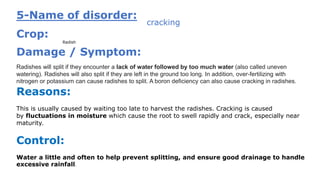
5-Name of disorder:
cracking
Crop:
Radish
Damage / Symptom:
Radishes will split if they encounter a lack of water followed by too much water (also called uneven
watering). Radishes will also split if they are left in the ground too long. In addition, over-fertilizing with
nitrogen or potassium can cause radishes to split. A boron deficiency can also cause cracking in radishes.
Reasons:
This is usually caused by waiting too late to harvest the radishes. Cracking is caused
by fluctuations in moisture which cause the root to swell rapidly and crack, especially near
maturity.
Control:
Water a little and often to help prevent splitting, and ensure good drainage to handle
excessive rainfall.
Raddish Presentation 2.pptx

Raddish Presentation 2.pptx

  • 1.
  • 2.
  • 3.
    Physiological Disorder of Reddish Thephysiological disorder can be defined as: Any kind of abnormality in an economically important part of vegetables or other parts that contribute to the yield and quality of vegetables is termed a physiological disorder.
  • 4.
    The reasons forphysiological disorders are environmental /abiotic factors. Physiological disorders are caused because of: Deficiency of micronutrients Sudden fluctuation in temper Poor soil conditions and Improper moisture availability during cultivation
  • 5.
    1 - Nameof disorder: Pore extent, Pore development, or Pithiness Crop: Radish Damage: Symptoms:  Pores are formed in the root. The quality of radish is reduced, destroying its commercial value.  It is caused by excessive root growth in comparison with the corresponding assimilation ability of leaf tissue. Physiologically, parenchymatous cells in root tissue collapse. Pore development is a sign of senescence and its degree varies from variety to variety. Varieties forming early pores have larger parenchymatous cells in roots, more tender basal tissue, and lower starch content.  Varieties showing early maturity, earlier enlargement of the root, and rapid reduction in T/R ratio (ratio of the root weight R to the top weight T) have a tendency to form large pores
  • 6.
    Reasons:  When harvestingis delayed, this disorder is more pronounced.  There is no particular gene identified that directly controls pore development, but genes indirectly influence these physiological characteristics. Control:  To avoid the pore extent, harvesting should be done at the appropriate time.  As long-term strategy, it is suggested that a variety with early root enlargement and late pore development might be bred by crossing between varieties that had high assimilation ability and early growth.
  • 8.
    2-Name of disorder: Elongatedroot or Forking Crop: Radish Damage: Symptoms: There is secondary elongating growth in the roots that gives a look of fork fork-lecture to the root Reasons: . Inter-varietal varivariations being considered to result from the degree of secondary elongating growth. Elongated root relates closely to soil adaptation. Varieties with vigorously elongated rootrootsort root or round roots have been selected in areas of shallow arable soil and varieties with poorly elongated roots, long roots, and, huge roots have been cultivated in areas with deep soil conditions. .The disorder is due to the excess moisture during the root development of reddish. .It also occurs in heavy soil due to compactness. .Un-decomposed organic manure favors elongated roots in radish.
  • 9.
    Control:  It canbe corrected by reducing the moisture from the field, by balanced irrigation, and also by sowing the radish and carrot in sandy loam or light soil having soils loose and friable in nature.
  • 10.
    3-Name of disorder:Bolting Crop: Radish Symptom: Development of seed stalk without proper development of economically important/edible vegetative part is termed as bolting. Radish is a seed vernalizing crop in response to low temperatures. The degree of bolting ability has been studied because of its disadvantage in cultivation, and breeding research has been directed toward late bolting. Reasons: If radishes are planted too late in spring or too early for fall, the warmer temps and longer days of summer will inevitably lead to bolting. Control: If your radishes are already planted later than they should be, you can minimize the effects of bolting by keeping the radish plants irrigated and adding mulch to help retain this moisture and keep the plants cooler
  • 12.
    4-Name of disorder: Pungency Crop: Radish Damage/ Symptom:  The taste of radish for fresh eating is one of the most important quality traits.  The pungent component of radish is 4-methylthio-3-butenyl isothiocynate (MTB-ITC).  It was confirmed that many varieties (temperate) were low in contents of 4-methylthio- 3-butenyl glucosinolate (MTB-GSL) (100-200 mmol per 100 g fresh weight) preferred in Europe and the USA.  As a disorder roots become more pungent. Reasons: It happens due to high temperature and water stress conditions. Control: Proper water management. Selection of variety as per season.
  • 14.
    5-Name of disorder: cracking Crop: Radish Damage/ Symptom: Radishes will split if they encounter a lack of water followed by too much water (also called uneven watering). Radishes will also split if they are left in the ground too long. In addition, over-fertilizing with nitrogen or potassium can cause radishes to split. A boron deficiency can also cause cracking in radishes. Reasons: This is usually caused by waiting too late to harvest the radishes. Cracking is caused by fluctuations in moisture which cause the root to swell rapidly and crack, especially near maturity. Control: Water a little and often to help prevent splitting, and ensure good drainage to handle excessive rainfall.