RHS Level 2
Certificate
Year 2 Week 8 – fertilizers and
alternative growing media.
Learning objectives -
fertilizers
 7.6 State what is meant by the terms ‘organic fertiliser’
and ‘inorganic fertiliser’ and list TWO examples of
EACH.
 7.7 State TWO benefits and TWO limitations of using
organic fertilisers and inorganic fertilisers.
 7.8 State what is meant by: single or straight fertilisers;
compound fertilisers. List TWO examples of EACH
 7.9 State what is meant by the terms
 ‘Base dressing’, ‘Top dressing’, ‘Liquid feed’ and
‘Foliar feed’. Describe ONE situation where EACH
type of fertiliser application would be appropriate.
 7.10 Describe the use of Controlled Release Fertiliser
(CRF) granules and state TWO benefits and TWO
limitations of their use in growing media.
Learning objectives –
alternative growing media
 8. Understand the uses of alternative growing
media
 8.1 Describe the range of compost types available, and
the use of EACH of these growing media as
alternatives to growing in soil: including peat-based,
loam-based, peat-free, multipurpose, ericaceous, seed
and cutting and container composts.
 8.2 State how air-fill porosity, water holding capacity,
and stability of growing media affect plant growth
 8.3 Describe the environmental implications of the use
of peat, coir and municipal green waste in growing
media.
Fertilizers – soil testing
Three approaches
• Rule of thumb – suitable for non-
cropping situations.
• Follow fertilizer intervals recommended –
e.g. N each year perhaps several times,
P annually and K every second or third
year.
• Soil testing – macro only (DIY) or full
nutrient analysis via laboratory.
Required to diagnose excess/deficiency
accurately.
Fertilizers – organic and
inorganic
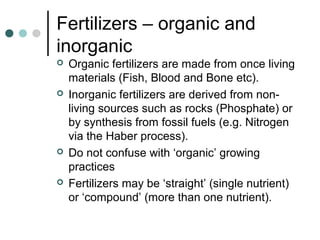
 Organic fertilizers are made from once living
materials (Fish, Blood and Bone etc).
 Inorganic fertilizers are derived from non-
living sources such as rocks (Phosphate) or
by synthesis from fossil fuels (e.g. Nitrogen
via the Haber process).
 Do not confuse with ‘organic’ growing
practices
 Fertilizers may be ‘straight’ (single nutrient)
or ‘compound’ (more than one nutrient).
Organic fertilizers – sources and
characteristics
Fertilizer Characteristics
Bone meal – heat
treated crushed animal
bone. A compound
fertilizer
Some Nitrogen, mostly
phosphorous, no
potassium. 4:15:0 (4%
N: 15%P;0% K)
Fish, blood and bone
(compound)
Contains all three
macro-nutrients (with
the potassium coming
from rock potash) 5:5:6
Wood ash Potassium – the only
organic source of
potassium at about
6% by dry weight
Organic fertilizers – advantages
and disadvantages
Advantages Disadvantages
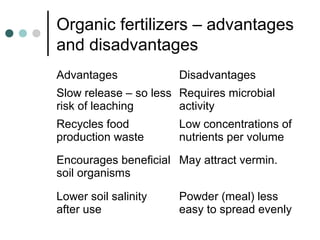
Slow release – so less
risk of leaching
Requires microbial
activity
Recycles food
production waste
Low concentrations of
nutrients per volume
Encourages beneficial
soil organisms
May attract vermin.
Lower soil salinity
after use
Powder (meal) less
easy to spread evenly
Inorganic fertilizers – sources
and characteristics
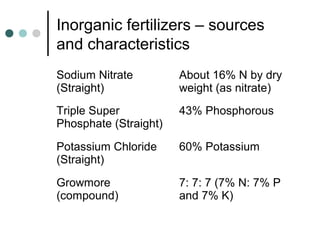
Sodium Nitrate
(Straight)
About 16% N by dry
weight (as nitrate)
Triple Super
Phosphate (Straight)
43% Phosphorous
Potassium Chloride
(Straight)
60% Potassium
Growmore
(compound)
7: 7: 7 (7% N: 7% P
and 7% K)
Inorganic fertilizers –
advantages and disadvantages
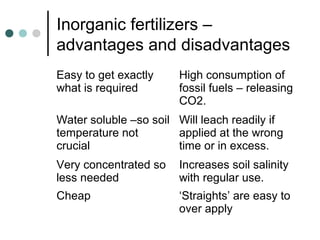
Easy to get exactly
what is required
High consumption of
fossil fuels – releasing
CO2.
Water soluble –so soil
temperature not
crucial
Will leach readily if
applied at the wrong
time or in excess.
Very concentrated so
less needed
Increases soil salinity
with regular use.
Cheap ‘Straights’ are easy to
over apply
Application methods
 Base Dressing – applied before planting
 Top Dressing – applied to existing planting.
 Foliar Feed – solution sprayed onto and
taken up by the leaves.
 Liquid feed – solution applied diluted to the
growing media or soil.
 Controlled Release Granules or tablets –
compound fertilizer in polymer shell.
Release over time triggered by soil
temperature.
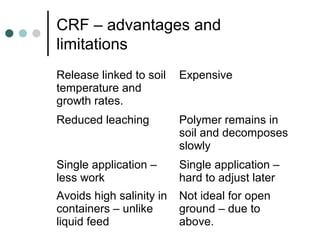
CRF – advantages and
limitations
Release linked to soil
temperature and
growth rates.
Expensive
Reduced leaching Polymer remains in
soil and decomposes
slowly
Single application –
less work
Single application –
hard to adjust later
Avoids high salinity in
containers – unlike
liquid feed
Not ideal for open
ground – due to
above.
Alternative Growing Media –
basic concepts
 Air Filled Porosity – the percentage of
pores in the growing media that will hold
air once gravitational water has drained.
 Water Holding Capacity – used to describe
the water content after drainage.
 Bulk Density – weight per unit volume
 Stability – ability of the media to form and
retain a good structure over time.
Nutrient Content and pH
 The nutrient content of growing media
varies according to their use. For
example cuttings compost contains no
added nutrients and seed compost very
little (perhaps a little added phosphate).
Multi-purpose compost contains N, P
and K.
 pH varies though most are
approximately neutral. Calcifuges will
need ericaceous compost which is
acidic.
Materials used – Peat based
 Has good AFP and low Bulk Density,
making it cheap to transport. Good WHC
but hard to re-wet once dried out. Usually
contains re-wetting agent because of this.
 Peat contains no nutrients of its own so it is
easy to add what is required.
 Environmentally problematic due to
destruction of wetlands and CO2 emissions
from processed peat and drained bogs.
Materials – peat alternatives
 Coir – made from coconut husks; good AFP
and WHC. Re-wets easily, unlike peat. Low
Bulk Density. Has been criticised for relatively
rapid decomposition though this may be down
to quality. Low in nutrients in original state
 Wood waste – composted bark or sawdust.
Good AFP and WHC. Higher Bulk Density than
peat or coir. Low in nutrients.
 Composted Green Waste – variable AFP and
WHC (though British Standard now introduced).
High in nutrients so not suitable for seed or
cuttings mixes.
Loam based growing media
 John Innes is the name of a standard formulation – not
a brand name.
 There are JI seed, cuttings, potting and general use
composts.
 Based on sieved loam, peat and sand with added lime
and variable amounts of JI Base Fertilizer depending on
use.
 High Bulk Density makes them suitable for long term
planting (but harder to handle and more expensive to
transport); medium AFP and good WHC (dry out less
easily than organic media).
 Ericaceous version available.
Learning Outcomes -
Fertilizers
 7.6 State what is meant by the terms ‘organic fertiliser’
and ‘inorganic fertiliser’ and list TWO examples of
EACH.
 7.7 State TWO benefits and TWO limitations of using
organic fertilisers and inorganic fertilisers.
 7.8 State what is meant by: single or straight fertilisers;
compound fertilisers. List TWO examples of EACH
 7.9 State what is meant by the terms
 ‘Base dressing’, ‘Top dressing’, ‘Liquid feed’ and
‘Foliar feed’. Describe ONE situation where EACH
type of fertiliser application would be appropriate.
 7.10 Describe the use of Controlled Release Fertiliser
(CRF) granules and state TWO benefits and TWO
limitations of their use in growing media.
Learning Outcomes –
Alternative Growing Media
 8. Understand the uses of alternative growing
media
 8.1 Describe the range of compost types available, and
the use of EACH of these growing media as
alternatives to growing in soil: including peat-based,
loam-based, peat-free, multipurpose, ericaceous, seed
and cutting and container composts.
 8.2 State how air-fill porosity, water holding capacity,
and stability of growing media affect plant growth
 8.3 Describe the environmental implications of the use
of peat, coir and municipal green waste in growing
media.

Rhs level 2 certificate year 2 week 8

  • 1.
    RHS Level 2 Certificate Year2 Week 8 – fertilizers and alternative growing media.
  • 2.
    Learning objectives - fertilizers 7.6 State what is meant by the terms ‘organic fertiliser’ and ‘inorganic fertiliser’ and list TWO examples of EACH.  7.7 State TWO benefits and TWO limitations of using organic fertilisers and inorganic fertilisers.  7.8 State what is meant by: single or straight fertilisers; compound fertilisers. List TWO examples of EACH  7.9 State what is meant by the terms  ‘Base dressing’, ‘Top dressing’, ‘Liquid feed’ and ‘Foliar feed’. Describe ONE situation where EACH type of fertiliser application would be appropriate.  7.10 Describe the use of Controlled Release Fertiliser (CRF) granules and state TWO benefits and TWO limitations of their use in growing media.
  • 3.
    Learning objectives – alternativegrowing media  8. Understand the uses of alternative growing media  8.1 Describe the range of compost types available, and the use of EACH of these growing media as alternatives to growing in soil: including peat-based, loam-based, peat-free, multipurpose, ericaceous, seed and cutting and container composts.  8.2 State how air-fill porosity, water holding capacity, and stability of growing media affect plant growth  8.3 Describe the environmental implications of the use of peat, coir and municipal green waste in growing media.
  • 4.
    Fertilizers – soiltesting Three approaches • Rule of thumb – suitable for non- cropping situations. • Follow fertilizer intervals recommended – e.g. N each year perhaps several times, P annually and K every second or third year. • Soil testing – macro only (DIY) or full nutrient analysis via laboratory. Required to diagnose excess/deficiency accurately.
  • 5.
    Fertilizers – organicand inorganic  Organic fertilizers are made from once living materials (Fish, Blood and Bone etc).  Inorganic fertilizers are derived from non- living sources such as rocks (Phosphate) or by synthesis from fossil fuels (e.g. Nitrogen via the Haber process).  Do not confuse with ‘organic’ growing practices  Fertilizers may be ‘straight’ (single nutrient) or ‘compound’ (more than one nutrient).
  • 6.
    Organic fertilizers –sources and characteristics Fertilizer Characteristics Bone meal – heat treated crushed animal bone. A compound fertilizer Some Nitrogen, mostly phosphorous, no potassium. 4:15:0 (4% N: 15%P;0% K) Fish, blood and bone (compound) Contains all three macro-nutrients (with the potassium coming from rock potash) 5:5:6 Wood ash Potassium – the only organic source of potassium at about 6% by dry weight
  • 7.
    Organic fertilizers –advantages and disadvantages Advantages Disadvantages Slow release – so less risk of leaching Requires microbial activity Recycles food production waste Low concentrations of nutrients per volume Encourages beneficial soil organisms May attract vermin. Lower soil salinity after use Powder (meal) less easy to spread evenly
  • 8.
    Inorganic fertilizers –sources and characteristics Sodium Nitrate (Straight) About 16% N by dry weight (as nitrate) Triple Super Phosphate (Straight) 43% Phosphorous Potassium Chloride (Straight) 60% Potassium Growmore (compound) 7: 7: 7 (7% N: 7% P and 7% K)
  • 9.
    Inorganic fertilizers – advantagesand disadvantages Easy to get exactly what is required High consumption of fossil fuels – releasing CO2. Water soluble –so soil temperature not crucial Will leach readily if applied at the wrong time or in excess. Very concentrated so less needed Increases soil salinity with regular use. Cheap ‘Straights’ are easy to over apply
  • 10.
    Application methods  BaseDressing – applied before planting  Top Dressing – applied to existing planting.  Foliar Feed – solution sprayed onto and taken up by the leaves.  Liquid feed – solution applied diluted to the growing media or soil.  Controlled Release Granules or tablets – compound fertilizer in polymer shell. Release over time triggered by soil temperature.
  • 11.
    CRF – advantagesand limitations Release linked to soil temperature and growth rates. Expensive Reduced leaching Polymer remains in soil and decomposes slowly Single application – less work Single application – hard to adjust later Avoids high salinity in containers – unlike liquid feed Not ideal for open ground – due to above.
  • 12.
    Alternative Growing Media– basic concepts  Air Filled Porosity – the percentage of pores in the growing media that will hold air once gravitational water has drained.  Water Holding Capacity – used to describe the water content after drainage.  Bulk Density – weight per unit volume  Stability – ability of the media to form and retain a good structure over time.
  • 13.
    Nutrient Content andpH  The nutrient content of growing media varies according to their use. For example cuttings compost contains no added nutrients and seed compost very little (perhaps a little added phosphate). Multi-purpose compost contains N, P and K.  pH varies though most are approximately neutral. Calcifuges will need ericaceous compost which is acidic.
  • 14.
    Materials used –Peat based  Has good AFP and low Bulk Density, making it cheap to transport. Good WHC but hard to re-wet once dried out. Usually contains re-wetting agent because of this.  Peat contains no nutrients of its own so it is easy to add what is required.  Environmentally problematic due to destruction of wetlands and CO2 emissions from processed peat and drained bogs.
  • 15.
    Materials – peatalternatives  Coir – made from coconut husks; good AFP and WHC. Re-wets easily, unlike peat. Low Bulk Density. Has been criticised for relatively rapid decomposition though this may be down to quality. Low in nutrients in original state  Wood waste – composted bark or sawdust. Good AFP and WHC. Higher Bulk Density than peat or coir. Low in nutrients.  Composted Green Waste – variable AFP and WHC (though British Standard now introduced). High in nutrients so not suitable for seed or cuttings mixes.
  • 16.
    Loam based growingmedia  John Innes is the name of a standard formulation – not a brand name.  There are JI seed, cuttings, potting and general use composts.  Based on sieved loam, peat and sand with added lime and variable amounts of JI Base Fertilizer depending on use.  High Bulk Density makes them suitable for long term planting (but harder to handle and more expensive to transport); medium AFP and good WHC (dry out less easily than organic media).  Ericaceous version available.
  • 17.
    Learning Outcomes - Fertilizers 7.6 State what is meant by the terms ‘organic fertiliser’ and ‘inorganic fertiliser’ and list TWO examples of EACH.  7.7 State TWO benefits and TWO limitations of using organic fertilisers and inorganic fertilisers.  7.8 State what is meant by: single or straight fertilisers; compound fertilisers. List TWO examples of EACH  7.9 State what is meant by the terms  ‘Base dressing’, ‘Top dressing’, ‘Liquid feed’ and ‘Foliar feed’. Describe ONE situation where EACH type of fertiliser application would be appropriate.  7.10 Describe the use of Controlled Release Fertiliser (CRF) granules and state TWO benefits and TWO limitations of their use in growing media.
  • 18.
    Learning Outcomes – AlternativeGrowing Media  8. Understand the uses of alternative growing media  8.1 Describe the range of compost types available, and the use of EACH of these growing media as alternatives to growing in soil: including peat-based, loam-based, peat-free, multipurpose, ericaceous, seed and cutting and container composts.  8.2 State how air-fill porosity, water holding capacity, and stability of growing media affect plant growth  8.3 Describe the environmental implications of the use of peat, coir and municipal green waste in growing media.