Hydroponics
“Seeds for the future”
project
Second Chance School of Corfu
2014
Differences between traditional and hydroponic cultivation
Traditional

Hydroponic

Soil cultivation

Controlled cultivation, instead of soil other
materials are used, roots grow in water in which
suitable nutrients are added

A lot of water is absorbed by the soil

Water can be recycled

We can avoid the use of power

Power is necessary

Great need for pesticides and fertilizers

Fewer pesticides and fertilizers needed

Low investment cost

Source: http://www.tovima.gr/society/article/?aid=358186

High investment cost
Ecological, cheap but ... hardly known
o Modern and ecological
o Amazing improvement of product quality!
o Impressively lower costs!
o Internationally gaining ground against
traditional methods
o In Greece, however, it can hardly reach 7% of
cultivations
Source: http://www.tovima.gr/society/article/?aid=358186
The importance of..... the recipe
o Technology aims at creating the suitable nutrition recipe.
o Mr. Lazanakis says:
o «In hydroponics everything is ideal. A possible mistake
though, could be fatal. If something is added wrong, the
plant gets destroyed and we could lose the whole
production»
o «My experience is talking. The first year my production
reached 40 tons, the second it reached 180!Did I do
something wrong at the beginning? Obviously! But we learn
from our mistakes»
o «Without good water quality you can't irrigate your plants»
[...] «After 4-5 heavy rainfalls I collect 2.000 cubic metres in a
tank and from there I channel water to the greenhouse.»
Source: http://www.tovima.gr/society/article/?aid=358186
Substrate
«Hydroponics with a substrate or plain water?»
Plain water hydroponics uses either a wet membrane
which irrigates the plant's roots or a small pond (tank)
where plants float.
Substrates, which come in various kinds, are safer.
contentious issue: should an industrial material be used (e.g
rockwool) or natural ones like pearlite and pumice?

Source: http://www.tovima.gr/society/article/?aid=358186
Hydrofertilizing
o A hydrofertilizing machine is connected with fertilizer
tanks. An expert, using his computer, programmes the
suitable nutrition recipe: He calculates the correct for
each plant proportions of ions (nitrogen, potassium
e.t.c) according to the plant's needs and development
stage.
o A close hydroponic system demands water of good
quality. Salty water doesn't allow its circulation, still it
is less harmful in hydroponics than in traditional soil
cultivation.
Source: http://www.tovima.gr/society/article/?aid=358186
Costs
o A fully equipped, ecological,hydroponic
cultivation is going to cost:
o About 200.000 euros / 1000 square metre. This
cost could be reduced by 50% with a few
“sacrifices”
o A plot of at least 6-8.000 square metres is
considered necessary for an economically viable
hydroponic cultivation.
Source: http://www.tovima.gr/society/article/?aid=358186
Payback
o From water:
o Soil cultivation:
60 litres/kg of tomato plant

o Typical greenhouse (with soil):
25-30 litres/kg of tomato plant

o Open hydroponic system (without water recycling):
20 litres/kg of tomato plant

o Closed hydroponic system (with water recycling):
15 litres/kg of tomato plant

o From fertilizers:
o Reduction by 50%
Source: http://www.tovima.gr/society/article/?aid=358186
Hydroponic strawberry
cultivation

Source: visionplants/Flickr | http://www.bostanistas.gr
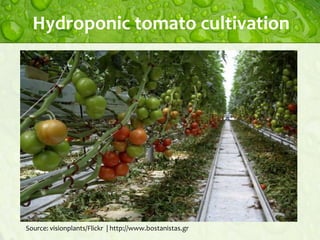
Hydroponic tomato cultivation

Source: visionplants/Flickr | http://www.bostanistas.gr
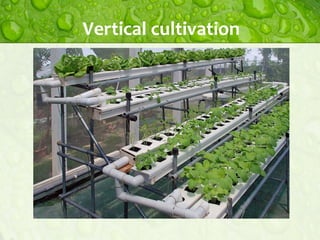
Vertical cultivation
Hydroponics in simple words
Imagine hydroponics like a sponge:
o The roots are in the sponge instead of the soil
o Through a scientifically elaborated and highly
advanced system we can feed the plant with what we
choose
o Nothing we cannot control reaches the plant's roots
o The plants are developing hybrids

Source: http://www.bostanistas.gr/?i=bostanistas.el.article&id=839
Advantages and difficulties
1. The vegetables' taste and appearance depend on the ingredients they
feed on
2. Their quality can be planned
3. In Greece they have a great advantage: the sun
4. In northern countries the electricity cost is doubled
5. The area where vegetables grow is sterilised and workers wear
hospital uniforms
6. A lot of attention should be given to microbs and microorganisms: e.g
if someone enters a hydroponic greenhouse with a ladybird on him, as
there are no natural enemies for the ladybird, it will multiply very
quickly!!

Source: http://www.bostanistas.gr/?i=bostanistas.el.article&id=839
Is hydroponics an organic
cultivation method?
Hydroponics is NOT an
organic cultivation
method, in any country of
the world,
because the plants are fed
with chemical fertilizers
that are added in water.

Source: http://www.viologika.gr/ydroponiki.php
Hydroponic equipment
1. Body
The body consists of
plastic, rectangular
channels, special little
pots, a supporting base
and a water tank.

Source: olamesa.homeftp.net/grow/hydroponic-equipment/
Hydroponic equipment
2.Nutritional
solutions.
Special nutritional
solutions are added
in the water tank
to feed the plants.

3.Ph measurer and

regulating ph
solution.

The plants need
water with a ph
of about 5.5 to
6.0.
Hydroponic equipment

4.Air pump.
An air pump will
provide water with
clean air and all the
oxygen needed.

5. Water pump.
It will send water
from the tank to the
plants.
Hydroponic equpment
6.Pumice gravel or
clay.
They are light and
porous materials
and support plants
in the pots.

7.Water conductivity
measurer (tds, ppm,
ec meter).

This instrument is
very important as it
measures salts in
water, thus we can
calculate quantities
of nutrients to be
added.
Hydroponic equipment
8. Greenhouse.
The success key in
hydroponics is: a lot
of attention to the
last detail. The more
we check
everything in the
greenhouse, the
better the results.

9. Fan
We must ensure
that air circulates
among the plants in
the greenhouse.
Hydroponic equipment
10. Thermometre.
We need it to
measure water
temperature which
should be 21-24
degrees C.

11. Young plants.
Plants should have
developed enough
roots, free of soil or
any other dirt that
could possibly block
the water pump.
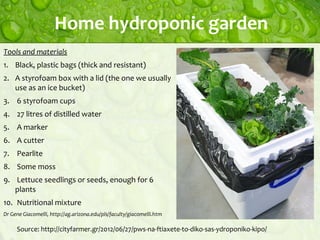
Home hydroponic garden
Tools and materials
1. Black, plastic bags (thick and resistant)
2. A styrofoam box with a lid (the one we usually
use as an ice bucket)
3. 6 styrofoam cups
4. 27 litres of distilled water
5. A marker
6. A cutter
7. Pearlite
8. Some moss
9. Lettuce seedlings or seeds, enough for 6
plants
10. Nutritional mixture
Dr Gene Giacomelli, http://ag.arizona.edu/pls/faculty/giacomelli.htm

Source: http://cityfarmer.gr/2012/06/27/pws-na-ftiaxete-to-diko-sas-ydroponiko-kipo/
Home hydroponic garden
How to make it
Dress the inner part of the
styrofoam box with the plastic
bags and add the distilled water.

Put the box lid upside down on the
box and then put the cups in the
holes.

Using the styrofoam cups as a
pattern, draw 6 circles on the lid of
the box. Cut the circles into holes,
trying to make the holes about 1/2
cm smaller than your drawing.

Water the plants daily with the
mixture and make sure the water
level has not risen. There must be a
distance of 2,5 cm between the
water level and bottom of cups.
After about a week or 10 days, the
roots will start getting into the box.
As the plants grow you can cut as
many leaves as you want, without...
overdoing it.

Make small holes at the bottom of
the styrofoam cups. Put the moss
at the bottom and then fill them
with the pearlite.
Put the lettuce seedlings in the pearlite
and add as much pearlite as
necessary around the plant.

Source: http://cityfarmer.gr/2012/06/27/pws-na-ftiaxete-to-diko-sas-ydroponiko-kipo/
Vertical hydroponic system
A vertical home hydroponic system can fit in
a space 1x2 m and can feed a family
throughout a year.
Materials:
PVC or ADS pipes 4,5 – 6 metres long and a
diameter of 10 cm (4 inches)

Sticks

2 rolls of duct tape
A water pump, the size depends on the
water flow demanded but an aquarium
pump will do.

4 corner pipes of a diameter of 10 cm (4
inches)

An air pump (optional). The system will take
air in even without the air pump but it
will function beter with one.

4 “ T” connectors 10 cm in diameter (4
inches)

Construction time: about 2 hours

2 barrels that can take 190 litres
Pex pipes or aquarium pipes 4,5 – 6 metres
long
Plastic cups
Straps from hard cloth e.g burlap or cable
connectors or any other kind of
connectors.

Plants and fish recommended:
Leafy vegetables, tomatoes, herbs are
suitable for such kinds of construction.
Tilapias and trout are favoured by a
hydroponic environment, grow fast and
are very tasty.

Source: http://www.permaculturegreece.gr/gr/2013/01/26/how-to-make-a-vertical-aquaponics-system/
The research was carried out by

the following participants in “Seeds for the Future” project

o Andriana Koskina
o Mariliza Kolovou
o Anastasia Revythi
o Giorgos Hondrogiannis
o Lazos Tsiatis
o Agelos Yiagas
o Panagiotis Glinias

Hydroponics

  • 1.
    Hydroponics “Seeds for thefuture” project Second Chance School of Corfu 2014
  • 2.
    Differences between traditionaland hydroponic cultivation Traditional Hydroponic Soil cultivation Controlled cultivation, instead of soil other materials are used, roots grow in water in which suitable nutrients are added A lot of water is absorbed by the soil Water can be recycled We can avoid the use of power Power is necessary Great need for pesticides and fertilizers Fewer pesticides and fertilizers needed Low investment cost Source: http://www.tovima.gr/society/article/?aid=358186 High investment cost
  • 3.
    Ecological, cheap but... hardly known o Modern and ecological o Amazing improvement of product quality! o Impressively lower costs! o Internationally gaining ground against traditional methods o In Greece, however, it can hardly reach 7% of cultivations Source: http://www.tovima.gr/society/article/?aid=358186
  • 4.
    The importance of.....the recipe o Technology aims at creating the suitable nutrition recipe. o Mr. Lazanakis says: o «In hydroponics everything is ideal. A possible mistake though, could be fatal. If something is added wrong, the plant gets destroyed and we could lose the whole production» o «My experience is talking. The first year my production reached 40 tons, the second it reached 180!Did I do something wrong at the beginning? Obviously! But we learn from our mistakes» o «Without good water quality you can't irrigate your plants» [...] «After 4-5 heavy rainfalls I collect 2.000 cubic metres in a tank and from there I channel water to the greenhouse.» Source: http://www.tovima.gr/society/article/?aid=358186
  • 5.
    Substrate «Hydroponics with asubstrate or plain water?» Plain water hydroponics uses either a wet membrane which irrigates the plant's roots or a small pond (tank) where plants float. Substrates, which come in various kinds, are safer. contentious issue: should an industrial material be used (e.g rockwool) or natural ones like pearlite and pumice? Source: http://www.tovima.gr/society/article/?aid=358186
  • 6.
    Hydrofertilizing o A hydrofertilizingmachine is connected with fertilizer tanks. An expert, using his computer, programmes the suitable nutrition recipe: He calculates the correct for each plant proportions of ions (nitrogen, potassium e.t.c) according to the plant's needs and development stage. o A close hydroponic system demands water of good quality. Salty water doesn't allow its circulation, still it is less harmful in hydroponics than in traditional soil cultivation. Source: http://www.tovima.gr/society/article/?aid=358186
  • 7.
    Costs o A fullyequipped, ecological,hydroponic cultivation is going to cost: o About 200.000 euros / 1000 square metre. This cost could be reduced by 50% with a few “sacrifices” o A plot of at least 6-8.000 square metres is considered necessary for an economically viable hydroponic cultivation. Source: http://www.tovima.gr/society/article/?aid=358186
  • 8.
    Payback o From water: oSoil cultivation: 60 litres/kg of tomato plant o Typical greenhouse (with soil): 25-30 litres/kg of tomato plant o Open hydroponic system (without water recycling): 20 litres/kg of tomato plant o Closed hydroponic system (with water recycling): 15 litres/kg of tomato plant o From fertilizers: o Reduction by 50% Source: http://www.tovima.gr/society/article/?aid=358186
  • 9.
  • 10.
    Hydroponic tomato cultivation Source:visionplants/Flickr | http://www.bostanistas.gr
  • 11.
  • 12.
    Hydroponics in simplewords Imagine hydroponics like a sponge: o The roots are in the sponge instead of the soil o Through a scientifically elaborated and highly advanced system we can feed the plant with what we choose o Nothing we cannot control reaches the plant's roots o The plants are developing hybrids Source: http://www.bostanistas.gr/?i=bostanistas.el.article&id=839
  • 13.
    Advantages and difficulties 1.The vegetables' taste and appearance depend on the ingredients they feed on 2. Their quality can be planned 3. In Greece they have a great advantage: the sun 4. In northern countries the electricity cost is doubled 5. The area where vegetables grow is sterilised and workers wear hospital uniforms 6. A lot of attention should be given to microbs and microorganisms: e.g if someone enters a hydroponic greenhouse with a ladybird on him, as there are no natural enemies for the ladybird, it will multiply very quickly!! Source: http://www.bostanistas.gr/?i=bostanistas.el.article&id=839
  • 14.
    Is hydroponics anorganic cultivation method? Hydroponics is NOT an organic cultivation method, in any country of the world, because the plants are fed with chemical fertilizers that are added in water. Source: http://www.viologika.gr/ydroponiki.php
  • 15.
    Hydroponic equipment 1. Body Thebody consists of plastic, rectangular channels, special little pots, a supporting base and a water tank. Source: olamesa.homeftp.net/grow/hydroponic-equipment/
  • 16.
    Hydroponic equipment 2.Nutritional solutions. Special nutritional solutionsare added in the water tank to feed the plants. 3.Ph measurer and regulating ph solution. The plants need water with a ph of about 5.5 to 6.0.
  • 17.
    Hydroponic equipment 4.Air pump. Anair pump will provide water with clean air and all the oxygen needed. 5. Water pump. It will send water from the tank to the plants.
  • 18.
    Hydroponic equpment 6.Pumice gravelor clay. They are light and porous materials and support plants in the pots. 7.Water conductivity measurer (tds, ppm, ec meter). This instrument is very important as it measures salts in water, thus we can calculate quantities of nutrients to be added.
  • 19.
    Hydroponic equipment 8. Greenhouse. Thesuccess key in hydroponics is: a lot of attention to the last detail. The more we check everything in the greenhouse, the better the results. 9. Fan We must ensure that air circulates among the plants in the greenhouse.
  • 20.
    Hydroponic equipment 10. Thermometre. Weneed it to measure water temperature which should be 21-24 degrees C. 11. Young plants. Plants should have developed enough roots, free of soil or any other dirt that could possibly block the water pump.
  • 21.
    Home hydroponic garden Toolsand materials 1. Black, plastic bags (thick and resistant) 2. A styrofoam box with a lid (the one we usually use as an ice bucket) 3. 6 styrofoam cups 4. 27 litres of distilled water 5. A marker 6. A cutter 7. Pearlite 8. Some moss 9. Lettuce seedlings or seeds, enough for 6 plants 10. Nutritional mixture Dr Gene Giacomelli, http://ag.arizona.edu/pls/faculty/giacomelli.htm Source: http://cityfarmer.gr/2012/06/27/pws-na-ftiaxete-to-diko-sas-ydroponiko-kipo/
  • 22.
    Home hydroponic garden Howto make it Dress the inner part of the styrofoam box with the plastic bags and add the distilled water. Put the box lid upside down on the box and then put the cups in the holes. Using the styrofoam cups as a pattern, draw 6 circles on the lid of the box. Cut the circles into holes, trying to make the holes about 1/2 cm smaller than your drawing. Water the plants daily with the mixture and make sure the water level has not risen. There must be a distance of 2,5 cm between the water level and bottom of cups. After about a week or 10 days, the roots will start getting into the box. As the plants grow you can cut as many leaves as you want, without... overdoing it. Make small holes at the bottom of the styrofoam cups. Put the moss at the bottom and then fill them with the pearlite. Put the lettuce seedlings in the pearlite and add as much pearlite as necessary around the plant. Source: http://cityfarmer.gr/2012/06/27/pws-na-ftiaxete-to-diko-sas-ydroponiko-kipo/
  • 23.
    Vertical hydroponic system Avertical home hydroponic system can fit in a space 1x2 m and can feed a family throughout a year. Materials: PVC or ADS pipes 4,5 – 6 metres long and a diameter of 10 cm (4 inches) Sticks 2 rolls of duct tape A water pump, the size depends on the water flow demanded but an aquarium pump will do. 4 corner pipes of a diameter of 10 cm (4 inches) An air pump (optional). The system will take air in even without the air pump but it will function beter with one. 4 “ T” connectors 10 cm in diameter (4 inches) Construction time: about 2 hours 2 barrels that can take 190 litres Pex pipes or aquarium pipes 4,5 – 6 metres long Plastic cups Straps from hard cloth e.g burlap or cable connectors or any other kind of connectors. Plants and fish recommended: Leafy vegetables, tomatoes, herbs are suitable for such kinds of construction. Tilapias and trout are favoured by a hydroponic environment, grow fast and are very tasty. Source: http://www.permaculturegreece.gr/gr/2013/01/26/how-to-make-a-vertical-aquaponics-system/
  • 24.
    The research wascarried out by the following participants in “Seeds for the Future” project o Andriana Koskina o Mariliza Kolovou o Anastasia Revythi o Giorgos Hondrogiannis o Lazos Tsiatis o Agelos Yiagas o Panagiotis Glinias