What is Rhetoric?
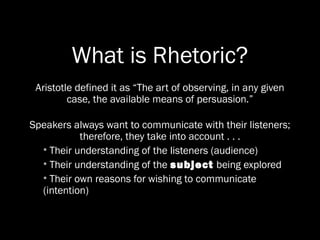
 Aristotle defined it as “The art of observing, in any given
         case, the available means of persuasion.”

Speakers always want to communicate with their listeners;
           therefore, they take into account . . .
  • Their understanding of the listeners (audience)
  • Their understanding of the subject being explored
  • Their own reasons for wishing to communicate
  (intention)
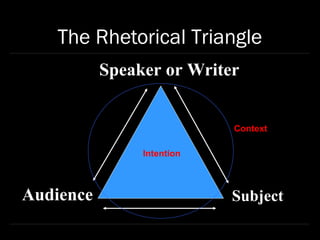
The Rhetorical Triangle
           Speaker or Writer


                            Context

                Intention


Audience                    Subject
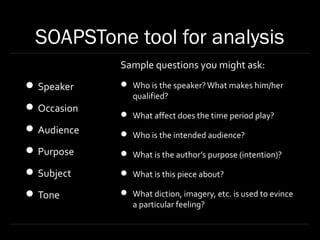
SOAPSTone tool for analysis
             Sample questions you might ask:
 Speaker     Who is the speaker? What makes him/her
               qualified?
 Occasion
              What affect does the time period play?
 Audience    Who is the intended audience?
 Purpose     What is the author’s purpose (intention)?

 Subject     What is this piece about?

 Tone        What diction, imagery, etc. is used to evince
               a particular feeling?
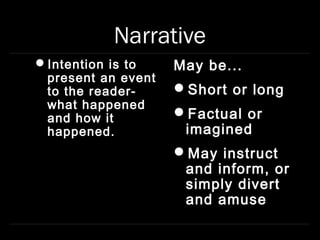
Narrative
Intention is to    May be...
 present an event
 to the reader-     Short or long
 what happened
 and how it         Factual or
 happened.           imagined
                    May instruct
                     and inform, or
                     simply divert
                     and amuse
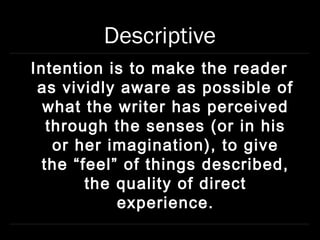
Descriptive
Intention is to make the reader
 as vividly aware as possible of
  what the writer has perceived
   through the senses (or in his
    or her imagination), to give
  the “feel” of things described,
        the quality of direct
            experience.
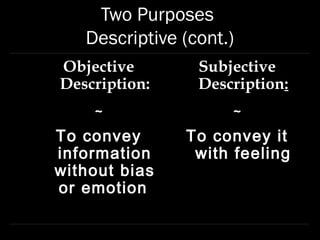
Two Purposes
   Descriptive (cont.)
Objective        Subjective
Description:     Description:
    ~                ~
To convey      To convey it
information     with feeling
without bias
or emotion
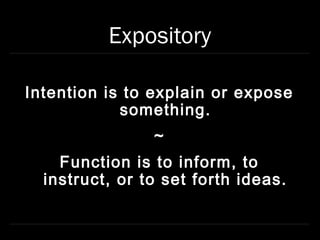
Expository

Intention is to explain or expose
            something.
                ~
    Function is to inform, to
  instruct, or to set forth ideas.
Expository
Can be broken into 5
 categories
 1. Comparison and Contrast
 2. Classification and Division
 3. Definition
 4. Process
 5. Cause and Effect
Argumentative
Intention is to make the reader
     change his or her mind,
    attitude, point of view, or
             feelings.
               ~
  The terms “argument” and
   “persuasion” often used
       interchangeably.
Argumentative
Argument -
 aims to win readers’
 agreement with an assertion
 or claim by engaging their
 powers of reasoning.
Argumentative
Persuasion –
 aims to influence readers’
 action, or their support for an
 action, by engaging their
beliefs
 and feelings.
Bibliography
 “Mr. Henry’s Webpage.” August 2012.
  http://www.ssdcougars.org/webpages/rhenry/news.cfm

Rhetorical modes

  • 1.
    What is Rhetoric? Aristotle defined it as “The art of observing, in any given case, the available means of persuasion.” Speakers always want to communicate with their listeners; therefore, they take into account . . . • Their understanding of the listeners (audience) • Their understanding of the subject being explored • Their own reasons for wishing to communicate (intention)
  • 2.
    The Rhetorical Triangle Speaker or Writer Context Intention Audience Subject
  • 3.
    SOAPSTone tool foranalysis Sample questions you might ask:  Speaker  Who is the speaker? What makes him/her qualified?  Occasion  What affect does the time period play?  Audience  Who is the intended audience?  Purpose  What is the author’s purpose (intention)?  Subject  What is this piece about?  Tone  What diction, imagery, etc. is used to evince a particular feeling?
  • 6.
    Narrative Intention is to May be... present an event to the reader- Short or long what happened and how it Factual or happened. imagined May instruct and inform, or simply divert and amuse
  • 7.
    Descriptive Intention is tomake the reader as vividly aware as possible of what the writer has perceived through the senses (or in his or her imagination), to give the “feel” of things described, the quality of direct experience.
  • 8.
    Two Purposes Descriptive (cont.) Objective Subjective Description: Description: ~ ~ To convey To convey it information with feeling without bias or emotion
  • 9.
    Expository Intention is toexplain or expose something. ~ Function is to inform, to instruct, or to set forth ideas.
  • 10.
    Expository Can be brokeninto 5 categories 1. Comparison and Contrast 2. Classification and Division 3. Definition 4. Process 5. Cause and Effect
  • 11.
    Argumentative Intention is tomake the reader change his or her mind, attitude, point of view, or feelings. ~ The terms “argument” and “persuasion” often used interchangeably.
  • 12.
    Argumentative Argument - aimsto win readers’ agreement with an assertion or claim by engaging their powers of reasoning.
  • 13.
    Argumentative Persuasion – aimsto influence readers’ action, or their support for an action, by engaging their beliefs and feelings.
  • 14.
    Bibliography  “Mr. Henry’sWebpage.” August 2012. http://www.ssdcougars.org/webpages/rhenry/news.cfm