Chapter 5: Evaluating the Author’s Techniques212:189Fall 2011
Connotative LanguageConnotative: includes feeling and associationsDenotative: standard meaningAuntDenotative meaning=mother or father’s sister; wife of mother or father’s brotherConnotative meaning= used as a term of respectful address to an older womanwhois not related to the speaker; often used for close friend of parents; slang for “aging homosexual man”
Figurative LanguageSimile: A comparison using “like” or “as”A computer hums like a beehive.Metaphor: Implies or states a relationship between 2 unlike items. Often use “is.”A computer is a beehive.Personification: compares humans with non-humans using a human characteristic and applying it to ideas or objects.The computer told me it needed repairs. The sound of a beehive coming from it implied it needed to go to the shop.
Evaluating Figurative LanguageWhy did the writer make the comparison?What is the basis of comparison-the shared characteristic?Is the comparison accurate?What images do you have in your mind? How do these images make you feel?Is the comparison positive or negative?Are several different interpretations possible?
Class Activity in GroupsPersonificationOn your own paper, write the object being personified and the meaning of the personification.The wind sang her mournful song through the falling leaves.The microwave timer told me it was time to turn my TV dinner.The video camera observed the whole scene.The strawberries seemed to sing, "Eat me first!"The rain kissed my cheeks as it fell.The daffodils nodded their yellow heads at the walkers.The water beckoned invitingly to the hot swimmers.The snow whispered as it fell to the ground during the early morning hours.The china danced on the shelves during the earthquake.The car engine coughed and sputtered when it started during the blizzard.
Class Activity in GroupsFigurative ExpressionsShe was dirty. ________________________.My friend screamed.___________________.The soccer ball was like_________________.The cloud was like_____________________.
Fair or Biased?Is the author acting as a reporter-presenting facts-or as a salesperson-providing only favorable information.Does the author feel strongly about or favor one side of the issue?Does the author use connotative or figurative language to create a positive or negative image?Does the author seem emotional about the issue?Are there other views toward the subject that the writer does not recognize or discuss?
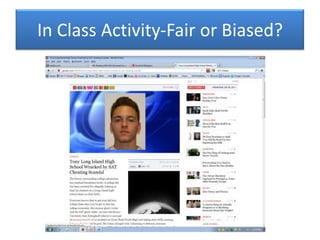
In Class Activity-Fair or Biased?
What isn’t the Author telling me?Essential details omittedIgnoring contradictory evidenceSelectively reporting detailsMaking an incomplete comparisonUsing passive voiceUsing unspecified nouns and pronouns (They, it)Uses a lot of modal auxiliariesHas very long verb phrases
So, in our article…What details were omitted?Was anything ignored?Does any information seem to be missing?Does it use the passive voice?Does it use unspecified nouns and pronouns (They, it)?Does it use a lot of modal auxiliaries?Does it have very long verb phrases?
Does the Author Make or Support Generalizations?Generalization: a reasoned statement about an entire group based on one part of the group.All Asians are smart because international students from Asia tend to do very well in American colleges.
A critical reader should:Evaluate types of evidence.Evaluate the quality of evidence.Evaluate the specifics.Think of exceptions.Now in our article…
Manipulative LanguageCliché: overused expressionCuriosity killed the catJargon: words, phrases and specialized terms used only by insiders in the field, and not understood by the general public.Allusions: references to well-known religious, literary, artistic or historical works or sourcesOedipus complexEuphemisms: word or phrase used in place of a word that is unpleasant, embarrassing, or otherwise objectionable.He was killed in friendly fire vs He was shot by a member of his own army on accident.Doublespeak: deliberately unclear or evasive language.Uses a lot of manipulative language tricksUses passive voice oftenUses high registers, often improperly.
AssumptionsASSuMEAssumption: idea or principle the writer accepts as true and makes no effort to prove or substantiate.
Manipulative LanguageCliché: tired, overused expressionIs the writer trying to gloss over or skip over details by using the cliché?Is the writer trying to avoid directly stating an unpopular or unpleasant idea?Is the cliché fitting or appropriate?What does the use of the cliché reveal about the author?
Manipulative LanguageJargon: subject/interest specific wordsOften a sign you are not the intended audienceIf you are the intended audience, often a sign author is trying to manipulate you
Manipulative LanguageAllusions: references to well-know religious, literary, artistic or historical works or sources.What does the allusion mean?Why did the writer include it?What does the allusion contribute to the overall meaning of the work?
Manipulative LanguageEuphemisms: a word or phrase used in place of a word that is unpleasant, embarrassing, or otherwise objectionable.Passed away/diedFriendly fire/killed my own soldiers by accidentSanitation engineer/janitor
Manipulative LanguageDoublespeak: deliberately unclear or evasive language.Why is the writer being evasive or unclear?What are they trying to hide?
Chapter 6: Reading and Evaluating Arguments212:189Fall 2011
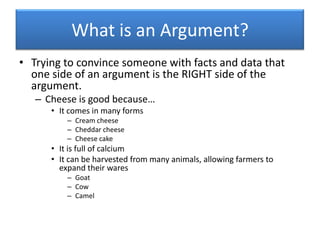
What is an Argument?Trying to convince someone with facts and data that one side of an argument is the RIGHT side of the argument.Cheese is good because…It comes in many formsCream cheeseCheddar cheeseCheese cakeIt is full of calciumIt can be harvested from many animals, allowing farmers to expand their waresGoatCowCamel
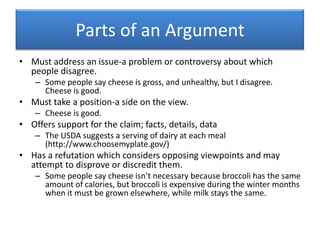
Parts of an ArgumentMust address an issue-a problem or controversy about which people disagree.Some people say cheese is gross, and unhealthy, but I disagree.  Cheese is good.Must take a position-a side on the view.Cheese is good.Offers support for the claim; facts, details, dataThe USDA suggests a serving of dairy at each meal (http://www.choosemyplate.gov/)Has a refutation which considers opposing viewpoints and may attempt to disprove or discredit them.Some people say cheese isn’t necessary because broccoli has the same amount of calories, but broccoli is expensive during the winter months when it must be grown elsewhere, while milk stays the same.
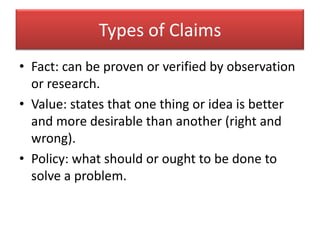
Types of ClaimsFact: can be proven or verified by observation or research.Value: states that one thing or idea is better and more desirable than another (right and wrong).Policy: what should or ought to be done to solve a problem.
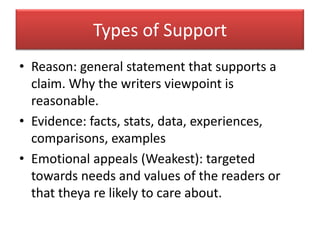
Types of SupportReason: general statement that supports a claim. Why the writers viewpoint is reasonable.Evidence: facts, stats, data, experiences, comparisons, examplesEmotional appeals (Weakest): targeted towards needs and values of the readers or that theya re likely to care about.
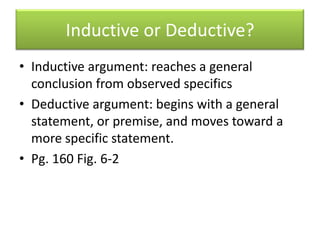
Inductive or Deductive?Inductive argument: reaches a general conclusion from observed specificsDeductive argument: begins with a general statement, or premise, and moves toward a more specific statement.Pg. 160 Fig. 6-2
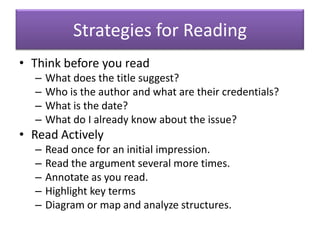
Strategies for ReadingThink before you readWhat does the title suggest?Who is the author and what are their credentials?What is the date?What do I already know about the issue?Read ActivelyRead once for an initial impression.Read the argument several more times.Annotate as you read.Highlight key termsDiagram or map and analyze structures.
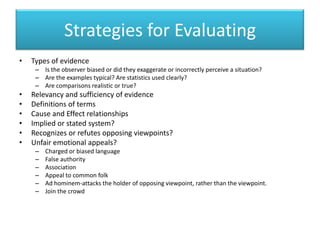
Strategies for EvaluatingTypes of evidenceIs the observer biased or did they exaggerate or incorrectly perceive a situation?Are the examples typical? Are statistics used clearly?Are comparisons realistic or true?Relevancy and sufficiency of evidenceDefinitions of termsCause and Effect relationshipsImplied or stated system?Recognizes or refutes opposing viewpoints?Unfair emotional appeals?Charged or biased languageFalse authorityAssociationAppeal to common folkAd hominem-attacks the holder of opposing viewpoint, rather than the viewpoint.Join the crowd
Errors in Logical ReasoningCircular reasoning-begging the question. Using part of the conclusion as evidence to support it.Female soldiers should not be sent to the front of the line because killing is a man’s job.No evidenceNo reason to acceptHasty generalizationsNon sequitur-it does not follow thatFalse causeEither Or Fallacy-only two sides

Chapter 5 and 6 FINAL

  • 1.
    Chapter 5: Evaluatingthe Author’s Techniques212:189Fall 2011
  • 2.
    Connotative LanguageConnotative: includesfeeling and associationsDenotative: standard meaningAuntDenotative meaning=mother or father’s sister; wife of mother or father’s brotherConnotative meaning= used as a term of respectful address to an older womanwhois not related to the speaker; often used for close friend of parents; slang for “aging homosexual man”
  • 3.
    Figurative LanguageSimile: Acomparison using “like” or “as”A computer hums like a beehive.Metaphor: Implies or states a relationship between 2 unlike items. Often use “is.”A computer is a beehive.Personification: compares humans with non-humans using a human characteristic and applying it to ideas or objects.The computer told me it needed repairs. The sound of a beehive coming from it implied it needed to go to the shop.
  • 4.
    Evaluating Figurative LanguageWhydid the writer make the comparison?What is the basis of comparison-the shared characteristic?Is the comparison accurate?What images do you have in your mind? How do these images make you feel?Is the comparison positive or negative?Are several different interpretations possible?
  • 5.
    Class Activity inGroupsPersonificationOn your own paper, write the object being personified and the meaning of the personification.The wind sang her mournful song through the falling leaves.The microwave timer told me it was time to turn my TV dinner.The video camera observed the whole scene.The strawberries seemed to sing, "Eat me first!"The rain kissed my cheeks as it fell.The daffodils nodded their yellow heads at the walkers.The water beckoned invitingly to the hot swimmers.The snow whispered as it fell to the ground during the early morning hours.The china danced on the shelves during the earthquake.The car engine coughed and sputtered when it started during the blizzard.
  • 6.
    Class Activity inGroupsFigurative ExpressionsShe was dirty. ________________________.My friend screamed.___________________.The soccer ball was like_________________.The cloud was like_____________________.
  • 7.
    Fair or Biased?Isthe author acting as a reporter-presenting facts-or as a salesperson-providing only favorable information.Does the author feel strongly about or favor one side of the issue?Does the author use connotative or figurative language to create a positive or negative image?Does the author seem emotional about the issue?Are there other views toward the subject that the writer does not recognize or discuss?
  • 8.
  • 9.
    What isn’t theAuthor telling me?Essential details omittedIgnoring contradictory evidenceSelectively reporting detailsMaking an incomplete comparisonUsing passive voiceUsing unspecified nouns and pronouns (They, it)Uses a lot of modal auxiliariesHas very long verb phrases
  • 10.
    So, in ourarticle…What details were omitted?Was anything ignored?Does any information seem to be missing?Does it use the passive voice?Does it use unspecified nouns and pronouns (They, it)?Does it use a lot of modal auxiliaries?Does it have very long verb phrases?
  • 11.
    Does the AuthorMake or Support Generalizations?Generalization: a reasoned statement about an entire group based on one part of the group.All Asians are smart because international students from Asia tend to do very well in American colleges.
  • 12.
    A critical readershould:Evaluate types of evidence.Evaluate the quality of evidence.Evaluate the specifics.Think of exceptions.Now in our article…
  • 13.
    Manipulative LanguageCliché: overusedexpressionCuriosity killed the catJargon: words, phrases and specialized terms used only by insiders in the field, and not understood by the general public.Allusions: references to well-known religious, literary, artistic or historical works or sourcesOedipus complexEuphemisms: word or phrase used in place of a word that is unpleasant, embarrassing, or otherwise objectionable.He was killed in friendly fire vs He was shot by a member of his own army on accident.Doublespeak: deliberately unclear or evasive language.Uses a lot of manipulative language tricksUses passive voice oftenUses high registers, often improperly.
  • 14.
    AssumptionsASSuMEAssumption: idea orprinciple the writer accepts as true and makes no effort to prove or substantiate.
  • 15.
    Manipulative LanguageCliché: tired,overused expressionIs the writer trying to gloss over or skip over details by using the cliché?Is the writer trying to avoid directly stating an unpopular or unpleasant idea?Is the cliché fitting or appropriate?What does the use of the cliché reveal about the author?
  • 16.
    Manipulative LanguageJargon: subject/interestspecific wordsOften a sign you are not the intended audienceIf you are the intended audience, often a sign author is trying to manipulate you
  • 17.
    Manipulative LanguageAllusions: referencesto well-know religious, literary, artistic or historical works or sources.What does the allusion mean?Why did the writer include it?What does the allusion contribute to the overall meaning of the work?
  • 18.
    Manipulative LanguageEuphemisms: aword or phrase used in place of a word that is unpleasant, embarrassing, or otherwise objectionable.Passed away/diedFriendly fire/killed my own soldiers by accidentSanitation engineer/janitor
  • 19.
    Manipulative LanguageDoublespeak: deliberatelyunclear or evasive language.Why is the writer being evasive or unclear?What are they trying to hide?
  • 20.
    Chapter 6: Readingand Evaluating Arguments212:189Fall 2011
  • 21.
    What is anArgument?Trying to convince someone with facts and data that one side of an argument is the RIGHT side of the argument.Cheese is good because…It comes in many formsCream cheeseCheddar cheeseCheese cakeIt is full of calciumIt can be harvested from many animals, allowing farmers to expand their waresGoatCowCamel
  • 22.
    Parts of anArgumentMust address an issue-a problem or controversy about which people disagree.Some people say cheese is gross, and unhealthy, but I disagree. Cheese is good.Must take a position-a side on the view.Cheese is good.Offers support for the claim; facts, details, dataThe USDA suggests a serving of dairy at each meal (http://www.choosemyplate.gov/)Has a refutation which considers opposing viewpoints and may attempt to disprove or discredit them.Some people say cheese isn’t necessary because broccoli has the same amount of calories, but broccoli is expensive during the winter months when it must be grown elsewhere, while milk stays the same.
  • 23.
    Types of ClaimsFact:can be proven or verified by observation or research.Value: states that one thing or idea is better and more desirable than another (right and wrong).Policy: what should or ought to be done to solve a problem.
  • 24.
    Types of SupportReason:general statement that supports a claim. Why the writers viewpoint is reasonable.Evidence: facts, stats, data, experiences, comparisons, examplesEmotional appeals (Weakest): targeted towards needs and values of the readers or that theya re likely to care about.
  • 25.
    Inductive or Deductive?Inductiveargument: reaches a general conclusion from observed specificsDeductive argument: begins with a general statement, or premise, and moves toward a more specific statement.Pg. 160 Fig. 6-2
  • 26.
    Strategies for ReadingThinkbefore you readWhat does the title suggest?Who is the author and what are their credentials?What is the date?What do I already know about the issue?Read ActivelyRead once for an initial impression.Read the argument several more times.Annotate as you read.Highlight key termsDiagram or map and analyze structures.
  • 27.
    Strategies for EvaluatingTypesof evidenceIs the observer biased or did they exaggerate or incorrectly perceive a situation?Are the examples typical? Are statistics used clearly?Are comparisons realistic or true?Relevancy and sufficiency of evidenceDefinitions of termsCause and Effect relationshipsImplied or stated system?Recognizes or refutes opposing viewpoints?Unfair emotional appeals?Charged or biased languageFalse authorityAssociationAppeal to common folkAd hominem-attacks the holder of opposing viewpoint, rather than the viewpoint.Join the crowd
  • 28.
    Errors in LogicalReasoningCircular reasoning-begging the question. Using part of the conclusion as evidence to support it.Female soldiers should not be sent to the front of the line because killing is a man’s job.No evidenceNo reason to acceptHasty generalizationsNon sequitur-it does not follow thatFalse causeEither Or Fallacy-only two sides

Editor's Notes