MAX MOLLON
Ph.D. CANDIDATE
INTERACTION DESIGN
RESEARCH BY PRACTICE
SACRe PSL
ENSADLab/ Sociable Media
Telecom ParisTech/ Codesign Lab
ANNIE GENTES
ASSOCIATE PR.
INFORMATION AND
COMMUNICATION SCIENCES
Telecom ParisTech/ Codesign Lab & Media Studies
DESIGN RESEARCH CONFERENCE 2014
UMEÅ, SWEDEN, 2014 JUNE 16-19TH
MAX MOLLON
Ph.D. CANDIDATE
INTERACTION DESIGN
RESEARCH BY PRACTICE
SACRe PSL
ENSADLab/ Sociable Media
Telecom ParisTech/ Codesign Lab
ANNIE GENTES
ASSOCIATE PR.
INFORMATION AND
COMMUNICATION SCIENCES
Telecom ParisTech/ Codesign Lab & Media Studies
DESIGN RESEARCH CONFERENCE 2014
UMEÅ, SWEDEN, 2014 JUNE 16-19TH
THE RHETORIC OF DESIGN FOR DEBATE:
TRIGGERING CONVERSATION WITH
AN “UNCANNY ENOUGH” ARTEFACT
THE RHETORIC OF DESIGN FOR DEBATE:
TRIGGERING CONVERSATION WITH
AN “UNCANNY ENOUGH” ARTEFACT
PROPOSE ALTERNATIVES — ENGAGE REFLECTION — SPARK DISCUSSION
SCHÖN, D. A. (1983).THE REFLECTIVE PRACTITIONER. BASIC BOOKS.
THE RHETORIC OF DESIGN FOR DEBATE:
TRIGGERING CONVERSATION WITH
AN “UNCANNY ENOUGH” ARTEFACT
PROPOSE ALTERNATIVES — ENGAGE REFLECTION — SPARK DISCUSSION
SCHÖN, D. A. (1983).THE REFLECTIVE PRACTITIONER. BASIC BOOKS.
THE RHETORIC OF DESIGN FOR DEBATE:
TRIGGERING CONVERSATION WITH
AN “UNCANNY ENOUGH” ARTEFACT
PROPOSE ALTERNATIVES — ENGAGE REFLECTION — SPARK DISCUSSION
THE RHETORIC OF DESIGN FOR DEBATE:
TRIGGERING CONVERSATION WITH
AN “UNCANNY ENOUGH” ARTEFACT
PROPOSE ALTERNATIVES — ENGAGE REFLECTION — SPARK DISCUSSION
KERRIDGE,T. (2009). DOES SPECULATIVE DESIGN CONTRIBUTE TO PUBLIC ENGAGEMENT OF SCIENCE AND TECHNOLOGY?
THE RHETORIC OF DESIGN FOR DEBATE:
TRIGGERING CONVERSATION WITH
AN “UNCANNY ENOUGH” ARTEFACT
PROPOSE ALTERNATIVES — ENGAGE REFLECTION — SPARK DISCUSSION
HOW DOES DESIGN
UNSETTLE EMOTIONS
TO ENGAGE AN AUDIENCE?
THE RHETORIC OF DESIGN FOR DEBATE:
TRIGGERING CONVERSATION WITH
AN “UNCANNY ENOUGH” ARTEFACT
HOW DOES DESIGN
UNSETTLE EMOTIONS
TO ENGAGE AN AUDIENCE?
THE RHETORIC OF DESIGN FOR DEBATE:
TRIGGERING CONVERSATION WITH
AN “UNCANNY ENOUGH” ARTEFACT
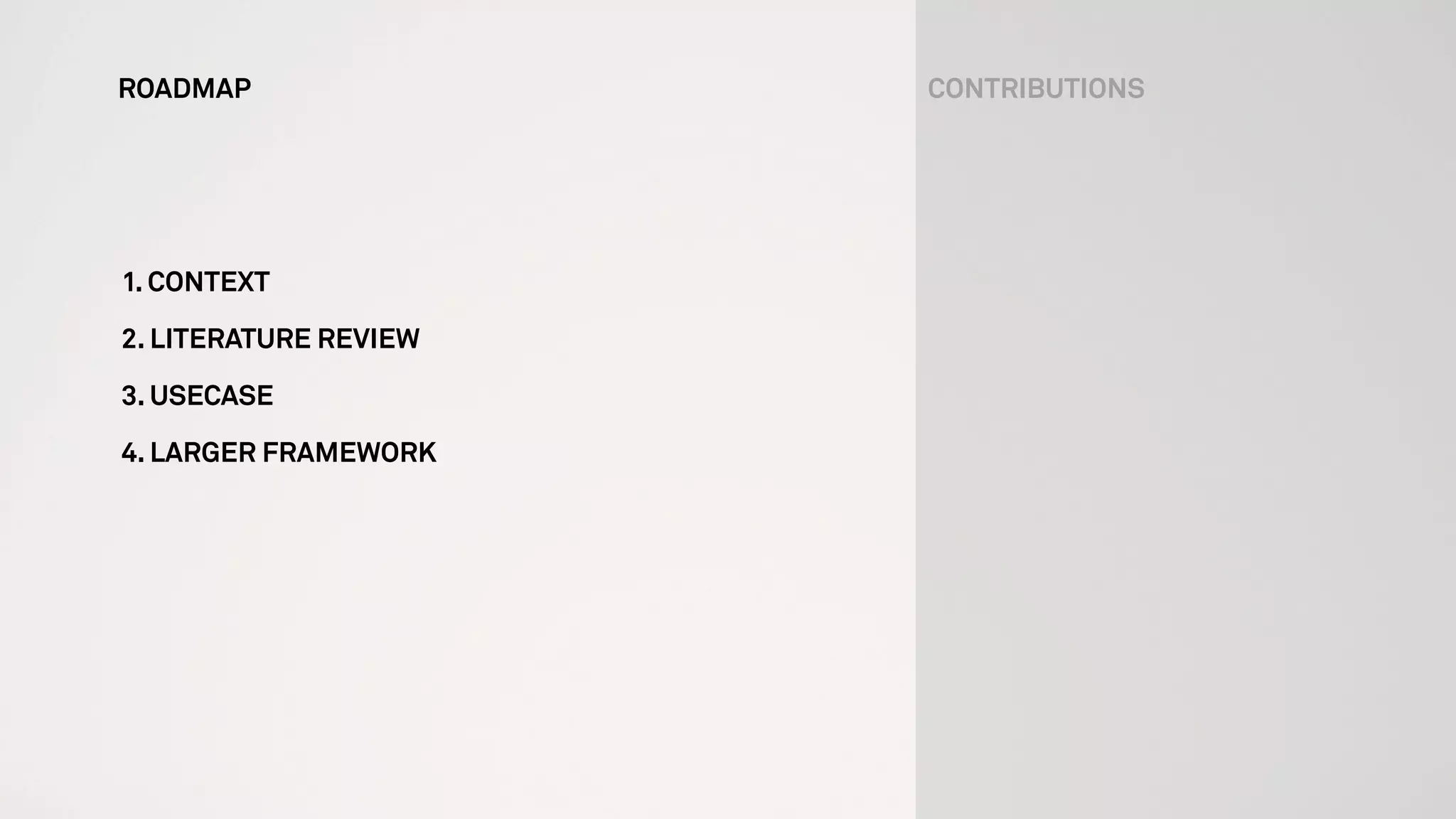
1. CONTEXT
2. LITERATURE REVIEW
3. USECASE
4. LARGER FRAMEWORK
ROADMAP CONTRIBUTIONS
1. CONTEXT
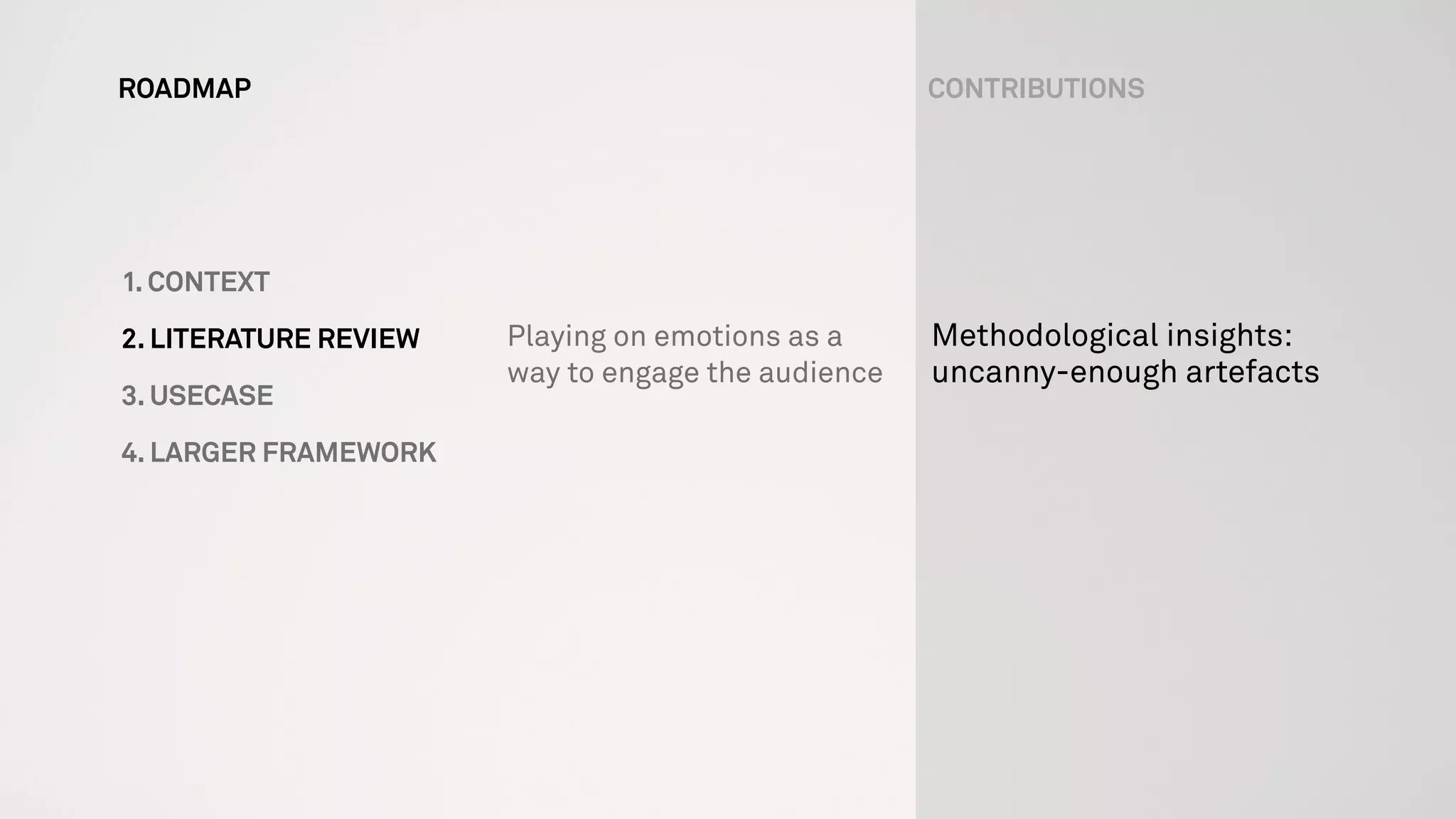
2. LITERATURE REVIEW
3. USECASE
4. LARGER FRAMEWORK
Playing on emotions as a
way to engage the audience
Methodological insights:
uncanny-enough artefacts
ROADMAP
1. CONTEXT
2. LITERATURE REVIEW
3. USECASE
4. LARGER FRAMEWORK
Methodological insights:
uncanny-enough artefacts
Theoretical Framework:
Classic Rhetoric
Playing on emotions as a
way to engage the audience
Art of persuasion
CONTRIBUTIONS
1. CONTEXT
Speculative design, Conceptual design,
Contestable futures, Cautionary tales, Activism,
Design for debate, Design fiction, Discursive design,
Interrogative design, Probe design, Radical design,
Satire, Social fiction…
“
”
DUNNE, A. (2012) PERSONAL COMMUNICATION, DUBLIN, FEBRUARY 03RD
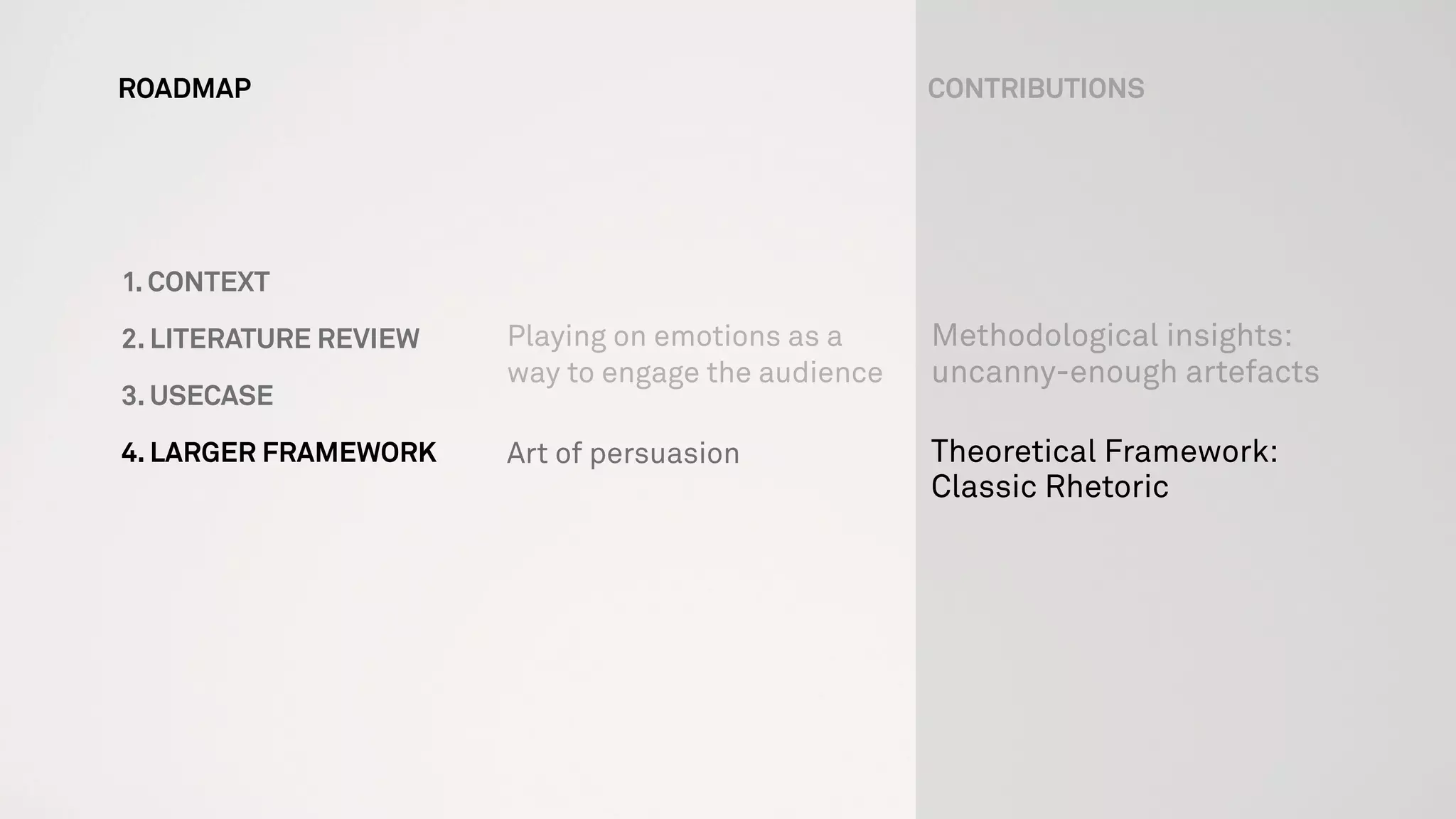
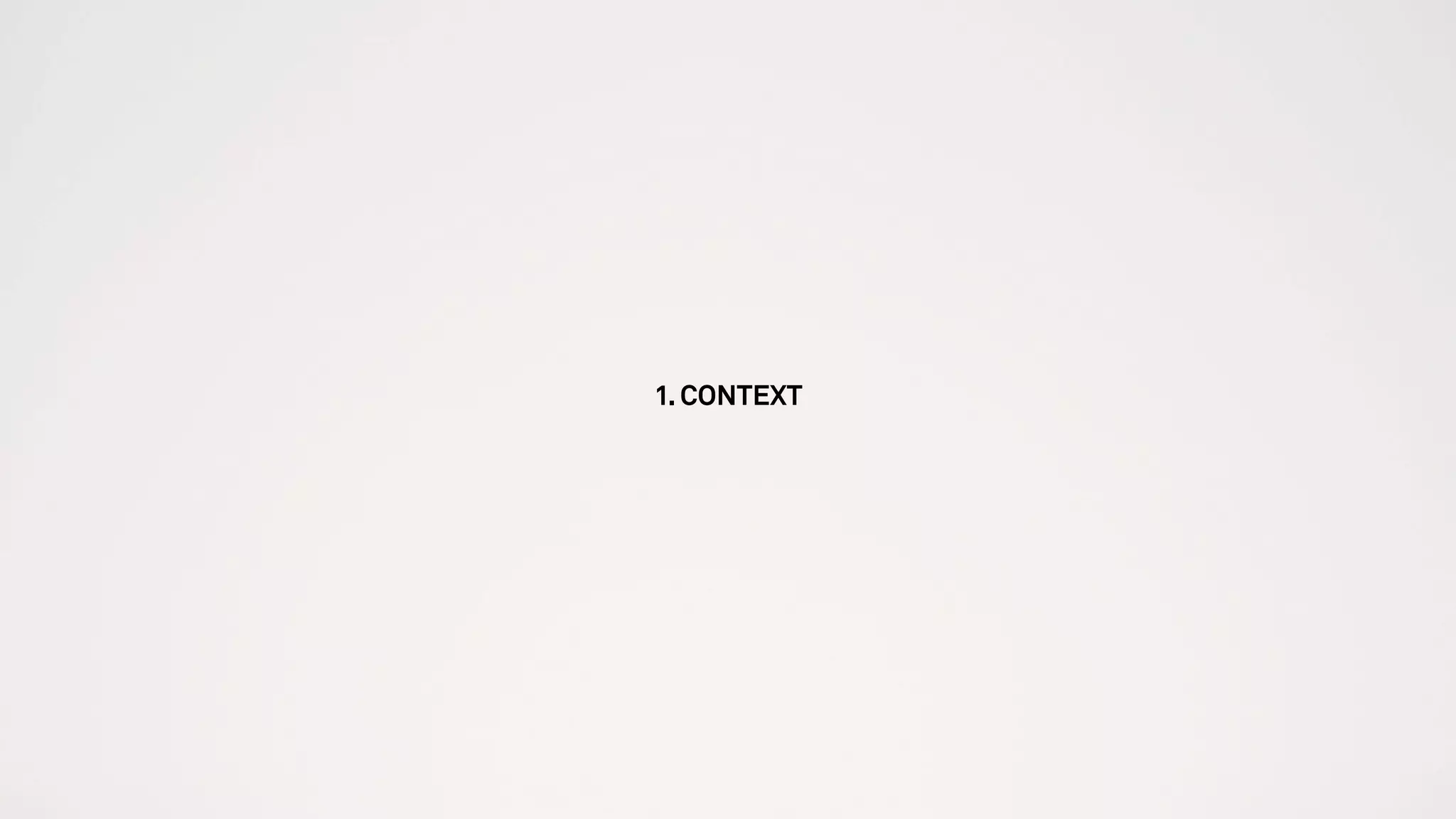
ARCHIGRAM, (70’S) MOVING CITIES. DUNNE & RABY, (2001) ELECTRO-DRAUGHT EXCLUDER, FROM PLACEBO PROJECT.
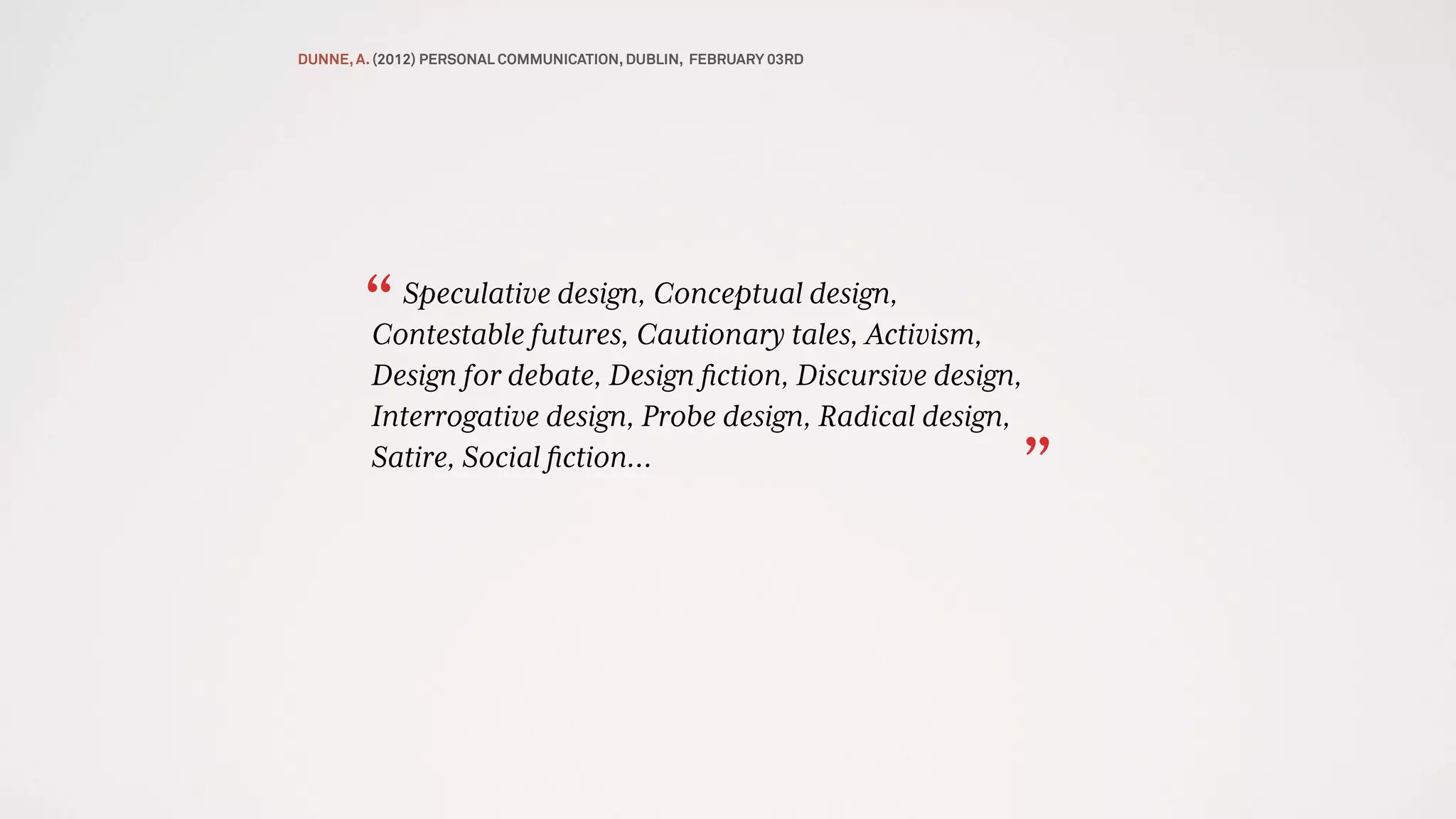
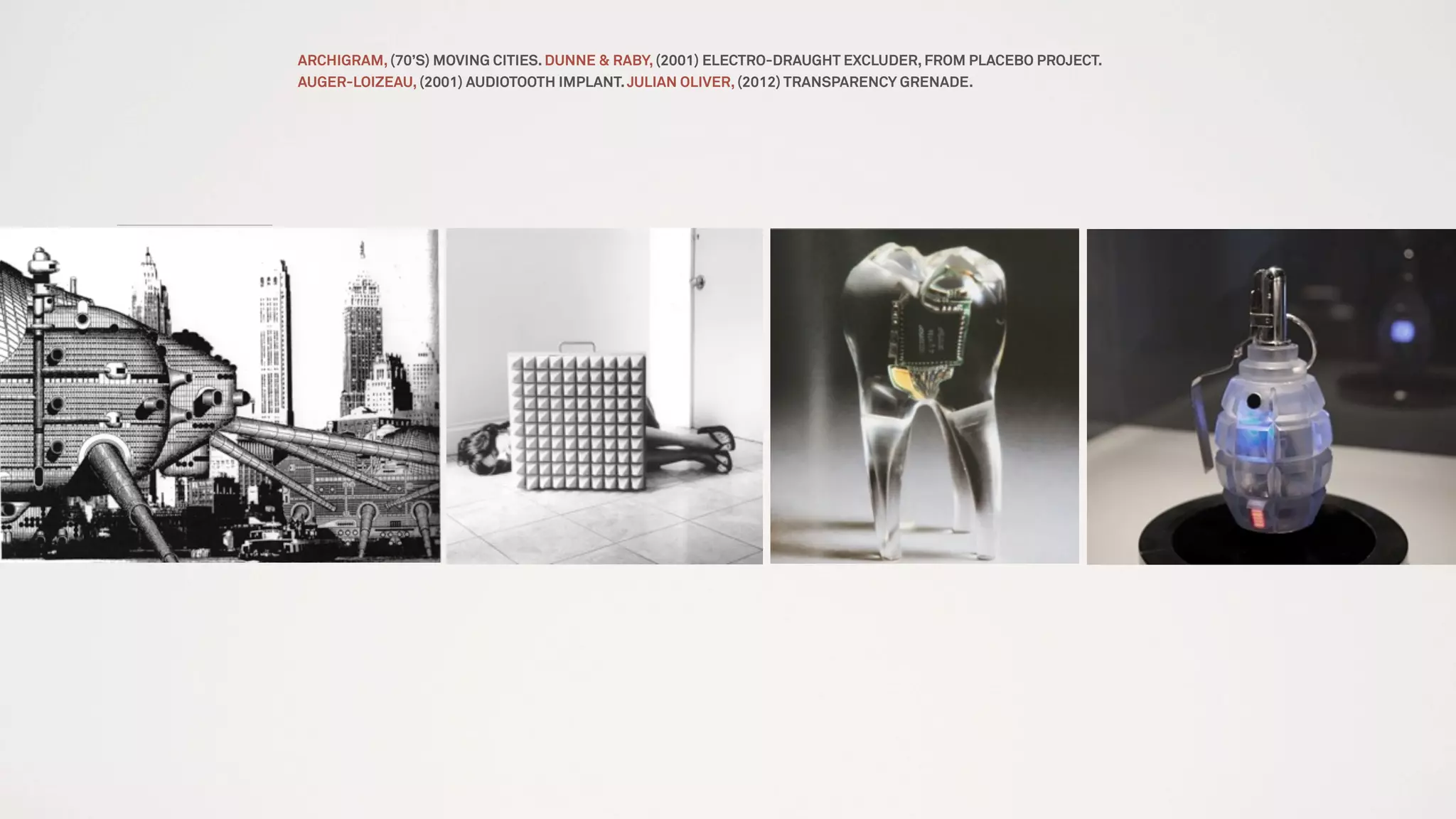
AUGER-LOIZEAU, (2001) AUDIOTOOTH IMPLANT.JULIAN OLIVER, (2012) TRANSPARENCY GRENADE.
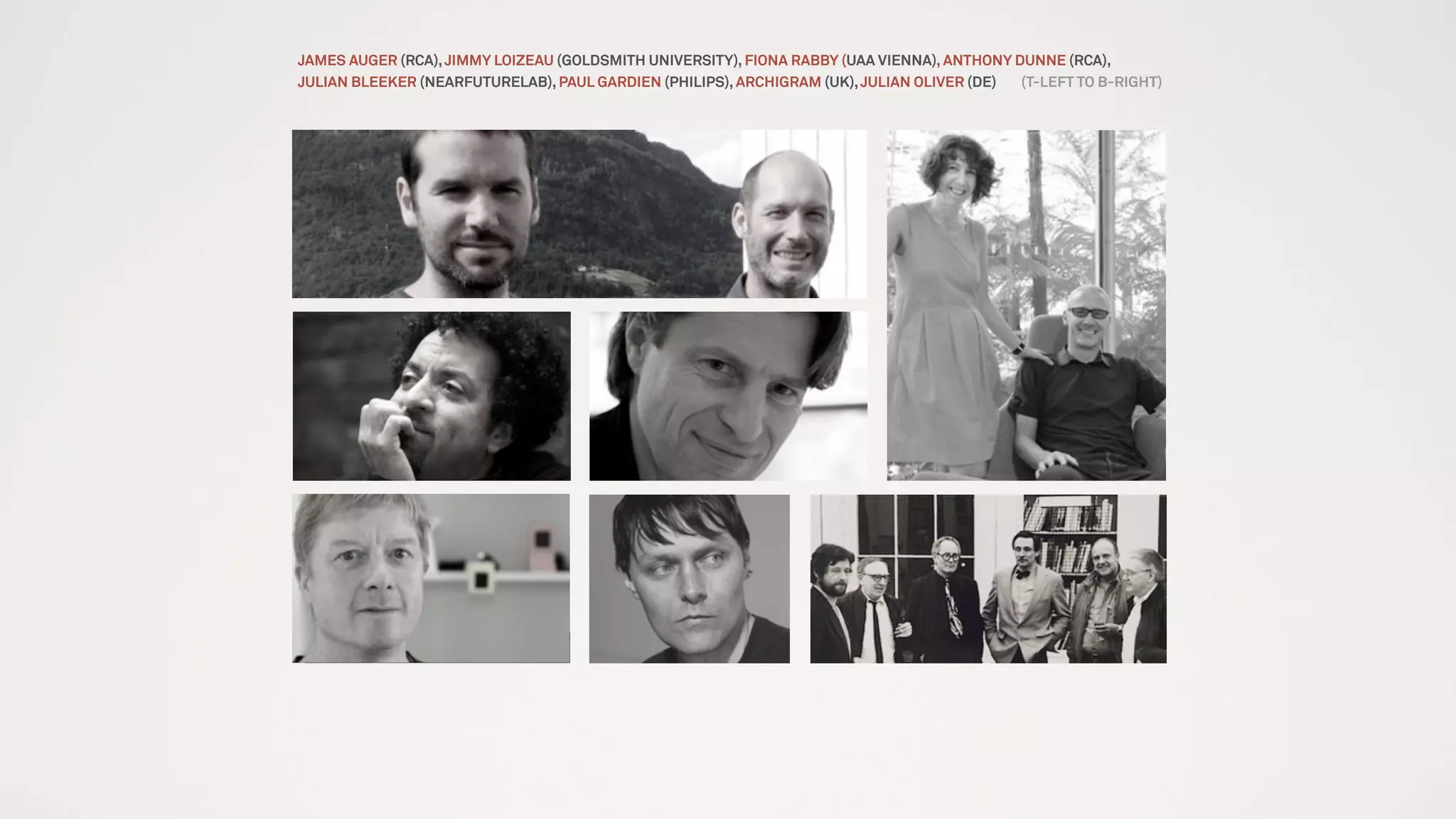
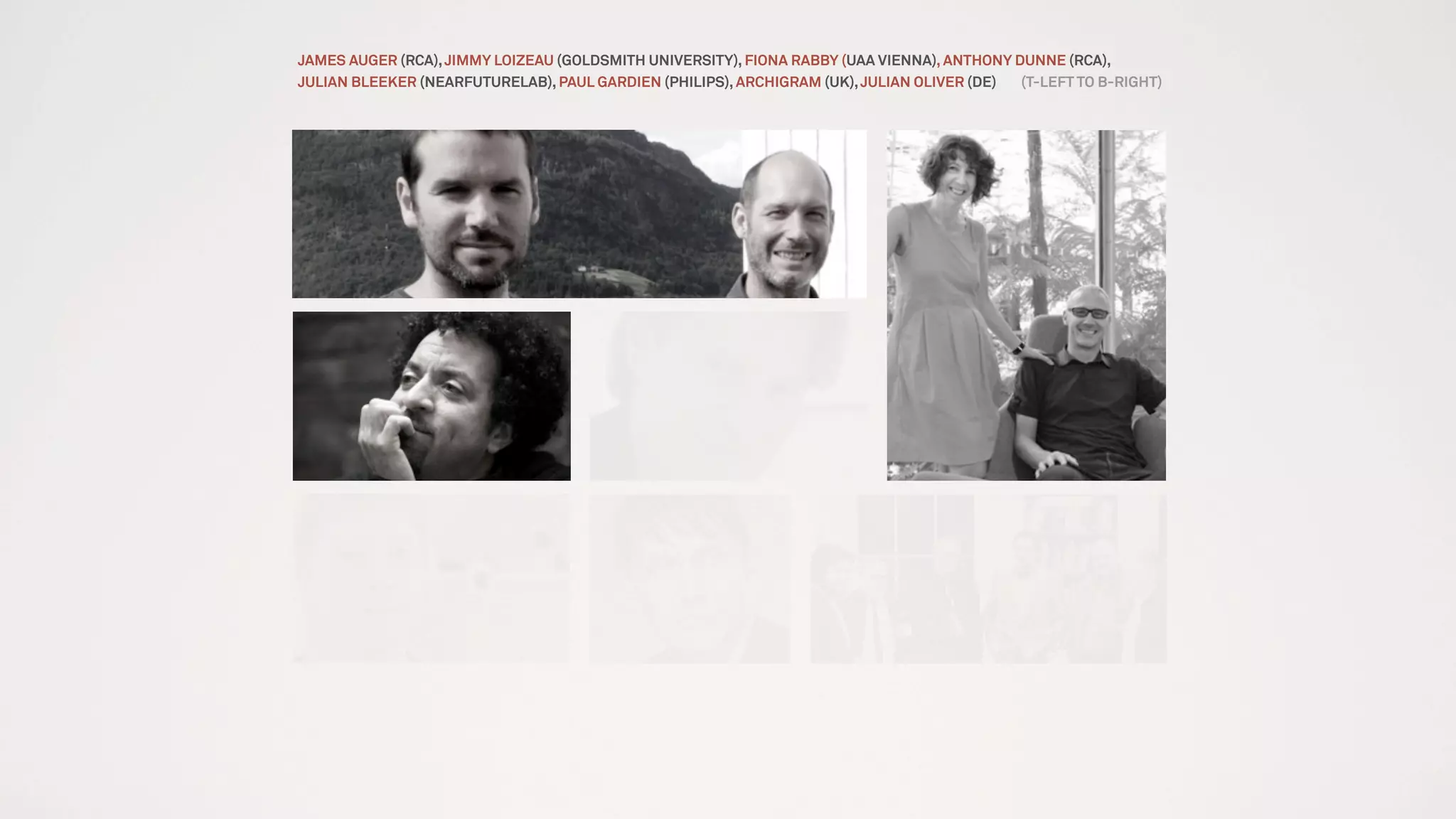
JAMES AUGER (RCA),JIMMY LOIZEAU (GOLDSMITH UNIVERSITY), FIONA RABBY (UAA VIENNA), ANTHONY DUNNE (RCA),
JULIAN BLEEKER (NEARFUTURELAB), PAUL GARDIEN (PHILIPS), ARCHIGRAM (UK),JULIAN OLIVER (DE) (T-LEFT TO B-RIGHT)
JAMES AUGER (RCA),JIMMY LOIZEAU (GOLDSMITH UNIVERSITY), FIONA RABBY (UAA VIENNA), ANTHONY DUNNE (RCA),
JULIAN BLEEKER (NEARFUTURELAB), PAUL GARDIEN (PHILIPS), ARCHIGRAM (UK),JULIAN OLIVER (DE) (T-LEFT TO B-RIGHT)
BARDZELL, S., BARDZELL,J., FORLIZZI,J.,ZIMMERMAN,J., & ANTANITIS,J. (2012). CRITICAL DESIGN AND CRITICAL THEORY:
THE CHALLENGE OF DESIGNING FOR PROVOCATION (PP. 288–297). PRESENTED AT THE MULTIPLE VALUES SELECTED, NEW
YORK, NEW YORK, USA
BOSCH,T. (2012, 02 MARCH). SCI-FI WRITER BRUCE STERLING EXPLAINS THE INTRIGUING NEW CONCEPT OF DESIGN FICTION.
SLATE.COM. RETRIEVED MARCH 2013, FROM HTTP://WWW.SLATE.COM/BLOGS/FUTURE_TENSE/2012/03/02/
BRUCE_STERLING_ON_DESIGN_FICTIONS_. HTML
DUNNE, A., & RABY, F. (2001). DESIGN NOIR:THE SECRET LIFE OF ELECTRONIC OBJECTS. AUGUST MEDIA.
DUNNE, A. (2009). INTERPRETATION COLLABORATION, AND CRITIQUE. (R. RICKENBERG, ED.)WWW.DUNNEANDRABY.CO.UK.
RETRIEVED FROM HTTP://WWW.DUNNEANDRABY.CO.UK/CONTENT/BYDANDR/465/0
FALLMAN, D. (2008).THE INTERACTION DESIGN RESEARCH TRIANGLE OF DESIGN PRACTICE, DESIGN STUDIES, AND DESIGN
EXPLORATION. DESIGN ISSUES, 24(3), 4–18.
KERRIDGE,T. (2009). DOES SPECULATIVE DESIGN CONTRIBUTE TO PUBLIC ENGAGEMENT OF SCIENCE AND TECHNOLOGY? (PP.
1–18). PRESENTED AT THE PROCEEDINGS OF THE SWISS DESIGN NETWORK SYMPOSIUM, LUGANO.
KIRBY, D. (2010).THE FUTURE IS NOW:DIEGETIC PROTOTYPES AND THE ROLE OF POPULAR FILMS IN GENERATING REAL-
WORLD TECHNOLOGICAL DEVELOPMENT. SOCIAL STUDIES OF SCIENCE, 40(1), 41–70.
STERLING, B. (2009). DESIGN FICTION. INTERACTIONS, 16(3).
AUGER,J. H. (2012). WHY ROBOT? SPECULATIVE DESIGN,THE DOMESTICATION OF TECHNOLOGY AND THE CONSIDERED
FUTURE.THE ROYAL COLLEGE OF ART.
BLEECKER,J. (2009). DESIGN FICTION. NEAR FUTURE LABORATORY.
DUNNE, A. (1999). HERTZIAN TALES:ELECTRONIC PRODUCTS, AESTHETIC EXPERIENCE AND CRITICAL DESIGN. LONDON:THE
ROYAL COLLEGE OF ART COMPUTER RELATED DESIGN RESEARCH STUDIO.
2. LITERATURE REVIEW:UNCANNY
It was also necessary to provide a convincing
description, in layman’s terms, of the technology
involved. [...] This description helped in
convincing those with a good understanding of
electronic technology.
(AUGER, 2012, P.158)
[…] the detail and finish of the artefacts,
combined with the short explanations describing
their functions and modes of interaction, entices
the audience into exploring the concept further.
(AUGER, 2012, P.145)
In this way the speculations appear convincing,
plausible or personal, whilst at the same time new
or alternative.
(AUGER, 2012, P.180)
I want to highlight what the story does so as to fill
out the meaning of the clue-construction device,
to make it something legible despite its foreignness
(BLEECKER, 2009, P.35).
For technological believability, the Audio Tooth
Implant relies on a general public awareness of
hard and well-publicised facts
(AUGER, 2012, P.158)
“
In effect a design speculation requires a
‘perceptual bridge’ between the audience
and the concept.
(AUGER, 2012, P.140)
These “perceptual bridges” can then be stretched
in precise ways: this might be a technical
perception such as extrapolating how they think a
technology is likely to develop; a psychological
perception such as not breaking taste or behaviour
taboos; or a cultural perception such as exploiting
nostalgia or familiarity with a particular subject. […]
(AUGER, 2012, P.180)
“
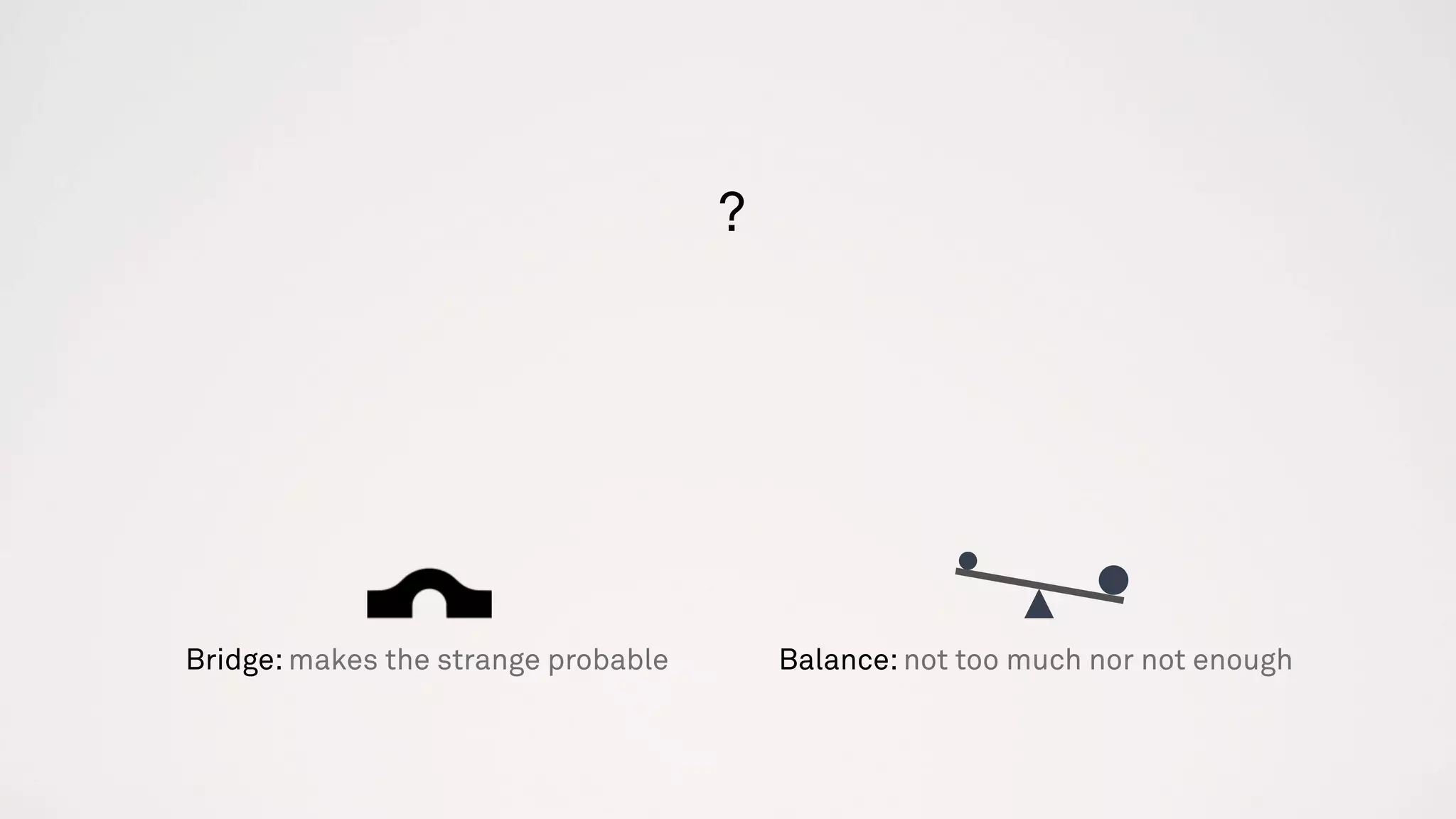
Bridge: makes the strange probable
In effect a design speculation requires a
‘perceptual bridge’ between the audience
and the concept.
(AUGER, 2012, P.140)
These “perceptual bridges” can then be stretched
in precise ways: this might be a technical
perception such as extrapolating how they think a
technology is likely to develop; a psychological
perception such as not breaking taste or behaviour
taboos; or a cultural perception such as exploiting
nostalgia or familiarity with a particular subject. […]
(AUGER, 2012, P.180)
“
[…] something legible despite its foreignness
(BLEECKER, 2009, P.35).
The success of this process requires viewers
to occupy a “fecund middle-ground”
(S. BARDZELL ET AL., 2012).
Things have to be not-quite-right; this
awkwardness is a way into the object
(DUNNE & RABY, 2009).
If it was too correct and as expected, they would
glance once and move on. If the object is too open-
ended in terms of meaning, then it can seem empty.
(DUNNE & RABY, 2001, P.2).
A slight strangeness is the key— too weird and
they are instantly dismissed, not strange enough
and they’re absorbed into everyday reality
(DUNNE & RABY, 2001, P.63).
If a speculative design proposal strays too far
into the future to present clearly implausible
conceptsordescribesacompletelyalientechnological
habitat, the audience will fail to relate to the
proposal, resulting in a lack of engagement
or connection.
(AUGER, 2012, P.138-140)
This effectively heightened the familiar aspect of
the uncanny experience. [...] This encouraged the
audience to reflect on how they themselves might
use the battery, countering the initial repulsion
factor and resulting in a form of desirable uncanny.
(AUGER, 2012)
“
Balance: not too much nor not enough
If a speculative design proposal strays too far
into the future to present clearly implausible
conceptsordescribesacompletelyalientechnological
habitat, the audience will fail to relate to the
proposal, resulting in a lack of engagement
or connection.
(AUGER, 2012, P.138-140)
This effectively heightened the familiar aspect of
the uncanny experience. [...] This encouraged the
audience to reflect on how they themselves might
use the battery, countering the initial repulsion
factor and resulting in a form of desirable uncanny.
(AUGER, 2012)
“
Balance: not too much nor not enough
If a speculative design proposal strays too far
into the future to present clearly implausible
conceptsordescribesacompletelyalientechnological
habitat, the audience will fail to relate to the
proposal, resulting in a lack of engagement
or connection.
(AUGER, 2012, P.138-140)
This effectively heightened the familiar aspect of
the uncanny experience. [...] This encouraged the
audience to reflect on how they themselves might
use the battery, countering the initial repulsion
factor and resulting in a form of desirable uncanny.
(AUGER, 2012)
“
If a speculative design proposal strays too far
into the future to present clearly implausible
conceptsordescribesacompletelyalientechnological
habitat, the audience will fail to relate to the
proposal, resulting in a lack of engagement
or connection.
(AUGER, 2012, P.138-140)
This effectively heightened the familiar aspect of
the uncanny experience. [...] This encouraged the
audience to reflect on how they themselves might
use the battery, countering the initial repulsion
factor and resulting in a form of desirable uncanny.
(AUGER, 2012)
“Freud goes on to suggest that by using the
uncanny, ‘the story-teller has a peculiarly directive
power over us; by means of the moods he can put
us into, he is able to guide the current of our
emotions’.”
(AUGER, 2012, P.138-150)
[…] and how it can be consciously manipulated
to elicit reaction.
(AUGER, 2012, P.138-140)
“
If a speculative design proposal strays too far
into the future to present clearly implausible
conceptsordescribesacompletelyalientechnological
habitat, the audience will fail to relate to the
proposal, resulting in a lack of engagement
or connection.
(AUGER, 2012, P.138-140)
This effectively heightened the familiar aspect of
the uncanny experience. [...] This encouraged the
audience to reflect on how they themselves might
use the battery, countering the initial repulsion
factor and resulting in a form of desirable uncanny.
(AUGER, 2012)
“Freud goes on to suggest that by using the
uncanny, ‘the story-teller has a peculiarly directive
power over us; by means of the moods he can put
us into, he is able to guide the current of our
emotions’.”
(AUGER, 2012, P.138-150)
[…] and how it can be consciously manipulated
to elicit reaction.
(AUGER, 2012, P.138-140)
“
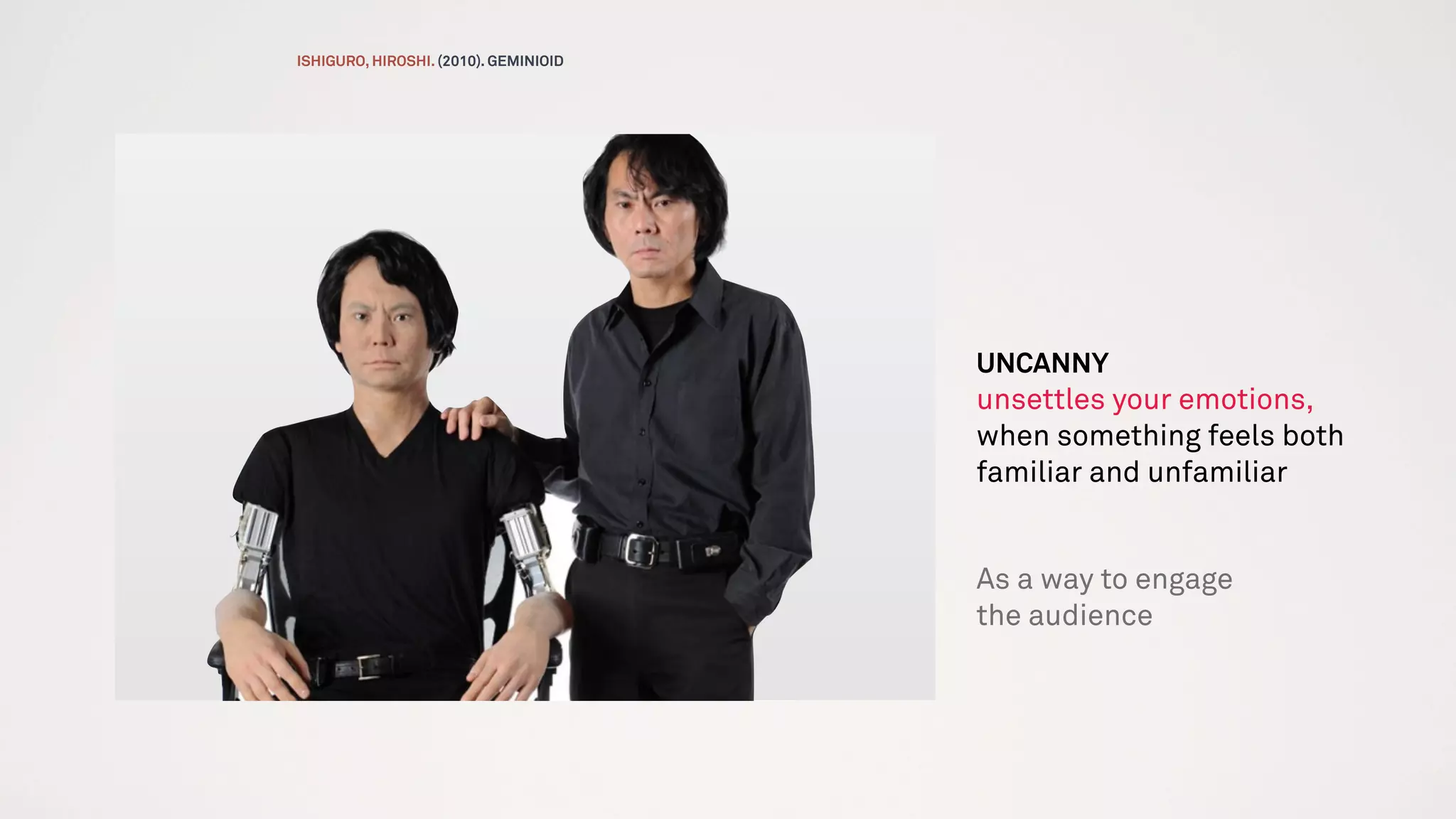
UNCANNY
unsettles your emotions,
when something feels both
familiar and unfamiliar
As a way to engage
the audience
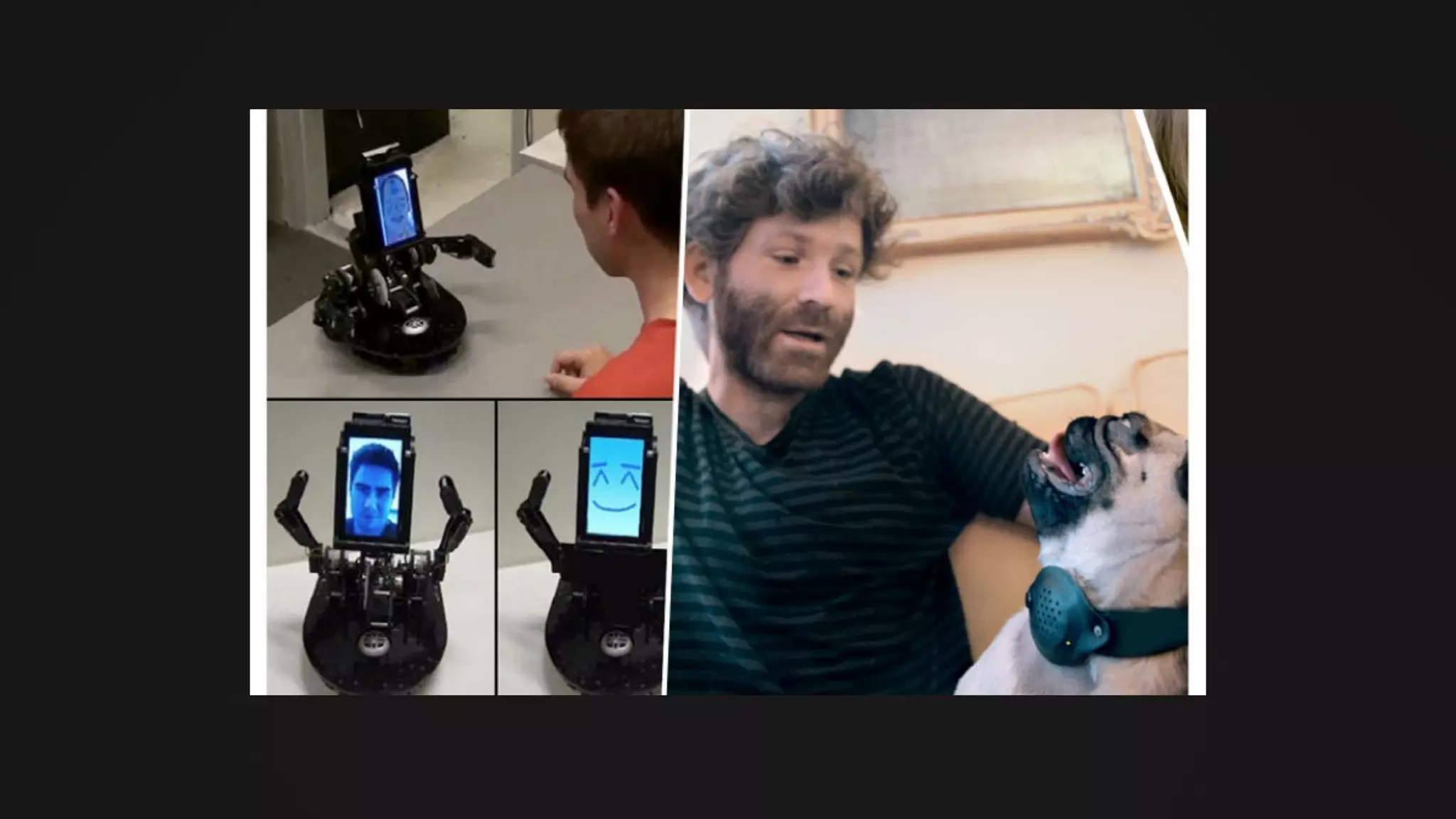
ISHIGURO, HIROSHI. (2010). GEMINIOID
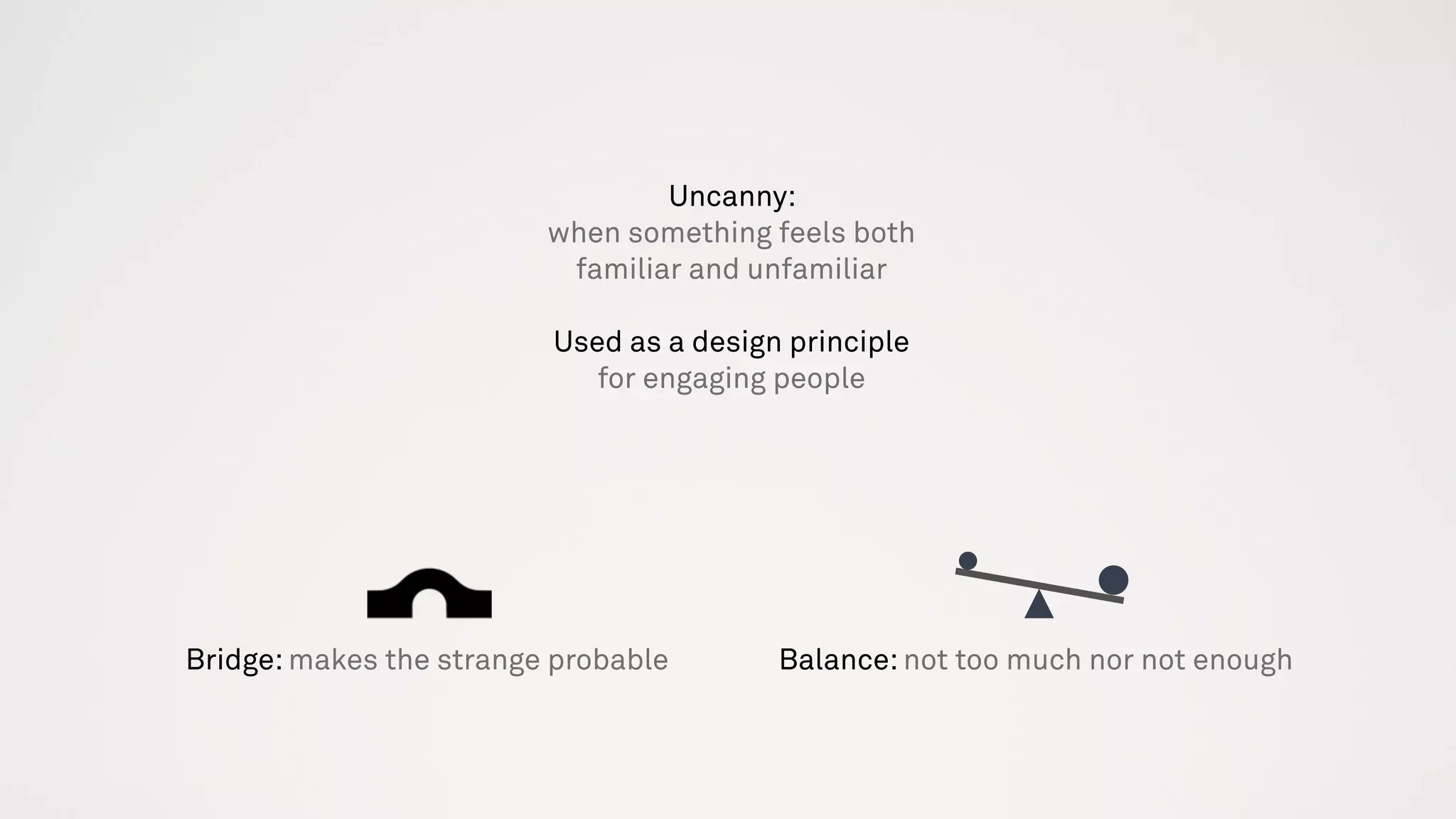
Uncanny:
when something feels both
familiar and unfamiliar
Used as a design principle
for engaging people
Balance: not too much nor not enoughBridge: makes the strange probable
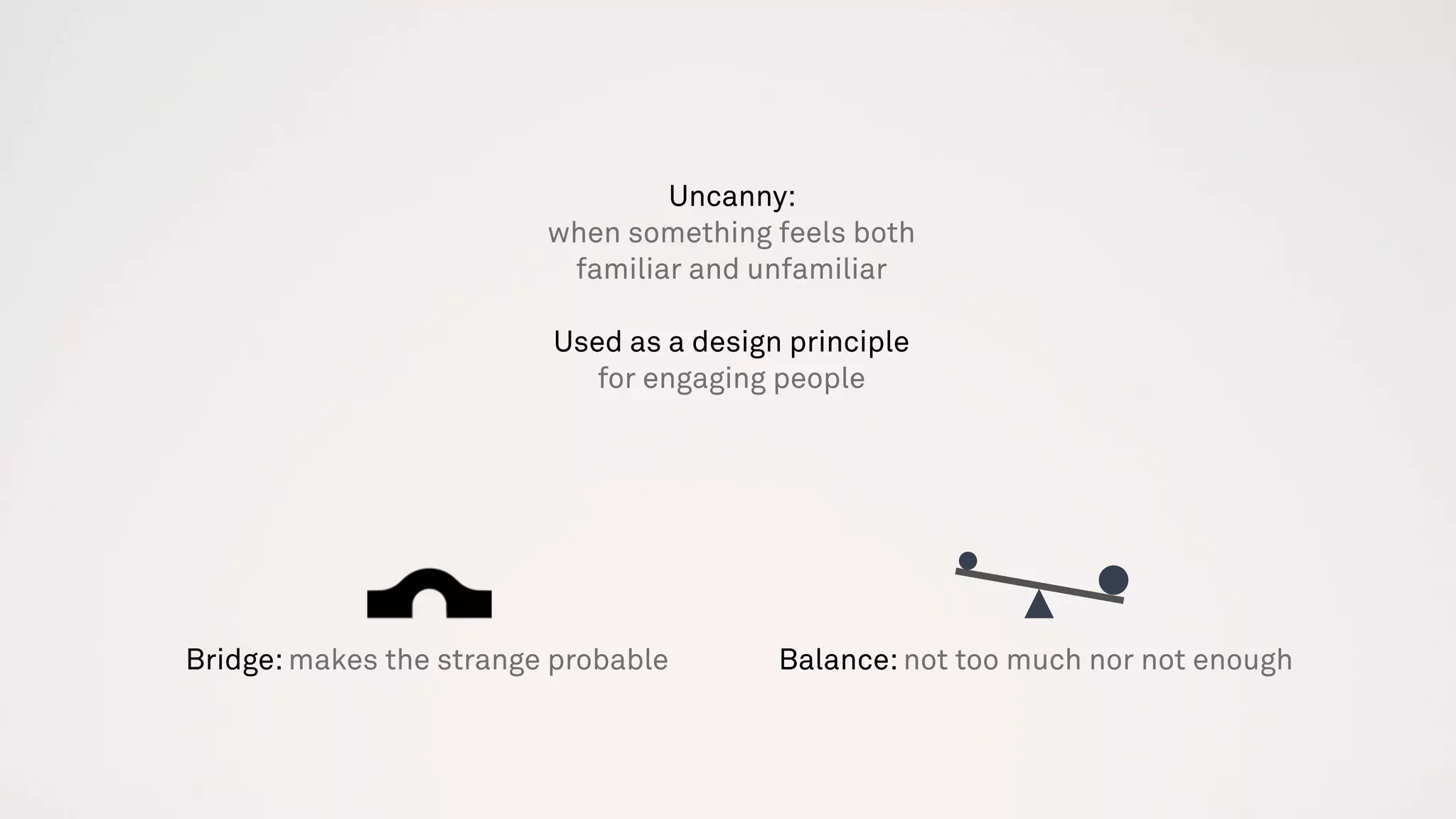
Uncanny:
when something feels both
familiar and unfamiliar
Used as a design principle
for engaging people
Balance: not too much nor not enoughBridge: makes the strange probable
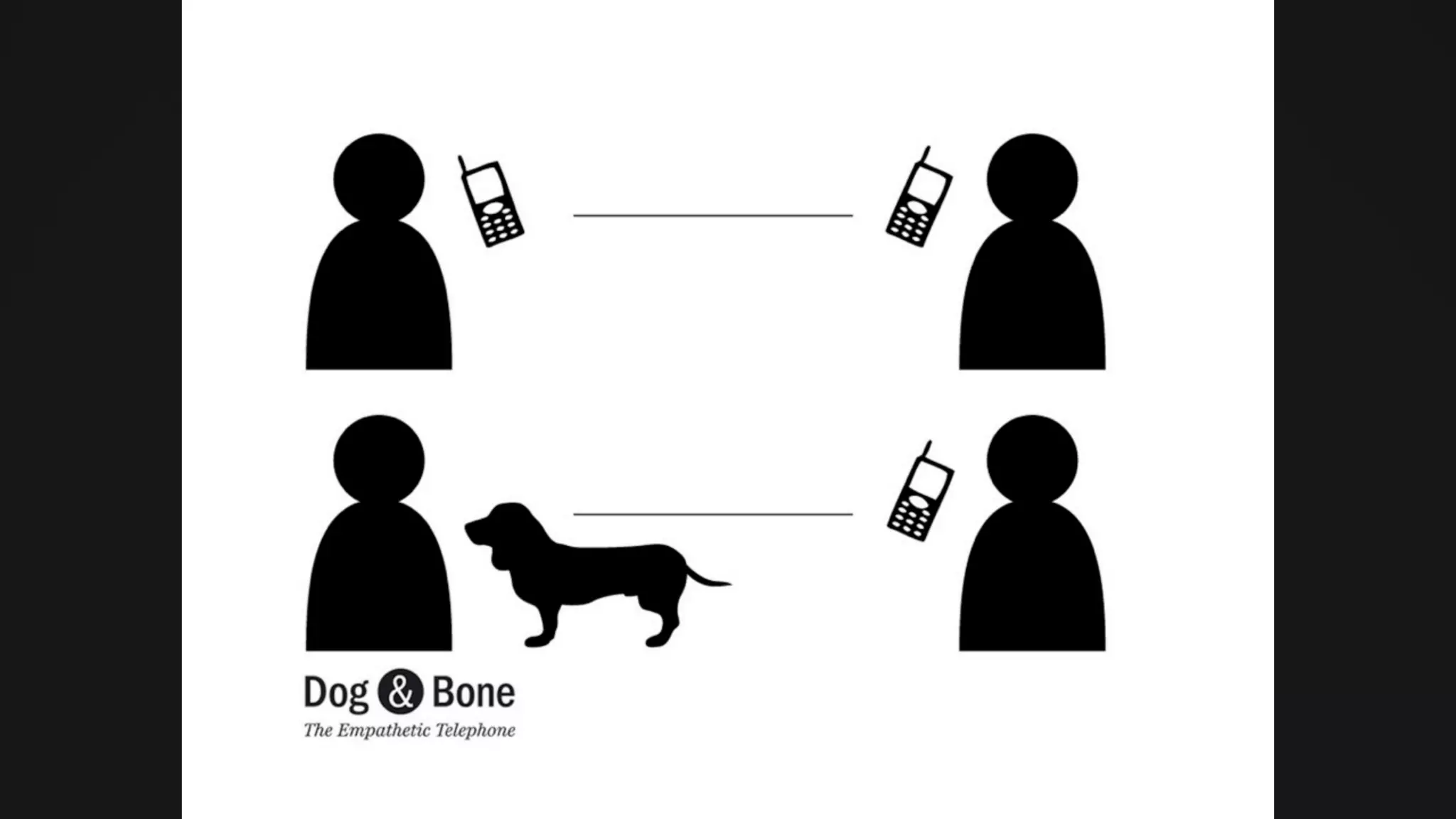
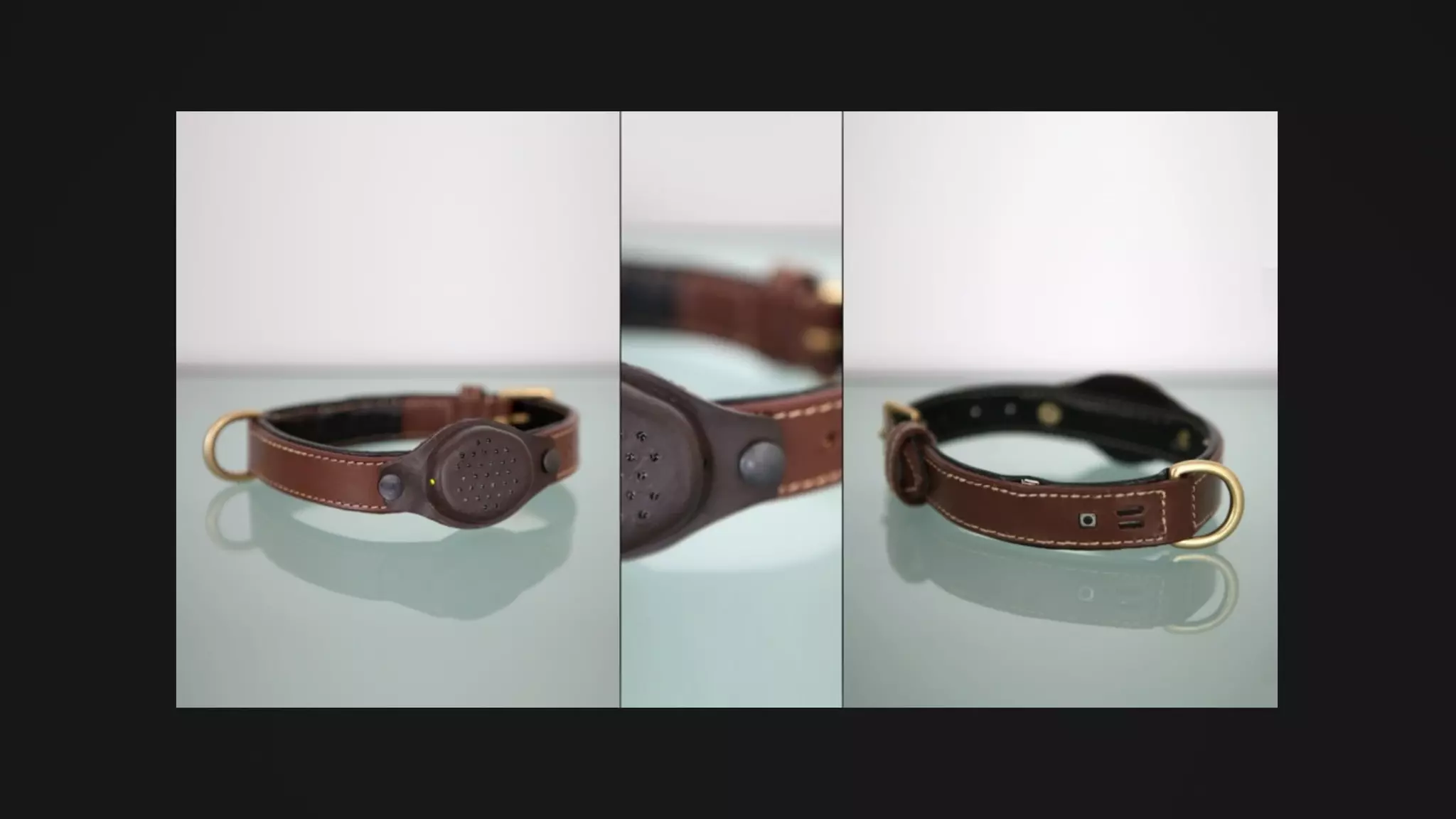
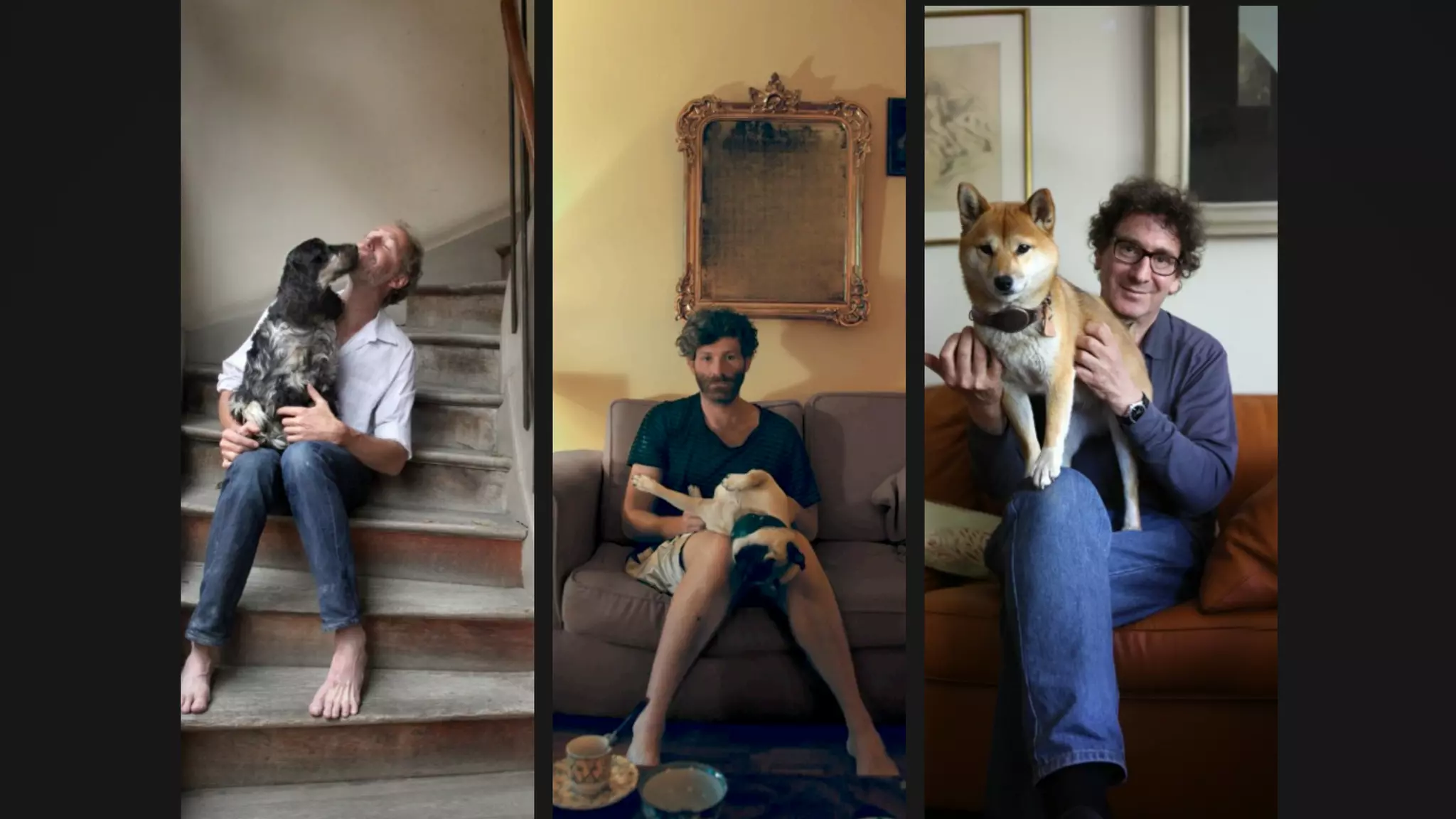
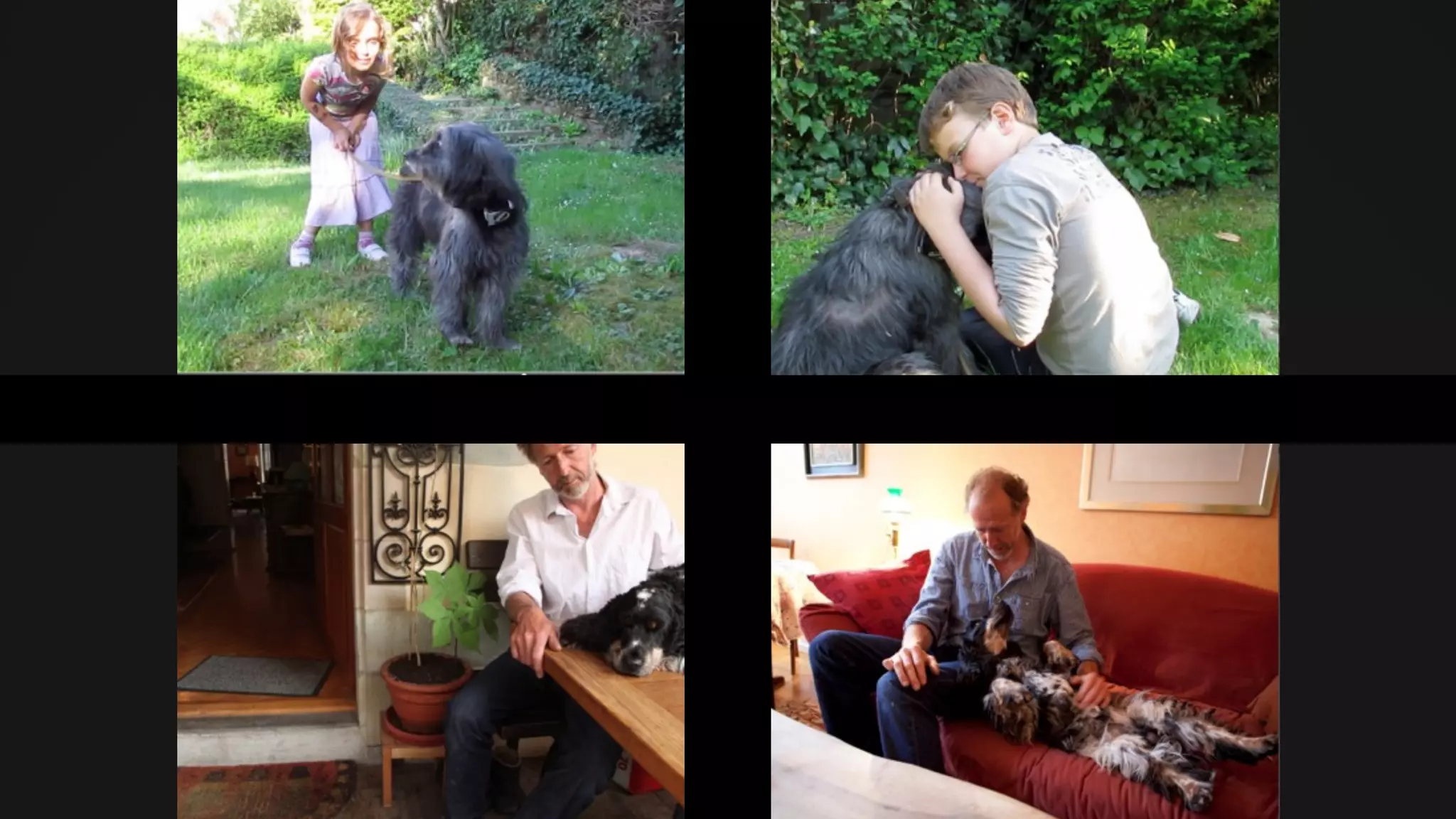
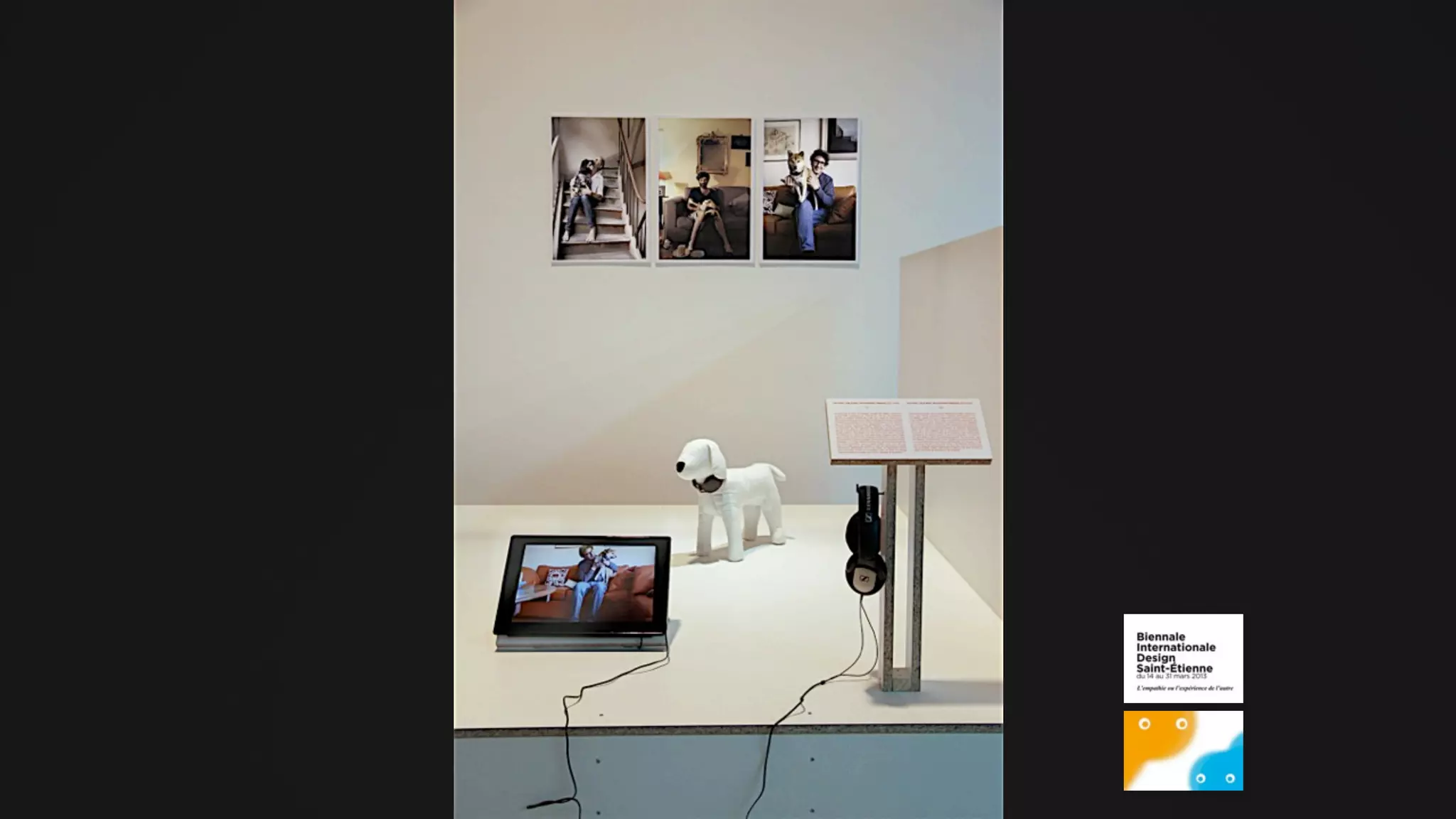
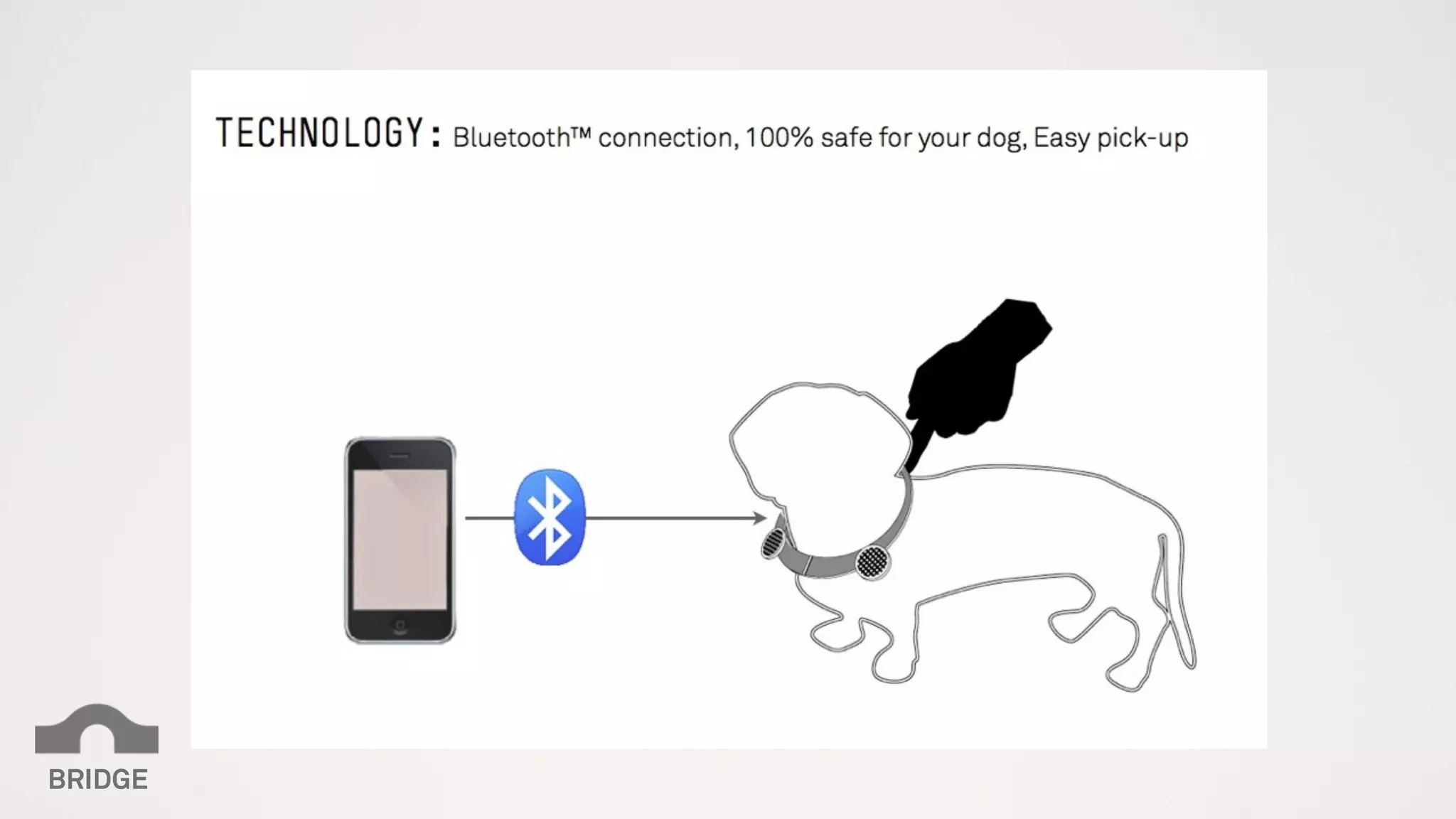
3. USECASE:DOG&BONE
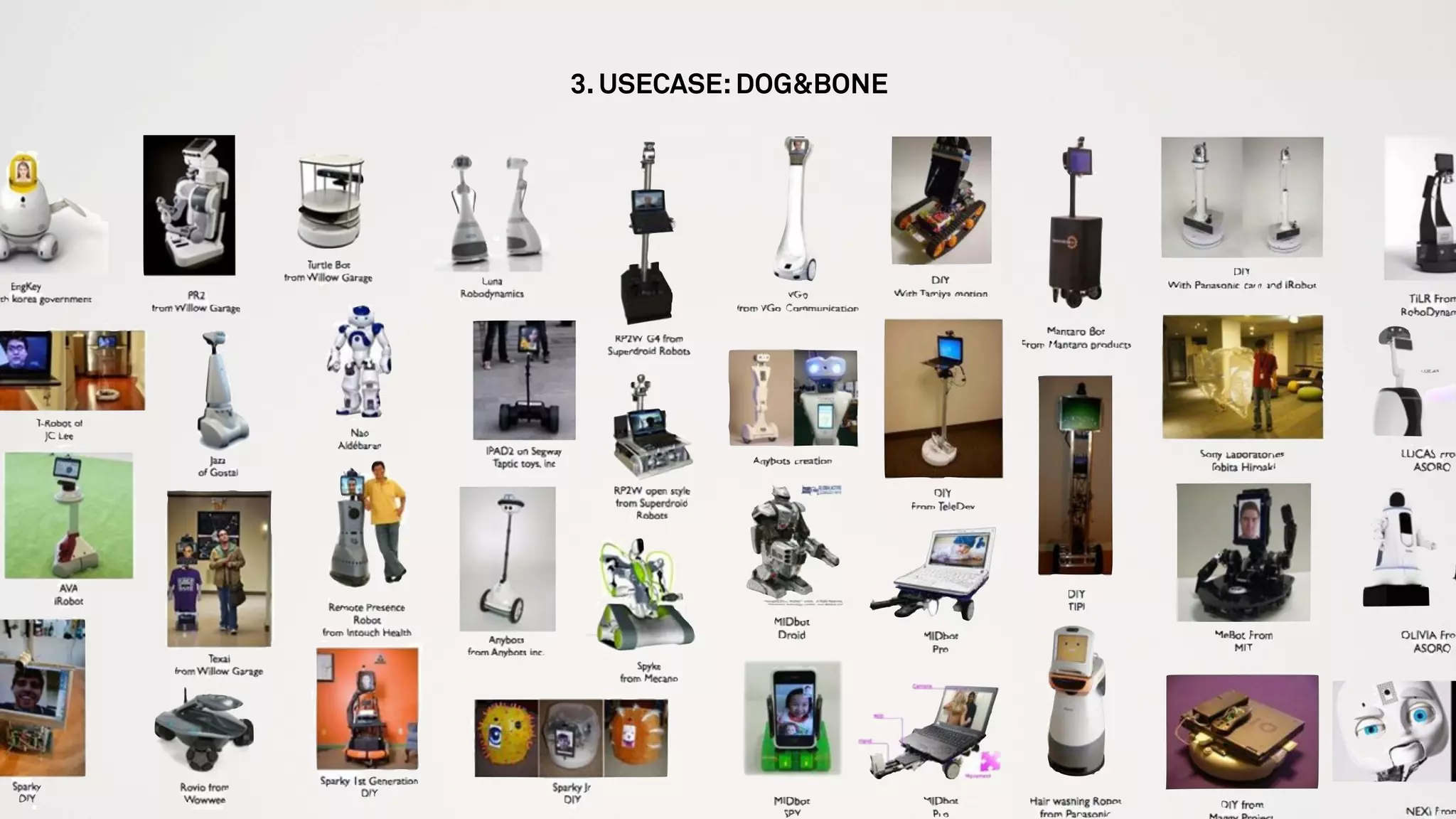
3. USECASE:DOG&BONE
http://vimeo.com/maxmollon/dogandbone
?
Balance: not too much nor not enoughBridge: makes the strange probable
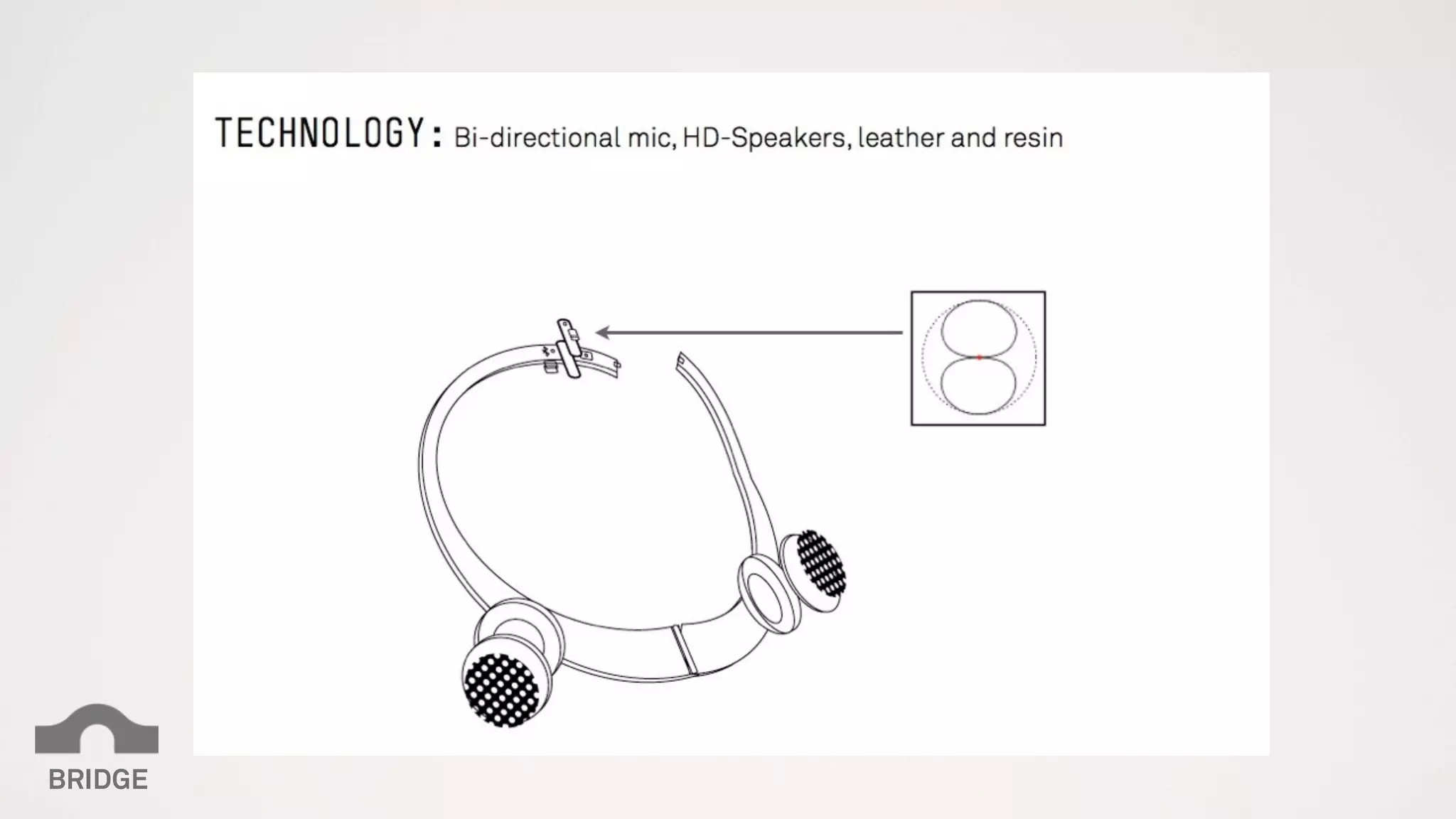
BRIDGE
BRIDGE
BRIDGE
…
…
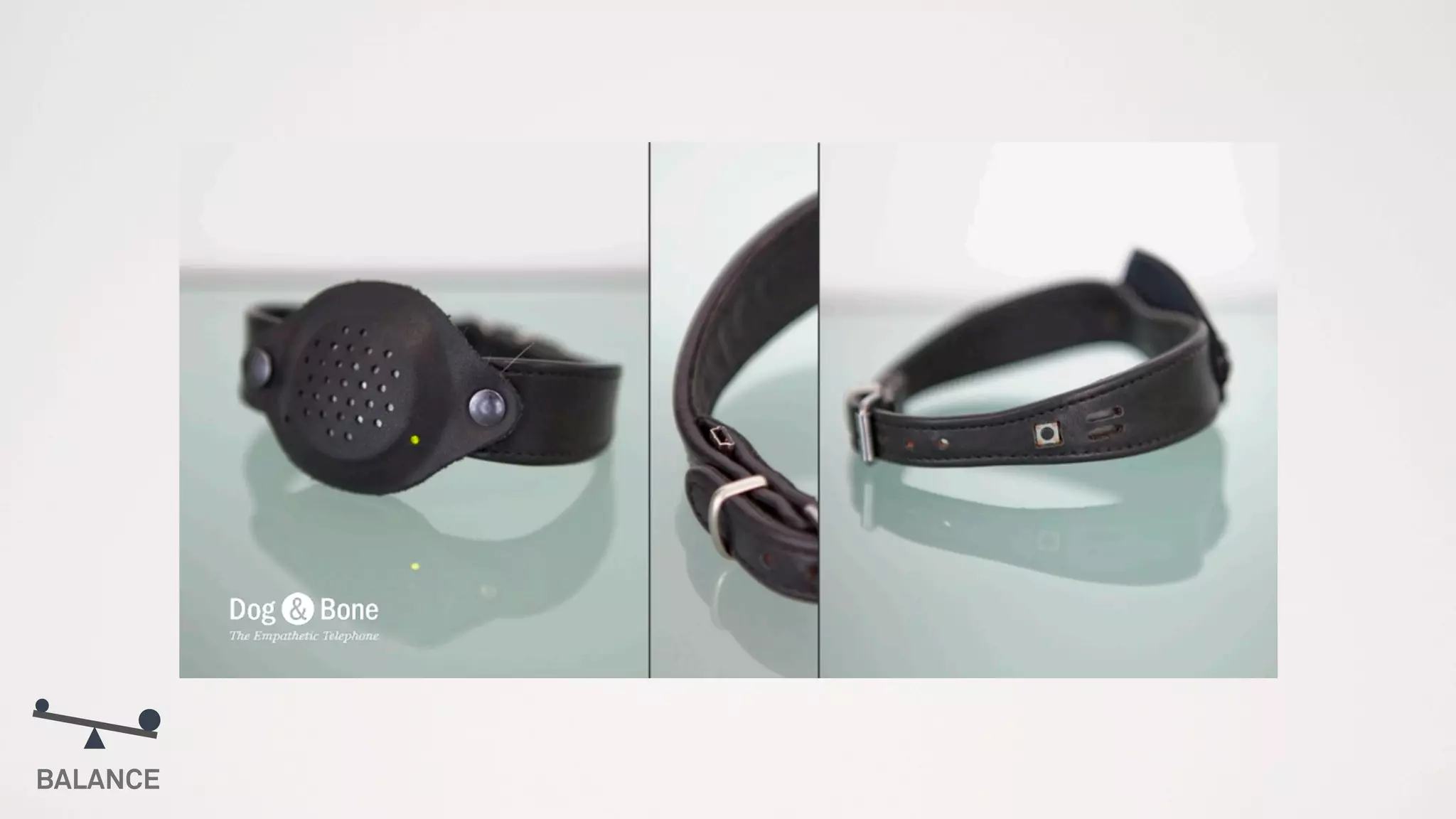
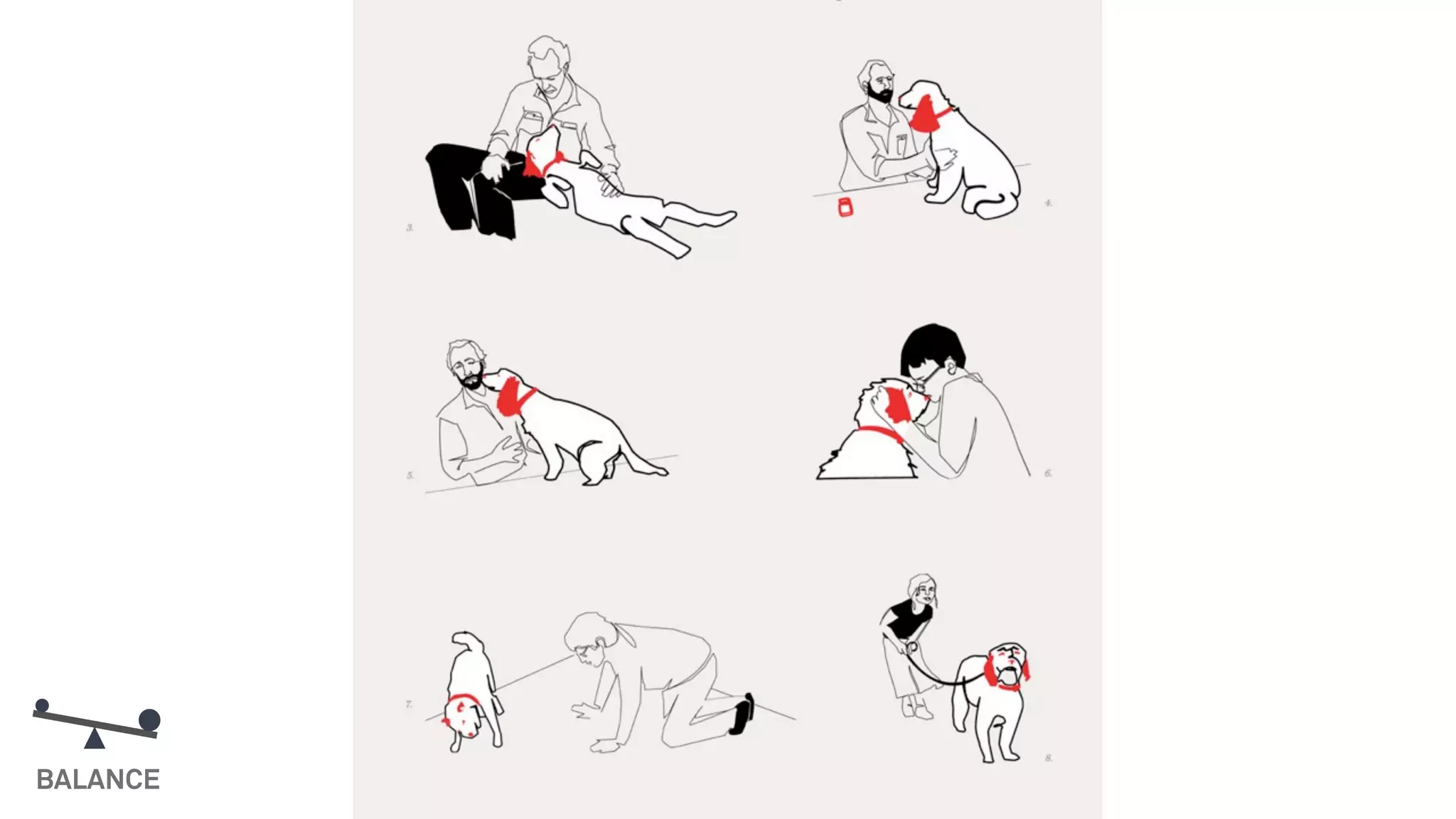
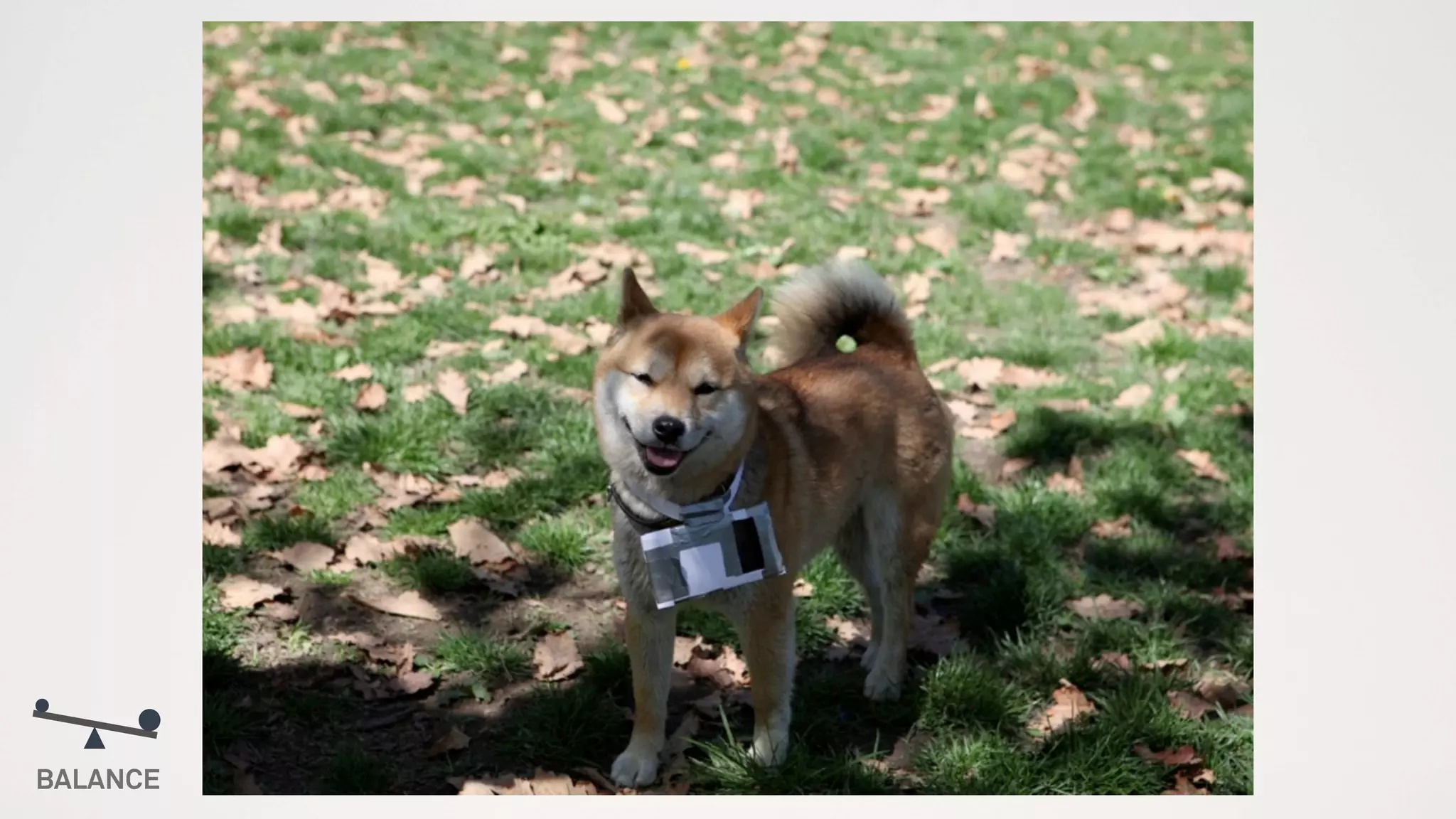
BALANCE
BALANCE
BALANCE
4. FRAMEWORK:RHETORIC
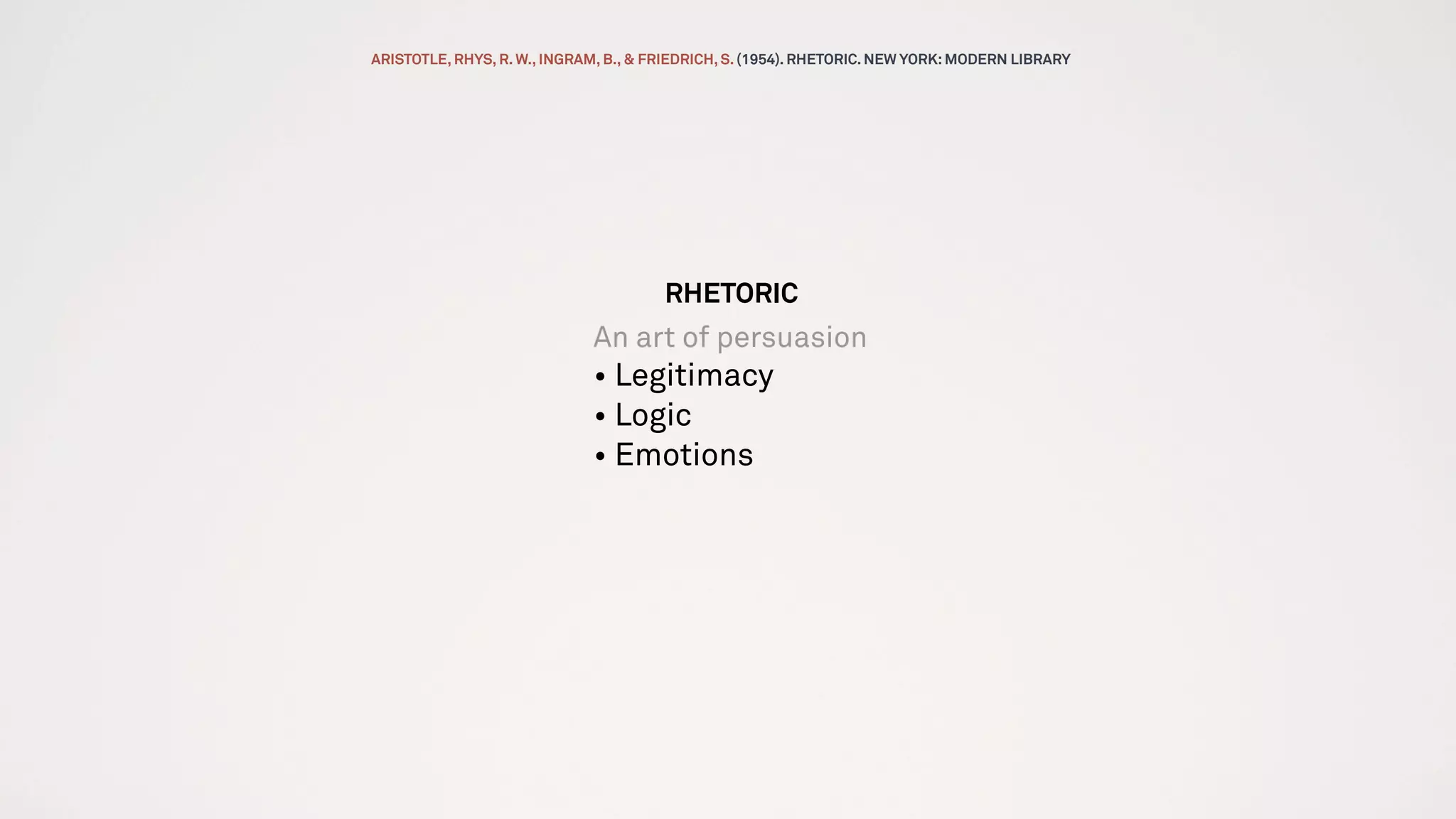
RHETORIC
An art of persuasion
• Legitimacy
• Logic
• Emotions
RHETORIC
An art of persuasion
• Legitimacy
• Logic
• Emotions
RHETORIC
An art of persuasion
• Legitimacy
• Logic
• Emotions
RHETORIC
An art of persuasion
• Legitimacy
• Logic
• Emotions
ARISTOTLE, RHYS, R. W., INGRAM, B., & FRIEDRICH, S. (1954). RHETORIC. NEW YORK:MODERN LIBRARY
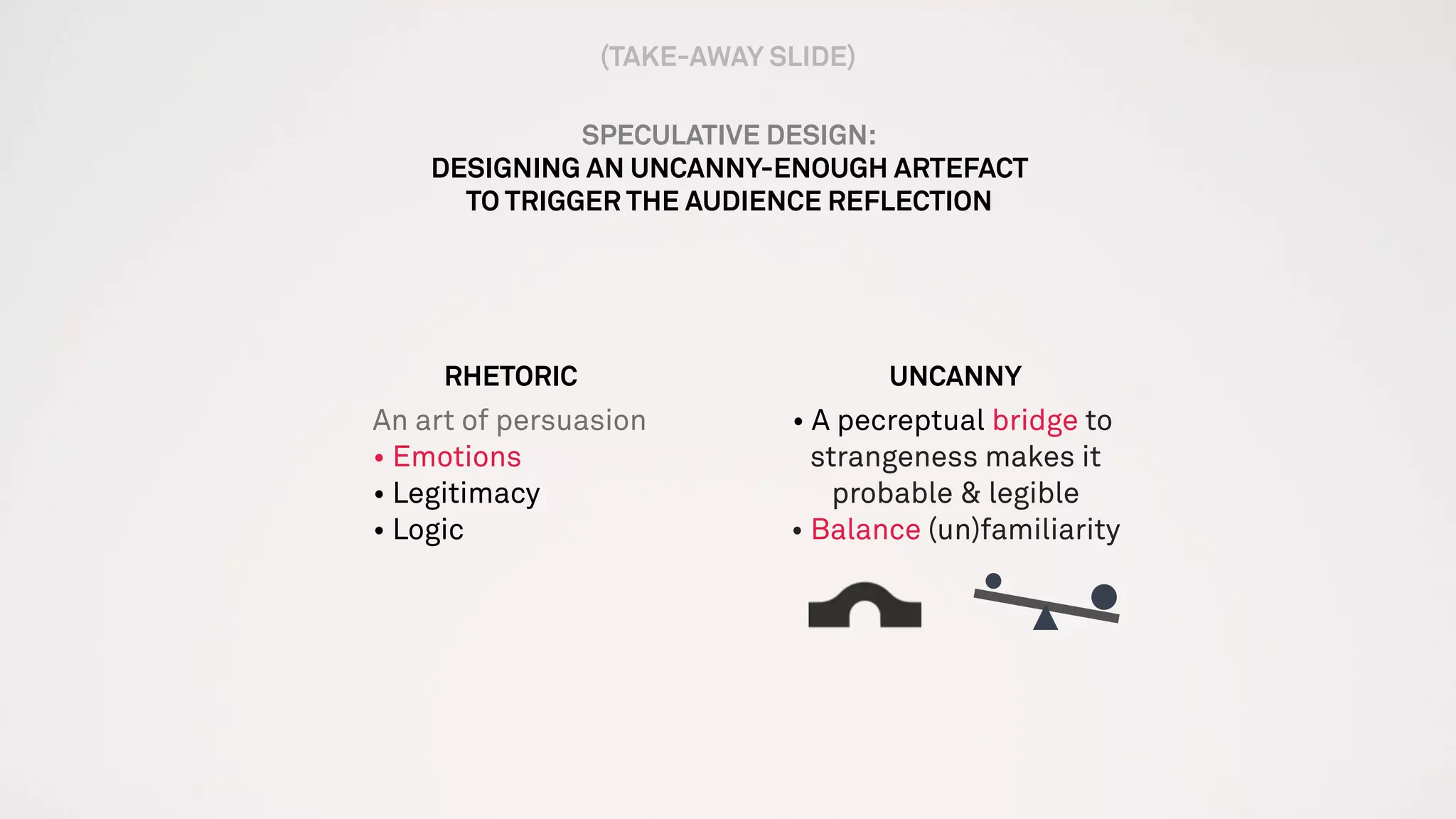
SPECULATIVE DESIGN:
DESIGNING AN UNCANNY-ENOUGH ARTEFACT
TO TRIGGER THE AUDIENCE REFLECTION
RHETORIC
An art of persuasion
• Emotions
• Legitimacy
• Logic
UNCANNY
• A pecreptual bridge to.
strangeness makes it
probable & legible
• Balance (un)familiarity
(TAKE-AWAY SLIDE)
CONCLUSIONS & LIMITATIONS
MAX MOLLON
Ph.D. CANDIDATE
INTERACTION DESIGN
RESEARCH BY PRACTICE
SACRe PSL
ENSADLab/ Sociable Media
Telecom ParisTech/ Codesign Lab
ANNIE GENTES
ASSOCIATE PR.
INFORMATION AND
COMMUNICATION SCIENCES
Telecom ParisTech/ Codesign Lab & Media Studies
DESIGN RESEARCH CONFERENCE 2014
UMEÅ, SWEDEN, 2014 JUNE 16-19TH
THE RHETORIC OF DESIGN FOR DEBATE:
TRIGGERING CONVERSATION WITH
AN “UNCANNY ENOUGH” ARTEFACT

(2014) The Rhetoric of Design for Debate: triggering conversation with an “uncanny enough” artefact – At ARD2014

  • 1.
    MAX MOLLON Ph.D. CANDIDATE INTERACTIONDESIGN RESEARCH BY PRACTICE SACRe PSL ENSADLab/ Sociable Media Telecom ParisTech/ Codesign Lab ANNIE GENTES ASSOCIATE PR. INFORMATION AND COMMUNICATION SCIENCES Telecom ParisTech/ Codesign Lab & Media Studies DESIGN RESEARCH CONFERENCE 2014 UMEÅ, SWEDEN, 2014 JUNE 16-19TH
  • 2.
    MAX MOLLON Ph.D. CANDIDATE INTERACTIONDESIGN RESEARCH BY PRACTICE SACRe PSL ENSADLab/ Sociable Media Telecom ParisTech/ Codesign Lab ANNIE GENTES ASSOCIATE PR. INFORMATION AND COMMUNICATION SCIENCES Telecom ParisTech/ Codesign Lab & Media Studies DESIGN RESEARCH CONFERENCE 2014 UMEÅ, SWEDEN, 2014 JUNE 16-19TH
  • 3.
    THE RHETORIC OFDESIGN FOR DEBATE: TRIGGERING CONVERSATION WITH AN “UNCANNY ENOUGH” ARTEFACT
  • 4.
    THE RHETORIC OFDESIGN FOR DEBATE: TRIGGERING CONVERSATION WITH AN “UNCANNY ENOUGH” ARTEFACT PROPOSE ALTERNATIVES — ENGAGE REFLECTION — SPARK DISCUSSION SCHÖN, D. A. (1983).THE REFLECTIVE PRACTITIONER. BASIC BOOKS.
  • 5.
    THE RHETORIC OFDESIGN FOR DEBATE: TRIGGERING CONVERSATION WITH AN “UNCANNY ENOUGH” ARTEFACT PROPOSE ALTERNATIVES — ENGAGE REFLECTION — SPARK DISCUSSION SCHÖN, D. A. (1983).THE REFLECTIVE PRACTITIONER. BASIC BOOKS.
  • 6.
    THE RHETORIC OFDESIGN FOR DEBATE: TRIGGERING CONVERSATION WITH AN “UNCANNY ENOUGH” ARTEFACT PROPOSE ALTERNATIVES — ENGAGE REFLECTION — SPARK DISCUSSION
  • 7.
    THE RHETORIC OFDESIGN FOR DEBATE: TRIGGERING CONVERSATION WITH AN “UNCANNY ENOUGH” ARTEFACT PROPOSE ALTERNATIVES — ENGAGE REFLECTION — SPARK DISCUSSION KERRIDGE,T. (2009). DOES SPECULATIVE DESIGN CONTRIBUTE TO PUBLIC ENGAGEMENT OF SCIENCE AND TECHNOLOGY?
  • 8.
    THE RHETORIC OFDESIGN FOR DEBATE: TRIGGERING CONVERSATION WITH AN “UNCANNY ENOUGH” ARTEFACT PROPOSE ALTERNATIVES — ENGAGE REFLECTION — SPARK DISCUSSION
  • 9.
    HOW DOES DESIGN UNSETTLEEMOTIONS TO ENGAGE AN AUDIENCE? THE RHETORIC OF DESIGN FOR DEBATE: TRIGGERING CONVERSATION WITH AN “UNCANNY ENOUGH” ARTEFACT
  • 10.
    HOW DOES DESIGN UNSETTLEEMOTIONS TO ENGAGE AN AUDIENCE? THE RHETORIC OF DESIGN FOR DEBATE: TRIGGERING CONVERSATION WITH AN “UNCANNY ENOUGH” ARTEFACT
  • 11.
    1. CONTEXT 2. LITERATUREREVIEW 3. USECASE 4. LARGER FRAMEWORK ROADMAP CONTRIBUTIONS
  • 12.
    ROADMAP CONTRIBUTIONS 1. CONTEXT 2.LITERATURE REVIEW 3. USECASE 4. LARGER FRAMEWORK Playing on emotions as a way to engage the audience Methodological insights: uncanny-enough artefacts
  • 13.
    ROADMAP 1. CONTEXT 2. LITERATUREREVIEW 3. USECASE 4. LARGER FRAMEWORK Methodological insights: uncanny-enough artefacts Theoretical Framework: Classic Rhetoric Playing on emotions as a way to engage the audience Art of persuasion CONTRIBUTIONS
  • 14.
  • 15.
    Speculative design, Conceptualdesign, Contestable futures, Cautionary tales, Activism, Design for debate, Design fiction, Discursive design, Interrogative design, Probe design, Radical design, Satire, Social fiction… “ ” DUNNE, A. (2012) PERSONAL COMMUNICATION, DUBLIN, FEBRUARY 03RD
  • 16.
    ARCHIGRAM, (70’S) MOVINGCITIES. DUNNE & RABY, (2001) ELECTRO-DRAUGHT EXCLUDER, FROM PLACEBO PROJECT. AUGER-LOIZEAU, (2001) AUDIOTOOTH IMPLANT.JULIAN OLIVER, (2012) TRANSPARENCY GRENADE.
  • 17.
    JAMES AUGER (RCA),JIMMYLOIZEAU (GOLDSMITH UNIVERSITY), FIONA RABBY (UAA VIENNA), ANTHONY DUNNE (RCA), JULIAN BLEEKER (NEARFUTURELAB), PAUL GARDIEN (PHILIPS), ARCHIGRAM (UK),JULIAN OLIVER (DE) (T-LEFT TO B-RIGHT)
  • 18.
    JAMES AUGER (RCA),JIMMYLOIZEAU (GOLDSMITH UNIVERSITY), FIONA RABBY (UAA VIENNA), ANTHONY DUNNE (RCA), JULIAN BLEEKER (NEARFUTURELAB), PAUL GARDIEN (PHILIPS), ARCHIGRAM (UK),JULIAN OLIVER (DE) (T-LEFT TO B-RIGHT)
  • 19.
    BARDZELL, S., BARDZELL,J.,FORLIZZI,J.,ZIMMERMAN,J., & ANTANITIS,J. (2012). CRITICAL DESIGN AND CRITICAL THEORY: THE CHALLENGE OF DESIGNING FOR PROVOCATION (PP. 288–297). PRESENTED AT THE MULTIPLE VALUES SELECTED, NEW YORK, NEW YORK, USA BOSCH,T. (2012, 02 MARCH). SCI-FI WRITER BRUCE STERLING EXPLAINS THE INTRIGUING NEW CONCEPT OF DESIGN FICTION. SLATE.COM. RETRIEVED MARCH 2013, FROM HTTP://WWW.SLATE.COM/BLOGS/FUTURE_TENSE/2012/03/02/ BRUCE_STERLING_ON_DESIGN_FICTIONS_. HTML DUNNE, A., & RABY, F. (2001). DESIGN NOIR:THE SECRET LIFE OF ELECTRONIC OBJECTS. AUGUST MEDIA. DUNNE, A. (2009). INTERPRETATION COLLABORATION, AND CRITIQUE. (R. RICKENBERG, ED.)WWW.DUNNEANDRABY.CO.UK. RETRIEVED FROM HTTP://WWW.DUNNEANDRABY.CO.UK/CONTENT/BYDANDR/465/0 FALLMAN, D. (2008).THE INTERACTION DESIGN RESEARCH TRIANGLE OF DESIGN PRACTICE, DESIGN STUDIES, AND DESIGN EXPLORATION. DESIGN ISSUES, 24(3), 4–18. KERRIDGE,T. (2009). DOES SPECULATIVE DESIGN CONTRIBUTE TO PUBLIC ENGAGEMENT OF SCIENCE AND TECHNOLOGY? (PP. 1–18). PRESENTED AT THE PROCEEDINGS OF THE SWISS DESIGN NETWORK SYMPOSIUM, LUGANO. KIRBY, D. (2010).THE FUTURE IS NOW:DIEGETIC PROTOTYPES AND THE ROLE OF POPULAR FILMS IN GENERATING REAL- WORLD TECHNOLOGICAL DEVELOPMENT. SOCIAL STUDIES OF SCIENCE, 40(1), 41–70. STERLING, B. (2009). DESIGN FICTION. INTERACTIONS, 16(3). AUGER,J. H. (2012). WHY ROBOT? SPECULATIVE DESIGN,THE DOMESTICATION OF TECHNOLOGY AND THE CONSIDERED FUTURE.THE ROYAL COLLEGE OF ART. BLEECKER,J. (2009). DESIGN FICTION. NEAR FUTURE LABORATORY. DUNNE, A. (1999). HERTZIAN TALES:ELECTRONIC PRODUCTS, AESTHETIC EXPERIENCE AND CRITICAL DESIGN. LONDON:THE ROYAL COLLEGE OF ART COMPUTER RELATED DESIGN RESEARCH STUDIO.
  • 20.
  • 21.
    It was alsonecessary to provide a convincing description, in layman’s terms, of the technology involved. [...] This description helped in convincing those with a good understanding of electronic technology. (AUGER, 2012, P.158) […] the detail and finish of the artefacts, combined with the short explanations describing their functions and modes of interaction, entices the audience into exploring the concept further. (AUGER, 2012, P.145) In this way the speculations appear convincing, plausible or personal, whilst at the same time new or alternative. (AUGER, 2012, P.180) I want to highlight what the story does so as to fill out the meaning of the clue-construction device, to make it something legible despite its foreignness (BLEECKER, 2009, P.35). For technological believability, the Audio Tooth Implant relies on a general public awareness of hard and well-publicised facts (AUGER, 2012, P.158) “
  • 22.
    In effect adesign speculation requires a ‘perceptual bridge’ between the audience and the concept. (AUGER, 2012, P.140) These “perceptual bridges” can then be stretched in precise ways: this might be a technical perception such as extrapolating how they think a technology is likely to develop; a psychological perception such as not breaking taste or behaviour taboos; or a cultural perception such as exploiting nostalgia or familiarity with a particular subject. […] (AUGER, 2012, P.180) “
  • 23.
    Bridge: makes thestrange probable In effect a design speculation requires a ‘perceptual bridge’ between the audience and the concept. (AUGER, 2012, P.140) These “perceptual bridges” can then be stretched in precise ways: this might be a technical perception such as extrapolating how they think a technology is likely to develop; a psychological perception such as not breaking taste or behaviour taboos; or a cultural perception such as exploiting nostalgia or familiarity with a particular subject. […] (AUGER, 2012, P.180) “
  • 24.
    […] something legibledespite its foreignness (BLEECKER, 2009, P.35). The success of this process requires viewers to occupy a “fecund middle-ground” (S. BARDZELL ET AL., 2012). Things have to be not-quite-right; this awkwardness is a way into the object (DUNNE & RABY, 2009). If it was too correct and as expected, they would glance once and move on. If the object is too open- ended in terms of meaning, then it can seem empty. (DUNNE & RABY, 2001, P.2). A slight strangeness is the key— too weird and they are instantly dismissed, not strange enough and they’re absorbed into everyday reality (DUNNE & RABY, 2001, P.63). If a speculative design proposal strays too far into the future to present clearly implausible conceptsordescribesacompletelyalientechnological habitat, the audience will fail to relate to the proposal, resulting in a lack of engagement or connection. (AUGER, 2012, P.138-140) This effectively heightened the familiar aspect of the uncanny experience. [...] This encouraged the audience to reflect on how they themselves might use the battery, countering the initial repulsion factor and resulting in a form of desirable uncanny. (AUGER, 2012) “
  • 25.
    Balance: not toomuch nor not enough If a speculative design proposal strays too far into the future to present clearly implausible conceptsordescribesacompletelyalientechnological habitat, the audience will fail to relate to the proposal, resulting in a lack of engagement or connection. (AUGER, 2012, P.138-140) This effectively heightened the familiar aspect of the uncanny experience. [...] This encouraged the audience to reflect on how they themselves might use the battery, countering the initial repulsion factor and resulting in a form of desirable uncanny. (AUGER, 2012) “
  • 26.
    Balance: not toomuch nor not enough If a speculative design proposal strays too far into the future to present clearly implausible conceptsordescribesacompletelyalientechnological habitat, the audience will fail to relate to the proposal, resulting in a lack of engagement or connection. (AUGER, 2012, P.138-140) This effectively heightened the familiar aspect of the uncanny experience. [...] This encouraged the audience to reflect on how they themselves might use the battery, countering the initial repulsion factor and resulting in a form of desirable uncanny. (AUGER, 2012) “
  • 27.
    If a speculativedesign proposal strays too far into the future to present clearly implausible conceptsordescribesacompletelyalientechnological habitat, the audience will fail to relate to the proposal, resulting in a lack of engagement or connection. (AUGER, 2012, P.138-140) This effectively heightened the familiar aspect of the uncanny experience. [...] This encouraged the audience to reflect on how they themselves might use the battery, countering the initial repulsion factor and resulting in a form of desirable uncanny. (AUGER, 2012) “Freud goes on to suggest that by using the uncanny, ‘the story-teller has a peculiarly directive power over us; by means of the moods he can put us into, he is able to guide the current of our emotions’.” (AUGER, 2012, P.138-150) […] and how it can be consciously manipulated to elicit reaction. (AUGER, 2012, P.138-140) “
  • 28.
    If a speculativedesign proposal strays too far into the future to present clearly implausible conceptsordescribesacompletelyalientechnological habitat, the audience will fail to relate to the proposal, resulting in a lack of engagement or connection. (AUGER, 2012, P.138-140) This effectively heightened the familiar aspect of the uncanny experience. [...] This encouraged the audience to reflect on how they themselves might use the battery, countering the initial repulsion factor and resulting in a form of desirable uncanny. (AUGER, 2012) “Freud goes on to suggest that by using the uncanny, ‘the story-teller has a peculiarly directive power over us; by means of the moods he can put us into, he is able to guide the current of our emotions’.” (AUGER, 2012, P.138-150) […] and how it can be consciously manipulated to elicit reaction. (AUGER, 2012, P.138-140) “
  • 29.
    UNCANNY unsettles your emotions, whensomething feels both familiar and unfamiliar As a way to engage the audience ISHIGURO, HIROSHI. (2010). GEMINIOID
  • 30.
    Uncanny: when something feelsboth familiar and unfamiliar Used as a design principle for engaging people Balance: not too much nor not enoughBridge: makes the strange probable
  • 31.
    Uncanny: when something feelsboth familiar and unfamiliar Used as a design principle for engaging people Balance: not too much nor not enoughBridge: makes the strange probable
  • 32.
  • 33.
  • 35.
  • 43.
    ? Balance: not toomuch nor not enoughBridge: makes the strange probable
  • 44.
  • 45.
  • 46.
  • 47.
  • 48.
  • 49.
  • 50.
  • 51.
  • 52.
    RHETORIC An art ofpersuasion • Legitimacy • Logic • Emotions
  • 53.
    RHETORIC An art ofpersuasion • Legitimacy • Logic • Emotions
  • 54.
    RHETORIC An art ofpersuasion • Legitimacy • Logic • Emotions
  • 55.
    RHETORIC An art ofpersuasion • Legitimacy • Logic • Emotions ARISTOTLE, RHYS, R. W., INGRAM, B., & FRIEDRICH, S. (1954). RHETORIC. NEW YORK:MODERN LIBRARY
  • 56.
    SPECULATIVE DESIGN: DESIGNING ANUNCANNY-ENOUGH ARTEFACT TO TRIGGER THE AUDIENCE REFLECTION RHETORIC An art of persuasion • Emotions • Legitimacy • Logic UNCANNY • A pecreptual bridge to. strangeness makes it probable & legible • Balance (un)familiarity (TAKE-AWAY SLIDE)
  • 57.
  • 58.
  • 59.
    MAX MOLLON Ph.D. CANDIDATE INTERACTIONDESIGN RESEARCH BY PRACTICE SACRe PSL ENSADLab/ Sociable Media Telecom ParisTech/ Codesign Lab ANNIE GENTES ASSOCIATE PR. INFORMATION AND COMMUNICATION SCIENCES Telecom ParisTech/ Codesign Lab & Media Studies DESIGN RESEARCH CONFERENCE 2014 UMEÅ, SWEDEN, 2014 JUNE 16-19TH THE RHETORIC OF DESIGN FOR DEBATE: TRIGGERING CONVERSATION WITH AN “UNCANNY ENOUGH” ARTEFACT