English 83R 
Week 7, Day 1 
October 6, 2014 
Elizabeth Buchanan, Assistant Professor
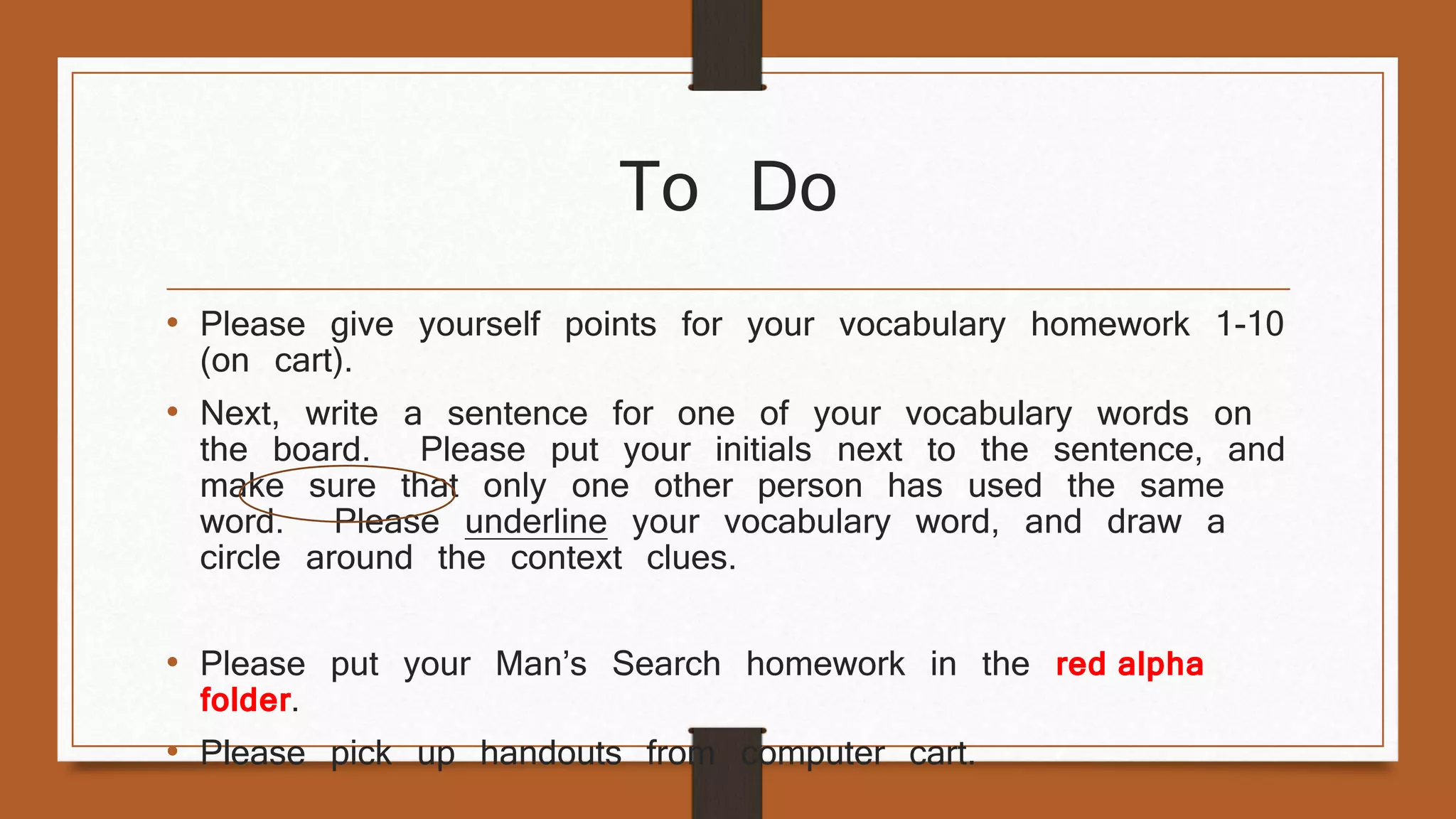
To Do 
• Please give yourself points for your vocabulary homework 1-10 
(on cart). 
• Next, write a sentence for one of your vocabulary words on 
the board. Please put your initials next to the sentence, and 
make sure that only one other person has used the same 
word. Please underline your vocabulary word, and draw a 
circle around the context clues. 
• Please put your Man’s Search homework in the red alpha 
folder. 
• Please pick up handouts from computer cart.
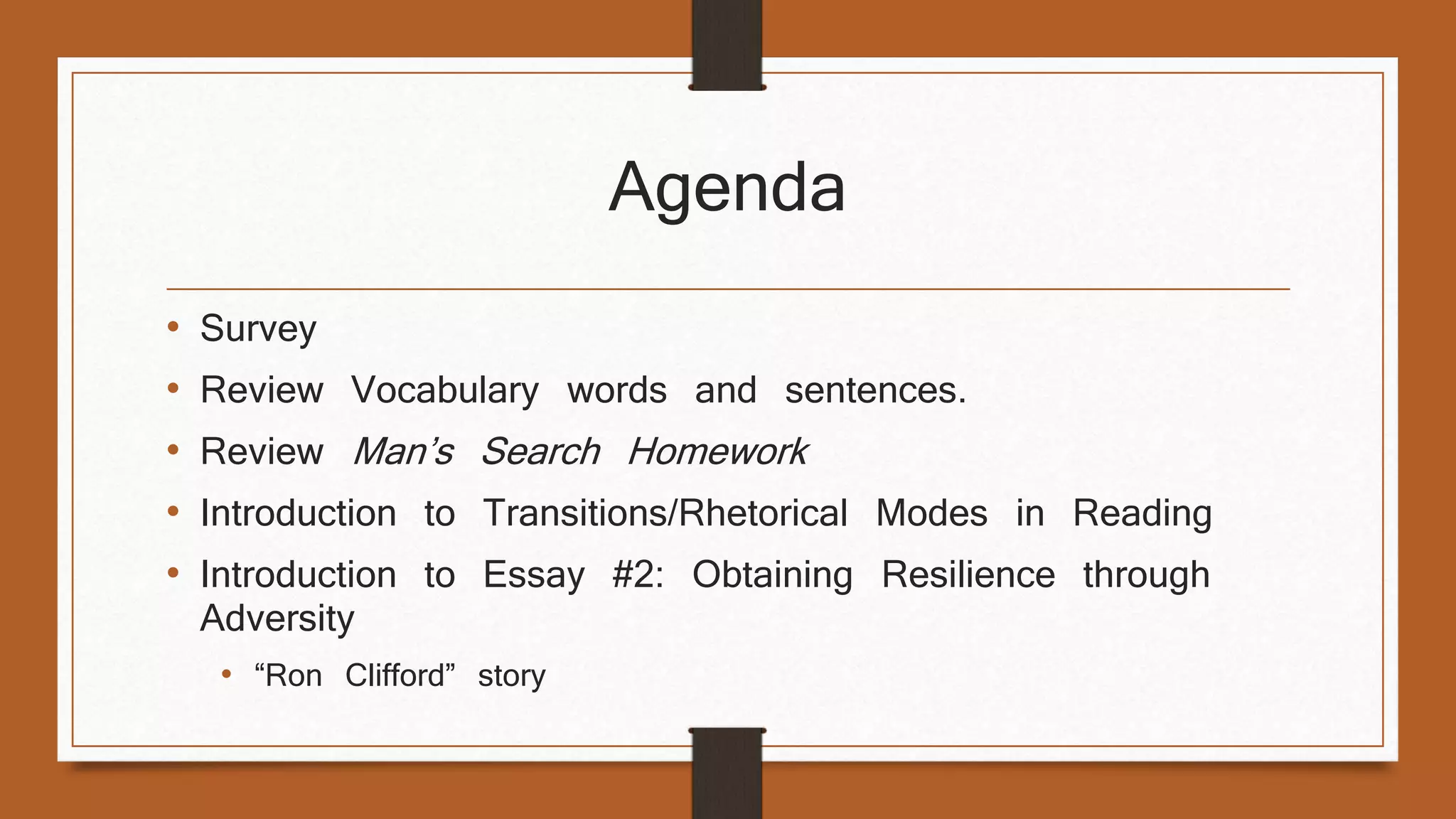
Agenda 
• Survey 
• Review Vocabulary words and sentences. 
• Review Man’s Search Homework 
• Introduction to Transitions/Rhetorical Modes in Reading 
• Introduction to Essay #2: Obtaining Resilience through 
Adversity 
• “Ron Clifford” story
Review Vocabulary Words
Transition and Rhetorical 
Modes in Reading & 
Writing
Let’s talk about Transitions 
• Transitions are words and phrases 
that signal though patterns by 
showing the logical relationships within 
a sentence and between sentences.
Transition Words 
• We all use transition words all the time – everyday - when 
you have a conversation with someone. 
• You might be talking at the dinner table with your family. 
You start out talking about your day at school, perhaps 
Essay #3 and other school related topics. 
• The next thing you realize is that you are now talking about 
your upcoming trip to Magic Mountain. 
• How did you jump topics during your conversation? 
• By using transition words
Transitions 
• The conversation might go like this: 
• Mom: How was your day at school, Juan? 
• Juan: First of all , I went to my English 83R 
class, took my vocab quiz, and got an A. 
After class, I went to the library to start working 
on my essay Next , I went to lunch with Joey, 
and finally I went online to purchase tickets for 
Magic Mountain .
Transitions 
• During reading, it is important to pay special attention to 
transition words. 
• These special words show the relationships between 
ideas within sentences and within paragraphs. 
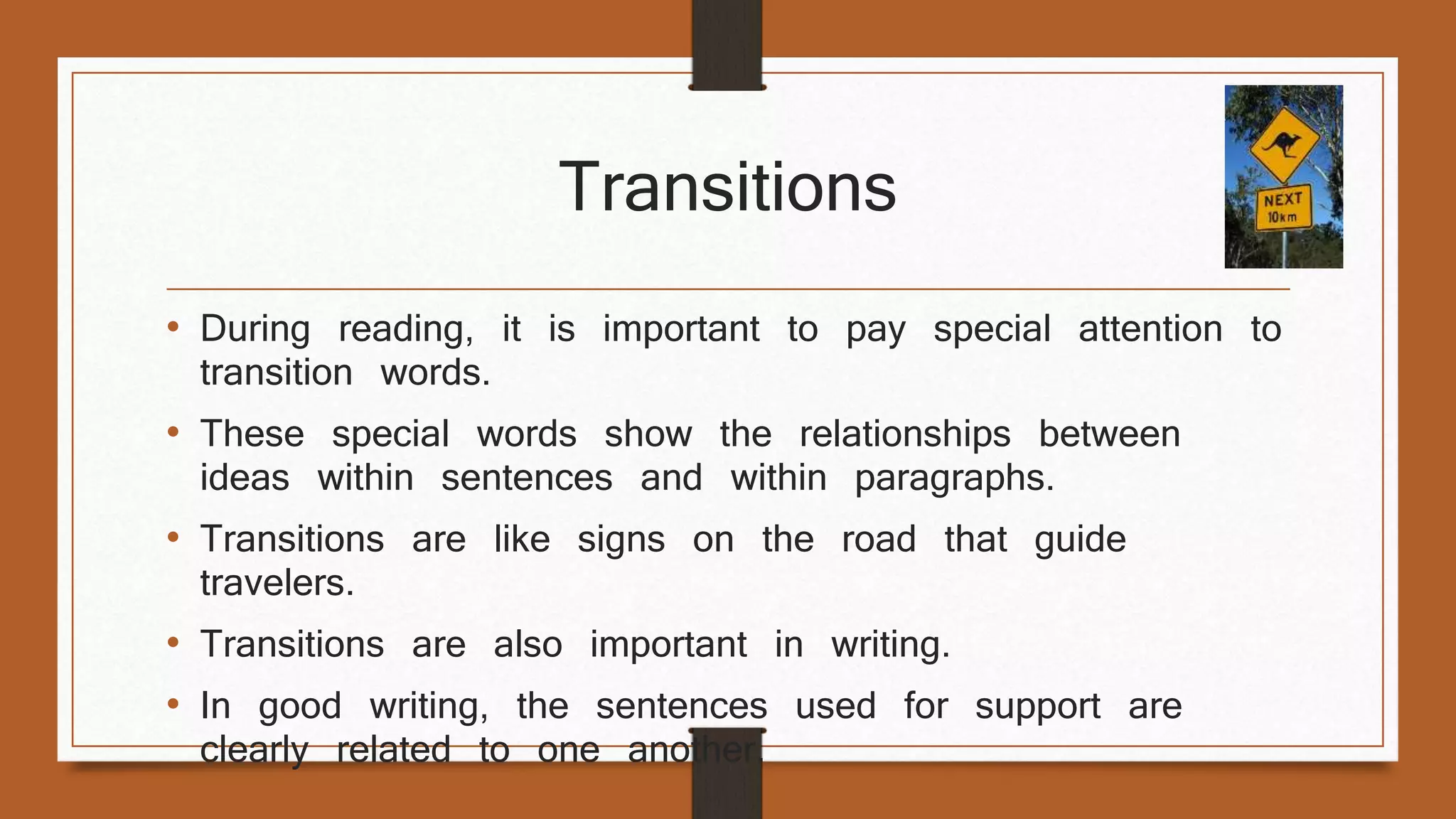
• Transitions are like signs on the road that guide 
travelers. 
• Transitions are also important in writing. 
• In good writing, the sentences used for support are 
clearly related to one another.
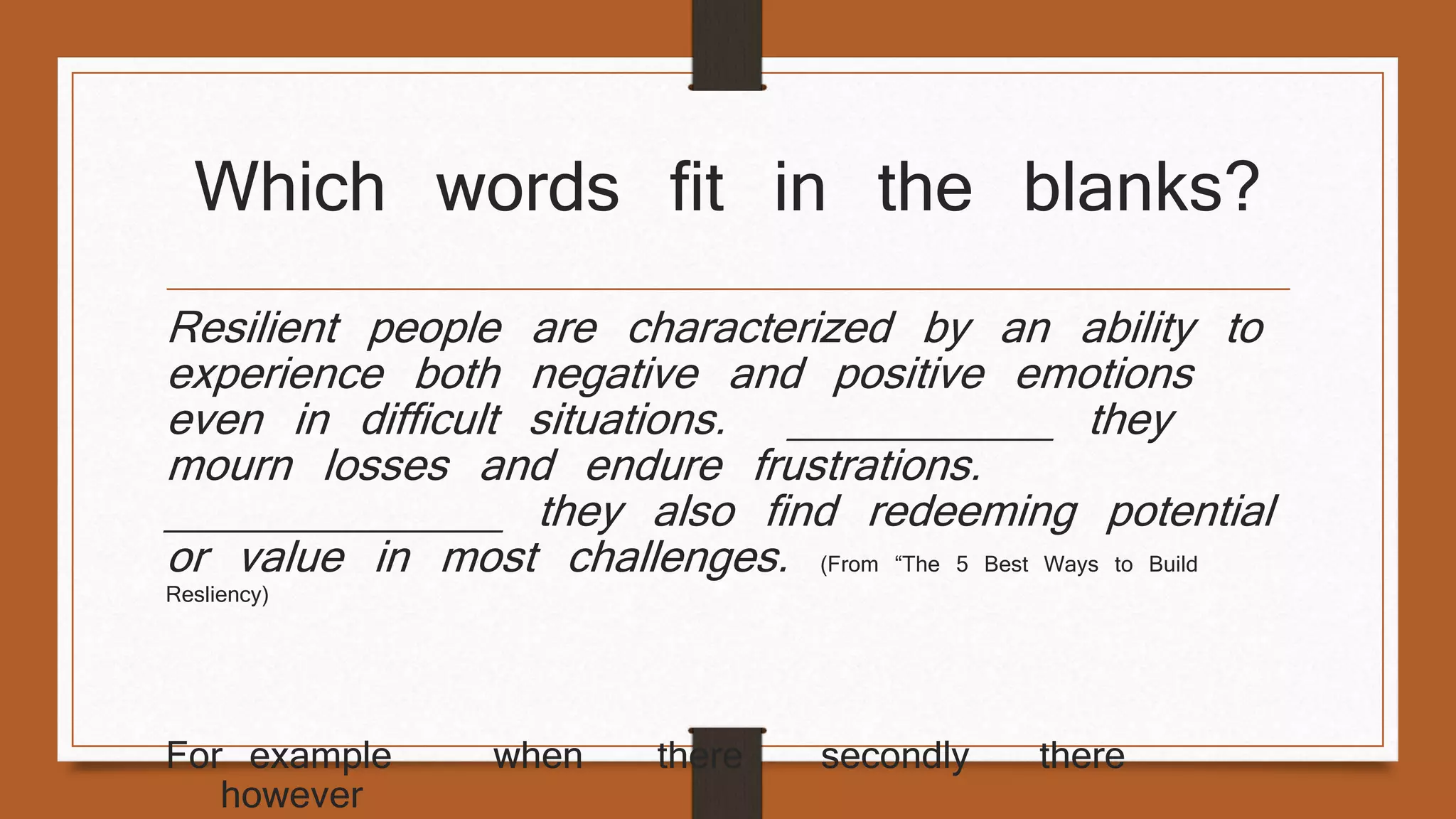
Which words fit in the blanks? 
Resilient people are characterized by an ability to 
experience both negative and positive emotions 
even in difficult situations. ___________ they 
mourn losses and endure frustrations. 
______________ they also find redeeming potential 
or value in most challenges. (From “The 5 Best Ways to Build 
Resliency) 
For example when there secondly there 
however
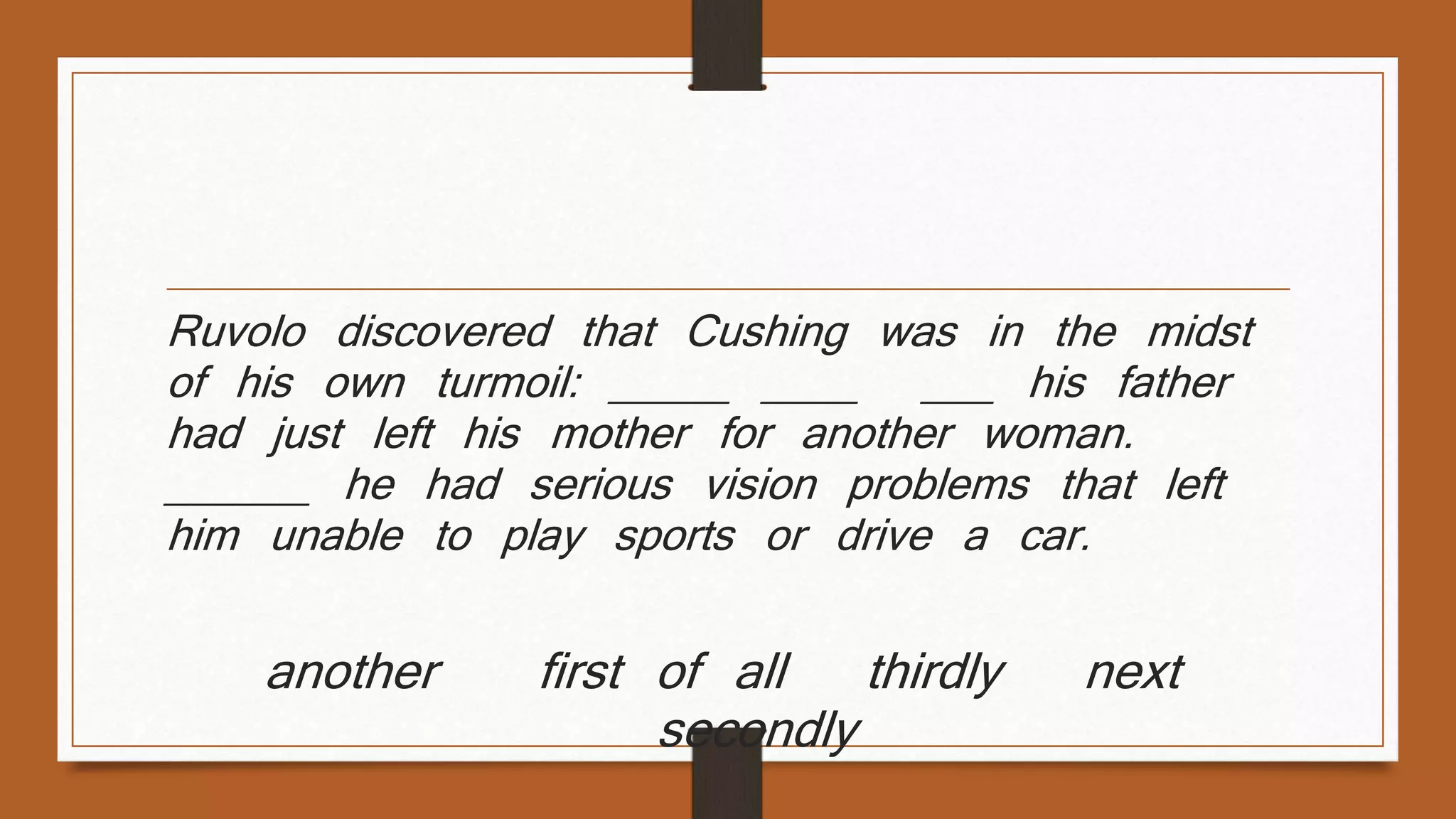
Ruvolo discovered that Cushing was in the midst 
of his own turmoil: _____ ____ ___ his father 
had just left his mother for another woman. 
______ he had serious vision problems that left 
him unable to play sports or drive a car. 
another first of all thirdly next 
secondly
Rhetorical Patterns of 
Organization 
• Writers organize their supporting sentences and ideas in 
ways called Patterns of Organization. 
• Just as transitions show relationships between ideas in 
sentences, patterns of organization show the relationships 
between supporting details in paragraphs, essays, and 
chapters. 
• Patterns of organization are structures our minds use all 
the time. 
• All of our thinking and communicating depend on 
patterns of organization .
Rhetorical Patterns of Thought 
• We are going to learn about four patterns: 
• Listing 
• Cause and Effect 
• Compare and Contract 
• Time Order/Chronological Order
Listing pattern 
• A list of items is a series of reasons, examples, or 
other details that support an idea. 
• The items have no time order, but are listed in 
whatever order the author prefers.
Listing 
Sometimes authors use 
numbers (1,2,3), 
letters (a, b, c) 
or asterisks (*) 
to show the individual items on the list.
Listing 
• Ruvolo had many tragedies in her 
life. First of all , two of her brothers 
died in separate incidents when she 
was a teenager. Secondly at age 35, 
she miscarried a much-longed-for 
child. Thirdly, in 2004 everyone bone 
in her face was broken.
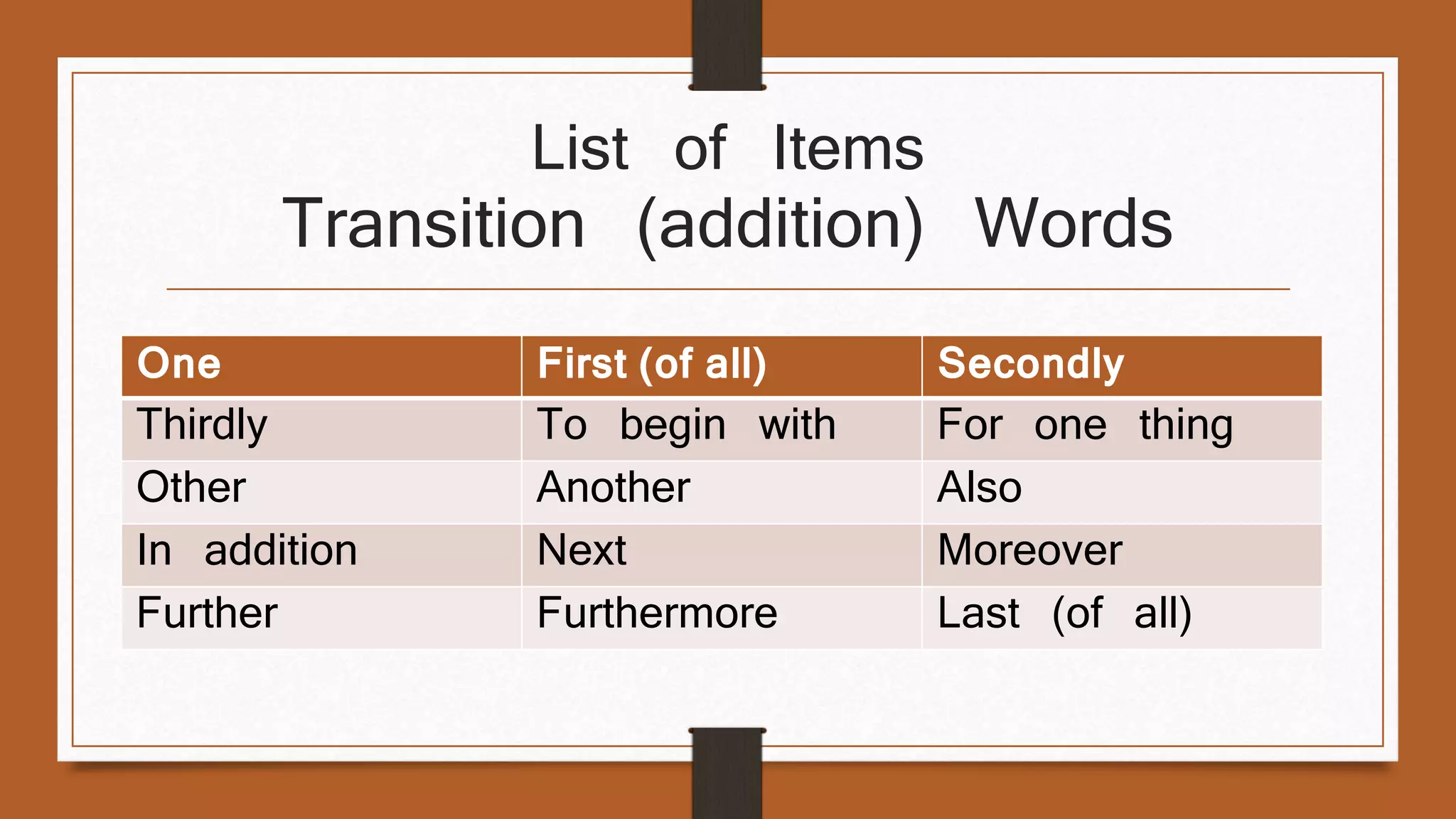
List of Items 
Transition (addition) Words 
One First (of all) Secondly 
Thirdly To begin with For one thing 
Other Another Also 
In addition Next Moreover 
Further Furthermore Last (of all)
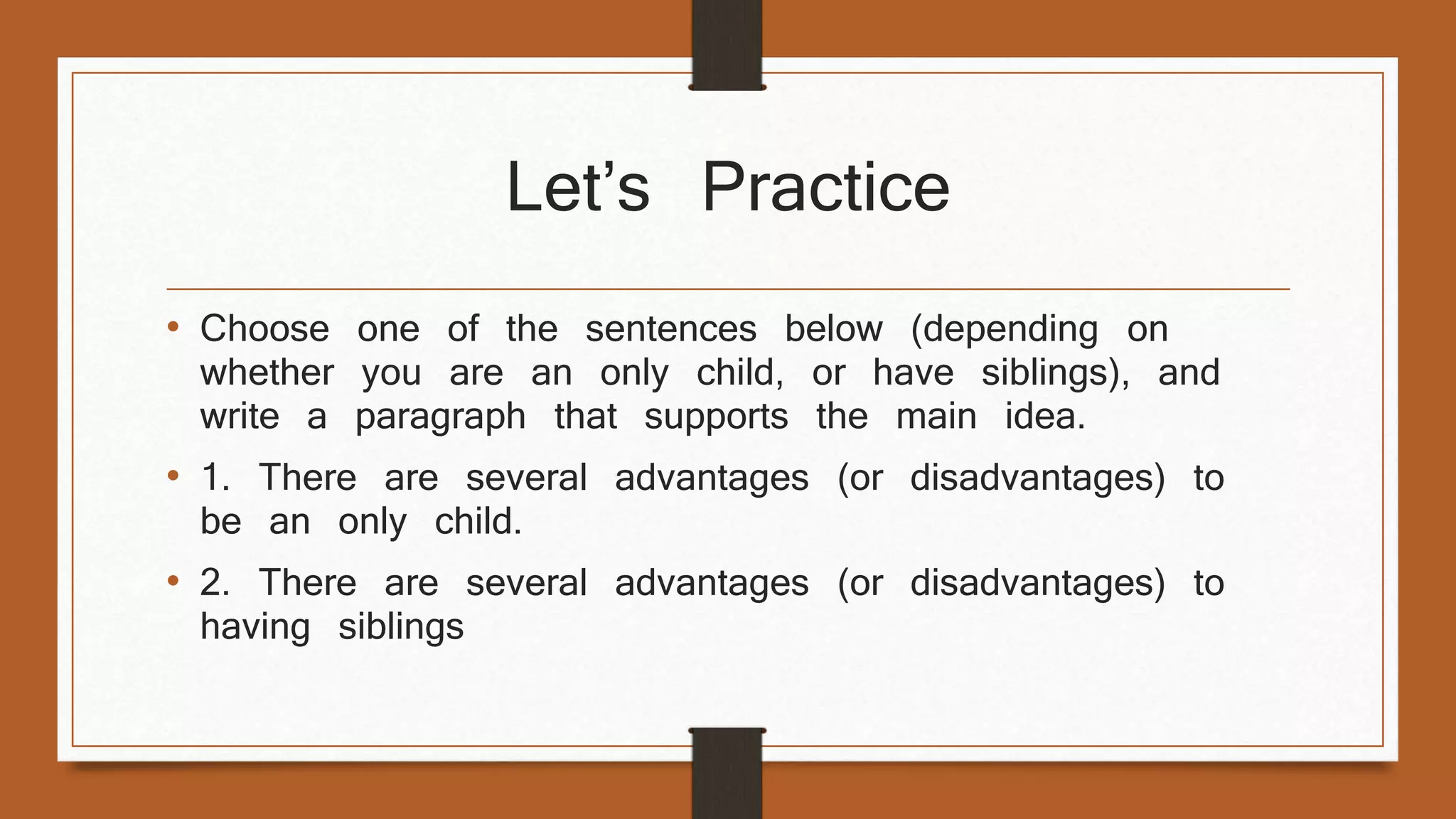
Let’s Practice 
• Choose one of the sentences below (depending on 
whether you are an only child, or have siblings), and 
write a paragraph that supports the main idea. 
• 1. There are several advantages (or disadvantages) to 
be an only child. 
• 2. There are several advantages (or disadvantages) to 
having siblings
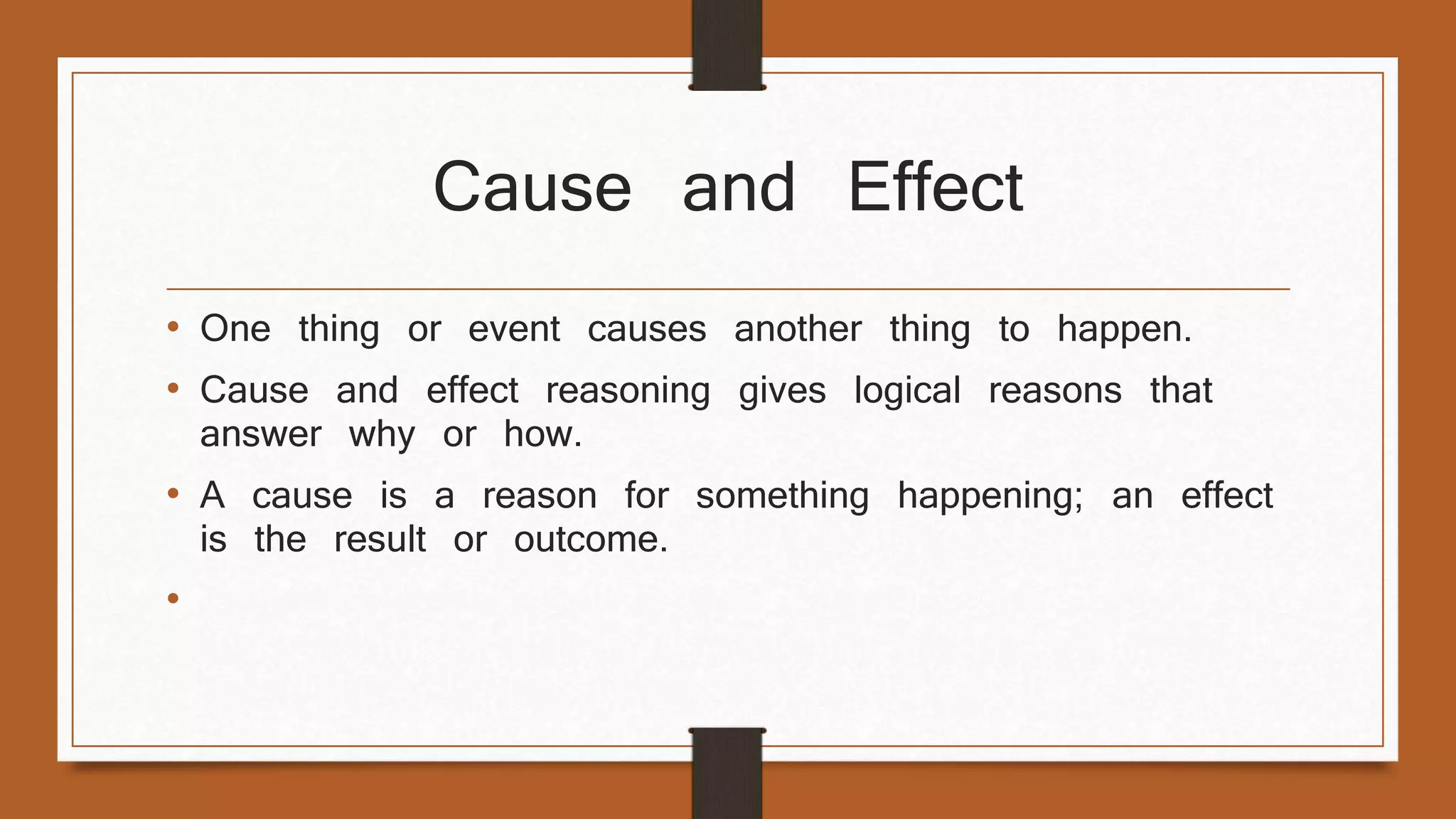
Cause and Effect 
• One thing or event causes another thing to happen. 
• Cause and effect reasoning gives logical reasons that 
answer why or how. 
• A cause is a reason for something happening; an effect 
is the result or outcome. 
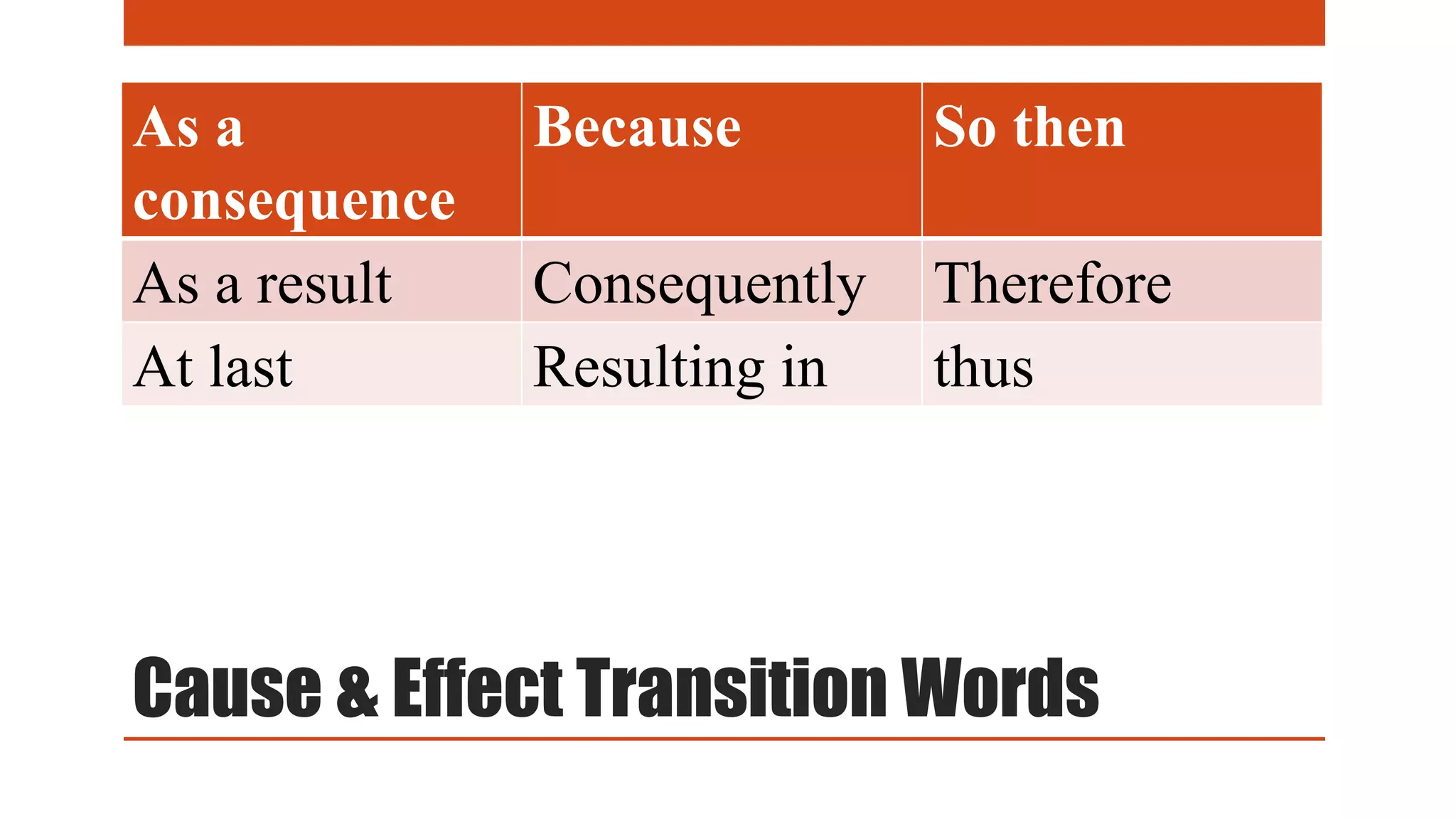
• Transition words: because, thus, therefore, as a result, for 
this reason, to explain, consequently, hence, so, affect, 
accordingly, due to, results in
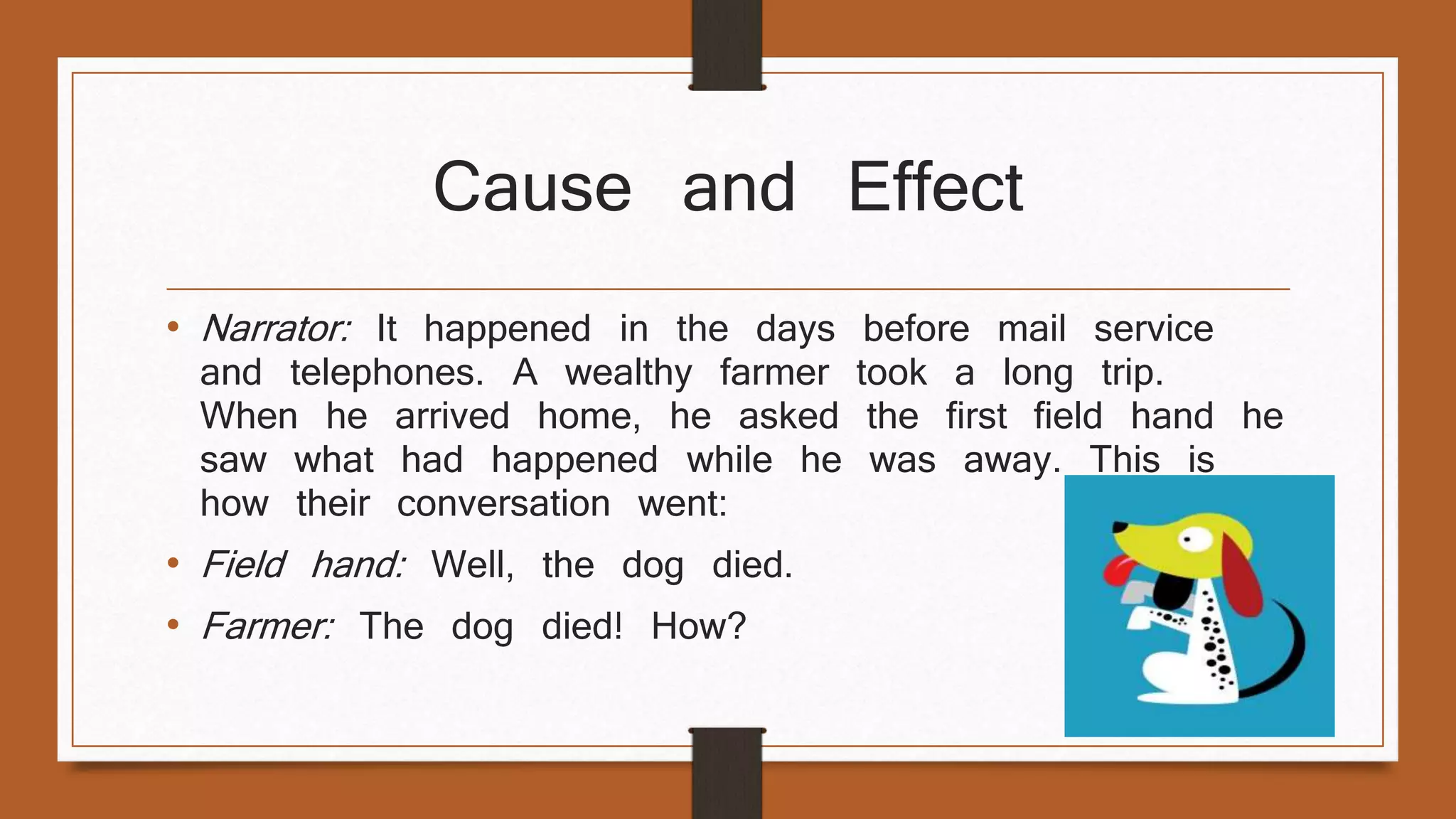
Cause and Effect 
• Narrator: It happened in the days before mail service 
and telephones. A wealthy farmer took a long trip. 
When he arrived home, he asked the first field hand he 
saw what had happened while he was away. This is 
how their conversation went: 
• Field hand: Well, the dog died. 
• Farmer: The dog died! How?
Cause and Effect 
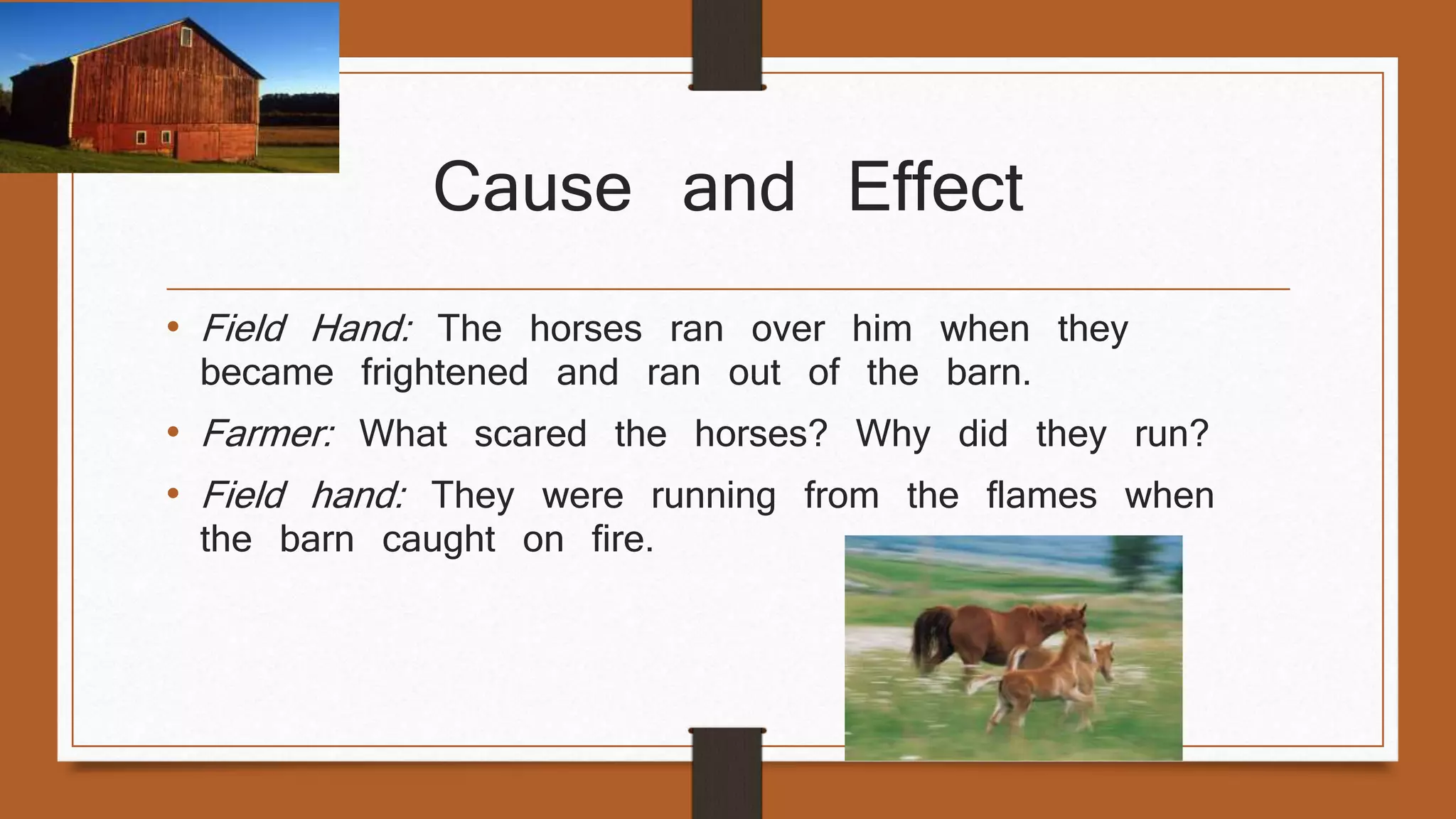
• Field Hand: The horses ran over him when they 
became frightened and ran out of the barn. 
• Farmer: What scared the horses? Why did they run? 
• Field hand: They were running from the flames when 
the barn caught on fire.
Cause and Effect 
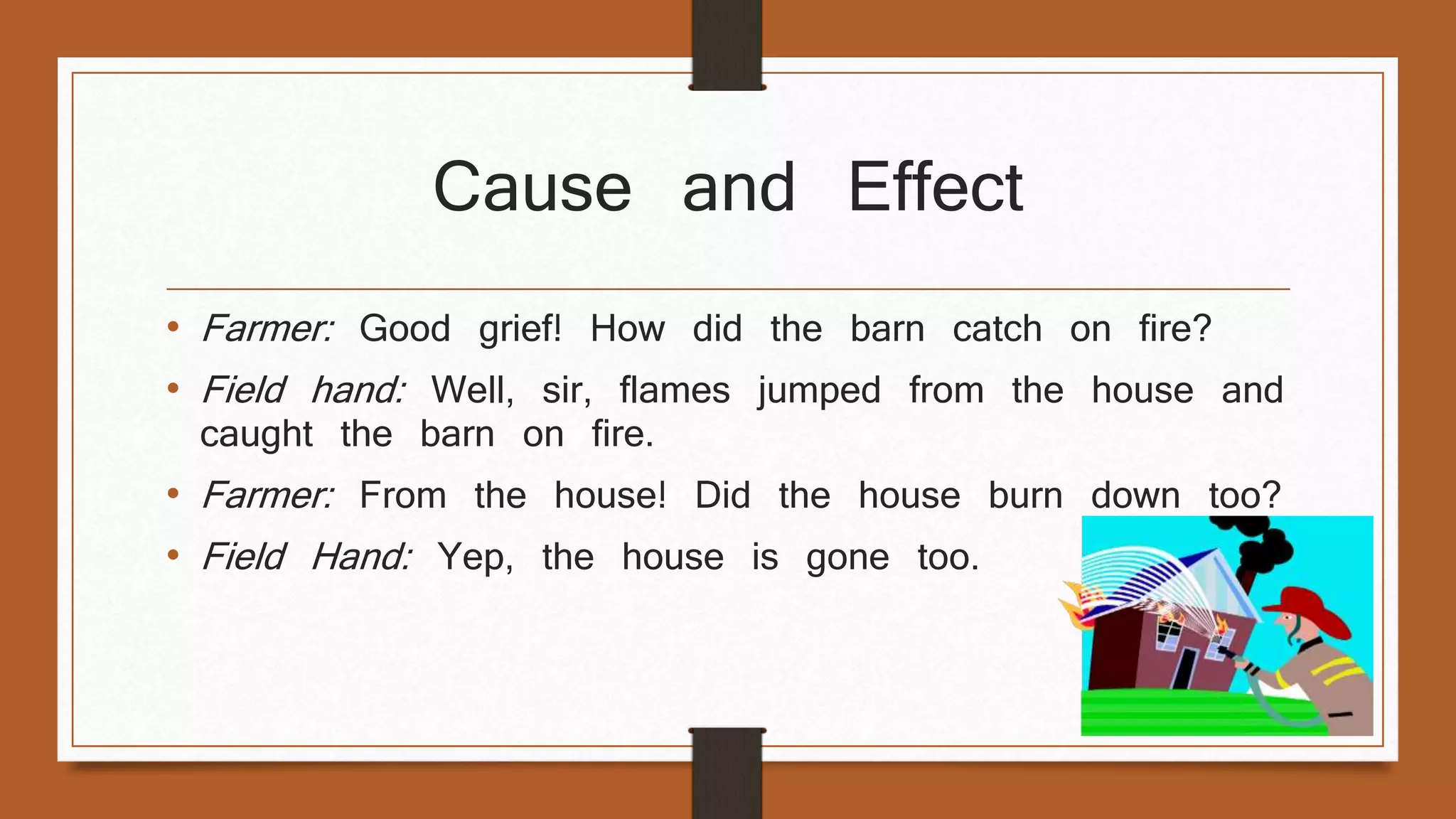
• Farmer: Good grief! How did the barn catch on fire? 
• Field hand: Well, sir, flames jumped from the house and 
caught the barn on fire. 
• Farmer: From the house! Did the house burn down too? 
• Field Hand: Yep, the house is gone too.
Cause and Effect 
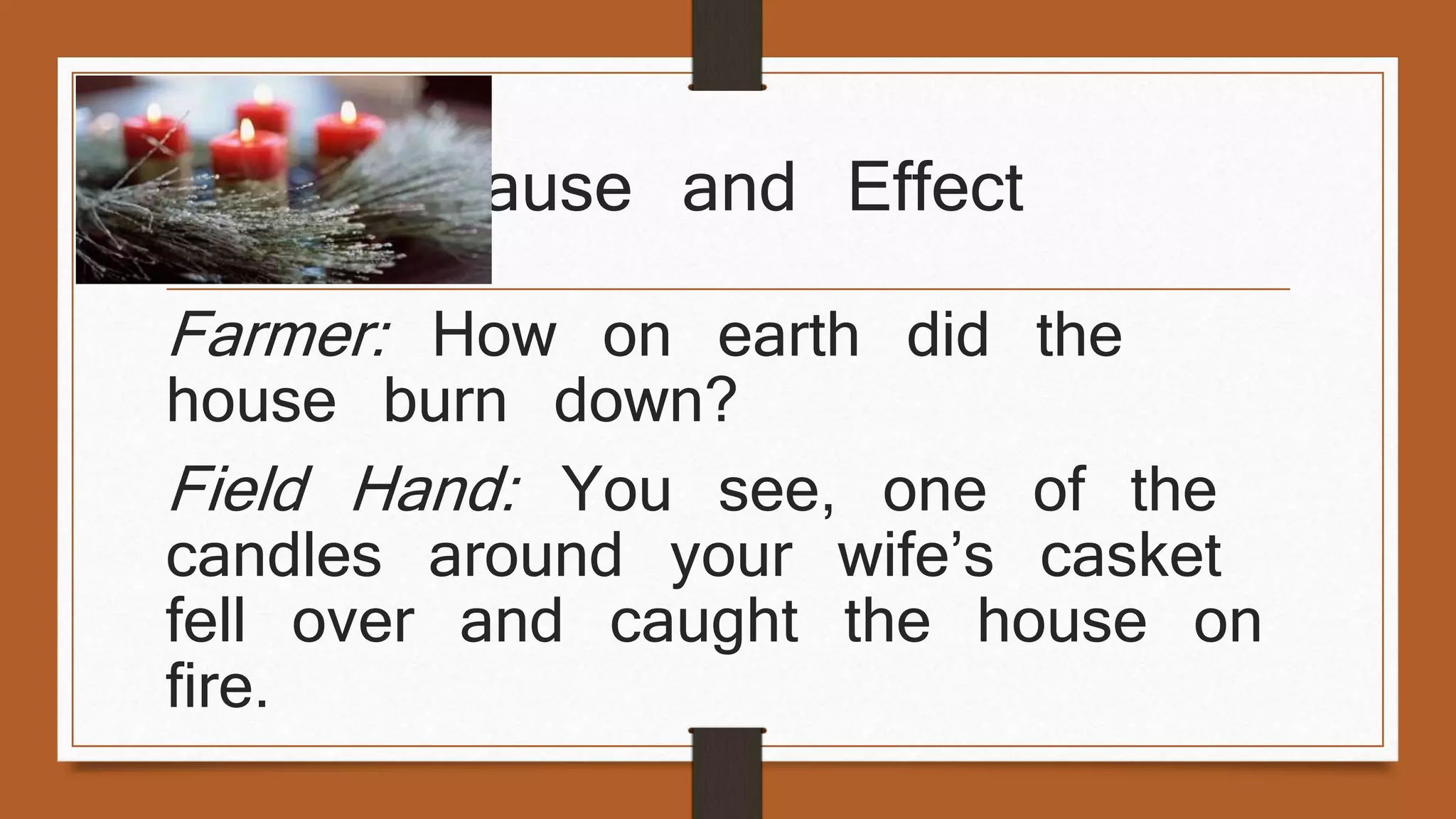
Farmer: How on earth did the 
house burn down? 
Field Hand: You see, one of the 
candles around your wife’s casket 
fell over and caught the house on 
fire.
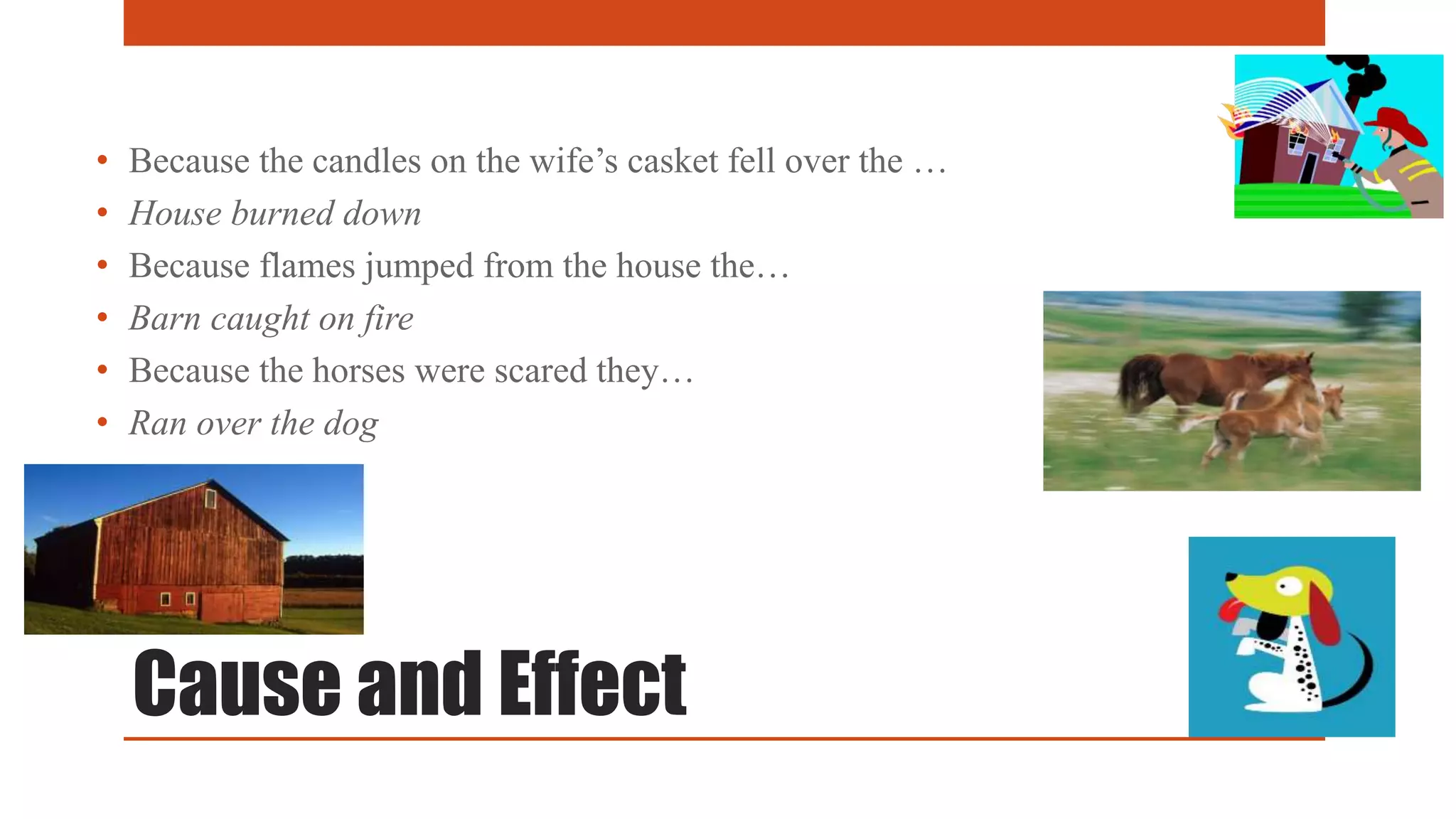
• Because the candles on the wife’s casket fell over the … 
• House burned down 
• Because flames jumped from the house the… 
• Barn caught on fire 
• Because the horses were scared they… 
• Ran over the dog 
Cause and Effect
As a 
consequence 
Because So then 
As a result Consequently Therefore 
At last Resulting in thus 
Cause & Effect Transition Words
Cause and Effect 
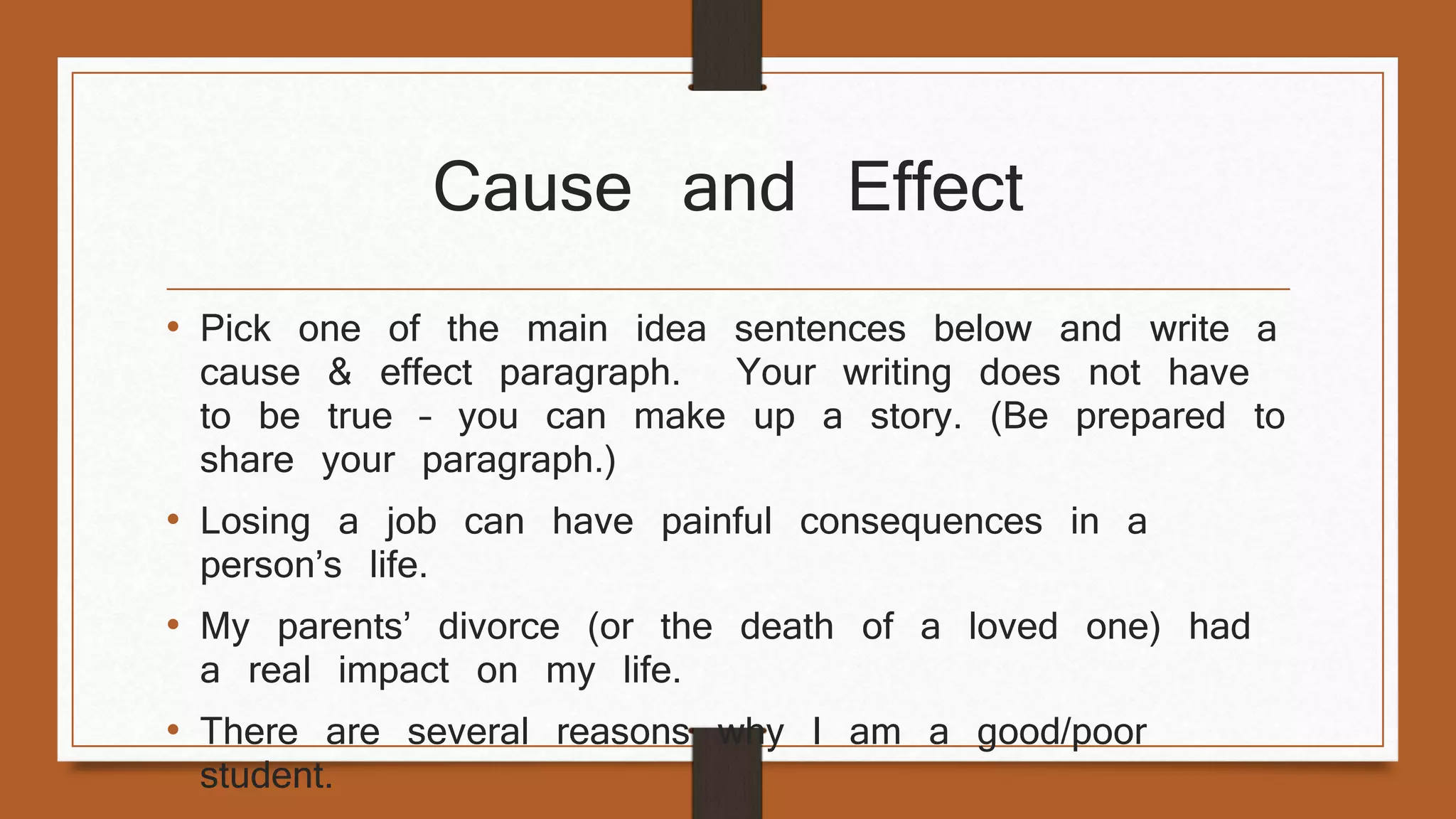
• Pick one of the main idea sentences below and write a 
cause & effect paragraph. Your writing does not have 
to be true – you can make up a story. (Be prepared to 
share your paragraph.) 
• Losing a job can have painful consequences in a 
person’s life. 
• My parents’ divorce (or the death of a loved one) had 
a real impact on my life. 
• There are several reasons why I am a good/poor 
student.
Break Time – 10 minutes
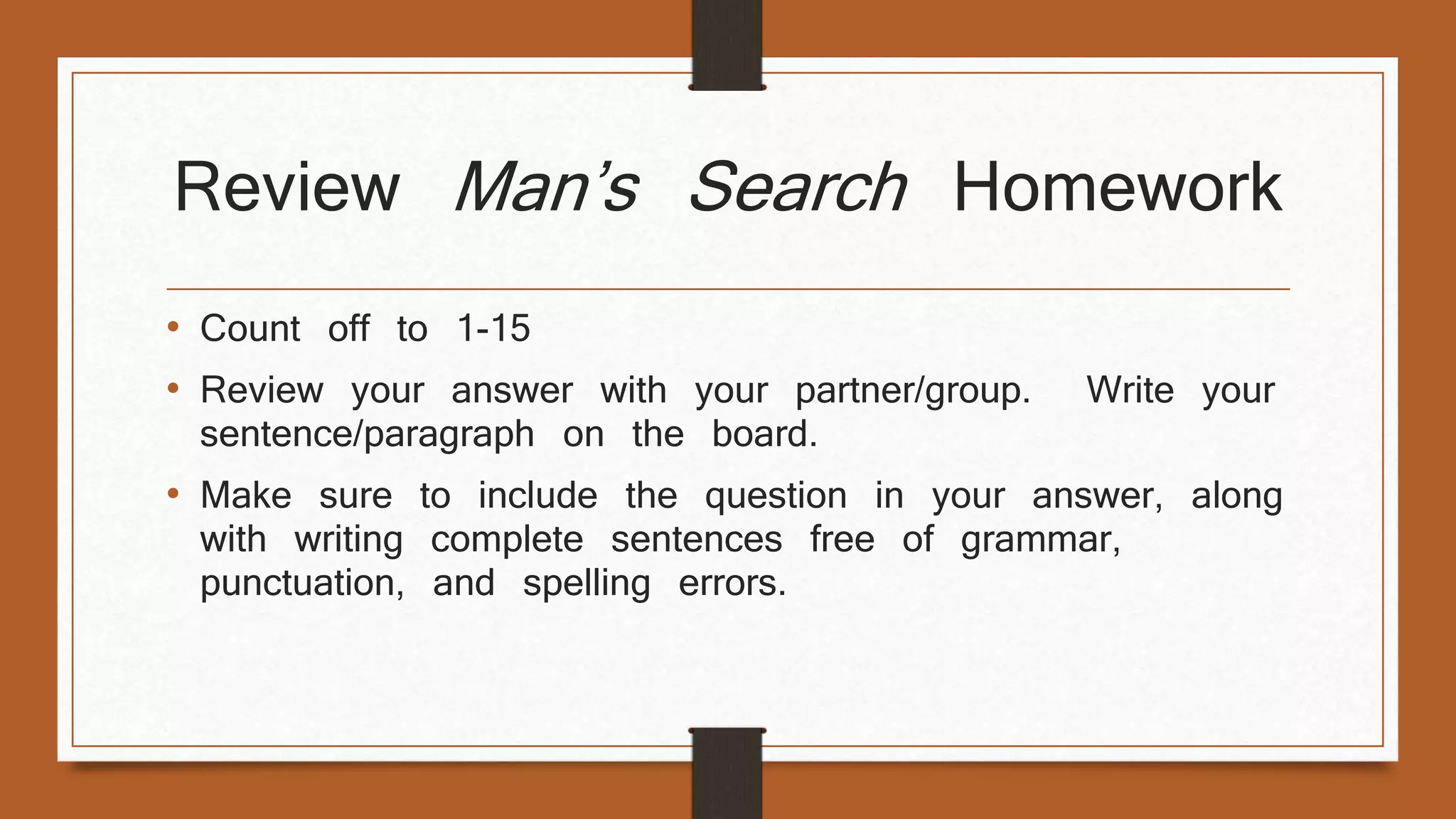
Review Man’s Search Homework 
• Count off to 1-15 
• Review your answer with your partner/group. Write your 
sentence/paragraph on the board. 
• Make sure to include the question in your answer, along 
with writing complete sentences free of grammar, 
punctuation, and spelling errors.
Essay #3: Resilience in the 
Face of Adversity
“Life is Beautiful” 
(continue watching)
Assignments for Wednesday 
• Reading Activity for: “The 5 Best Ways to Build 
Resiliency.” 
• Literature Circle #2 
• PSA Step 2, Analyzing PSAs 
• PSA Step 3, What is a Nonprofit Organization

Eng 83 r week 7 day 1 100614

  • 1.
    English 83R Week7, Day 1 October 6, 2014 Elizabeth Buchanan, Assistant Professor
  • 2.
    To Do •Please give yourself points for your vocabulary homework 1-10 (on cart). • Next, write a sentence for one of your vocabulary words on the board. Please put your initials next to the sentence, and make sure that only one other person has used the same word. Please underline your vocabulary word, and draw a circle around the context clues. • Please put your Man’s Search homework in the red alpha folder. • Please pick up handouts from computer cart.
  • 3.
    Agenda • Survey • Review Vocabulary words and sentences. • Review Man’s Search Homework • Introduction to Transitions/Rhetorical Modes in Reading • Introduction to Essay #2: Obtaining Resilience through Adversity • “Ron Clifford” story
  • 4.
  • 5.
    Transition and Rhetorical Modes in Reading & Writing
  • 6.
    Let’s talk aboutTransitions • Transitions are words and phrases that signal though patterns by showing the logical relationships within a sentence and between sentences.
  • 7.
    Transition Words •We all use transition words all the time – everyday - when you have a conversation with someone. • You might be talking at the dinner table with your family. You start out talking about your day at school, perhaps Essay #3 and other school related topics. • The next thing you realize is that you are now talking about your upcoming trip to Magic Mountain. • How did you jump topics during your conversation? • By using transition words
  • 8.
    Transitions • Theconversation might go like this: • Mom: How was your day at school, Juan? • Juan: First of all , I went to my English 83R class, took my vocab quiz, and got an A. After class, I went to the library to start working on my essay Next , I went to lunch with Joey, and finally I went online to purchase tickets for Magic Mountain .
  • 9.
    Transitions • Duringreading, it is important to pay special attention to transition words. • These special words show the relationships between ideas within sentences and within paragraphs. • Transitions are like signs on the road that guide travelers. • Transitions are also important in writing. • In good writing, the sentences used for support are clearly related to one another.
  • 10.
    Which words fitin the blanks? Resilient people are characterized by an ability to experience both negative and positive emotions even in difficult situations. ___________ they mourn losses and endure frustrations. ______________ they also find redeeming potential or value in most challenges. (From “The 5 Best Ways to Build Resliency) For example when there secondly there however
  • 11.
    Ruvolo discovered thatCushing was in the midst of his own turmoil: _____ ____ ___ his father had just left his mother for another woman. ______ he had serious vision problems that left him unable to play sports or drive a car. another first of all thirdly next secondly
  • 12.
    Rhetorical Patterns of Organization • Writers organize their supporting sentences and ideas in ways called Patterns of Organization. • Just as transitions show relationships between ideas in sentences, patterns of organization show the relationships between supporting details in paragraphs, essays, and chapters. • Patterns of organization are structures our minds use all the time. • All of our thinking and communicating depend on patterns of organization .
  • 13.
    Rhetorical Patterns ofThought • We are going to learn about four patterns: • Listing • Cause and Effect • Compare and Contract • Time Order/Chronological Order
  • 14.
    Listing pattern •A list of items is a series of reasons, examples, or other details that support an idea. • The items have no time order, but are listed in whatever order the author prefers.
  • 15.
    Listing Sometimes authorsuse numbers (1,2,3), letters (a, b, c) or asterisks (*) to show the individual items on the list.
  • 16.
    Listing • Ruvolohad many tragedies in her life. First of all , two of her brothers died in separate incidents when she was a teenager. Secondly at age 35, she miscarried a much-longed-for child. Thirdly, in 2004 everyone bone in her face was broken.
  • 17.
    List of Items Transition (addition) Words One First (of all) Secondly Thirdly To begin with For one thing Other Another Also In addition Next Moreover Further Furthermore Last (of all)
  • 18.
    Let’s Practice •Choose one of the sentences below (depending on whether you are an only child, or have siblings), and write a paragraph that supports the main idea. • 1. There are several advantages (or disadvantages) to be an only child. • 2. There are several advantages (or disadvantages) to having siblings
  • 19.
    Cause and Effect • One thing or event causes another thing to happen. • Cause and effect reasoning gives logical reasons that answer why or how. • A cause is a reason for something happening; an effect is the result or outcome. • Transition words: because, thus, therefore, as a result, for this reason, to explain, consequently, hence, so, affect, accordingly, due to, results in
  • 20.
    Cause and Effect • Narrator: It happened in the days before mail service and telephones. A wealthy farmer took a long trip. When he arrived home, he asked the first field hand he saw what had happened while he was away. This is how their conversation went: • Field hand: Well, the dog died. • Farmer: The dog died! How?
  • 21.
    Cause and Effect • Field Hand: The horses ran over him when they became frightened and ran out of the barn. • Farmer: What scared the horses? Why did they run? • Field hand: They were running from the flames when the barn caught on fire.
  • 22.
    Cause and Effect • Farmer: Good grief! How did the barn catch on fire? • Field hand: Well, sir, flames jumped from the house and caught the barn on fire. • Farmer: From the house! Did the house burn down too? • Field Hand: Yep, the house is gone too.
  • 23.
    Cause and Effect Farmer: How on earth did the house burn down? Field Hand: You see, one of the candles around your wife’s casket fell over and caught the house on fire.
  • 24.
    • Because thecandles on the wife’s casket fell over the … • House burned down • Because flames jumped from the house the… • Barn caught on fire • Because the horses were scared they… • Ran over the dog Cause and Effect
  • 25.
    As a consequence Because So then As a result Consequently Therefore At last Resulting in thus Cause & Effect Transition Words
  • 26.
    Cause and Effect • Pick one of the main idea sentences below and write a cause & effect paragraph. Your writing does not have to be true – you can make up a story. (Be prepared to share your paragraph.) • Losing a job can have painful consequences in a person’s life. • My parents’ divorce (or the death of a loved one) had a real impact on my life. • There are several reasons why I am a good/poor student.
  • 27.
    Break Time –10 minutes
  • 28.
    Review Man’s SearchHomework • Count off to 1-15 • Review your answer with your partner/group. Write your sentence/paragraph on the board. • Make sure to include the question in your answer, along with writing complete sentences free of grammar, punctuation, and spelling errors.
  • 29.
    Essay #3: Resiliencein the Face of Adversity
  • 30.
    “Life is Beautiful” (continue watching)
  • 31.
    Assignments for Wednesday • Reading Activity for: “The 5 Best Ways to Build Resiliency.” • Literature Circle #2 • PSA Step 2, Analyzing PSAs • PSA Step 3, What is a Nonprofit Organization