Karen S. Wright
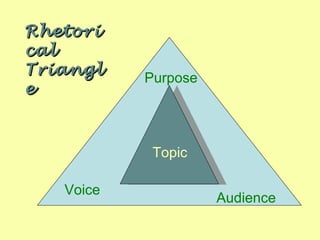
Rhetori
cal
Triangl
e

Purpose

Topic
Voice

Audience
Ask the Right Questions Before
You Begin to Write
•What am I trying to say?
•What effect do I hope to
achieve?
•What main point do I
want to make?
•What form/type of writing
will I use?
•What is my purpose?
Your strategy becomes the purpose and
the goal you wish to reach with your paper.
Narration
Explanation
Persuasive
Definition

Description
Argument
A Narrative tells a
personal story
The narrative essay is told
from first or third person
point-of-view
It’s important to follow
a clear sequence of
events.
A descriptive essay will put into
words what you want your reader to
see in his or her mind.
Using concrete examples are very
important in a descriptive essay.
Example essays begin with
generalizations and then move to
examples.
If you were writing an essay on
city traffic, you would begin with
a general statement and then give
specific examples.
Definition
A definition essay says what
something is and what something is
not
The denotative and connotative
definitions of the word need to be
included in the essay.
•All of our lives we have tried to
persuade someone to do
something or to think like we
do…that is the beginning of an
argument paper.
•Your reader won’t believe you,
just because you say something
is true.
•The argument requires
research to support your
thinking.
When you consider the
purpose of your essay, consider
the following:
1.What problem is suggested
by the topic?
2. What are your writing
goals?
3. What is your intent-persuasive, argumentative,
informative?
Voice is the identity the
writer adopts and his/her
credibility as an authority.
Do you want to sound-…objective and fair
…
heated and passionate …
sincere and persuasive …
informative and impartial
A piece of writing is
often judged by how
effectively it reaches its
intended audience.
Here are some questions to consider
about audience:
1. Who are your readers (age, sex,
income, belief systems, potential
biases)?
2. Are your readers novices or experts on
the subject?
3. What are your readers likely to know
(education level, prior knowledge)?
The rhetorical Stance reflects the way you
define the various components of the writing
situation: your purpose for writing, your
voice or how you wish to come across to your
readers, and your audience.

Rhetorical stance copy 1

  • 1.
  • 2.
  • 3.
    Ask the RightQuestions Before You Begin to Write •What am I trying to say? •What effect do I hope to achieve? •What main point do I want to make? •What form/type of writing will I use? •What is my purpose?
  • 4.
    Your strategy becomesthe purpose and the goal you wish to reach with your paper. Narration Explanation Persuasive Definition Description Argument
  • 5.
    A Narrative tellsa personal story The narrative essay is told from first or third person point-of-view It’s important to follow a clear sequence of events.
  • 6.
    A descriptive essaywill put into words what you want your reader to see in his or her mind. Using concrete examples are very important in a descriptive essay.
  • 7.
    Example essays beginwith generalizations and then move to examples. If you were writing an essay on city traffic, you would begin with a general statement and then give specific examples.
  • 8.
    Definition A definition essaysays what something is and what something is not The denotative and connotative definitions of the word need to be included in the essay.
  • 9.
    •All of ourlives we have tried to persuade someone to do something or to think like we do…that is the beginning of an argument paper. •Your reader won’t believe you, just because you say something is true. •The argument requires research to support your thinking.
  • 10.
    When you considerthe purpose of your essay, consider the following: 1.What problem is suggested by the topic? 2. What are your writing goals? 3. What is your intent-persuasive, argumentative, informative?
  • 11.
    Voice is theidentity the writer adopts and his/her credibility as an authority.
  • 12.
    Do you wantto sound-…objective and fair … heated and passionate … sincere and persuasive … informative and impartial
  • 13.
    A piece ofwriting is often judged by how effectively it reaches its intended audience.
  • 14.
    Here are somequestions to consider about audience: 1. Who are your readers (age, sex, income, belief systems, potential biases)? 2. Are your readers novices or experts on the subject? 3. What are your readers likely to know (education level, prior knowledge)?
  • 15.
    The rhetorical Stancereflects the way you define the various components of the writing situation: your purpose for writing, your voice or how you wish to come across to your readers, and your audience.