INTRODUCTION OF RHFACTOR
• The resus factor gets its name from experiments conducted in 1937 by
scientists KARL LANDSTEINER and alexander s. weiner.
• Their experiments involved rabbits which, when injected with the RHESUS
monkey’s red blood cells, produced an antigen that is present in the red
blood cells of many humans.
3.
• The genotypeis determined by the inheritance of 3 pairs of closely linked allelic
genes situated on chromosomes 9 named as
• D/d
• C/c
• E/e
(fisher- race theory )
4.
RH- BLOOD GROUPINGSYSTEM
• First demonstrated in rhesus monkey.
• Blood groups are Classified as Rh positive and Rh negative.
• The Rh factor, Rh- usually refers specifically to the presence or absence of
antigen – D .
• There are two alleles, or genetic variants, of the antigen : D and d.
• A person who is Rh- has two recessive traits, dd. Anyone who has at least
one D- DD or Dd – is Rh+.
5.
Rh Type andPregnancy
• A person’s Rh type is generally most relevant with respect to pregnancies.
• If the pregnant woman and her husband are Rh negative, there is no reasons
to worry about Rh incompatibility.
• If she is Rh negative and her husband is Rh positive, the baby will inherit the
father’s blood type, creating incompatibility between mother and her fetus.
• If some of the fetal blood gets into mother’s blood stream, her body will
produce antibodies.
6.
• These antibodiescould pass back through the placenta and harm the developing
baby’s red blood cells, causing very mild to very serious anemia in the fetus.
DEFINITION :
Rh incompatibility is a condition which develops when a pregnant woman have a rh
negative blood and the baby in her womb has Rh positive blood. Develops Rh
incompatibility
Also called “ hemolytic disease of newborn’s.”
7.
Causes Of RhIncompatibility
• mother’s Rh negative blood : when the Rh negative mother carries
on Rh positive fetus.
• previous exposure to rh negative blood : through previous
pregnancy, blood transfusions, or other.
• Fetal blood cells enter mother’s blood- stream : during
pregnancy, childbirth , or medical procedures.
TYPES OF ANTIBODIES
•TYPES OF ANTIBODIES ARE FORMED :
• IGM : this type of antibody is the first to appear in the maternal
circulation and agglutations red cells containing D when suspended in
saline. Igm being larger molecules cannot pass through the placental
barrier and is not harmful to the fetus.
• IgG : it is also called incomplete or blocking antibody. It will
agglutinate the red cells containing D only when suspended in 20%
albumin. Because of its small molecular size, it can cross the placental
barrier and cause damage to the fetus. It appears at the later period
than does the IgM antibody. It is important to recognize the
preponderance of one or the other type of antibody than the actual
level of the titer.
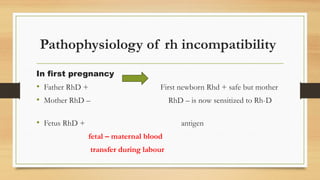
Pathophysiology of rhincompatibility
In first pregnancy
• Father RhD + First newborn Rhd + safe but mother
• Mother RhD – RhD – is now sensitized to Rh-D
• Fetus RhD + antigen
fetal – maternal blood
transfer during labour
13.
Rapid production ofIgG anti D by mother
Maternal IgG anti D crosses placenta
IgG anti D attaches to fetal RBC and marks them for destruction
Fetal or newborn hemolytic anemia
Increased bilirubin , CNS damage (Kernicterus) ,death
IN SECOND
PREGNANCY
14.
Investigation for Rhincompatibility
• Blood test : blood testing for Rh and ABO grouping should be done at the first
antenatal visit .
• If the woman is found Rh negative ,Rh grouping of the husband is to be done . If
husband is found to be Rh-positive ,further investigation are to be carried out.
• Obstetric history : If woman is a primigravida with no previous history of blood
transfusion ,it is quite unlikely that the baby will be affected.
In a parous woman ,a detailed obstetric history has to be taken. Example: History of
stillbirth ,neonatal death due to jaundice ,etc . Also enquire about the administration of
anti–D immunoglobulin following delievery or abortion.
15.
• Antibody detection: In all cases of Rh negative woman irrespective of blood
grouping and parity ,IgG antibody is detected by indirect Coombs test.
Quantitative estimation of IgG antibody should be done at weekly interval.
Sudden rise in the titer from 1:8 to 1:256 is very much suggestive of fetal affection.
• Some centers consider the titer of 1:6 or antibody level >10 IU/ml as a critical
one. Critical titer means anti-D antibody level that causes hydrops fetalis .
• Doppler ultrasound : Serial Doppler study of middle cerebral artery (MCA) peak
systolic velocity (PSV) is the main predictor for fetal anemia. A value>1.5 multiples
of the median (MoMs) for the corresponding gestational age predicts moderate to
severe fetal anemia.
16.
• Amniocentesis :Amniocentesis and estimation of bilirubin in the amniotic fluid by
spectrophotometer predict the severity of fetal hemolysis.
• The optical density of the liquor containing the bilirubin pigment is observed at 250-
700 nm wavelength.
• In the presence of bilirubin ,there is ‘deviation bulge’ peaking at 450nm wavelength.
For any given period of gestation, the height Of spectrophotometric ‘deviation bulge’
at OD450 falls within one of the three zones when plotted on liley’s chart.
• Interpretations:
1. Liley’s zone 1(low zone): The fetus is unlikely to be affected and the pregnancy can
be continued to term.
17.
2. Liley’s zone2(mid zone) : Repeat amniocentesis by 2 weeks Value upward
Cordocentesis hematocrit <30% Intrauterine transfusion to raise hematocrit
40-45%. Preterm delivery after 34 weeks.
3. Liley’s zone 3( high zone) : Fetus is severely affected and death is imminent.
• Pregnancy >34 weeks Delivery .
• Pregnancy <34 weeks Cordocentesis Hematocrit <30% Intrauterine
transfusion to raise hematocrit 40-45% . Preterm delivery after 34 weeks .
18.
Prevention
• To preventionactive immunizations : Rh anti-D immunoglobulin
(IgG)300 microgram is administered. IM to the mother during pregnancy .
72 hours following delivery or
abortions.
• To prevent or minimize fetomaternal bleeding : use
precautions during cesarean section to prevent blood spilling into peritoneal
cavity and while removing placenta.
• Prophylactic ergometrine with delivery of the anterior shoulder should
preferably be withheld.
19.
• Amniocentesis shouldbe done after sonographic localizations of the placenta to
prevent its injury.
• Avoid external versions in Rh – negative pregnancy.
• Manual removal of placenta should be done gently.
• Avoid abdominal palpation in case of placental abruption
( abruptio placentae )
• To avoid mismatched transfusions .
PLAN OF DELIVERY
Unimmunizedmothers : In cases where there is no detectable antibody found during
pregnancy, an expectant is followed till term .
Tendency of pregnancy to overrun the expected date should not be allowed .
Immunized mothers : As mentioned previously, whenever there is evidence of hemolytic
process in the fetus in utero , the patient should be shifted to an equipped center specialized
to deal with Rh problems. An intensive neonatal care unit, arrangements for exchange
transfusion and an expert neonatologist are the basic requirements to tackle the
affected babies.
22.
• Delivery isto be done in all cases of immunized mothers with evidences of
hemolysis in utero. The following factors are to be considered as to when
terminate the pregnancy :
• Previous history of stillbirth with father being homozygous.
• Sudden rise in maternal antibody titer
• The optical density difference at 450 nm wavelength as plotted on Liley’s chart
• Doppler and ultrasound features of fetal affection .
23.
In mild affection,the pregnancy may be continued up to 38 weeks and then
termination is to be done .
In severe affection ,It is reasonable to terminate the pregnancy around 34 weeks
after maternal steroid administration . In every case of premature termination
before 34 weeks ,it is desirable to confirm the fetal lung maturation by measuring
the L:S ratio in the amniotic fluid. In a specialized center where there is severe
affection before 34weeks ,intrauterine fetal transfusion (intraperitoneal or
intravascular)is done to continued pregnancy beyond 34 weeks.
24.
Methods of delivery:
Amniotomy (low rupture of the membranes) is quite effective , if termination is
done near term. Vaginal prostaglandin gel could be used to make the cervix ripe.
Cesarean section : In cases when termination has to be done prematurely (say
34-37 weeks ),the cervix will be unfavorable and considering the severity of
affection and urgency of termination ,cesarean section is a safe procedure .
25.
Care during delivery:Vaginal delivery :
• Careful fetal monitoring is to be done to detect at the earliest , evidences of
distress
• Prophylactic ergometrine during second stage should be withheld
• Gentle handling of the uterus in the third stage
• To take care of postpartum hemorrhage .
26.
• Cesarean section:
i. To avoid spillage of blood into the peritoneal cavity
ii. Routine manual removal of placenta should be withheld.
• Clamping the umbilical cord: In either methods ,the cord is to be clamped as
quickly as possible to minimize even minute amount of antibody to cross to the
fetus from the mother. The cord should be kept long (15-20cm ) for exchange
transfusion ,if required .
• Collection of cord blood for investigation : cord blood sample is to be taken
from the placental end of the cut cord . The cord should not be squeezed to
prevent contamination
27.
with Wharton’s jelly. About 5ml ,of blood (2ml oxalated and 3ml ,clotted ) should
be collected for the following tests:
Clotted blood : ABO and Rh grouping ,reticulocyte count ,direct Coombs test and
serum bilirubin .
Oxalated blood : Hemoglobin estimation and blood smear for presence of immature
RBC .
28.
EXCHANGE TRANSFUSION INTHE NEWBORN
• Exchange transfusion is a life saving procedure in severly affected hemolytic
disease of the fetus and newborn (HDFN).
• With the advent of wider use prophylactic anti – D immunoglobulin. Less
and less problem babies are born and through exchange transfusions, the
incidence of kernicterus has also been reduced.
• Indications : rh positive with direct coomb’s test positive babies having
• Cord blood bilirubin level more than 4 mg /dl and hemo-globin level is less
than 11g /dl .
• Rising rare of bilirubin is over 1 mg /dl/ hour despite phototherapy.
29.
• Total bilirubinlevel 20 mg /dl or more.
• Objectives: to stop hemolysis, and bilirubin production.
• to correct anemia and to improve congestive cardiac failure of the neonates.
• To remove the circulatory antibodies.
• To remove sensitized RBCs.
• To eliminate the circulatory bilirubin production.
• While about 80 -90 % of the fetal blood is exchanged during the procedure,
transfusions of Rh – negative blood cannot alter the Rh – factor of the baby’s blood.
The replacement temporarily help to tide over the crisis from anemia and
hyperbilirubinemia for about 2 weeks. Thereafter, the baby is quite capable to get rid
of the maternal antibodies by protecting sufficiently his own Rh-positive blood.
30.
• Nature andamount of blood transfused – Blood for exchange should be Rh –Negative
whole blood with the same blood ABO grouping to that of the baby , otherwise group ‘O’ . The
blood should be cross matched with the mother’s serum or with the infant’s serum.
• The blood should be collected relatively fresh (<7days old ).
• The amount is about 160mL/Kg body weight of the baby.
• Adjuvant therapy :
1) Phototherapy : phototherapy is to be continued for 24 hours . Phototherapy
(blue or blue green light of 420-470 nm wavelength ) degrades bilirubin
by photo-oxidation and structural isomerization (lumibilirubin). Bilirubin is converted to less toxic
polar isomer .these products are water soluble and therefore readily excreted in the bile and urine .
Ultraviolet light should be screened out and the baby’s eyes should be protected by dark
glasses .
31.
2) Photochemical reactionsconvert bilirubin to less toxic and water-soluble polar
isomer or to lumirubin.
3) Antibiotics should be administered for 3-5 days .