Education  2030:  Mapping the Future Results of the first stage of Russian education foresight
Disclaimer : This foresight is neither a forecast nor an action plan .  It is a map of highly probable events and emerging trends that may occur in the foreseeable future   and that should be taken into consideration in the present .  Foresight is built by collective creative work of a large number of experts mapping events of the future .  The foresight technology used by our group allows to consider not only linear trends ,  but also possible qualitative shifts in trends .  However, any forecasts beyond next five years are indicative. This foresight report is largely focused on Russia.   As the variety of the content and management models of different educational systems is very large ,  educational systems stand on different stages of development and try to solve different challenges, the application of this report to other countries is limited .  However, in respect to technologies that influence education, and to markets that exist in global competition  ( university education and education for adults ),  conclusions of this foresight are applicable on the global scale . Important note :  The list of trends and events in this foresight does not reflect the position of foresight authors and experts about the desirable future !
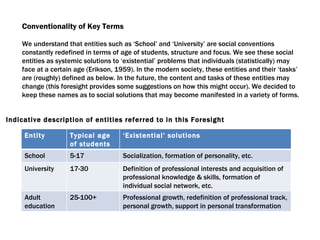
Conventionality of Key Terms We understand that entities such as ‘School’ and ‘University’ are social conventions constantly redefined in terms of age of students, structure and focus. We see these social entities as systemic solutions to ‘existential’ problems that individuals (statistically) may face at a certain age  ( Erikson, 1959). In the modern society, these entities and their ‘tasks’ are (roughly) defined as below. In the future, the content and tasks of these entities may change (this foresight provides some suggestions on how this might occur). We decided to keep these names as to social solutions that may become manifested in a variety of forms. Indicative description of entities referred to in this Foresight Entity Typical age of students ‘ Existential’ solutions School 5-17 Socialization, formation of personality, etc. University 17-30 Definition of professional interests and acquisition of professional knowledge & skills, formation of individual social network, etc. Adult education 25-100+ Professional growth, redefinition of professional track, personal growth, support in personal transformation
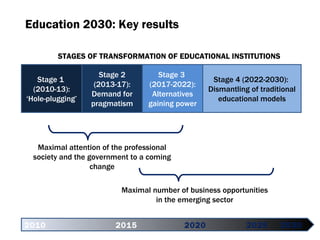
Education  2030:  Key results Mass-scale transformation of education within next few years is inevitable. Education will become total ,  continuous ,  human-centered ,  and represented by a variety of forms. Transformation of education is a growth opportunity for the business and economy ,  and is a tool of influence in the global market .  Foresight indicates some of these emerging opportunities . The government and the society can support or block these opportunities.
2010   2015 2020   2025 2030 Stage  1  (2010-13):  ‘Hole-plugging’ Stage  2 (2013-17):  Demand for pragmatism Stage  3  (2017-2022):  Alternatives gaining power Stage  4 (2022-2030):  Dismantling of traditional educational models Education  2030:  Key results Maximal attention of the professional society and the government to a coming change Maximal number of business opportunities in the emerging sector STAGES OF TRANSFORMATION OF EDUCATIONAL INSTITUTIONS
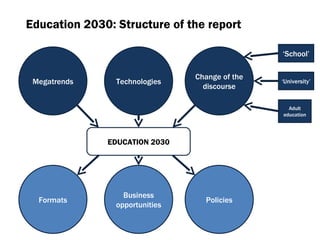
Megatrends Technologies Change of the discourse ‘ School’ ‘ University’ Adult education EDUCATION  2030 Formats Business opportunities Policies Education  2030:  Structure of the report
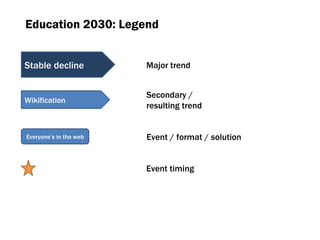
Education  2030:  Legend Everyone’s in the web Stable decline Wikification Major trend Secondary  /  resulting trend Event  /  format  /  solution Event timing
MEGATRENDS INFLUENCING EDUCATION
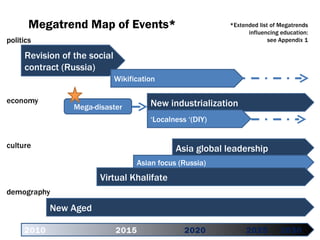
Mega-disaster 2010   2015 2020   2025 2030 New industrialization ‘ Localness   ‘ ( DIY) Revision of the social contract (Russia) Wikification Asia global leadership Asian focus (Russia) New Aged Megatrend Map of Events * Virtual Khalifate * Extended list of Megatrends influencing education: see Appendix  1
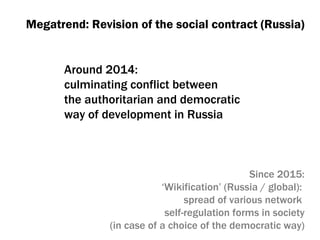
Megatrend: Revision of the social contract (Russia) Around  2014:  culminating conflict between  the authoritarian and democratic  way of development in Russia Since  2015: ‘ Wikification’ (Russia / global) :  spread of various network  self-regulation forms in society ( in case of a choice of the democratic way )
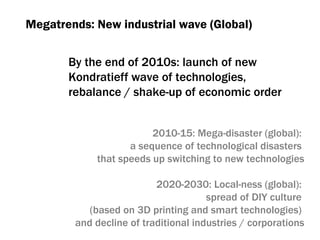
Megatrends :  New industrial wave (Global) By the end of  2010 s :  launch of new  Kondratieff wave of technologies , rebalance  /  shake-up of economic order 2010-15:  Mega-disaster (global) :  a sequence of technological disasters  that speeds up switching to new technologies 20 20 -20 3 0:  Local-ness (global) :  spread of DIY culture   ( based on 3D printing and   smart technologies )  and decline of traditional industries / corporations
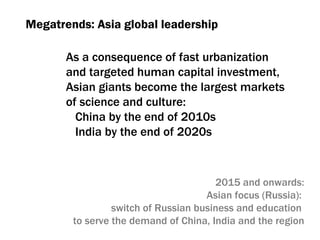
Megatrends :  Asia global leadership As a consequence of fast urbanization and targeted human capital investment, Asian giants become the largest markets  of science and culture :   China by the end of  2010 s India by the end of  2020 s 201 5 and onwards : Asian focus (Russia) :  switch of Russian business and education   to serve the demand of China ,  India and the region
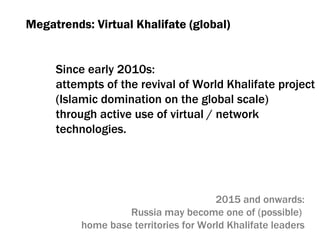
Megatrends :  Virtual Khalifate (global) Since early  2010 s :  attempts of the revival of World Khalifate   project ( Islamic domination on the global scale )  through active use of virtual / network  technologies .  20 15 and onwards : Russia may become one of  ( possible )   home base territories for World Khalifate leaders
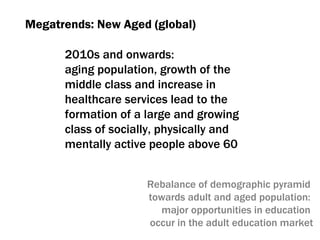
Megatrends :  New Aged (global) 2010 s   and onwards :  aging population ,  growth of the middle class and increase in healthcare services lead to the formation of a large and growing class of socially, physically and mentally active people above 60 Rebalance of demographic pyramid  towards adult and aged population :  major opportunities in education  occur in the adult education market
TECHNOLOGIES INFLUENCING  EDUCATION
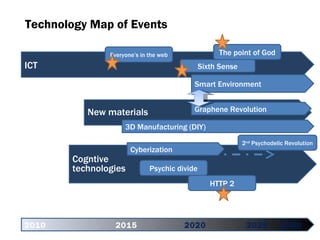
2010   2015 2020   2025 2030 ICT Everyone’s in the web The point of God Sixth Sense Smart Environment Cogntive technologies Psychic divide HTTP 2 New materials 3 D Manufacturing (DIY) Graphene Revolution Cyberization Technology Map of Events 2 nd  Psychodelic Revolution
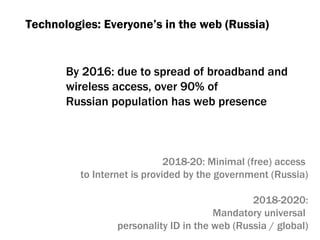
By  2016:  due to spread of broadband and  wireless access, over 90% of  Russian population has web presence Technologies :  Everyone’s in the web (Russia) 2018 -20 :  Minimal  ( free )  access  to Internet is provided by the government (Russia) 2018-2020: Mandatory universal  personality ID in the web (Russia / global)
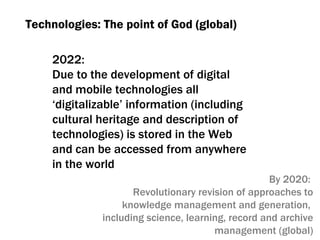
Technologies :  The point of God (global) 2022:  Due to the development of digital and mobile technologies all ‘digitalizable’ information  ( including   cultural heritage and description of technologies )  is stored in the Web and can be accessed from anywhere in the world By  2020:  Revolutionary revision of approaches to knowledge management and generation ,  including science ,  learning, record and archive management (global)
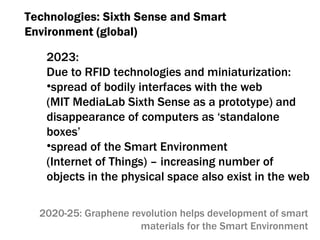
Technologies :  Sixth Sense and Smart Environment (global) 2023: Due to RFID technologies and miniaturization :  spread of bodily interfaces with the web (MIT MediaLab Sixth Sense as a prototype) and  disappearance of computers as ‘standalone  boxes’ spread of the Smart Environment  (Internet of Things)  –  increasing number of  objects in the physical space also exist in the web 2020-25:  Graphene revolution helps development of smart materials for the Smart Environment
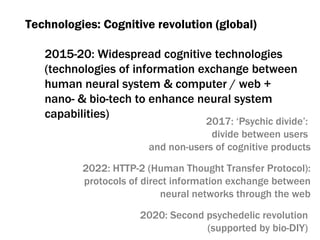
Technologies :  Cognitive revolution (global) 2015-20:  Widespread cognitive technologies  ( technologies of information exchange between human neural system & computer / web + nano- & bio-tech to enhance neural system capabilities ) 2017:  ‘Psychic divide’ :  divide between users  and non-users of cognitive products 2022:  HTTP -2 ( Human Thought Transfer Protocol ):  protocols of direct information exchange between neural networks through the web 2020:  Second psychedelic revolution   ( supported by bio - DIY)
SCHOOL  EDUCATION
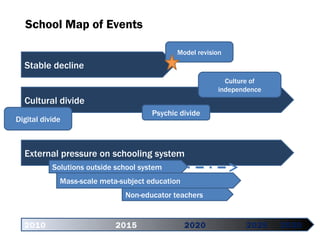
2010   2015 2020   2025 2030 Stable decline School Map of Events Cultural divide Psychic divide Culture of independence Digital divide External pressure on schooling system Solutions outside school system Non-educator teachers Mass-scale meta-subject education Model revision
School :  Stable decline (Russia) Before  2015-17: Degrading quality of teachers  ( low-paid & small-time job attracts low quality human capital ) Degrading quality of students :  poor health ,  poor preparation in the family ,  declining motivation to learn ,  ‘A Button Empire’ School is demanded by the society largely as a children ‘locker’ In Russia, demographic collapse   and collapse of the school system go in parallel, making the decline less visible
School :  Cultural Divide (global) 2010 s :  Increasing gap between digital students and non-digital teachers 2015-20:  Psychic divide (see in Technology section) 2022-25:  Culture of independence :  spread of early socialization formats that help integration in the adult life  ( entrepreneurship etc .) Support by expanding DIY culture, available economies of game universes ,  international certification and national certification transformation
School :  External pressures upon the System (global) 2013-2020:  Growth of education outside the School System and its increased availability through the web 2015-2025:  Non-educator teachers (professionals) 2015-2025:  Employer demand pushes meta-subject education for the increasingly uncertain environment Government loses its strategic leverage  over schooling system ,  keeping to itself only administration of buildings and funds but not the content.
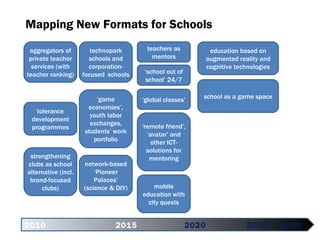
Mapping New Formats for   Schools 2010   2015 2020   2025 2030 aggregators of private teacher services  ( with teacher ranking ) tolerance development programmes strengthening clubs as school   alternative  ( incl .  brand-focused clubs ) technopark schools and corporation-focused  schools ‘ game economies’ ,  youth labor exchanges ,  students’ work portfolio network-based ‘Pioneer Palaces’  ( science & DIY ) teachers as mentors ‘ school out of school’  24/7 ‘ global classes’ ‘ remote friend’ ,  ‘avatar’ and other ICT-solutions for mentoring mobile education with city quests education based on augmented reality and cognitive technologies school as a game space
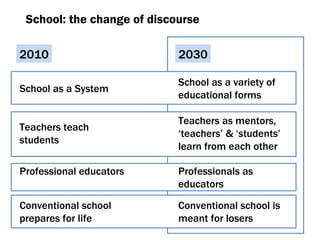
School :  the change of discourse 2010 2030 School as a System Teachers teach students Professional educators School as a variety of educational forms Teachers as mentors ,  ‘teachers’ & ‘students’  learn from each other  Professionals as educators Conventional school prepares for life Conventional school is meant for losers
UNIVERSITY  EDUCATION
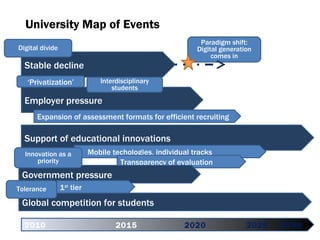
Global competition for students University Map of Events Stable decline 2010   2015 2020   2025 2030 Digital divide Support of educational innovations Mobile techologies, individual tracks Transparency of evaluation Employer pressure ‘ Privatization’ Interdisciplinary students Expansion of assessment formats for efficient recruiting Government pressure Innovation as a priority Tolerance Paradigm shift: Digital generation comes in 1 st  tier
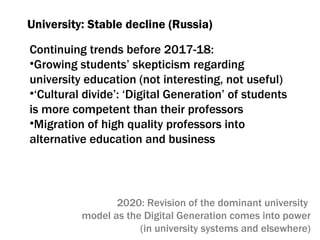
University :  Stable decline (Russia) Continuing trends before  2017-18:  Growing students’ skepticism regarding university education (not interesting, not useful) ‘ Cultural divide’ :  ‘Digital Generation’ of students is more competent than their professors Migration of high quality professors into alternative education and business 2020:  Revision of the dominant university  model as the Digital Generation comes into power (in university systems and elsewhere)
University: Employer pressure (Russia) Since  2010-х:  ‘privatization’ of educational systems by corporations due to unsatisfactory quality  ( and responsibility )  of prospective recruits 2012  and onwards :  expansion of assessment formats for more efficient recruiting 2013:  revival of blue collar education in colleges  [ likely failure of the reform before  2025] 2015:  degree in inter- and trans-disciplinary studies (‘universal problem-solvers’)
University: Factors of external pressure (Russia) Continuing globalization of the educational system and global competition for students Pressures from the government 2010-15:  selection of ‘first tier’ universities that receive political and financial support from the government for their transformation 2010-20:  demand to solve innovation development challenges on the state / regional level  ( increased innovativeness ) 2010-20:  demand to solve issues of migrant integration
University: Support to Educational Innovations Since  2010 s :  growing number of non-educator professors from various domains of practice 2013-15: Legitimization to new educational forms in student preparation  ( online ,  mobile etc .)  Legitimization to individual learning trajectories Transparency of educational process in terms of teaching and assessment ,  incl .  online broadcasting of Thesis defence
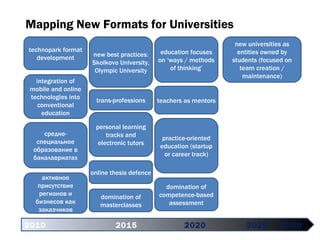
2010   2015 2020   2025 2030 Mapping New Formats for   Universities technopark format development integration of mobile and online technologies into conventional education средне-специальное образование в бакалавриатах активное присутствие регионов и бизнесов как заказчиков new best practices :  Skolkovo University ,  Olympic University trans-professions personal learning tracks and electronic tutors online thesis defence domination of masterclasses education focuses on ‘ways / methods of thinking’ teachers as mentors practice-oriented education  ( startup or career track ) domination of competence-based assessment new universities as entities owned by students  ( focused on team creation / maintenance )
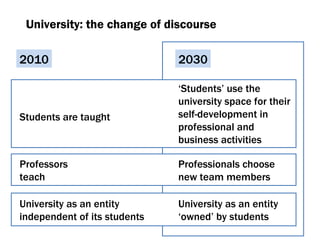
University: the change of discourse 2010 2030 Students are taught Professors teach University as an entity independent of its students ‘ Students’   use the  university space for their self-development in professional and  business activities Professionals choose new team members University as an entity ‘owned’ by students
ADULT EDUCATION
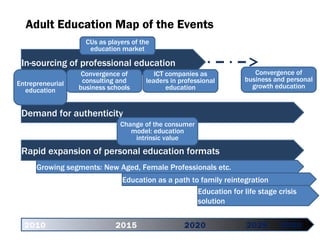
Adult Education Map of the Events In-sourcing of professional education 2010   2015 2020   2025 2030 CUs as players of the education market ICT companies as leaders in professional education Convergence of consulting and business schools Demand for authenticity Rapid expansion of personal education formats Entrepreneurial education Change of the consumer model: education intrinsic value Growing segments: New Aged, Female Professionals etc. Convergence of business and personal growth education Education as a path to family reintegration Education for life stage crisis solution
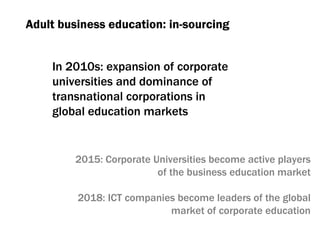
Adult business education :  in-sourcing In 2010s :  expansion of corporate universities and dominance of transnational corporations in global education markets 2015:  Corporate Universities become active players of the business education market 2018:  ICT companies become leaders of the global market of corporate education
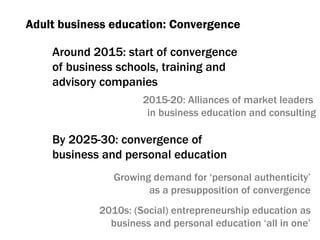
Adult business education :  Convergence Around  2015:  start of convergence of business schools, training and advisory companies Growing demand for ‘personal authenticity’ as a presupposition of convergence 2010 s :  (Social) entrepreneurship education as business and personal education ‘all in one’ 2015-20:  Alliances of market leaders  in business education and consulting By  2025-30:  convergence of business and personal education
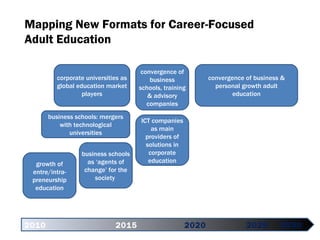
2010   2015 2020   2025 2030 Mapping New Formats for   Career-Focused Adult Education business schools :  mergers with technological universities growth of entre/intra-preneurship education convergence of business & personal growth adult education corporate universities as global education market players business schools as ‘agents of change’ for the society  convergence of business schools, training & advisory companies ICT companies as main providers of solutions in corporate education
Adult education :  burst of formats  in personal growth education Largest segments in  2010-20 s :  education meeting needs of working women, parents, New Aged etc. 2015-17:  Co-education of different family generations as a way to reintegrated the family 2020:  Education as a way to solve personal existential crisis  ( ‘middle age’ crisis ,  ‘aging’ crisis etc .)
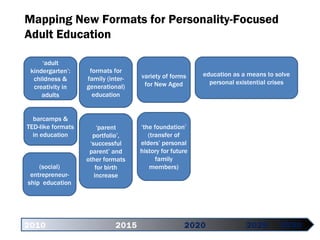
2010   2015 2020   2025 2030 Mapping New Formats for   Personality-Focused Adult Education ‘ adult kindergarten’ :  childness & creativity in adults barcamps &   TED-like formats in education (social) entrepreneur-ship  education formats for family  ( inter-generational )  education ‘ parent portfolio’ ,  ‘successful parent’   and other formats for birth increase variety of forms for New Aged ‘ the foundation’  ( transfer of elders’ personal history for future family members ) education as a means to solve personal existential crises
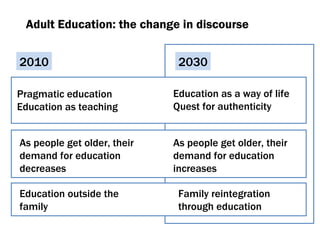
Adult Education :  the change in discourse 2010 2030 Pragmatic education Education as teaching As people get older, their demand for education decreases Education outside the family Education as a way of life Quest for authenticity As people get older, their demand for education increases Family reintegration through education
TRANSFORMATION OF  EDUCATIONAL SYSTEMS
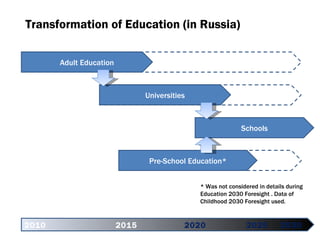
Pre-School Education * Transformation of Education (in Russia) 2010   2015 2020   2025 2030 Adult Education Universities Schools *  Was not considered in details during Education  2030  Foresight  .  Data of Childhood 2030 Foresight used.
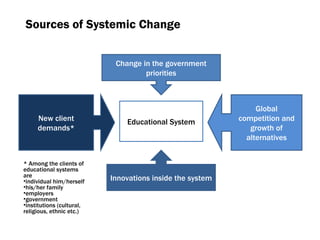
Sources of Systemic Change Educational System *  Among the clients of educational systems are individual him/herself his/her family employers government institutions  ( cultural ,  religious ,  ethnic etc. ) New client demands * Global competition and growth of alternatives Change in the government priorities Innovations inside the system
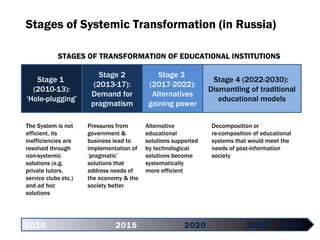
2010   2015 2020   2025 2030 Stages of Systemic Transformation (in Russia) The System is not efficient ,  its inefficiencies are resolved through non-systemic solutions  ( e . g. private tutors, service clubs etc .)  and  ad hoc   solutions Pressures from government & business lead to implementation of ‘pragmatic’ solutions that address needs of the economy & the society better Alternative educational solutions supported by technological solutions become systematically more efficient Decomposition or  re-composition of educational systems that would meet the needs of post-information society Stage  1  (2010-13):  ‘Hole-plugging’ Stage  2 (2013-17):  Demand for pragmatism Stage  3  (2017-2022):  Alternatives gaining power Stage  4 (2022-2030):  Dismantling of traditional educational models STAGES OF TRANSFORMATION OF EDUCATIONAL INSTITUTIONS
BUSINESS AND  POLICIES
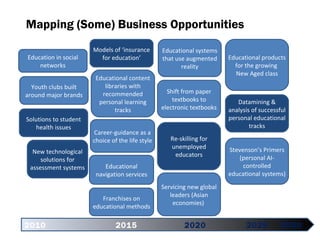
Mapping (Some) Business Opportunities 2010   2015 2020   2025 2030 New technological solutions for assessment systems Education in social networks Youth clubs built around major brands Educational content libraries with recommended personal learning tracks Models of ‘insurance for education’ Solutions to student health issues Career-guidance as a choice of the life style Franchises on educational methods Educational navigation services Educational systems that use augmented reality Shift from paper textbooks to electronic textbooks Re-skilling for unemployed educators Servicing new global leaders  ( Asian economies )  Educational products for the growing  New Aged class Datamining & analysis of successful personal educational tracks Stevenson’s Primers  ( personal AI-controlled educational systems )
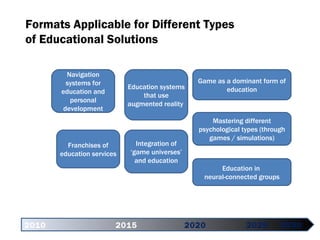
2010   2015 2020   2025 2030 Formats Applicable for Different Types  of Educational Solutions Navigation systems for education and personal development Franchises of education services Education systems that use augmented reality  Integration of ‘game universes’ and education Game as a dominant form of education Mastering different psychological types  ( through games / simulations ) Education in  neural-connected groups
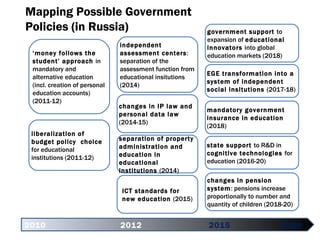
Mapping Possible Government  Policies (in Russia) 2010 2012    2015 2020 ‘ money follows the student’ approach  in mandatory and alternative education  ( incl .  creation of personal education accounts )  (2011-12) liberalization of budget policy  choice  for educational institutions  (2011-12) independent assessment centers :  separation of the assessment function from educational insitutions  (2014) ICT standards for new education   (2015) separation of property administration and education in educational institutions  (2014) changes in IP law and personal data law   (2014-15) government support  to expansion of  educational innovators  into global education markets  (2018) EGE transformation into a system of independent social insitutions  (2017-18)  mandatory government insurance in education  (2018)   state support  to R&D in  cognitive technologies  for education  (2016-20)  changes in pension system :  pensions increase proportionally to number and quantity of children  (2018-20)
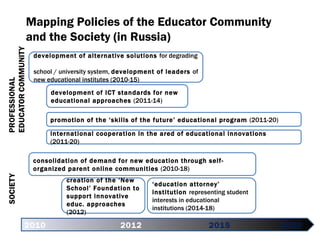
Mapping Policies of the Educator Community  and the Society (in Russia) 2010 2012    2015 2020 development of alternative solutions  for degrading  school  /  university system ,  development of leaders  of new educational institutes  (2010-15) development of ICT standards for new educational approaches  (2011-14) promotion of the ‘skills of the future’ educational program  (2011-20) international cooperation in the ared of educational innovations  (2011-20) consolidation of demand for new education through self-organized parent online communities  (2010-18) ‘ education attorney’ institution  representing student interests in educational institutions  (2014-18) creation of the ‘New School’ Foundation to support innovative educ. approaches  (2012)
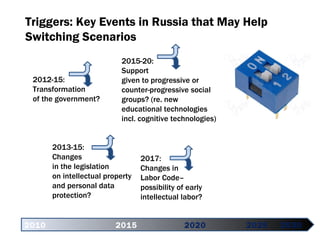
Triggers: Key Events in Russia that May Help Switching Scenarios 2010   2015 2020   2025 2030 2012-15:  Transformation  of the government ? 2013-15:  Changes  in the legislation  on intellectual property and personal data protection ? 2015-20:  Support  given to progressive or counter-progressive social groups ? ( re .  new educational technologies incl. cognitive technologies ) 2017:  Changes in  Labor Code –  possibility of early intellectual labor ?
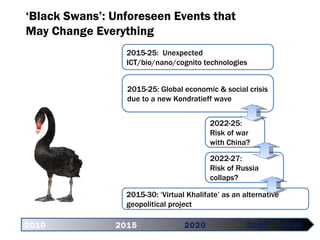
‘ Black Swans’ :  Unforeseen Events that  May Change Everything 2010   2015 2020   2025 2030 2015-25:  Unexpected ICT / bio / nano / cognito technologies 2015-25:  Global economic & social crisis due to a new Kondratieff wave 2022-27:  Risk of Russia collaps ? 2022-25:  Risk of war with China ? 2015-30:  ‘Virtual Khalifate’ as an alternative geopolitical project
ANNEX  1: MEGATRENDS
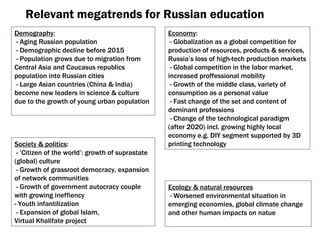
Relevant megatrends for Russian education Demography : -  Aging Russian population -  Demographic decline before  2015 -  Population grows due to migration from Central Asia and Caucasus republics population into Russian cities -  Large Asian countries  ( China & India )  become new leaders in science & culture due to the growth of young urban population Ecology & natural resources -  Worsened environmental situation in emerging economies ,  global climate change and other human impacts on natue Society & politics : -  ‘Citizen of the world’ :  growth of suprastate  ( global )  culture -  Growth of grassroot democracy ,  expansion of network communities -  Growth of government autocracy couple with growing ineffiency  -  Youth infantilization - Expansion of global Islam ,  Virtual Khalifate project Economy : -  Globalization as a global competition for production of resources, products & services ,  Russia’s loss of high-tech production markets -  Global competition in the labor market ,  increased proffessional mobility -  Growth of the middle class ,  variety of consumption as a personal value -  Fast change of the set and content of dominant professions -  Change of the technological paradigm  ( after  2020)  incl .  growing highly local economy e.g. DIY segment supported by  3 D   printing technology
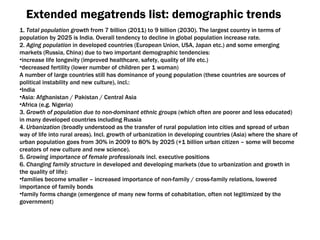
Extended megatrends list :  demographic trends 1.   Total population growth  from  7  billion  (2011)  to  9  billion  (2030) . The largest country in terms of population by 2025 is India .  Overall tendency to decline in global population increase rate . 2.  Aging population  in developed countries  ( European Union ,  USA ,  Japan etc .)  and some emerging markets  ( Russia ,  China )  due to two important demographic tendencies : increase life longevity  ( improved healthcare ,  safety ,  quality of life etc .) decreased fertility  ( lower number of children per  1  woman ) A number of large countries still has dominance of young population  ( these countries are sources of political instability and new culture ),  incl .:  India Asia :  Afghanistan  /  Pakistan  /  Central Asia Africa  ( e . g.   Nigeria ) 3.  Growth of population due to non-dominant ethnic groups  ( which often are poorer and less educated )  in many developed countries including Russia 4.  Urbanization  ( broadly understood as the transfer of rural population into cities and spread of urban way of life into rural areas ).  Incl. growth of urbanization in developing countries  ( Asia )  where the share of urban population goes from  30%  in 2009 to  80%  by  2025 (+1  billion urban citizen – some will become creators of new culture and new science ). 5.  Growing importance of female professionals  incl. executive positions 6.  Changing family structure  in developed and developing markets  ( due to urbanization and growth in the quality of life ): families become smaller  –  increased importance of non-family / cross-family relations, lowered importance of family bonds family forms change  ( emergence of many new forms of cohabitation ,  often not legitimized by the government )
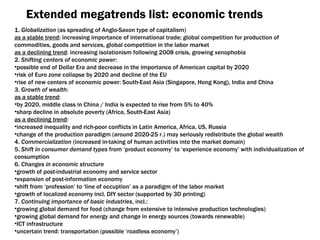
Extended megatrends list :  economic trends 1.   Globalization  ( as spreading of Anglo-Saxon type of capitalism ) as a stable trend :  increasing importance of international trade ;  global competition for production of commodities ,  goods and services ,  global competition in the labor market as a declining trend :  increasing isolationism following 2008 crisis ,  growing xenophobia 2.  Shifting centers of economic power : possible end of Dollar Era and decrease in the importance of American capital by  2020  risk of Euro zone collapse by  2020  and decline of the EU rise of new centers of economic power :  South-East Asia  ( Singapore ,  Hong Kong ),  India and China 3.  Growth of wealth : as a stable trend :  by  2020 ,   middle class in China / India is expected to rise from  5%  to  40% sharp decline in absolute poverty  ( Africa ,  South-East Asia ) as a declining trend : increased inequality and rich-poor conflicts in Latin America, Africa, US ,  Russia change of the production paradigm  ( around  2020-25 г.)  may seriously redistribute the global wealth 4.  Commercialization  ( increased in-taking of human activities into the market domain ) 5.  Shift in consumer demand types  from ‘product economy’ to ‘experience economy’ with individualization of consumption 6.  Changes in economic structure growth of post-industrial economy and service sector expansion of post-information economy shift from ‘profession’ to ‘line of occuption’ as a paradigm of the labor market growth of localized economy incl .  DIY   sector  ( supported by  3 D printing ) 7.  Continuing importance of basic industries ,  incl .: growing global demand for food  ( change from extensive to intensive production technologies ) growing global demand for energy and change in energy sources  ( towards renewable ) ICT infrastructure uncertain trend :  transportation  ( possible ‘roadless economy’ )
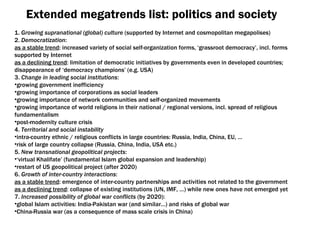
Extended megatrends list :  politics and society 1.  Growing supranational  ( global )  culture  ( supported by Internet and cosmopolitan megapolises ) 2.  Democratization : as a stable trend :  increased variety of social self-organization forms ,  ‘grassroot democracy’ ,  incl .  forms supported by Internet as a declining trend :  limitation of democratic initiatives by governments even in developed countries ;  disappearance of ‘democracy champions’  ( e.g .  USA ) 3.  Change in leading social institutions : growing government inefficiency growing importance of corporations as social leaders growing importance of network communities and self-organized movements growing importance of world religions in their national  /  regional versions ,  incl .  spread of religious fundamentalism post-modernity culture crisis 4.  Territorial and social instability intra-country ethnic  /  religious conflicts in large countries :  Russia ,  India ,  China ,  EU , … risk of large country collapse  ( Russia ,  China ,  India ,  USA etc .) 5.  New transnational geopolitical projects : ‘ virtual Khalifate’ (fundamental Islam global expansion and leadership) restart of US geopolitical project  ( after  2020) 6.  Growth of inter-country interactions : as a stable trend :  emergence of inter-country partnerships and activities not related to the government as a declining trend :  collapse of existing institutions (UN, IMF, …) while new ones have not emerged yet 7.  Increased possibility of global war conflicts  ( by  2020): global Islam activities :  India-Pakistan war  ( and similar …)  and risks of global war China-Russia war  ( as a consequence of mass scale crisis in China )
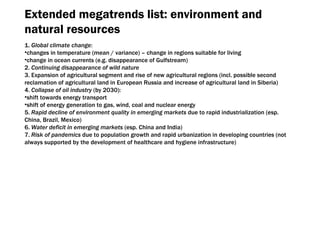
Extended megatrends list :  environment and natural resources 1.  Global climate change : changes in temperature  ( mean  /  variance ) –  change in regions suitable for living change in ocean currents  ( e.g.   disappearance of Gulfstream ) 2.  Continuing disappearance of wild nature 3.  Expansion of agricultural segment and rise of new agricultural regions  ( incl .  possible second reclamation of agricultural land in European Russia and increase of agricultural land in Siberia ) 4.  Collapse of oil industry  ( by  2030): shift towards energy transport shift of energy generation to gas ,  wind ,  coal and nuclear energy 5.  Rapid decline of environment quality in emerging markets  due to rapid industrialization  ( esp. China ,  Brazil ,  Mexico ) 6.  Water deficit in emerging markets  ( esp. China and India ) 7.  Risk of pandemics  due to population growth and rapid urbanization in developing countries  ( not always supported by the development of healthcare and hygiene infrastructure )
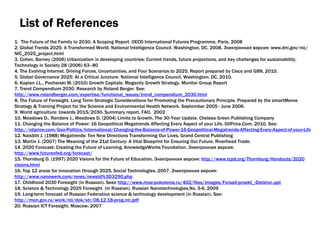
List of References 1.  The Future of the Family to 2030. A Scoping Report. OECD International Futures Programme, Paris, 2008 2. Global Trends 2025: A Transformed World. National Intelligence Council, Washington, DC, 2008.  Электронная версия : www.dni.gov/nic/NIC_2025_project.html 3. Cohen, Barney (2006) Urbanization in developing countries: Current trends, future projections, and key challenges for sustainability. Technology in Society 28 (2006) 63–80 4. The Evolving Internet. Driving Forces, Uncertainties, and Four Scenarios to 2025. Report prepared by Cisco and GBN, 2010. 5. Global Governance 2025: At a Critical Juncture. National Intelligence Council, Washington, DC, 2010.  6. Kaplan J.L., Pocharski M. (2010) Growth Capitals: Megacity Growth Strategy. Monitor Group Report 7. Trend Compendium 2030. Research by Roland Berger. See :  http://www.rolandberger.com/expertise/functional_issues/trend_compendium_2030.html 8. The Future of Foresight. Long Term Strategic Considerations for Promoting the Precautionary Principle. Prepared by the smartMeme Strategy & Training Project for the Science and Environmental Health Network. September 2005 - June 2006. 9. World agriculture: towards 2015/2030. Summary report. FAO,  2002 10. Meadows D., Randers J., Meadows D. (2004) Limits to Growth, The 30‑Year Update.  Chelsea Green Publishing Company 11. Changing the Balance of Power: 16 Geopolitical Megatrends Affecting Every Aspect of your Life. OilPrice . Com, 2010 .  See :  http://oilprice.com/Geo-Politics/International/Changing-the-Balance-of-Power-16-Geopolitical-Megatrends-Affecting-Every-Aspect-of-your-Life.html 12. Naisbitt J. (1988) Megatrends: Ten New Directions Transforming Our Lives. Grand Central Publishing 13. Martin J. (2007) The Meaning of the 21st Century: A Vital Blueprint for Ensuring Our Future. Riverhead Trade. 14. 2020 Forecast: Creating the Future of Learning. KnowledgeWorks Foundation.  Электронная версия :  http://www.futureofed.org/forecast/ 15. Thornburg D. (1997) 2020 Visions for the Future of Education.  Электронная версия:  http :// www . tcpd . org / Thornburg / Handouts /2020 visions . html 16. Top 12 areas for innovation through 2025. Social Technologies , 2007. Электронная версия:  http://www.nanowerk.com/news/newsid%3D3290.php 17.  Childhood 2030 Foresight (in Russian) .  Seee   http://www.moe-pokolenie.ru/402/files/images/Forsait-proekt_-Detstvo-.ppt 18.  Science & Technology 2025 Foresight  (in Russian) .  Russian Nanotechnologies , No.  5-6 ,  2009 19.  Long-term forecast of Russian Federation science & technology development (in Russian) .  See:  http://mon.gov.ru/work/nti/dok/str/08.12.18-prog.ntr.pdf 20.  Russian ICT  Foresight.  Moscow , 2007
ANNEX  2: FORESIGHT DESIGN PROCESS
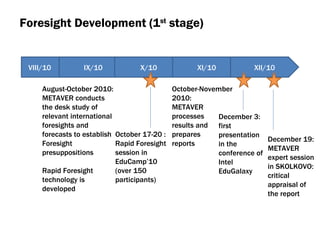
VIII/ 10 IX/ 10 X/ 10 XI/ 10 XII/ 10 August - October  2010:  METAVER conducts the desk study of relevant international foresights and forecasts to establish Foresight presuppositions Rapid Foresight   technology is developed October  17-20 :  Rapid Foresight   session in EduCamp’10  ( over  150  participants ) October-November  2010:  METAVER processes  results and prepares  reports December  3:  first presentation in the conference of Intel   EduGalaxy December 1 9:  METAVER expert session in SKOLKOVO :  critical appraisal of the report Foresight Development  ( 1 st  stage )
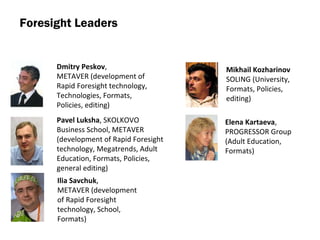
Foresight Leaders Dmitry Peskov ,  METAVER  ( development of Rapid Foresight technology,   Technologies ,  Formats ,  Policies, editing ) Ilia Savchuk ,  METAVER  ( development of Rapid Foresight technology,   School ,  Formats ) Pavel Luksha ,  SKOLKOVO Business School ,  METAVER  ( development of Rapid Foresight technology,   Megatrends ,  Adult Education ,  Formats ,  Policies ,  general editing ) Mikhail Kozharinov  SOLING  ( University ,  Formats ,  Policies ,  editing ) Elena Kartaeva ,  PROGRESSOR Group  ( Adult Education ,  Formats )

Foresight on the Future of Education

  • 1.
    Education 2030: Mapping the Future Results of the first stage of Russian education foresight
  • 2.
    Disclaimer : Thisforesight is neither a forecast nor an action plan . It is a map of highly probable events and emerging trends that may occur in the foreseeable future and that should be taken into consideration in the present . Foresight is built by collective creative work of a large number of experts mapping events of the future . The foresight technology used by our group allows to consider not only linear trends , but also possible qualitative shifts in trends . However, any forecasts beyond next five years are indicative. This foresight report is largely focused on Russia. As the variety of the content and management models of different educational systems is very large , educational systems stand on different stages of development and try to solve different challenges, the application of this report to other countries is limited . However, in respect to technologies that influence education, and to markets that exist in global competition ( university education and education for adults ), conclusions of this foresight are applicable on the global scale . Important note : The list of trends and events in this foresight does not reflect the position of foresight authors and experts about the desirable future !
  • 3.
    Conventionality of KeyTerms We understand that entities such as ‘School’ and ‘University’ are social conventions constantly redefined in terms of age of students, structure and focus. We see these social entities as systemic solutions to ‘existential’ problems that individuals (statistically) may face at a certain age ( Erikson, 1959). In the modern society, these entities and their ‘tasks’ are (roughly) defined as below. In the future, the content and tasks of these entities may change (this foresight provides some suggestions on how this might occur). We decided to keep these names as to social solutions that may become manifested in a variety of forms. Indicative description of entities referred to in this Foresight Entity Typical age of students ‘ Existential’ solutions School 5-17 Socialization, formation of personality, etc. University 17-30 Definition of professional interests and acquisition of professional knowledge & skills, formation of individual social network, etc. Adult education 25-100+ Professional growth, redefinition of professional track, personal growth, support in personal transformation
  • 4.
    Education 2030: Key results Mass-scale transformation of education within next few years is inevitable. Education will become total , continuous , human-centered , and represented by a variety of forms. Transformation of education is a growth opportunity for the business and economy , and is a tool of influence in the global market . Foresight indicates some of these emerging opportunities . The government and the society can support or block these opportunities.
  • 5.
    2010 2015 2020 2025 2030 Stage 1 (2010-13): ‘Hole-plugging’ Stage 2 (2013-17): Demand for pragmatism Stage 3 (2017-2022): Alternatives gaining power Stage 4 (2022-2030): Dismantling of traditional educational models Education 2030: Key results Maximal attention of the professional society and the government to a coming change Maximal number of business opportunities in the emerging sector STAGES OF TRANSFORMATION OF EDUCATIONAL INSTITUTIONS
  • 6.
    Megatrends Technologies Changeof the discourse ‘ School’ ‘ University’ Adult education EDUCATION 2030 Formats Business opportunities Policies Education 2030: Structure of the report
  • 7.
    Education 2030: Legend Everyone’s in the web Stable decline Wikification Major trend Secondary / resulting trend Event / format / solution Event timing
  • 8.
  • 9.
    Mega-disaster 2010 2015 2020 2025 2030 New industrialization ‘ Localness ‘ ( DIY) Revision of the social contract (Russia) Wikification Asia global leadership Asian focus (Russia) New Aged Megatrend Map of Events * Virtual Khalifate * Extended list of Megatrends influencing education: see Appendix 1
  • 10.
    Megatrend: Revision ofthe social contract (Russia) Around 2014: culminating conflict between the authoritarian and democratic way of development in Russia Since 2015: ‘ Wikification’ (Russia / global) : spread of various network self-regulation forms in society ( in case of a choice of the democratic way )
  • 11.
    Megatrends : New industrial wave (Global) By the end of 2010 s : launch of new Kondratieff wave of technologies , rebalance / shake-up of economic order 2010-15: Mega-disaster (global) : a sequence of technological disasters that speeds up switching to new technologies 20 20 -20 3 0: Local-ness (global) : spread of DIY culture ( based on 3D printing and smart technologies ) and decline of traditional industries / corporations
  • 12.
    Megatrends : Asia global leadership As a consequence of fast urbanization and targeted human capital investment, Asian giants become the largest markets of science and culture : China by the end of 2010 s India by the end of 2020 s 201 5 and onwards : Asian focus (Russia) : switch of Russian business and education to serve the demand of China , India and the region
  • 13.
    Megatrends : Virtual Khalifate (global) Since early 2010 s : attempts of the revival of World Khalifate project ( Islamic domination on the global scale ) through active use of virtual / network technologies . 20 15 and onwards : Russia may become one of ( possible ) home base territories for World Khalifate leaders
  • 14.
    Megatrends : New Aged (global) 2010 s and onwards : aging population , growth of the middle class and increase in healthcare services lead to the formation of a large and growing class of socially, physically and mentally active people above 60 Rebalance of demographic pyramid towards adult and aged population : major opportunities in education occur in the adult education market
  • 15.
  • 16.
    2010 2015 2020 2025 2030 ICT Everyone’s in the web The point of God Sixth Sense Smart Environment Cogntive technologies Psychic divide HTTP 2 New materials 3 D Manufacturing (DIY) Graphene Revolution Cyberization Technology Map of Events 2 nd Psychodelic Revolution
  • 17.
    By 2016: due to spread of broadband and wireless access, over 90% of Russian population has web presence Technologies : Everyone’s in the web (Russia) 2018 -20 : Minimal ( free ) access to Internet is provided by the government (Russia) 2018-2020: Mandatory universal personality ID in the web (Russia / global)
  • 18.
    Technologies : The point of God (global) 2022: Due to the development of digital and mobile technologies all ‘digitalizable’ information ( including cultural heritage and description of technologies ) is stored in the Web and can be accessed from anywhere in the world By 2020: Revolutionary revision of approaches to knowledge management and generation , including science , learning, record and archive management (global)
  • 19.
    Technologies : Sixth Sense and Smart Environment (global) 2023: Due to RFID technologies and miniaturization : spread of bodily interfaces with the web (MIT MediaLab Sixth Sense as a prototype) and disappearance of computers as ‘standalone boxes’ spread of the Smart Environment (Internet of Things) – increasing number of objects in the physical space also exist in the web 2020-25: Graphene revolution helps development of smart materials for the Smart Environment
  • 20.
    Technologies : Cognitive revolution (global) 2015-20: Widespread cognitive technologies ( technologies of information exchange between human neural system & computer / web + nano- & bio-tech to enhance neural system capabilities ) 2017: ‘Psychic divide’ : divide between users and non-users of cognitive products 2022: HTTP -2 ( Human Thought Transfer Protocol ): protocols of direct information exchange between neural networks through the web 2020: Second psychedelic revolution ( supported by bio - DIY)
  • 21.
  • 22.
    2010 2015 2020 2025 2030 Stable decline School Map of Events Cultural divide Psychic divide Culture of independence Digital divide External pressure on schooling system Solutions outside school system Non-educator teachers Mass-scale meta-subject education Model revision
  • 23.
    School : Stable decline (Russia) Before 2015-17: Degrading quality of teachers ( low-paid & small-time job attracts low quality human capital ) Degrading quality of students : poor health , poor preparation in the family , declining motivation to learn , ‘A Button Empire’ School is demanded by the society largely as a children ‘locker’ In Russia, demographic collapse and collapse of the school system go in parallel, making the decline less visible
  • 24.
    School : Cultural Divide (global) 2010 s : Increasing gap between digital students and non-digital teachers 2015-20: Psychic divide (see in Technology section) 2022-25: Culture of independence : spread of early socialization formats that help integration in the adult life ( entrepreneurship etc .) Support by expanding DIY culture, available economies of game universes , international certification and national certification transformation
  • 25.
    School : External pressures upon the System (global) 2013-2020: Growth of education outside the School System and its increased availability through the web 2015-2025: Non-educator teachers (professionals) 2015-2025: Employer demand pushes meta-subject education for the increasingly uncertain environment Government loses its strategic leverage over schooling system , keeping to itself only administration of buildings and funds but not the content.
  • 26.
    Mapping New Formatsfor Schools 2010 2015 2020 2025 2030 aggregators of private teacher services ( with teacher ranking ) tolerance development programmes strengthening clubs as school alternative ( incl . brand-focused clubs ) technopark schools and corporation-focused schools ‘ game economies’ , youth labor exchanges , students’ work portfolio network-based ‘Pioneer Palaces’ ( science & DIY ) teachers as mentors ‘ school out of school’ 24/7 ‘ global classes’ ‘ remote friend’ , ‘avatar’ and other ICT-solutions for mentoring mobile education with city quests education based on augmented reality and cognitive technologies school as a game space
  • 27.
    School : the change of discourse 2010 2030 School as a System Teachers teach students Professional educators School as a variety of educational forms Teachers as mentors , ‘teachers’ & ‘students’ learn from each other Professionals as educators Conventional school prepares for life Conventional school is meant for losers
  • 28.
  • 29.
    Global competition forstudents University Map of Events Stable decline 2010 2015 2020 2025 2030 Digital divide Support of educational innovations Mobile techologies, individual tracks Transparency of evaluation Employer pressure ‘ Privatization’ Interdisciplinary students Expansion of assessment formats for efficient recruiting Government pressure Innovation as a priority Tolerance Paradigm shift: Digital generation comes in 1 st tier
  • 30.
    University : Stable decline (Russia) Continuing trends before 2017-18: Growing students’ skepticism regarding university education (not interesting, not useful) ‘ Cultural divide’ : ‘Digital Generation’ of students is more competent than their professors Migration of high quality professors into alternative education and business 2020: Revision of the dominant university model as the Digital Generation comes into power (in university systems and elsewhere)
  • 31.
    University: Employer pressure(Russia) Since 2010-х: ‘privatization’ of educational systems by corporations due to unsatisfactory quality ( and responsibility ) of prospective recruits 2012 and onwards : expansion of assessment formats for more efficient recruiting 2013: revival of blue collar education in colleges [ likely failure of the reform before 2025] 2015: degree in inter- and trans-disciplinary studies (‘universal problem-solvers’)
  • 32.
    University: Factors ofexternal pressure (Russia) Continuing globalization of the educational system and global competition for students Pressures from the government 2010-15: selection of ‘first tier’ universities that receive political and financial support from the government for their transformation 2010-20: demand to solve innovation development challenges on the state / regional level ( increased innovativeness ) 2010-20: demand to solve issues of migrant integration
  • 33.
    University: Support toEducational Innovations Since 2010 s : growing number of non-educator professors from various domains of practice 2013-15: Legitimization to new educational forms in student preparation ( online , mobile etc .) Legitimization to individual learning trajectories Transparency of educational process in terms of teaching and assessment , incl . online broadcasting of Thesis defence
  • 34.
    2010 2015 2020 2025 2030 Mapping New Formats for Universities technopark format development integration of mobile and online technologies into conventional education средне-специальное образование в бакалавриатах активное присутствие регионов и бизнесов как заказчиков new best practices : Skolkovo University , Olympic University trans-professions personal learning tracks and electronic tutors online thesis defence domination of masterclasses education focuses on ‘ways / methods of thinking’ teachers as mentors practice-oriented education ( startup or career track ) domination of competence-based assessment new universities as entities owned by students ( focused on team creation / maintenance )
  • 35.
    University: the changeof discourse 2010 2030 Students are taught Professors teach University as an entity independent of its students ‘ Students’ use the university space for their self-development in professional and business activities Professionals choose new team members University as an entity ‘owned’ by students
  • 36.
  • 37.
    Adult Education Mapof the Events In-sourcing of professional education 2010 2015 2020 2025 2030 CUs as players of the education market ICT companies as leaders in professional education Convergence of consulting and business schools Demand for authenticity Rapid expansion of personal education formats Entrepreneurial education Change of the consumer model: education intrinsic value Growing segments: New Aged, Female Professionals etc. Convergence of business and personal growth education Education as a path to family reintegration Education for life stage crisis solution
  • 38.
    Adult business education: in-sourcing In 2010s : expansion of corporate universities and dominance of transnational corporations in global education markets 2015: Corporate Universities become active players of the business education market 2018: ICT companies become leaders of the global market of corporate education
  • 39.
    Adult business education: Convergence Around 2015: start of convergence of business schools, training and advisory companies Growing demand for ‘personal authenticity’ as a presupposition of convergence 2010 s : (Social) entrepreneurship education as business and personal education ‘all in one’ 2015-20: Alliances of market leaders in business education and consulting By 2025-30: convergence of business and personal education
  • 40.
    2010 2015 2020 2025 2030 Mapping New Formats for Career-Focused Adult Education business schools : mergers with technological universities growth of entre/intra-preneurship education convergence of business & personal growth adult education corporate universities as global education market players business schools as ‘agents of change’ for the society convergence of business schools, training & advisory companies ICT companies as main providers of solutions in corporate education
  • 41.
    Adult education : burst of formats in personal growth education Largest segments in 2010-20 s : education meeting needs of working women, parents, New Aged etc. 2015-17: Co-education of different family generations as a way to reintegrated the family 2020: Education as a way to solve personal existential crisis ( ‘middle age’ crisis , ‘aging’ crisis etc .)
  • 42.
    2010 2015 2020 2025 2030 Mapping New Formats for Personality-Focused Adult Education ‘ adult kindergarten’ : childness & creativity in adults barcamps & TED-like formats in education (social) entrepreneur-ship education formats for family ( inter-generational ) education ‘ parent portfolio’ , ‘successful parent’ and other formats for birth increase variety of forms for New Aged ‘ the foundation’ ( transfer of elders’ personal history for future family members ) education as a means to solve personal existential crises
  • 43.
    Adult Education : the change in discourse 2010 2030 Pragmatic education Education as teaching As people get older, their demand for education decreases Education outside the family Education as a way of life Quest for authenticity As people get older, their demand for education increases Family reintegration through education
  • 44.
    TRANSFORMATION OF EDUCATIONAL SYSTEMS
  • 45.
    Pre-School Education *Transformation of Education (in Russia) 2010 2015 2020 2025 2030 Adult Education Universities Schools * Was not considered in details during Education 2030 Foresight . Data of Childhood 2030 Foresight used.
  • 46.
    Sources of SystemicChange Educational System * Among the clients of educational systems are individual him/herself his/her family employers government institutions ( cultural , religious , ethnic etc. ) New client demands * Global competition and growth of alternatives Change in the government priorities Innovations inside the system
  • 47.
    2010 2015 2020 2025 2030 Stages of Systemic Transformation (in Russia) The System is not efficient , its inefficiencies are resolved through non-systemic solutions ( e . g. private tutors, service clubs etc .) and ad hoc solutions Pressures from government & business lead to implementation of ‘pragmatic’ solutions that address needs of the economy & the society better Alternative educational solutions supported by technological solutions become systematically more efficient Decomposition or re-composition of educational systems that would meet the needs of post-information society Stage 1 (2010-13): ‘Hole-plugging’ Stage 2 (2013-17): Demand for pragmatism Stage 3 (2017-2022): Alternatives gaining power Stage 4 (2022-2030): Dismantling of traditional educational models STAGES OF TRANSFORMATION OF EDUCATIONAL INSTITUTIONS
  • 48.
    BUSINESS AND POLICIES
  • 49.
    Mapping (Some) BusinessOpportunities 2010 2015 2020 2025 2030 New technological solutions for assessment systems Education in social networks Youth clubs built around major brands Educational content libraries with recommended personal learning tracks Models of ‘insurance for education’ Solutions to student health issues Career-guidance as a choice of the life style Franchises on educational methods Educational navigation services Educational systems that use augmented reality Shift from paper textbooks to electronic textbooks Re-skilling for unemployed educators Servicing new global leaders ( Asian economies ) Educational products for the growing New Aged class Datamining & analysis of successful personal educational tracks Stevenson’s Primers ( personal AI-controlled educational systems )
  • 50.
    2010 2015 2020 2025 2030 Formats Applicable for Different Types of Educational Solutions Navigation systems for education and personal development Franchises of education services Education systems that use augmented reality Integration of ‘game universes’ and education Game as a dominant form of education Mastering different psychological types ( through games / simulations ) Education in neural-connected groups
  • 51.
    Mapping Possible Government Policies (in Russia) 2010 2012 2015 2020 ‘ money follows the student’ approach in mandatory and alternative education ( incl . creation of personal education accounts ) (2011-12) liberalization of budget policy choice for educational institutions (2011-12) independent assessment centers : separation of the assessment function from educational insitutions (2014) ICT standards for new education (2015) separation of property administration and education in educational institutions (2014) changes in IP law and personal data law (2014-15) government support to expansion of educational innovators into global education markets (2018) EGE transformation into a system of independent social insitutions (2017-18) mandatory government insurance in education (2018) state support to R&D in cognitive technologies for education (2016-20) changes in pension system : pensions increase proportionally to number and quantity of children (2018-20)
  • 52.
    Mapping Policies ofthe Educator Community and the Society (in Russia) 2010 2012 2015 2020 development of alternative solutions for degrading school / university system , development of leaders of new educational institutes (2010-15) development of ICT standards for new educational approaches (2011-14) promotion of the ‘skills of the future’ educational program (2011-20) international cooperation in the ared of educational innovations (2011-20) consolidation of demand for new education through self-organized parent online communities (2010-18) ‘ education attorney’ institution representing student interests in educational institutions (2014-18) creation of the ‘New School’ Foundation to support innovative educ. approaches (2012)
  • 53.
    Triggers: Key Eventsin Russia that May Help Switching Scenarios 2010 2015 2020 2025 2030 2012-15: Transformation of the government ? 2013-15: Changes in the legislation on intellectual property and personal data protection ? 2015-20: Support given to progressive or counter-progressive social groups ? ( re . new educational technologies incl. cognitive technologies ) 2017: Changes in Labor Code – possibility of early intellectual labor ?
  • 54.
    ‘ Black Swans’: Unforeseen Events that May Change Everything 2010 2015 2020 2025 2030 2015-25: Unexpected ICT / bio / nano / cognito technologies 2015-25: Global economic & social crisis due to a new Kondratieff wave 2022-27: Risk of Russia collaps ? 2022-25: Risk of war with China ? 2015-30: ‘Virtual Khalifate’ as an alternative geopolitical project
  • 55.
    ANNEX 1:MEGATRENDS
  • 56.
    Relevant megatrends forRussian education Demography : - Aging Russian population - Demographic decline before 2015 - Population grows due to migration from Central Asia and Caucasus republics population into Russian cities - Large Asian countries ( China & India ) become new leaders in science & culture due to the growth of young urban population Ecology & natural resources - Worsened environmental situation in emerging economies , global climate change and other human impacts on natue Society & politics : - ‘Citizen of the world’ : growth of suprastate ( global ) culture - Growth of grassroot democracy , expansion of network communities - Growth of government autocracy couple with growing ineffiency - Youth infantilization - Expansion of global Islam , Virtual Khalifate project Economy : - Globalization as a global competition for production of resources, products & services , Russia’s loss of high-tech production markets - Global competition in the labor market , increased proffessional mobility - Growth of the middle class , variety of consumption as a personal value - Fast change of the set and content of dominant professions - Change of the technological paradigm ( after 2020) incl . growing highly local economy e.g. DIY segment supported by 3 D printing technology
  • 57.
    Extended megatrends list: demographic trends 1. Total population growth from 7 billion (2011) to 9 billion (2030) . The largest country in terms of population by 2025 is India . Overall tendency to decline in global population increase rate . 2. Aging population in developed countries ( European Union , USA , Japan etc .) and some emerging markets ( Russia , China ) due to two important demographic tendencies : increase life longevity ( improved healthcare , safety , quality of life etc .) decreased fertility ( lower number of children per 1 woman ) A number of large countries still has dominance of young population ( these countries are sources of political instability and new culture ), incl .: India Asia : Afghanistan / Pakistan / Central Asia Africa ( e . g. Nigeria ) 3. Growth of population due to non-dominant ethnic groups ( which often are poorer and less educated ) in many developed countries including Russia 4. Urbanization ( broadly understood as the transfer of rural population into cities and spread of urban way of life into rural areas ). Incl. growth of urbanization in developing countries ( Asia ) where the share of urban population goes from 30% in 2009 to 80% by 2025 (+1 billion urban citizen – some will become creators of new culture and new science ). 5. Growing importance of female professionals incl. executive positions 6. Changing family structure in developed and developing markets ( due to urbanization and growth in the quality of life ): families become smaller – increased importance of non-family / cross-family relations, lowered importance of family bonds family forms change ( emergence of many new forms of cohabitation , often not legitimized by the government )
  • 58.
    Extended megatrends list: economic trends 1. Globalization ( as spreading of Anglo-Saxon type of capitalism ) as a stable trend : increasing importance of international trade ; global competition for production of commodities , goods and services , global competition in the labor market as a declining trend : increasing isolationism following 2008 crisis , growing xenophobia 2. Shifting centers of economic power : possible end of Dollar Era and decrease in the importance of American capital by 2020 risk of Euro zone collapse by 2020 and decline of the EU rise of new centers of economic power : South-East Asia ( Singapore , Hong Kong ), India and China 3. Growth of wealth : as a stable trend : by 2020 , middle class in China / India is expected to rise from 5% to 40% sharp decline in absolute poverty ( Africa , South-East Asia ) as a declining trend : increased inequality and rich-poor conflicts in Latin America, Africa, US , Russia change of the production paradigm ( around 2020-25 г.) may seriously redistribute the global wealth 4. Commercialization ( increased in-taking of human activities into the market domain ) 5. Shift in consumer demand types from ‘product economy’ to ‘experience economy’ with individualization of consumption 6. Changes in economic structure growth of post-industrial economy and service sector expansion of post-information economy shift from ‘profession’ to ‘line of occuption’ as a paradigm of the labor market growth of localized economy incl . DIY sector ( supported by 3 D printing ) 7. Continuing importance of basic industries , incl .: growing global demand for food ( change from extensive to intensive production technologies ) growing global demand for energy and change in energy sources ( towards renewable ) ICT infrastructure uncertain trend : transportation ( possible ‘roadless economy’ )
  • 59.
    Extended megatrends list: politics and society 1. Growing supranational ( global ) culture ( supported by Internet and cosmopolitan megapolises ) 2. Democratization : as a stable trend : increased variety of social self-organization forms , ‘grassroot democracy’ , incl . forms supported by Internet as a declining trend : limitation of democratic initiatives by governments even in developed countries ; disappearance of ‘democracy champions’ ( e.g . USA ) 3. Change in leading social institutions : growing government inefficiency growing importance of corporations as social leaders growing importance of network communities and self-organized movements growing importance of world religions in their national / regional versions , incl . spread of religious fundamentalism post-modernity culture crisis 4. Territorial and social instability intra-country ethnic / religious conflicts in large countries : Russia , India , China , EU , … risk of large country collapse ( Russia , China , India , USA etc .) 5. New transnational geopolitical projects : ‘ virtual Khalifate’ (fundamental Islam global expansion and leadership) restart of US geopolitical project ( after 2020) 6. Growth of inter-country interactions : as a stable trend : emergence of inter-country partnerships and activities not related to the government as a declining trend : collapse of existing institutions (UN, IMF, …) while new ones have not emerged yet 7. Increased possibility of global war conflicts ( by 2020): global Islam activities : India-Pakistan war ( and similar …) and risks of global war China-Russia war ( as a consequence of mass scale crisis in China )
  • 60.
    Extended megatrends list: environment and natural resources 1. Global climate change : changes in temperature ( mean / variance ) – change in regions suitable for living change in ocean currents ( e.g. disappearance of Gulfstream ) 2. Continuing disappearance of wild nature 3. Expansion of agricultural segment and rise of new agricultural regions ( incl . possible second reclamation of agricultural land in European Russia and increase of agricultural land in Siberia ) 4. Collapse of oil industry ( by 2030): shift towards energy transport shift of energy generation to gas , wind , coal and nuclear energy 5. Rapid decline of environment quality in emerging markets due to rapid industrialization ( esp. China , Brazil , Mexico ) 6. Water deficit in emerging markets ( esp. China and India ) 7. Risk of pandemics due to population growth and rapid urbanization in developing countries ( not always supported by the development of healthcare and hygiene infrastructure )
  • 61.
    List of References1. The Future of the Family to 2030. A Scoping Report. OECD International Futures Programme, Paris, 2008 2. Global Trends 2025: A Transformed World. National Intelligence Council, Washington, DC, 2008. Электронная версия : www.dni.gov/nic/NIC_2025_project.html 3. Cohen, Barney (2006) Urbanization in developing countries: Current trends, future projections, and key challenges for sustainability. Technology in Society 28 (2006) 63–80 4. The Evolving Internet. Driving Forces, Uncertainties, and Four Scenarios to 2025. Report prepared by Cisco and GBN, 2010. 5. Global Governance 2025: At a Critical Juncture. National Intelligence Council, Washington, DC, 2010. 6. Kaplan J.L., Pocharski M. (2010) Growth Capitals: Megacity Growth Strategy. Monitor Group Report 7. Trend Compendium 2030. Research by Roland Berger. See : http://www.rolandberger.com/expertise/functional_issues/trend_compendium_2030.html 8. The Future of Foresight. Long Term Strategic Considerations for Promoting the Precautionary Principle. Prepared by the smartMeme Strategy & Training Project for the Science and Environmental Health Network. September 2005 - June 2006. 9. World agriculture: towards 2015/2030. Summary report. FAO, 2002 10. Meadows D., Randers J., Meadows D. (2004) Limits to Growth, The 30‑Year Update. Chelsea Green Publishing Company 11. Changing the Balance of Power: 16 Geopolitical Megatrends Affecting Every Aspect of your Life. OilPrice . Com, 2010 . See : http://oilprice.com/Geo-Politics/International/Changing-the-Balance-of-Power-16-Geopolitical-Megatrends-Affecting-Every-Aspect-of-your-Life.html 12. Naisbitt J. (1988) Megatrends: Ten New Directions Transforming Our Lives. Grand Central Publishing 13. Martin J. (2007) The Meaning of the 21st Century: A Vital Blueprint for Ensuring Our Future. Riverhead Trade. 14. 2020 Forecast: Creating the Future of Learning. KnowledgeWorks Foundation. Электронная версия : http://www.futureofed.org/forecast/ 15. Thornburg D. (1997) 2020 Visions for the Future of Education. Электронная версия: http :// www . tcpd . org / Thornburg / Handouts /2020 visions . html 16. Top 12 areas for innovation through 2025. Social Technologies , 2007. Электронная версия: http://www.nanowerk.com/news/newsid%3D3290.php 17. Childhood 2030 Foresight (in Russian) . Seee http://www.moe-pokolenie.ru/402/files/images/Forsait-proekt_-Detstvo-.ppt 18. Science & Technology 2025 Foresight (in Russian) . Russian Nanotechnologies , No. 5-6 , 2009 19. Long-term forecast of Russian Federation science & technology development (in Russian) . See: http://mon.gov.ru/work/nti/dok/str/08.12.18-prog.ntr.pdf 20. Russian ICT Foresight. Moscow , 2007
  • 62.
    ANNEX 2:FORESIGHT DESIGN PROCESS
  • 63.
    VIII/ 10 IX/10 X/ 10 XI/ 10 XII/ 10 August - October 2010: METAVER conducts the desk study of relevant international foresights and forecasts to establish Foresight presuppositions Rapid Foresight technology is developed October 17-20 : Rapid Foresight session in EduCamp’10 ( over 150 participants ) October-November 2010: METAVER processes results and prepares reports December 3: first presentation in the conference of Intel EduGalaxy December 1 9: METAVER expert session in SKOLKOVO : critical appraisal of the report Foresight Development ( 1 st stage )
  • 64.
    Foresight Leaders DmitryPeskov , METAVER ( development of Rapid Foresight technology, Technologies , Formats , Policies, editing ) Ilia Savchuk , METAVER ( development of Rapid Foresight technology, School , Formats ) Pavel Luksha , SKOLKOVO Business School , METAVER ( development of Rapid Foresight technology, Megatrends , Adult Education , Formats , Policies , general editing ) Mikhail Kozharinov SOLING ( University , Formats , Policies , editing ) Elena Kartaeva , PROGRESSOR Group ( Adult Education , Formats )