Operational Success
      By Ken Hogan
Hybrid organizations
 Some organizations are a blend of
  service/manufacturing/quasi-manufacturing Quasi-
  Manufacturing (QM) organizations
 QM characteristics include
    Low customer contact & Capital Intensive


                           2
Improving Products

 http://www.businessweek.com/magazine/cont
  ent/11_02/b4210048400234.htm?chan=rss_to
  pStories_ssi_5
 http://www.npr.org/templates/story/story.php?
  storyId=89070760


                       3
Improving Services
 http://www.npr.org/templates/story/story.php?storyId
  =88196545

 http://www.npr.org/templates/story/story.php?storyId
  =7000908


                           4
Improving Services
 http://www.npr.org/templates/story/story.php?storyId
  =88196545

 http://www.npr.org/templates/story/story.php?storyId
  =7000908


                           5
Improving Both Simultaneously

 http://www.businessweek.com/globalbiz/content/sep2
  009/gb2009099_395466_page_2.htm


                         6
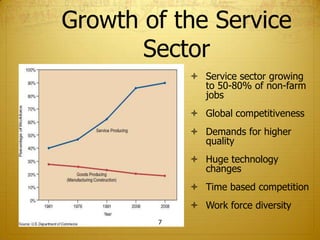
Growth of the Service
       Sector
             Service sector growing
              to 50-80% of non-farm
              jobs
             Global competitiveness
             Demands for higher
              quality
             Huge technology
              changes
             Time based competition
             Work force diversity
        7
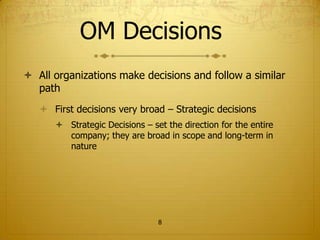
OM Decisions
 All organizations make decisions and follow a similar
  path
    First decisions very broad – Strategic decisions
       Strategic Decisions – set the direction for the entire
        company; they are broad in scope and long-term in
        nature


                                8
OM Decisions
 Following decisions focus on specifics -
  Tactical decision
   Tactical decisions: focus on specific day-to-day
    issues like resource needs, schedules, &
    quantities to produce
   are frequent
 Strategic decisions less frequent
 Tactical and Strategic decisions must align
                           9
OM Decisions


     10
Historical Development of
            OM
        Industrial revolution                        Late 1700s

        Scientific management                        Early 1900s

                Hawthorne Effect                     1930s
        Human relations movement                     1930s-

        Management science                           1940s-

        Computer age                                 1960s-

        Environmental Issues                         1970s-

        JIT & TQM*                                   1980s-


 *JIT= Just in Time, TQM= Total Quality Management


                                                     11
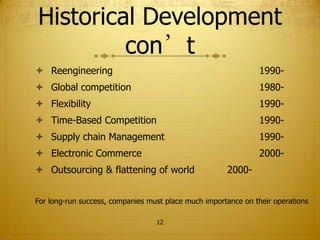
Historical Development
         con’t
 Reengineering                                                1990-
 Global competition                                           1980-
 Flexibility                                                  1990-
 Time-Based Competition                                       1990-
 Supply chain Management                                      1990-
 Electronic Commerce                                          2000-
 Outsourcing & flattening of world                   2000-


For long-run success, companies must place much importance on their operations

                                  12
Today’s OM
           Environment
 Customers demand better quality, greater
  speed, and lower costs
 Companies implementing lean system
  concepts – a total systems approach to
  efficient operations
 Recognized need to better manage
  information using ERP and CRM systems
 Increased cross-functional decision making
                       13
OM in Practice
 OM has the most diverse organizational
  function
 Manages the transformation process
 OM has many faces and names such as;
   V. P. operations, Director of supply chains,
    Manufacturing manager
   Plant manger, Quality specialists, etc.
 All business functions need information from
  OM in order to perform their tasks
                           14
Business Information
        Flow


        15
OM Across the
             Organization
 Most businesses are supported by the functions of
  operations, marketing, and finance

 The major functional areas must interact to achieve
  the organization goals


                           16
OM Across the
       Organization – con’t
 Marketing is not fully able to meet customer needs if they
  do not understand what operations can produce
 Finance cannot judge the need for capital investments if
  they do not understand operations concepts and needs
 Information systems enables the information flow
  throughout the organization
 Human resources must understand job requirements and
  worker skills
 Accounting needs to consider inventory management,
  capacity information, and labor standards

                              17

Operational success

  • 1.
  • 2.
    Hybrid organizations  Someorganizations are a blend of service/manufacturing/quasi-manufacturing Quasi- Manufacturing (QM) organizations  QM characteristics include  Low customer contact & Capital Intensive 2
  • 3.
    Improving Products  http://www.businessweek.com/magazine/cont ent/11_02/b4210048400234.htm?chan=rss_to pStories_ssi_5  http://www.npr.org/templates/story/story.php? storyId=89070760 3
  • 4.
    Improving Services  http://www.npr.org/templates/story/story.php?storyId =88196545  http://www.npr.org/templates/story/story.php?storyId =7000908 4
  • 5.
    Improving Services  http://www.npr.org/templates/story/story.php?storyId =88196545  http://www.npr.org/templates/story/story.php?storyId =7000908 5
  • 6.
    Improving Both Simultaneously http://www.businessweek.com/globalbiz/content/sep2 009/gb2009099_395466_page_2.htm 6
  • 7.
    Growth of theService Sector  Service sector growing to 50-80% of non-farm jobs  Global competitiveness  Demands for higher quality  Huge technology changes  Time based competition  Work force diversity 7
  • 8.
    OM Decisions  Allorganizations make decisions and follow a similar path  First decisions very broad – Strategic decisions  Strategic Decisions – set the direction for the entire company; they are broad in scope and long-term in nature 8
  • 9.
    OM Decisions  Followingdecisions focus on specifics - Tactical decision  Tactical decisions: focus on specific day-to-day issues like resource needs, schedules, & quantities to produce  are frequent  Strategic decisions less frequent  Tactical and Strategic decisions must align 9
  • 10.
  • 11.
    Historical Development of OM  Industrial revolution Late 1700s  Scientific management Early 1900s  Hawthorne Effect 1930s  Human relations movement 1930s-  Management science 1940s-  Computer age 1960s-  Environmental Issues 1970s-  JIT & TQM* 1980s- *JIT= Just in Time, TQM= Total Quality Management 11
  • 12.
    Historical Development con’t  Reengineering 1990-  Global competition 1980-  Flexibility 1990-  Time-Based Competition 1990-  Supply chain Management 1990-  Electronic Commerce 2000-  Outsourcing & flattening of world 2000- For long-run success, companies must place much importance on their operations 12
  • 13.
    Today’s OM Environment  Customers demand better quality, greater speed, and lower costs  Companies implementing lean system concepts – a total systems approach to efficient operations  Recognized need to better manage information using ERP and CRM systems  Increased cross-functional decision making 13
  • 14.
    OM in Practice OM has the most diverse organizational function  Manages the transformation process  OM has many faces and names such as;  V. P. operations, Director of supply chains, Manufacturing manager  Plant manger, Quality specialists, etc.  All business functions need information from OM in order to perform their tasks 14
  • 15.
  • 16.
    OM Across the Organization  Most businesses are supported by the functions of operations, marketing, and finance  The major functional areas must interact to achieve the organization goals 16
  • 17.
    OM Across the Organization – con’t  Marketing is not fully able to meet customer needs if they do not understand what operations can produce  Finance cannot judge the need for capital investments if they do not understand operations concepts and needs  Information systems enables the information flow throughout the organization  Human resources must understand job requirements and worker skills  Accounting needs to consider inventory management, capacity information, and labor standards 17