Management: Principles, Processes & Practices
© Oxford University Press 2008 All rights reserved
CHAPTER 10
NATIONAL INCOME
ACCOUNTING
Management: Principles, Processes & Practices
© Oxford University Press 2008 All rights reserved
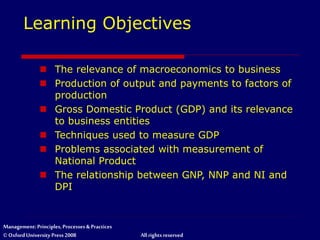
Learning Objectives
 The relevance of macroeconomics to business
 Production of output and payments to factors of
production
 Gross Domestic Product (GDP) and its relevance
to business entities
 Techniques used to measure GDP
 Problems associated with measurement of
National Product
 The relationship between GNP, NNP and NI and
DPI
Management: Principles, Processes & Practices
© Oxford University Press 2008 All rights reserved
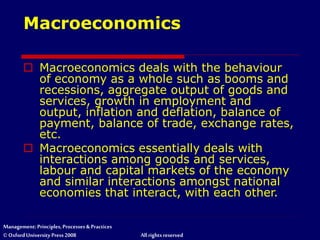
Macroeconomics
 Macroeconomics deals with the behaviour
of economy as a whole such as booms and
recessions, aggregate output of goods and
services, growth in employment and
output, inflation and deflation, balance of
payment, balance of trade, exchange rates,
etc.
 Macroeconomics essentially deals with
interactions among goods and services,
labour and capital markets of the economy
and similar interactions amongst national
economies that interact, with each other.
Management: Principles, Processes & Practices
© Oxford University Press 2008 All rights reserved
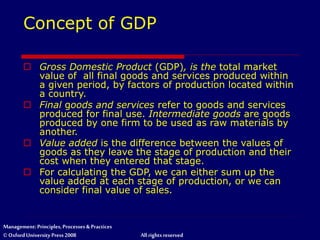
Concept of GDP
 Gross Domestic Product (GDP), is the total market
value of all final goods and services produced within
a given period, by factors of production located within
a country.
 Final goods and services refer to goods and services
produced for final use. Intermediate goods are goods
produced by one firm to be used as raw materials by
another.
 Value added is the difference between the values of
goods as they leave the stage of production and their
cost when they entered that stage.
 For calculating the GDP, we can either sum up the
value added at each stage of production, or we can
consider final value of sales.
Management: Principles, Processes & Practices
© Oxford University Press 2008 All rights reserved
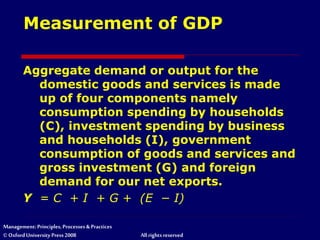
Measurement of GDP
Aggregate demand or output for the
domestic goods and services is made
up of four components namely
consumption spending by households
(C), investment spending by business
and households (I), government
consumption of goods and services and
gross investment (G) and foreign
demand for our net exports.
Y = C + I + G + (E − I)
Management: Principles, Processes & Practices
© Oxford University Press 2008 All rights reserved
Gross Investment Net
Investment
 Gross investment is defined as the total value of all
newly produced capital goods such as plants,
machinery, equipment, housing, building, and
inventory in a given time period.
 Investments determine the long-term plan of growth
that the economy will adopt.
 It is the demand for capital formation that gets
affected by aggregate demand for goods and
services, prevailing interest rates, taxation system
and structure, and other monetary and fiscal
considerations.
 Capital is subject to wear and tear with usage and
time. It may also become completely obsolete on
account of various factors. The rate of depreciation
depends upon the type of capital and its useful life.
The net investment is the difference between gross
investment and depreciation.
Management: Principles, Processes & Practices
© Oxford University Press 2008 All rights reserved
National Product – Problems of
Measurement
 Double counting - avoid adding the value of all
intermediate goods.
 Second-hand goods already sold once should
not be accounted in the national product
accounts.
 Some outputs are not traded in the market and
thus are not rightly reflected in the GDP. These
include services of a housewife, vegetables,
and fruits produced a kitchen garden, etc.
 Government services are not directly priced by
the market and, therefore, it is not necessary
that a rupee spent by the government is worth
its value.
Management: Principles, Processes & Practices
© Oxford University Press 2008 All rights reserved
 Certain expenses that are added to GDP
represent use of resources to contain or
overcome social evils such as crime or risk to
national economy.
 Quality of Life getting affected on account of
environmental pollution and degradation and
the improvement in the quality of products
such as computers, whose quality and
efficiency are improving while the prices are
falling, resulting in lesser contribution in GDP
for each additional unit produced.
Economists have been trying to overcome these
limitations to arrive at an adjusted GNP.

Management chapter 10

  • 1.
    Management: Principles, Processes& Practices © Oxford University Press 2008 All rights reserved CHAPTER 10 NATIONAL INCOME ACCOUNTING
  • 2.
    Management: Principles, Processes& Practices © Oxford University Press 2008 All rights reserved Learning Objectives  The relevance of macroeconomics to business  Production of output and payments to factors of production  Gross Domestic Product (GDP) and its relevance to business entities  Techniques used to measure GDP  Problems associated with measurement of National Product  The relationship between GNP, NNP and NI and DPI
  • 3.
    Management: Principles, Processes& Practices © Oxford University Press 2008 All rights reserved Macroeconomics  Macroeconomics deals with the behaviour of economy as a whole such as booms and recessions, aggregate output of goods and services, growth in employment and output, inflation and deflation, balance of payment, balance of trade, exchange rates, etc.  Macroeconomics essentially deals with interactions among goods and services, labour and capital markets of the economy and similar interactions amongst national economies that interact, with each other.
  • 4.
    Management: Principles, Processes& Practices © Oxford University Press 2008 All rights reserved Concept of GDP  Gross Domestic Product (GDP), is the total market value of all final goods and services produced within a given period, by factors of production located within a country.  Final goods and services refer to goods and services produced for final use. Intermediate goods are goods produced by one firm to be used as raw materials by another.  Value added is the difference between the values of goods as they leave the stage of production and their cost when they entered that stage.  For calculating the GDP, we can either sum up the value added at each stage of production, or we can consider final value of sales.
  • 5.
    Management: Principles, Processes& Practices © Oxford University Press 2008 All rights reserved Measurement of GDP Aggregate demand or output for the domestic goods and services is made up of four components namely consumption spending by households (C), investment spending by business and households (I), government consumption of goods and services and gross investment (G) and foreign demand for our net exports. Y = C + I + G + (E − I)
  • 6.
    Management: Principles, Processes& Practices © Oxford University Press 2008 All rights reserved Gross Investment Net Investment  Gross investment is defined as the total value of all newly produced capital goods such as plants, machinery, equipment, housing, building, and inventory in a given time period.  Investments determine the long-term plan of growth that the economy will adopt.  It is the demand for capital formation that gets affected by aggregate demand for goods and services, prevailing interest rates, taxation system and structure, and other monetary and fiscal considerations.  Capital is subject to wear and tear with usage and time. It may also become completely obsolete on account of various factors. The rate of depreciation depends upon the type of capital and its useful life. The net investment is the difference between gross investment and depreciation.
  • 7.
    Management: Principles, Processes& Practices © Oxford University Press 2008 All rights reserved National Product – Problems of Measurement  Double counting - avoid adding the value of all intermediate goods.  Second-hand goods already sold once should not be accounted in the national product accounts.  Some outputs are not traded in the market and thus are not rightly reflected in the GDP. These include services of a housewife, vegetables, and fruits produced a kitchen garden, etc.  Government services are not directly priced by the market and, therefore, it is not necessary that a rupee spent by the government is worth its value.
  • 8.
    Management: Principles, Processes& Practices © Oxford University Press 2008 All rights reserved  Certain expenses that are added to GDP represent use of resources to contain or overcome social evils such as crime or risk to national economy.  Quality of Life getting affected on account of environmental pollution and degradation and the improvement in the quality of products such as computers, whose quality and efficiency are improving while the prices are falling, resulting in lesser contribution in GDP for each additional unit produced. Economists have been trying to overcome these limitations to arrive at an adjusted GNP.