MANAGERIAL ECONOMICS SESSION
PLAN
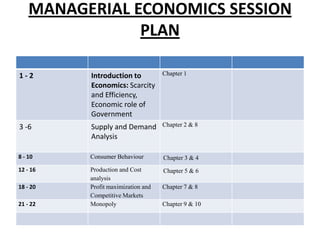
1 - 2 Introduction to
Economics: Scarcity
and Efficiency,
Economic role of
Government
Chapter 1
3 -6 Supply and Demand
Analysis
Chapter 2 & 8
8 - 10 Consumer Behaviour Chapter 3 & 4
12 - 16 Production and Cost
analysis
Chapter 5 & 6
18 - 20 Profit maximization and
Competitive Markets
Chapter 7 & 8
21 - 22 Monopoly Chapter 9 & 10
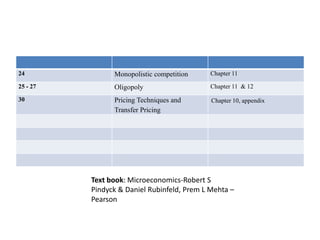
24 Monopolistic competition Chapter 11
25 - 27 Oligopoly Chapter 11 & 12
30 Pricing Techniques and
Transfer Pricing
Chapter 10, appendix
Text book: Microeconomics-Robert S
Pindyck & Daniel Rubinfeld, Prem L Mehta –
Pearson
Evaluation
• 7 Evaluation Test – Numericals 7 marks
• 11 Evaluation Case Study Presentation Continuous evaluation
8 marks
• 17 Midterm examination 20 marks
• 23 Evaluation Quiz MCQs 5 marks
• 29 Group presentations of project on industry Market structures
10marks
Pre Mid-
Semester
Mid Semester
Examination
Post Mid-
Semester
End Semester
Examination
15% 20% 15% 50% (4 to 5
questions, 1 to2
caselets)
Economics
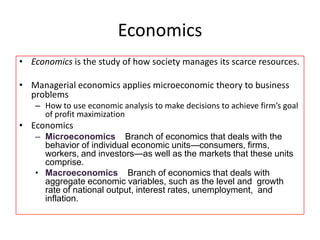
• Economics is the study of how society manages its scarce resources.
• Managerial economics applies microeconomic theory to business
problems
– How to use economic analysis to make decisions to achieve firm’s goal
of profit maximization
• Economics
– Microeconomics Branch of economics that deals with the
behavior of individual economic units—consumers, firms,
workers, and investors—as well as the markets that these units
comprise.
• Macroeconomics Branch of economics that deals with
aggregate economic variables, such as the level and growth
rate of national output, interest rates, unemployment, and
inflation.
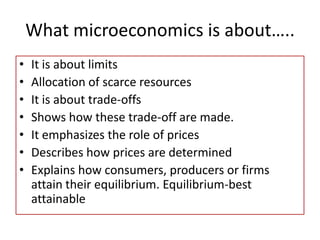
What microeconomics is about…..
• It is about limits
• Allocation of scarce resources
• It is about trade-offs
• Shows how these trade-off are made.
• It emphasizes the role of prices
• Describes how prices are determined
• Explains how consumers, producers or firms
attain their equilibrium. Equilibrium-best
attainable
Theories and models
• Explanation and predictions are based on
theories which explain observed phenomenon
in terms of a set of basic rules and
assumptions.
• Theories are used to construct models which
is a mathematical representation
WHAT IS A MARKET?
• market Collection of buyers and sellers
that, through their actual or potential
interactions, determine the price of a product
or set of products.
• market definition Determination of the
buyers, sellers, and range of products that
should be included in a particular market
• arbitrage Practice of buying at a low price
at one location and selling at a higher price in
another.
Market Definition—The Extent of a Market
● extent of a market Boundaries of a market, both
geographical and in terms of range of products produced
and sold within it.
Market definition is important for two reasons:
A company must understand who its actual and potential
competitors are for the various products that it sells or
might sell in the future.
Market definition can be important for public policy decisions.
WHAT IS A MARKET?
Market Definition—The Extent of a Market
● extent of a market Boundaries of a market, both
geographical and in terms of range of products produced
and sold within it.
Market definition is important for two reasons:
• A company must understand who its actual and potential
competitors are for the various products that it sells or
might sell in the future.
• Market definition can be important for public policy
decisions.
WHAT IS A MARKET?
REAL VERSUS NOMINAL PRICES
● nominal price Absolute price of a good, unadjusted for
inflation.
● real price Price of a good relative to an aggregate
measure of prices; price adjusted for inflation.
● Consumer Price Index Measure of the aggregate price
level.
● Producer Price Index Measure of the aggregate price
level for intermediate products and wholesale goods.
Fundamental Economic Problems
• Scarcity
• Unlimited Wants/choices
Production possibility frontier
• Concepts Illustrated by the Production
Possibilities Frontier
– Efficiency
– Tradeoffs
– Opportunity Cost
– Economic Growth
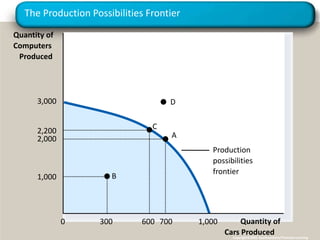
The Production Possibilities Frontier
Copyright©2003 Southwestern/ThomsonLearning
Production
possibilities
frontier
A
B
C
Quantity of
Cars Produced
2,200
600
1,000
3000 700
2,000
3,000
1,000
Quantity of
Computers
Produced
D
PPF
• Shape of the PPF
• Straight line OR concave
• Outward shift of the PPF
• Positive or negative output gap
Fundamental economic questions
• What goods and services to produce? Does the
economy uses its resources to build more hospitals,
roads, schools or luxury hotels? Do we make more
iPhones and iPads or double-espressos?
• How best to produce goods and services? What is the
best use of our scarce resources? Should school playing
fields be sold off to provide more land for affordable
housing?
• Who is to receive goods and services? Who will get
expensive hospital treatment - and who not? Should
there be a minimum wage?
Kinds of economic systems
• Free enterprise Economy
• Government controlled/ Command Economy
• Mixed Economy
Free Enterprise Economy
• Private ownership
• Private gains as motivating force
• Freedom of choice
• Factor mobility
• Free competition
• Eg- Hongkong, USA
Government controlled/ Command
Economy
• Means of production are owned by the
state/society
• Social welfare is the objective
• Curbed freedom of choice
• Market forces and competition are eliminated
• Eg-North Korea and Cuba
Mixed Economy
• Both private and public sector
• Government controls guide and control the
economy, providing infrastructure and
promotes private sector economic activities.
• Most popular form

Presentation 2013

  • 2.
    MANAGERIAL ECONOMICS SESSION PLAN 1- 2 Introduction to Economics: Scarcity and Efficiency, Economic role of Government Chapter 1 3 -6 Supply and Demand Analysis Chapter 2 & 8 8 - 10 Consumer Behaviour Chapter 3 & 4 12 - 16 Production and Cost analysis Chapter 5 & 6 18 - 20 Profit maximization and Competitive Markets Chapter 7 & 8 21 - 22 Monopoly Chapter 9 & 10
  • 3.
    24 Monopolistic competitionChapter 11 25 - 27 Oligopoly Chapter 11 & 12 30 Pricing Techniques and Transfer Pricing Chapter 10, appendix Text book: Microeconomics-Robert S Pindyck & Daniel Rubinfeld, Prem L Mehta – Pearson
  • 4.
    Evaluation • 7 EvaluationTest – Numericals 7 marks • 11 Evaluation Case Study Presentation Continuous evaluation 8 marks • 17 Midterm examination 20 marks • 23 Evaluation Quiz MCQs 5 marks • 29 Group presentations of project on industry Market structures 10marks Pre Mid- Semester Mid Semester Examination Post Mid- Semester End Semester Examination 15% 20% 15% 50% (4 to 5 questions, 1 to2 caselets)
  • 5.
    Economics • Economics isthe study of how society manages its scarce resources. • Managerial economics applies microeconomic theory to business problems – How to use economic analysis to make decisions to achieve firm’s goal of profit maximization • Economics – Microeconomics Branch of economics that deals with the behavior of individual economic units—consumers, firms, workers, and investors—as well as the markets that these units comprise. • Macroeconomics Branch of economics that deals with aggregate economic variables, such as the level and growth rate of national output, interest rates, unemployment, and inflation.
  • 6.
    What microeconomics isabout….. • It is about limits • Allocation of scarce resources • It is about trade-offs • Shows how these trade-off are made. • It emphasizes the role of prices • Describes how prices are determined • Explains how consumers, producers or firms attain their equilibrium. Equilibrium-best attainable
  • 7.
    Theories and models •Explanation and predictions are based on theories which explain observed phenomenon in terms of a set of basic rules and assumptions. • Theories are used to construct models which is a mathematical representation
  • 8.
    WHAT IS AMARKET? • market Collection of buyers and sellers that, through their actual or potential interactions, determine the price of a product or set of products. • market definition Determination of the buyers, sellers, and range of products that should be included in a particular market • arbitrage Practice of buying at a low price at one location and selling at a higher price in another.
  • 9.
    Market Definition—The Extentof a Market ● extent of a market Boundaries of a market, both geographical and in terms of range of products produced and sold within it. Market definition is important for two reasons: A company must understand who its actual and potential competitors are for the various products that it sells or might sell in the future. Market definition can be important for public policy decisions. WHAT IS A MARKET?
  • 10.
    Market Definition—The Extentof a Market ● extent of a market Boundaries of a market, both geographical and in terms of range of products produced and sold within it. Market definition is important for two reasons: • A company must understand who its actual and potential competitors are for the various products that it sells or might sell in the future. • Market definition can be important for public policy decisions. WHAT IS A MARKET?
  • 11.
    REAL VERSUS NOMINALPRICES ● nominal price Absolute price of a good, unadjusted for inflation. ● real price Price of a good relative to an aggregate measure of prices; price adjusted for inflation. ● Consumer Price Index Measure of the aggregate price level. ● Producer Price Index Measure of the aggregate price level for intermediate products and wholesale goods.
  • 12.
    Fundamental Economic Problems •Scarcity • Unlimited Wants/choices Production possibility frontier • Concepts Illustrated by the Production Possibilities Frontier – Efficiency – Tradeoffs – Opportunity Cost – Economic Growth
  • 13.
    The Production PossibilitiesFrontier Copyright©2003 Southwestern/ThomsonLearning Production possibilities frontier A B C Quantity of Cars Produced 2,200 600 1,000 3000 700 2,000 3,000 1,000 Quantity of Computers Produced D
  • 14.
    PPF • Shape ofthe PPF • Straight line OR concave • Outward shift of the PPF • Positive or negative output gap
  • 15.
    Fundamental economic questions •What goods and services to produce? Does the economy uses its resources to build more hospitals, roads, schools or luxury hotels? Do we make more iPhones and iPads or double-espressos? • How best to produce goods and services? What is the best use of our scarce resources? Should school playing fields be sold off to provide more land for affordable housing? • Who is to receive goods and services? Who will get expensive hospital treatment - and who not? Should there be a minimum wage?
  • 16.
    Kinds of economicsystems • Free enterprise Economy • Government controlled/ Command Economy • Mixed Economy
  • 17.
    Free Enterprise Economy •Private ownership • Private gains as motivating force • Freedom of choice • Factor mobility • Free competition • Eg- Hongkong, USA
  • 18.
    Government controlled/ Command Economy •Means of production are owned by the state/society • Social welfare is the objective • Curbed freedom of choice • Market forces and competition are eliminated • Eg-North Korea and Cuba
  • 19.
    Mixed Economy • Bothprivate and public sector • Government controls guide and control the economy, providing infrastructure and promotes private sector economic activities. • Most popular form