
MANAGERIAL ECONOMICS
MBAPEM 103
UNIT III - PRICING
DECISIONS
Kalipada Adhikary
Manager/Corp Comp
Service/NLC
1
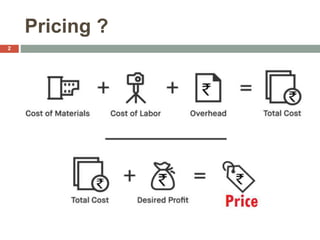
Pricing ?
2
Pricing : It’s Importance
 Important component of Revenue.
 Very sensitive w.r.t. common goods.
 Much more important for poor and lower-
middle class income group people.
 Change in price has very sharp impact on
profitability.
 Recently, Price is getting more tricky.
3
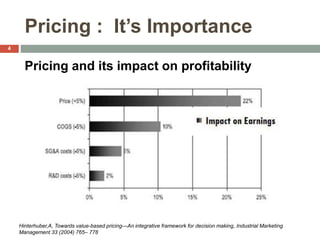
Pricing : It’s Importance
Pricing and its impact on profitability
Hinterhuber,A, Towards value-based pricing—An integrative framework for decision making, Industrial Marketing
Management 33 (2004) 765– 778
4
Learning Objectives
 Basic Concepts of Pricing
 Four market/competition
structures
 Pure competition and Perfect
competition
 Pricing in Perfect Competition
5
Pricing Timeline : Short-run
pricing
 time horizon of less than one year
 Pricing a one-time-only order
 This include decisions such as:
Adjusting product mix and output
volume in a competitive market
High return aim
Variable Component changes
6
Pricing Timeline : Long-run
pricing
 one year or longer time span
 include decisions such as:
All factor including fixed costs can be
altered
Profit margin is set to earn a reasonable
return on investment
7
Pricing Approaches
Market-Based:
 price charged is based on what customers want
and how competitors react. Starts with a target
price.
 Estimated on customers’ perceived value and
how competitors price competing
products/services
Cost-Based:
 price charged is based on what it cost to
produce, coupled with the ability to recoup the
costs and achieve a required rate of return.
8
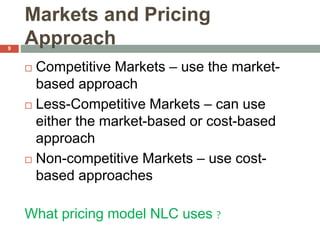
Markets and Pricing
Approach
 Competitive Markets – use the market-
based approach
 Less-Competitive Markets – can use
either the market-based or cost-based
approach
 Non-competitive Markets – use cost-
based approaches
What pricing model NLC uses ?
9
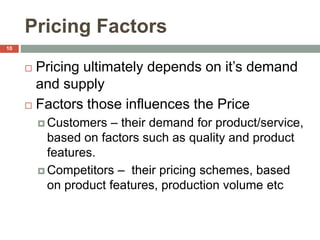
Pricing Factors
 Pricing ultimately depends on it’s demand
and supply
 Factors those influences the Price
 Customers – their demand for product/service,
based on factors such as quality and product
features.
 Competitors – their pricing schemes, based
on product features, production volume etc
10
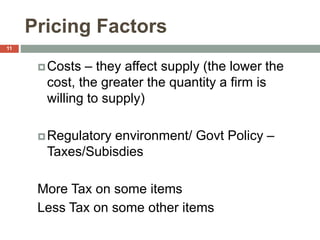
Pricing Factors
Costs – they affect supply (the lower the
cost, the greater the quantity a firm is
willing to supply)
Regulatory environment/ Govt Policy –
Taxes/Subisdies
More Tax on some items
Less Tax on some other items
11
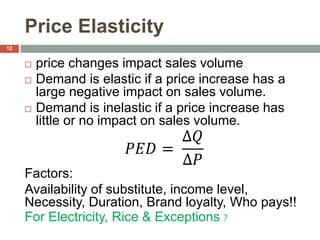
Price Elasticity
 price changes impact sales volume
 Demand is elastic if a price increase has a
large negative impact on sales volume.
 Demand is inelastic if a price increase has
little or no impact on sales volume.
𝑃𝐸𝐷 =
Δ𝑄
Δ𝑃
Factors:
Availability of substitute, income level,
Necessity, Duration, Brand loyalty, Who pays!!
For Electricity, Rice & Exceptions ?
12
Who determines the price?
 Price takers – company in competitive
market has no influence on price
 As competition increase, the price becomes
squeezed between the cost of the product
and the lowest price of a competitor.
 Price makers - companies that influence the
price
 Organizations that compete by offering
innovative products/services have a more
difficult pricing decision.
13
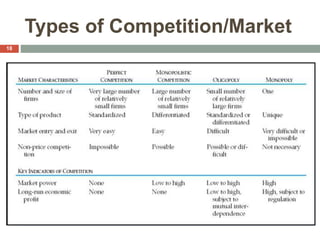
Types of Competition/Market
 Perfect competition
large number of relatively small buyers and
sellers
standardized product
very easy market entry and exit
No non-price competition
Most Free Market Economist advocate for
this type, WHY ?
14
Types of Competition/Market
Imperfect Markets
 Monopoly (absolute market power)
one firm, firm is the industry
unique product or no close substitutes
market entry and exit difficult or legally
impossible
non-price competition not necessary
15
Types of Competition/Market
Imperfect Markets
 Monopolistic competition
large number of small firms acting
independently
differentiated product
market entry and exit relatively easy
non-price competition very important
16
Types of Competition/Market
Imperfect Markets
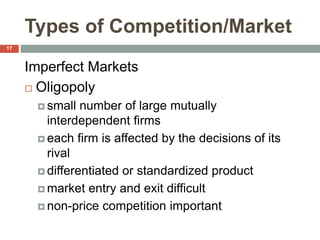
 Oligopoly
 small number of large mutually
interdependent firms
 each firm is affected by the decisions of its
rival
 differentiated or standardized product
 market entry and exit difficult
 non-price competition important
17
Types of Competition/Market
18
Types of Competition/Market
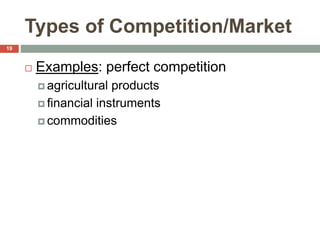
 Examples: perfect competition
 agricultural products
 financial instruments
 commodities
19
Types of Competition/Market
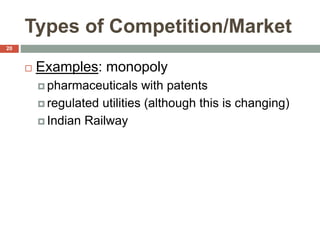
 Examples: monopoly
 pharmaceuticals with patents
 regulated utilities (although this is changing)
 Indian Railway
20
Types of Competition/Market
 Examples: monopolistic competition
 Saloon
 restaurants
 Repair/service shops
21
Types of Competition/Market
 Examples: oligopoly
 oil refining
 airlines
 internet access and cell phone service
22
Types of Competition/Market
What about NLC ?
PSU ?
e-commerce ?
23
UNIT TOPICS
Pure Competition
AND
Perfect Competition
24
Pure competition
 Large no. of firms each produce a tiny
fraction of market supply.
Important Characteristics
 large number of independent sellers
 homogeneous product.
Examples: farm commodities (wheat,
soybean, strawberries, milo)
25
Perfect Competition
 large number of independent, relatively
small sellers and buyers as compared to
the market size,
 no individual buyer or seller has any
influence over the price.
 economic forces operate to full extent
 allows best allocation of resources to
maximize efficiency
26
Perfect Competition
Important Characteristics
 large number of independent sellers
 identical product
 No barriers to entry and exit : no need of
patents, very high capital expenditure,
regulated market, licencing
 complete information, absence of
transport cost, perfect mobility of factors.
stock market, and the foreign exchange
market
27
Pure and Perfect Competition
Basic Difference
 Only two conditions in Pure Competition,
which ensures no question of monopoly
control
 Four condition in Perfect competition
Buyers and sellers are price takers in both
cases.
28
Price & Output Decision :
business decision questions
 What to Produce and How much to
produce?
 How much profit will be earned?
 If a loss is incurred, will it be worthwhile to
continue in this market in the long run or
should exit ?
29
Price & Output Decision :
Perfect Competition
Key assumptions
 Firm is a price taker
 Firm makes the distinction between the short
run and the long run
 Firm’s objective – profit maximization (or
loss minimization) in the short run
 Firm includes its opportunity cost of
operations in its total cost of production
30
Price & Output Decision :
Perfect Competition
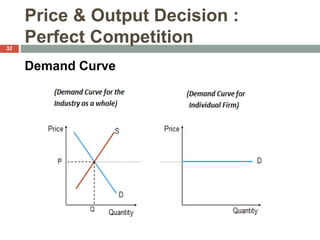
Demand Curve
 Perfectly elastic demand curve: consumers are
willing to buy as much as the firm is willing to
sell at the going market price
 The firm receives the same MR from the sale
of each additional unit of product = P
 No limit to the total revenue that the firm can
gain in a perfectly competitive market
31
Price & Output Decision :
Perfect Competition
Demand Curve
32
Price & Output Decision :
Perfect Competition
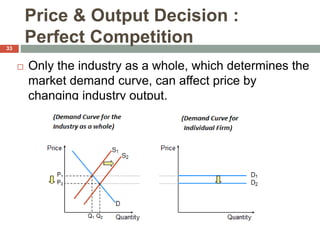
 Only the industry as a whole, which determines the
market demand curve, can affect price by
changing industry output.
33
Pricing Mechanism: Some Basic
Concepts
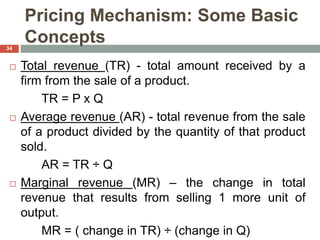
 Total revenue (TR) - total amount received by a
firm from the sale of a product.
TR = P x Q
 Average revenue (AR) - total revenue from the sale
of a product divided by the quantity of that product
sold.
AR = TR ÷ Q
 Marginal revenue (MR) – the change in total
revenue that results from selling 1 more unit of
output.
MR = ( change in TR) ÷ (change in Q)
34
Pricing Mechanism: Some Basic
Concepts
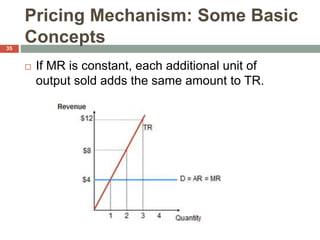
 If MR is constant, each additional unit of
output sold adds the same amount to TR.
35
Pricing Mechanism
 Total revenue/Total cost approach:
Compare the TR and TC schedules, find the level of
output that
maximizes the firm’s profits or minimizes its loss.
 Marginal revenue/Marginal cost approach:
Level of output at which the additional revenue received
from
the last unit is equal to the additional cost of producing
that unit
(at MR=MC)
 Both the TR/TC and MR=MC approach lead to the same
price/output decision
36
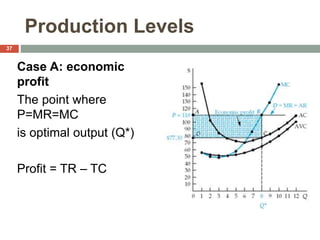
Production Levels
Case A: economic
profit
The point where
P=MR=MC
is optimal output (Q*)
Profit = TR – TC
37
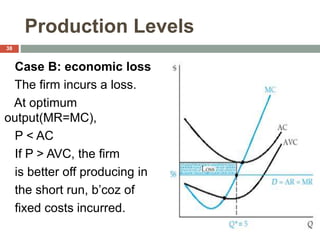
Production Levels
Case B: economic loss
The firm incurs a loss.
At optimum
output(MR=MC),
P < AC
If P > AVC, the firm
is better off producing in
the short run, b’coz of
fixed costs incurred.
38
Production Levels
Case C: Shutdown point: the lowest price at
which the firm would still produce
 At this point, P = the minimum point on the AVC.
 Price below this point, revenues fail to cover the
fixed costs and the variable costs. The firm
would be better off if it shut down.
39
Production Levels in Short run :
Competitive Market
Profit maximizing output
 individual firm cannot influence the market price,
 horizontal demand curve i.e. perfectly elastic – its
elasticity is infinity at all levels of output.
 Marginal Revenue (MR) curve horizontal and
coincides with AR curve. AR and MR are constant
and equal at all output.
 MR = MC rule
 The firm can adjust its variable resources (but not
fixed resources) to achieve the output level that
maximizes profit.
40
Production Levels in Long run :
Competitive Market
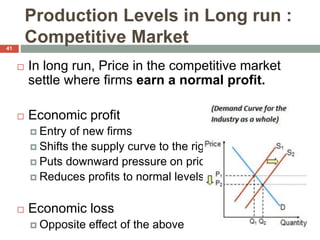
 In long run, Price in the competitive market
settle where firms earn a normal profit.
 Economic profit
 Entry of new firms
 Shifts the supply curve to the right
 Puts downward pressure on price
 Reduces profits to normal levels
 Economic loss
 Opposite effect of the above
41
Perfectly competitive markets in
action
 the earlier the firm enters - better chances
of earning above-normal profit – for longer
period
 new firms must find lowest possible
production cost
 Otherwise try competing by product
differentiation
 All firms in the industry have identical cost
curves
42
Perfectly competitive markets in
action
 At long-run equilibrium, firms earn zero
economic profit and earn a normal profit.
P (=MR) = MC = minimum ATC
 Firms use the limited resources in a way to
maximize the satisfaction of consumers.
 This leads to higher efficient resource
allocation, more productivity, innovation and
altogether more business.
That’s Why Most Free Market Economist
advocate for Market type.
43
THANK YOU
44

Managerial Economics - Pricing Decision Lecture 1

  • 1.
    MANAGERIAL ECONOMICS MBAPEM 103 UNITIII - PRICING DECISIONS Kalipada Adhikary Manager/Corp Comp Service/NLC 1
  • 2.
  • 3.
    Pricing : It’sImportance  Important component of Revenue.  Very sensitive w.r.t. common goods.  Much more important for poor and lower- middle class income group people.  Change in price has very sharp impact on profitability.  Recently, Price is getting more tricky. 3
  • 4.
    Pricing : It’sImportance Pricing and its impact on profitability Hinterhuber,A, Towards value-based pricing—An integrative framework for decision making, Industrial Marketing Management 33 (2004) 765– 778 4
  • 5.
    Learning Objectives  BasicConcepts of Pricing  Four market/competition structures  Pure competition and Perfect competition  Pricing in Perfect Competition 5
  • 6.
    Pricing Timeline :Short-run pricing  time horizon of less than one year  Pricing a one-time-only order  This include decisions such as: Adjusting product mix and output volume in a competitive market High return aim Variable Component changes 6
  • 7.
    Pricing Timeline :Long-run pricing  one year or longer time span  include decisions such as: All factor including fixed costs can be altered Profit margin is set to earn a reasonable return on investment 7
  • 8.
    Pricing Approaches Market-Based:  pricecharged is based on what customers want and how competitors react. Starts with a target price.  Estimated on customers’ perceived value and how competitors price competing products/services Cost-Based:  price charged is based on what it cost to produce, coupled with the ability to recoup the costs and achieve a required rate of return. 8
  • 9.
    Markets and Pricing Approach Competitive Markets – use the market- based approach  Less-Competitive Markets – can use either the market-based or cost-based approach  Non-competitive Markets – use cost- based approaches What pricing model NLC uses ? 9
  • 10.
    Pricing Factors  Pricingultimately depends on it’s demand and supply  Factors those influences the Price  Customers – their demand for product/service, based on factors such as quality and product features.  Competitors – their pricing schemes, based on product features, production volume etc 10
  • 11.
    Pricing Factors Costs –they affect supply (the lower the cost, the greater the quantity a firm is willing to supply) Regulatory environment/ Govt Policy – Taxes/Subisdies More Tax on some items Less Tax on some other items 11
  • 12.
    Price Elasticity  pricechanges impact sales volume  Demand is elastic if a price increase has a large negative impact on sales volume.  Demand is inelastic if a price increase has little or no impact on sales volume. 𝑃𝐸𝐷 = Δ𝑄 Δ𝑃 Factors: Availability of substitute, income level, Necessity, Duration, Brand loyalty, Who pays!! For Electricity, Rice & Exceptions ? 12
  • 13.
    Who determines theprice?  Price takers – company in competitive market has no influence on price  As competition increase, the price becomes squeezed between the cost of the product and the lowest price of a competitor.  Price makers - companies that influence the price  Organizations that compete by offering innovative products/services have a more difficult pricing decision. 13
  • 14.
    Types of Competition/Market Perfect competition large number of relatively small buyers and sellers standardized product very easy market entry and exit No non-price competition Most Free Market Economist advocate for this type, WHY ? 14
  • 15.
    Types of Competition/Market ImperfectMarkets  Monopoly (absolute market power) one firm, firm is the industry unique product or no close substitutes market entry and exit difficult or legally impossible non-price competition not necessary 15
  • 16.
    Types of Competition/Market ImperfectMarkets  Monopolistic competition large number of small firms acting independently differentiated product market entry and exit relatively easy non-price competition very important 16
  • 17.
    Types of Competition/Market ImperfectMarkets  Oligopoly  small number of large mutually interdependent firms  each firm is affected by the decisions of its rival  differentiated or standardized product  market entry and exit difficult  non-price competition important 17
  • 18.
  • 19.
    Types of Competition/Market Examples: perfect competition  agricultural products  financial instruments  commodities 19
  • 20.
    Types of Competition/Market Examples: monopoly  pharmaceuticals with patents  regulated utilities (although this is changing)  Indian Railway 20
  • 21.
    Types of Competition/Market Examples: monopolistic competition  Saloon  restaurants  Repair/service shops 21
  • 22.
    Types of Competition/Market Examples: oligopoly  oil refining  airlines  internet access and cell phone service 22
  • 23.
    Types of Competition/Market Whatabout NLC ? PSU ? e-commerce ? 23
  • 24.
  • 25.
    Pure competition  Largeno. of firms each produce a tiny fraction of market supply. Important Characteristics  large number of independent sellers  homogeneous product. Examples: farm commodities (wheat, soybean, strawberries, milo) 25
  • 26.
    Perfect Competition  largenumber of independent, relatively small sellers and buyers as compared to the market size,  no individual buyer or seller has any influence over the price.  economic forces operate to full extent  allows best allocation of resources to maximize efficiency 26
  • 27.
    Perfect Competition Important Characteristics large number of independent sellers  identical product  No barriers to entry and exit : no need of patents, very high capital expenditure, regulated market, licencing  complete information, absence of transport cost, perfect mobility of factors. stock market, and the foreign exchange market 27
  • 28.
    Pure and PerfectCompetition Basic Difference  Only two conditions in Pure Competition, which ensures no question of monopoly control  Four condition in Perfect competition Buyers and sellers are price takers in both cases. 28
  • 29.
    Price & OutputDecision : business decision questions  What to Produce and How much to produce?  How much profit will be earned?  If a loss is incurred, will it be worthwhile to continue in this market in the long run or should exit ? 29
  • 30.
    Price & OutputDecision : Perfect Competition Key assumptions  Firm is a price taker  Firm makes the distinction between the short run and the long run  Firm’s objective – profit maximization (or loss minimization) in the short run  Firm includes its opportunity cost of operations in its total cost of production 30
  • 31.
    Price & OutputDecision : Perfect Competition Demand Curve  Perfectly elastic demand curve: consumers are willing to buy as much as the firm is willing to sell at the going market price  The firm receives the same MR from the sale of each additional unit of product = P  No limit to the total revenue that the firm can gain in a perfectly competitive market 31
  • 32.
    Price & OutputDecision : Perfect Competition Demand Curve 32
  • 33.
    Price & OutputDecision : Perfect Competition  Only the industry as a whole, which determines the market demand curve, can affect price by changing industry output. 33
  • 34.
    Pricing Mechanism: SomeBasic Concepts  Total revenue (TR) - total amount received by a firm from the sale of a product. TR = P x Q  Average revenue (AR) - total revenue from the sale of a product divided by the quantity of that product sold. AR = TR ÷ Q  Marginal revenue (MR) – the change in total revenue that results from selling 1 more unit of output. MR = ( change in TR) ÷ (change in Q) 34
  • 35.
    Pricing Mechanism: SomeBasic Concepts  If MR is constant, each additional unit of output sold adds the same amount to TR. 35
  • 36.
    Pricing Mechanism  Totalrevenue/Total cost approach: Compare the TR and TC schedules, find the level of output that maximizes the firm’s profits or minimizes its loss.  Marginal revenue/Marginal cost approach: Level of output at which the additional revenue received from the last unit is equal to the additional cost of producing that unit (at MR=MC)  Both the TR/TC and MR=MC approach lead to the same price/output decision 36
  • 37.
    Production Levels Case A:economic profit The point where P=MR=MC is optimal output (Q*) Profit = TR – TC 37
  • 38.
    Production Levels Case B:economic loss The firm incurs a loss. At optimum output(MR=MC), P < AC If P > AVC, the firm is better off producing in the short run, b’coz of fixed costs incurred. 38
  • 39.
    Production Levels Case C:Shutdown point: the lowest price at which the firm would still produce  At this point, P = the minimum point on the AVC.  Price below this point, revenues fail to cover the fixed costs and the variable costs. The firm would be better off if it shut down. 39
  • 40.
    Production Levels inShort run : Competitive Market Profit maximizing output  individual firm cannot influence the market price,  horizontal demand curve i.e. perfectly elastic – its elasticity is infinity at all levels of output.  Marginal Revenue (MR) curve horizontal and coincides with AR curve. AR and MR are constant and equal at all output.  MR = MC rule  The firm can adjust its variable resources (but not fixed resources) to achieve the output level that maximizes profit. 40
  • 41.
    Production Levels inLong run : Competitive Market  In long run, Price in the competitive market settle where firms earn a normal profit.  Economic profit  Entry of new firms  Shifts the supply curve to the right  Puts downward pressure on price  Reduces profits to normal levels  Economic loss  Opposite effect of the above 41
  • 42.
    Perfectly competitive marketsin action  the earlier the firm enters - better chances of earning above-normal profit – for longer period  new firms must find lowest possible production cost  Otherwise try competing by product differentiation  All firms in the industry have identical cost curves 42
  • 43.
    Perfectly competitive marketsin action  At long-run equilibrium, firms earn zero economic profit and earn a normal profit. P (=MR) = MC = minimum ATC  Firms use the limited resources in a way to maximize the satisfaction of consumers.  This leads to higher efficient resource allocation, more productivity, innovation and altogether more business. That’s Why Most Free Market Economist advocate for Market type. 43
  • 44.