Advanced Molecular Biology
1
Coverage
1. Prokaryotic gene expression and regulation
Prokaryotic “gene structure”
A. Basic structure of Operon
B. Lactose Operon” regulation
C. Tryptophan Operon” regulation
2. Eukaryotic gene expression and regulation
Eukaryotic gene structure
Regulons
2
Terminologies
Gene expression is the process by which the information on genes is used
to synthesize a gene product.
Two steps
1. Transcription
2. Translation
Gene regulation is the process of turning genes on and off
to controls the amount and the type of gene products
Regulation of gene expression
 Controls the developmental process
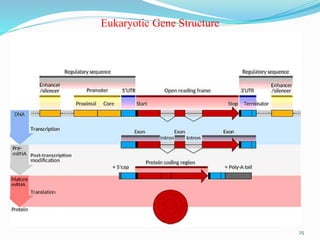
 Responds to environmental stimuli
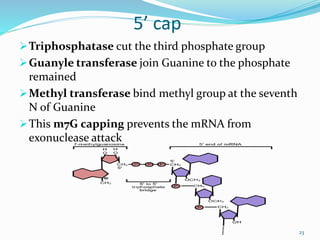
 Helps for adaptation to a novel environmental condition
Gene structure is the organization of specialized sequences of genes
in the genome.
3
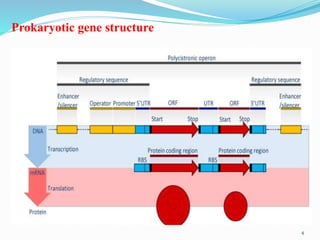
Prokaryotic gene structure
4
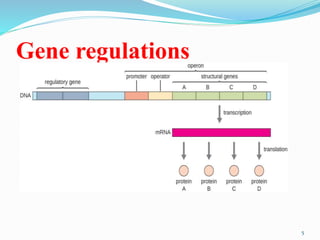
Gene regulations
5
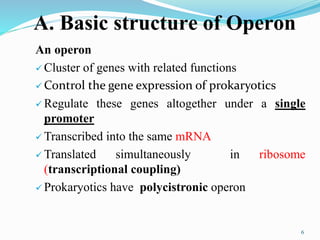
A. Basic structure of Operon
An operon
 Cluster of genes with related functions
 Control the gene expression of prokaryotics
 Regulate these genes altogether under a single
promoter
 Transcribed into the same mRNA
 Translated simultaneously in ribosome
(transcriptional coupling)
 Prokaryotics have polycistronic operon
6
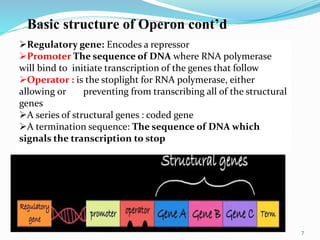
Regulatory gene: Encodes a repressor
Promoter The sequence of DNA where RNA polymerase
will bind to initiate transcription of the genes that follow
Operator : is the stoplight for RNA polymerase, either
allowing or preventing from transcribing all of the structural
genes
A series of structural genes : coded gene
A termination sequence: The sequence of DNA which
signals the transcription to stop
Basic structure of Operon cont’d
7
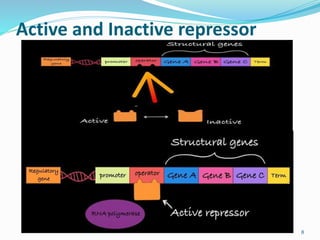
Active and Inactive repressor
8
Operon in prokaryotics
There are different types of operon in prokaryotics
I. Lactose operon: lactose to Glucose & Galactose
II. Tryptophan Operon: synthesis of tryptophan
III. Lux operon; production of luminescent proteins
IV. L-arabinose operon - L-arabinose to pentise
phosphate pathway , D-xylulose-5-phosphate.
9
I. Lac Operon
The most common example
Catabolic type of operon
E. Coli prefers glucose as source carbon and energy
but will metabolize lactose in the absence of
glucose
Contains structural genes that encode enzymes to
break down lactose
Activate when Glucose is absent and lactose is
present
10
Regulator of lac operon:
cAMP
CAP
cAMP-CAP complex
Presence or absence of Glucose and Lactose
Lac Operon Regulation
Catabolite repression
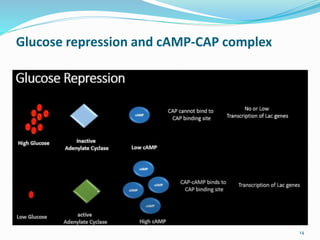
 Glucose has affinity to bind to enzyme adenylate cyclase
 Enzyme adenylate cyclase changes ATP to cAMP
 If glucose binds to adenylate cyclase ATP won’t be
converted to cAMP
11
Lac Operon Regulation
12
High percentage of glucose
Preventing the conversion
of ATP into cAMP
CAP remain in an inactive
conformation
 Inactivate lac operon
Low percentage of glucose
 Adenylate cyclase is free and
active
 cAMP is formed
 cAMP-CAP complex formed
and activate lac operon
CAP-cAMP complex increases the binding ability of RNA
polymerase to the promoter region to initiate the transcription.
Catabolite repression
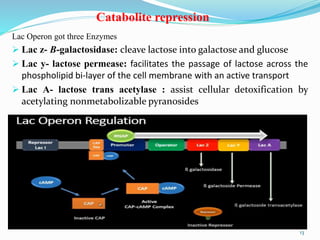
Lac Operon got three Enzymes
 Lac z- B-galactosidase: cleave lactose into galactose and glucose
 Lac y- lactose permease: facilitates the passage of lactose across the
phospholipid bi-layer of the cell membrane with an active transport
 Lac A- lactose trans acetylase : assist cellular detoxification by
acetylating nonmetabolizable pyranosides
13
Glucose repression and cAMP-CAP complex
14
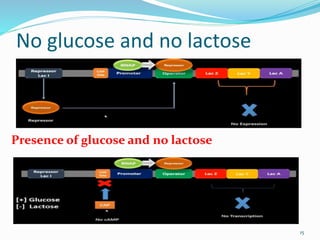
No glucose and no lactose
15
Presence of glucose and no lactose
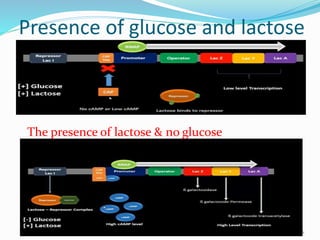
Presence of glucose and lactose
16
The presence of lactose & no glucose
II. Tryptophan Operon/trp Operon
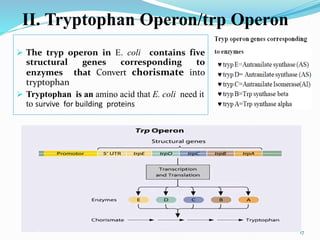
 The tryp operon in E. coli contains five
structural genes corresponding to
enzymes that Convert chorismate into
tryptophan
 Tryptophan is an amino acid that E. coli need it
to survive for building proteins
17
At high tryptophan concentration
18
At low tryptophan concentration
19
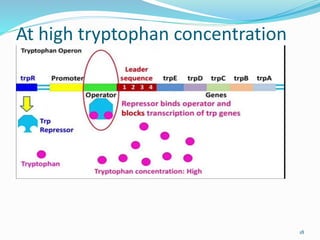
At high concentration of tryptophan
 Two tryptophan molecules bind the repressor
 The repressor bind to operator sequence
RNA polymerase will be blocked from transcribing
the tryptophan genes
20
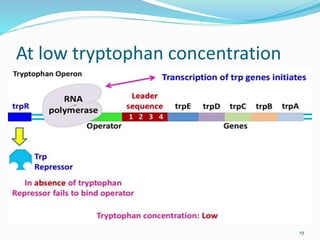
At low concentration of tryptophan
 The repressor protein does not bind to the operator
 RNA polymerase can bypass and
 The tryptophan genes will be transcribed
2. Eukaryotic Gene Regulation
21
Eukaryotic gene structure
Eukaryotic gene structure is the organization of the
eukaryotic genes in the genome.
Immature Transcript contains exons and introns regions
At post-transcriptional processing introns are spliced out by
spliceosome
Exon regions are retained in the mature mRNA
Adds a 5' cap to the start of the mRNA
 A poly-adenosine tail to the end of the mRNA
These additions stabilise the mRNA and direct its transport
from the nucleus to the cytoplasm,
22
5’ cap
Triphosphatase cut the third phosphate group
Guanyle transferase join Guanine to the phosphate
remained
Methyl transferase bind methyl group at the seventh
N of Guanine
This m7G capping prevents the mRNA from
exonuclease attack
23
A poly-adenosine tail
Pre-mrna is first cleaved off by Cleavage and
polyadenylation specificity factor (CPSF)
Poly(A) polymerase synthesizes poly(A) tails
Poly(A)-binding protein II (PAB II) adds Adenine
(A) at the 3′ end of mRNA
24
Eukaryotic Gene Structure
25
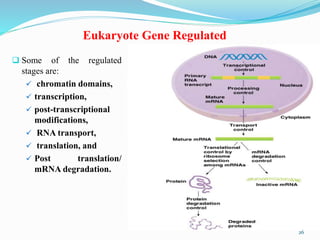
Eukaryote Gene Regulated
 Some of the regulated
stages are:
 chromatin domains,
 transcription,
 post-transcriptional
modifications,
 RNA transport,
 translation, and
 Post translation/
mRNA degradation.
26
Eukaryotic gene regulation
Eukaryotic genes are regulated in protein-coding
sequences and controlling sites called regulon.
 unlike operon regulon is a functional genetic unit that
composed of a non-contiguous group of genes.
 Predominantly regulons are found in eukaryotes.
Eg. Ada regulon, CRP regulon, FNR regulon
Eukaryotic gene regulation is more complex
Transcription is conducted in nucleus
Translation occurs in Golgi body or ribosome
Transcription and translation are not coupled
27
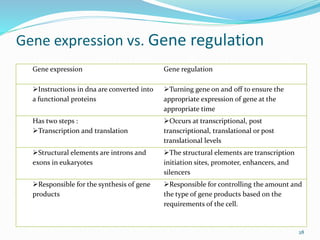
Gene expression vs. Gene regulation
28
Gene expression Gene regulation
Instructions in dna are converted into
a functional proteins
Turning gene on and off to ensure the
appropriate expression of gene at the
appropriate time
Has two steps :
Transcription and translation
Occurs at transcriptional, post
transcriptional, translational or post
translational levels
Structural elements are introns and
exons in eukaryotes
The structural elements are transcription
initiation sites, promoter, enhancers, and
silencers
Responsible for the synthesis of gene
products
Responsible for controlling the amount and
the type of gene products based on the
requirements of the cell.
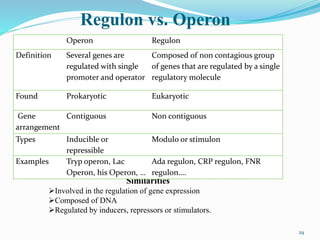
Regulon vs. Operon
29
Similarities
Involved in the regulation of gene expression
Composed of DNA
Regulated by inducers, repressors or stimulators.
Operon Regulon
Definition Several genes are
regulated with single
promoter and operator
Composed of non contagious group
of genes that are regulated by a single
regulatory molecule
Found Prokaryotic Eukaryotic
Gene
arrangement
Contiguous Non contiguous
Types Inducible or
repressible
Modulo or stimulon
Examples Tryp operon, Lac
Operon, his Operon, …
Ada regulon, CRP regulon, FNR
regulon….
30

Gene expression and regulation

  • 1.
  • 2.
    Coverage 1. Prokaryotic geneexpression and regulation Prokaryotic “gene structure” A. Basic structure of Operon B. Lactose Operon” regulation C. Tryptophan Operon” regulation 2. Eukaryotic gene expression and regulation Eukaryotic gene structure Regulons 2
  • 3.
    Terminologies Gene expression isthe process by which the information on genes is used to synthesize a gene product. Two steps 1. Transcription 2. Translation Gene regulation is the process of turning genes on and off to controls the amount and the type of gene products Regulation of gene expression  Controls the developmental process  Responds to environmental stimuli  Helps for adaptation to a novel environmental condition Gene structure is the organization of specialized sequences of genes in the genome. 3
  • 4.
  • 5.
  • 6.
    A. Basic structureof Operon An operon  Cluster of genes with related functions  Control the gene expression of prokaryotics  Regulate these genes altogether under a single promoter  Transcribed into the same mRNA  Translated simultaneously in ribosome (transcriptional coupling)  Prokaryotics have polycistronic operon 6
  • 7.
    Regulatory gene: Encodesa repressor Promoter The sequence of DNA where RNA polymerase will bind to initiate transcription of the genes that follow Operator : is the stoplight for RNA polymerase, either allowing or preventing from transcribing all of the structural genes A series of structural genes : coded gene A termination sequence: The sequence of DNA which signals the transcription to stop Basic structure of Operon cont’d 7
  • 8.
  • 9.
    Operon in prokaryotics Thereare different types of operon in prokaryotics I. Lactose operon: lactose to Glucose & Galactose II. Tryptophan Operon: synthesis of tryptophan III. Lux operon; production of luminescent proteins IV. L-arabinose operon - L-arabinose to pentise phosphate pathway , D-xylulose-5-phosphate. 9
  • 10.
    I. Lac Operon Themost common example Catabolic type of operon E. Coli prefers glucose as source carbon and energy but will metabolize lactose in the absence of glucose Contains structural genes that encode enzymes to break down lactose Activate when Glucose is absent and lactose is present 10
  • 11.
    Regulator of lacoperon: cAMP CAP cAMP-CAP complex Presence or absence of Glucose and Lactose Lac Operon Regulation Catabolite repression  Glucose has affinity to bind to enzyme adenylate cyclase  Enzyme adenylate cyclase changes ATP to cAMP  If glucose binds to adenylate cyclase ATP won’t be converted to cAMP 11
  • 12.
    Lac Operon Regulation 12 Highpercentage of glucose Preventing the conversion of ATP into cAMP CAP remain in an inactive conformation  Inactivate lac operon Low percentage of glucose  Adenylate cyclase is free and active  cAMP is formed  cAMP-CAP complex formed and activate lac operon CAP-cAMP complex increases the binding ability of RNA polymerase to the promoter region to initiate the transcription.
  • 13.
    Catabolite repression Lac Operongot three Enzymes  Lac z- B-galactosidase: cleave lactose into galactose and glucose  Lac y- lactose permease: facilitates the passage of lactose across the phospholipid bi-layer of the cell membrane with an active transport  Lac A- lactose trans acetylase : assist cellular detoxification by acetylating nonmetabolizable pyranosides 13
  • 14.
    Glucose repression andcAMP-CAP complex 14
  • 15.
    No glucose andno lactose 15 Presence of glucose and no lactose
  • 16.
    Presence of glucoseand lactose 16 The presence of lactose & no glucose
  • 17.
    II. Tryptophan Operon/trpOperon  The tryp operon in E. coli contains five structural genes corresponding to enzymes that Convert chorismate into tryptophan  Tryptophan is an amino acid that E. coli need it to survive for building proteins 17
  • 18.
    At high tryptophanconcentration 18
  • 19.
    At low tryptophanconcentration 19
  • 20.
    At high concentrationof tryptophan  Two tryptophan molecules bind the repressor  The repressor bind to operator sequence RNA polymerase will be blocked from transcribing the tryptophan genes 20 At low concentration of tryptophan  The repressor protein does not bind to the operator  RNA polymerase can bypass and  The tryptophan genes will be transcribed
  • 21.
    2. Eukaryotic GeneRegulation 21
  • 22.
    Eukaryotic gene structure Eukaryoticgene structure is the organization of the eukaryotic genes in the genome. Immature Transcript contains exons and introns regions At post-transcriptional processing introns are spliced out by spliceosome Exon regions are retained in the mature mRNA Adds a 5' cap to the start of the mRNA  A poly-adenosine tail to the end of the mRNA These additions stabilise the mRNA and direct its transport from the nucleus to the cytoplasm, 22
  • 23.
    5’ cap Triphosphatase cutthe third phosphate group Guanyle transferase join Guanine to the phosphate remained Methyl transferase bind methyl group at the seventh N of Guanine This m7G capping prevents the mRNA from exonuclease attack 23
  • 24.
    A poly-adenosine tail Pre-mrnais first cleaved off by Cleavage and polyadenylation specificity factor (CPSF) Poly(A) polymerase synthesizes poly(A) tails Poly(A)-binding protein II (PAB II) adds Adenine (A) at the 3′ end of mRNA 24
  • 25.
  • 26.
    Eukaryote Gene Regulated Some of the regulated stages are:  chromatin domains,  transcription,  post-transcriptional modifications,  RNA transport,  translation, and  Post translation/ mRNA degradation. 26
  • 27.
    Eukaryotic gene regulation Eukaryoticgenes are regulated in protein-coding sequences and controlling sites called regulon.  unlike operon regulon is a functional genetic unit that composed of a non-contiguous group of genes.  Predominantly regulons are found in eukaryotes. Eg. Ada regulon, CRP regulon, FNR regulon Eukaryotic gene regulation is more complex Transcription is conducted in nucleus Translation occurs in Golgi body or ribosome Transcription and translation are not coupled 27
  • 28.
    Gene expression vs.Gene regulation 28 Gene expression Gene regulation Instructions in dna are converted into a functional proteins Turning gene on and off to ensure the appropriate expression of gene at the appropriate time Has two steps : Transcription and translation Occurs at transcriptional, post transcriptional, translational or post translational levels Structural elements are introns and exons in eukaryotes The structural elements are transcription initiation sites, promoter, enhancers, and silencers Responsible for the synthesis of gene products Responsible for controlling the amount and the type of gene products based on the requirements of the cell.
  • 29.
    Regulon vs. Operon 29 Similarities Involvedin the regulation of gene expression Composed of DNA Regulated by inducers, repressors or stimulators. Operon Regulon Definition Several genes are regulated with single promoter and operator Composed of non contagious group of genes that are regulated by a single regulatory molecule Found Prokaryotic Eukaryotic Gene arrangement Contiguous Non contiguous Types Inducible or repressible Modulo or stimulon Examples Tryp operon, Lac Operon, his Operon, … Ada regulon, CRP regulon, FNR regulon….
  • 30.

Editor's Notes

  • #14 . The transport mechanism used is that uses the inwardly directed H+ electrochemical gradient as its driving force.
  • #17 Lactose repressor complex changes the repressor so that it cant bind to the operator. Thus RNAP will pass easily. Presence of glucose bind the adenaylate cyclase cant change ATP to Camp and can’t activate CAP to join with RANP alpha sub unit to be active.