Ancient Greece
500-323 B.C.E.
Questions for Today
 How does family form change with change from
hunting gathering society to more permanent
settlements?
 What was the basis for citizenship in Athens
Greece?
 What are some characteristics of medieval
towns?
 How did trade help to spread the plague?
 What is a ‘demographic transition’?
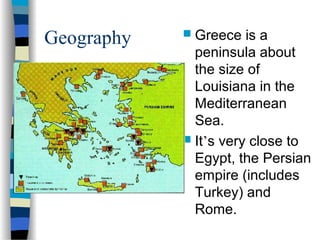
Geography  Greece is a
peninsula about
the size of
Louisiana in the
Mediterranean
Sea.
 It’s very close to
Egypt, the Persian
empire (includes
Turkey) and
Rome.
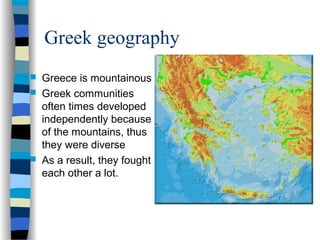
Greek geography
 Greece is mountainous
 Greek communities
often times developed
independently because
of the mountains, thus
they were diverse
 As a result, they fought
each other a lot.
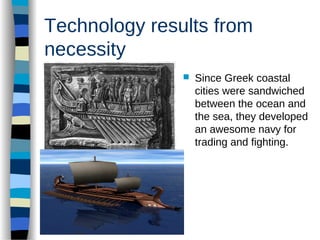
Technology results from
necessity
 Since Greek coastal
cities were sandwiched
between the ocean and
the sea, they developed
an awesome navy for
trading and fighting.
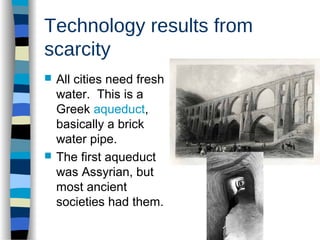
Technology results from
scarcity
 All cities need fresh
water. This is a
Greek aqueduct,
basically a brick
water pipe.
 The first aqueduct
was Assyrian, but
most ancient
societies had them.
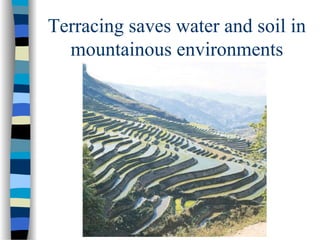
Terracing saves water and soil in
mountainous environments
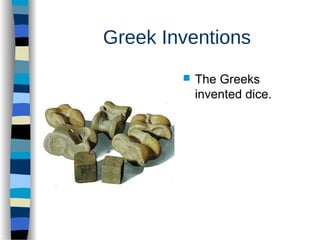
Greek Inventions
 The Greeks
invented dice.
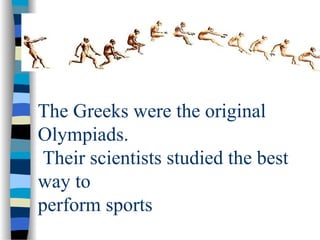
The Greeks were the original
Olympiads.
Their scientists studied the best
way to
perform sports
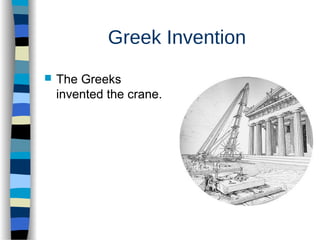
Greek Invention
 The Greeks
invented the crane.
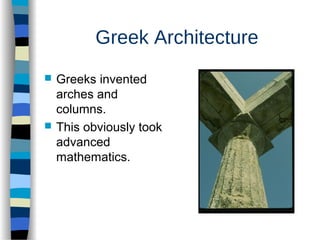
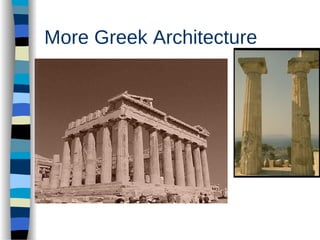
Greek Architecture
 Greeks invented
arches and
columns.
 This obviously took
advanced
mathematics.
More Greek Architecture
Greek Military
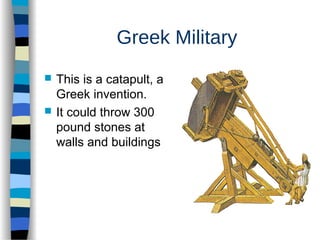
 This is a catapult, a
Greek invention.
 It could throw 300
pound stones at
walls and buildings
Greek Military
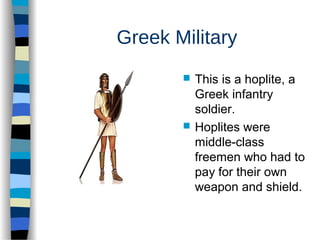
 This is a hoplite, a
Greek infantry
soldier.
 Hoplites were
middle-class
freemen who had to
pay for their own
weapon and shield.
Greek Military
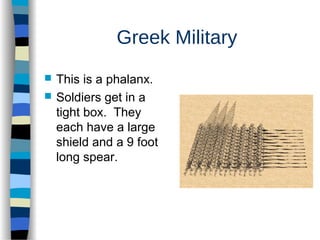
 This is a phalanx.
 Soldiers get in a
tight box. They
each have a large
shield and a 9 foot
long spear.
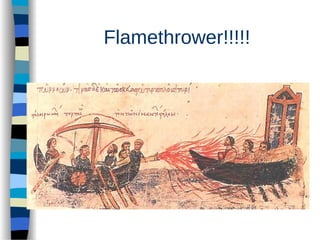
Flamethrower!!!!!
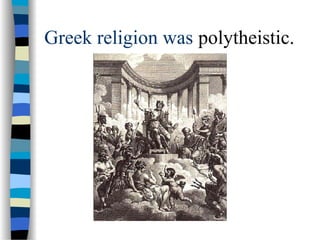
Greek religion was polytheistic.
Political: Athens was the first
democracy.
 Democracy: type of government where
people vote.
 Well, actually, Athens was a direct
democracy where people vote on
everything.
 The U.S. today is a representative
democracy, where we vote for people to
make decisions for us.
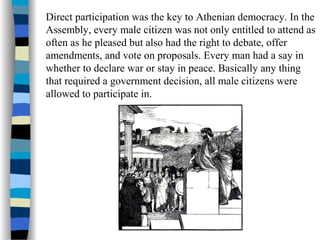
Direct participation was the key to Athenian democracy. In the
Assembly, every male citizen was not only entitled to attend as
often as he pleased but also had the right to debate, offer
amendments, and vote on proposals. Every man had a say in
whether to declare war or stay in peace. Basically any thing
that required a government decision, all male citizens were
allowed to participate in.
Remember! If you think the U.S.
is so much better. . .
 Some southern states did not let African
Americans vote until the 1960s (Voting
Rights Act 1965)
 Women could not vote in the U.S. until
1920 (19th
Amendment)
 Eighteen year olds could not vote until
the late 1970s.
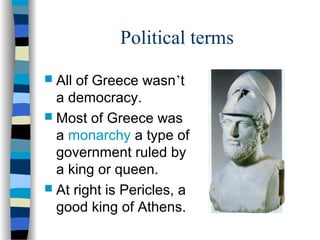
Political terms
 All of Greece wasn’t
a democracy.
 Most of Greece was
a monarchy a type of
government ruled by
a king or queen.
 At right is Pericles, a
good king of Athens.
Ancient Cities: 1000 B.C. to A.D. 300
 Despite their many differences, stemming
from their various histories, cultures,
locations, ancient imperial centers shared
several important structural characteristics:
repository of knowledge, power, wealth, and
control in ancient world. Euripedes “may all
“first requisite to happiness is birth in a great
city” notions of government, religion,
civilization, family, and country closely
intertwined for the ancients with the concept
of the “city”
Physical Features Ancient City
 Physical features of the ancient cities – constructed
with an eye toward public life: temples for worship,
markets for commerce, theaters for entertainment,
and for a (plural of the Latin for him) for
debate/discussion. Built environment a reflection of
nature of government: highly centralized/militaristic.
Ancient Greece partially planned, main roads
converging on marketplace /temple. Every city
fortified, surrounded by walls, contain one or more
forts located in a high place (Acropolis) Like Athens
center of Rome contained plazas, markets, public
buildings such as the Forum and Coliseum;
Social patterns in Ancient Cities
 Social patterns – substantial wealth available
only to elite, gain access to benefits that
society would have to be a member, which in
most cases meant being a citizen, but access
to membership was restricted. There was
limited by gender; men had full access to
legal rights, women badly limited or no
access to citizenship and few property rights.
Second, membership limited by descent.
Social patterns ….
 Ancient civilization used patrilineal descent systems,
male children inherit father’s positions, including
property and social obligations. Precapitalist
economy no wage labor so no working class; small
artisan class produce necessary items for household
consumption. Real engine of the economy production
of public goods and services/slave labor. Slaves by
definition were excluded from participation in political
and economic system despite constituting three-
fourths of population in Athens at its peak in fifth
century BC.
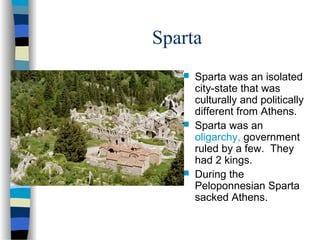
Sparta
 Sparta was an isolated
city-state that was
culturally and politically
different from Athens.
 Sparta was an
oligarchy, government
ruled by a few. They
had 2 kings.
 During the
Peloponnesian Sparta
sacked Athens.
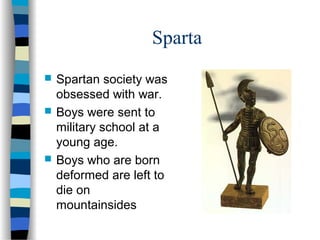
Sparta
 Spartan society was
obsessed with war.
 Boys were sent to
military school at a
young age.
 Boys who are born
deformed are left to
die on
mountainsides
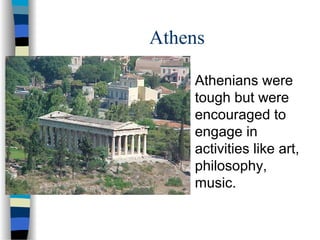
Athens
 Athenians were
tough but were
encouraged to
engage in
activities like art,
philosophy,
music.
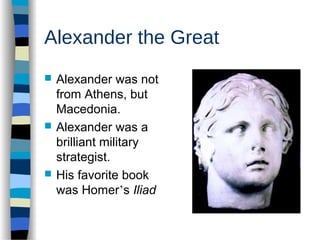
Alexander the Great
 Alexander was not
from Athens, but
Macedonia.
 Alexander was a
brilliant military
strategist.
 His favorite book
was Homer’s Iliad
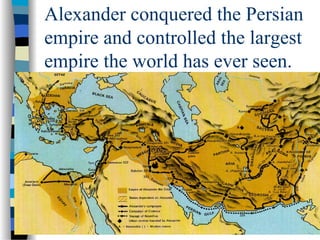
Alexander conquered the Persian
empire and controlled the largest
empire the world has ever seen.
What happens when
cultures collide?
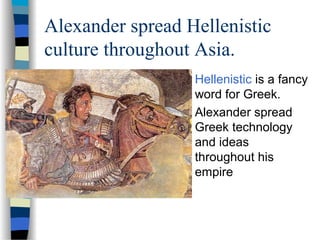
Alexander spread Hellenistic
culture throughout Asia.
 Hellenistic is a fancy
word for Greek.
 Alexander spread
Greek technology
and ideas
throughout his
empire
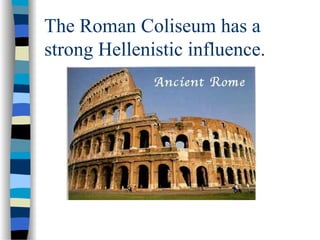
The Roman Coliseum has a
strong Hellenistic influence.
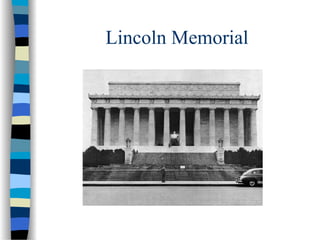
What buildings in the USA have
a Hellenistic influence?
Lincoln Memorial
Any questions
before the quiz?
Greece Quiz
 1.What is Greece’s political contribution to
the political world (especially the United
States)?
 2. How did geography influence Greece’s
economy and military technology?
 3. How did Hellenistic ideas spread
throughout Asia?
 4. Describe an example of how necessity
brings about technological change.
 5. Define monarchy
 6. Define oligarchy

Ancient greece general history

  • 1.
  • 2.
    Questions for Today How does family form change with change from hunting gathering society to more permanent settlements?  What was the basis for citizenship in Athens Greece?  What are some characteristics of medieval towns?  How did trade help to spread the plague?  What is a ‘demographic transition’?
  • 3.
    Geography  Greeceis a peninsula about the size of Louisiana in the Mediterranean Sea.  It’s very close to Egypt, the Persian empire (includes Turkey) and Rome.
  • 4.
    Greek geography  Greeceis mountainous  Greek communities often times developed independently because of the mountains, thus they were diverse  As a result, they fought each other a lot.
  • 5.
    Technology results from necessity Since Greek coastal cities were sandwiched between the ocean and the sea, they developed an awesome navy for trading and fighting.
  • 6.
    Technology results from scarcity All cities need fresh water. This is a Greek aqueduct, basically a brick water pipe.  The first aqueduct was Assyrian, but most ancient societies had them.
  • 7.
    Terracing saves waterand soil in mountainous environments
  • 8.
    Greek Inventions  TheGreeks invented dice.
  • 9.
    The Greeks werethe original Olympiads. Their scientists studied the best way to perform sports
  • 10.
    Greek Invention  TheGreeks invented the crane.
  • 11.
    Greek Architecture  Greeksinvented arches and columns.  This obviously took advanced mathematics.
  • 12.
  • 13.
    Greek Military  Thisis a catapult, a Greek invention.  It could throw 300 pound stones at walls and buildings
  • 14.
    Greek Military  Thisis a hoplite, a Greek infantry soldier.  Hoplites were middle-class freemen who had to pay for their own weapon and shield.
  • 15.
    Greek Military  Thisis a phalanx.  Soldiers get in a tight box. They each have a large shield and a 9 foot long spear.
  • 16.
  • 17.
    Greek religion waspolytheistic.
  • 18.
    Political: Athens wasthe first democracy.  Democracy: type of government where people vote.  Well, actually, Athens was a direct democracy where people vote on everything.  The U.S. today is a representative democracy, where we vote for people to make decisions for us.
  • 19.
    Direct participation wasthe key to Athenian democracy. In the Assembly, every male citizen was not only entitled to attend as often as he pleased but also had the right to debate, offer amendments, and vote on proposals. Every man had a say in whether to declare war or stay in peace. Basically any thing that required a government decision, all male citizens were allowed to participate in.
  • 20.
    Remember! If youthink the U.S. is so much better. . .  Some southern states did not let African Americans vote until the 1960s (Voting Rights Act 1965)  Women could not vote in the U.S. until 1920 (19th Amendment)  Eighteen year olds could not vote until the late 1970s.
  • 21.
    Political terms  Allof Greece wasn’t a democracy.  Most of Greece was a monarchy a type of government ruled by a king or queen.  At right is Pericles, a good king of Athens.
  • 22.
    Ancient Cities: 1000B.C. to A.D. 300  Despite their many differences, stemming from their various histories, cultures, locations, ancient imperial centers shared several important structural characteristics: repository of knowledge, power, wealth, and control in ancient world. Euripedes “may all “first requisite to happiness is birth in a great city” notions of government, religion, civilization, family, and country closely intertwined for the ancients with the concept of the “city”
  • 23.
    Physical Features AncientCity  Physical features of the ancient cities – constructed with an eye toward public life: temples for worship, markets for commerce, theaters for entertainment, and for a (plural of the Latin for him) for debate/discussion. Built environment a reflection of nature of government: highly centralized/militaristic. Ancient Greece partially planned, main roads converging on marketplace /temple. Every city fortified, surrounded by walls, contain one or more forts located in a high place (Acropolis) Like Athens center of Rome contained plazas, markets, public buildings such as the Forum and Coliseum;
  • 24.
    Social patterns inAncient Cities  Social patterns – substantial wealth available only to elite, gain access to benefits that society would have to be a member, which in most cases meant being a citizen, but access to membership was restricted. There was limited by gender; men had full access to legal rights, women badly limited or no access to citizenship and few property rights. Second, membership limited by descent.
  • 25.
    Social patterns …. Ancient civilization used patrilineal descent systems, male children inherit father’s positions, including property and social obligations. Precapitalist economy no wage labor so no working class; small artisan class produce necessary items for household consumption. Real engine of the economy production of public goods and services/slave labor. Slaves by definition were excluded from participation in political and economic system despite constituting three- fourths of population in Athens at its peak in fifth century BC.
  • 26.
    Sparta  Sparta wasan isolated city-state that was culturally and politically different from Athens.  Sparta was an oligarchy, government ruled by a few. They had 2 kings.  During the Peloponnesian Sparta sacked Athens.
  • 27.
    Sparta  Spartan societywas obsessed with war.  Boys were sent to military school at a young age.  Boys who are born deformed are left to die on mountainsides
  • 28.
    Athens  Athenians were toughbut were encouraged to engage in activities like art, philosophy, music.
  • 29.
    Alexander the Great Alexander was not from Athens, but Macedonia.  Alexander was a brilliant military strategist.  His favorite book was Homer’s Iliad
  • 30.
    Alexander conquered thePersian empire and controlled the largest empire the world has ever seen.
  • 31.
  • 32.
    Alexander spread Hellenistic culturethroughout Asia.  Hellenistic is a fancy word for Greek.  Alexander spread Greek technology and ideas throughout his empire
  • 33.
    The Roman Coliseumhas a strong Hellenistic influence.
  • 34.
    What buildings inthe USA have a Hellenistic influence?
  • 35.
  • 36.
  • 37.
    Greece Quiz  1.Whatis Greece’s political contribution to the political world (especially the United States)?  2. How did geography influence Greece’s economy and military technology?  3. How did Hellenistic ideas spread throughout Asia?  4. Describe an example of how necessity brings about technological change.  5. Define monarchy  6. Define oligarchy