GOOD AFTERNOON
GRADE 9!
GREEK ARCHITECTURE
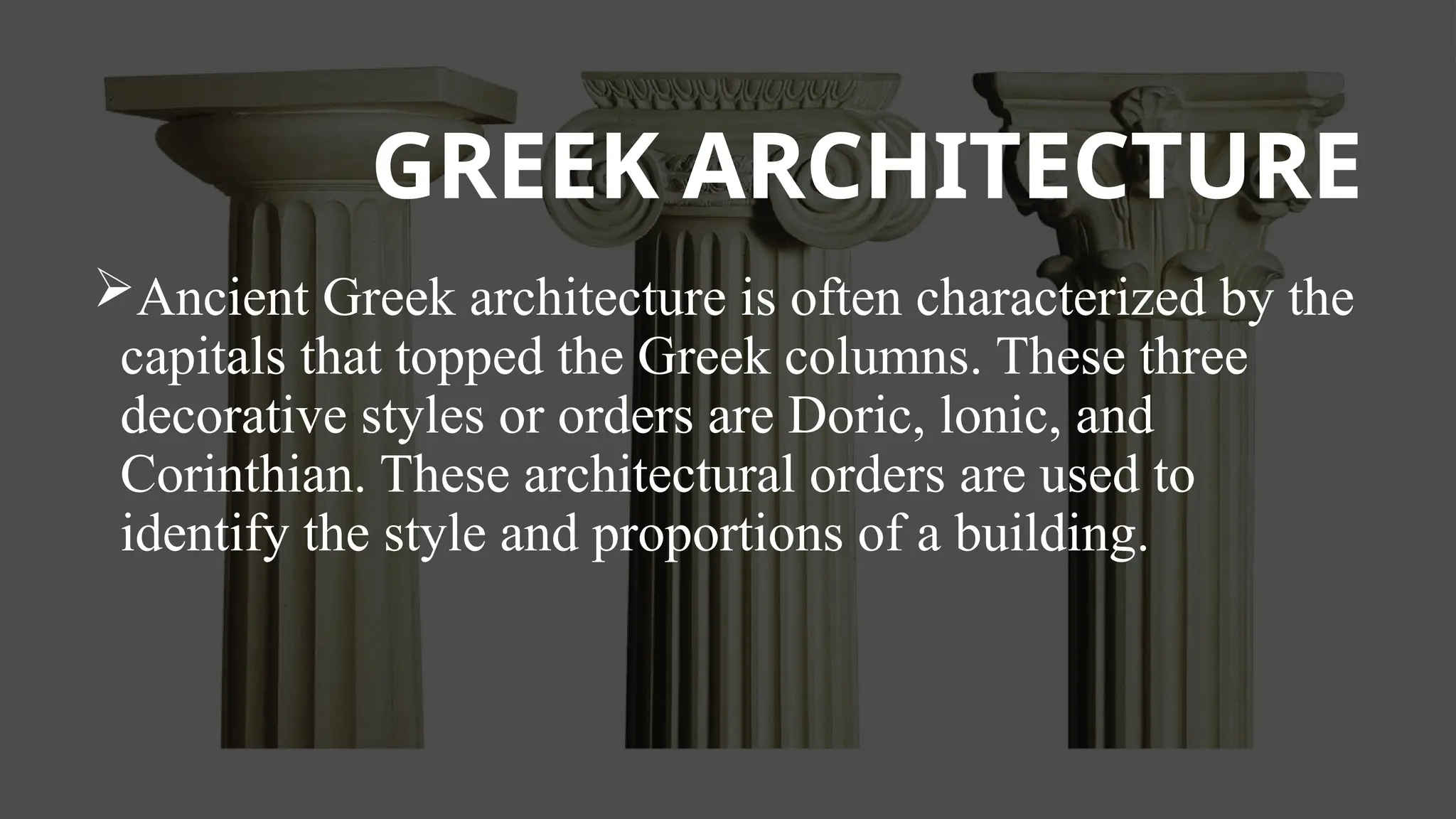
Ancient Greek architecture is often characterized by the
capitals that topped the Greek columns. These three
decorative styles or orders are Doric, lonic, and
Corinthian. These architectural orders are used to
identify the style and proportions of a building.
GREEK
ARCHITECTURE
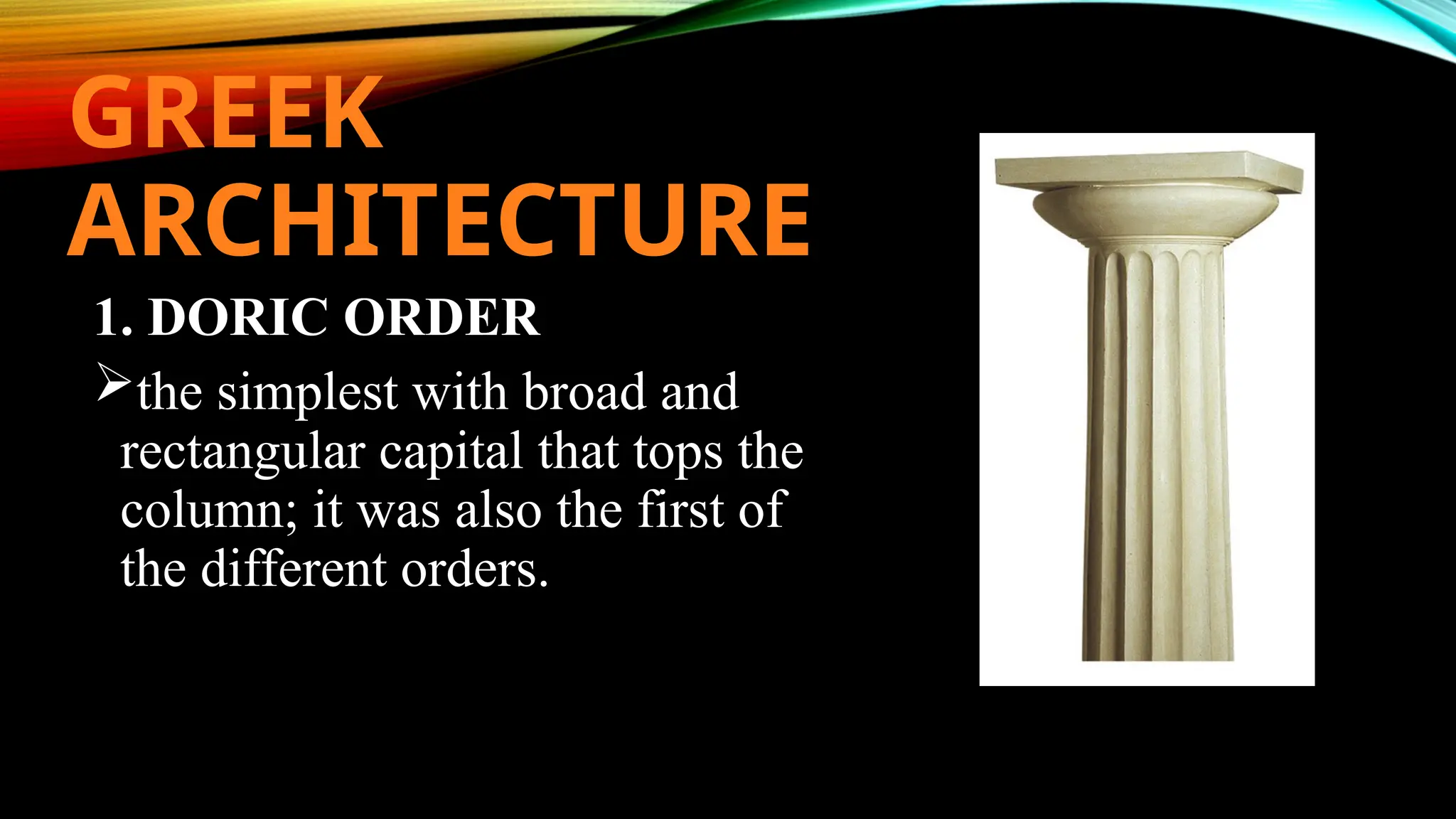
1. DORIC ORDER
the simplest with broad and
rectangular capital that tops the
column; it was also the first of
the different orders.
GREEK
ARCHITECTURE
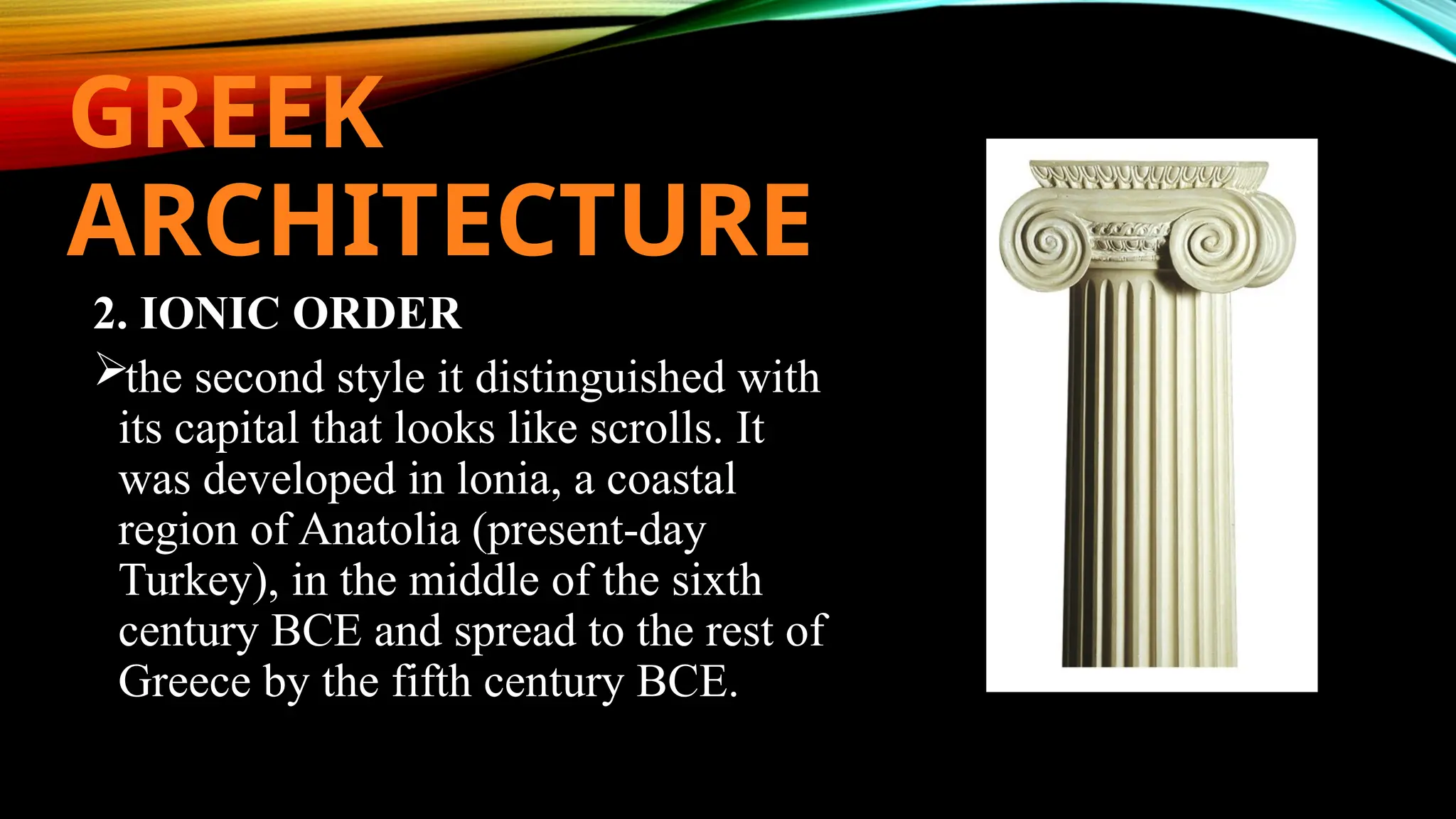
2. IONIC ORDER
the second style it distinguished with
its capital that looks like scrolls. It
was developed in lonia, a coastal
region of Anatolia (present-day
Turkey), in the middle of the sixth
century BCE and spread to the rest of
Greece by the fifth century BCE.
GREEK
ARCHITECTURE
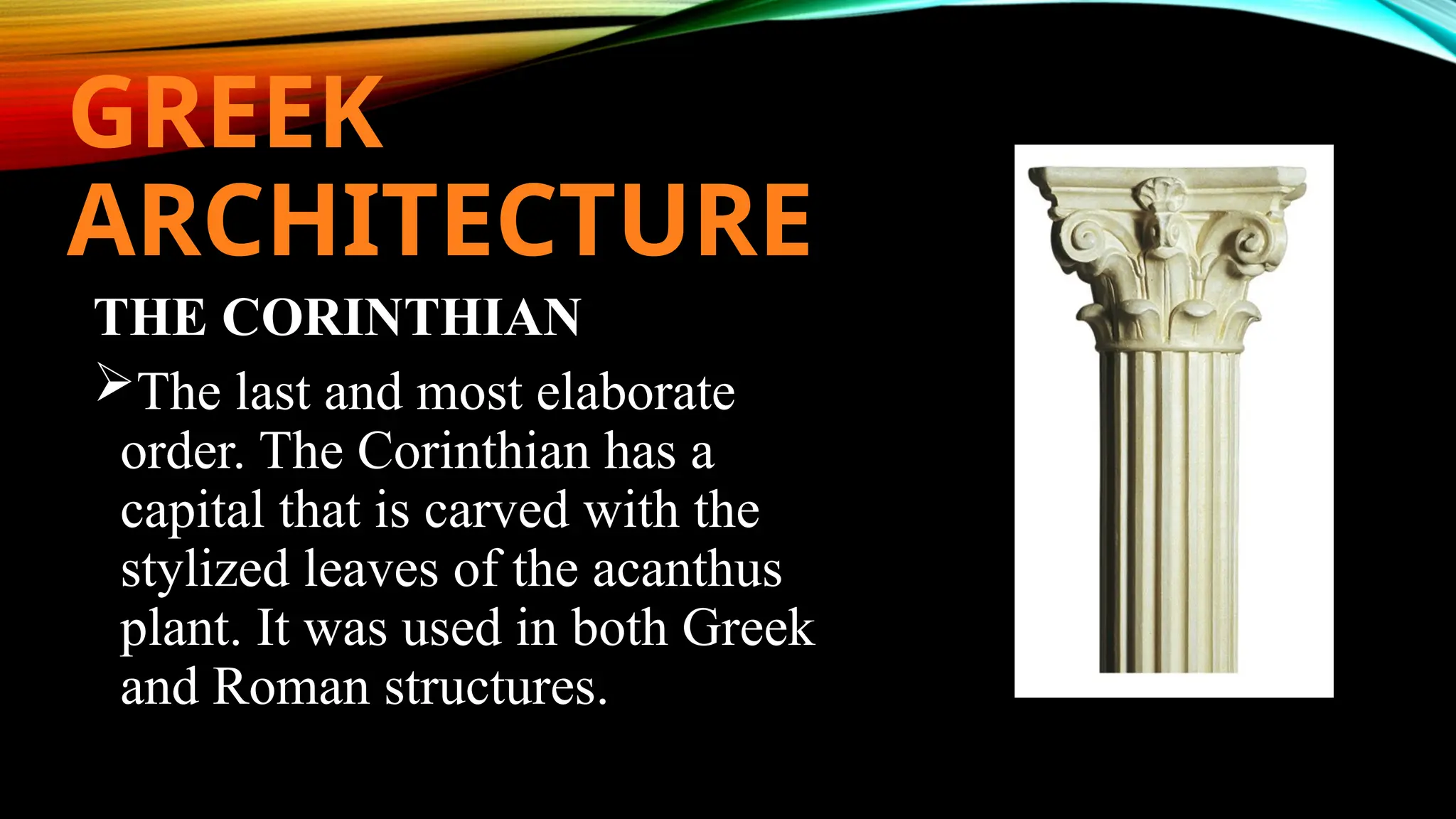
THE CORINTHIAN
The last and most elaborate
order. The Corinthian has a
capital that is carved with the
stylized leaves of the acanthus
plant. It was used in both Greek
and Roman structures.
GREEK
ARCHITECTURE
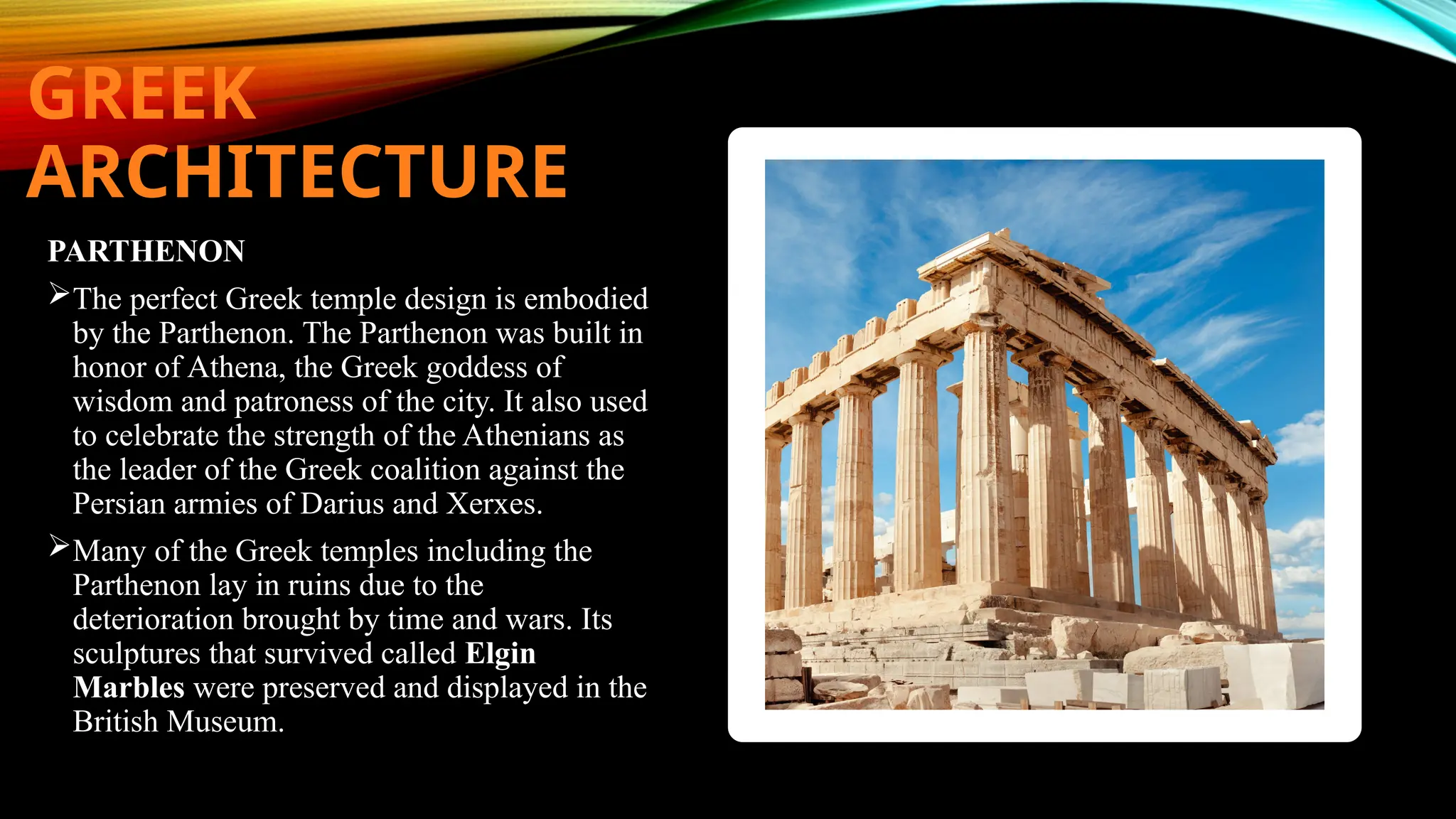
PARTHENON
The perfect Greek temple design is embodied
by the Parthenon. The Parthenon was built in
honor of Athena, the Greek goddess of
wisdom and patroness of the city. It also used
to celebrate the strength of the Athenians as
the leader of the Greek coalition against the
Persian armies of Darius and Xerxes.
Many of the Greek temples including the
Parthenon lay in ruins due to the
deterioration brought by time and wars. Its
sculptures that survived called Elgin
Marbles were preserved and displayed in the
British Museum.
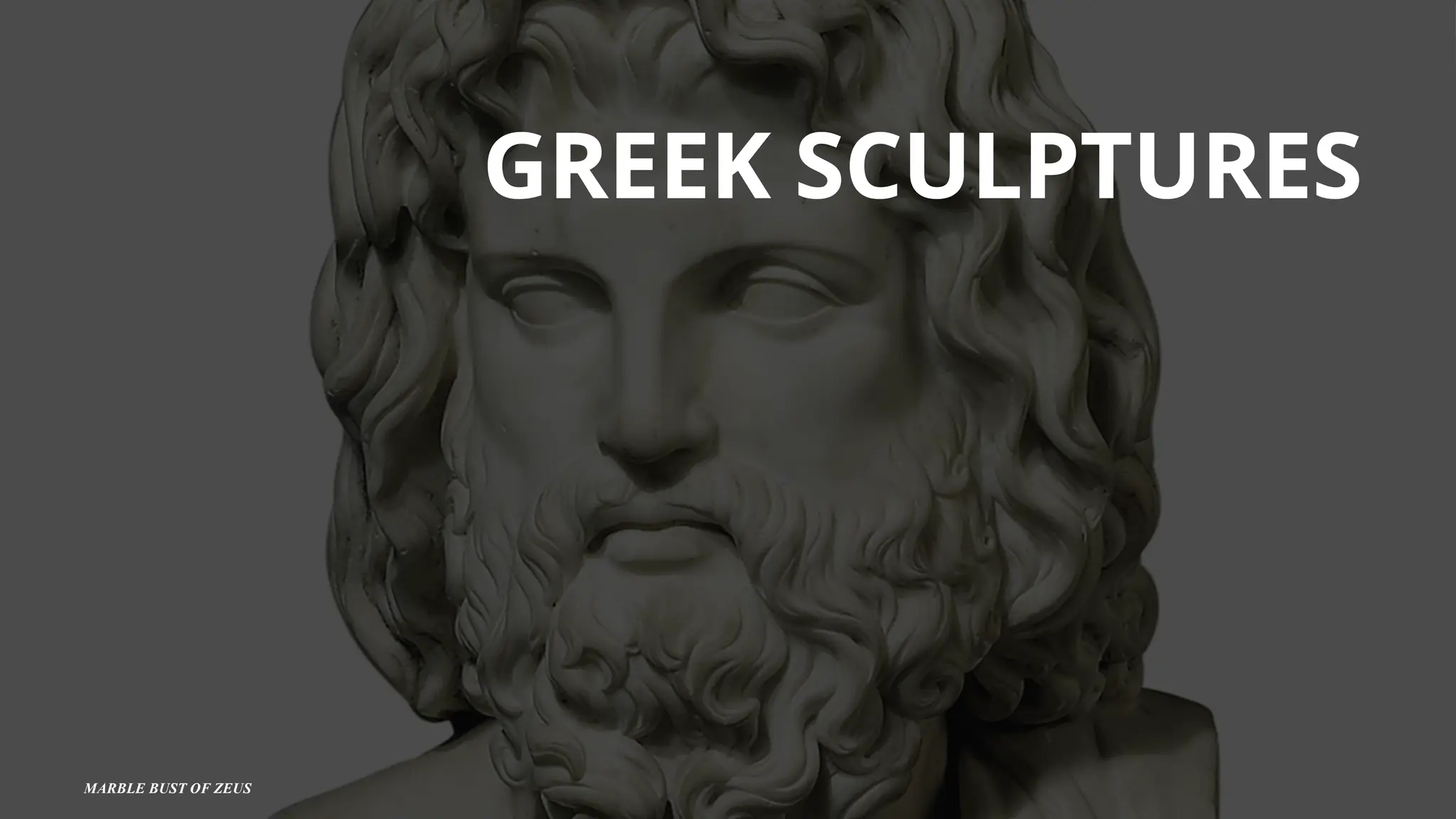
GREEK SCULPTURES
MARBLE BUST OF ZEUS
GREEK
SCULPTURES
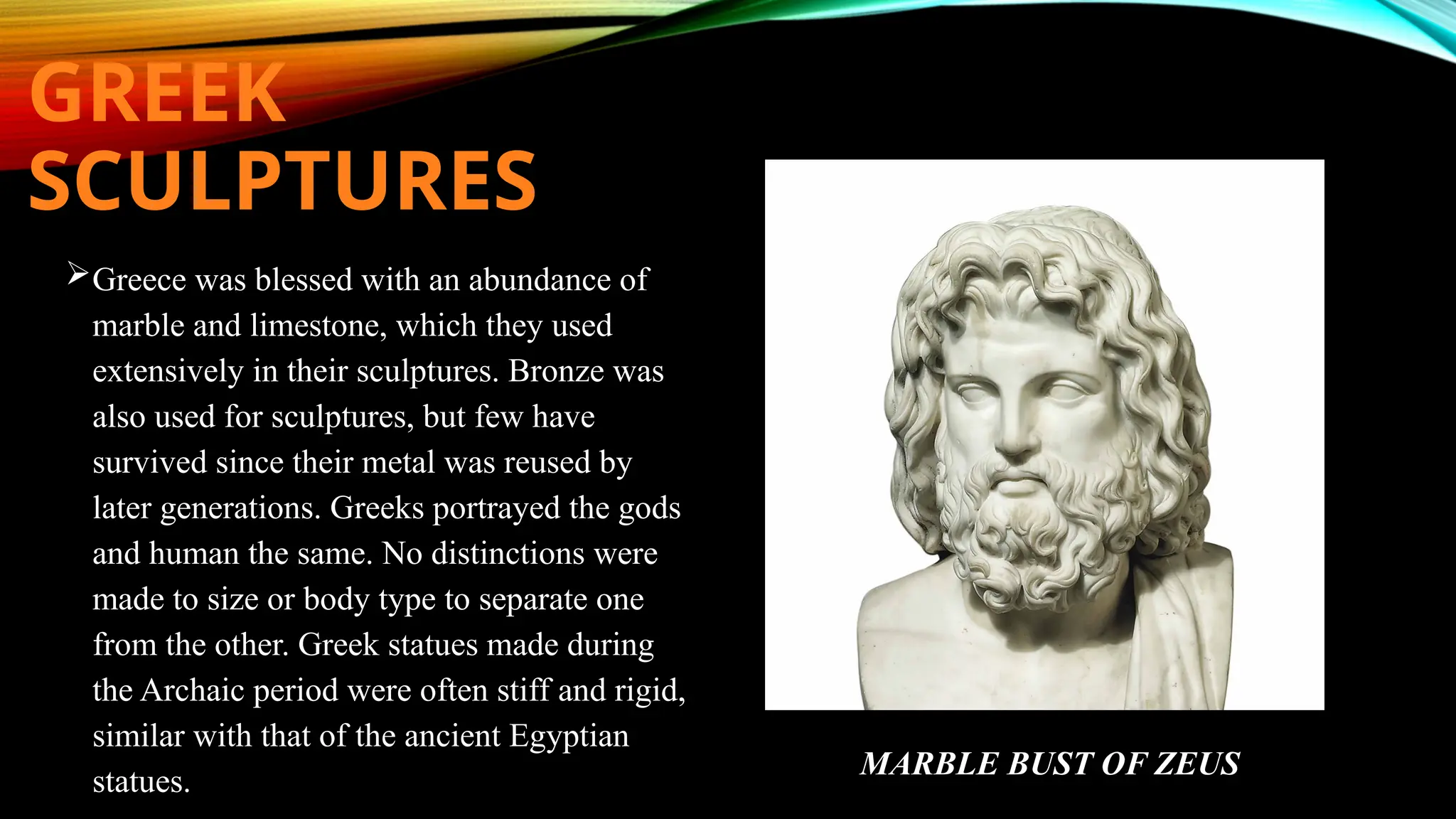
Greece was blessed with an abundance of
marble and limestone, which they used
extensively in their sculptures. Bronze was
also used for sculptures, but few have
survived since their metal was reused by
later generations. Greeks portrayed the gods
and human the same. No distinctions were
made to size or body type to separate one
from the other. Greek statues made during
the Archaic period were often stiff and rigid,
similar with that of the ancient Egyptian
statues.
MARBLE BUST OF ZEUS
GREEK
SCULPTURES
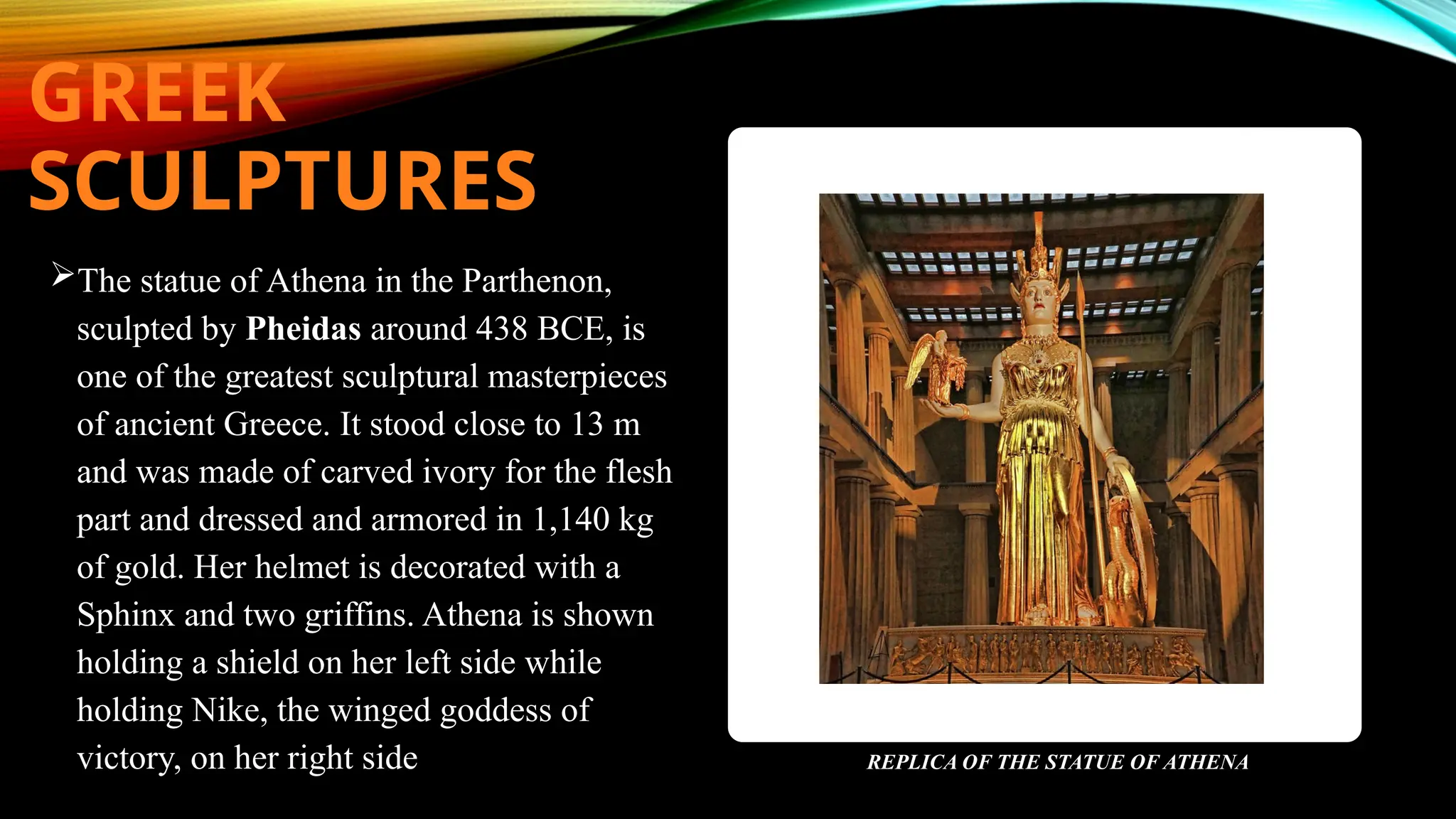
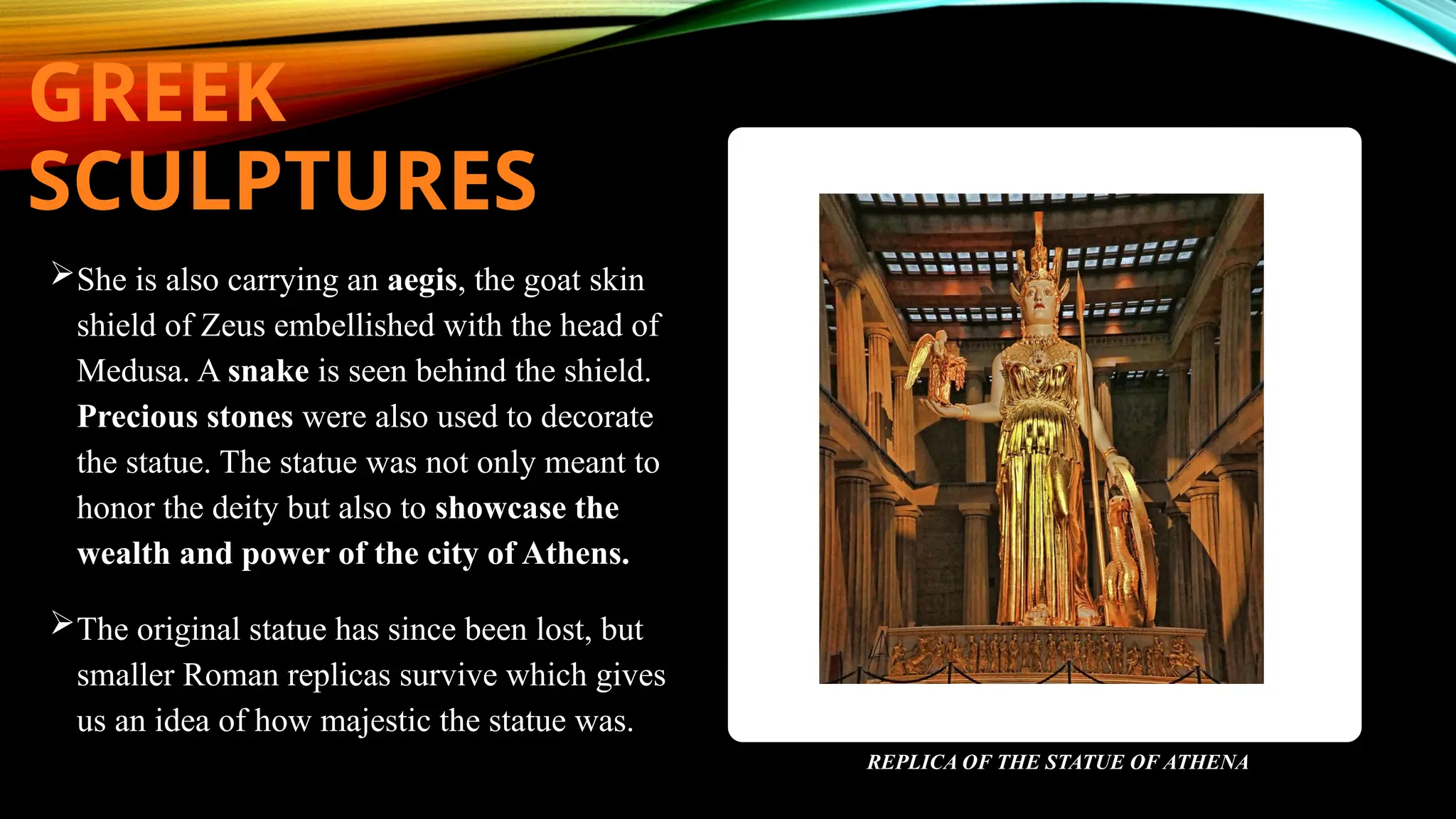
The statue of Athena in the Parthenon,
sculpted by Pheidas around 438 BCE, is
one of the greatest sculptural masterpieces
of ancient Greece. It stood close to 13 m
and was made of carved ivory for the flesh
part and dressed and armored in 1,140 kg
of gold. Her helmet is decorated with a
Sphinx and two griffins. Athena is shown
holding a shield on her left side while
holding Nike, the winged goddess of
victory, on her right side REPLICA OF THE STATUE OF ATHENA
GREEK
SCULPTURES
She is also carrying an aegis, the goat skin
shield of Zeus embellished with the head of
Medusa. A snake is seen behind the shield.
Precious stones were also used to decorate
the statue. The statue was not only meant to
honor the deity but also to showcase the
wealth and power of the city of Athens.
The original statue has since been lost, but
smaller Roman replicas survive which gives
us an idea of how majestic the statue was.
REPLICA OF THE STATUE OF ATHENA
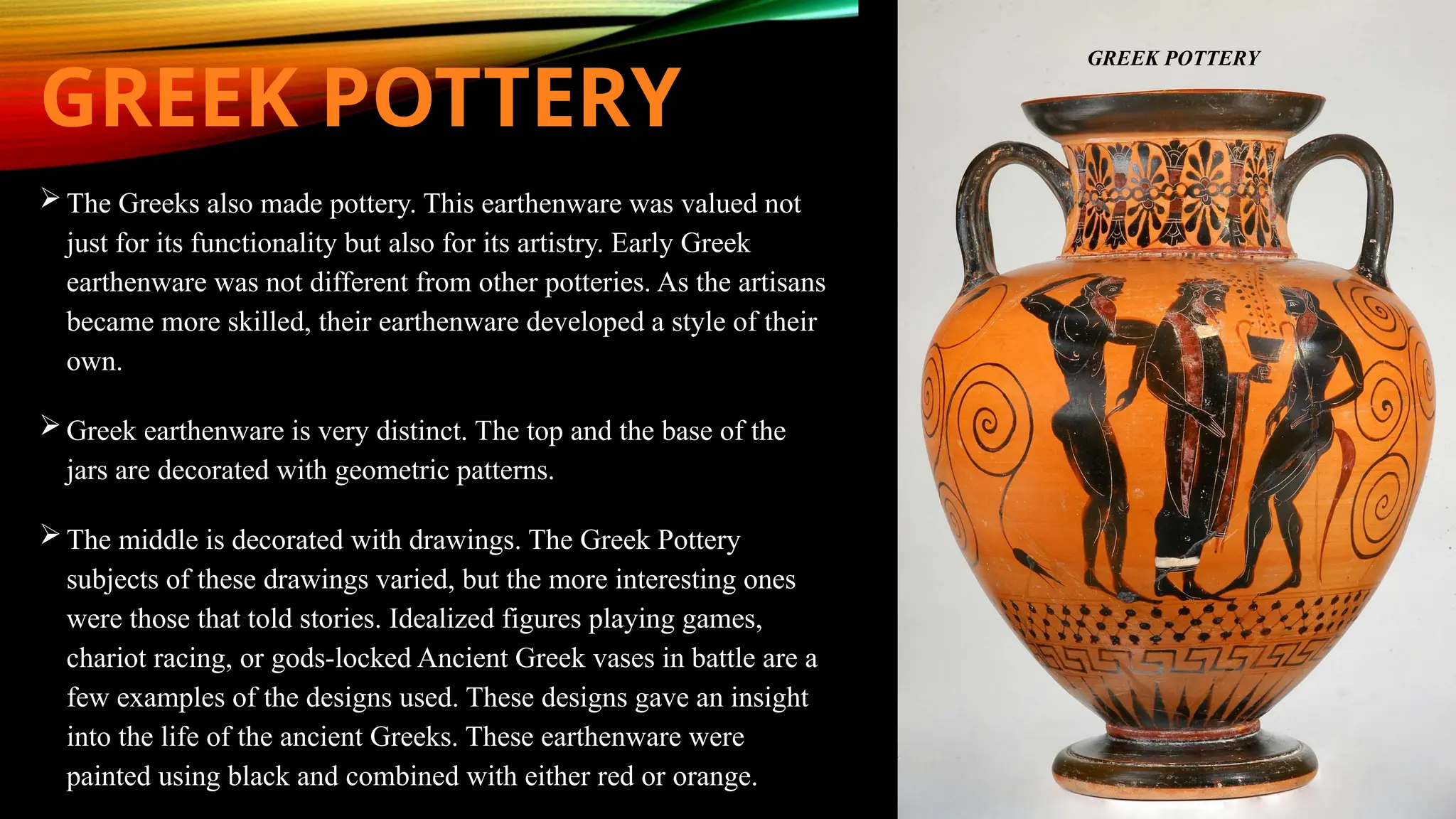
GREEK POTTERY
 The Greeks also made pottery. This earthenware was valued not
just for its functionality but also for its artistry. Early Greek
earthenware was not different from other potteries. As the artisans
became more skilled, their earthenware developed a style of their
own.
 Greek earthenware is very distinct. The top and the base of the
jars are decorated with geometric patterns.
 The middle is decorated with drawings. The Greek Pottery
subjects of these drawings varied, but the more interesting ones
were those that told stories. Idealized figures playing games,
chariot racing, or gods-locked Ancient Greek vases in battle are a
few examples of the designs used. These designs gave an insight
into the life of the ancient Greeks. These earthenware were
painted using black and combined with either red or orange.
GREEK POTTERY
FALL OF THE GREECE
 The death of Alexander the Great in 323 BCE created turmoil within the Greek Empire. Alexander's generals
warred among themselves. Continued conflicts among Greece's city states made them weak. The Romans took
advantage of this instability and invaded Greece and made it their territory Greece became a province of Rome
in 146 BCE
ART OF ANCIENT ROME
Rome started as a village in the eighth century BCE It was a monarchy that later became a
republic in 509 BCE By the third Century BCE, Rome gained control of the entire Italian
peninsula. From 246-146 BCE, Rome warred against Carthage in the Punic
Rome's victory gave them dominion over the Mediterranean, dislodging Hellenistic Greece
as the regional power for the next five centuries. The Roman Empire was established under
Emperor Augustus in 27 BCE Rome reached the peak of its power in the second century
BCE It occupied most of Europe including the areas that surround the Mediterranean Sea
During Emperor Trajan, the Roman Empire reached its peak-covering an area of 5 million
km2 and ruled one-fifth or 21 percent of the entire human population at the time.
Roman practicality, combined with their Greek obsession of the ideal resulted in more
realistic depictions in art.
ROMAN
SCULPTURES
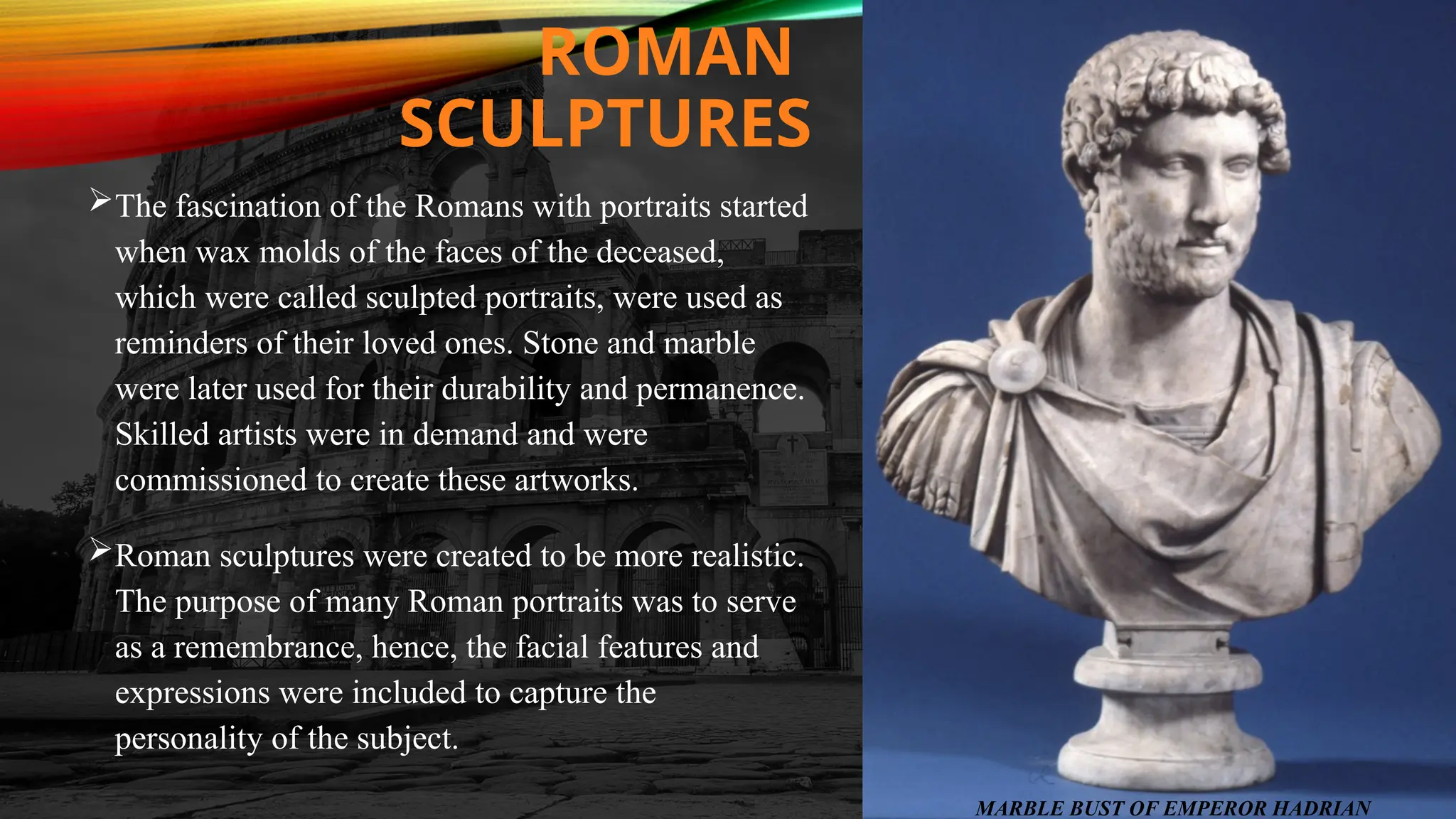
The fascination of the Romans with portraits started
when wax molds of the faces of the deceased,
which were called sculpted portraits, were used as
reminders of their loved ones. Stone and marble
were later used for their durability and permanence.
Skilled artists were in demand and were
commissioned to create these artworks.
Roman sculptures were created to be more realistic.
The purpose of many Roman portraits was to serve
as a remembrance, hence, the facial features and
expressions were included to capture the
personality of the subject.
MARBLE BUST OF EMPEROR HADRIAN
ROMAN POTTERY
Pottery during the ancient Roman times was mostly
utilitarian and was used in their daily lives. Early Roman
earthenware was influenced by the Etruscans (located in
Tuscan, Italy) and the Greeks. Later on, they developed their
own style. Decorations on Roman pottery were engraved,
unlike the Greek earthenware whose designs were painted
on.
Two types of Roman earthenware:
1. Coarse ware - Made for everyday use such as cooking,
storing liquids, etc. These were often cheaply made and were
simple in design.
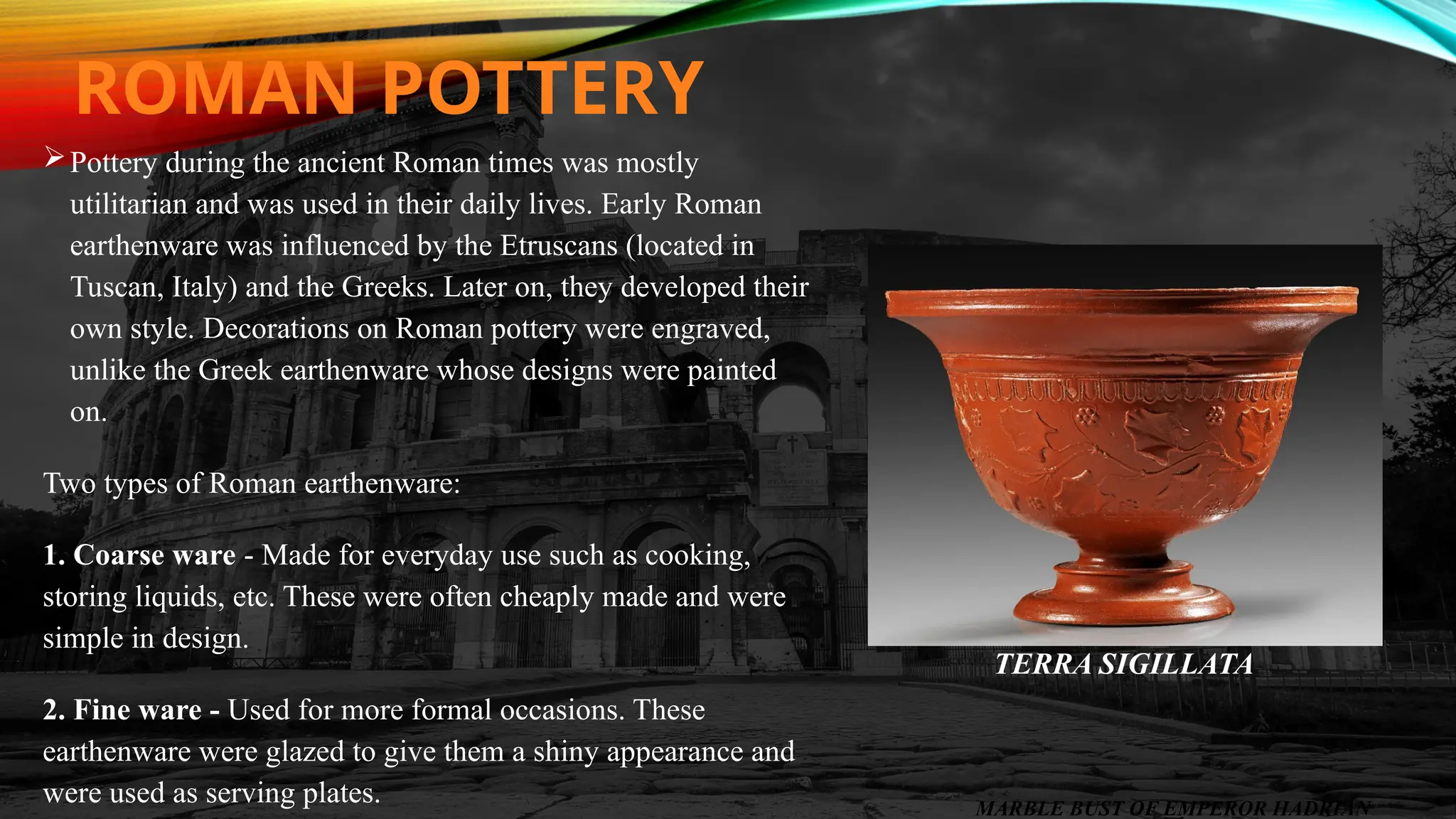
2. Fine ware - Used for more formal occasions. These
earthenware were glazed to give them a shiny appearance and
were used as serving plates. MARBLE BUST OF EMPEROR HADRIAN
TERRA SIGILLATA
ROMAN ARCHITECTURE
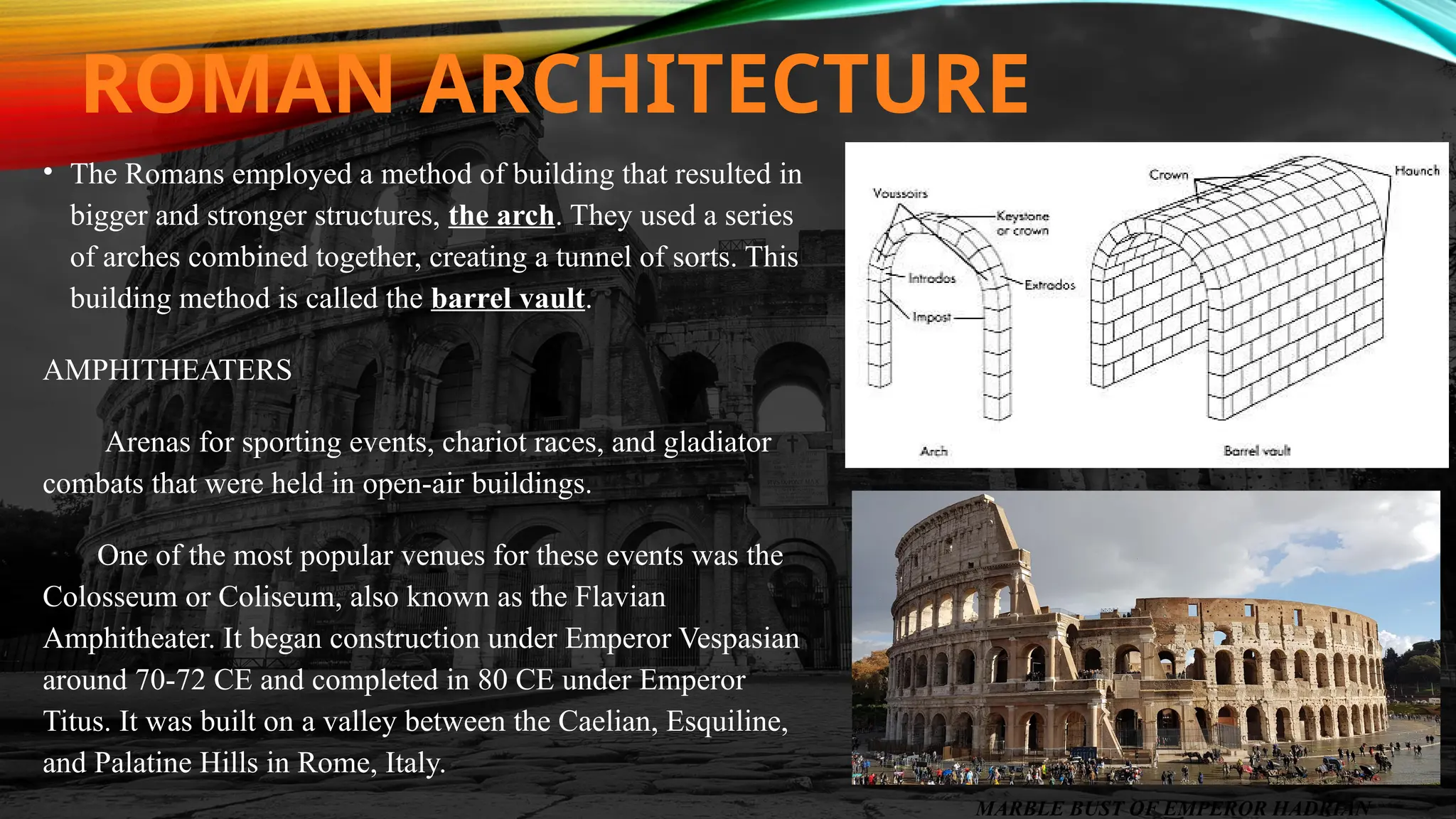
• The Romans employed a method of building that resulted in
bigger and stronger structures, the arch. They used a series
of arches combined together, creating a tunnel of sorts. This
building method is called the barrel vault.
AMPHITHEATERS
Arenas for sporting events, chariot races, and gladiator
combats that were held in open-air buildings.
One of the most popular venues for these events was the
Colosseum or Coliseum, also known as the Flavian
Amphitheater. It began construction under Emperor Vespasian
around 70-72 CE and completed in 80 CE under Emperor
Titus. It was built on a valley between the Caelian, Esquiline,
and Palatine Hills in Rome, Italy.
MARBLE BUST OF EMPEROR HADRIAN
ROMAN ARCHITECTURE
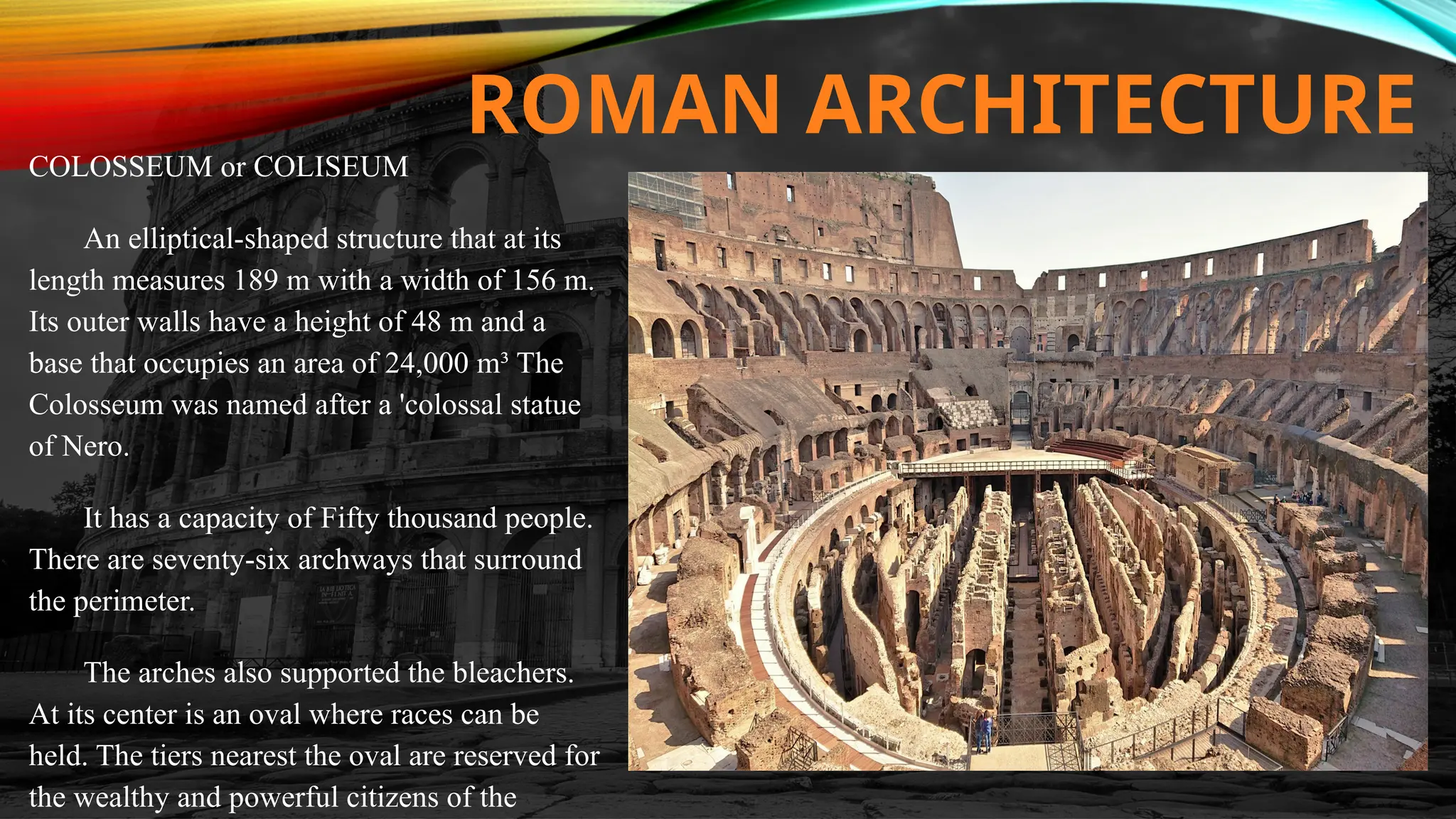
COLOSSEUM or COLISEUM
An elliptical-shaped structure that at its
length measures 189 m with a width of 156 m.
Its outer walls have a height of 48 m and a
base that occupies an area of 24,000 m³ The
Colosseum was named after a 'colossal statue
of Nero.
It has a capacity of Fifty thousand people.
There are seventy-six archways that surround
the perimeter.
The arches also supported the bleachers.
At its center is an oval where races can be
held. The tiers nearest the oval are reserved for
the wealthy and powerful citizens of the
ROMAN TEMPLES
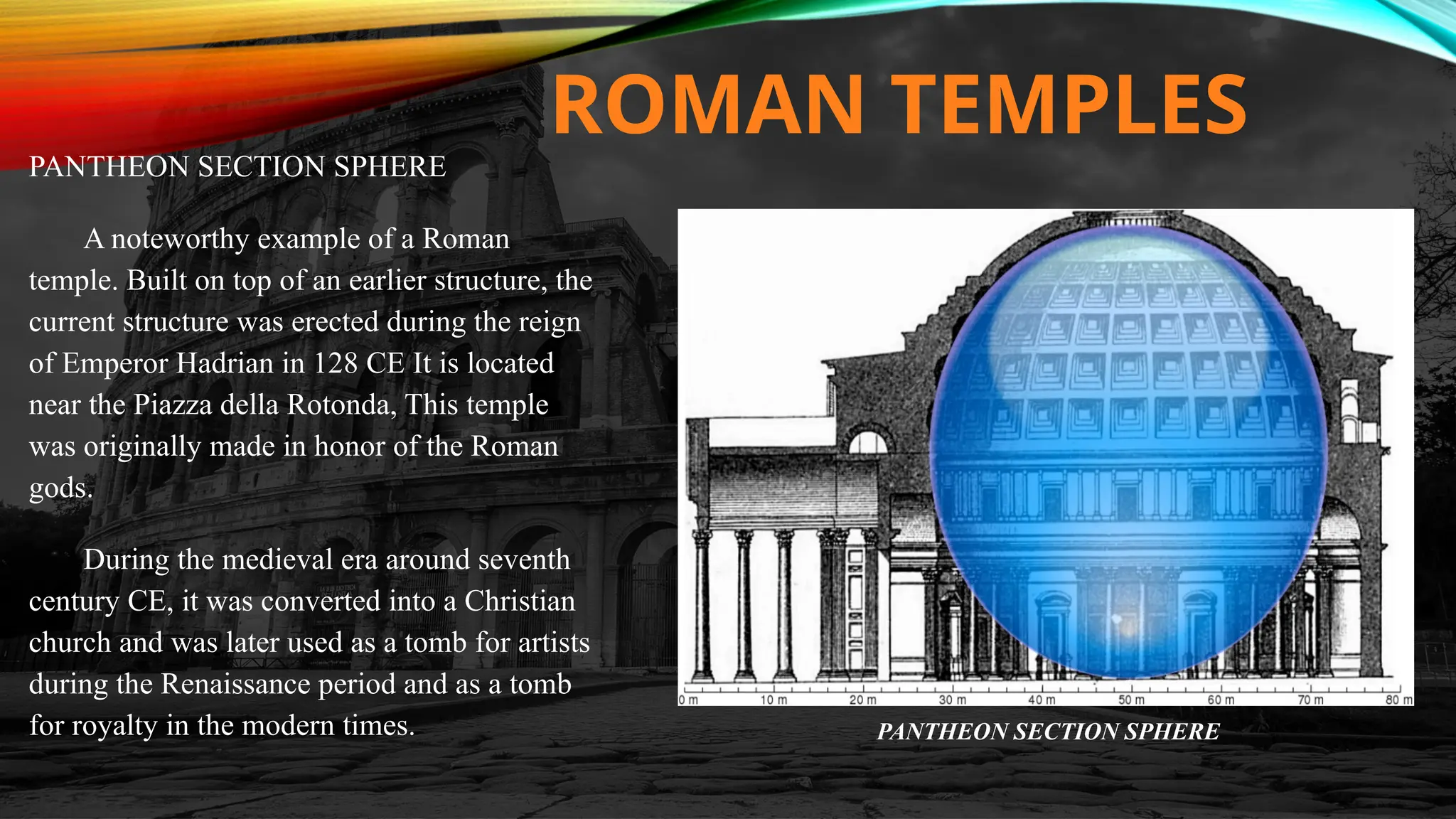
PANTHEON SECTION SPHERE
A noteworthy example of a Roman
temple. Built on top of an earlier structure, the
current structure was erected during the reign
of Emperor Hadrian in 128 CE It is located
near the Piazza della Rotonda, This temple
was originally made in honor of the Roman
gods.
During the medieval era around seventh
century CE, it was converted into a Christian
church and was later used as a tomb for artists
during the Renaissance period and as a tomb
for royalty in the modern times. PANTHEON SECTION SPHERE

ARTS 9 Q1, W1&W2 PowerPoint presentation

  • 1.
  • 2.
    GREEK ARCHITECTURE Ancient Greekarchitecture is often characterized by the capitals that topped the Greek columns. These three decorative styles or orders are Doric, lonic, and Corinthian. These architectural orders are used to identify the style and proportions of a building.
  • 3.
    GREEK ARCHITECTURE 1. DORIC ORDER thesimplest with broad and rectangular capital that tops the column; it was also the first of the different orders.
  • 4.
    GREEK ARCHITECTURE 2. IONIC ORDER thesecond style it distinguished with its capital that looks like scrolls. It was developed in lonia, a coastal region of Anatolia (present-day Turkey), in the middle of the sixth century BCE and spread to the rest of Greece by the fifth century BCE.
  • 5.
    GREEK ARCHITECTURE THE CORINTHIAN The lastand most elaborate order. The Corinthian has a capital that is carved with the stylized leaves of the acanthus plant. It was used in both Greek and Roman structures.
  • 6.
    GREEK ARCHITECTURE PARTHENON The perfect Greektemple design is embodied by the Parthenon. The Parthenon was built in honor of Athena, the Greek goddess of wisdom and patroness of the city. It also used to celebrate the strength of the Athenians as the leader of the Greek coalition against the Persian armies of Darius and Xerxes. Many of the Greek temples including the Parthenon lay in ruins due to the deterioration brought by time and wars. Its sculptures that survived called Elgin Marbles were preserved and displayed in the British Museum.
  • 7.
  • 8.
    GREEK SCULPTURES Greece was blessedwith an abundance of marble and limestone, which they used extensively in their sculptures. Bronze was also used for sculptures, but few have survived since their metal was reused by later generations. Greeks portrayed the gods and human the same. No distinctions were made to size or body type to separate one from the other. Greek statues made during the Archaic period were often stiff and rigid, similar with that of the ancient Egyptian statues. MARBLE BUST OF ZEUS
  • 9.
    GREEK SCULPTURES The statue ofAthena in the Parthenon, sculpted by Pheidas around 438 BCE, is one of the greatest sculptural masterpieces of ancient Greece. It stood close to 13 m and was made of carved ivory for the flesh part and dressed and armored in 1,140 kg of gold. Her helmet is decorated with a Sphinx and two griffins. Athena is shown holding a shield on her left side while holding Nike, the winged goddess of victory, on her right side REPLICA OF THE STATUE OF ATHENA
  • 10.
    GREEK SCULPTURES She is alsocarrying an aegis, the goat skin shield of Zeus embellished with the head of Medusa. A snake is seen behind the shield. Precious stones were also used to decorate the statue. The statue was not only meant to honor the deity but also to showcase the wealth and power of the city of Athens. The original statue has since been lost, but smaller Roman replicas survive which gives us an idea of how majestic the statue was. REPLICA OF THE STATUE OF ATHENA
  • 11.
    GREEK POTTERY  TheGreeks also made pottery. This earthenware was valued not just for its functionality but also for its artistry. Early Greek earthenware was not different from other potteries. As the artisans became more skilled, their earthenware developed a style of their own.  Greek earthenware is very distinct. The top and the base of the jars are decorated with geometric patterns.  The middle is decorated with drawings. The Greek Pottery subjects of these drawings varied, but the more interesting ones were those that told stories. Idealized figures playing games, chariot racing, or gods-locked Ancient Greek vases in battle are a few examples of the designs used. These designs gave an insight into the life of the ancient Greeks. These earthenware were painted using black and combined with either red or orange. GREEK POTTERY
  • 12.
    FALL OF THEGREECE  The death of Alexander the Great in 323 BCE created turmoil within the Greek Empire. Alexander's generals warred among themselves. Continued conflicts among Greece's city states made them weak. The Romans took advantage of this instability and invaded Greece and made it their territory Greece became a province of Rome in 146 BCE
  • 13.
    ART OF ANCIENTROME Rome started as a village in the eighth century BCE It was a monarchy that later became a republic in 509 BCE By the third Century BCE, Rome gained control of the entire Italian peninsula. From 246-146 BCE, Rome warred against Carthage in the Punic Rome's victory gave them dominion over the Mediterranean, dislodging Hellenistic Greece as the regional power for the next five centuries. The Roman Empire was established under Emperor Augustus in 27 BCE Rome reached the peak of its power in the second century BCE It occupied most of Europe including the areas that surround the Mediterranean Sea During Emperor Trajan, the Roman Empire reached its peak-covering an area of 5 million km2 and ruled one-fifth or 21 percent of the entire human population at the time. Roman practicality, combined with their Greek obsession of the ideal resulted in more realistic depictions in art.
  • 14.
    ROMAN SCULPTURES The fascination ofthe Romans with portraits started when wax molds of the faces of the deceased, which were called sculpted portraits, were used as reminders of their loved ones. Stone and marble were later used for their durability and permanence. Skilled artists were in demand and were commissioned to create these artworks. Roman sculptures were created to be more realistic. The purpose of many Roman portraits was to serve as a remembrance, hence, the facial features and expressions were included to capture the personality of the subject. MARBLE BUST OF EMPEROR HADRIAN
  • 15.
    ROMAN POTTERY Pottery duringthe ancient Roman times was mostly utilitarian and was used in their daily lives. Early Roman earthenware was influenced by the Etruscans (located in Tuscan, Italy) and the Greeks. Later on, they developed their own style. Decorations on Roman pottery were engraved, unlike the Greek earthenware whose designs were painted on. Two types of Roman earthenware: 1. Coarse ware - Made for everyday use such as cooking, storing liquids, etc. These were often cheaply made and were simple in design. 2. Fine ware - Used for more formal occasions. These earthenware were glazed to give them a shiny appearance and were used as serving plates. MARBLE BUST OF EMPEROR HADRIAN TERRA SIGILLATA
  • 16.
    ROMAN ARCHITECTURE • TheRomans employed a method of building that resulted in bigger and stronger structures, the arch. They used a series of arches combined together, creating a tunnel of sorts. This building method is called the barrel vault. AMPHITHEATERS Arenas for sporting events, chariot races, and gladiator combats that were held in open-air buildings. One of the most popular venues for these events was the Colosseum or Coliseum, also known as the Flavian Amphitheater. It began construction under Emperor Vespasian around 70-72 CE and completed in 80 CE under Emperor Titus. It was built on a valley between the Caelian, Esquiline, and Palatine Hills in Rome, Italy. MARBLE BUST OF EMPEROR HADRIAN
  • 17.
    ROMAN ARCHITECTURE COLOSSEUM orCOLISEUM An elliptical-shaped structure that at its length measures 189 m with a width of 156 m. Its outer walls have a height of 48 m and a base that occupies an area of 24,000 m³ The Colosseum was named after a 'colossal statue of Nero. It has a capacity of Fifty thousand people. There are seventy-six archways that surround the perimeter. The arches also supported the bleachers. At its center is an oval where races can be held. The tiers nearest the oval are reserved for the wealthy and powerful citizens of the
  • 18.
    ROMAN TEMPLES PANTHEON SECTIONSPHERE A noteworthy example of a Roman temple. Built on top of an earlier structure, the current structure was erected during the reign of Emperor Hadrian in 128 CE It is located near the Piazza della Rotonda, This temple was originally made in honor of the Roman gods. During the medieval era around seventh century CE, it was converted into a Christian church and was later used as a tomb for artists during the Renaissance period and as a tomb for royalty in the modern times. PANTHEON SECTION SPHERE