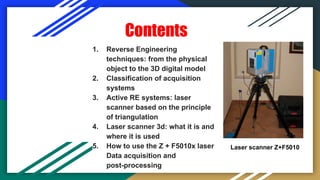
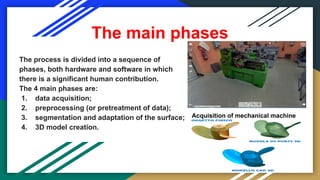
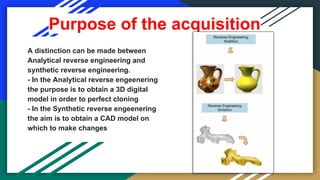
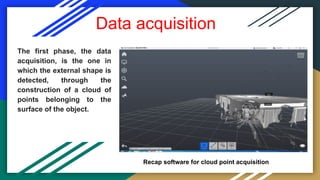
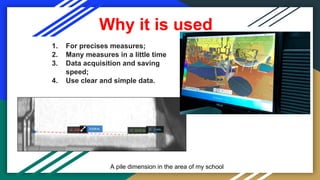
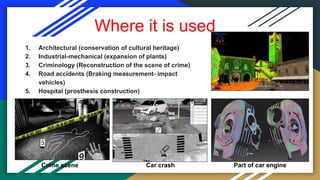
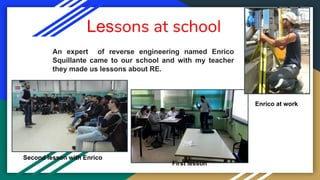
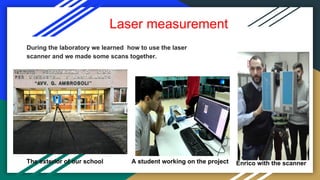
The document discusses the process of reverse engineering, which involves 4 main phases: 1) data acquisition using laser scanners, 2) preprocessing the data, 3) segmenting and adapting the scanned surface, and 4) creating the 3D model. Laser scanners are used to precisely and quickly acquire large amounts of data on an object's external shape through point clouds. Reverse engineering has applications in architecture, industrial/mechanical fields, criminology, accident reconstruction, healthcare, and more. The document also describes a visit from an expert who gave lessons to students on reverse engineering and demonstrated the use of a laser scanner.