SAGE Computing Services
Customised Oracle Training Workshops and Consulting
The SQL and PL/SQL Results Cache
Is it a Dream Come True or Your Latest Nightmare?
Penny Cookson
Managing Director
penny@sagecomputing.com.au
Agenda
What it is?
How does it work?
What is it good for?
www.sagecomputing.com.au
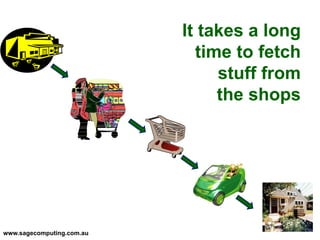
It takes a long
time to fetch
stuff from
the shops
www.sagecomputing.com.au
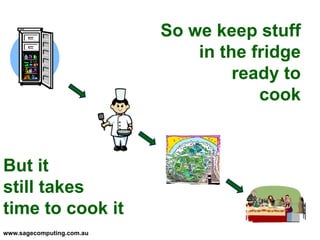
So we keep stuff
in the fridge
ready to
cook
But it
still takes
time to cook it
www.sagecomputing.com.au
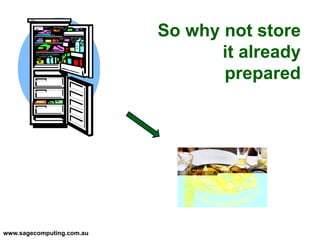
So why not store
it already
prepared
www.sagecomputing.com.au
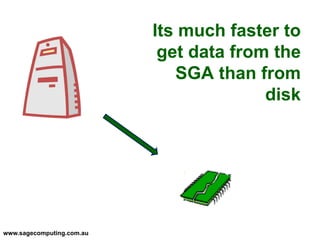
Its much faster to
get data from the
SGA than from
disk
www.sagecomputing.com.au
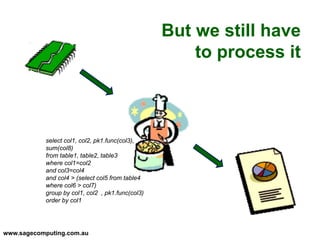
But we still have
to process it
select col1, col2, pk1.func(col3),
sum(col8)
from table1, table2, table3
where col1=col2
and col3=col4
and col4 > (select col5 from table4
where col6 > col7)
group by col1, col2 , pk1.func(col3)
order by col1
www.sagecomputing.com.au
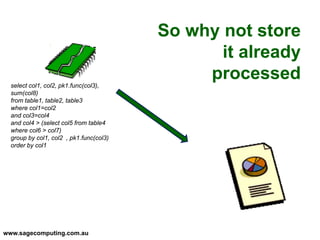
So why not store
it already
processedselect col1, col2, pk1.func(col3),
sum(col8)
from table1, table2, table3
where col1=col2
and col3=col4
and col4 > (select col5 from table4
where col6 > col7)
group by col1, col2 , pk1.func(col3)
order by col1
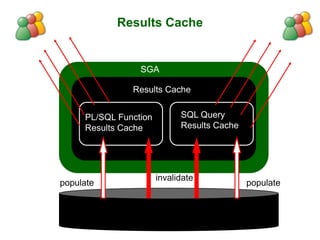
Results Cache
SGA
SQL Query
Results Cache
Results Cache
PL/SQL Function
Results Cache
populate
invalidate
populate
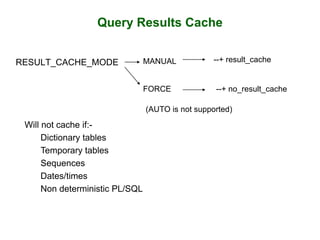
Query Results Cache
RESULT_CACHE_MODE MANUAL
FORCE
--+ result_cache
--+ no_result_cache
Will not cache if:-
Dictionary tables
Temporary tables
Sequences
Dates/times
Non deterministic PL/SQL
(AUTO is not supported)
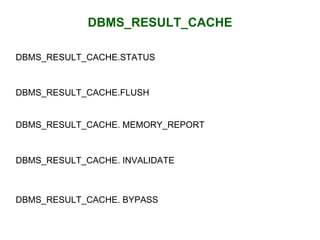
DBMS_RESULT_CACHE
DBMS_RESULT_CACHE.STATUS
DBMS_RESULT_CACHE.FLUSH
DBMS_RESULT_CACHE. MEMORY_REPORT
DBMS_RESULT_CACHE. INVALIDATE
DBMS_RESULT_CACHE. BYPASS
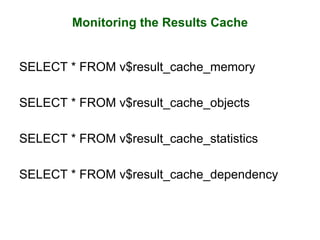
Monitoring the Results Cache
SELECT * FROM v$result_cache_memory
SELECT * FROM v$result_cache_objects
SELECT * FROM v$result_cache_statistics
SELECT * FROM v$result_cache_dependency
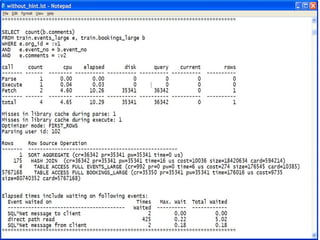
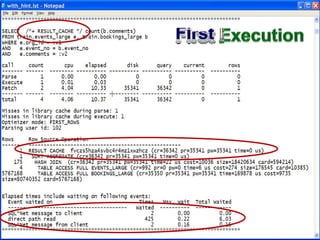
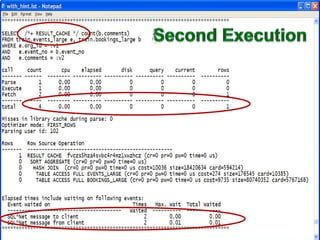
Demo 1
Disk v Buffer Cache v Result Cache
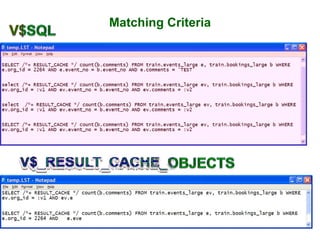
Matching Criteria
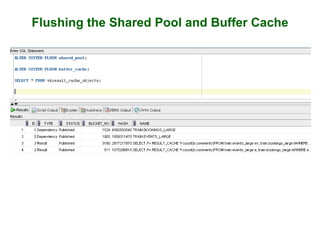
Flushing the Shared Pool and Buffer Cache
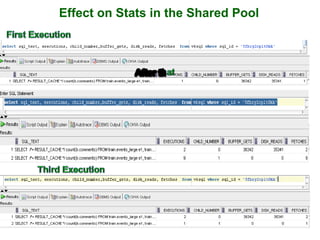
Effect on Stats in the Shared Pool
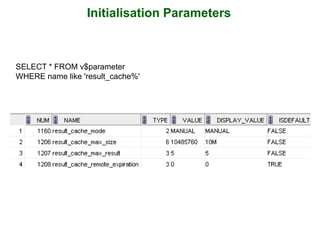
SELECT * FROM v$parameter
WHERE name like 'result_cache%'
Initialisation Parameters
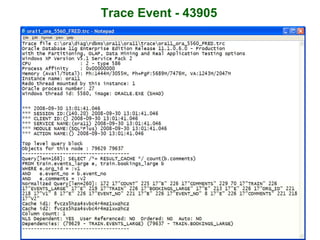
Trace Event - 43905
BEGIN DBMS_RESULT_CACHE.MEMORY_REPORT(true); END;
R e s u l t C a c h e M e m o r y R e p o r t
[Parameters]
Block Size = 1K bytes
Maximum Cache Size = 10M bytes (10K blocks)
Maximum Result Size = 10M bytes (10K blocks)
[Memory]
Total Memory = 103536 bytes [0.056% of the Shared Pool]
... Fixed Memory = 5140 bytes [0.003% of the Shared Pool]
....... Cache Mgr = 112 bytes
....... Memory Mgr = 128 bytes
....... Bloom Fltr = 2K bytes
....... State Objs = 2852 bytes
... Dynamic Memory = 98396 bytes [0.053% of the Shared Pool]
....... Overhead = 65628 bytes
........... Hash Table = 32K bytes (4K buckets)
........... Chunk Ptrs = 12K bytes (3K slots)
........... Chunk Maps = 12K bytes
........... Miscellaneous = 8284 bytes
....... Cache Memory = 32K bytes (32 blocks)
........... Unused Memory = 16 blocks
........... Used Memory = 16 blocks
............... Dependencies = 4 blocks (4 count)
............... Results = 12 blocks
................... SQL = 4 blocks (1 count)
................... Invalid = 8 blocks (2 count)
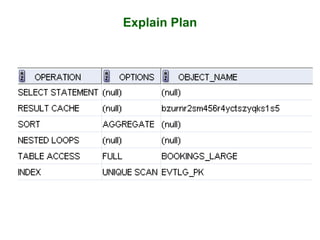
Explain Plan
So What Should We Use it For?
Demo 2
Single table – once
Single table – multiple
Join
More complex statement
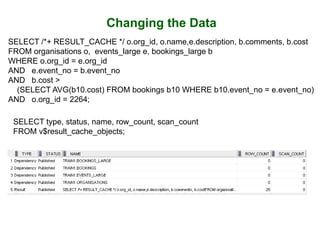
Changing the Data
SELECT /*+ RESULT_CACHE */ o.org_id, o.name,e.description, b.comments, b.cost
FROM organisations o, events_large e, bookings_large b
WHERE o.org_id = e.org_id
AND e.event_no = b.event_no
AND b.cost >
(SELECT AVG(b10.cost) FROM bookings b10 WHERE b10.event_no = e.event_no)
AND o.org_id = 2264;
SELECT type, status, name, row_count, scan_count
FROM v$result_cache_objects;
Changing the Data
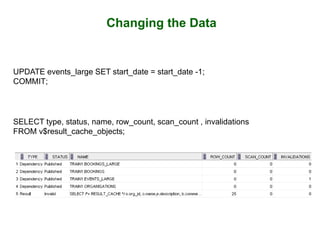
SELECT type, status, name, row_count, scan_count , invalidations
FROM v$result_cache_objects;
UPDATE events_large SET start_date = start_date -1;
COMMIT;
Changing the Data
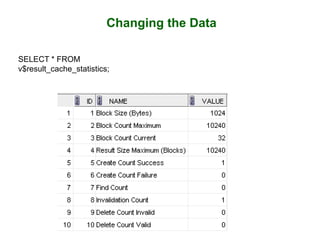
SELECT * FROM
v$result_cache_statistics;
So What Should We Use it For?
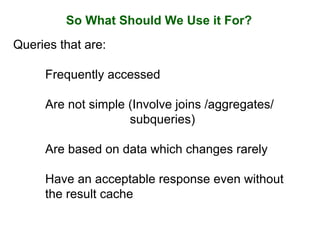
Queries that are:
Frequently accessed
Are not simple (Involve joins /aggregates/
subqueries)
Are based on data which changes rarely
Have an acceptable response even without
the result cache
Which Products Should (NOT) Use It
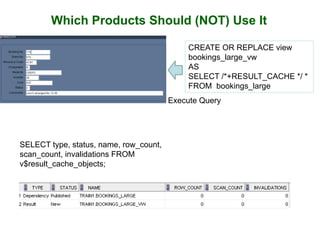
SELECT type, status, name, row_count,
scan_count, invalidations FROM
v$result_cache_objects;
CREATE OR REPLACE view
bookings_large_vw
AS
SELECT /*+RESULT_CACHE */ *
FROM bookings_large
Execute Query
Second Form
Execute Query
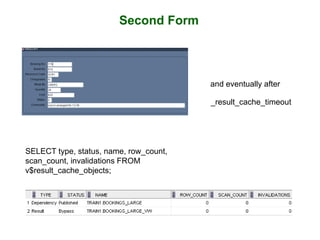
Second Form
SELECT type, status, name, row_count,
scan_count, invalidations FROM
v$result_cache_objects;
and eventually after
_result_cache_timeout
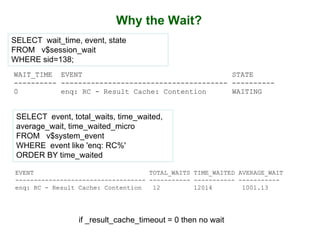
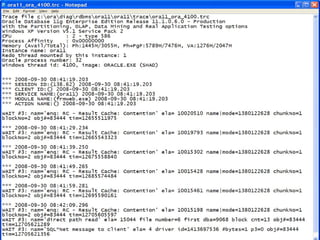
Why the Wait?
SELECT wait_time, event, state
FROM v$session_wait
WHERE sid=138;
WAIT_TIME EVENT STATE
---------- --------------------------------------- ----------
0 enq: RC - Result Cache: Contention WAITING
SELECT event, total_waits, time_waited,
average_wait, time_waited_micro
FROM v$system_event
WHERE event like 'enq: RC%'
ORDER BY time_waited
EVENT TOTAL_WAITS TIME_WAITED AVERAGE_WAIT
----------------------------------- ----------- ----------- -----------
enq: RC - Result Cache: Contention 12 12014 1001.13
if _result_cache_timeout = 0 then no wait
Which Products Should Use It
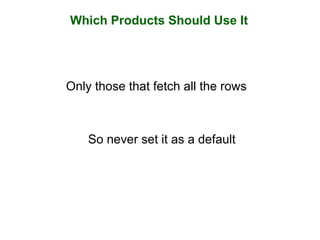
Only those that fetch all the rows
So never set it as a default
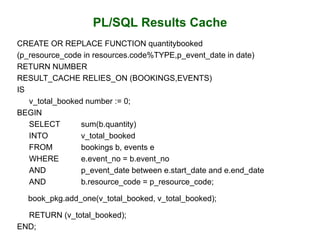
PL/SQL Results Cache
CREATE OR REPLACE FUNCTION quantitybooked
(p_resource_code in resources.code%TYPE,p_event_date in date)
RETURN NUMBER
RESULT_CACHE RELIES_ON (BOOKINGS,EVENTS)
IS
v_total_booked number := 0;
BEGIN
SELECT sum(b.quantity)
INTO v_total_booked
FROM bookings b, events e
WHERE e.event_no = b.event_no
AND p_event_date between e.start_date and e.end_date
AND b.resource_code = p_resource_code;
book_pkg.add_one(v_total_booked, v_total_booked);
RETURN (v_total_booked);
END;
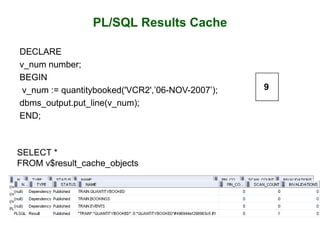
PL/SQL Results Cache
DECLARE
v_num number;
BEGIN
v_num := quantitybooked('VCR2',’06-NOV-2007’);
dbms_output.put_line(v_num);
END;
SELECT *
FROM v$result_cache_objects
9
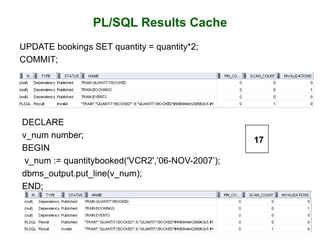
PL/SQL Results Cache
UPDATE bookings SET quantity = quantity*2;
COMMIT;
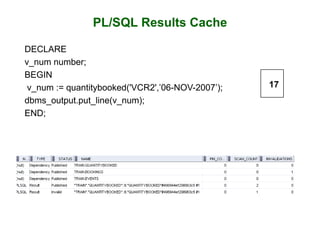
DECLARE
v_num number;
BEGIN
v_num := quantitybooked('VCR2',’06-NOV-2007’);
dbms_output.put_line(v_num);
END;
17
PL/SQL Results Cache
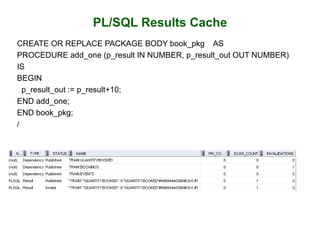
CREATE OR REPLACE PACKAGE BODY book_pkg AS
PROCEDURE add_one (p_result IN NUMBER, p_result_out OUT NUMBER)
IS
BEGIN
p_result_out := p_result+10;
END add_one;
END book_pkg;
/
PL/SQL Results Cache
DECLARE
v_num number;
BEGIN
v_num := quantitybooked('VCR2',’06-NOV-2007’);
dbms_output.put_line(v_num);
END;
17
www.sagecomputing.com.au
PL/SQL Results Cache
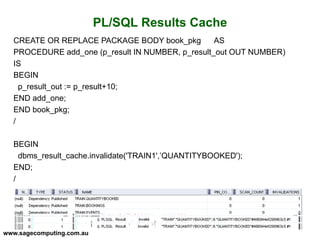
CREATE OR REPLACE PACKAGE BODY book_pkg AS
PROCEDURE add_one (p_result IN NUMBER, p_result_out OUT NUMBER)
IS
BEGIN
p_result_out := p_result+10;
END add_one;
END book_pkg;
/
BEGIN
dbms_result_cache.invalidate('TRAIN1',’QUANTITYBOOKED');
END;
/
PL/SQL Results Cache
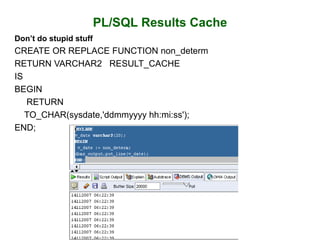
Don’t do stupid stuff
CREATE OR REPLACE FUNCTION non_determ
RETURN VARCHAR2 RESULT_CACHE
IS
BEGIN
RETURN
TO_CHAR(sysdate,'ddmmyyyy hh:mi:ss');
END;
PL/SQL Results Cache - Example
Demo 3
Create and execute a RESULT CACHE function
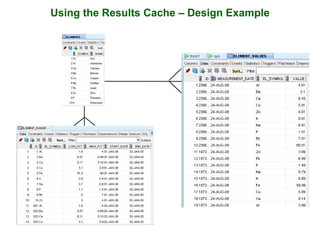
Using the Results Cache – Design Example
Demo 4
Designing a Results Cache Layer
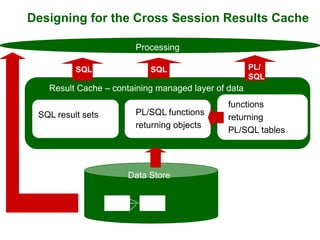
Designing for the Cross Session Results Cache
Data Store
Result Cache – containing managed layer of data
PL/SQL functions
returning objects
Processing
SQL result sets
functions
returning
PL/SQL tables
SQL SQL PL/
SQL
www.sagecomputing.com.au
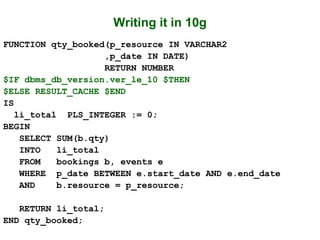
Writing it in 10g
FUNCTION qty_booked(p_resource IN VARCHAR2
,p_date IN DATE)
RETURN NUMBER
$IF dbms_db_version.ver_le_10 $THEN
$ELSE RESULT_CACHE $END
IS
li_total PLS_INTEGER := 0;
BEGIN
SELECT SUM(b.qty)
INTO li_total
FROM bookings b, events e
WHERE p_date BETWEEN e.start_date AND e.end_date
AND b.resource = p_resource;
RETURN li_total;
END qty_booked;
www.sagecomputing.com.au
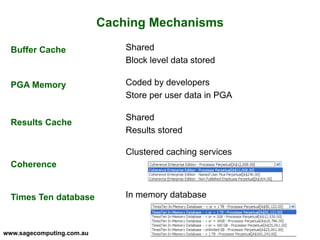
Caching Mechanisms
Buffer Cache
PGA Memory
Coherence
Times Ten database
Results Cache
In memory database
Clustered caching services
Coded by developers
Store per user data in PGA
Shared
Results stored
Shared
Block level data stored
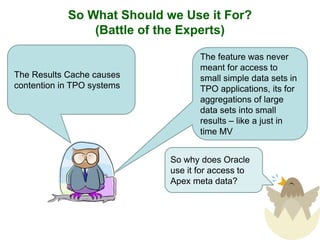
So What Should we Use it For?
(Battle of the Experts)
The feature was never
meant for access to
small simple data sets in
TPO applications, its for
aggregations of large
data sets into small
results – like a just in
time MV
The Results Cache causes
contention in TPO systems
So why does Oracle
use it for access to
Apex meta data?
www.sagecomputing.com.au
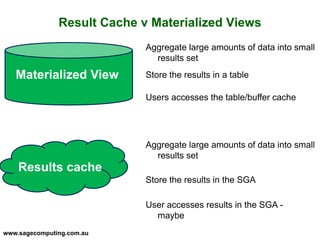
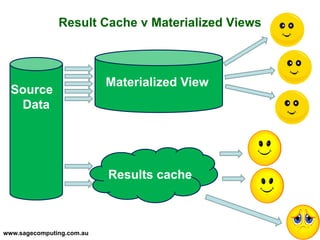
Result Cache v Materialized Views
Aggregate large amounts of data into small
results set
Store the results in a table
Aggregate large amounts of data into small
results set
Store the results in the SGA
Users accesses the table/buffer cache
User accesses results in the SGA -
maybe
Materialized View
Results cache
www.sagecomputing.com.au
Result Cache v Materialized Views
Materialized View
Results cache
Source
Data
www.sagecomputing.com.au
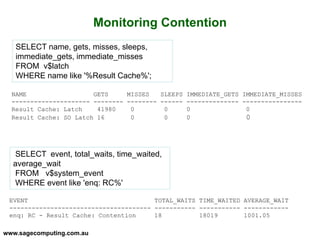
Monitoring Contention
SELECT name, gets, misses, sleeps,
immediate_gets, immediate_misses
FROM v$latch
WHERE name like '%Result Cache%';
NAME GETS MISSES SLEEPS IMMEDIATE_GETS IMMEDIATE_MISSES
--------------------- -------- -------- ------ -------------- ----------------
Result Cache: Latch 41980 0 0 0 0
Result Cache: SO Latch 16 0 0 0 0
SELECT event, total_waits, time_waited,
average_wait
FROM v$system_event
WHERE event like 'enq: RC%'
EVENT TOTAL_WAITS TIME_WAITED AVERAGE_WAIT
-------------------------------------- ----------- ----------- ------------
enq: RC - Result Cache: Contention 18 18019 1001.05
www.sagecomputing.com.au
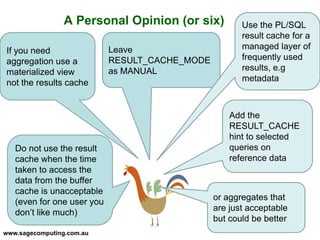
A Personal Opinion (or six)
Leave
RESULT_CACHE_MODE
as MANUAL
If you need
aggregation use a
materialized view
not the results cache
Use the PL/SQL
result cache for a
managed layer of
frequently used
results, e.g
metadata
Do not use the result
cache when the time
taken to access the
data from the buffer
cache is unacceptable
(even for one user you
don’t like much)
or aggregates that
are just acceptable
but could be better
Add the
RESULT_CACHE
hint to selected
queries on
reference data
www.sagecomputing.com.au
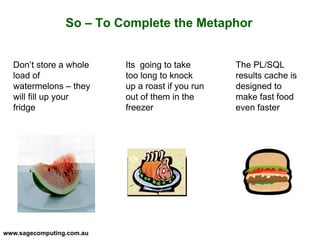
So – To Complete the Metaphor
Don’t store a whole
load of
watermelons – they
will fill up your
fridge
Its going to take
too long to knock
up a roast if you run
out of them in the
freezer
The PL/SQL
results cache is
designed to
make fast food
even faster
SAGE Computing Services
Customised Oracle Training Workshops and Consulting
Information sources:
The Oracle doco
Vladimir Begun: http://vbegun.blogspot.com
Alex Fatkulin: http://www.pythian.com
Connor McDonald: OracleDBA.co.uk
(who took the p*ss at me using SQL*Developer – thank you for
getting me back to the command line, I promise not to lapse
again)
And a whole load of playing around with the features
SAGE Computing Services
Customised Oracle Training Workshops and Consulting
Questions and Answers?
Presentations are available from our website:
http://www.sagecomputing.com.au
enquiries@sagecomputing.com.au
penny@sagecomputing.com.au
Register for the Next
PL/SQL course:
18th – 20th November
Call in at the Sage Computing Services exhibition booth, or contact Penny
penny@sagecomputing.com.au
0419904458
SAGE Computing Services
(Unrepentant Marketing)

Results cache

  • 1.
    SAGE Computing Services CustomisedOracle Training Workshops and Consulting The SQL and PL/SQL Results Cache Is it a Dream Come True or Your Latest Nightmare? Penny Cookson Managing Director penny@sagecomputing.com.au
  • 2.
    Agenda What it is? Howdoes it work? What is it good for?
  • 3.
    www.sagecomputing.com.au It takes along time to fetch stuff from the shops
  • 4.
    www.sagecomputing.com.au So we keepstuff in the fridge ready to cook But it still takes time to cook it
  • 5.
    www.sagecomputing.com.au So why notstore it already prepared
  • 6.
    www.sagecomputing.com.au Its much fasterto get data from the SGA than from disk
  • 7.
    www.sagecomputing.com.au But we stillhave to process it select col1, col2, pk1.func(col3), sum(col8) from table1, table2, table3 where col1=col2 and col3=col4 and col4 > (select col5 from table4 where col6 > col7) group by col1, col2 , pk1.func(col3) order by col1
  • 8.
    www.sagecomputing.com.au So why notstore it already processedselect col1, col2, pk1.func(col3), sum(col8) from table1, table2, table3 where col1=col2 and col3=col4 and col4 > (select col5 from table4 where col6 > col7) group by col1, col2 , pk1.func(col3) order by col1
  • 9.
    Results Cache SGA SQL Query ResultsCache Results Cache PL/SQL Function Results Cache populate invalidate populate
  • 10.
    Query Results Cache RESULT_CACHE_MODEMANUAL FORCE --+ result_cache --+ no_result_cache Will not cache if:- Dictionary tables Temporary tables Sequences Dates/times Non deterministic PL/SQL (AUTO is not supported)
  • 11.
  • 12.
    Monitoring the ResultsCache SELECT * FROM v$result_cache_memory SELECT * FROM v$result_cache_objects SELECT * FROM v$result_cache_statistics SELECT * FROM v$result_cache_dependency
  • 13.
    Demo 1 Disk vBuffer Cache v Result Cache
  • 17.
  • 18.
    Flushing the SharedPool and Buffer Cache
  • 19.
    Effect on Statsin the Shared Pool
  • 20.
    SELECT * FROMv$parameter WHERE name like 'result_cache%' Initialisation Parameters
  • 21.
  • 22.
    BEGIN DBMS_RESULT_CACHE.MEMORY_REPORT(true); END; Re s u l t C a c h e M e m o r y R e p o r t [Parameters] Block Size = 1K bytes Maximum Cache Size = 10M bytes (10K blocks) Maximum Result Size = 10M bytes (10K blocks) [Memory] Total Memory = 103536 bytes [0.056% of the Shared Pool] ... Fixed Memory = 5140 bytes [0.003% of the Shared Pool] ....... Cache Mgr = 112 bytes ....... Memory Mgr = 128 bytes ....... Bloom Fltr = 2K bytes ....... State Objs = 2852 bytes ... Dynamic Memory = 98396 bytes [0.053% of the Shared Pool] ....... Overhead = 65628 bytes ........... Hash Table = 32K bytes (4K buckets) ........... Chunk Ptrs = 12K bytes (3K slots) ........... Chunk Maps = 12K bytes ........... Miscellaneous = 8284 bytes ....... Cache Memory = 32K bytes (32 blocks) ........... Unused Memory = 16 blocks ........... Used Memory = 16 blocks ............... Dependencies = 4 blocks (4 count) ............... Results = 12 blocks ................... SQL = 4 blocks (1 count) ................... Invalid = 8 blocks (2 count)
  • 23.
  • 24.
    So What ShouldWe Use it For? Demo 2 Single table – once Single table – multiple Join More complex statement
  • 25.
    Changing the Data SELECT/*+ RESULT_CACHE */ o.org_id, o.name,e.description, b.comments, b.cost FROM organisations o, events_large e, bookings_large b WHERE o.org_id = e.org_id AND e.event_no = b.event_no AND b.cost > (SELECT AVG(b10.cost) FROM bookings b10 WHERE b10.event_no = e.event_no) AND o.org_id = 2264; SELECT type, status, name, row_count, scan_count FROM v$result_cache_objects;
  • 26.
    Changing the Data SELECTtype, status, name, row_count, scan_count , invalidations FROM v$result_cache_objects; UPDATE events_large SET start_date = start_date -1; COMMIT;
  • 27.
    Changing the Data SELECT* FROM v$result_cache_statistics;
  • 28.
    So What ShouldWe Use it For? Queries that are: Frequently accessed Are not simple (Involve joins /aggregates/ subqueries) Are based on data which changes rarely Have an acceptable response even without the result cache
  • 29.
    Which Products Should(NOT) Use It SELECT type, status, name, row_count, scan_count, invalidations FROM v$result_cache_objects; CREATE OR REPLACE view bookings_large_vw AS SELECT /*+RESULT_CACHE */ * FROM bookings_large Execute Query
  • 30.
  • 31.
    Second Form SELECT type,status, name, row_count, scan_count, invalidations FROM v$result_cache_objects; and eventually after _result_cache_timeout
  • 32.
    Why the Wait? SELECTwait_time, event, state FROM v$session_wait WHERE sid=138; WAIT_TIME EVENT STATE ---------- --------------------------------------- ---------- 0 enq: RC - Result Cache: Contention WAITING SELECT event, total_waits, time_waited, average_wait, time_waited_micro FROM v$system_event WHERE event like 'enq: RC%' ORDER BY time_waited EVENT TOTAL_WAITS TIME_WAITED AVERAGE_WAIT ----------------------------------- ----------- ----------- ----------- enq: RC - Result Cache: Contention 12 12014 1001.13 if _result_cache_timeout = 0 then no wait
  • 34.
    Which Products ShouldUse It Only those that fetch all the rows So never set it as a default
  • 35.
    PL/SQL Results Cache CREATEOR REPLACE FUNCTION quantitybooked (p_resource_code in resources.code%TYPE,p_event_date in date) RETURN NUMBER RESULT_CACHE RELIES_ON (BOOKINGS,EVENTS) IS v_total_booked number := 0; BEGIN SELECT sum(b.quantity) INTO v_total_booked FROM bookings b, events e WHERE e.event_no = b.event_no AND p_event_date between e.start_date and e.end_date AND b.resource_code = p_resource_code; book_pkg.add_one(v_total_booked, v_total_booked); RETURN (v_total_booked); END;
  • 36.
    PL/SQL Results Cache DECLARE v_numnumber; BEGIN v_num := quantitybooked('VCR2',’06-NOV-2007’); dbms_output.put_line(v_num); END; SELECT * FROM v$result_cache_objects 9
  • 37.
    PL/SQL Results Cache UPDATEbookings SET quantity = quantity*2; COMMIT; DECLARE v_num number; BEGIN v_num := quantitybooked('VCR2',’06-NOV-2007’); dbms_output.put_line(v_num); END; 17
  • 38.
    PL/SQL Results Cache CREATEOR REPLACE PACKAGE BODY book_pkg AS PROCEDURE add_one (p_result IN NUMBER, p_result_out OUT NUMBER) IS BEGIN p_result_out := p_result+10; END add_one; END book_pkg; /
  • 39.
    PL/SQL Results Cache DECLARE v_numnumber; BEGIN v_num := quantitybooked('VCR2',’06-NOV-2007’); dbms_output.put_line(v_num); END; 17
  • 40.
    www.sagecomputing.com.au PL/SQL Results Cache CREATEOR REPLACE PACKAGE BODY book_pkg AS PROCEDURE add_one (p_result IN NUMBER, p_result_out OUT NUMBER) IS BEGIN p_result_out := p_result+10; END add_one; END book_pkg; / BEGIN dbms_result_cache.invalidate('TRAIN1',’QUANTITYBOOKED'); END; /
  • 41.
    PL/SQL Results Cache Don’tdo stupid stuff CREATE OR REPLACE FUNCTION non_determ RETURN VARCHAR2 RESULT_CACHE IS BEGIN RETURN TO_CHAR(sysdate,'ddmmyyyy hh:mi:ss'); END;
  • 42.
    PL/SQL Results Cache- Example Demo 3 Create and execute a RESULT CACHE function
  • 43.
    Using the ResultsCache – Design Example
  • 44.
    Using the ResultsCache – Design Example Demo 4 Designing a Results Cache Layer
  • 45.
    Designing for theCross Session Results Cache Data Store Result Cache – containing managed layer of data PL/SQL functions returning objects Processing SQL result sets functions returning PL/SQL tables SQL SQL PL/ SQL
  • 46.
    www.sagecomputing.com.au Writing it in10g FUNCTION qty_booked(p_resource IN VARCHAR2 ,p_date IN DATE) RETURN NUMBER $IF dbms_db_version.ver_le_10 $THEN $ELSE RESULT_CACHE $END IS li_total PLS_INTEGER := 0; BEGIN SELECT SUM(b.qty) INTO li_total FROM bookings b, events e WHERE p_date BETWEEN e.start_date AND e.end_date AND b.resource = p_resource; RETURN li_total; END qty_booked;
  • 47.
    www.sagecomputing.com.au Caching Mechanisms Buffer Cache PGAMemory Coherence Times Ten database Results Cache In memory database Clustered caching services Coded by developers Store per user data in PGA Shared Results stored Shared Block level data stored
  • 48.
    So What Shouldwe Use it For? (Battle of the Experts) The feature was never meant for access to small simple data sets in TPO applications, its for aggregations of large data sets into small results – like a just in time MV The Results Cache causes contention in TPO systems So why does Oracle use it for access to Apex meta data?
  • 49.
    www.sagecomputing.com.au Result Cache vMaterialized Views Aggregate large amounts of data into small results set Store the results in a table Aggregate large amounts of data into small results set Store the results in the SGA Users accesses the table/buffer cache User accesses results in the SGA - maybe Materialized View Results cache
  • 50.
    www.sagecomputing.com.au Result Cache vMaterialized Views Materialized View Results cache Source Data
  • 51.
    www.sagecomputing.com.au Monitoring Contention SELECT name,gets, misses, sleeps, immediate_gets, immediate_misses FROM v$latch WHERE name like '%Result Cache%'; NAME GETS MISSES SLEEPS IMMEDIATE_GETS IMMEDIATE_MISSES --------------------- -------- -------- ------ -------------- ---------------- Result Cache: Latch 41980 0 0 0 0 Result Cache: SO Latch 16 0 0 0 0 SELECT event, total_waits, time_waited, average_wait FROM v$system_event WHERE event like 'enq: RC%' EVENT TOTAL_WAITS TIME_WAITED AVERAGE_WAIT -------------------------------------- ----------- ----------- ------------ enq: RC - Result Cache: Contention 18 18019 1001.05
  • 52.
    www.sagecomputing.com.au A Personal Opinion(or six) Leave RESULT_CACHE_MODE as MANUAL If you need aggregation use a materialized view not the results cache Use the PL/SQL result cache for a managed layer of frequently used results, e.g metadata Do not use the result cache when the time taken to access the data from the buffer cache is unacceptable (even for one user you don’t like much) or aggregates that are just acceptable but could be better Add the RESULT_CACHE hint to selected queries on reference data
  • 53.
    www.sagecomputing.com.au So – ToComplete the Metaphor Don’t store a whole load of watermelons – they will fill up your fridge Its going to take too long to knock up a roast if you run out of them in the freezer The PL/SQL results cache is designed to make fast food even faster
  • 54.
    SAGE Computing Services CustomisedOracle Training Workshops and Consulting Information sources: The Oracle doco Vladimir Begun: http://vbegun.blogspot.com Alex Fatkulin: http://www.pythian.com Connor McDonald: OracleDBA.co.uk (who took the p*ss at me using SQL*Developer – thank you for getting me back to the command line, I promise not to lapse again) And a whole load of playing around with the features
  • 55.
    SAGE Computing Services CustomisedOracle Training Workshops and Consulting Questions and Answers? Presentations are available from our website: http://www.sagecomputing.com.au enquiries@sagecomputing.com.au penny@sagecomputing.com.au
  • 56.
    Register for theNext PL/SQL course: 18th – 20th November Call in at the Sage Computing Services exhibition booth, or contact Penny penny@sagecomputing.com.au 0419904458 SAGE Computing Services (Unrepentant Marketing)