www.sagecomputing.com.au
penny@sagecomputing.com.au
Meet the Cost Based
Optimiser in 11g
Penny Cookson
SAGE Computing Services
Customised Oracle Training Workshops and Consulting
SAGE Computing Services
Customised Oracle Training Workshops and Consulting
Penny Cookson
Managing Director and Principal Consultant
Working with Oracle products since 1987
Oracle Magazine Educator of the Year 2004
www.sagecomputing.com.au
penny@sagecomputing.com.au
A Characteristic Problem
I haven’t changed anything
Its really slow this morning
I did the same thing yesterday and it was fine
Actually its OK now
No its not
Thank you so much you’ve fixed it (I haven’t done anything)
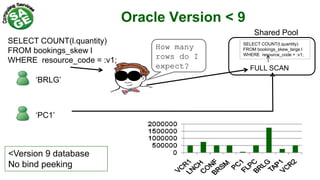
Oracle Version < 9
SELECT COUNT(l.quantity)
FROM bookings_skew l
WHERE resource_code = :v1;
‘BRLG’
<Version 9 database
No bind peeking
Shared Pool
SELECT COUNT(l.quantity)
FROM bookings_skew_large l
WHERE resource_code = :v1;
‘PC1’
FULL SCAN
How many
rows do I
expect?
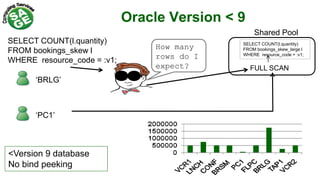
Oracle Version < 9
SELECT COUNT(l.quantity)
FROM bookings_skew l
WHERE resource_code = :v1;
‘BRLG’
<Version 9 database
No bind peeking
Shared Pool
SELECT COUNT(l.quantity)
FROM bookings_skew_large l
WHERE resource_code = :v1;
‘PC1’
FULL SCAN
How many
rows do I
expect?
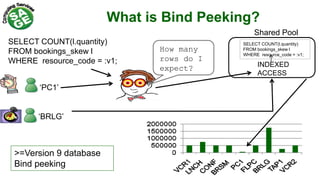
What is Bind Peeking?
SELECT COUNT(l.quantity)
FROM bookings_skew l
WHERE resource_code = :v1;
‘PC1’
>=Version 9 database
Bind peeking
Shared Pool
SELECT COUNT(l.quantity)
FROM bookings_skew l
WHERE resource_code = :v1;
‘BRLG’
INDEXED
ACCESS
How many
rows do I
expect?
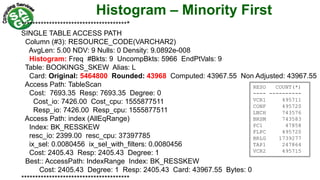
Histogram – Minority First
***************************************
SINGLE TABLE ACCESS PATH
Column (#3): RESOURCE_CODE(VARCHAR2)
AvgLen: 5.00 NDV: 9 Nulls: 0 Density: 9.0892e-008
Histogram: Freq #Bkts: 9 UncompBkts: 5966 EndPtVals: 9
Table: BOOKINGS_SKEW Alias: L
Card: Original: 5464800 Rounded: 43968 Computed: 43967.55 Non Adjusted: 43967.55
Access Path: TableScan
Cost: 7693.35 Resp: 7693.35 Degree: 0
Cost_io: 7426.00 Cost_cpu: 1555877511
Resp_io: 7426.00 Resp_cpu: 1555877511
Access Path: index (AllEqRange)
Index: BK_RESSKEW
resc_io: 2399.00 resc_cpu: 37397785
ix_sel: 0.0080456 ix_sel_with_filters: 0.0080456
Cost: 2405.43 Resp: 2405.43 Degree: 1
Best:: AccessPath: IndexRange Index: BK_RESSKEW
Cost: 2405.43 Degree: 1 Resp: 2405.43 Card: 43967.55 Bytes: 0
***************************************
RESO COUNT(*)
---- ----------
VCR1 495711
CONF 495720
LNCH 743576
BRSM 743583
PC1 47858
FLPC 495720
BRLG 1739277
TAP1 247864
VCR2 495715
Histogram – Minority First
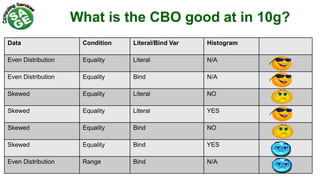
What is the CBO good at in 10g?
Data Condition Literal/Bind Var Histogram
Even Distribution Equality Literal N/A
Even Distribution Equality Bind N/A
Skewed Equality Literal NO
Skewed Equality Literal YES
Skewed Equality Bind NO
Skewed Equality Bind YES
Even Distribution Range Bind N/A
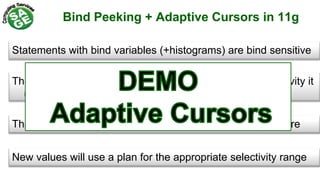
Bind Peeking + Adaptive Cursors in 11g
Statements with bind variables (+histograms) are bind sensitive
The first time you execute a statement with different selectivity it
uses the original plan
The second time it changes the plan and become bind aware
New values will use a plan for the appropriate selectivity range
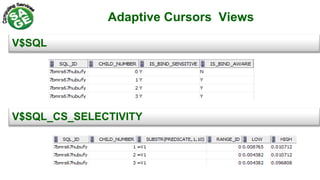
Adaptive Cursors Views
V$SQL
V$SQL_CS_SELECTIVITY
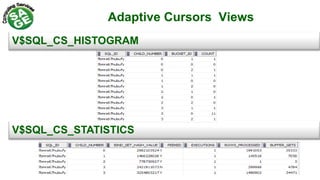
Adaptive Cursors Views
V$SQL_CS_HISTOGRAM
V$SQL_CS_STATISTICS
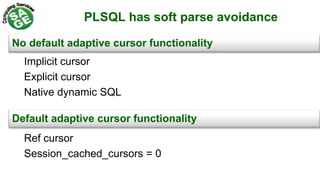
PLSQL has soft parse avoidance
Implicit cursor
Explicit cursor
Native dynamic SQL
Ref cursor
Session_cached_cursors = 0
No default adaptive cursor functionality
Default adaptive cursor functionality
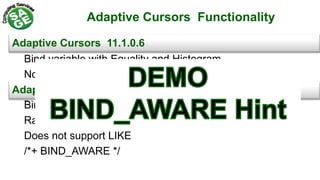
Adaptive Cursors Functionality
Bind variable with Equality and Histogram
Not for range conditions
Bind variable with Equality and Histogram
Range conditions
Does not support LIKE
/*+ BIND_AWARE */
Adaptive Cursors 11.1.0.6
Adaptive Cursors 11.1.0.7 and 11.2
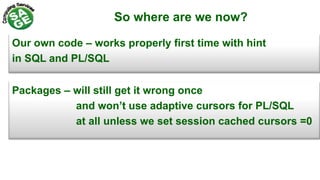
So where are we now?
Our own code – works properly first time with hint
in SQL and PL/SQL
Packages – will still get it wrong once
and won’t use adaptive cursors for PL/SQL
at all unless we set session cached cursors =0
xxxxxxxxxxxxxxxxxxxxx
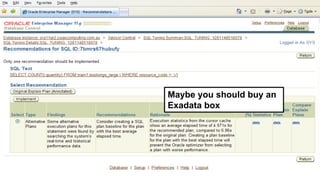
Maybe you should buy an
Exadata box
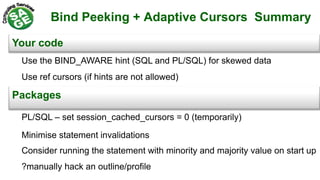
Bind Peeking + Adaptive Cursors Summary
Your code
Packages
Minimise statement invalidations
Consider running the statement with minority and majority value on start up
Use the BIND_AWARE hint (SQL and PL/SQL) for skewed data
Use ref cursors (if hints are not allowed)
?manually hack an outline/profile
PL/SQL – set session_cached_cursors = 0 (temporarily)
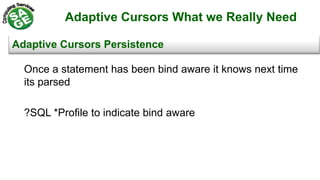
Adaptive Cursors What we Really Need
Once a statement has been bind aware it knows next time
its parsed
?SQL *Profile to indicate bind aware
Adaptive Cursors Persistence
Try to get rid of your hints
_optimizer_ignore_hints
Create additional statistics
Set _optimizer_ignore_hints to TRUE
Test the app
If it runs OK remove your hints
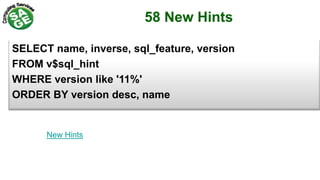
58 New Hints
SELECT name, inverse, sql_feature, version
FROM v$sql_hint
WHERE version like '11%'
ORDER BY version desc, name
New Hints
New Hints
IGNORE_ROW_ON_DUPKEY_INDEX
This has nothing to do with optimisation I just like it
New Hints
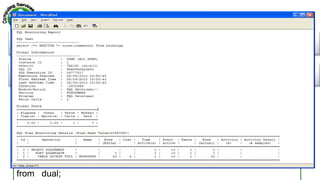
MONITOR
NO_MONITOR
select /*+ MONITOR */
count(comments) from bookings ;
select DBMS_SQLTUNE.REPORT_SQL_MONITOR(
session_id=>sys_context('userenv','sid'),
report_level=>'ALL') as report
from dual;
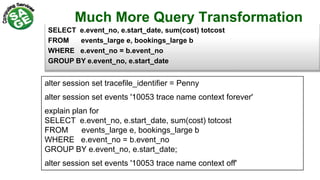
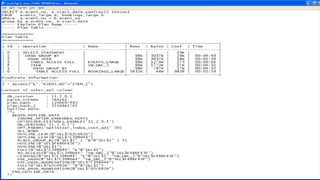
Much More Query Transformation
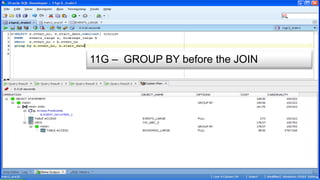
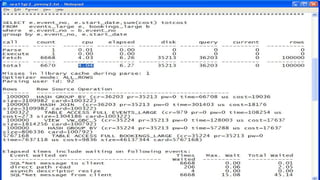
SELECT e.event_no, e.start_date, sum(cost) totcost
FROM events_large e, bookings_large b
WHERE e.event_no = b.event_no
GROUP BY e.event_no, e.start_date
alter session set tracefile_identifier = Penny
alter session set events '10053 trace name context forever'
explain plan for
SELECT e.event_no, e.start_date, sum(cost) totcost
FROM events_large e, bookings_large b
WHERE e.event_no = b.event_no
GROUP BY e.event_no, e.start_date;
alter session set events '10053 trace name context off'
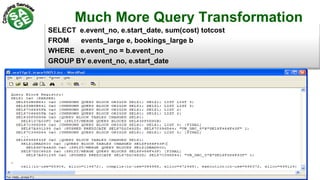
Much More Query Transformation
SELECT e.event_no, e.start_date, sum(cost) totcost
FROM events_large e, bookings_large b
WHERE e.event_no = b.event_no
GROUP BY e.event_no, e.start_date
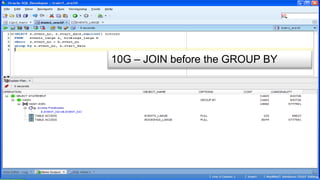
10G – JOIN before the GROUP BY
11G – GROUP BY before the JOIN
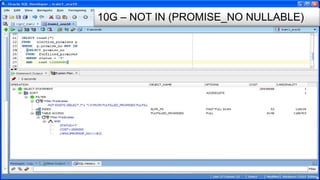
10G – NOT IN (PROMISE_NO NULLABLE)
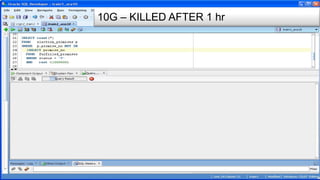
10G – KILLED AFTER 1 hr
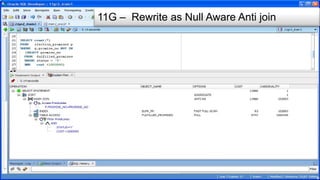
11G – Rewrite as Null Aware Anti join
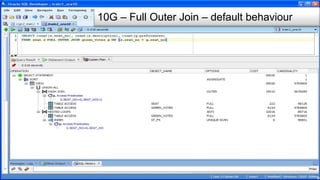
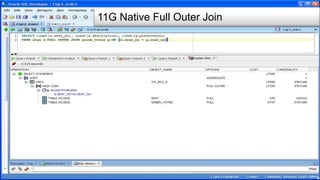
10G – Full Outer Join – default behaviour
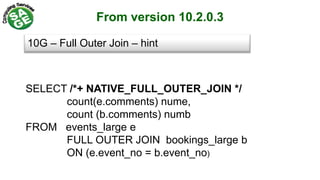
From version 10.2.0.3
SELECT /*+ NATIVE_FULL_OUTER_JOIN */
count(e.comments) nume,
count (b.comments) numb
FROM events_large e
FULL OUTER JOIN bookings_large b
ON (e.event_no = b.event_no)
10G – Full Outer Join – hint
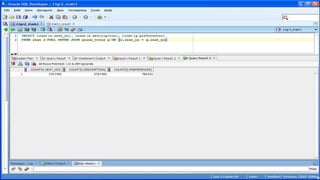
11G Native Full Outer Join
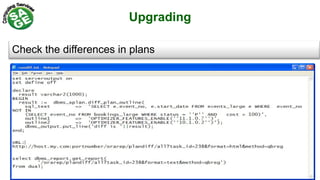
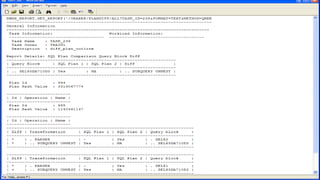
Check the differences in plans
Upgrading
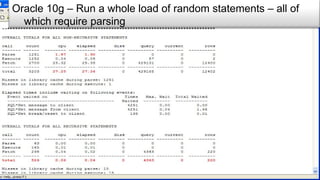
Oracle 10g – Run a whole load of random statements – all of
which require parsing
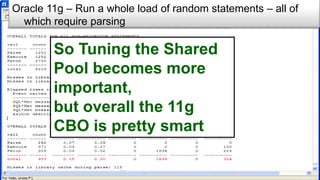
Oracle 11g – Run a whole load of random statements – all of
which require parsing
So Tuning the Shared
Pool becomes more
important,
but overall the 11g
CBO is pretty smart
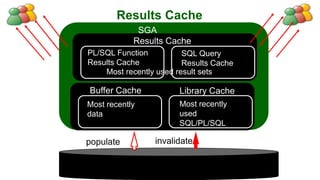
Results Cache
SGA
populate invalidate
Most recently
used
SQL/PL/SQL
SQL Query
Results Cache
Results Cache
PL/SQL Function
Results Cache
Most recently used result sets
Buffer Cache Library Cache
Most recently
data
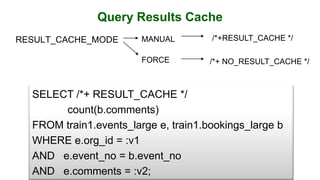
Query Results Cache
RESULT_CACHE_MODE MANUAL
FORCE
/*+RESULT_CACHE */
/*+ NO_RESULT_CACHE */
SELECT /*+ RESULT_CACHE */
count(b.comments)
FROM train1.events_large e, train1.bookings_large b
WHERE e.org_id = :v1
AND e.event_no = b.event_no
AND e.comments = :v2;
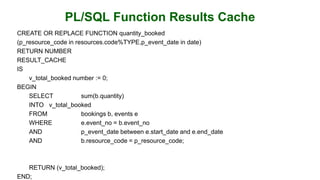
PL/SQL Function Results Cache
CREATE OR REPLACE FUNCTION quantity_booked
(p_resource_code in resources.code%TYPE,p_event_date in date)
RETURN NUMBER
RESULT_CACHE
IS
v_total_booked number := 0;
BEGIN
SELECT sum(b.quantity)
INTO v_total_booked
FROM bookings b, events e
WHERE e.event_no = b.event_no
AND p_event_date between e.start_date and e.end_date
AND b.resource_code = p_resource_code;
RETURN (v_total_booked);
END;
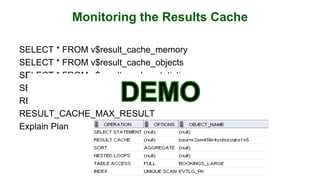
Monitoring the Results Cache
SELECT * FROM v$result_cache_memory
SELECT * FROM v$result_cache_objects
SELECT * FROM v$result_cache_statistics
SELECT * FROM v$result_cache_dependency
RESULT_CACHE_MAX_SIZE
RESULT_CACHE_MAX_RESULT
Explain Plan
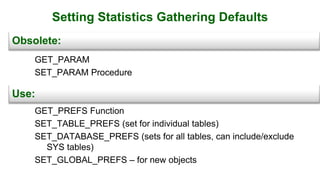
Setting Statistics Gathering Defaults
GET_PARAM
SET_PARAM Procedure
GET_PREFS Function
SET_TABLE_PREFS (set for individual tables)
SET_DATABASE_PREFS (sets for all tables, can include/exclude
SYS tables)
SET_GLOBAL_PREFS – for new objects
Obsolete:
Use:
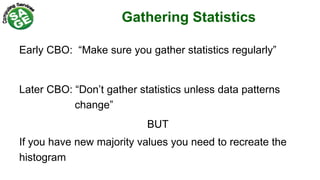
Gathering Statistics
Early CBO: “Make sure you gather statistics regularly”
Later CBO: “Don’t gather statistics unless data patterns
change”
BUT
If you have new majority values you need to recreate the
histogram
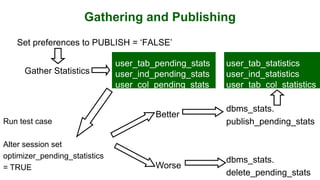
Gathering and Publishing
Set preferences to PUBLISH = ‘FALSE’
Gather Statistics
user_tab_pending_stats
user_ind_pending_stats
user_col_pending_stats
Run test case
Alter session set
optimizer_pending_statistics
= TRUE Worse
Better
dbms_stats.
delete_pending_stats
dbms_stats.
publish_pending_stats
user_tab_statistics
user_ind_statistics
user_tab_col_statistics
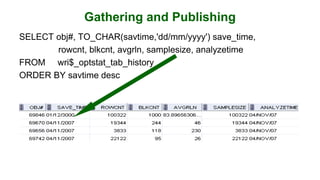
Gathering and Publishing
SELECT obj#, TO_CHAR(savtime,'dd/mm/yyyy') save_time,
rowcnt, blkcnt, avgrln, samplesize, analyzetime
FROM wri$_optstat_tab_history
ORDER BY savtime desc
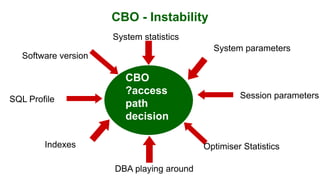
CBO - Instability
CBO
?access
path
decision
System parameters
Session parameters
Optimiser StatisticsIndexes
SQL Profile
Software version
System statistics
DBA playing around
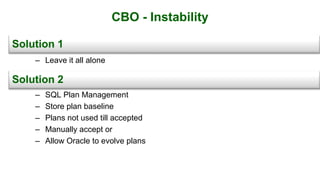
CBO - Instability
– Leave it all alone
– SQL Plan Management
– Store plan baseline
– Plans not used till accepted
– Manually accept or
– Allow Oracle to evolve plans
Solution 1
Solution 2
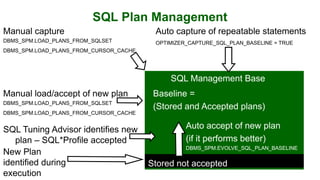
SQL Plan Management
Manual capture
DBMS_SPM.LOAD_PLANS_FROM_SQLSET
DBMS_SPM.LOAD_PLANS_FROM_CURSOR_CACHE
Auto capture of repeatable statements
OPTIMIZER_CAPTURE_SQL_PLAN_BASELINE = TRUE
Baseline =
(Stored and Accepted plans)
SQL Management Base
New Plan
identified during
execution
Stored not accepted
SQL Tuning Advisor identifies new
plan – SQL*Profile accepted
Auto accept of new plan
(if it performs better)
DBMS_SPM.EVOLVE_SQL_PLAN_BASELINE
Manual load/accept of new plan
DBMS_SPM.LOAD_PLANS_FROM_SQLSET
DBMS_SPM.LOAD_PLANS_FROM_CURSOR_CACHE
www.sagecomputing.com.au
penny@sagecomputing.com.au
SAGE Computing Services
Customised Oracle Training Workshops and Consulting
Questions?
www.sagecomputing.com.au
penny@sagecomputing.com.au

Meet the CBO in Version 11g

  • 1.
    www.sagecomputing.com.au penny@sagecomputing.com.au Meet the CostBased Optimiser in 11g Penny Cookson SAGE Computing Services SAGE Computing Services Customised Oracle Training Workshops and Consulting
  • 2.
    SAGE Computing Services CustomisedOracle Training Workshops and Consulting Penny Cookson Managing Director and Principal Consultant Working with Oracle products since 1987 Oracle Magazine Educator of the Year 2004 www.sagecomputing.com.au penny@sagecomputing.com.au
  • 3.
    A Characteristic Problem Ihaven’t changed anything Its really slow this morning I did the same thing yesterday and it was fine Actually its OK now No its not Thank you so much you’ve fixed it (I haven’t done anything)
  • 4.
    Oracle Version <9 SELECT COUNT(l.quantity) FROM bookings_skew l WHERE resource_code = :v1; ‘BRLG’ <Version 9 database No bind peeking Shared Pool SELECT COUNT(l.quantity) FROM bookings_skew_large l WHERE resource_code = :v1; ‘PC1’ FULL SCAN How many rows do I expect?
  • 5.
    Oracle Version <9 SELECT COUNT(l.quantity) FROM bookings_skew l WHERE resource_code = :v1; ‘BRLG’ <Version 9 database No bind peeking Shared Pool SELECT COUNT(l.quantity) FROM bookings_skew_large l WHERE resource_code = :v1; ‘PC1’ FULL SCAN How many rows do I expect?
  • 6.
    What is BindPeeking? SELECT COUNT(l.quantity) FROM bookings_skew l WHERE resource_code = :v1; ‘PC1’ >=Version 9 database Bind peeking Shared Pool SELECT COUNT(l.quantity) FROM bookings_skew l WHERE resource_code = :v1; ‘BRLG’ INDEXED ACCESS How many rows do I expect?
  • 7.
    Histogram – MinorityFirst *************************************** SINGLE TABLE ACCESS PATH Column (#3): RESOURCE_CODE(VARCHAR2) AvgLen: 5.00 NDV: 9 Nulls: 0 Density: 9.0892e-008 Histogram: Freq #Bkts: 9 UncompBkts: 5966 EndPtVals: 9 Table: BOOKINGS_SKEW Alias: L Card: Original: 5464800 Rounded: 43968 Computed: 43967.55 Non Adjusted: 43967.55 Access Path: TableScan Cost: 7693.35 Resp: 7693.35 Degree: 0 Cost_io: 7426.00 Cost_cpu: 1555877511 Resp_io: 7426.00 Resp_cpu: 1555877511 Access Path: index (AllEqRange) Index: BK_RESSKEW resc_io: 2399.00 resc_cpu: 37397785 ix_sel: 0.0080456 ix_sel_with_filters: 0.0080456 Cost: 2405.43 Resp: 2405.43 Degree: 1 Best:: AccessPath: IndexRange Index: BK_RESSKEW Cost: 2405.43 Degree: 1 Resp: 2405.43 Card: 43967.55 Bytes: 0 *************************************** RESO COUNT(*) ---- ---------- VCR1 495711 CONF 495720 LNCH 743576 BRSM 743583 PC1 47858 FLPC 495720 BRLG 1739277 TAP1 247864 VCR2 495715
  • 8.
  • 9.
    What is theCBO good at in 10g? Data Condition Literal/Bind Var Histogram Even Distribution Equality Literal N/A Even Distribution Equality Bind N/A Skewed Equality Literal NO Skewed Equality Literal YES Skewed Equality Bind NO Skewed Equality Bind YES Even Distribution Range Bind N/A
  • 10.
    Bind Peeking +Adaptive Cursors in 11g Statements with bind variables (+histograms) are bind sensitive The first time you execute a statement with different selectivity it uses the original plan The second time it changes the plan and become bind aware New values will use a plan for the appropriate selectivity range
  • 11.
  • 12.
  • 13.
    PLSQL has softparse avoidance Implicit cursor Explicit cursor Native dynamic SQL Ref cursor Session_cached_cursors = 0 No default adaptive cursor functionality Default adaptive cursor functionality
  • 14.
    Adaptive Cursors Functionality Bindvariable with Equality and Histogram Not for range conditions Bind variable with Equality and Histogram Range conditions Does not support LIKE /*+ BIND_AWARE */ Adaptive Cursors 11.1.0.6 Adaptive Cursors 11.1.0.7 and 11.2
  • 15.
    So where arewe now? Our own code – works properly first time with hint in SQL and PL/SQL Packages – will still get it wrong once and won’t use adaptive cursors for PL/SQL at all unless we set session cached cursors =0
  • 24.
  • 25.
    Bind Peeking +Adaptive Cursors Summary Your code Packages Minimise statement invalidations Consider running the statement with minority and majority value on start up Use the BIND_AWARE hint (SQL and PL/SQL) for skewed data Use ref cursors (if hints are not allowed) ?manually hack an outline/profile PL/SQL – set session_cached_cursors = 0 (temporarily)
  • 26.
    Adaptive Cursors Whatwe Really Need Once a statement has been bind aware it knows next time its parsed ?SQL *Profile to indicate bind aware Adaptive Cursors Persistence
  • 27.
    Try to getrid of your hints _optimizer_ignore_hints Create additional statistics Set _optimizer_ignore_hints to TRUE Test the app If it runs OK remove your hints
  • 28.
    58 New Hints SELECTname, inverse, sql_feature, version FROM v$sql_hint WHERE version like '11%' ORDER BY version desc, name New Hints
  • 29.
    New Hints IGNORE_ROW_ON_DUPKEY_INDEX This hasnothing to do with optimisation I just like it
  • 30.
    New Hints MONITOR NO_MONITOR select /*+MONITOR */ count(comments) from bookings ; select DBMS_SQLTUNE.REPORT_SQL_MONITOR( session_id=>sys_context('userenv','sid'), report_level=>'ALL') as report from dual;
  • 31.
    Much More QueryTransformation SELECT e.event_no, e.start_date, sum(cost) totcost FROM events_large e, bookings_large b WHERE e.event_no = b.event_no GROUP BY e.event_no, e.start_date alter session set tracefile_identifier = Penny alter session set events '10053 trace name context forever' explain plan for SELECT e.event_no, e.start_date, sum(cost) totcost FROM events_large e, bookings_large b WHERE e.event_no = b.event_no GROUP BY e.event_no, e.start_date; alter session set events '10053 trace name context off'
  • 32.
    Much More QueryTransformation SELECT e.event_no, e.start_date, sum(cost) totcost FROM events_large e, bookings_large b WHERE e.event_no = b.event_no GROUP BY e.event_no, e.start_date
  • 33.
    10G – JOINbefore the GROUP BY
  • 35.
    11G – GROUPBY before the JOIN
  • 41.
    10G – NOTIN (PROMISE_NO NULLABLE)
  • 42.
    10G – KILLEDAFTER 1 hr
  • 43.
    11G – Rewriteas Null Aware Anti join
  • 45.
    10G – FullOuter Join – default behaviour
  • 47.
    From version 10.2.0.3 SELECT/*+ NATIVE_FULL_OUTER_JOIN */ count(e.comments) nume, count (b.comments) numb FROM events_large e FULL OUTER JOIN bookings_large b ON (e.event_no = b.event_no) 10G – Full Outer Join – hint
  • 48.
    11G Native FullOuter Join
  • 50.
    Check the differencesin plans Upgrading
  • 54.
    Oracle 10g –Run a whole load of random statements – all of which require parsing
  • 55.
    Oracle 11g –Run a whole load of random statements – all of which require parsing So Tuning the Shared Pool becomes more important, but overall the 11g CBO is pretty smart
  • 56.
    Results Cache SGA populate invalidate Mostrecently used SQL/PL/SQL SQL Query Results Cache Results Cache PL/SQL Function Results Cache Most recently used result sets Buffer Cache Library Cache Most recently data
  • 57.
    Query Results Cache RESULT_CACHE_MODEMANUAL FORCE /*+RESULT_CACHE */ /*+ NO_RESULT_CACHE */ SELECT /*+ RESULT_CACHE */ count(b.comments) FROM train1.events_large e, train1.bookings_large b WHERE e.org_id = :v1 AND e.event_no = b.event_no AND e.comments = :v2;
  • 58.
    PL/SQL Function ResultsCache CREATE OR REPLACE FUNCTION quantity_booked (p_resource_code in resources.code%TYPE,p_event_date in date) RETURN NUMBER RESULT_CACHE IS v_total_booked number := 0; BEGIN SELECT sum(b.quantity) INTO v_total_booked FROM bookings b, events e WHERE e.event_no = b.event_no AND p_event_date between e.start_date and e.end_date AND b.resource_code = p_resource_code; RETURN (v_total_booked); END;
  • 59.
    Monitoring the ResultsCache SELECT * FROM v$result_cache_memory SELECT * FROM v$result_cache_objects SELECT * FROM v$result_cache_statistics SELECT * FROM v$result_cache_dependency RESULT_CACHE_MAX_SIZE RESULT_CACHE_MAX_RESULT Explain Plan
  • 61.
    Setting Statistics GatheringDefaults GET_PARAM SET_PARAM Procedure GET_PREFS Function SET_TABLE_PREFS (set for individual tables) SET_DATABASE_PREFS (sets for all tables, can include/exclude SYS tables) SET_GLOBAL_PREFS – for new objects Obsolete: Use:
  • 62.
    Gathering Statistics Early CBO:“Make sure you gather statistics regularly” Later CBO: “Don’t gather statistics unless data patterns change” BUT If you have new majority values you need to recreate the histogram
  • 63.
    Gathering and Publishing Setpreferences to PUBLISH = ‘FALSE’ Gather Statistics user_tab_pending_stats user_ind_pending_stats user_col_pending_stats Run test case Alter session set optimizer_pending_statistics = TRUE Worse Better dbms_stats. delete_pending_stats dbms_stats. publish_pending_stats user_tab_statistics user_ind_statistics user_tab_col_statistics
  • 64.
    Gathering and Publishing SELECTobj#, TO_CHAR(savtime,'dd/mm/yyyy') save_time, rowcnt, blkcnt, avgrln, samplesize, analyzetime FROM wri$_optstat_tab_history ORDER BY savtime desc
  • 65.
    CBO - Instability CBO ?access path decision Systemparameters Session parameters Optimiser StatisticsIndexes SQL Profile Software version System statistics DBA playing around
  • 66.
    CBO - Instability –Leave it all alone – SQL Plan Management – Store plan baseline – Plans not used till accepted – Manually accept or – Allow Oracle to evolve plans Solution 1 Solution 2
  • 67.
    SQL Plan Management Manualcapture DBMS_SPM.LOAD_PLANS_FROM_SQLSET DBMS_SPM.LOAD_PLANS_FROM_CURSOR_CACHE Auto capture of repeatable statements OPTIMIZER_CAPTURE_SQL_PLAN_BASELINE = TRUE Baseline = (Stored and Accepted plans) SQL Management Base New Plan identified during execution Stored not accepted SQL Tuning Advisor identifies new plan – SQL*Profile accepted Auto accept of new plan (if it performs better) DBMS_SPM.EVOLVE_SQL_PLAN_BASELINE Manual load/accept of new plan DBMS_SPM.LOAD_PLANS_FROM_SQLSET DBMS_SPM.LOAD_PLANS_FROM_CURSOR_CACHE
  • 68.
  • 69.
    SAGE Computing Services CustomisedOracle Training Workshops and Consulting Questions? www.sagecomputing.com.au penny@sagecomputing.com.au