

Exadata, Oracle Data Integrator
and Parallel Data Load: A Real-
World Case Study
Kellyn Pot’Vin, Sr. Technical Consultant
Who I am
3
• Westminster, CO
• Oracle ACE Director
• Sr. Technical Consultant, Enkitec
• Blog at http://dbakevlar.com
• Board of Directors and Directory of RMOUG
Training Days Conference in Denver, CO.
• Database Track Lead for KSCOPE 2014 in
Seattle, Wa.
• Tweet @DBAKevlar
• Author: Expert Enterprise Manager 12c, Pro
SQL Server 2012, Apress
• WIT, (Women In Technology) advocate
Agenda for this Session
4
• Discuss ODI Requirements
• Discuss Exadata Features
• Discuss “Old School” Limitations to
ETL design.
• Solution to Create Speed in
Reporting.
Environment
5
• Multiple Exadata Environment
• Oracle Data Integrator is New Feature as part of
recent consolidation effort.
• 15-20 consolidated databases on each
development Exadata.
• 10 currently on production Exadata and
consolidating more monthly.
• Monitored by EM12c
• Golden Gate utilized originally for
consolidations, now commissioned to support
ODI for new project.
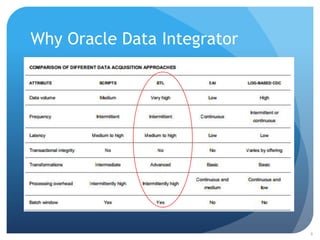
Why Oracle Data Integrator
6
Oracle Data Integrator, (ODI)
7
• Enterprise platforms with its open and
integrated E-LT architecture
• Simple mapping wizards, user-friendly
interface.
• Integrates successfully with Enterprise
Manager 12c.
• Also integrates with weblogic, SAP, APIs and
other advanced features.
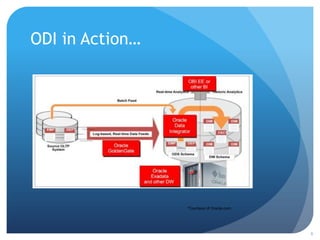
ODI in Action…
8
*Courtesy of Oracle.com
What is Change Data Capture,
(CDC)?
9
• Originally self-contained, then part of Streams.
• Not all CDC is created, (built) the same.
• Transaction “aware”
• Recoverable
• Handle Data Integrity
• Are Scalable
• Flexible and Robust
• This is your goal, practice, (testing) makes
perfect!
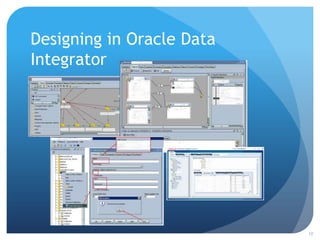
Designing in Oracle Data
Integrator
10
CDC and/or just ODI?
11
• CDC is part of the Golden Gate piece.
• Golden Gate offers real-time “continuous
capture and delivery” of changes to your
warehouse.
• Once synchronized with the source, Golden
Gate can be integrated into ODI.
• Golden Gate requires a term license from
Oracle.
Where Does Exadata Come in?
12
• Smartscans- Offloading large table scans to
cell nodes are an impressive enhancement
to performance.
• Storage Indexes- If a report offers an
opportunity for Exadata to create a storage
index to assist in performance, then this
feature will benefit reporting.
• HCC- Compression if data is loaded
appropriately, (APPEND should be used) and
NO UPDATING data in compressed objects!
Out of the Starting Gate with
ODI..
13
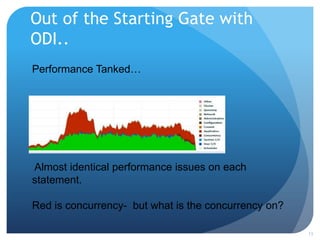
Almost identical performance issues on each
statement.
Red is concurrency- but what is the concurrency on?
Performance Tanked…
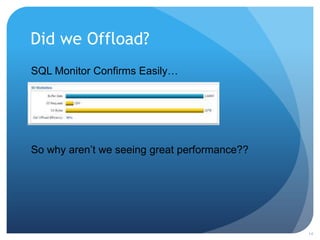
Did we Offload?
14
SQL Monitor Confirms Easily…
So why aren’t we seeing great performance??
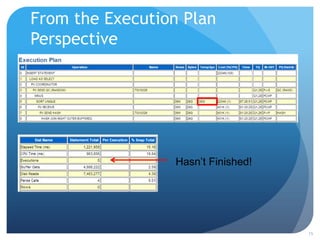
From the Execution Plan
Perspective
15
Hasn’t Finished!
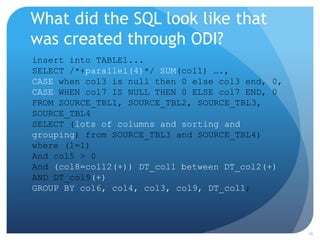
What did the SQL look like that
was created through ODI?
16
insert into TABLE1...
SELECT /*+parallel(4)*/ SUM(col1) ….,
CASE when col3 is null then 0 else col3 end, 0,
CASE WHEN col7 IS NULL THEN 0 ELSE col7 END, 0
FROM SOURCE_TBL1, SOURCE_TBL2, SOURCE_TBL3,
SOURCE_TBL4
SELECT (lots of columns and sorting and
grouping) from SOURCE_TBL3 and SOURCE_TBL4)
where (1=1)
And col5 > 0
And (col8=col12(+)) DT_col1 between DT_col2(+)
AND DT_col9(+)
GROUP BY col6, col4, col3, col9, DT_col1;
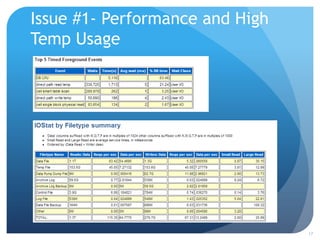
Issue #1- Performance and High
Temp Usage
17
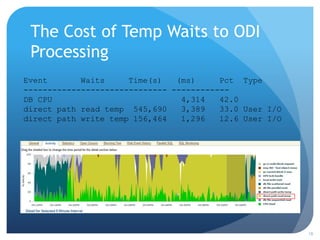
The Cost of Temp Waits to ODI
Processing
18
Event Waits Time(s) (ms) Pct Type
------------------------------ ------------
DB CPU 4,314 42.0
direct path read temp 545,690 3,389 33.0 User I/O
direct path write temp 156,464 1,296 12.6 User I/O
Why the Temp Usage?
19
• Large hash joins following offload table scans.
• Summing of the data in the query.
• Sorting the data in the query.
• DOP, (Degree of Parallelism) set at table level
or as hint.
Data was not aggregated or stored in the
format easily utilized for reporting.
Let’s Talk About Performance,
PGA and Limits…
20
Two Types of PGA-
• Non-limited, outside of Oracle’s control, often
used for PL/SQL tables, etc.
• Limited by allocation per process set within Oracle
for hashing, sorting, etc.
• Depending on release, process type, etc., there
are approximate percentages that can be
expected for limits of PGA allocated to sort and
hash processing.
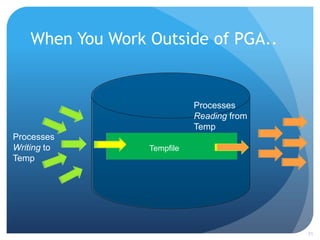
When You Work Outside of PGA..
21
Tempfile
Processes
Writing to
Temp
Processes
Reading from
Temp
Types of PGA Processing
22
Optimal- All fits within the PGA allocation per
process.
Single Pass- Written once to temp tablespace.
Multi-Pass- Writte multiple times to temp
tablesapace to achive results, (least desirable)
Disk is Slow…
23
What is “* Cache Hit”?
When something does not “fit”, we know it’s gone
back to disk to perform the task and disk is slow.
If PGA allocation is surpassed, the processing is then
performed in the Temp Tablespace.
Where do the tempfiles for the Temp Tablespace
reside?
Temp is disk, disk is SLOW!
Tuning these Limits
24
Increasing PGA will of course increase the
percentage per process for some types of
sorting and hashing, but there is still a limit.
Parallel can offer some assistance by spreading
the PGA load across multiple processes- but
there is a cost to “knitting” the results back
together.
What you should not do:
• Do not start playing with “_pga_max_size",
"_smm_max_size" and "_smm_px_max_size"
Stop Using Temp
25
Sorting and Hashing should be done as much
as possible within PGA.
Limit any “swapping” to temp.
Ensure you are viewing temp usage in your
explain/execution plans!
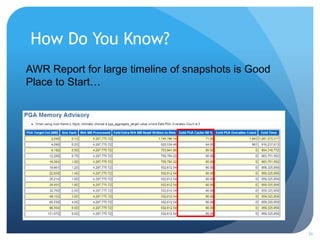
How Do You Know?
26
AWR Report for large timeline of snapshots is Good
Place to Start…
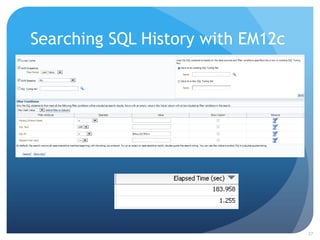
Searching SQL History with EM12c
27
Issue #2- So What is Causing our
Changes now?
28
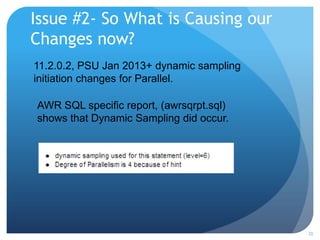
11.2.0.2, PSU Jan 2013+ dynamic sampling
initiation changes for Parallel.
AWR SQL specific report, (awrsqrpt.sql)
shows that Dynamic Sampling did occur.
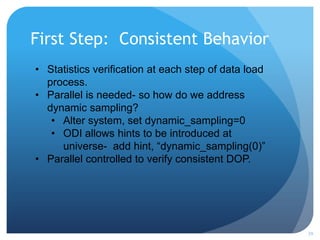
First Step: Consistent Behavior
29
• Statistics verification at each step of data load
process.
• Parallel is needed- so how do we address
dynamic sampling?
• Alter system, set dynamic_sampling=0
• ODI allows hints to be introduced at
universe- add hint, “dynamic_sampling(0)”
• Parallel controlled to verify consistent DOP.
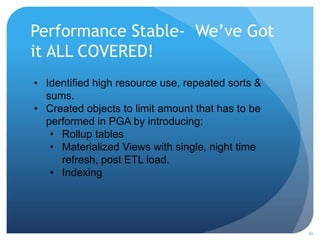
Performance Stable- We’ve Got
it ALL COVERED!
30
• Identified high resource use, repeated sorts &
sums.
• Created objects to limit amount that has to be
performed in PGA by introducing:
• Rollup tables
• Materialized Views with single, night time
refresh, post ETL load.
• Indexing
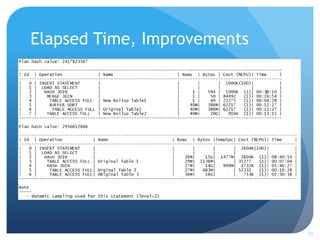
Elapsed Time, Improvements
31
Summary
32
• Identify WHAT is consuming time.
• Understand the limits on PGA/Temp
usage- Repeatedly the biggest hurdle in
ETL projects.
• Understand that TEMP is disk and disk is
SLOW, even on Exadata.
• Identify what data you repeatedly are
aggregating and create objects to support
reporting.
34
Questions?
Fastest Growing Companies
in Dallas

OOW13 Exadata and ODI with Parallel

  • 1.
    Exadata, Oracle DataIntegrator and Parallel Data Load: A Real- World Case Study Kellyn Pot’Vin, Sr. Technical Consultant
  • 2.
    Who I am 3 •Westminster, CO • Oracle ACE Director • Sr. Technical Consultant, Enkitec • Blog at http://dbakevlar.com • Board of Directors and Directory of RMOUG Training Days Conference in Denver, CO. • Database Track Lead for KSCOPE 2014 in Seattle, Wa. • Tweet @DBAKevlar • Author: Expert Enterprise Manager 12c, Pro SQL Server 2012, Apress • WIT, (Women In Technology) advocate
  • 3.
    Agenda for thisSession 4 • Discuss ODI Requirements • Discuss Exadata Features • Discuss “Old School” Limitations to ETL design. • Solution to Create Speed in Reporting.
  • 4.
    Environment 5 • Multiple ExadataEnvironment • Oracle Data Integrator is New Feature as part of recent consolidation effort. • 15-20 consolidated databases on each development Exadata. • 10 currently on production Exadata and consolidating more monthly. • Monitored by EM12c • Golden Gate utilized originally for consolidations, now commissioned to support ODI for new project.
  • 5.
    Why Oracle DataIntegrator 6
  • 6.
    Oracle Data Integrator,(ODI) 7 • Enterprise platforms with its open and integrated E-LT architecture • Simple mapping wizards, user-friendly interface. • Integrates successfully with Enterprise Manager 12c. • Also integrates with weblogic, SAP, APIs and other advanced features.
  • 7.
  • 8.
    What is ChangeData Capture, (CDC)? 9 • Originally self-contained, then part of Streams. • Not all CDC is created, (built) the same. • Transaction “aware” • Recoverable • Handle Data Integrity • Are Scalable • Flexible and Robust • This is your goal, practice, (testing) makes perfect!
  • 9.
    Designing in OracleData Integrator 10
  • 10.
    CDC and/or justODI? 11 • CDC is part of the Golden Gate piece. • Golden Gate offers real-time “continuous capture and delivery” of changes to your warehouse. • Once synchronized with the source, Golden Gate can be integrated into ODI. • Golden Gate requires a term license from Oracle.
  • 11.
    Where Does ExadataCome in? 12 • Smartscans- Offloading large table scans to cell nodes are an impressive enhancement to performance. • Storage Indexes- If a report offers an opportunity for Exadata to create a storage index to assist in performance, then this feature will benefit reporting. • HCC- Compression if data is loaded appropriately, (APPEND should be used) and NO UPDATING data in compressed objects!
  • 12.
    Out of theStarting Gate with ODI.. 13 Almost identical performance issues on each statement. Red is concurrency- but what is the concurrency on? Performance Tanked…
  • 13.
    Did we Offload? 14 SQLMonitor Confirms Easily… So why aren’t we seeing great performance??
  • 14.
    From the ExecutionPlan Perspective 15 Hasn’t Finished!
  • 15.
    What did theSQL look like that was created through ODI? 16 insert into TABLE1... SELECT /*+parallel(4)*/ SUM(col1) …., CASE when col3 is null then 0 else col3 end, 0, CASE WHEN col7 IS NULL THEN 0 ELSE col7 END, 0 FROM SOURCE_TBL1, SOURCE_TBL2, SOURCE_TBL3, SOURCE_TBL4 SELECT (lots of columns and sorting and grouping) from SOURCE_TBL3 and SOURCE_TBL4) where (1=1) And col5 > 0 And (col8=col12(+)) DT_col1 between DT_col2(+) AND DT_col9(+) GROUP BY col6, col4, col3, col9, DT_col1;
  • 16.
    Issue #1- Performanceand High Temp Usage 17
  • 17.
    The Cost ofTemp Waits to ODI Processing 18 Event Waits Time(s) (ms) Pct Type ------------------------------ ------------ DB CPU 4,314 42.0 direct path read temp 545,690 3,389 33.0 User I/O direct path write temp 156,464 1,296 12.6 User I/O
  • 18.
    Why the TempUsage? 19 • Large hash joins following offload table scans. • Summing of the data in the query. • Sorting the data in the query. • DOP, (Degree of Parallelism) set at table level or as hint. Data was not aggregated or stored in the format easily utilized for reporting.
  • 19.
    Let’s Talk AboutPerformance, PGA and Limits… 20 Two Types of PGA- • Non-limited, outside of Oracle’s control, often used for PL/SQL tables, etc. • Limited by allocation per process set within Oracle for hashing, sorting, etc. • Depending on release, process type, etc., there are approximate percentages that can be expected for limits of PGA allocated to sort and hash processing.
  • 20.
    When You WorkOutside of PGA.. 21 Tempfile Processes Writing to Temp Processes Reading from Temp
  • 21.
    Types of PGAProcessing 22 Optimal- All fits within the PGA allocation per process. Single Pass- Written once to temp tablespace. Multi-Pass- Writte multiple times to temp tablesapace to achive results, (least desirable)
  • 22.
    Disk is Slow… 23 Whatis “* Cache Hit”? When something does not “fit”, we know it’s gone back to disk to perform the task and disk is slow. If PGA allocation is surpassed, the processing is then performed in the Temp Tablespace. Where do the tempfiles for the Temp Tablespace reside? Temp is disk, disk is SLOW!
  • 23.
    Tuning these Limits 24 IncreasingPGA will of course increase the percentage per process for some types of sorting and hashing, but there is still a limit. Parallel can offer some assistance by spreading the PGA load across multiple processes- but there is a cost to “knitting” the results back together. What you should not do: • Do not start playing with “_pga_max_size", "_smm_max_size" and "_smm_px_max_size"
  • 24.
    Stop Using Temp 25 Sortingand Hashing should be done as much as possible within PGA. Limit any “swapping” to temp. Ensure you are viewing temp usage in your explain/execution plans!
  • 25.
    How Do YouKnow? 26 AWR Report for large timeline of snapshots is Good Place to Start…
  • 26.
    Searching SQL Historywith EM12c 27
  • 27.
    Issue #2- SoWhat is Causing our Changes now? 28 11.2.0.2, PSU Jan 2013+ dynamic sampling initiation changes for Parallel. AWR SQL specific report, (awrsqrpt.sql) shows that Dynamic Sampling did occur.
  • 28.
    First Step: ConsistentBehavior 29 • Statistics verification at each step of data load process. • Parallel is needed- so how do we address dynamic sampling? • Alter system, set dynamic_sampling=0 • ODI allows hints to be introduced at universe- add hint, “dynamic_sampling(0)” • Parallel controlled to verify consistent DOP.
  • 29.
    Performance Stable- We’veGot it ALL COVERED! 30 • Identified high resource use, repeated sorts & sums. • Created objects to limit amount that has to be performed in PGA by introducing: • Rollup tables • Materialized Views with single, night time refresh, post ETL load. • Indexing
  • 30.
  • 31.
    Summary 32 • Identify WHATis consuming time. • Understand the limits on PGA/Temp usage- Repeatedly the biggest hurdle in ETL projects. • Understand that TEMP is disk and disk is SLOW, even on Exadata. • Identify what data you repeatedly are aggregating and create objects to support reporting.
  • 33.