Technology Trends in Finance
Rey Lugtu
Imagine your life in 2020…..
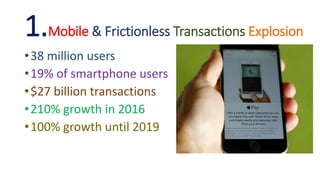
1.Mobile & Frictionless Transactions Explosion
•38 million users
•19% of smartphone users
•$27 billion transactions
•210% growth in 2016
•100% growth until 2019
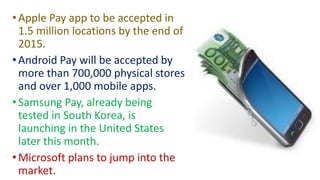
•Apple Pay app to be accepted in
1.5 million locations by the end of
2015.
•Android Pay will be accepted by
more than 700,000 physical stores
and over 1,000 mobile apps.
•Samsung Pay, already being
tested in South Korea, is
launching in the United States
later this month.
•Microsoft plans to jump into the
market.
• Growth in digital deals and
discounts
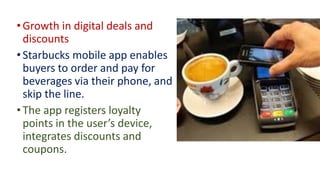
• Starbucks mobile app enables
buyers to order and pay for
beverages via their phone, and
skip the line.
• The app registers loyalty
points in the user’s device,
integrates discounts and
coupons.
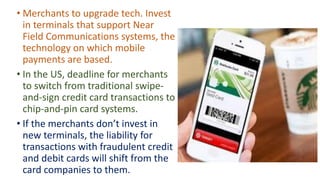
• Merchants to upgrade tech. Invest
in terminals that support Near
Field Communications systems, the
technology on which mobile
payments are based.
• In the US, deadline for merchants
to switch from traditional swipe-
and-sign credit card transactions to
chip-and-pin card systems.
• If the merchants don’t invest in
new terminals, the liability for
transactions with fraudulent credit
and debit cards will shift from the
card companies to them.
2. Growth in Chip Cards
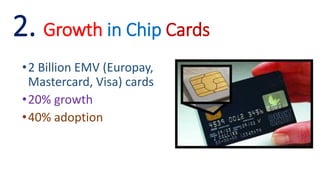
•2 Billion EMV (Europay,
Mastercard, Visa) cards
•20% growth
•40% adoption
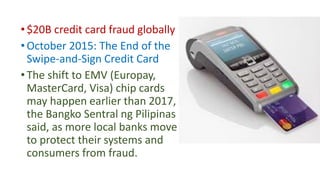
•$20B credit card fraud globally
•October 2015: The End of the
Swipe-and-Sign Credit Card
•The shift to EMV (Europay,
MasterCard, Visa) chip cards
may happen earlier than 2017,
the Bangko Sentral ng Pilipinas
said, as more local banks move
to protect their systems and
consumers from fraud.
3. Growth in Digital Currency
• Bitcoin versus Blockchain
• Bitcoin is a form of digital currency, created and held
electronically. No one controls it. Bitcoins aren't
printed, like dollars or euros – they're produced by
people, and increasingly businesses, running
computers all around the world, using software that
solves mathematical problems
• Blockchain is just a record, or ledger, of digital events
— one that’s “distributed,” or shared among many
different parties. It can only be updated by consensus
of a majority of the participants in the system. And,
once entered, information can never be erased. The
bitcoin blockchain contains a certain and verifiable
record of every single bitcoin transaction ever made.
• Faster, cheaper bank
transfers
• A boost to global
remittances
• Safe money for the poor
• Unleashing the potential of
e-commerce
• Programmable money and
smart contracts
4. Omnichannel for Financial Services
•Seamless integration
•Any product delivered from
anywhere
•Digital payment
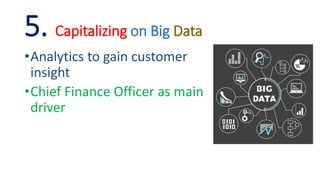
5. Capitalizing on Big Data
•Analytics to gain customer
insight
•Chief Finance Officer as main
driver
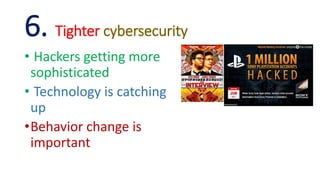
6. Tighter cybersecurity
• Hackers getting more
sophisticated
• Technology is catching
up
•Behavior change is
important
Implications
•Growth in eCommerce
•We are less and less
secure
•Regulatory scrutiny
•More venture capital
funds
What you should be prepared for
•You will drive the
changes
•Learn technologies
•Be responsible
•More opportunities
END
Goodluck!
Rey Lugtu

Technology Trends in Finance 2016

  • 1.
    Technology Trends inFinance Rey Lugtu
  • 2.
    Imagine your lifein 2020…..
  • 4.
    1.Mobile & FrictionlessTransactions Explosion •38 million users •19% of smartphone users •$27 billion transactions •210% growth in 2016 •100% growth until 2019
  • 5.
    •Apple Pay appto be accepted in 1.5 million locations by the end of 2015. •Android Pay will be accepted by more than 700,000 physical stores and over 1,000 mobile apps. •Samsung Pay, already being tested in South Korea, is launching in the United States later this month. •Microsoft plans to jump into the market.
  • 6.
    • Growth indigital deals and discounts • Starbucks mobile app enables buyers to order and pay for beverages via their phone, and skip the line. • The app registers loyalty points in the user’s device, integrates discounts and coupons.
  • 7.
    • Merchants toupgrade tech. Invest in terminals that support Near Field Communications systems, the technology on which mobile payments are based. • In the US, deadline for merchants to switch from traditional swipe- and-sign credit card transactions to chip-and-pin card systems. • If the merchants don’t invest in new terminals, the liability for transactions with fraudulent credit and debit cards will shift from the card companies to them.
  • 8.
    2. Growth inChip Cards •2 Billion EMV (Europay, Mastercard, Visa) cards •20% growth •40% adoption
  • 9.
    •$20B credit cardfraud globally •October 2015: The End of the Swipe-and-Sign Credit Card •The shift to EMV (Europay, MasterCard, Visa) chip cards may happen earlier than 2017, the Bangko Sentral ng Pilipinas said, as more local banks move to protect their systems and consumers from fraud.
  • 10.
    3. Growth inDigital Currency • Bitcoin versus Blockchain • Bitcoin is a form of digital currency, created and held electronically. No one controls it. Bitcoins aren't printed, like dollars or euros – they're produced by people, and increasingly businesses, running computers all around the world, using software that solves mathematical problems • Blockchain is just a record, or ledger, of digital events — one that’s “distributed,” or shared among many different parties. It can only be updated by consensus of a majority of the participants in the system. And, once entered, information can never be erased. The bitcoin blockchain contains a certain and verifiable record of every single bitcoin transaction ever made.
  • 11.
    • Faster, cheaperbank transfers • A boost to global remittances • Safe money for the poor • Unleashing the potential of e-commerce • Programmable money and smart contracts
  • 12.
    4. Omnichannel forFinancial Services •Seamless integration •Any product delivered from anywhere •Digital payment
  • 13.
    5. Capitalizing onBig Data •Analytics to gain customer insight •Chief Finance Officer as main driver
  • 14.
    6. Tighter cybersecurity •Hackers getting more sophisticated • Technology is catching up •Behavior change is important
  • 15.
    Implications •Growth in eCommerce •Weare less and less secure •Regulatory scrutiny •More venture capital funds
  • 16.
    What you shouldbe prepared for •You will drive the changes •Learn technologies •Be responsible •More opportunities
  • 17.