Better lives through livestock
Food safety research and training in informal/wet markets in Southeast Asia
Hung Nguyen, Co-leader, Animal and Human Health program, International Livestock Research Institute
Contribution: Fred Unger, Sinh Dang-Xuan, Phuc Pham Duc, Pham Van Hung, Sothyra Tum, Chhay Ty, Rortana Chea, Delia Grace
28 January 2021
2
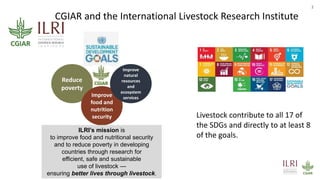
Reduce
poverty
Improve
food and
nutrition
security
Improve
natural
resources
and
ecosystem
services
ILRI’s mission is
to improve food and nutritional security
and to reduce poverty in developing
countries through research for
efficient, safe and sustainable
use of livestock —
ensuring better lives through livestock.
CGIAR and the International Livestock Research Institute
Livestock contribute to all 17 of
the SDGs and directly to at least 8
of the goals.
3
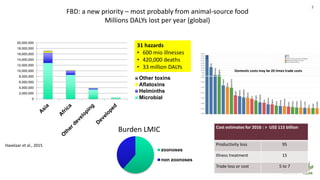
FBD: a new priority – most probably from animal-source food
Millions DALYs lost per year (global)
0
2,000,000
4,000,000
6,000,000
8,000,000
10,000,000
12,000,000
14,000,000
16,000,000
18,000,000
20,000,000
Other toxins
Aflatoxins
Helminths
Microbial
Havelaar et al., 2015
31 hazards
• 600 mio illnesses
• 420,000 deaths
• 33 million DALYs
zoonoses
non zoonoses
Burden LMIC Cost estimates for 2016 : > US$ 115 billion
Productivity loss 95
Illness treatment 15
Trade loss or cost 5 to 7
Domestic costs may be 20 times trade costs
4
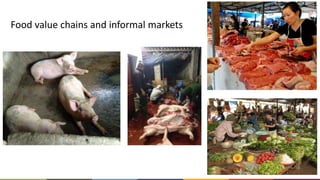
Food value chains and informal markets
5
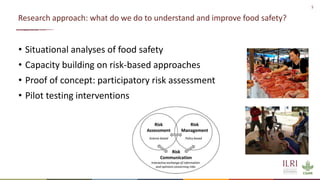
Research approach: what do we do to understand and improve food safety?
• Situational analyses of food safety
• Capacity building on risk-based approaches
• Proof of concept: participatory risk assessment
• Pilot testing interventions
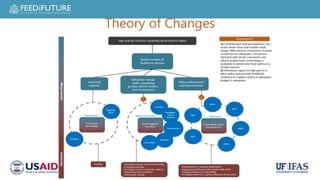
Theory of Changes
7
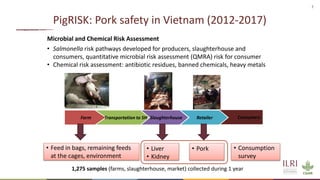
Microbial and Chemical Risk Assessment
• Salmonella risk pathways developed for producers, slaughterhouse and
consumers, quantitative microbial risk assessment (QMRA) risk for consumer
• Chemical risk assessment: antibiotic residues, banned chemicals, heavy metals
1,275 samples (farms, slaughterhouse, market) collected during 1 year
PigRISK: Pork safety in Vietnam (2012-2017)
Farm Transportation to SH Slaughterhouse Consumers
Retailer
• Feed in bags, remaining feeds
at the cages, environment
• Pork
• Liver
• Kidney
• Consumption
survey
8
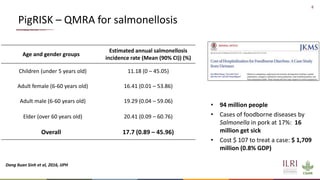
PigRISK – QMRA for salmonellosis
Age and gender groups
Estimated annual salmonellosis
incidence rate (Mean (90% CI)) (%)
Children (under 5 years old) 11.18 (0 – 45.05)
Adult female (6-60 years old) 16.41 (0.01 – 53.86)
Adult male (6-60 years old) 19.29 (0.04 – 59.06)
Elder (over 60 years old) 20.41 (0.09 – 60.76)
Overall 17.7 (0.89 – 45.96)
Dang Xuan Sinh et al, 2016, IJPH
• 94 million people
• Cases of foodborne diseases by
Salmonella in pork at 17%: 16
million get sick
• Cost $ 107 to treat a case: $ 1,709
million (0.8% GDP)
9
Safe Food, Fair Food for Cambodia (2018-2021)
A nationwide multi-hazard survey in
markets in Cambodia found the
prevalence in meat (pork and chicken) of
Salmonella was 43% and of
Staphylococcus was 31%.
The cost of illness of foodborne diarrhea
was $63 USD per case.
Sample type
N.
Specimen
N. positive both
Salmonella and S. aureus
Salmonella
positive
S. aureus
positive
Chicken 186 38 (20.4%) 84 (45.2%) 78 (41.9%)
Cuttingboard chicken 62 6 (9.7%) 26 (41.9%) 12 (19.4%)
Cuttingboard pork 62 1 (1.6%) 19 (30.6%) 7 (11.3%)
Pork 186 33 (17.7%) 85 (45.7%) 58 (31.2%)
Grand Total 496 78 (15.7%) 214 (43.1%) 155 (31.3%)
Cost National
Hospital
(n=44)
Referral
Hospital
(n=60)
Regiona
l Hosp.
(n=100)
Commu
nity
Clinic
(n=62)
Overall
(n=266)
Direct medical cost
[usd] 125.77 9.42 27.85 4.19 34.38
Direct non-medical
cost
[usd] 40.64 8.36 26.33 0.30 18.58
Indirect cost
[usd] 21.43 6.38 10.89 3.08 9.80
Total cost [usd] 185.88 24.16 65.07 7.57 62.76
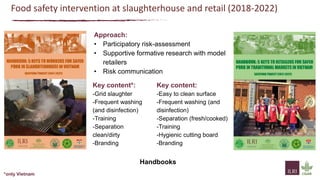
Handbooks
INTERVENTION
Development of Instruction & Training materials
Food safety intervention at slaughterhouse and retail (2018-2022)
Approach:
• Participatory risk-assessment
• Supportive formative research with model
retailers
• Risk communication
Key content*:
-Grid slaughter
-Frequent washing
(and disinfection)
-Training
-Separation
clean/dirty
-Branding
Key content:
-Easy to clean surface
-Frequent washing (and
disinfection)
-Separation (fresh/cooked)
-Training
-Hygienic cutting board
-Branding
*only Vietnam
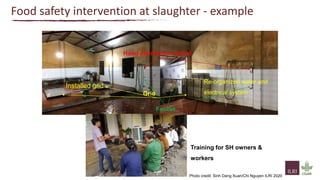
INTERVENTION
Results at SH
Grid
Hand disinfection liquid
Faucet
Installed grid
Re-organized water and
electrical system
Training for SH owners &
workers
Food safety intervention at slaughter - example
Photo credit: Sinh Dang Xuan/Chi Nguyen ILRI 2020
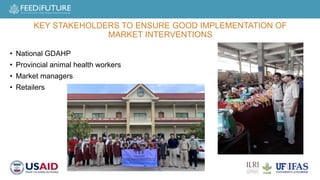
• National GDAHP
• Provincial animal health workers
• Market managers
• Retailers
KEY STAKEHOLDERS TO ENSURE GOOD IMPLEMENTATION OF
MARKET INTERVENTIONS
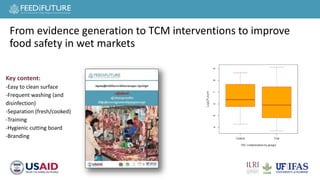
From evidence generation to TCM interventions to improve
food safety in wet markets
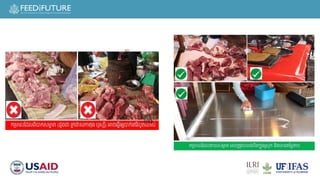
Key content:
-Easy to clean surface
-Frequent washing (and
disinfection)
-Separation (fresh/cooked)
-Training
-Hygienic cutting board
-Branding
15
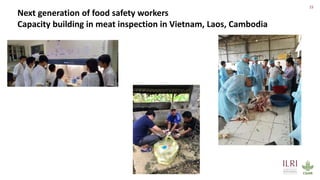
Next generation of food safety workers
Capacity building in meat inspection in Vietnam, Laos, Cambodia
16
INTERVENTION
Development of Instruction & Training materials
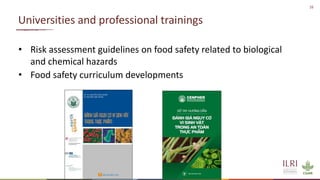
Universities and professional trainings
• Risk assessment guidelines on food safety related to biological
and chemical hazards
• Food safety curriculum developments
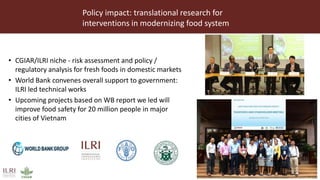
Policy impact: translational research for
interventions in modernizing food system
• CGIAR/ILRI niche - risk assessment and policy /
regulatory analysis for fresh foods in domestic markets
• World Bank convenes overall support to government:
ILRI led technical works
• Upcoming projects based on WB report we led will
improve food safety for 20 million people in major
cities of Vietnam
18
Key messages
1. Food safety in informal/wet markets: high level of microbial
contamination along the value chains and of public concerns
2. Risk based approach (hazard vs. risks) helps identify targeted
interventions and key stakeholders to improve food safety
3. Capacity building: trainings at different levels are key to improve food
safety
4. Strong engagement of high level ‘taskforce’, and other actors (animal
health workers, market managers, retailers) made intervention
implementation successful
Acknowledgements
• ILRI team: Kristina Roesel, Silvia Alonso, Johanna
Lindahl, PigRISK and SafePORK team
• Melissa Youth and SFFF Cambodia team
• BMZ project team
• Funding: ACIAR, CGIAR Research Program on
Agriculture for Nutrition and Health, World Bank,
BMZ, USAID through LSIL, IAFP

Food safety research and training in informal/wet markets in Southeast Asia

  • 1.
    Better lives throughlivestock Food safety research and training in informal/wet markets in Southeast Asia Hung Nguyen, Co-leader, Animal and Human Health program, International Livestock Research Institute Contribution: Fred Unger, Sinh Dang-Xuan, Phuc Pham Duc, Pham Van Hung, Sothyra Tum, Chhay Ty, Rortana Chea, Delia Grace 28 January 2021
  • 2.
    2 Reduce poverty Improve food and nutrition security Improve natural resources and ecosystem services ILRI’s missionis to improve food and nutritional security and to reduce poverty in developing countries through research for efficient, safe and sustainable use of livestock — ensuring better lives through livestock. CGIAR and the International Livestock Research Institute Livestock contribute to all 17 of the SDGs and directly to at least 8 of the goals.
  • 3.
    3 FBD: a newpriority – most probably from animal-source food Millions DALYs lost per year (global) 0 2,000,000 4,000,000 6,000,000 8,000,000 10,000,000 12,000,000 14,000,000 16,000,000 18,000,000 20,000,000 Other toxins Aflatoxins Helminths Microbial Havelaar et al., 2015 31 hazards • 600 mio illnesses • 420,000 deaths • 33 million DALYs zoonoses non zoonoses Burden LMIC Cost estimates for 2016 : > US$ 115 billion Productivity loss 95 Illness treatment 15 Trade loss or cost 5 to 7 Domestic costs may be 20 times trade costs
  • 4.
    4 Food value chainsand informal markets
  • 5.
    5 Research approach: whatdo we do to understand and improve food safety? • Situational analyses of food safety • Capacity building on risk-based approaches • Proof of concept: participatory risk assessment • Pilot testing interventions
  • 6.
  • 7.
    7 Microbial and ChemicalRisk Assessment • Salmonella risk pathways developed for producers, slaughterhouse and consumers, quantitative microbial risk assessment (QMRA) risk for consumer • Chemical risk assessment: antibiotic residues, banned chemicals, heavy metals 1,275 samples (farms, slaughterhouse, market) collected during 1 year PigRISK: Pork safety in Vietnam (2012-2017) Farm Transportation to SH Slaughterhouse Consumers Retailer • Feed in bags, remaining feeds at the cages, environment • Pork • Liver • Kidney • Consumption survey
  • 8.
    8 PigRISK – QMRAfor salmonellosis Age and gender groups Estimated annual salmonellosis incidence rate (Mean (90% CI)) (%) Children (under 5 years old) 11.18 (0 – 45.05) Adult female (6-60 years old) 16.41 (0.01 – 53.86) Adult male (6-60 years old) 19.29 (0.04 – 59.06) Elder (over 60 years old) 20.41 (0.09 – 60.76) Overall 17.7 (0.89 – 45.96) Dang Xuan Sinh et al, 2016, IJPH • 94 million people • Cases of foodborne diseases by Salmonella in pork at 17%: 16 million get sick • Cost $ 107 to treat a case: $ 1,709 million (0.8% GDP)
  • 9.
    9 Safe Food, FairFood for Cambodia (2018-2021) A nationwide multi-hazard survey in markets in Cambodia found the prevalence in meat (pork and chicken) of Salmonella was 43% and of Staphylococcus was 31%. The cost of illness of foodborne diarrhea was $63 USD per case. Sample type N. Specimen N. positive both Salmonella and S. aureus Salmonella positive S. aureus positive Chicken 186 38 (20.4%) 84 (45.2%) 78 (41.9%) Cuttingboard chicken 62 6 (9.7%) 26 (41.9%) 12 (19.4%) Cuttingboard pork 62 1 (1.6%) 19 (30.6%) 7 (11.3%) Pork 186 33 (17.7%) 85 (45.7%) 58 (31.2%) Grand Total 496 78 (15.7%) 214 (43.1%) 155 (31.3%) Cost National Hospital (n=44) Referral Hospital (n=60) Regiona l Hosp. (n=100) Commu nity Clinic (n=62) Overall (n=266) Direct medical cost [usd] 125.77 9.42 27.85 4.19 34.38 Direct non-medical cost [usd] 40.64 8.36 26.33 0.30 18.58 Indirect cost [usd] 21.43 6.38 10.89 3.08 9.80 Total cost [usd] 185.88 24.16 65.07 7.57 62.76
  • 10.
    Handbooks INTERVENTION Development of Instruction& Training materials Food safety intervention at slaughterhouse and retail (2018-2022) Approach: • Participatory risk-assessment • Supportive formative research with model retailers • Risk communication Key content*: -Grid slaughter -Frequent washing (and disinfection) -Training -Separation clean/dirty -Branding Key content: -Easy to clean surface -Frequent washing (and disinfection) -Separation (fresh/cooked) -Training -Hygienic cutting board -Branding *only Vietnam
  • 11.
    INTERVENTION Results at SH Grid Handdisinfection liquid Faucet Installed grid Re-organized water and electrical system Training for SH owners & workers Food safety intervention at slaughter - example Photo credit: Sinh Dang Xuan/Chi Nguyen ILRI 2020
  • 13.
    • National GDAHP •Provincial animal health workers • Market managers • Retailers KEY STAKEHOLDERS TO ENSURE GOOD IMPLEMENTATION OF MARKET INTERVENTIONS
  • 14.
    From evidence generationto TCM interventions to improve food safety in wet markets Key content: -Easy to clean surface -Frequent washing (and disinfection) -Separation (fresh/cooked) -Training -Hygienic cutting board -Branding
  • 15.
    15 Next generation offood safety workers Capacity building in meat inspection in Vietnam, Laos, Cambodia
  • 16.
    16 INTERVENTION Development of Instruction& Training materials Universities and professional trainings • Risk assessment guidelines on food safety related to biological and chemical hazards • Food safety curriculum developments
  • 17.
    Policy impact: translationalresearch for interventions in modernizing food system • CGIAR/ILRI niche - risk assessment and policy / regulatory analysis for fresh foods in domestic markets • World Bank convenes overall support to government: ILRI led technical works • Upcoming projects based on WB report we led will improve food safety for 20 million people in major cities of Vietnam
  • 18.
    18 Key messages 1. Foodsafety in informal/wet markets: high level of microbial contamination along the value chains and of public concerns 2. Risk based approach (hazard vs. risks) helps identify targeted interventions and key stakeholders to improve food safety 3. Capacity building: trainings at different levels are key to improve food safety 4. Strong engagement of high level ‘taskforce’, and other actors (animal health workers, market managers, retailers) made intervention implementation successful
  • 19.
    Acknowledgements • ILRI team:Kristina Roesel, Silvia Alonso, Johanna Lindahl, PigRISK and SafePORK team • Melissa Youth and SFFF Cambodia team • BMZ project team • Funding: ACIAR, CGIAR Research Program on Agriculture for Nutrition and Health, World Bank, BMZ, USAID through LSIL, IAFP