Hasimah Azit
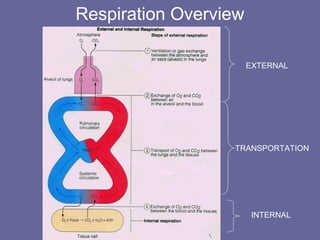
Respiration Overview
EXTERNAL
INTERNAL
TRANSPORTATION
ENERGY REQUIREMENT
FOR:
• Muscle contraction
• Active transport
• Transmission of nerves
• Formation of new organelle
• Cell division
• Maintain body temperature
Cellular respiration is the
process in which energy-rich
molecules such as glucose are
converted into energy usable for
life processes
• The process occurs in gradual
steps that result in the conversion
of the energy stored in glucose to
usable chemical energy in the
form of ATP
• Waste products (CO2 + H2O) are
released through exhaled air,
sweat and urine
Cellular respiration
Substrate for energy production:
Glucose – obtain from food
Oxygen - from air
– Aerobic respiration
– Anaerobic respiration
Aerobic respiration
• Aerobic respiration requires oxygen in
order to generate energy.
• 36 ATP molecules can be made per
glucose
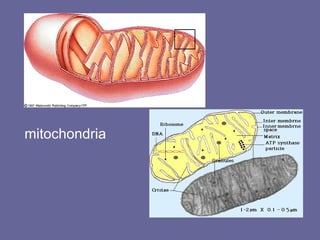
• reactions take place in the mitochondria
mitochondria
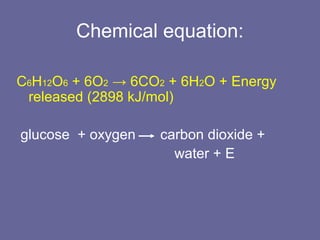
Chemical equation:
C6H12O6 + 6O2 → 6CO2 + 6H2O + Energy
released (2898 kJ/mol)
glucose + oxygen carbon dioxide +
water + E
• Activities like sprinting require
levels of energy that are greater
than the body can produce with
the aerobic (with oxygen)
metabolism.
• For these activities, the body
relies on anaerobic (without
oxygen) processes.
Anaerobic respiration
• Lactic acid is a byproduct of
anaerobic metabolism.
• It builds up to high levels within
the muscles and eventually leads
to fatigue during these high
intensity activities.
Anaerobic respiration
• In the absence of oxygen
• Glucose undergoes a process of
fermentation.
• in the cytoplasm
• In human cells the waste product is
lactic acid.
• 2 ATP are produced during anaerobic
respiration per glucose
Chemical reaction for
Anaerobic in muscle
C6H12O6 → 2C3H6O3 + E (150kJ mol−1)
[Glucose] [lactic acid] + Energy
• Lactic acid will build up causes fatigue
• Fast and deep breathing – supply extra
oxygen to :
– breakdown lactic acid into CO2 and H2O
– Converted back to glycogen
• The amount of O2 needed = oxygen debt
Anaerobic in yeast
• In yeast, the waste product is ethanol and
carbon dioxide
• Discuss:
– The important of ethanol and carbon dioxide
production for human
Comparison
Between aerobic and anaerobic
respiration:
–Place
–Reaction
–Product
–Energy produced
Characteristic of
respiratory surfaces
• Large surface area for gas exchange
• Thin respiratory surface, one layer
epithelial cells that allow oxygen and
carbon dioxide to exchange.
• respiratory surfaces must be moist, gases
can only cross cell membranes when they
are dissolved in water or an aqueous
solution
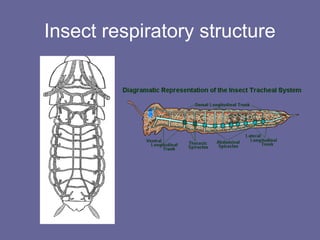
Insect respiratory structure
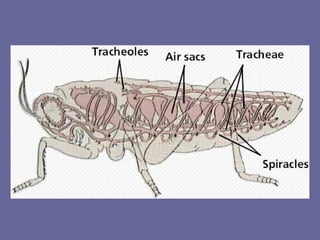
Tracheal system
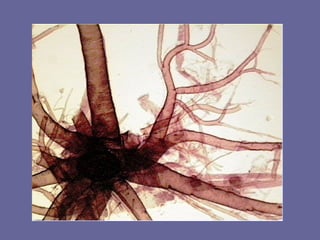
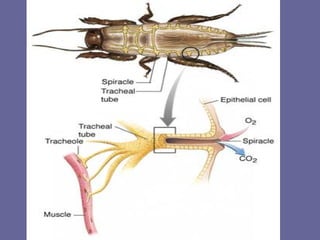
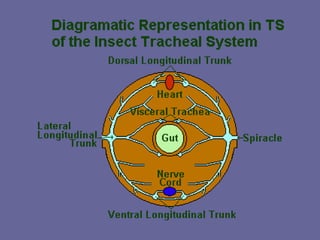
• spiracles - openings on the sides of the thorax
and abdomen
• usually one pair of spiracles per segment
• The tracheae are invaginations of the cuticular
exoskeleton that branch throughout the body
with diameters from only a few micrometers up
to 0.8mm.
• The smallest tubes, tracheoles, penetrate cells
and serve as sites of diffusion for oxygen and
carbon dioxide
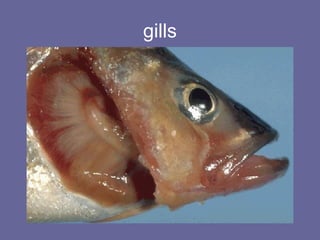
Fish respiratory structure
gills
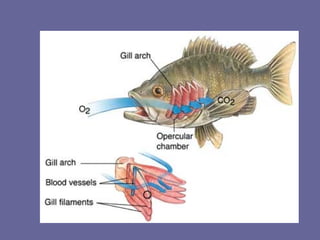
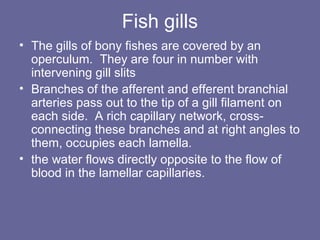
Fish gills
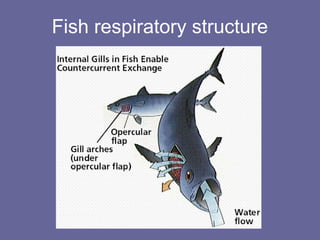
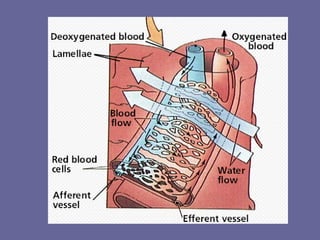
• The gills of bony fishes are covered by an
operculum. They are four in number with
intervening gill slits
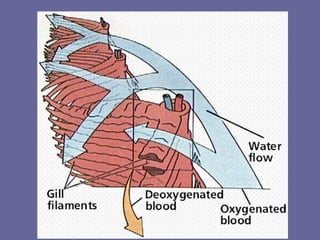
• Branches of the afferent and efferent branchial
arteries pass out to the tip of a gill filament on
each side. A rich capillary network, cross-
connecting these branches and at right angles to
them, occupies each lamella.
• the water flows directly opposite to the flow of
blood in the lamellar capillaries.
Amphibian
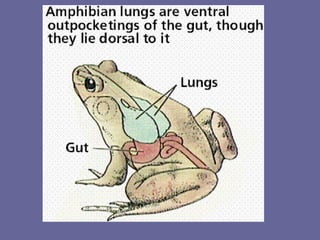
• Frogs have three respiratory surfaces :
– skin:
• Frogs can breathe through their skin while they are
in wet places.
• They can also exchange gases between the blood
vessels in it, and with its outer environment.
• There are also mucus glands in the skin, these
keep the skin moist.
• Their skin absorbs a lot of dissolved oxygen from
the surrounding atmosphere.
– the thin membranes lining its mouth and
pharynx.
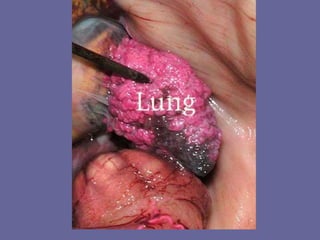
– the lungs.
• Adult frogs have poorly developed lungs. Their
lungs are used on dry land while the frogs are
active.
• Gas exchanged by the lungs is used to make the
vocal cords vibrate. They are located in the larynx,
and are necessary for the sound generated by a
frog.
• The frog inhales and exahales
– When the frog breathes, the air enters the
mouth. The floor of the mouth drops, and the
external nares open.
– The floor of the mouth rises and falls in a
rhythmic pattern. These movements are
interrupted by a rapid expansion and
contraction of the sides of the body wall at
less frequent intervals.
– At rest, frogs usually breathe through the
lining of the mouth. This process only fills the
lung occasionally.
Human respiratory structure
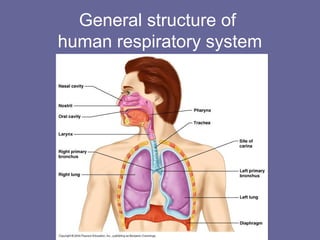
General structure of
human respiratory system
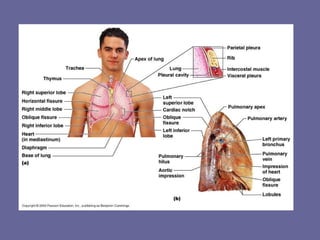
• The lungs are large, lobed, paired
organs
• in the thoracic cavity
• Thin sheets of epithelium (pleura)
separate the inside of the chest
cavity from the outer surface of
the lungs.
• The bottom of the thoracic cavity
is formed by the diaphragm.
Lung
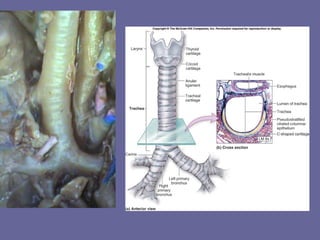
• Bronchi are reinforced by cartilage ring to
prevent their collapse
• They are lined with ciliated epithelium and
mucus-producing cells.
• Bronchi branch into smaller and smaller
tubes known as bronchioles.
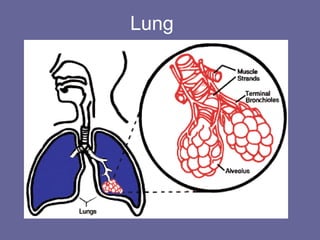
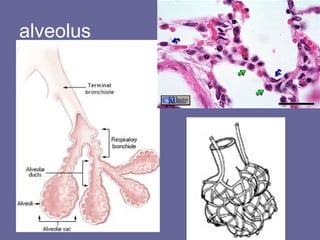
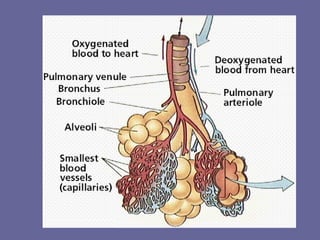
• Bronchioles terminate in grape-like sac
clusters known as alveoli.
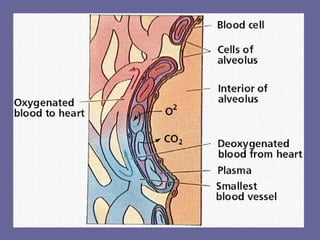
• Alveoli are surrounded by a network of
thin-walled capillaries.
• Only about 0.2 µm separate the alveoli
from the capillaries due to the extremely
thin walls of both structures.
alveolus
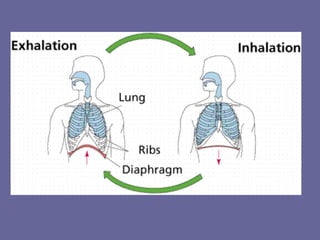
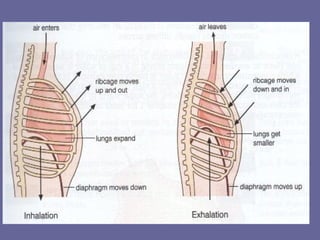
Ventilation
• the mechanics of breathing in and out
• inhalation,
– muscles in the chest wall contract,
– lifting the ribs and pulling them, outward
– diaphragm at this time moves downward
enlarging the chest cavity
• Reduced air pressure in the lungs causes
air to enter the lungs.
• Exhalation
– muscles in the chest wall relax,
– lifting the ribs and pulling them, outward
– diaphragm at this time moves downward
enlarging the chest cavity
• Increased air pressure in the lungs causes
air to exit the lungs.
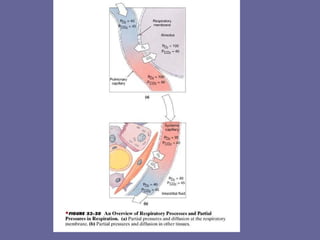
• Diffusion is the movement of materials
from a higher to a lower concentration.
• The differences between oxygen and
carbon dioxide concentrations are
measured by partial pressures.
• The greater the difference in partial
pressure the greater the rate of diffusion.
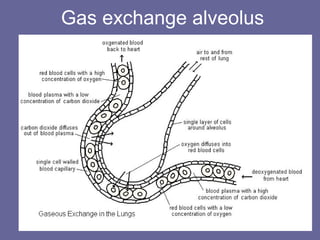
Gas exchange alveolus
Gas exchange
• Partial pressure of oxygen in alveolus is
higher than in alveolar blood capillaries
• Oxygen from the air dissolve in water
[moist] at alveoli lining and diffuse in blood
• Oxygen binds to hemoglobin in red blood
cells to form oxyhaemoglobin.
• Oxyhaemoglobin is carried to all body
cells by blood circulation
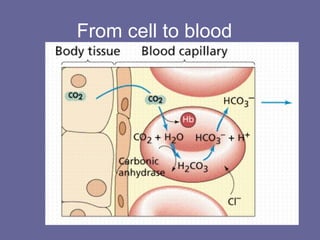
From cell to blood
Carbon dioxide - transported from
the body cells back to the lungs as:
• 1 - bicarbonate (HCO3) - 60%
– formed when CO2 (released by cells making
ATP) combines with H2O
• 2 - carbaminohemoglobin - 30%
– formed when CO2 combines with hemoglobin
(hemoglobin molecules that have given up
their oxygen)
• 3 - dissolved in the plasma - 10%
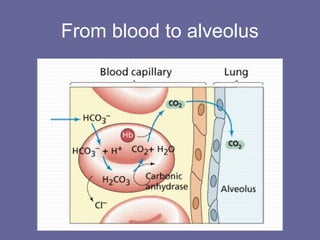
• Carbon dioxide diffuses in the opposite direction,
from capillary blood to alveolar air.
• Partial pressure of carbon dioxide in the blood is
higher than in the alveoli
• Carbon dioxide diffuse out to the alveoli
• Exhalation follows, to get rid of the carbon
dioxide and completing the cycle of respiration.
From blood to alveolus
What are differences between
inhaled and exhaled air?
Regulatory mechanism
• After vigorous exercise the rate of
respiration increase and heartbeat
increase
– To supply more oxygen to the muscle
– To eliminate more carbon dioxide from the
muscle
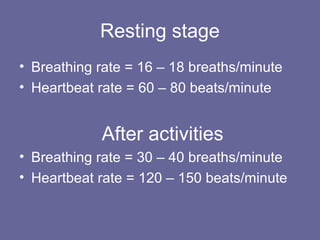
Resting stage
• Breathing rate = 16 – 18 breaths/minute
• Heartbeat rate = 60 – 80 beats/minute
After activities
• Breathing rate = 30 – 40 breaths/minute
• Heartbeat rate = 120 – 150 beats/minute
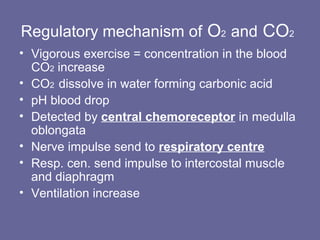
• Vigorous exercise = concentration in the blood
CO2 increase
• CO2 dissolve in water forming carbonic acid
• pH blood drop
• Detected by central chemoreceptor in medulla
oblongata
• Nerve impulse send to respiratory centre
• Resp. cen. send impulse to intercostal muscle
and diaphragm
• Ventilation increase
Regulatory mechanism of O2 and CO2
CO2
Water
Carbonic acid pH
Central chemoreceptor
[medulla oblongata]
Respiratory centre
Intercostals muscle diaphragm
Ventilation faster CO2 eliminate faster
Detected by
Impulse send
Impulse send
Respiration in plant
• Occurs all the time
• In daylight photosynthesis produces plenty
of oxygen
• Used by plant in respiration processes
• At night O2 from atmosphere is used for
respiration
Compare respiration and
photosynthesis

Respiration 091101010608-phpapp01

  • 1.
  • 2.
  • 3.
    ENERGY REQUIREMENT FOR: • Musclecontraction • Active transport • Transmission of nerves • Formation of new organelle • Cell division • Maintain body temperature
  • 4.
    Cellular respiration isthe process in which energy-rich molecules such as glucose are converted into energy usable for life processes
  • 5.
    • The processoccurs in gradual steps that result in the conversion of the energy stored in glucose to usable chemical energy in the form of ATP • Waste products (CO2 + H2O) are released through exhaled air, sweat and urine
  • 6.
    Cellular respiration Substrate forenergy production: Glucose – obtain from food Oxygen - from air
  • 7.
    – Aerobic respiration –Anaerobic respiration
  • 8.
    Aerobic respiration • Aerobicrespiration requires oxygen in order to generate energy. • 36 ATP molecules can be made per glucose • reactions take place in the mitochondria
  • 9.
  • 10.
    Chemical equation: C6H12O6 +6O2 → 6CO2 + 6H2O + Energy released (2898 kJ/mol) glucose + oxygen carbon dioxide + water + E
  • 11.
    • Activities likesprinting require levels of energy that are greater than the body can produce with the aerobic (with oxygen) metabolism. • For these activities, the body relies on anaerobic (without oxygen) processes. Anaerobic respiration
  • 12.
    • Lactic acidis a byproduct of anaerobic metabolism. • It builds up to high levels within the muscles and eventually leads to fatigue during these high intensity activities.
  • 13.
    Anaerobic respiration • Inthe absence of oxygen • Glucose undergoes a process of fermentation. • in the cytoplasm • In human cells the waste product is lactic acid. • 2 ATP are produced during anaerobic respiration per glucose
  • 14.
    Chemical reaction for Anaerobicin muscle C6H12O6 → 2C3H6O3 + E (150kJ mol−1) [Glucose] [lactic acid] + Energy
  • 15.
    • Lactic acidwill build up causes fatigue • Fast and deep breathing – supply extra oxygen to : – breakdown lactic acid into CO2 and H2O – Converted back to glycogen • The amount of O2 needed = oxygen debt
  • 16.
    Anaerobic in yeast •In yeast, the waste product is ethanol and carbon dioxide • Discuss: – The important of ethanol and carbon dioxide production for human
  • 17.
    Comparison Between aerobic andanaerobic respiration: –Place –Reaction –Product –Energy produced
  • 18.
    Characteristic of respiratory surfaces •Large surface area for gas exchange • Thin respiratory surface, one layer epithelial cells that allow oxygen and carbon dioxide to exchange. • respiratory surfaces must be moist, gases can only cross cell membranes when they are dissolved in water or an aqueous solution
  • 19.
  • 20.
    Tracheal system • spiracles- openings on the sides of the thorax and abdomen • usually one pair of spiracles per segment • The tracheae are invaginations of the cuticular exoskeleton that branch throughout the body with diameters from only a few micrometers up to 0.8mm. • The smallest tubes, tracheoles, penetrate cells and serve as sites of diffusion for oxygen and carbon dioxide
  • 25.
  • 26.
  • 28.
    Fish gills • Thegills of bony fishes are covered by an operculum. They are four in number with intervening gill slits • Branches of the afferent and efferent branchial arteries pass out to the tip of a gill filament on each side. A rich capillary network, cross- connecting these branches and at right angles to them, occupies each lamella. • the water flows directly opposite to the flow of blood in the lamellar capillaries.
  • 31.
    Amphibian • Frogs havethree respiratory surfaces : – skin: • Frogs can breathe through their skin while they are in wet places. • They can also exchange gases between the blood vessels in it, and with its outer environment. • There are also mucus glands in the skin, these keep the skin moist. • Their skin absorbs a lot of dissolved oxygen from the surrounding atmosphere.
  • 32.
    – the thinmembranes lining its mouth and pharynx. – the lungs. • Adult frogs have poorly developed lungs. Their lungs are used on dry land while the frogs are active. • Gas exchanged by the lungs is used to make the vocal cords vibrate. They are located in the larynx, and are necessary for the sound generated by a frog.
  • 33.
    • The froginhales and exahales – When the frog breathes, the air enters the mouth. The floor of the mouth drops, and the external nares open. – The floor of the mouth rises and falls in a rhythmic pattern. These movements are interrupted by a rapid expansion and contraction of the sides of the body wall at less frequent intervals. – At rest, frogs usually breathe through the lining of the mouth. This process only fills the lung occasionally.
  • 36.
  • 37.
    General structure of humanrespiratory system
  • 39.
    • The lungsare large, lobed, paired organs • in the thoracic cavity • Thin sheets of epithelium (pleura) separate the inside of the chest cavity from the outer surface of the lungs. • The bottom of the thoracic cavity is formed by the diaphragm.
  • 40.
  • 41.
    • Bronchi arereinforced by cartilage ring to prevent their collapse • They are lined with ciliated epithelium and mucus-producing cells. • Bronchi branch into smaller and smaller tubes known as bronchioles.
  • 43.
    • Bronchioles terminatein grape-like sac clusters known as alveoli. • Alveoli are surrounded by a network of thin-walled capillaries. • Only about 0.2 µm separate the alveoli from the capillaries due to the extremely thin walls of both structures.
  • 44.
  • 46.
    Ventilation • the mechanicsof breathing in and out • inhalation, – muscles in the chest wall contract, – lifting the ribs and pulling them, outward – diaphragm at this time moves downward enlarging the chest cavity • Reduced air pressure in the lungs causes air to enter the lungs.
  • 47.
    • Exhalation – musclesin the chest wall relax, – lifting the ribs and pulling them, outward – diaphragm at this time moves downward enlarging the chest cavity • Increased air pressure in the lungs causes air to exit the lungs.
  • 50.
    • Diffusion isthe movement of materials from a higher to a lower concentration. • The differences between oxygen and carbon dioxide concentrations are measured by partial pressures. • The greater the difference in partial pressure the greater the rate of diffusion.
  • 51.
  • 52.
    Gas exchange • Partialpressure of oxygen in alveolus is higher than in alveolar blood capillaries • Oxygen from the air dissolve in water [moist] at alveoli lining and diffuse in blood • Oxygen binds to hemoglobin in red blood cells to form oxyhaemoglobin. • Oxyhaemoglobin is carried to all body cells by blood circulation
  • 53.
  • 54.
    Carbon dioxide -transported from the body cells back to the lungs as: • 1 - bicarbonate (HCO3) - 60% – formed when CO2 (released by cells making ATP) combines with H2O • 2 - carbaminohemoglobin - 30% – formed when CO2 combines with hemoglobin (hemoglobin molecules that have given up their oxygen) • 3 - dissolved in the plasma - 10%
  • 55.
    • Carbon dioxidediffuses in the opposite direction, from capillary blood to alveolar air. • Partial pressure of carbon dioxide in the blood is higher than in the alveoli • Carbon dioxide diffuse out to the alveoli • Exhalation follows, to get rid of the carbon dioxide and completing the cycle of respiration.
  • 56.
    From blood toalveolus
  • 59.
    What are differencesbetween inhaled and exhaled air?
  • 60.
    Regulatory mechanism • Aftervigorous exercise the rate of respiration increase and heartbeat increase – To supply more oxygen to the muscle – To eliminate more carbon dioxide from the muscle
  • 61.
    Resting stage • Breathingrate = 16 – 18 breaths/minute • Heartbeat rate = 60 – 80 beats/minute After activities • Breathing rate = 30 – 40 breaths/minute • Heartbeat rate = 120 – 150 beats/minute
  • 62.
    • Vigorous exercise= concentration in the blood CO2 increase • CO2 dissolve in water forming carbonic acid • pH blood drop • Detected by central chemoreceptor in medulla oblongata • Nerve impulse send to respiratory centre • Resp. cen. send impulse to intercostal muscle and diaphragm • Ventilation increase Regulatory mechanism of O2 and CO2
  • 63.
    CO2 Water Carbonic acid pH Centralchemoreceptor [medulla oblongata] Respiratory centre Intercostals muscle diaphragm Ventilation faster CO2 eliminate faster Detected by Impulse send Impulse send
  • 64.
    Respiration in plant •Occurs all the time • In daylight photosynthesis produces plenty of oxygen • Used by plant in respiration processes • At night O2 from atmosphere is used for respiration
  • 65.