RESPIRATORY PHYSIOLOGY-1
LUNG VOLUMES, CAPACITIES, VENTILATION-
PERFUSION
MODERATOR : DR. NISHANT
PRESENTER : DR. DEEPTI
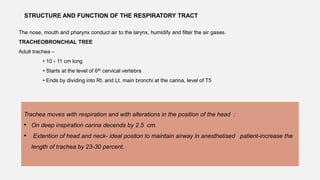
STRUCTURE AND FUNCTION OF THE RESPIRATORY TRACT
The nose, mouth and pharynx conduct air to the larynx, humidify and filter the air gases.
TRACHEOBRONCHIAL TREE
Adult trachea –
• 10 - 11 cm long
• Starts at the level of 6th cervical vertebra
• Ends by dividing into Rt. and Lt. main bronchi at the carina, level of T5
Trachea moves with respiration and with alterations in the position of the head :
• On deep inspiration carina decends by 2.5 cm.
• Extention of head and neck- ideal positon to maintain airway in anesthetised patient-increase the
length of trachea by 23-30 percent.
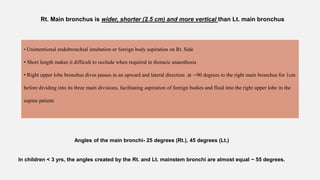
Rt. Main bronchus is wider, shorter (2.5 cm) and more vertical than Lt. main bronchus
•
• Unintentional endobronchial intubation or foreign body aspiration on Rt. Side
• Short length makes it difficult to occlude when required in thoracic anaesthesia
• Right upper lobe bronchus dives passes in an upward and lateral direction at ∼90 degrees to the right main bronchus for 1cm
before dividing into its three main divisions, facilitating aspiration of foreign bodies and fluid into the right upper lobe in the
supine patient.
Angles of the main bronchi- 25 degrees (Rt.), 45 degrees (Lt.)
In children < 3 yrs, the angles created by the Rt. and Lt. mainstem bronchi are almost equal ~ 55 degrees.
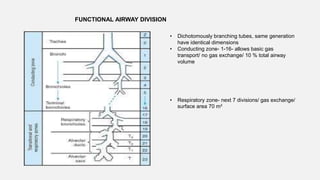
FUNCTIONAL AIRWAY DIVISION
• Dichotomously branching tubes, same generation
have identical dimensions
• Conducting zone- 1-16- allows basic gas
transport/ no gas exchange/ 10 % total airway
volume
• Respiratory zone- next 7 divisions/ gas exchange/
surface area 70 m²
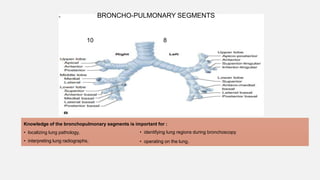
Knowledge of the bronchopulmonary segments is important for :
• localizing lung pathology,
• interpreting lung radiographs,
• identifying lung regions during bronchoscopy
• operating on the lung.
10 8
BRONCHO-PULMONARY SEGMENTS
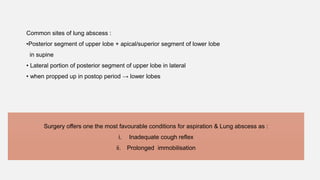
Common sites of lung abscess :
•Posterior segment of upper lobe + apical/superior segment of lower lobe
in supine
• Lateral portion of posterior segment of upper lobe in lateral
• when propped up in postop period → lower lobes
Surgery offers one the most favourable conditions for aspiration & Lung abscess as :
i. Inadequate cough reflex
ii. Prolonged immobilisation
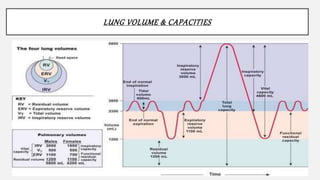
LUNG VOLUME & CAPACITIES
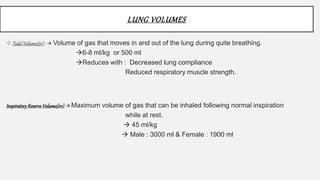
LUNG VOLUMES
Tidal Volume(tv) :  Volume of gas that moves in and out of the lung during quite breathing.
6-8 ml/kg or 500 ml
Reduces with : Decreased lung compliance
Reduced respiratory muscle strength.
InspiratoryReserveVolume(irv): Maximum volume of gas that can be inhaled following normal inspiration
while at rest.
 45 ml/kg
 Male : 3000 ml & Female : 1900 ml
Expiratoryreserve volume (erv) :  Maximum volume of gas that can be exhaled following normal expiration
while at rest.
 15 ml/kg
 Male : 1100 ml & Female : 700 ml
Residual volume (rv) : Volume of gas that remain in lung after forced exhalation.
 15-20 ml/kg
 Male : 1200 ml & Female : 1100 ml
 Not measured by Spirometry
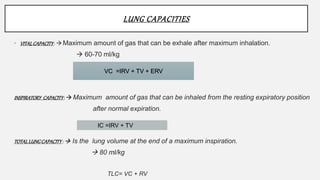
LUNG CAPACITIES
• VITALCAPACITY:  Maximum amount of gas that can be exhale after maximum inhalation.
 60-70 ml/kg
INSPIRATORY CAPACITY:  Maximum amount of gas that can be inhaled from the resting expiratory position
after normal expiration.
TOTALLUNGCAPACITY:  Is the lung volume at the end of a maximum inspiration.
 80 ml/kg
TLC= VC + RV
VC =IRV + TV + ERV
IC =IRV + TV
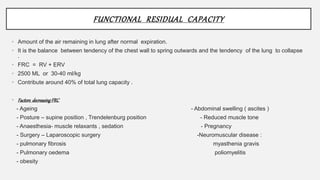
FUNCTIONAL RESIDUAL CAPACITY
• Amount of the air remaining in lung after normal expiration.
• It is the balance between tendency of the chest wall to spring outwards and the tendency of the lung to collapse
.
• FRC = RV + ERV
• 2500 ML or 30-40 ml/kg
• Contribute around 40% of total lung capacity .
• Factors decreasingFRC
- Ageing - Abdominal swelling ( ascites )
- Posture – supine position , Trendelenburg position - Reduced muscle tone
- Anaesthesia- muscle relaxants , sedation - Pregnancy
- Surgery – Laparoscopic surgery -Neuromuscular disease :
- pulmonary fibrosis myasthenia gravis
- Pulmonary oedema poliomyelitis
- obesity
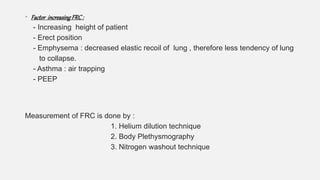
• Factor increasingFRC:
- Increasing height of patient
- Erect position
- Emphysema : decreased elastic recoil of lung , therefore less tendency of lung
to collapse.
- Asthma : air trapping
- PEEP
Measurement of FRC is done by :
1. Helium dilution technique
2. Body Plethysmography
3. Nitrogen washout technique
SIGNIFICANCE OF FRC
• Help in gas exchange
• Dilute inhaled toxic gases
• Load on rt ventricle is reduced as collapsed lung increases the PVR
• Preoxygenation fills FRC with oxygen. It increases oxygen reserve from 500ml to 2400 ml ,
thus increases apenic time to 7-8 min
• Effects of Anaesthesia :
- FRC reduced by around 20% after induction , reduction may account to around 50% in
obese patients.
-Mechanism of reduced FRC :
1. Loss of inspiratory muscle tone causing loss of outward recoil
of
chest wall
2. Loss of tone of scalene , sternocleidomastoid & intercostal muscle.
3. Loss of tone of diaphragm leading to cephalad displacement
4. Supine or Trendelenburg position
In a healthy young adult , FRC is above CC, increase in CC or decrease in FRC can results in
closure of the small airways during certain period of normal tidal ventilation. This airway
closure produces shunting , with perfusion of unventilated lung. Therefore shunt is increased
and arterial oxygenation is decreased.
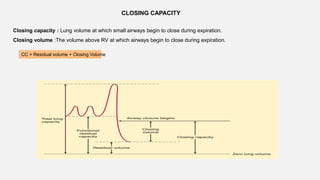
Closing Capacity (CC) : It is the lung volume at which small airways in the dependent part of
lung begins to close. CC= CV+RV.
If CC = FRC , some airway remain closed , even with normal tidal volume breathing
If CC> FRC, airway closure occur , causing V/Q mismatch
• TV+IRV+ERV
• Varies with age, height, weight, physical training & normal VC is about 60–70 mL/kg.
Decreased by
1. Lesions in brain, nerve, neuromuscular mechanism
2. Pulmonary disease- asthma, chronic bronchitis, pulm.fibrosis
3. Chest Space occupying lesions- Pericardial and pleural effusions, pneumothorax, tumours, consolidation,etc
4. Abdominal tumors impeding diaphragmatic descent
5. Abdominal pain: 70-75% in upper abdominal & 50% in lower abdominal operations
6. Tight abdominal binders, strapping or bandaging
7. Alterations in posture→alter blood volume in the lung → maximum decrease with lithotomy
VITAL CAPACITY
Significance of Vital Capacity :
• During anaesthesia:
• minimal change unless alteration in vital capacity is significantly pronounced, e.g., tension
pneumothorax, etc.
•Post operative period:
• Reduction in VC may impede expulsion of secretions.
• If VC falls below 3 times of TV artificial help may be needed to maintain airway free of secretions.
CLOSING CAPACITY
Closing capacity : Lung volume at which small airways begin to close during expiration.
Closing volume :The volume above RV at which airways begin to close during expiration.
CC = Residual volume + Closing Volume
CC ↑es with :
•Age
• Smokers
• Obesity
• COPD
• LVF
• After surgery
Relation of CC with FRC :
• Normally FRC > CC
• CC= FRC :
At 66 yrs in upright position
At 44 yrs in supine position
• Beyond this CC >> FRC
When FRC ↓ below CC → small airways close at the end of normal tidal expiration →
hypoxaemia, atelectasis and worsening gas exchange (d/t increasing V/Q mismatch)
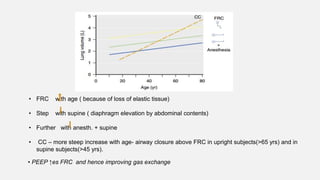
• PEEP ↑es FRC and hence improving gas exchange
• FRC with age ( because of loss of elastic tissue)
• Step with supine ( diaphragm elevation by abdominal contents)
• Further with anesth. + supine
• CC – more steep increase with age- airway closure above FRC in upright subjects(>65 yrs) and in
supine subjects(>45 yrs).
DEAD SPACE
The part of the tidal volume not participating in alveolar gas exchange is known as dead
space.
Types of Dead Space :
•Anatomical dead space
•Alveolar dead space
•Physiological dead space
•Apparatus dead space
 ANATOMICAL DEAD SPACE
Volume of the conducting air passages i.e. from nostrils and mouth down to
but not including respiratory bronchioles.
• ~ 150 ml in most adults in upright position ( approx. 2ml/kg )
Factors affecting anatomical dead space :
Size of subject => increases with body size.
Age , sex => at infancy, anatomical dead space is higher for body weight
(3.3ml/kg) ,it may be 100 ml in young woman and 200 ml in old man.
Position of neck and jaw => Depression of jaw with flexion of head ( as
occurs in respiratory obstruction in anesthetized person) can reduce dead space
by 30 ml, on contrary protrusion of jaw with neck extension may increase by 40
ml.
Drugs e.g. bronchodilator will increase dead space.
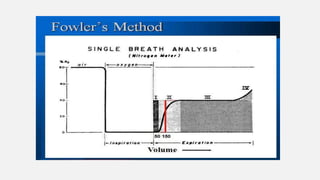
Measurement of anatomical dead space
Fowler's method
Based on rapid dilution of gas already in lung (N2 or CO2) by inspired gas
(100% O2).
1.Single breath of 100% O2
2.During the following expiration, [N2] increases from 0% (pure dead space
gas) to equilibrium (pure alveolar gas) (i.e. plateau)
=> as per [N2] vs time graph
3.Using [N2] vs expired volume graph, anatomical dead space is taken to be
at the mid-point of the transition from conducting zone to gas exchange zone.
• The part of the inspired gas that passes through the anatomical dead space to mix with
gas at the alveolar level, but which does not take part in gas exchange (wasted ventilation,
high V/Q zones)
• Too small to be measured accurately in healthy subjects
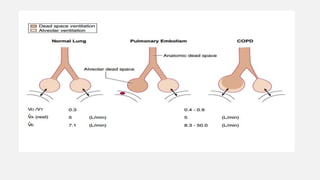
 ALVEOLAR DEAD SPACE
Factors increasing alveolar dead space :
• Low cardiac output states
Pulmonary hypotension → failure of perfusion of upper most parts of
lung (West zone 1)
• Pulmonary embolism
• Artificial ventilation in lateral position
 PHYSIOLOGICAL DEAD SPACE
That fraction of the tidal volume which is not available for gaseous exchange.
• Includes both anatomical and alveolar dead space.
• In normal humans anatomical and physiological dead space are almost equal ~ 30% of tidal volume, i.e., the V
D/ VT ratio is 0.3(0.25-0.4)
Physiological dead space is increased by :
• Old age
• Upright> Supine position
• Large tidal volume
• High RR
• Bronchodilator
• Inspiratory time is ≤ 0.5 sec during controlled ventilation
• Lung diseases with altered V/Q ratio
Estimation of physiological dead space during anaesthesia with
passive ventilation : Cooper’s formula
V D/ VT = [33 + Age/3 ] %
Where PACO2 is alveolar CO2 tension
PECO2 is mixed expired CO2 tension
Bohr equation : Measures physiological dead space
ALVEOLAR VENTILATION
That part of minute volume which participates in gas exchange.
• 2 – 2.4 L/min/m2 BSA
• ~ 3.5 - 4.5 L/ min in adults
• VA = (VT – VD Phy ) x RR
Where VA – Alveolar Ventilation
VT - Tidal volume
VD Phy - Physiological dead space
RR – Respiratory rate
• It is the pulmonary factor controlling the excretion of carbon dioxide by the lungs.
• Alveolar ventilation depends on relationship b/w RR and TV.
• * High RR and low TV result in higher proportion of wasted ventilation per min.
• * Most efficient breathing pattern is slow and deep breathing.
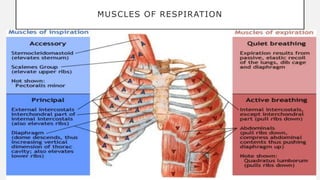
MUSCLES OF RESPIRATION
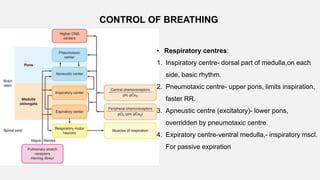
CONTROL OF BREATHING
• Respiratory centres:
1. Inspiratory centre- dorsal part of medulla,on each
side, basic rhythm.
2. Pneumotaxic centre- upper pons, limits inspiration,
faster RR.
3. Apneustic centre (excitatory)- lower pons,
overridden by pneumotaxic centre.
4. Expiratory centre-ventral medulla,- inspiratory mscl.
For passive expiration
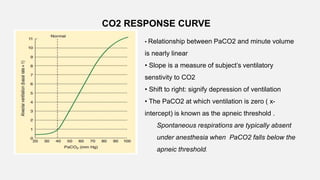
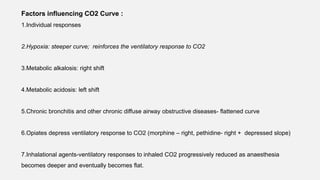
CO2 RESPONSE CURVE
• Relationship between PaCO2 and minute volume
is nearly linear
• Slope is a measure of subject’s ventilatory
senstivity to CO2
• Shift to right: signify depression of ventilation
• The PaCO2 at which ventilation is zero ( x-
intercept) is known as the apneic threshold .
Spontaneous respirations are typically absent
under anesthesia when PaCO2 falls below the
apneic threshold.
Factors influencing CO2 Curve :
1.Individual responses
2.Hypoxia: steeper curve; reinforces the ventilatory response to CO2
3.Metabolic alkalosis: right shift
4.Metabolic acidosis: left shift
5.Chronic bronchitis and other chronic diffuse airway obstructive diseases- flattened curve
6.Opiates depress ventilatory response to CO2 (morphine – right, pethidine- right + depressed slope)
7.Inhalational agents-ventilatory responses to inhaled CO2 progressively reduced as anaesthesia
becomes deeper and eventually becomes flat.
• Central Chemoreceptors
• Lie on the anterolateral surface of the medulla
• Respond primarily to changes in cerebrospinal fluid (CSF) [H+]
• Blood–brain barrier is permeable to dissolved CO2 but not to bicarbonate ions.
• Acute changes in PaCO2 , but not in arterial [HCO3-], are reflected in CSF
• ↑PaCO2 → ↑ CSF [H+] concentration → activate the chemoreceptors → stimulates
adjacent respiratory medullary centers → alveolar ventilation ↑→ PaCO2 ↓ back to
normal.
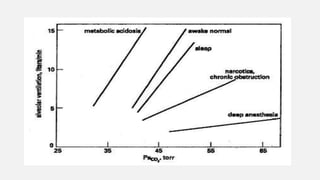
• Peripheral Chemoreceptors
Include :
• carotid bodies (at the bifurcation of the common carotid arteries)
• aortic bodies (surrounding the aortic arch)
 Carotid bodies are the principal peripheral chemoreceptors and are sensitive to
changes in PaO2 (most sensitive to PaO2), PaCO2, pH and arterial perfusion presssure.
• also stimulated by cyanide, doxapram, and large doses of nicotine
• Receptor activity does not appreciably increase until PaO2 decreases below 50 mm Hg
Respiratory tract reflexes
1. Hering- Breuer Inflation Reflex - inhibition of inspiration when the lung is inflated to
excessive volumes.
2. Deflation Reflex - shortening of exhalation when the lung is deflated.
3. Irritant receptors in the tracheobronchial mucosa react to noxious gases, smoke, dust, and
cold gases; activation produces reflex increases in respiratory rate, bronchoconstriction,
and coughing.
4. J (juxta-capillary) receptors located in alveolar walls → induce dyspnea,
bronchoconstriction and contraction of adductor muscles of larynx in response to
expansion of interstitial fluid like in pulmonary oedema, microembolism and pnemonia.
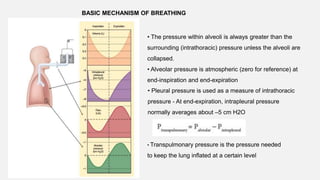
BASIC MECHANISM OF BREATHING
• The pressure within alveoli is always greater than the
surrounding (intrathoracic) pressure unless the alveoli are
collapsed.
• Alveolar pressure is atmospheric (zero for reference) at
end-inspiration and end-expiration
• Pleural pressure is used as a measure of intrathoracic
pressure - At end-expiration, intrapleural pressure
normally averages about –5 cm H2O
• Transpulmonary pressure is the pressure needed
to keep the lung inflated at a certain level
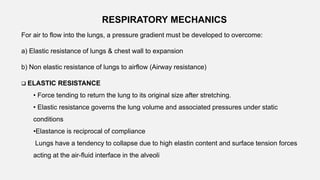
For air to flow into the lungs, a pressure gradient must be developed to overcome:
a) Elastic resistance of lungs & chest wall to expansion
b) Non elastic resistance of lungs to airflow (Airway resistance)
RESPIRATORY MECHANICS
 ELASTIC RESISTANCE
• Force tending to return the lung to its original size after stretching.
• Elastic resistance governs the lung volume and associated pressures under static
conditions
•Elastance is reciprocal of compliance
Lungs have a tendency to collapse due to high elastin content and surface tension forces
acting at the air-fluid interface in the alveoli
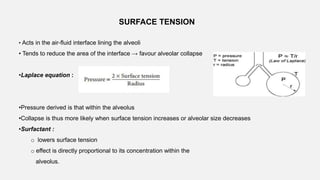
SURFACE TENSION
• Acts in the air-fluid interface lining the alveoli
• Tends to reduce the area of the interface → favour alveolar collapse
•Laplace equation :
•Pressure derived is that within the alveolus
•Collapse is thus more likely when surface tension increases or alveolar size decreases
•Surfactant :
o lowers surface tension
o effect is directly proportional to its concentration within the
alveolus.
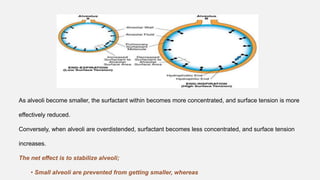
As alveoli become smaller, the surfactant within becomes more concentrated, and surface tension is more
effectively reduced.
Conversely, when alveoli are overdistended, surfactant becomes less concentrated, and surface tension
increases.
The net effect is to stabilize alveoli;
• Small alveoli are prevented from getting smaller, whereas
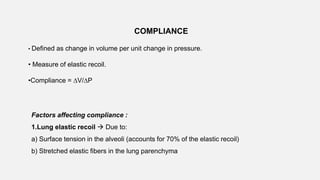
COMPLIANCE
• Defined as change in volume per unit change in pressure.
• Measure of elastic recoil.
•Compliance = ∆V/∆P
Factors affecting compliance :
1.Lung elastic recoil  Due to:
a) Surface tension in the alveoli (accounts for 70% of the elastic recoil)
b) Stretched elastic fibers in the lung parenchyma
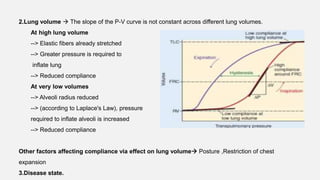
2.Lung volume  The slope of the P-V curve is not constant across different lung volumes.
At high lung volume
--> Elastic fibers already stretched
--> Greater pressure is required to
inflate lung
--> Reduced compliance
At very low volumes
--> Alveoli radius reduced
--> (according to Laplace's Law), pressure
required to inflate alveoli is increased
--> Reduced compliance
Other factors affecting compliance via effect on lung volume Posture ,Restriction of chest
expansion
3.Disease state.
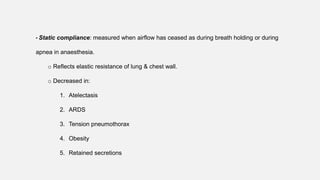
• Static compliance: measured when airflow has ceased as during breath holding or during
apnea in anaesthesia.
o Reflects elastic resistance of lung & chest wall.
o Decreased in:
1. Atelectasis
2. ARDS
3. Tension pneumothorax
4. Obesity
5. Retained secretions
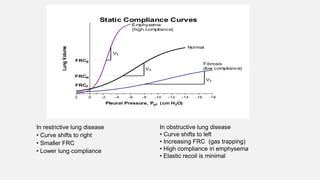
Static Compliance Curves
-18
-16
-14
-12
-10
-8
-6
-4
-2
0
2
Fibrosis
(low compliance)
Normal
Emphysema
(high compliance)
VT
FRCN
VT
FRCF
VT
FRCE
Pleural Pressure, Ppl (cm H2O)
Lung
Volume
In restrictive lung disease
• Curve shifts to right
• Smaller FRC
• Lower lung compliance
In obstructive lung disease
• Curve shifts to left
• Increasing FRC (gas trapping)
• High compliance in emphysema
• Elastic recoil is minimal
• Dynamic compliance: measured when air flow is present.
o Reflects airway + elastic resistance.
o Decreased in :
1. Bronchospasm
2. Kinking of ETT
3. Airway obstruction
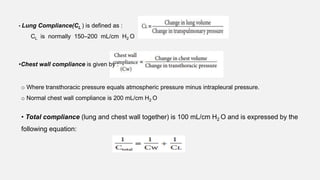
• Lung Compliance(CL ) is defined as :
CL is normally 150–200 mL/cm H2 O
•Chest wall compliance is given by :
o Where transthoracic pressure equals atmospheric pressure minus intrapleural pressure.
o Normal chest wall compliance is 200 mL/cm H2 O
• Total compliance (lung and chest wall together) is 100 mL/cm H2 O and is expressed by the
following equation:
NON ELASTIC RESISTANCE
 Airway Resistance = Pressure Gradient
Rate of Airflow
 Normal = 0.5-2 Cm H2O/L/sec
 Highest contribution - medium sized bronchi ( before 7th generation)
Factors affecting airway resistance
1. Lung volume
2. Density and viscosity of inspired gas
3. Small airway obstruction
• Constriction of bronchial smooth muscles
• Oedema of bronchiolar tissues, mucosal congestion, inflammation
• Plugging of the lumen by mucus, oedema fluid, exudate, or foreign bodies
 LAMINAR FLOW
• Consists of concentric cylinders of gas flowing at different velocities, velocity is highest in the
centre & ↓ towards periphery
•During laminar flow,
Flow = Pressure gradient
Airway resistance
•Using Poiseuille’s equation
R = 8 x length x viscosity = __Δ P__
π x (radius)4 Flow
• Laminar flow-distal to small bronchioles (<1mm)
 TURBULENT FLOW
• Characterised by random movement of the gas molecules in air passages
∆P = FLOW2 x GAS DENSITY
Radius5
• Is extremely sensitive to airway calibre
• Turbulence occurs at
- High gas flows - Sharp angles
- Bifurcations - Abrupt change in airway diameter
- large airways
REYNOLD’S NUMBER
• Predicts flow
• = linear velocity x diameter x gas density
gas viscosity
• < 1000 = Laminar flow
• > 1500 = Turbulent flow
Helium has lower density to viscosity ratio → He-O2 mixture reduces turbulent flow & airway resistance
INFERENCES FROM POISEULLE’S HAGEN EQUATION
Reducing tube diameter by half requires 16 fold ↑in
Pressure to maintain same flow
Small changes in bronchial caliber can markedly
change flow rates.
Basis for - 1. bronchodilator therapy
2. using largest practical size of artificial
airway
WORK OF BREATHING
Done by respiratory muscles to overcome
• elastic resistance of lung and chest wall
• airflow resistance at tracheo-bronchial tree
• tissue frictional resistance or structural resistance
Normal breathing – active inhalation
- passive exhalation
( work of exhalation recovered from potential energy stored in expanded lungs & thorax during inspiration)
WORK = FORCE x DISTANCE
FORCE = PRESSURE x AREA
Distance = volume / area
WORK = PRESSURE x VOLUME
= Area under P-V curve
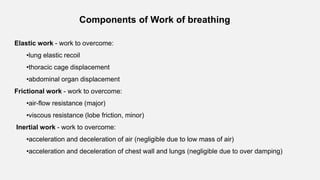
Components of Work of breathing
Elastic work - work to overcome:
•lung elastic recoil
•thoracic cage displacement
•abdominal organ displacement
Frictional work - work to overcome:
•air-flow resistance (major)
•viscous resistance (lobe friction, minor)
Inertial work - work to overcome:
•acceleration and deceleration of air (negligible due to low mass of air)
•acceleration and deceleration of chest wall and lungs (negligible due to over damping)
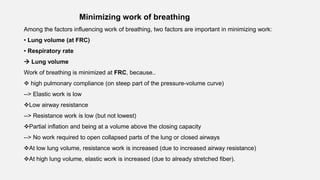
Minimizing work of breathing
Among the factors influencing work of breathing, two factors are important in minimizing work:
• Lung volume (at FRC)
• Respiratory rate
 Lung volume
Work of breathing is minimized at FRC, because..
 high pulmonary compliance (on steep part of the pressure-volume curve)
--> Elastic work is low
Low airway resistance
--> Resistance work is low (but not lowest)
Partial inflation and being at a volume above the closing capacity
--> No work required to open collapsed parts of the lung or closed airways
At low lung volume, resistance work is increased (due to increased airway resistance)
At high lung volume, elastic work is increased (due to already stretched fiber).
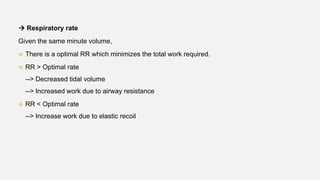
 Respiratory rate
Given the same minute volume,
 There is a optimal RR which minimizes the total work required.
 RR > Optimal rate
--> Decreased tidal volume
--> Increased work due to airway resistance
 RR < Optimal rate
--> Increase work due to elastic recoil
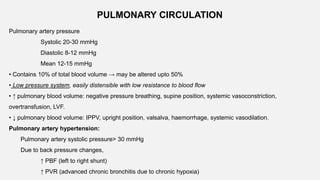
Pulmonary artery pressure
Systolic 20-30 mmHg
Diastolic 8-12 mmHg
Mean 12-15 mmHg
• Contains 10% of total blood volume → may be altered upto 50%
• Low pressure system, easily distensible with low resistance to blood flow
• ↑ pulmonary blood volume: negative pressure breathing, supine position, systemic vasoconstriction,
overtransfusion, LVF.
• ↓ pulmonary blood volume: IPPV, upright position, valsalva, haemorrhage, systemic vasodilation.
Pulmonary artery hypertension:
Pulmonary artery systolic pressure> 30 mmHg
Due to back pressure changes,
↑ PBF (left to right shunt)
↑ PVR (advanced chronic bronchitis due to chronic hypoxia)
PULMONARY CIRCULATION
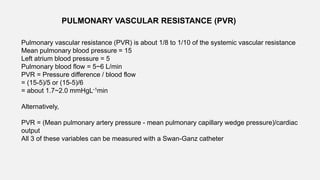
PULMONARY VASCULAR RESISTANCE (PVR)
Pulmonary vascular resistance (PVR) is about 1/8 to 1/10 of the systemic vascular resistance
Mean pulmonary blood pressure = 15
Left atrium blood pressure = 5
Pulmonary blood flow = 5~6 L/min
PVR = Pressure difference / blood flow
= (15-5)/5 or (15-5)/6
= about 1.7~2.0 mmHgL-1min
Alternatively,
PVR = (Mean pulmonary artery pressure - mean pulmonary capillary wedge pressure)/cardiac
output
All 3 of these variables can be measured with a Swan-Ganz catheter
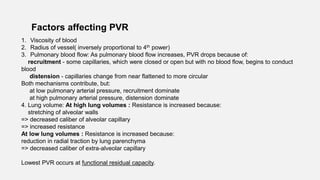
Factors affecting PVR
1. Viscosity of blood
2. Radius of vessel( inversely proportional to 4th power)
3. Pulmonary blood flow: As pulmonary blood flow increases, PVR drops because of:
recruitment - some capillaries, which were closed or open but with no blood flow, begins to conduct
blood
distension - capillaries change from near flattened to more circular
Both mechanisms contribute, but:
at low pulmonary arterial pressure, recruitment dominate
at high pulmonary arterial pressure, distension dominate
4. Lung volume: At high lung volumes : Resistance is increased because:
stretching of alveolar walls
=> decreased caliber of alveolar capillary
=> increased resistance
At low lung volumes : Resistance is increased because:
reduction in radial traction by lung parenchyma
=> decreased caliber of extra-alveolar capillary
Lowest PVR occurs at functional residual capacity.
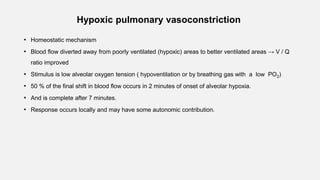
Hypoxic pulmonary vasoconstriction
• Homeostatic mechanism
• Blood flow diverted away from poorly ventilated (hypoxic) areas to better ventilated areas → V / Q
ratio improved
• Stimulus is low alveolar oxygen tension ( hypoventilation or by breathing gas with a low PO2)
• 50 % of the final shift in blood flow occurs in 2 minutes of onset of alveolar hypoxia.
• And is complete after 7 minutes.
• Response occurs locally and may have some autonomic contribution.
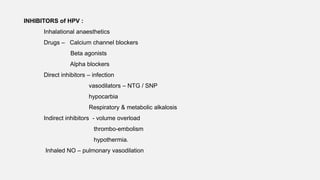
INHIBITORS of HPV :
Inhalational anaesthetics
Drugs – Calcium channel blockers
Beta agonists
Alpha blockers
Direct inhibitors – infection
vasodilators – NTG / SNP
hypocarbia
Respiratory & metabolic alkalosis
Indirect inhibitors - volume overload
thrombo-embolism
hypothermia.
Inhaled NO – pulmonary vasodilation
VENTILATION
&
PERFUSION
VENTILATION
The rate at which air enters or leaves the lungs.
 Types : i) Pulmonary Ventilation
ii) Alveolar Ventilation
1)Pulmonary Ventilation (minute ventilation or
respiratory minute volume): Is the volume of air
moving in and out of respiratory tract in a given unit of
time during quiet breathing.
INTRODUCTION


 Pulmonary Ventilation= Tidal volume X Respiratory a
= 500 ml x 12/minute
= 6000 ml/minute
2) Alveolar ventilation: It is the amount of air utilized for
gaseous exchange every minute.
Alveolar ventilation
= (Tidal volume – Dead space) X Respiratory Rate
= ( 500 – 150 ) ml x 12/minute
= 4200ml/minute
TYPES OF
VENTILATION.....

 PERFUSION: The movement of blood
into lung through pulmonary capillaries.
 VENTILATION/PERFUSION RATIO:
It is the ratio of alveolar ventilation and
the amount of blood that perfuse the alveoli.
Mathematically, V/Q = 0.84
VENTILATION AND PERFUSION
Distribution of perfusion
• Low pressure of the pulmonary circulation allow gravity to exert a significant influence on blood flow.
• Pulmonary artery pressure increases by 1 cm H₂O/ cm distance down the lung (hydrostatic pressure
builds up).
• This causes a pressure difference in the pulmonary arterial vessels between the apex and the base of 11
to 15 mm Hg.
• Blood flow in upright position: Base > Apex
supine position: Base = Apex
Posterior > anterior
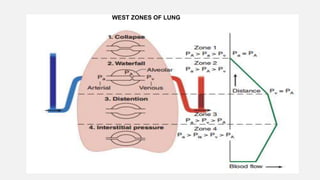
WEST ZONES OF LUNG
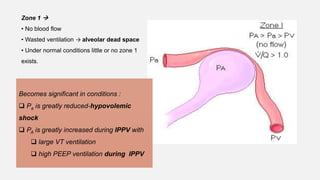
Zone 1 
• No blood flow
• Wasted ventilation → alveolar dead space
• Under normal conditions little or no zone 1
exists.
Becomes significant in conditions :
 Pa is greatly reduced-hypovolemic
shock
 PA is greatly increased during IPPV with
 large VT ventilation
 high PEEP ventilation during IPPV
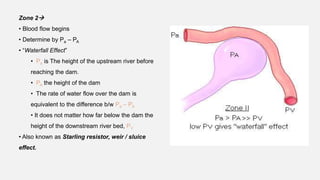
Zone 2
• Blood flow begins
• Determine by Pa – PA
• “Waterfall Effect”
• Pa is The height of the upstream river before
reaching the dam.
• PA the height of the dam
• The rate of water flow over the dam is
equivalent to the difference b/w Pa – PA
• It does not matter how far below the dam the
height of the downstream river bed, PV
• Also known as Starling resistor, weir / sluice
effect.
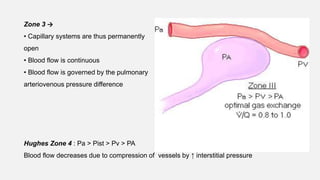
Zone 3 →
• Capillary systems are thus permanently
open
• Blood flow is continuous
• Blood flow is governed by the pulmonary
arteriovenous pressure difference
Hughes Zone 4 : Pa > Pist > Pv > PA
Blood flow decreases due to compression of vessels by ↑ interstitial pressure
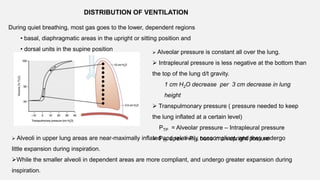
DISTRIBUTION OF VENTILATION
During quiet breathing, most gas goes to the lower, dependent regions
• basal, diaphragmatic areas in the upright or sitting position and
• dorsal units in the supine position  Alveolar pressure is constant all over the lung.
 Intrapleural pressure is less negative at the bottom than
the top of the lung d/t gravity.
1 cm H2O decrease per 3 cm decrease in lung
height
 Transpulmonary pressure ( pressure needed to keep
the lung inflated at a certain level)
PTP = Alveolar pressure – Intrapleural pressure
 PTP apex > PTP base in an upright posture
 Alveoli in upper lung areas are near-maximally inflated and relatively noncompliant, and they undergo
little expansion during inspiration.
While the smaller alveoli in dependent areas are more compliant, and undergo greater expansion during
inspiration.
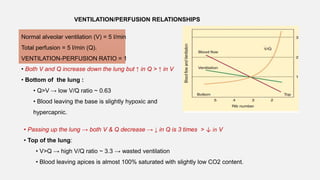
VENTILATION/PERFUSION RELATIONSHIPS
Normal alveolar ventilation (V) = 5 l/min
Total perfusion = 5 l/min (Q).
VENTILATION-PERFUSION RATIO = 1
• Both V and Q increase down the lung but ↑ in Q > ↑ in V
• Bottom of the lung :
• Q>V → low V/Q ratio ~ 0.63
• Blood leaving the base is slightly hypoxic and
hypercapnic.
• Passing up the lung → both V & Q decrease → ↓ in Q is 3 times > ↓ in V
• Top of the lung:
• V>Q → high V/Q ratio ~ 3.3 → wasted ventilation
• Blood leaving apices is almost 100% saturated with slightly low CO2 content.
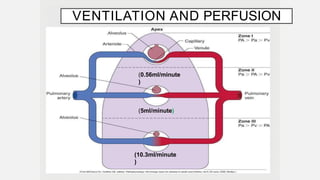

VENTILATION AND PERFUSION
(5ml/minute)
(0.56ml/minute
)
(10.3ml/minute
)

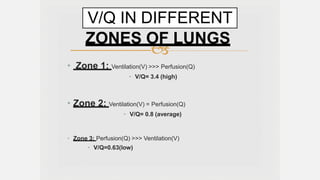
• Zone 1: Ventilation(V) >>> Perfusion(Q)
• V/Q= 3.4 (high)
• Zone 2: Ventilation(V) = Perfusion(Q)
• V/Q= 0.8 (average)
• Zone 3: Perfusion(Q) >>> Ventilation(V)
• V/Q=0.63(low)
V/Q IN DIFFERENT
ZONES OF LUNGS
ALVEOLAR – ARTERIAL PO₂ DIFFERENCE (PAO₂ - PaO₂)
•Normally PAo₂ = 101 mm Hg and Pao₂ = 97 mm Hg.
•PAo₂ - Pao₂ ranges from 5-25 mm Hg.
•Increases with age(for every decade  by 1 mm Hg).
FACTORS responsible for increase :
1. Increased partial pressure of oxygen in inspired gas
2. Venous admixture
i. LOW V/Q RATIO
ii. TRUE SHUNT
3. Reduced partial pressure of O₂ in mixed venous blood (PѵO₂)
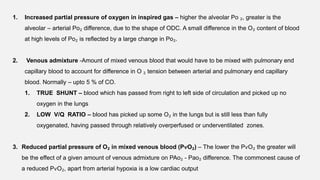
1. Increased partial pressure of oxygen in inspired gas – higher the alveolar Po ₂, greater is the
alveolar – arterial Po₂ difference, due to the shape of ODC. A small difference in the O₂ content of blood
at high levels of Po₂ is reflected by a large change in Po₂.
2. Venous admixture -Amount of mixed venous blood that would have to be mixed with pulmonary end
capillary blood to account for difference in O ₂ tension between arterial and pulmonary end capillary
blood. Normally – upto 5 % of CO.
1. TRUE SHUNT – blood which has passed from right to left side of circulation and picked up no
oxygen in the lungs
2. LOW V/Q RATIO – blood has picked up some O₂ in the lungs but is still less than fully
oxygenated, having passed through relatively overperfused or underventilated zones.
3. Reduced partial pressure of O₂ in mixed venous blood (PѵO₂) – The lower the PѵO₂ the greater will
be the effect of a given amount of venous admixture on PAo₂ - Pao₂ difference. The commonest cause of
a reduced PѵO₂, apart from arterial hypoxia is a low cardiac output
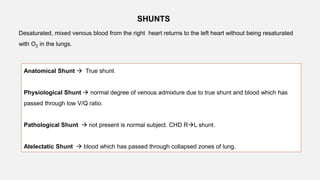
Desaturated, mixed venous blood from the right heart returns to the left heart without being resaturated
with O2 in the lungs.
SHUNTS
Anatomical Shunt  True shunt
Physiological Shunt  normal degree of venous admixture due to true shunt and blood which has
passed through low V/Q ratio.
Pathological Shunt  not present is normal subject. CHD RL shunt.
Atelectatic Shunt  blood which has passed through collapsed zones of lung.
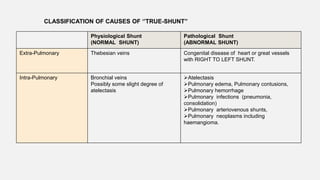
Physiological Shunt
(NORMAL SHUNT)
Pathological Shunt
(ABNORMAL SHUNT)
Extra-Pulmonary Thebesian veins Congenital disease of heart or great vessels
with RIGHT TO LEFT SHUNT.
Intra-Pulmonary Bronchial veins
Possibly some slight degree of
atelectasis
Atelectasis
Pulmonary edema, Pulmonary contusions,
Pulmonary hemorrhage
Pulmonary infections (pneumonia,
consolidation)
Pulmonary arteriovenous shunts,
Pulmonary neoplasms including
haemangioma.
CLASSIFICATION OF CAUSES OF ‘’TRUE-SHUNT’’
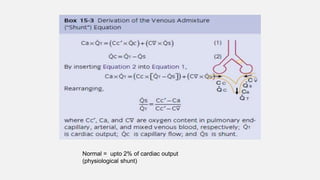
Normal = upto 2% of cardiac output
(physiological shunt)
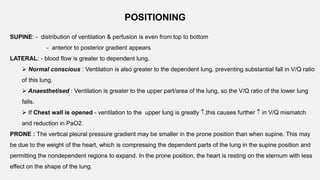
POSITIONING
SUPINE: - distribution of ventilation & perfusion is even from top to bottom
- anterior to posterior gradient appears
LATERAL: - blood flow is greater to dependent lung.
 Normal conscious : Ventilation is also greater to the dependent lung, preventing substantial fall in V/Q ratio
of this lung.
 Anaesthetised : Ventilation is greater to the upper part/area of the lung, so the V/Q ratio of the lower lung
falls.
 If Chest wall is opened - ventilation to the upper lung is greatly ,this causes further  in V/Q mismatch
and reduction in PaO2.
PRONE : The vertical pleural pressure gradient may be smaller in the prone position than when supine. This may
be due to the weight of the heart, which is compressing the dependent parts of the lung in the supine position and
permitting the nondependent regions to expand. In the prone position, the heart is resting on the sternum with less
effect on the shape of the lung.
• Thank You !

RESPI PHYSIO 1.pptx

  • 1.
    RESPIRATORY PHYSIOLOGY-1 LUNG VOLUMES,CAPACITIES, VENTILATION- PERFUSION MODERATOR : DR. NISHANT PRESENTER : DR. DEEPTI
  • 2.
    STRUCTURE AND FUNCTIONOF THE RESPIRATORY TRACT The nose, mouth and pharynx conduct air to the larynx, humidify and filter the air gases. TRACHEOBRONCHIAL TREE Adult trachea – • 10 - 11 cm long • Starts at the level of 6th cervical vertebra • Ends by dividing into Rt. and Lt. main bronchi at the carina, level of T5 Trachea moves with respiration and with alterations in the position of the head : • On deep inspiration carina decends by 2.5 cm. • Extention of head and neck- ideal positon to maintain airway in anesthetised patient-increase the length of trachea by 23-30 percent.
  • 3.
    Rt. Main bronchusis wider, shorter (2.5 cm) and more vertical than Lt. main bronchus • • Unintentional endobronchial intubation or foreign body aspiration on Rt. Side • Short length makes it difficult to occlude when required in thoracic anaesthesia • Right upper lobe bronchus dives passes in an upward and lateral direction at ∼90 degrees to the right main bronchus for 1cm before dividing into its three main divisions, facilitating aspiration of foreign bodies and fluid into the right upper lobe in the supine patient. Angles of the main bronchi- 25 degrees (Rt.), 45 degrees (Lt.) In children < 3 yrs, the angles created by the Rt. and Lt. mainstem bronchi are almost equal ~ 55 degrees.
  • 4.
    FUNCTIONAL AIRWAY DIVISION •Dichotomously branching tubes, same generation have identical dimensions • Conducting zone- 1-16- allows basic gas transport/ no gas exchange/ 10 % total airway volume • Respiratory zone- next 7 divisions/ gas exchange/ surface area 70 m²
  • 5.
    Knowledge of thebronchopulmonary segments is important for : • localizing lung pathology, • interpreting lung radiographs, • identifying lung regions during bronchoscopy • operating on the lung. 10 8 BRONCHO-PULMONARY SEGMENTS
  • 6.
    Common sites oflung abscess : •Posterior segment of upper lobe + apical/superior segment of lower lobe in supine • Lateral portion of posterior segment of upper lobe in lateral • when propped up in postop period → lower lobes Surgery offers one the most favourable conditions for aspiration & Lung abscess as : i. Inadequate cough reflex ii. Prolonged immobilisation
  • 7.
    LUNG VOLUME &CAPACITIES
  • 8.
    LUNG VOLUMES Tidal Volume(tv):  Volume of gas that moves in and out of the lung during quite breathing. 6-8 ml/kg or 500 ml Reduces with : Decreased lung compliance Reduced respiratory muscle strength. InspiratoryReserveVolume(irv): Maximum volume of gas that can be inhaled following normal inspiration while at rest.  45 ml/kg  Male : 3000 ml & Female : 1900 ml
  • 9.
    Expiratoryreserve volume (erv):  Maximum volume of gas that can be exhaled following normal expiration while at rest.  15 ml/kg  Male : 1100 ml & Female : 700 ml Residual volume (rv) : Volume of gas that remain in lung after forced exhalation.  15-20 ml/kg  Male : 1200 ml & Female : 1100 ml  Not measured by Spirometry
  • 10.
    LUNG CAPACITIES • VITALCAPACITY: Maximum amount of gas that can be exhale after maximum inhalation.  60-70 ml/kg INSPIRATORY CAPACITY:  Maximum amount of gas that can be inhaled from the resting expiratory position after normal expiration. TOTALLUNGCAPACITY:  Is the lung volume at the end of a maximum inspiration.  80 ml/kg TLC= VC + RV VC =IRV + TV + ERV IC =IRV + TV
  • 11.
    FUNCTIONAL RESIDUAL CAPACITY •Amount of the air remaining in lung after normal expiration. • It is the balance between tendency of the chest wall to spring outwards and the tendency of the lung to collapse . • FRC = RV + ERV • 2500 ML or 30-40 ml/kg • Contribute around 40% of total lung capacity . • Factors decreasingFRC - Ageing - Abdominal swelling ( ascites ) - Posture – supine position , Trendelenburg position - Reduced muscle tone - Anaesthesia- muscle relaxants , sedation - Pregnancy - Surgery – Laparoscopic surgery -Neuromuscular disease : - pulmonary fibrosis myasthenia gravis - Pulmonary oedema poliomyelitis - obesity
  • 12.
    • Factor increasingFRC: -Increasing height of patient - Erect position - Emphysema : decreased elastic recoil of lung , therefore less tendency of lung to collapse. - Asthma : air trapping - PEEP Measurement of FRC is done by : 1. Helium dilution technique 2. Body Plethysmography 3. Nitrogen washout technique
  • 13.
    SIGNIFICANCE OF FRC •Help in gas exchange • Dilute inhaled toxic gases • Load on rt ventricle is reduced as collapsed lung increases the PVR • Preoxygenation fills FRC with oxygen. It increases oxygen reserve from 500ml to 2400 ml , thus increases apenic time to 7-8 min • Effects of Anaesthesia : - FRC reduced by around 20% after induction , reduction may account to around 50% in obese patients. -Mechanism of reduced FRC : 1. Loss of inspiratory muscle tone causing loss of outward recoil of chest wall
  • 14.
    2. Loss oftone of scalene , sternocleidomastoid & intercostal muscle. 3. Loss of tone of diaphragm leading to cephalad displacement 4. Supine or Trendelenburg position In a healthy young adult , FRC is above CC, increase in CC or decrease in FRC can results in closure of the small airways during certain period of normal tidal ventilation. This airway closure produces shunting , with perfusion of unventilated lung. Therefore shunt is increased and arterial oxygenation is decreased. Closing Capacity (CC) : It is the lung volume at which small airways in the dependent part of lung begins to close. CC= CV+RV. If CC = FRC , some airway remain closed , even with normal tidal volume breathing If CC> FRC, airway closure occur , causing V/Q mismatch
  • 15.
    • TV+IRV+ERV • Varieswith age, height, weight, physical training & normal VC is about 60–70 mL/kg. Decreased by 1. Lesions in brain, nerve, neuromuscular mechanism 2. Pulmonary disease- asthma, chronic bronchitis, pulm.fibrosis 3. Chest Space occupying lesions- Pericardial and pleural effusions, pneumothorax, tumours, consolidation,etc 4. Abdominal tumors impeding diaphragmatic descent 5. Abdominal pain: 70-75% in upper abdominal & 50% in lower abdominal operations 6. Tight abdominal binders, strapping or bandaging 7. Alterations in posture→alter blood volume in the lung → maximum decrease with lithotomy VITAL CAPACITY
  • 16.
    Significance of VitalCapacity : • During anaesthesia: • minimal change unless alteration in vital capacity is significantly pronounced, e.g., tension pneumothorax, etc. •Post operative period: • Reduction in VC may impede expulsion of secretions. • If VC falls below 3 times of TV artificial help may be needed to maintain airway free of secretions.
  • 17.
    CLOSING CAPACITY Closing capacity: Lung volume at which small airways begin to close during expiration. Closing volume :The volume above RV at which airways begin to close during expiration. CC = Residual volume + Closing Volume
  • 18.
    CC ↑es with: •Age • Smokers • Obesity • COPD • LVF • After surgery Relation of CC with FRC : • Normally FRC > CC • CC= FRC : At 66 yrs in upright position At 44 yrs in supine position • Beyond this CC >> FRC When FRC ↓ below CC → small airways close at the end of normal tidal expiration → hypoxaemia, atelectasis and worsening gas exchange (d/t increasing V/Q mismatch)
  • 19.
    • PEEP ↑esFRC and hence improving gas exchange • FRC with age ( because of loss of elastic tissue) • Step with supine ( diaphragm elevation by abdominal contents) • Further with anesth. + supine • CC – more steep increase with age- airway closure above FRC in upright subjects(>65 yrs) and in supine subjects(>45 yrs).
  • 20.
    DEAD SPACE The partof the tidal volume not participating in alveolar gas exchange is known as dead space. Types of Dead Space : •Anatomical dead space •Alveolar dead space •Physiological dead space •Apparatus dead space
  • 21.
     ANATOMICAL DEADSPACE Volume of the conducting air passages i.e. from nostrils and mouth down to but not including respiratory bronchioles. • ~ 150 ml in most adults in upright position ( approx. 2ml/kg ) Factors affecting anatomical dead space : Size of subject => increases with body size. Age , sex => at infancy, anatomical dead space is higher for body weight (3.3ml/kg) ,it may be 100 ml in young woman and 200 ml in old man. Position of neck and jaw => Depression of jaw with flexion of head ( as occurs in respiratory obstruction in anesthetized person) can reduce dead space by 30 ml, on contrary protrusion of jaw with neck extension may increase by 40 ml. Drugs e.g. bronchodilator will increase dead space.
  • 22.
    Measurement of anatomicaldead space Fowler's method Based on rapid dilution of gas already in lung (N2 or CO2) by inspired gas (100% O2). 1.Single breath of 100% O2 2.During the following expiration, [N2] increases from 0% (pure dead space gas) to equilibrium (pure alveolar gas) (i.e. plateau) => as per [N2] vs time graph 3.Using [N2] vs expired volume graph, anatomical dead space is taken to be at the mid-point of the transition from conducting zone to gas exchange zone.
  • 24.
    • The partof the inspired gas that passes through the anatomical dead space to mix with gas at the alveolar level, but which does not take part in gas exchange (wasted ventilation, high V/Q zones) • Too small to be measured accurately in healthy subjects  ALVEOLAR DEAD SPACE Factors increasing alveolar dead space : • Low cardiac output states Pulmonary hypotension → failure of perfusion of upper most parts of lung (West zone 1) • Pulmonary embolism • Artificial ventilation in lateral position
  • 26.
     PHYSIOLOGICAL DEADSPACE That fraction of the tidal volume which is not available for gaseous exchange. • Includes both anatomical and alveolar dead space. • In normal humans anatomical and physiological dead space are almost equal ~ 30% of tidal volume, i.e., the V D/ VT ratio is 0.3(0.25-0.4) Physiological dead space is increased by : • Old age • Upright> Supine position • Large tidal volume • High RR • Bronchodilator • Inspiratory time is ≤ 0.5 sec during controlled ventilation • Lung diseases with altered V/Q ratio
  • 27.
    Estimation of physiologicaldead space during anaesthesia with passive ventilation : Cooper’s formula V D/ VT = [33 + Age/3 ] % Where PACO2 is alveolar CO2 tension PECO2 is mixed expired CO2 tension Bohr equation : Measures physiological dead space
  • 28.
    ALVEOLAR VENTILATION That partof minute volume which participates in gas exchange. • 2 – 2.4 L/min/m2 BSA • ~ 3.5 - 4.5 L/ min in adults • VA = (VT – VD Phy ) x RR Where VA – Alveolar Ventilation VT - Tidal volume VD Phy - Physiological dead space RR – Respiratory rate • It is the pulmonary factor controlling the excretion of carbon dioxide by the lungs. • Alveolar ventilation depends on relationship b/w RR and TV. • * High RR and low TV result in higher proportion of wasted ventilation per min. • * Most efficient breathing pattern is slow and deep breathing.
  • 29.
  • 30.
    CONTROL OF BREATHING •Respiratory centres: 1. Inspiratory centre- dorsal part of medulla,on each side, basic rhythm. 2. Pneumotaxic centre- upper pons, limits inspiration, faster RR. 3. Apneustic centre (excitatory)- lower pons, overridden by pneumotaxic centre. 4. Expiratory centre-ventral medulla,- inspiratory mscl. For passive expiration
  • 31.
    CO2 RESPONSE CURVE •Relationship between PaCO2 and minute volume is nearly linear • Slope is a measure of subject’s ventilatory senstivity to CO2 • Shift to right: signify depression of ventilation • The PaCO2 at which ventilation is zero ( x- intercept) is known as the apneic threshold . Spontaneous respirations are typically absent under anesthesia when PaCO2 falls below the apneic threshold.
  • 32.
    Factors influencing CO2Curve : 1.Individual responses 2.Hypoxia: steeper curve; reinforces the ventilatory response to CO2 3.Metabolic alkalosis: right shift 4.Metabolic acidosis: left shift 5.Chronic bronchitis and other chronic diffuse airway obstructive diseases- flattened curve 6.Opiates depress ventilatory response to CO2 (morphine – right, pethidine- right + depressed slope) 7.Inhalational agents-ventilatory responses to inhaled CO2 progressively reduced as anaesthesia becomes deeper and eventually becomes flat.
  • 34.
    • Central Chemoreceptors •Lie on the anterolateral surface of the medulla • Respond primarily to changes in cerebrospinal fluid (CSF) [H+] • Blood–brain barrier is permeable to dissolved CO2 but not to bicarbonate ions. • Acute changes in PaCO2 , but not in arterial [HCO3-], are reflected in CSF • ↑PaCO2 → ↑ CSF [H+] concentration → activate the chemoreceptors → stimulates adjacent respiratory medullary centers → alveolar ventilation ↑→ PaCO2 ↓ back to normal.
  • 35.
    • Peripheral Chemoreceptors Include: • carotid bodies (at the bifurcation of the common carotid arteries) • aortic bodies (surrounding the aortic arch)  Carotid bodies are the principal peripheral chemoreceptors and are sensitive to changes in PaO2 (most sensitive to PaO2), PaCO2, pH and arterial perfusion presssure. • also stimulated by cyanide, doxapram, and large doses of nicotine • Receptor activity does not appreciably increase until PaO2 decreases below 50 mm Hg
  • 36.
    Respiratory tract reflexes 1.Hering- Breuer Inflation Reflex - inhibition of inspiration when the lung is inflated to excessive volumes. 2. Deflation Reflex - shortening of exhalation when the lung is deflated. 3. Irritant receptors in the tracheobronchial mucosa react to noxious gases, smoke, dust, and cold gases; activation produces reflex increases in respiratory rate, bronchoconstriction, and coughing. 4. J (juxta-capillary) receptors located in alveolar walls → induce dyspnea, bronchoconstriction and contraction of adductor muscles of larynx in response to expansion of interstitial fluid like in pulmonary oedema, microembolism and pnemonia.
  • 37.
    BASIC MECHANISM OFBREATHING • The pressure within alveoli is always greater than the surrounding (intrathoracic) pressure unless the alveoli are collapsed. • Alveolar pressure is atmospheric (zero for reference) at end-inspiration and end-expiration • Pleural pressure is used as a measure of intrathoracic pressure - At end-expiration, intrapleural pressure normally averages about –5 cm H2O • Transpulmonary pressure is the pressure needed to keep the lung inflated at a certain level
  • 38.
    For air toflow into the lungs, a pressure gradient must be developed to overcome: a) Elastic resistance of lungs & chest wall to expansion b) Non elastic resistance of lungs to airflow (Airway resistance) RESPIRATORY MECHANICS  ELASTIC RESISTANCE • Force tending to return the lung to its original size after stretching. • Elastic resistance governs the lung volume and associated pressures under static conditions •Elastance is reciprocal of compliance Lungs have a tendency to collapse due to high elastin content and surface tension forces acting at the air-fluid interface in the alveoli
  • 39.
    SURFACE TENSION • Actsin the air-fluid interface lining the alveoli • Tends to reduce the area of the interface → favour alveolar collapse •Laplace equation : •Pressure derived is that within the alveolus •Collapse is thus more likely when surface tension increases or alveolar size decreases •Surfactant : o lowers surface tension o effect is directly proportional to its concentration within the alveolus.
  • 40.
    As alveoli becomesmaller, the surfactant within becomes more concentrated, and surface tension is more effectively reduced. Conversely, when alveoli are overdistended, surfactant becomes less concentrated, and surface tension increases. The net effect is to stabilize alveoli; • Small alveoli are prevented from getting smaller, whereas
  • 41.
    COMPLIANCE • Defined aschange in volume per unit change in pressure. • Measure of elastic recoil. •Compliance = ∆V/∆P Factors affecting compliance : 1.Lung elastic recoil  Due to: a) Surface tension in the alveoli (accounts for 70% of the elastic recoil) b) Stretched elastic fibers in the lung parenchyma
  • 42.
    2.Lung volume The slope of the P-V curve is not constant across different lung volumes. At high lung volume --> Elastic fibers already stretched --> Greater pressure is required to inflate lung --> Reduced compliance At very low volumes --> Alveoli radius reduced --> (according to Laplace's Law), pressure required to inflate alveoli is increased --> Reduced compliance Other factors affecting compliance via effect on lung volume Posture ,Restriction of chest expansion 3.Disease state.
  • 43.
    • Static compliance:measured when airflow has ceased as during breath holding or during apnea in anaesthesia. o Reflects elastic resistance of lung & chest wall. o Decreased in: 1. Atelectasis 2. ARDS 3. Tension pneumothorax 4. Obesity 5. Retained secretions
  • 44.
    Static Compliance Curves -18 -16 -14 -12 -10 -8 -6 -4 -2 0 2 Fibrosis (lowcompliance) Normal Emphysema (high compliance) VT FRCN VT FRCF VT FRCE Pleural Pressure, Ppl (cm H2O) Lung Volume In restrictive lung disease • Curve shifts to right • Smaller FRC • Lower lung compliance In obstructive lung disease • Curve shifts to left • Increasing FRC (gas trapping) • High compliance in emphysema • Elastic recoil is minimal
  • 45.
    • Dynamic compliance:measured when air flow is present. o Reflects airway + elastic resistance. o Decreased in : 1. Bronchospasm 2. Kinking of ETT 3. Airway obstruction
  • 46.
    • Lung Compliance(CL) is defined as : CL is normally 150–200 mL/cm H2 O •Chest wall compliance is given by : o Where transthoracic pressure equals atmospheric pressure minus intrapleural pressure. o Normal chest wall compliance is 200 mL/cm H2 O • Total compliance (lung and chest wall together) is 100 mL/cm H2 O and is expressed by the following equation:
  • 47.
    NON ELASTIC RESISTANCE Airway Resistance = Pressure Gradient Rate of Airflow  Normal = 0.5-2 Cm H2O/L/sec  Highest contribution - medium sized bronchi ( before 7th generation) Factors affecting airway resistance 1. Lung volume 2. Density and viscosity of inspired gas 3. Small airway obstruction • Constriction of bronchial smooth muscles • Oedema of bronchiolar tissues, mucosal congestion, inflammation • Plugging of the lumen by mucus, oedema fluid, exudate, or foreign bodies
  • 48.
     LAMINAR FLOW •Consists of concentric cylinders of gas flowing at different velocities, velocity is highest in the centre & ↓ towards periphery •During laminar flow, Flow = Pressure gradient Airway resistance •Using Poiseuille’s equation R = 8 x length x viscosity = __Δ P__ π x (radius)4 Flow • Laminar flow-distal to small bronchioles (<1mm)
  • 49.
     TURBULENT FLOW •Characterised by random movement of the gas molecules in air passages ∆P = FLOW2 x GAS DENSITY Radius5 • Is extremely sensitive to airway calibre • Turbulence occurs at - High gas flows - Sharp angles - Bifurcations - Abrupt change in airway diameter - large airways
  • 50.
    REYNOLD’S NUMBER • Predictsflow • = linear velocity x diameter x gas density gas viscosity • < 1000 = Laminar flow • > 1500 = Turbulent flow Helium has lower density to viscosity ratio → He-O2 mixture reduces turbulent flow & airway resistance
  • 51.
    INFERENCES FROM POISEULLE’SHAGEN EQUATION Reducing tube diameter by half requires 16 fold ↑in Pressure to maintain same flow Small changes in bronchial caliber can markedly change flow rates. Basis for - 1. bronchodilator therapy 2. using largest practical size of artificial airway
  • 52.
    WORK OF BREATHING Doneby respiratory muscles to overcome • elastic resistance of lung and chest wall • airflow resistance at tracheo-bronchial tree • tissue frictional resistance or structural resistance Normal breathing – active inhalation - passive exhalation ( work of exhalation recovered from potential energy stored in expanded lungs & thorax during inspiration) WORK = FORCE x DISTANCE FORCE = PRESSURE x AREA Distance = volume / area WORK = PRESSURE x VOLUME = Area under P-V curve
  • 53.
    Components of Workof breathing Elastic work - work to overcome: •lung elastic recoil •thoracic cage displacement •abdominal organ displacement Frictional work - work to overcome: •air-flow resistance (major) •viscous resistance (lobe friction, minor) Inertial work - work to overcome: •acceleration and deceleration of air (negligible due to low mass of air) •acceleration and deceleration of chest wall and lungs (negligible due to over damping)
  • 54.
    Minimizing work ofbreathing Among the factors influencing work of breathing, two factors are important in minimizing work: • Lung volume (at FRC) • Respiratory rate  Lung volume Work of breathing is minimized at FRC, because..  high pulmonary compliance (on steep part of the pressure-volume curve) --> Elastic work is low Low airway resistance --> Resistance work is low (but not lowest) Partial inflation and being at a volume above the closing capacity --> No work required to open collapsed parts of the lung or closed airways At low lung volume, resistance work is increased (due to increased airway resistance) At high lung volume, elastic work is increased (due to already stretched fiber).
  • 55.
     Respiratory rate Giventhe same minute volume,  There is a optimal RR which minimizes the total work required.  RR > Optimal rate --> Decreased tidal volume --> Increased work due to airway resistance  RR < Optimal rate --> Increase work due to elastic recoil
  • 56.
    Pulmonary artery pressure Systolic20-30 mmHg Diastolic 8-12 mmHg Mean 12-15 mmHg • Contains 10% of total blood volume → may be altered upto 50% • Low pressure system, easily distensible with low resistance to blood flow • ↑ pulmonary blood volume: negative pressure breathing, supine position, systemic vasoconstriction, overtransfusion, LVF. • ↓ pulmonary blood volume: IPPV, upright position, valsalva, haemorrhage, systemic vasodilation. Pulmonary artery hypertension: Pulmonary artery systolic pressure> 30 mmHg Due to back pressure changes, ↑ PBF (left to right shunt) ↑ PVR (advanced chronic bronchitis due to chronic hypoxia) PULMONARY CIRCULATION
  • 57.
    PULMONARY VASCULAR RESISTANCE(PVR) Pulmonary vascular resistance (PVR) is about 1/8 to 1/10 of the systemic vascular resistance Mean pulmonary blood pressure = 15 Left atrium blood pressure = 5 Pulmonary blood flow = 5~6 L/min PVR = Pressure difference / blood flow = (15-5)/5 or (15-5)/6 = about 1.7~2.0 mmHgL-1min Alternatively, PVR = (Mean pulmonary artery pressure - mean pulmonary capillary wedge pressure)/cardiac output All 3 of these variables can be measured with a Swan-Ganz catheter
  • 58.
    Factors affecting PVR 1.Viscosity of blood 2. Radius of vessel( inversely proportional to 4th power) 3. Pulmonary blood flow: As pulmonary blood flow increases, PVR drops because of: recruitment - some capillaries, which were closed or open but with no blood flow, begins to conduct blood distension - capillaries change from near flattened to more circular Both mechanisms contribute, but: at low pulmonary arterial pressure, recruitment dominate at high pulmonary arterial pressure, distension dominate 4. Lung volume: At high lung volumes : Resistance is increased because: stretching of alveolar walls => decreased caliber of alveolar capillary => increased resistance At low lung volumes : Resistance is increased because: reduction in radial traction by lung parenchyma => decreased caliber of extra-alveolar capillary Lowest PVR occurs at functional residual capacity.
  • 59.
    Hypoxic pulmonary vasoconstriction •Homeostatic mechanism • Blood flow diverted away from poorly ventilated (hypoxic) areas to better ventilated areas → V / Q ratio improved • Stimulus is low alveolar oxygen tension ( hypoventilation or by breathing gas with a low PO2) • 50 % of the final shift in blood flow occurs in 2 minutes of onset of alveolar hypoxia. • And is complete after 7 minutes. • Response occurs locally and may have some autonomic contribution.
  • 60.
    INHIBITORS of HPV: Inhalational anaesthetics Drugs – Calcium channel blockers Beta agonists Alpha blockers Direct inhibitors – infection vasodilators – NTG / SNP hypocarbia Respiratory & metabolic alkalosis Indirect inhibitors - volume overload thrombo-embolism hypothermia. Inhaled NO – pulmonary vasodilation
  • 61.
  • 62.
    VENTILATION The rate atwhich air enters or leaves the lungs.  Types : i) Pulmonary Ventilation ii) Alveolar Ventilation 1)Pulmonary Ventilation (minute ventilation or respiratory minute volume): Is the volume of air moving in and out of respiratory tract in a given unit of time during quiet breathing. INTRODUCTION 
  • 63.
      Pulmonary Ventilation=Tidal volume X Respiratory a = 500 ml x 12/minute = 6000 ml/minute 2) Alveolar ventilation: It is the amount of air utilized for gaseous exchange every minute. Alveolar ventilation = (Tidal volume – Dead space) X Respiratory Rate = ( 500 – 150 ) ml x 12/minute = 4200ml/minute TYPES OF VENTILATION.....
  • 64.
      PERFUSION: Themovement of blood into lung through pulmonary capillaries.  VENTILATION/PERFUSION RATIO: It is the ratio of alveolar ventilation and the amount of blood that perfuse the alveoli. Mathematically, V/Q = 0.84 VENTILATION AND PERFUSION
  • 65.
    Distribution of perfusion •Low pressure of the pulmonary circulation allow gravity to exert a significant influence on blood flow. • Pulmonary artery pressure increases by 1 cm H₂O/ cm distance down the lung (hydrostatic pressure builds up). • This causes a pressure difference in the pulmonary arterial vessels between the apex and the base of 11 to 15 mm Hg. • Blood flow in upright position: Base > Apex supine position: Base = Apex Posterior > anterior
  • 66.
  • 67.
    Zone 1  •No blood flow • Wasted ventilation → alveolar dead space • Under normal conditions little or no zone 1 exists. Becomes significant in conditions :  Pa is greatly reduced-hypovolemic shock  PA is greatly increased during IPPV with  large VT ventilation  high PEEP ventilation during IPPV
  • 68.
    Zone 2 • Bloodflow begins • Determine by Pa – PA • “Waterfall Effect” • Pa is The height of the upstream river before reaching the dam. • PA the height of the dam • The rate of water flow over the dam is equivalent to the difference b/w Pa – PA • It does not matter how far below the dam the height of the downstream river bed, PV • Also known as Starling resistor, weir / sluice effect.
  • 69.
    Zone 3 → •Capillary systems are thus permanently open • Blood flow is continuous • Blood flow is governed by the pulmonary arteriovenous pressure difference Hughes Zone 4 : Pa > Pist > Pv > PA Blood flow decreases due to compression of vessels by ↑ interstitial pressure
  • 70.
    DISTRIBUTION OF VENTILATION Duringquiet breathing, most gas goes to the lower, dependent regions • basal, diaphragmatic areas in the upright or sitting position and • dorsal units in the supine position  Alveolar pressure is constant all over the lung.  Intrapleural pressure is less negative at the bottom than the top of the lung d/t gravity. 1 cm H2O decrease per 3 cm decrease in lung height  Transpulmonary pressure ( pressure needed to keep the lung inflated at a certain level) PTP = Alveolar pressure – Intrapleural pressure  PTP apex > PTP base in an upright posture  Alveoli in upper lung areas are near-maximally inflated and relatively noncompliant, and they undergo little expansion during inspiration. While the smaller alveoli in dependent areas are more compliant, and undergo greater expansion during inspiration.
  • 71.
    VENTILATION/PERFUSION RELATIONSHIPS Normal alveolarventilation (V) = 5 l/min Total perfusion = 5 l/min (Q). VENTILATION-PERFUSION RATIO = 1 • Both V and Q increase down the lung but ↑ in Q > ↑ in V • Bottom of the lung : • Q>V → low V/Q ratio ~ 0.63 • Blood leaving the base is slightly hypoxic and hypercapnic. • Passing up the lung → both V & Q decrease → ↓ in Q is 3 times > ↓ in V • Top of the lung: • V>Q → high V/Q ratio ~ 3.3 → wasted ventilation • Blood leaving apices is almost 100% saturated with slightly low CO2 content.
  • 72.
  • 73.
     • Zone 1:Ventilation(V) >>> Perfusion(Q) • V/Q= 3.4 (high) • Zone 2: Ventilation(V) = Perfusion(Q) • V/Q= 0.8 (average) • Zone 3: Perfusion(Q) >>> Ventilation(V) • V/Q=0.63(low) V/Q IN DIFFERENT ZONES OF LUNGS
  • 74.
    ALVEOLAR – ARTERIALPO₂ DIFFERENCE (PAO₂ - PaO₂) •Normally PAo₂ = 101 mm Hg and Pao₂ = 97 mm Hg. •PAo₂ - Pao₂ ranges from 5-25 mm Hg. •Increases with age(for every decade  by 1 mm Hg). FACTORS responsible for increase : 1. Increased partial pressure of oxygen in inspired gas 2. Venous admixture i. LOW V/Q RATIO ii. TRUE SHUNT 3. Reduced partial pressure of O₂ in mixed venous blood (PѵO₂)
  • 75.
    1. Increased partialpressure of oxygen in inspired gas – higher the alveolar Po ₂, greater is the alveolar – arterial Po₂ difference, due to the shape of ODC. A small difference in the O₂ content of blood at high levels of Po₂ is reflected by a large change in Po₂. 2. Venous admixture -Amount of mixed venous blood that would have to be mixed with pulmonary end capillary blood to account for difference in O ₂ tension between arterial and pulmonary end capillary blood. Normally – upto 5 % of CO. 1. TRUE SHUNT – blood which has passed from right to left side of circulation and picked up no oxygen in the lungs 2. LOW V/Q RATIO – blood has picked up some O₂ in the lungs but is still less than fully oxygenated, having passed through relatively overperfused or underventilated zones. 3. Reduced partial pressure of O₂ in mixed venous blood (PѵO₂) – The lower the PѵO₂ the greater will be the effect of a given amount of venous admixture on PAo₂ - Pao₂ difference. The commonest cause of a reduced PѵO₂, apart from arterial hypoxia is a low cardiac output
  • 76.
    Desaturated, mixed venousblood from the right heart returns to the left heart without being resaturated with O2 in the lungs. SHUNTS Anatomical Shunt  True shunt Physiological Shunt  normal degree of venous admixture due to true shunt and blood which has passed through low V/Q ratio. Pathological Shunt  not present is normal subject. CHD RL shunt. Atelectatic Shunt  blood which has passed through collapsed zones of lung.
  • 77.
    Physiological Shunt (NORMAL SHUNT) PathologicalShunt (ABNORMAL SHUNT) Extra-Pulmonary Thebesian veins Congenital disease of heart or great vessels with RIGHT TO LEFT SHUNT. Intra-Pulmonary Bronchial veins Possibly some slight degree of atelectasis Atelectasis Pulmonary edema, Pulmonary contusions, Pulmonary hemorrhage Pulmonary infections (pneumonia, consolidation) Pulmonary arteriovenous shunts, Pulmonary neoplasms including haemangioma. CLASSIFICATION OF CAUSES OF ‘’TRUE-SHUNT’’
  • 78.
    Normal = upto2% of cardiac output (physiological shunt)
  • 79.
    POSITIONING SUPINE: - distributionof ventilation & perfusion is even from top to bottom - anterior to posterior gradient appears LATERAL: - blood flow is greater to dependent lung.  Normal conscious : Ventilation is also greater to the dependent lung, preventing substantial fall in V/Q ratio of this lung.  Anaesthetised : Ventilation is greater to the upper part/area of the lung, so the V/Q ratio of the lower lung falls.  If Chest wall is opened - ventilation to the upper lung is greatly ,this causes further  in V/Q mismatch and reduction in PaO2. PRONE : The vertical pleural pressure gradient may be smaller in the prone position than when supine. This may be due to the weight of the heart, which is compressing the dependent parts of the lung in the supine position and permitting the nondependent regions to expand. In the prone position, the heart is resting on the sternum with less effect on the shape of the lung.
  • 80.

Editor's Notes

  • #4 The presence of 5 cm of bronchial lumen uninterrupted by any branching makes the left main bronchus particularly suitable for intubation and blocking during thoracic surgery.
  • #5 The respiratory bronchiole, which follows the terminal bronchiole, is the first site in the tracheobronchial tree where gas exchange occurs. In adults, two or three generations of respiratory bronchioles lead to alveolar ducts, of which there are four to five generations, each with multiple openings into alveolar sacs. The final divisions of alveolar ducts terminate in alveolar sacs that open into alveolar clusters
  • #6 Medial basal bronchus of right side is the cardiac branch and corresponds to the anterior basal bronchus of the left side
  • #7 Incidence of lung abscess is twice as high in upper lobes as in the lower ones Although post segment of the upper lobe is most commonest to be involved it is one of the most difficult segment to be examined radiographically or clinically being situated in the upper part of axilla it is almost completely hidden by scapula
  • #16 18 % reduction of VC with lithotomy position
  • #17 Etc- hemothorax, diaphragmatic hernia, exomphalos in newborn, neuromuscular disease and upper airway obstruction.
  • #18 Airway closure is a normal physiologic phenomenon and is the effect of increasing pleural pressure during expiration. When pleural pressure becomes “positive” (or rather, above atmospheric), it will exceed the pressure inside the airway, which is just or nearly atmospheric at a low flow rate. The higher pressure outside than inside will compress the airway and may close it. Because pleural pressure is higher in dependent regions than higher up, closure of airways begins in the bottom of the lung. In young subjects it may not occur until they have expired to RV. However, with increasing age, pleural pressure becomes “positive” at higher and higher lung volume, and airway closure may occur above FRC.
  • #19 Cc is measured using single breath nitrogen washout technique. Pt expires to residual volume and then take single breath of O2 to max inhalation. Hold breath for few seconds and then evenly expires. 1- dead space gas 2- mixed dead and alveolar gas 3 – mixed alveolar gas from alveoli 4 – sudden rising conc of N2 Explanation – inhalation of O2 goes prefrentially to smaller alveoli in dependent regions of the lung due to shape of the alveolar compliance curve. Therefore N2 is diluted in smaller alveoli. Expiration – Mixed alveolar N2 comes in phase 3 until the pt where airway closure occurs and N2 increases because of expulsion of gases from smaller airway ceases and exhalation continue from areas of lung where N2 conc is higher. SO begining of phase 4 is the CC
  • #20 Use of PEEP increases frc above cc.
  • #22 At early infancy 3.3ml/kg , 6 yrs adult value 2ml/kg , after early adulthood increases by 1 ml per year. Lung volume at the end of inspiration => anatomical dead space increases by 20ml for each L of lung volume.
  • #23 Nitrogen washout (or Fowler's method) is a test for measuring anatomic dead space in the lung during a respiratory cycle, as well as some parameters related to the closure of airways. A nitrogen washout can be performed with a single nitrogen breath, or multiple ones. Both tests use similar tools, both can estimate functional residual capacity and the degree of nonuniformity of gas distribution in the lungs, but the multiple-breath test more accurately measures absolute lung volumes.[1] The following describes a single-breath nitrogen test: A subject takes a breath of 100% oxygen and exhales through a one-way valve measuring nitrogen content and volume. A plot of the nitrogen concentration (as a % of total gas) vs. expired volume is obtained by increasing the nitrogen concentration from zero to the percentage of nitrogen in the alveoli. The nitrogen concentration is initially zero because the subject is exhaling the dead space oxygen they just breathed in (does not participate in alveolar exchange), and climbs as alveolar air mixes with the dead space air. The dead space can be determined from this curve by drawing a vertical line down the curve such that the areas below the curve (left of the line) and above the curve (right of the line) are equal. Most people with a normal distribution of airways resistances will reduce their expired end-tidal nitrogen concentrations to less than 2.5% within seven minutes. Individuals with high resistance in their airways can take longer than seven minutes to remove all the nitrogen.
  • #27 Lung diseases with altered V/Q ratios- chronic bronchitis, asthma, pul embolism, haemorrhage and controlled hypotension.
  • #28 Enghoffs modification of Bohrs equation- States that volume of CO2 in gas taking part in gas exchange ie (Vt-Vd)PaCO2 is equal to volume of CO2 in mixed expired gas which is now diluted in large volume ie the tidal volume Vt * PeCO2 So (Vt-Vd) * PaCO2 = Vt * PeCO2 Assumption is made that PaCO2 = PACO2
  • #29 Deep anaesthesia and respiratory depressants – depress alveolar ventilation Resulting rise in PACO2 will lead to Decrease in PAO2 unless extra oxygen is added to inspired air. Because alveolar ventilation is almost invariably reduced by anaesthesia with spontaneous ventilation and because other changes leading to arterial hypoxemia occur in lungs it is advisable to administer 33% oxygen in all anaesthetic gas mixtures.
  • #30 All muscles have one thing in common that is all are attached to the thoracic cage. Diaphragm is the principal muscle of resipration. It moves 1.5 cm upward and downward during quiet respiration which can be extended to 6-10 cm in deep breathing. 1 cm movement causes 350 ml of air to enter lungs so 1.5 cm is equivalent to approx 500 ml air. Scalene – quiet inspiration or voilent expiratory motion like coughinh to support the apex of the lung. SCM- vigorous as ventilation increases like in dyspnea.
  • #31 The inspiratory centers that reside in the dorsal respiratory group (DRG) are located in the dorsal medullary reticular formation.DRG is the source of basic rhythm of respiration23,24 and serves as the “pacemaker” for the respiratory system. The ventral respiratory group (VRG), which is located in the ventral medullary reticular formation, serves as the expiratory coordinating center. This VRG transmission prohibits further use of the inspiratory muscles, thus allowing passive expiration to occur. It is stimulated during expiratory muscle activity like during exercise. Pneumotaxic centre located in pons send impulses to inspiratory area limiting the inspiration and thus increasing the respiratory rate. Apneustic centre located in lower pons is overridden by pneumotaxoic centre. Transection below pneumotaxic centre will thus lead to slow and gasping breathing.
  • #32 It is the graph showing ventilatory response to CO2. Steady state method – Inspires 3 different conc of CO2 2%,4% and 6% for 20 minutes or until ventilation is steady and then obtain a curve of ventilation with etco2. Rebreathing method – Rebreathes for 4 minuted from 6 lt bag filled with 7% co2 50% o2 and 43% n2. it is rapid method, less distressing and can readily be repeated. It is a sensitive index of respiratory depression hence used to study the respiratory effects of narcotic drugs.
  • #33 Individual responses vary widely from person to person and time to time. In met acidosis and alkalosis - slope is unchanges.
  • #35 Coming to the chemical control of breathing. The ventilation is required to maintain adequate oxygenation and excrete CO2 to maintain brain pH within narrow limits. Antero lateral surface of medulla in the region of origin of 9th and 10th cranial nerve. Sensitive to H ion conc of the interstitial fluid bathing it. Hco3 is the only buffer system in CSf and its chemical buffering power is small thus for a given rise in PCO2 the CSF pH will fall more than that of blood. Anaesthetic agents depress the chemoreceptor activity. Response of central respiratory mechanisms to chemoreceptor activity is depressed. In total spinal analgesia the action of local anaesthetic on this site may explain cessation of respiration.
  • #36 Carotid bodies are 5 mm in diameter innervated by branches of glossopharyngeal nerve. It is highly vascular organ of the body with blood supply of 2000ml/100g/min. Fast component of respiratory responses to Co2 are due to peripheral chemoreceptors. In response to chronic hypoxia there is eventually a greater increase in ventilation than occurs in response to similar degree of acute hypoxia. This is because- Hypoxia causes hyperventilation- Co2 washout- increase in central chemoreceptor pH- which opposes any further increase in ventilation. If hypoxia is maintained then CSF Hco3 decreases – so that CSF pH comes back towards normal- removing the inhibition to ventilation.
  • #37 Inflation reflex – inflation of lungs inhibit spontaneous contraction of diaphragm. By pulmonary stretch receptors. Eg apnea produced in response to inflation of newborn babys lung. Deflation reflex – during expiration the tonic discharge of stretch receptors decrease so that soon insp can start again. Act to increase ventilation in event of pulmonary collapse. Stimulated by inhalational an. Paradoxical reflex – present only when vagus is partially blocked. Inflation of lungs cause strong diaphragmatic contraction. Eg is pimitive gasp observed in newborn babies when the lungs are first inflated.
  • #38 Diaphragmatic and intercostal muscle activation during inspiration expands the chest and decreases intrapleural pressure from –5 cm H2O to –8 or –9 cm H2O. As a result, alveolar pressure also decreases (between –3 and –4 cm H2O), and an alveolar–upper airway gradient is established; gas flows from the upper airway into alveoli. At endinspiration (when gas inflow has ceased), alveolar pressure returns to zero, but intrapleural pressure remains decreased; the new transpulmonary pressure (5 cm H2O) sustains lung expansion. During expiration, diaphragmatic relaxation returns intrapleural pressure to –5 cm H2O. Now the transpulmonary pressure does not support the new lung volume, and the elastic recoil of the lung causes reversal of the previous alveolar–upper airway gradient; gas flows out of alveoli, and original lung volume is restored.
  • #40 Laplace law states that pressure in a sphere is twice the wall tension or surface tension divided by radius of that sphere. So according to this law if alveoli decrease in size during expiraton the pressure tending to collapse them increases and a vicious circle is established. But this does not happen because of surfactant that decreases the surface tension.
  • #41 As alveoli deflate amount of surfactant per unit area of alveolar membrane increases and surface tension is reduced even further. So action of surfactant becomes more efficient as alveoli decrease in size contrary to laplace law. So smaller alveoli inflate easily than the larger ones.. If there was no surfactant larger alveoli would tend to inflate further at the expanse of smaller ones which would collapse.
  • #43 At very lower lung volumes the compliance of the lung is poor → greater pressure change is required to cause a change in volume. Eg. Collapsed lung for a period of time. At FRC compliance is optimal since the elastic recoil of the lung towards collapse is balanced by the tendency of the chest wall to spring outwards. At higher lung volumes the compliance of the lung again becomes less as the lung becomes stiffer. Expiration is deemed a passive process due to the elastic recoil of the lung; because of this the inspiratory curve is not identical to the expiratory curve on a correctly drawn compliance curve. This is known as hysteresis. Hysteresis is the time-based dependence of a system's output on present and past inputs.Compliance is the slope of the pressure-volume curve. But when plotting lung-chest wall volume vs. pressure, the curve is not the same during inflation and deflation. The dependence of a property on past history is termed hysteresis. The difference in compliance (volume/pressure) is due to the additional energy required during inspiration to recruit and inflate additional alveoli. Lung volume at any given pressure during inhalation is less than the lung volume at any given pressure during exhalation.
  • #47 Total thoracic compliance is pressure gradient measured between the airway and atmosphere. In concious patient use tank ventilator and in anaes endotracheal tube method. Lung compliance is the pressure gradient between airway and pleural space. Oesophageal pressure closely parallels intrapleural pressure. So thoracic wall compliace is measured via total thoracic compliance-lung compliance. Decreased compliance is seen in pul edema because of altered surface tension, emphysema because of destruction of elastic fibers, mitral stenosis because of increased vascular congestion. Induction of anaes causes a fall in compliance.
  • #51 The air resistance in laminar flow can be lowered by reducing the viscosity whereas in turbulent flow it is the density that must be lowered. So in upper airway obstruction He:O2 (79:21%) is used As viscosity of He:O2 > air And density is < air So resistance to turbulent flow is decreased. As partial upper respiratory obstruction sets up turbulence this therapy produces higher flow for a given pressure gradient.
  • #53 Work of breathing is the energy required to ventilate the lungs. Forces that tend to prevent the lungs being inflated must be overcome and there are 3 components in opposition that is-
  • #54 The elastic resistance of lung is the force tending to return the lung to its original size after stretching. It should not be thought as force required to expand the lung as this is also measure of rigidity of the lung which varies with pulmonary congestion.
  • #60 If alveolar hypoxia occurs for any reason either generally or locally within the lungs- vasoconstriction occurs and reduction of blood flow in those vessels supplying the hypoxic area so that blood is diverted to oxygenated part of the lung. This response to hypoxia is opposite to that which occurs in systemic circulation. At high altitude → generalized pulmonary vasoconstriction → Pulmonary hypertension and pulmonary oedema may develop Chronic lung disease with hypoxemia → HPV → slow progress of the disease → remodeling & thickening of the pulmonary vascular wall → edema formation prevented
  • #66 For adequate respiratory function ventilation must not only be sufficient to move an adequate volume of air but its distribution throughout the lungs must be related to distribution and quantity of pulmonary blood flow.
  • #67 West zones within the lung are 4 split zones (in the upright subject) which explain how alveoli, arterial and venous pressures differ in each zone and thus affect perfusion and ventilation throughout the lung. And the effects of these pressures on the collapsible pulmonary vessels.
  • #68 Zone 1  Alveolar pressure(PA) exceeds pulmonary artery pressure(Pa),which is negative at this height, so vessels are collapsed- no blood flow, no gas exchange, hence wasted ventilation-alveolar dead space
  • #69 In zone 2 The Pa exceeds PA pressure & blood flow begins. But, PA still exceeds Pv so it’s the Pa-PA which determines the flow. WATERFALL EFFECT- The height of the upstream river before reaching the dam is the pa & the height of the dam is the PA.So the rate of water flow over the dam is equivalent to the diff between the height of the upstream river & the height of the dam(Pa-PA). It does not matter how far below the dam the height of the downstream river bed is- Pv. Also known as STARLING RESISTOR, WEIR / SLUICE EFFECT. Zone 2 is the part of the lungs about 3 cm above the heart. In this region blood flows in pulses. At first there is no flow because of obstruction at the venous end of the capillary bed. Pressure from the arterial side builds up until it exceeds alveolar pressure and flow resumes. This dissipates the capillary pressure and returns to the start of the cycle. Flow here is sometimes compared to a starlings resistor or waterfall effect.
  • #70 In zone 3 Pv becomes positive and also exceeds PA and the capillary systems are thus permanently open and blood flow is continuous down zone 3. In this region, blood flow is governed by the pulmonary arteriovenous pressure difference (Pa - Pv) Zone 4- Zone 4 can be seen at the lung bases at low lung volumes or in Pulmonary oedema. Pulmonary interstitial pressure (Pi) rises as lung volume decreases due to reduced radial tethering of the lung Parenchyma Pi is highest at the base of the lung due to the weight of the above lung tissue. Pi can also rise due to an increased volume of 'leaked' fluid fluid from the pulmonary vasculature aka Pulmonary oedema . An increase in Pi causes extralveolar blood vessels to reduce in caliber and so blood flow decreases. Extralveolar blood vessels are those blood vessels outside alveoli. Intralveolar Blood vessels aka Pulmonary capillaries are considered to be the thin walled vessels adjacent to alveoli which are subject to the pressure changes described by zones 1-3. Flow in zone 4 is governed by the arteriointerstitial pressure difference (Pa − Pi). This is because as Pi rises further the arterial caliber is further reduced and so resistance to flow rises, the Pa/Pv difference remains absolute since Pi is applied over both vessels.
  • #71 In normal upright lung ventilation per unit lung volume is greater at the base than it is at the apex. The change in ventilation decreases approximately linearly with the distance up the lung being about twice as great at the base than at the apex. Difference disappear in supine position, the ventilation becoming almost even from apex to base. In upright position because of gravity lung sags down and alveoli at the base are smaller than they are at the apex and smaller alveoli are more compliant than the larger ones. So greater volume change occurs in the smaller ones.
  • #72 V/Q ratio of whole lung is composite of ratios from each individual alveolus. So in ideal lung ratio for each alveolus should be the same as that of whole lung. At bottom of lung ventilation is exceeded by blood flow so that V/Q rati is low that is 0.63. so PaO2 is ow that is around 89 mmHg but owing to the shape of ODC po2 of 89 only results in small fall in o2 saturation to 96 as curve is nearly horizontal at this level. Also excretion of co2 is impaired as ventilation is not sufficient to wash out all the CO2 passing into the alveoli from venous blood without a small rise in its alveolar conc PAco2 of 42. So blood leaving the base is slightly hypoxic and hypercapnic. So V/Q mismatch is the situation where alveoli are either over or under perfused relative to their ventilation. Up the lung both V and Q decrease but Q decreases at abt 3 times than the rate at which V does. So V/Q rati is 3.3. so O2 supplied at the upper alveoli at greater rate than it is removed PAO2=132. alveloar CO2 is lower than at the bases PACo2 = 38 owing to excessive washout. Thus blood leaving the apex is 100% saturated with slightly low co2 content. If blood from zones of high and low V/Q ratios are mixed the CO2 content and PCO2 of the blood are close to normal whereas O2 content and PO2 are reduced.
  • #76 Blood returning to left side of the heart is the 1 blood passing thro the ideal alveoli that is with perfect V/Q 2 mixed venous blood- o2 and co2 content of the mixed venous blood depends on organ or part of the body the blood came from. By the time venous blood has reached the pulmonary artery mixing has occurred so that blood sample taken from pulmonary artery is considered mixed venous blood. blood from ideal alveoli has po2 equal to ideal alveolar PAo2. So for PAo2-Pao2 diff certain quantity of mixed venous blood would have to be added. So venous admixture is calculated as amount of mixed venous blood which would be required to mix with blood draining ideal alveoli to produce the observed difference between ideal alveoli and arterial pao2. It is entirely a theoratical concept as blood contributing to venous admixture effect may have po2 lower than mixed venous partial pressure as from myocardium ot po2 higher than mixed venous partial pressure of o2 like blood which has picked up somr o2 in lungs but less than fully oxygenated.
  • #77 Physiologica l shunt is normal degree of venous admixture that is admixture due to normal true shunt or anatomical shunt and the low V/Q zones. Venous admixture also causes increase in arterial CO2 content that is similar in magnitude to reduction in arterial O2 content normallu 0.3 volume percent. But because of shape of ODC and CO2 dissociation curve. Increase in co2 content causes small increase in Paco2 ie 1 mm Hg And small decrease in O2 content causes large reduction in Pao2 ie 15 mm Hg So arterial Po2 is the best indicator of the venous admixture and whether this is due to true shunt or low V/Q areas can be diagnosed by giving 100% o2 to breath. If there is only small increase in Pao2 then there is true shunt.
  • #79 Pulmonary capillary blood flow + blood flow through shunt = cardiac output This can be written in terms of o2 content. Cao2 from arterial sample and Cvo2 from pulmonary arterial sample. Cco2 refers to o2 content of blood in equilibrium with ideal alveolar gas which cannot be sampled since it becomes comtaminated with alveolar dead space gas. So ideal alveolar po2 can be derived using alveolar air equation.