Resource	
  Management	
  for	
  
Computer	
  Opera3ng	
  Systems	
  	
  
Sarah	
  Bird	
  
PhD	
  Candidate	
  
Berkeley	
  EECS	


Burton	
  Smith	
  
Technical	
  Fellow	
  
MicrosoB	


OS	
  Architecture	
  Is	
  Ancient	
  
Hardware	
  Has	
  Changed	


SoBware	
  Has	
  Changed	


A	
  Way	
  Forward	
  
•  Resources	
  should	
  be	
  allocated	
  to	
  processes	
  
–  Cores	
  of	
  various	
  types	
  
–  Memory	
  (working	
  sets)	
  
–  Bandwidths,	
  e.g.	
  to	
  shared	
  caches,	
  memory,	
  storage	
  
and	
  interconnec3on	
  networks	
  
•  The	
  opera3ng	
  system	
  should:	
  
–  Op3mize	
  the	
  responsiveness	
  of	
  the	
  system	
  
–  Respond	
  to	
  changes	
  in	
  user	
  expecta3ons	
  
–  Respond	
  to	
  changes	
  in	
  process	
  requirements	
  
–  Maintain	
  resource,	
  power	
  and	
  energy	
  constraints	
  
What	
  follows	
  is	
  a	
  scheme	
  to	
  realize	
  this	
  vision	
  
Responsiveness	
  
•  Run	
  3mes	
  determine	
  process	
  responsiveness	
  
–  The	
  3me	
  from	
  a	
  mouse	
  click	
  to	
  its	
  result	
  
–  The	
  3me	
  from	
  a	
  service	
  request	
  to	
  its	
  response	
  
–  The	
  3me	
  from	
  job	
  launch	
  to	
  job	
  comple3on	
  
–  The	
  3me	
  to	
  execute	
  a	
  specified	
  amount	
  of	
  work	
  
•  The	
  rela3onship	
  is	
  usually	
  a	
  nonlinear	
  one	
  
–  Achievable	
  responses	
  may	
  be	
  needlessly	
  fast	
  
–  There	
  is	
  generally	
  a	
  threshold	
  of	
  acceptability	
  
•  Run	
  3me	
  depends	
  on	
  the	
  resources	
  
–  Some	
  resources	
  will	
  have	
  more	
  effect	
  than	
  others	
  
–  Effects	
  will	
  oBen	
  vary	
  with	
  computa3onal	
  phase	
  
Penalty	
  Func3ons	
  
•  The	
  penalty	
  func.on	
  of	
  a	
  process	
  defines	
  how	
  run	
  
3mes	
  translate	
  into	
  responsiveness	
  
–  Its	
  shape	
  expresses	
  the	
  nonlinearity	
  of	
  the	
  rela3onship	
  
–  The	
  shape	
  will	
  depend	
  on	
  the	
  applica3on	
  and	
  on	
  the	
  
current	
  user	
  interface	
  state	
  (e.g.	
  minimized)	
  
•  We	
  let	
  the	
  total	
  penalty	
  be	
  the	
  instantaneous	
  sum	
  
of	
  the	
  current	
  penal3es	
  of	
  the	
  running	
  processes	
  
–  Resources	
  determine	
  run	
  3mes	
  and	
  therefore	
  penal3es	
  
•  Assigning	
  resources	
  to	
  processes	
  to	
  minimize	
  the	
  
total	
  penalty	
  maximizes	
  system	
  responsiveness	
  
Typical	
  Penalty	
  Func3ons	
  
Run	
  .me	
  
Penalty	
  Deadline	
  
Run	
  .me	
  
Penalty	
  
Adjus3ng	
  Penalty	
  Func3ons	
  
•  Penalty	
  func3ons	
  are	
  like	
  priori3es,	
  except:	
  
– They	
  apply	
  to	
  processes,	
  not	
  kernel	
  threads	
  
– They	
  are	
  explicit	
  convex	
  func3ons	
  of	
  the	
  run	
  3me	
  
•  The	
  opera3ng	
  system	
  can	
  adjust	
  their	
  slopes	
  
– Up	
  or	
  down,	
  based	
  on	
  user	
  behavior	
  or	
  
preference	
  
– The	
  deadlines	
  can	
  probably	
  be	
  leB	
  alone	
  
•  The	
  total	
  penalty	
  is	
  easy	
  to	
  compute	
  
– The	
  objec3ve	
  is	
  to	
  keep	
  minimizing	
  it	
  
Run	
  Time	
  Func3ons	
  
•  Generally,	
  they	
  exhibit	
  “diminishing	
  returns”	
  
as	
  resources	
  are	
  added	
  to	
  a	
  process	
  
– That	
  is,	
  run	
  3mes	
  are	
  roughly	
  convex	
  func3ons	
  	
  
•  They	
  vary	
  with	
  input	
  and	
  must	
  be	
  measured	
  
– Some3mes	
  run	
  3me	
  increases	
  with	
  some	
  resource	
  
– We	
  may	
  see	
  “plateaus”	
  or	
  various	
  types	
  of	
  “noise”	
  
Run	
  3me	
  
Memory	
  alloca3on	
  
Resource	
  Alloca3on	
  As	
  Op3miza3on	
  
Con3nuously	
  minimize	
  Σp∈P	
  πp(τp(rp,0,	
  …	
  rp,n-­‐1)	
  with	
  
respect	
  to	
  the	
  resource	
  alloca3ons	
  rp,j	
  ,	
  where	
  
•  P,	
  πp,	
  τp,	
  and	
  the	
  rp,j	
  are	
  all	
  3me-­‐varying;	
  
•  P	
  is	
  the	
  set	
  of	
  runnable	
  processes;	
  
•  rp,j	
  	
  ≥	
  0	
  is	
  the	
  alloca3on	
  of	
  resource	
  j	
  to	
  process	
  p;	
  
•  The	
  penalty	
  πp	
  depends	
  on	
  the	
  run	
  3me	
  τp;	
  
•  τp	
  depends	
  in	
  turn	
  on	
  the	
  allocated	
  resources	
  rp,j;	
  
•  Σp∈P	
  rp,j	
  =	
  Aj	
  ,	
  the	
  available	
  quan3ty	
  of	
  resource	
  j.	
  
–  All	
  unused	
  (slack)	
  resources	
  	
  are	
  allocated	
  to	
  process	
  0	
  
The	
  Op3miza3on	
  Picture	
  
	
  Run3me1(r(0,1),	
  …,	
  r(n-­‐1,1))	
  
	
  Run3me1
	
  
Penalty1	
  
Con3nuously	
  	
  
minimize	
  the	
  total	
  
penalty	
  
	
  Run3me2	
  (r(0,2),	
  …,	
  r(n-­‐1,2))	
  
	
  Run3me2


  Run3mei(r(0,i),	
  …,	
  r(n-­‐1,i))	
  
	
  Run3mei
	
  
Penalty2	
  Penaltyi	
  
Subject	
  to	
  the	
  total	
  
available	
  resources	
  
Convexity	
  and	
  Concavity	
  
•  A	
  func3on	
  f	
  is	
  convex	
  if	
  for	
  all	
  x,	
  y	
  in	
  ℜn,	
  λ	
  in	
  ℜ,	
  and	
  
0	
  ≤	
  λ	
  ≤	
  1,	
  f(λx	
  +	
  (1−λ)y)	
  	
  ≤	
  	
  λf(x)	
  +	
  (1−λ)f(y)	
  
–  Chords	
  of	
  the	
  func3on’s	
  graph	
  must	
  lie	
  on	
  or	
  above	
  it	
  
•  A	
  func3on	
  f	
  is	
  concave	
  if	
  for	
  all	
  x,	
  y	
  in	
  ℜn,	
  λ	
  in	
  ℜ,	
  and	
  
0	
  ≤	
  λ	
  ≤	
  1,	
  f(λx	
  +	
  (1−λ)y)	
  	
  ≥	
  	
  λf(x)	
  +	
  (1−λ)f(y)	
  
–  Alterna3vely,	
  f	
  is	
  concave	
  if	
  and	
  only	
  if	
  –f	
  is	
  convex	
  
•  Affine	
  func3ons	
  Ax	
  +	
  b	
  are	
  both	
  convex	
  and	
  concave	
  
•  If	
  func3ons	
  fi	
  are	
  convex	
  so	
  is	
  their	
  sum	
  Σi	
  fi	
  	
  
•  If	
  func3ons	
  fi	
  are	
  convex	
  so	
  is	
  their	
  maximum	
  maxi	
  fi	
  	
  
•  If	
  f	
  is	
  both	
  convex	
  and	
  monotone	
  non-­‐decreasing	
  and	
  g	
  is	
  
convex	
  then	
  h(x)	
  =	
  f(g(x))	
  is	
  convex	
  
•  If	
  f	
  is	
  convex,	
  so	
  is	
  the	
  set	
  Cα	
  =	
  {	
  x∈dom(f)	
  |	
  f(x)≤α	
  }	
  
–  Cα	
  is	
  called	
  the	
  α-­‐sublevel	
  set	
  of	
  f	


Convex	
  Op3miza3on	
  
•  A	
  convex	
  op3miza3on	
  problem	
  has	
  the	
  form:	
  
	
  Minimize	
  f0(x1,	
  …	
  xm)	
  
	
  subject	
  to	
  	
  fi(x1,	
  …	
  xm)	
  ≤	
  0,	
  i	
  =	
  1,	
  …	
  k	
  
	
  where	
  the	
  func3ons	
  fi	
  :	
  Rm	
  →	
  R	
  are	
  all	
  convex	
  
•  Convex	
  op3miza3on	
  has	
  several	
  virtues	
  
– It	
  guarantees	
  a	
  single	
  global	
  op3mal	
  value	
  
– It	
  is	
  not	
  much	
  slower	
  than	
  linear	
  programming	
  
•  In	
  our	
  formula3on,	
  resource	
  management	
  is	
  a	
  
convex	
  op3miza3on	
  problem	
  
Managing	
  Power	
  and	
  Energy	
  
•  Total	
  system	
  power	
  can	
  be	
  limited	
  by	
  an	
  affine	
  
resource	
  constraint	
  	
  Σj	
  wj	
  ·∙	
  Σp≠	
  0	
  rp,j	
  ≤	
  W	
  	
  
•  Total	
  power	
  can	
  also	
  be	
  limited	
  using	
  π0	
  and	
  τ0	
  
–  Assume	
  all	
  slack	
  resources	
  r0,j	
  	
  are	
  powered	
  off	
  
–  Instead	
  of	
  being	
  a	
  run	
  3me,τ0	
  is	
  total	
  power	
  
•  It	
  will	
  be	
  convex	
  in	
  each	
  of	
  the	
  slack	
  resources	
  r0,j	
  
–  π0	
  has	
  a	
  slope	
  that	
  can	
  depend	
  on	
  the	
  bagery	
  charge	
  
•  Low-­‐penalty	
  work	
  loses	
  to	
  π0	
  when	
  the	
  bagery	
  is	
  depleted	


Total	
  Power	
  
Penalty	
  
As	
  charge	
  depletes,	
  
slope	
  increases	
  
a0,r	
  
Total	
  Power	
  
Modeling	
  Run	
  Times	
  
•  Run	
  3me	
  measurements	
  can	
  be	
  used	
  to	
  
construct	
  a	
  model,	
  yielding	
  several	
  advantages	
  
– “Noise”	
  can	
  be	
  removed	
  while	
  building	
  the	
  model	
  
– Interpola3on	
  among	
  measurements	
  is	
  avoided	
  
– Rates	
  of	
  change	
  with	
  resources	
  are	
  computable	
  
•  We	
  have	
  constructed	
  several	
  types	
  of	
  model	
  
– Linear	
  and	
  quadra3c	
  (rate)	
  models	
  
– 	
  Kernel	
  Canonical	
  Correla3on	
  Analysis	
  
– Gene3cally	
  Programmed	
  Response	
  Surfaces	
  
– Convex	
  non-­‐nega3ve	
  least	
  squares	
  models	
  
Convex	
  Models	
  
17	
  
w:	
  learned	
  parameters	
  
b:	
  bandwidth	
  alloca3ons	
  
α:	
  bandwidth	
  amplifica3ons	
  
m:	
  memory	
  alloca3ons	
  
∑+=
ji ji
ji
bb
w
Tbw
,
,
0
*
),(τ
3
3
2
2
1
1
0),(
b
w
m
w
b
w
Tbw +++=τ
( )∑+=
i iii
i
mb
w
Tmbw
α
ατ 0),,,(
Modeling	
  Results	
  
•  Non-­‐nega3ve	
  least-­‐squares	
  applied	
  to	
  past	
  
run	
  3me	
  data	
  learns	
  the	
  model	
  parameters	
  
– Rows	
  of	
  the	
  QR	
  factoriza3on	
  are	
  updated	
  and	
  
downdated	
  to	
  track	
  changes	
  in	
  process	
  behavior	
  
– Columns	
  are	
  also	
  updated	
  and	
  downdated	
  to	
  
remove	
  and	
  restore	
  infeasible	
  alloca3ons	
  
•  Our	
  convex	
  models	
  fit	
  the	
  data	
  quite	
  well	
  
– They	
  work	
  even	
  beger	
  within	
  the	
  control	
  loop	
  
– We	
  have	
  discovered	
  some	
  interes3ng	
  ar3facts	
  
Nbodies	
  Frame	
  Time	
  
0.01	
  
0.1	
  
0	
   500	
   1000	
   1500	
   2000	
   2500	
   3000	
   3500	
  
Seconds	
  
Memory	
  Pages	
  
1	
  
2	
  
3	
  
4	
  
5	
  
6	
  
7	
  
8	
  
9	
  
10	
  
11	
  
12	
  
13	
  
14	
  
15	
  
16	
  
PACORA	
  
•  PACORA	
  stands	
  for	
  “Performance-­‐Aware	
  
Convex	
  Op3miza3on	
  for	
  Resource	
  Alloca3on”	
  
– See	
  our	
  paper	
  in	
  the	
  poster	
  session	
  of	
  HotPar	
  ‘11	
  
•  It	
  manages	
  resource	
  alloca3on	
  policy	
  in	
  the	
  
Berkeley	
  ParLab’s	
  Tessela3on	
  opera3ng	
  system	
  
– One	
  of	
  us	
  (Bird)	
  is	
  currently	
  demonstra3ng	
  it	
  
•  Nearly	
  all	
  of	
  the	
  ideas	
  presented	
  here	
  are	
  being	
  
prototyped	
  in	
  PACORA	
  and	
  Tessela3on	
  
– Perhaps	
  they	
  may	
  be	
  valuable	
  elsewhere	
  
PolicyService
Major
Change
Request
ACK/
NACK
App
Creation
and
Resizing
Requests
from Users
Admission
Control
Minor
Changes
ACK/NACK
App App App
All system
resources
App group
with fraction
of resources
App
Current
Application
Store
(Current Resources)
Global Policies /
User Policies and
Preferences
Offline Models
and Behavioral
Parameters
Build and
Refine
Resource
Value
Functions
App#1
App#2
App#3
User/System
Convex
Optimization
Set Penalty
Functions
Decision Validation
23	
  
PACORA	
  in	
  Tessella3on	
  
Resource
Allocations
Performance/
Energy Counters
Acknowledgements	
  
•  Stephen	
  Boyd	
  and	
  Lieven	
  Vandenberghe,	
  
whose	
  book	
  taught	
  us	
  about	
  convex	
  
op3miza3on	
  
•  Krste	
  Asanović,	
  David	
  Pagerson,	
  and	
  John	
  
Kubiatowicz	
  at	
  Berkeley,	
  for	
  their	
  strong	
  
support	
  
•  The	
  MicrosoB	
  Windows	
  developers,	
  for	
  giving	
  
us	
  real	
  applica3ons	
  and	
  ways	
  to	
  measure	
  them	
  
•  Colleagues	
  at	
  the	
  UC	
  Berkeley	
  ParLab	
  and	
  at	
  
MicrosoB	
  Research,	
  for	
  helping	
  us	
  tell	
  the	
  story	
  	
  
Thanks!	


Any	
  ques3ons?	
  

Resource Management for Computer Operating Systems

  • 1.
    Resource  Management  for   Computer  Opera3ng  Systems     Sarah  Bird   PhD  Candidate   Berkeley  EECS     Burton  Smith   Technical  Fellow   MicrosoB    
  • 2.
  • 3.
  • 4.
  • 5.
    A  Way  Forward   •  Resources  should  be  allocated  to  processes   –  Cores  of  various  types   –  Memory  (working  sets)   –  Bandwidths,  e.g.  to  shared  caches,  memory,  storage   and  interconnec3on  networks   •  The  opera3ng  system  should:   –  Op3mize  the  responsiveness  of  the  system   –  Respond  to  changes  in  user  expecta3ons   –  Respond  to  changes  in  process  requirements   –  Maintain  resource,  power  and  energy  constraints   What  follows  is  a  scheme  to  realize  this  vision  
  • 6.
    Responsiveness   •  Run  3mes  determine  process  responsiveness   –  The  3me  from  a  mouse  click  to  its  result   –  The  3me  from  a  service  request  to  its  response   –  The  3me  from  job  launch  to  job  comple3on   –  The  3me  to  execute  a  specified  amount  of  work   •  The  rela3onship  is  usually  a  nonlinear  one   –  Achievable  responses  may  be  needlessly  fast   –  There  is  generally  a  threshold  of  acceptability   •  Run  3me  depends  on  the  resources   –  Some  resources  will  have  more  effect  than  others   –  Effects  will  oBen  vary  with  computa3onal  phase  
  • 7.
    Penalty  Func3ons   • The  penalty  func.on  of  a  process  defines  how  run   3mes  translate  into  responsiveness   –  Its  shape  expresses  the  nonlinearity  of  the  rela3onship   –  The  shape  will  depend  on  the  applica3on  and  on  the   current  user  interface  state  (e.g.  minimized)   •  We  let  the  total  penalty  be  the  instantaneous  sum   of  the  current  penal3es  of  the  running  processes   –  Resources  determine  run  3mes  and  therefore  penal3es   •  Assigning  resources  to  processes  to  minimize  the   total  penalty  maximizes  system  responsiveness  
  • 8.
    Typical  Penalty  Func3ons   Run  .me   Penalty  Deadline   Run  .me   Penalty  
  • 9.
    Adjus3ng  Penalty  Func3ons   •  Penalty  func3ons  are  like  priori3es,  except:   – They  apply  to  processes,  not  kernel  threads   – They  are  explicit  convex  func3ons  of  the  run  3me   •  The  opera3ng  system  can  adjust  their  slopes   – Up  or  down,  based  on  user  behavior  or   preference   – The  deadlines  can  probably  be  leB  alone   •  The  total  penalty  is  easy  to  compute   – The  objec3ve  is  to  keep  minimizing  it  
  • 10.
    Run  Time  Func3ons   •  Generally,  they  exhibit  “diminishing  returns”   as  resources  are  added  to  a  process   – That  is,  run  3mes  are  roughly  convex  func3ons     •  They  vary  with  input  and  must  be  measured   – Some3mes  run  3me  increases  with  some  resource   – We  may  see  “plateaus”  or  various  types  of  “noise”   Run  3me   Memory  alloca3on  
  • 11.
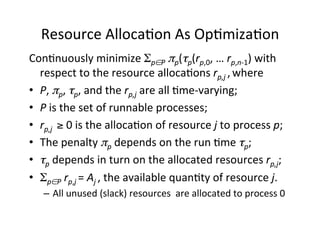
    Resource  Alloca3on  As  Op3miza3on   Con3nuously  minimize  Σp∈P  πp(τp(rp,0,  …  rp,n-­‐1)  with   respect  to  the  resource  alloca3ons  rp,j  ,  where   •  P,  πp,  τp,  and  the  rp,j  are  all  3me-­‐varying;   •  P  is  the  set  of  runnable  processes;   •  rp,j    ≥  0  is  the  alloca3on  of  resource  j  to  process  p;   •  The  penalty  πp  depends  on  the  run  3me  τp;   •  τp  depends  in  turn  on  the  allocated  resources  rp,j;   •  Σp∈P  rp,j  =  Aj  ,  the  available  quan3ty  of  resource  j.   –  All  unused  (slack)  resources    are  allocated  to  process  0  
  • 12.
    The  Op3miza3on  Picture    Run3me1(r(0,1),  …,  r(n-­‐1,1))    Run3me1   Penalty1   Con3nuously     minimize  the  total   penalty    Run3me2  (r(0,2),  …,  r(n-­‐1,2))    Run3me2    Run3mei(r(0,i),  …,  r(n-­‐1,i))    Run3mei   Penalty2  Penaltyi   Subject  to  the  total   available  resources  
  • 13.
    Convexity  and  Concavity   •  A  func3on  f  is  convex  if  for  all  x,  y  in  ℜn,  λ  in  ℜ,  and   0  ≤  λ  ≤  1,  f(λx  +  (1−λ)y)    ≤    λf(x)  +  (1−λ)f(y)   –  Chords  of  the  func3on’s  graph  must  lie  on  or  above  it   •  A  func3on  f  is  concave  if  for  all  x,  y  in  ℜn,  λ  in  ℜ,  and   0  ≤  λ  ≤  1,  f(λx  +  (1−λ)y)    ≥    λf(x)  +  (1−λ)f(y)   –  Alterna3vely,  f  is  concave  if  and  only  if  –f  is  convex   •  Affine  func3ons  Ax  +  b  are  both  convex  and  concave   •  If  func3ons  fi  are  convex  so  is  their  sum  Σi  fi     •  If  func3ons  fi  are  convex  so  is  their  maximum  maxi  fi     •  If  f  is  both  convex  and  monotone  non-­‐decreasing  and  g  is   convex  then  h(x)  =  f(g(x))  is  convex   •  If  f  is  convex,  so  is  the  set  Cα  =  {  x∈dom(f)  |  f(x)≤α  }   –  Cα  is  called  the  α-­‐sublevel  set  of  f      
  • 14.
    Convex  Op3miza3on   • A  convex  op3miza3on  problem  has  the  form:    Minimize  f0(x1,  …  xm)    subject  to    fi(x1,  …  xm)  ≤  0,  i  =  1,  …  k    where  the  func3ons  fi  :  Rm  →  R  are  all  convex   •  Convex  op3miza3on  has  several  virtues   – It  guarantees  a  single  global  op3mal  value   – It  is  not  much  slower  than  linear  programming   •  In  our  formula3on,  resource  management  is  a   convex  op3miza3on  problem  
  • 15.
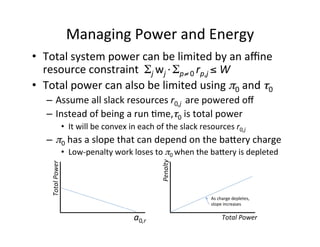
    Managing  Power  and  Energy   •  Total  system  power  can  be  limited  by  an  affine   resource  constraint    Σj  wj  ·∙  Σp≠  0  rp,j  ≤  W     •  Total  power  can  also  be  limited  using  π0  and  τ0   –  Assume  all  slack  resources  r0,j    are  powered  off   –  Instead  of  being  a  run  3me,τ0  is  total  power   •  It  will  be  convex  in  each  of  the  slack  resources  r0,j   –  π0  has  a  slope  that  can  depend  on  the  bagery  charge   •  Low-­‐penalty  work  loses  to  π0  when  the  bagery  is  depleted       Total  Power   Penalty   As  charge  depletes,   slope  increases   a0,r   Total  Power  
  • 16.
    Modeling  Run  Times   •  Run  3me  measurements  can  be  used  to   construct  a  model,  yielding  several  advantages   – “Noise”  can  be  removed  while  building  the  model   – Interpola3on  among  measurements  is  avoided   – Rates  of  change  with  resources  are  computable   •  We  have  constructed  several  types  of  model   – Linear  and  quadra3c  (rate)  models   –   Kernel  Canonical  Correla3on  Analysis   – Gene3cally  Programmed  Response  Surfaces   – Convex  non-­‐nega3ve  least  squares  models  
  • 17.
    Convex  Models   17   w:  learned  parameters   b:  bandwidth  alloca3ons   α:  bandwidth  amplifica3ons   m:  memory  alloca3ons   ∑+= ji ji ji bb w Tbw , , 0 * ),(τ 3 3 2 2 1 1 0),( b w m w b w Tbw +++=τ ( )∑+= i iii i mb w Tmbw α ατ 0),,,(
  • 20.
    Modeling  Results   • Non-­‐nega3ve  least-­‐squares  applied  to  past   run  3me  data  learns  the  model  parameters   – Rows  of  the  QR  factoriza3on  are  updated  and   downdated  to  track  changes  in  process  behavior   – Columns  are  also  updated  and  downdated  to   remove  and  restore  infeasible  alloca3ons   •  Our  convex  models  fit  the  data  quite  well   – They  work  even  beger  within  the  control  loop   – We  have  discovered  some  interes3ng  ar3facts  
  • 21.
    Nbodies  Frame  Time   0.01   0.1   0   500   1000   1500   2000   2500   3000   3500   Seconds   Memory  Pages   1   2   3   4   5   6   7   8   9   10   11   12   13   14   15   16  
  • 22.
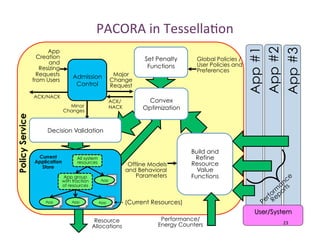
    PACORA   •  PACORA  stands  for  “Performance-­‐Aware   Convex  Op3miza3on  for  Resource  Alloca3on”   – See  our  paper  in  the  poster  session  of  HotPar  ‘11   •  It  manages  resource  alloca3on  policy  in  the   Berkeley  ParLab’s  Tessela3on  opera3ng  system   – One  of  us  (Bird)  is  currently  demonstra3ng  it   •  Nearly  all  of  the  ideas  presented  here  are  being   prototyped  in  PACORA  and  Tessela3on   – Perhaps  they  may  be  valuable  elsewhere  
  • 23.
    PolicyService Major Change Request ACK/ NACK App Creation and Resizing Requests from Users Admission Control Minor Changes ACK/NACK App AppApp All system resources App group with fraction of resources App Current Application Store (Current Resources) Global Policies / User Policies and Preferences Offline Models and Behavioral Parameters Build and Refine Resource Value Functions App#1 App#2 App#3 User/System Convex Optimization Set Penalty Functions Decision Validation 23   PACORA  in  Tessella3on   Resource Allocations Performance/ Energy Counters
  • 24.
    Acknowledgements   •  Stephen  Boyd  and  Lieven  Vandenberghe,   whose  book  taught  us  about  convex   op3miza3on   •  Krste  Asanović,  David  Pagerson,  and  John   Kubiatowicz  at  Berkeley,  for  their  strong   support   •  The  MicrosoB  Windows  developers,  for  giving   us  real  applica3ons  and  ways  to  measure  them   •  Colleagues  at  the  UC  Berkeley  ParLab  and  at   MicrosoB  Research,  for  helping  us  tell  the  story    
  • 25.
    Thanks!           Any  ques3ons?