

TMJ ARTHRITIS
NURHANANI ABD HALIM
PHARMACY SERVICES
CONTENT
 Introduction
 Definition
 Function
 Causes
 Symptoms
 Investigation
 Management
 Treatment
 Risk Factor
 Prevention
2
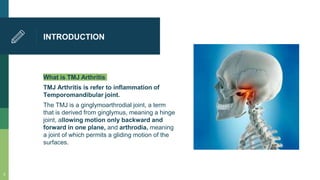
INTRODUCTION
What is TMJ Arthritis
TMJ Arthritis is refer to inflammation of
Temporomandibular joint.
The TMJ is a ginglymoarthrodial joint, a term
that is derived from ginglymus, meaning a hinge
joint, allowing motion only backward and
forward in one plane, and arthrodia, meaning
a joint of which permits a gliding motion of the
surfaces.
3
TMJ Facts!
The only mobile joint of skull
formed between head of mandible
and articular fossa of temporal
bone.
4
The only joint in human body that have
a rigid endpoint of closure.
Stress can make
TMJ disorder
worse.
The temporomandibular joint is the
joint that connects your jaw to your
skull. When this joint is injured or
damaged, it can lead to a localized pain
disorder called temporomandibular
joint (TMJ) syndrome or
temporomandibular disorder (TMD).
Definition
5
👤Breathing movement
👦Protrusion, retrusion, lateralization of the jaw
👪Phonation
😂Facial expressions
👶Sucking
🍒Swallowing
🍔Chewing
🎃Opening the mouth
🔌Maintain the correct pressure of the middle ear
😉
6
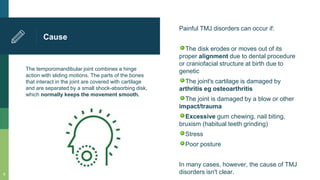
TMJ FUNCTION
The temporomandibular joint combines a hinge
action with sliding motions. The parts of the bones
that interact in the joint are covered with cartilage
and are separated by a small shock-absorbing disk,
which normally keeps the movement smooth.
Cause
Painful TMJ disorders can occur if:
The disk erodes or moves out of its
proper alignment due to dental procedure
or craniofacial structure at birth due to
genetic
The joint's cartilage is damaged by
arthritis eg osteoarthritis
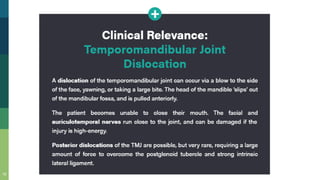
The joint is damaged by a blow or other
impact/trauma
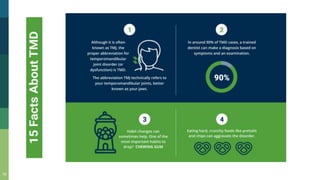
Excessive gum chewing, nail biting,
bruxism (habitual teeth grinding)
Stress
Poor posture
In many cases, however, the cause of TMJ
disorders isn't clear.8
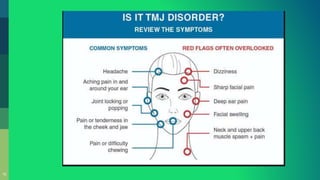
Symptoms:
▪ Pain or tenderness of your jaw
▪ Pain in one or both of the temporomandibular joints
▪ Aching pain in and around your ear
▪ Difficulty chewing or pain while chewing
▪ Aching facial pain
▪ Locking of the joint, making it difficult to open or close your
mouth
▪ Headaches, backaches, ear ringing (tinnitus)
9
10
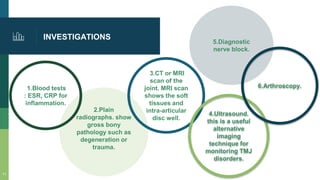
2.Plain
radiographs. show
gross bony
pathology such as
degeneration or
trauma.
1.Blood tests
: ESR, CRP for
inflammation.
3.CT or MRI
scan of the
joint. MRI scan
shows the soft
tissues and
intra-articular
disc well.
4.Ultrasound.
this is a useful
alternative
imaging
technique for
monitoring TMJ
disorders.
INVESTIGATIONS
6.Arthroscopy.
11
5.Diagnostic
nerve block.
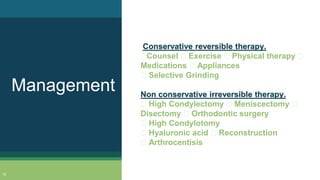
Conservative reversible therapy.
Counsel Exercise Physical therapy
Medications Appliances
Selective Grinding
Non conservative irreversible therapy.
High Condylectomy Meniscectomy
Disectomy Orthodontic surgery
High Condylotomy
Hyaluronic acid Reconstruction
Arthrocentisis
Management
12
13
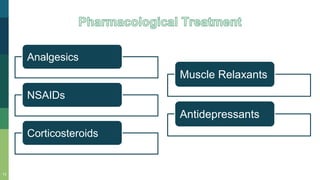
Analgesics
NSAIDs
Corticosteroids
Muscle Relaxants
Antidepressants
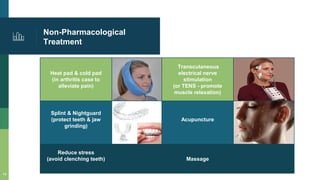
Non-Pharmacological
Treatment
Heat pad & cold pad
(in arthritis case to
alleviate pain)
Transcutaneous
electrical nerve
stimulation
(or TENS - promote
muscle relaxation)
Splint & Nightguard
(protect teeth & jaw
grinding)
Acupuncture
Reduce stress
(avoid clenching teeth) Massage
14
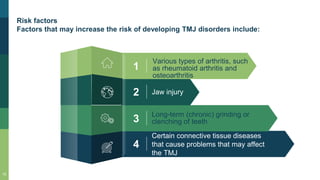
Risk factors
Factors that may increase the risk of developing TMJ disorders include:
1
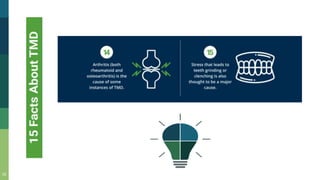
Various types of arthritis, such
as rheumatoid arthritis and
osteoarthritis
2 Jaw injury
3
Long-term (chronic) grinding or
clenching of teeth
4
Certain connective tissue diseases
that cause problems that may affect
the TMJ
15
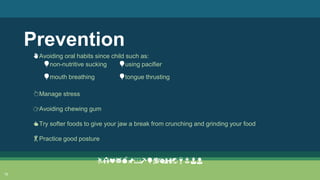
Prevention
16
✋Avoiding oral habits since child such as:
👆Manage stress
👉Avoiding chewing gum
👍Try softer foods to give your jaw a break from crunching and grinding your food
💃Practice good posture
🏃💑❤😸💣📌📖🔨🎈🎨🏈🏰🌏🔑👧👨👩
🎈non-nutritive sucking 🎈using pacifier
🎈mouth breathing 🎈tongue thrusting
Some of these effects may not be
noticeable until adulthood when most
TMJ disorder symptoms arise, although
some people have symptoms in the
teenage years. Women age 18-44 years
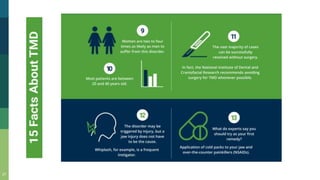
old tend to be more risky to get TMD.
17
18
19
20
21
22
Any questions?
30 seconds from now
23
THANK YOU!
KPJ Perlis Specialist
Hospital
Pharmacy
Services
Care For Life

TMJ Arthritis

  • 1.
    TMJ ARTHRITIS NURHANANI ABDHALIM PHARMACY SERVICES
  • 2.
    CONTENT  Introduction  Definition Function  Causes  Symptoms  Investigation  Management  Treatment  Risk Factor  Prevention 2
  • 3.
    INTRODUCTION What is TMJArthritis TMJ Arthritis is refer to inflammation of Temporomandibular joint. The TMJ is a ginglymoarthrodial joint, a term that is derived from ginglymus, meaning a hinge joint, allowing motion only backward and forward in one plane, and arthrodia, meaning a joint of which permits a gliding motion of the surfaces. 3
  • 4.
    TMJ Facts! The onlymobile joint of skull formed between head of mandible and articular fossa of temporal bone. 4 The only joint in human body that have a rigid endpoint of closure. Stress can make TMJ disorder worse.
  • 5.
    The temporomandibular jointis the joint that connects your jaw to your skull. When this joint is injured or damaged, it can lead to a localized pain disorder called temporomandibular joint (TMJ) syndrome or temporomandibular disorder (TMD). Definition 5
  • 6.
    👤Breathing movement 👦Protrusion, retrusion,lateralization of the jaw 👪Phonation 😂Facial expressions 👶Sucking 🍒Swallowing 🍔Chewing 🎃Opening the mouth 🔌Maintain the correct pressure of the middle ear 😉 6 TMJ FUNCTION
  • 8.
    The temporomandibular jointcombines a hinge action with sliding motions. The parts of the bones that interact in the joint are covered with cartilage and are separated by a small shock-absorbing disk, which normally keeps the movement smooth. Cause Painful TMJ disorders can occur if: The disk erodes or moves out of its proper alignment due to dental procedure or craniofacial structure at birth due to genetic The joint's cartilage is damaged by arthritis eg osteoarthritis The joint is damaged by a blow or other impact/trauma Excessive gum chewing, nail biting, bruxism (habitual teeth grinding) Stress Poor posture In many cases, however, the cause of TMJ disorders isn't clear.8
  • 9.
    Symptoms: ▪ Pain ortenderness of your jaw ▪ Pain in one or both of the temporomandibular joints ▪ Aching pain in and around your ear ▪ Difficulty chewing or pain while chewing ▪ Aching facial pain ▪ Locking of the joint, making it difficult to open or close your mouth ▪ Headaches, backaches, ear ringing (tinnitus) 9
  • 10.
  • 11.
    2.Plain radiographs. show gross bony pathologysuch as degeneration or trauma. 1.Blood tests : ESR, CRP for inflammation. 3.CT or MRI scan of the joint. MRI scan shows the soft tissues and intra-articular disc well. 4.Ultrasound. this is a useful alternative imaging technique for monitoring TMJ disorders. INVESTIGATIONS 6.Arthroscopy. 11 5.Diagnostic nerve block.
  • 12.
    Conservative reversible therapy. CounselExercise Physical therapy Medications Appliances Selective Grinding Non conservative irreversible therapy. High Condylectomy Meniscectomy Disectomy Orthodontic surgery High Condylotomy Hyaluronic acid Reconstruction Arthrocentisis Management 12
  • 13.
  • 14.
    Non-Pharmacological Treatment Heat pad &cold pad (in arthritis case to alleviate pain) Transcutaneous electrical nerve stimulation (or TENS - promote muscle relaxation) Splint & Nightguard (protect teeth & jaw grinding) Acupuncture Reduce stress (avoid clenching teeth) Massage 14
  • 15.
    Risk factors Factors thatmay increase the risk of developing TMJ disorders include: 1 Various types of arthritis, such as rheumatoid arthritis and osteoarthritis 2 Jaw injury 3 Long-term (chronic) grinding or clenching of teeth 4 Certain connective tissue diseases that cause problems that may affect the TMJ 15
  • 16.
    Prevention 16 ✋Avoiding oral habitssince child such as: 👆Manage stress 👉Avoiding chewing gum 👍Try softer foods to give your jaw a break from crunching and grinding your food 💃Practice good posture 🏃💑❤😸💣📌📖🔨🎈🎨🏈🏰🌏🔑👧👨👩 🎈non-nutritive sucking 🎈using pacifier 🎈mouth breathing 🎈tongue thrusting
  • 17.
    Some of theseeffects may not be noticeable until adulthood when most TMJ disorder symptoms arise, although some people have symptoms in the teenage years. Women age 18-44 years old tend to be more risky to get TMD. 17
  • 18.
  • 19.
  • 20.
  • 21.
  • 22.
  • 23.
  • 24.
    THANK YOU! KPJ PerlisSpecialist Hospital Pharmacy Services Care For Life

Editor's Notes

  • #2 https://www.slideshare.net/pramodchahar9/tmj-and-prosthodontic-implications https://www.slideshare.net/BhaumikThakkar2/temporomandibular-joint-71240638