Siv K. Ali
Petroleum Reservoir Engineering
Sivar.Kais@knu.edu.iq
Department of Petroleum Engineering - Knowledge University
Fundamental of Reservoir Engineering 2
Lecture-1: Introduction to Reservoir Engineering
1
Outlines
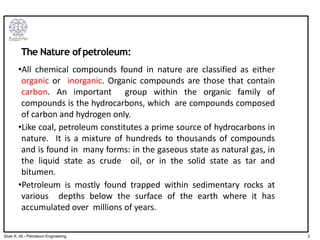
•The nature of Petroleum
•Petroleum Reservoir
•Reservoir Rock Properties
•Integration Reservoir Engineering
•Activities of Reservoir Engineering
•Reserve Estimation
•Reservoir Rock Properties
2
Siver K. Ali - Petroleum Engineering
The Nature ofpetroleum:
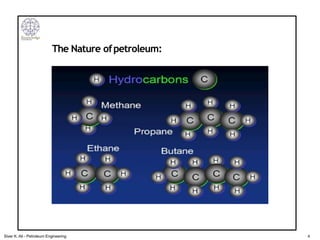
•All chemical compounds found in nature are classified as either
organic or inorganic. Organic compounds are those that contain
carbon. An important group within the organic family of
compounds is the hydrocarbons, which are compounds composed
of carbon and hydrogen only.
•Like coal, petroleum constitutes a prime source of hydrocarbons in
nature. It is a mixture of hundreds to thousands of compounds
and is found in many forms: in the gaseous state as natural gas, in
the liquid state as crude oil, or in the solid state as tar and
bitumen.
•Petroleum is mostly found trapped within sedimentary rocks at
various depths below the surface of the earth where it has
accumulated over millions of years.
3
Siver K. Ali - Petroleum Engineering
The Nature ofpetroleum:
4
Siver K. Ali - Petroleum Engineering
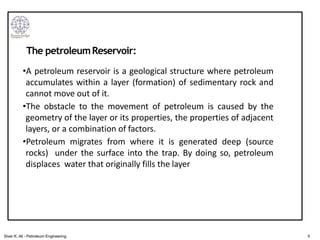
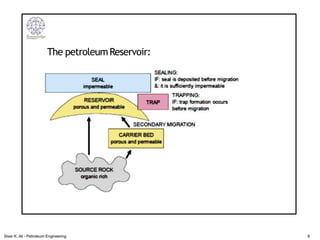
•A petroleum reservoir is a geological structure where petroleum
accumulates within a layer (formation) of sedimentary rock and
cannot move out of it.
•The obstacle to the movement of petroleum is caused by the
geometry of the layer or its properties, the properties of adjacent
layers, or a combination of factors.
•Petroleum migrates from where it is generated deep (source
rocks) under the surface into the trap. By doing so, petroleum
displaces water that originally fills the layer
The petroleumReservoir:
5
Siver K. Ali - Petroleum Engineering
The petroleumReservoir:
6
Siver K. Ali - Petroleum Engineering
The petroleumReservoir
7
Siver K. Ali - Petroleum Engineering
Reservoir Pressure
8
Siver K. Ali - Petroleum Engineering
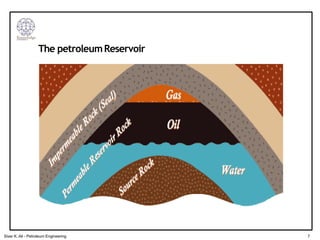
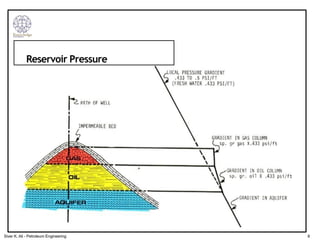
•Because petroleum is lighter than water, it accumulates at the
top of the structure. However, layer above the trap is too
impervious to allow petroleum to continue its movement
upwards, which causes the petroleum to remain trapped in
the reservoir.
•Discovering a petroleum trap does not necessarily mean that
petroleum can be produced. This depends on two key factors:
a)The quantity of petroleum within the trap.
b)The rate at which it can be produced.
If these two parameters justify the cost of production then the
trap is considered a petroleum reservoir.
Petroleum Reservoir
9
Siver K. Ali - Petroleum Engineering
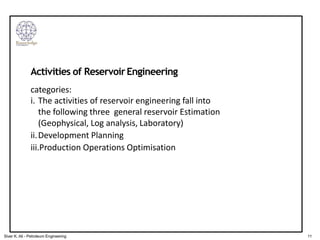
The reservoir engineer in modern oil and gas field
management is located at the heart of many of the activities
acting as a central co-ordinating role in relation to receiving
information processing it and passing it on to others.
Integration Reservoir Engineering
10
Siver K. Ali - Petroleum Engineering
Activities of ReservoirEngineering
categories:
i. The activities of reservoir engineering fall into
the following three general reservoir Estimation
(Geophysical, Log analysis, Laboratory)
ii.Development Planning
iii.Production Operations Optimisation
11
Siver K. Ali - Petroleum Engineering
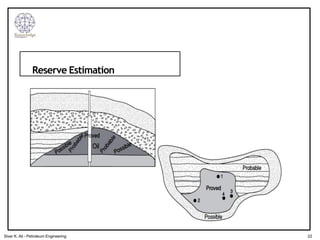
Reserves are those quantities of petroleum which are anticipated
to be commercially recovered from known accumulations from a
given date forward.
•Reserve estimates involve some degree of uncertainty.
•The uncertainty depends chiefly on the amount of reliable geologic
and engineering data available at the time of the estimate and the
interpretation of these data.
•The relative degree of uncertainty
•may be conveyed by placing reserves into one of two principal
classifications:
Reserve Estimation
12
Siver K. Ali - Petroleum Engineering
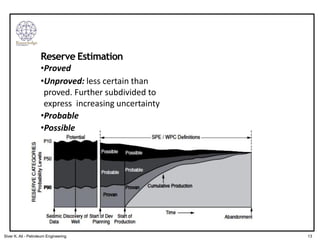
Reserve Estimation
•Proved
•Unproved: less certain than
proved. Further subdivided to
express increasing uncertainty
•Probable
•Possible
13
Siver K. Ali - Petroleum Engineering
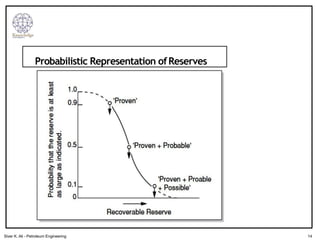
Probabilistic Representation ofReserves
14
Siver K. Ali - Petroleum Engineering
Reserve Estimation
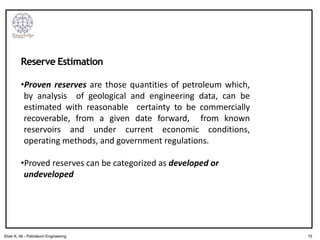
•Proven reserves are those quantities of petroleum which,
by analysis of geological and engineering data, can be
estimated with reasonable certainty to be commercially
recoverable, from a given date forward, from known
reservoirs and under current economic conditions,
operating methods, and government regulations.
•Proved reserves can be categorized as developed or
undeveloped
15
Siver K. Ali - Petroleum Engineering
Reserve Estimation
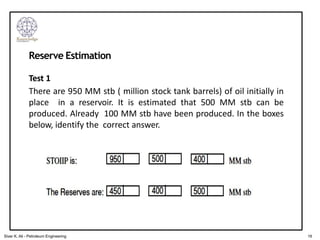
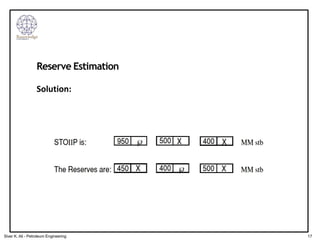
Test 1
There are 950 MM stb ( million stock tank barrels) of oil initially in
place in a reservoir. It is estimated that 500 MM stb can be
produced. Already 100 MM stb have been produced. In the boxes
below, identify the correct answer.
16
Siver K. Ali - Petroleum Engineering
Reserve Estimation
Solution:
17
Siver K. Ali - Petroleum Engineering
Reserve Estimation
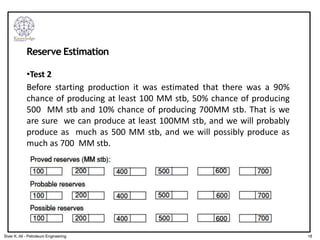
•Test 2
Before starting production it was estimated that there was a 90%
chance of producing at least 100 MM stb, 50% chance of producing
500 MM stb and 10% chance of producing 700MM stb. That is we
are sure we can produce at least 100MM stb, and we will probably
produce as much as 500 MM stb, and we will possibly produce as
much as 700 MM stb.
18
Siver K. Ali - Petroleum Engineering
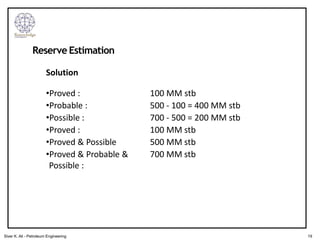
•Proved :
•Probable :
•Possible :
•Proved :
•Proved & Possible
•Proved & Probable &
Possible :
100 MM stb
500 - 100 = 400 MM stb
700 - 500 = 200 MM stb
100 MM stb
500 MM stb
700 MM stb
Solution
Reserve Estimation
19
Siver K. Ali - Petroleum Engineering
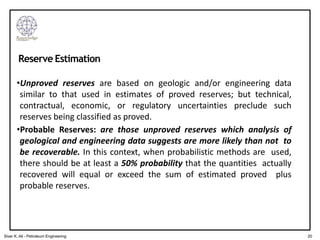
•Unproved reserves are based on geologic and/or engineering data
similar to that used in estimates of proved reserves; but technical,
contractual, economic, or regulatory uncertainties preclude such
reserves being classified as proved.
•Probable Reserves: are those unproved reserves which analysis of
geological and engineering data suggests are more likely than not to
be recoverable. In this context, when probabilistic methods are used,
there should be at least a 50% probability that the quantities actually
recovered will equal or exceed the sum of estimated proved plus
probable reserves.
Reserve Estimation
20
Siver K. Ali - Petroleum Engineering
Reserve Estimation
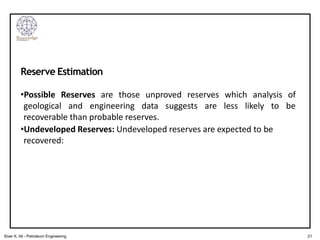
•Possible Reserves are those unproved reserves which analysis of
geological and engineering data suggests are less likely to be
recoverable than probable reserves.
•Undeveloped Reserves: Undeveloped reserves are expected to be
recovered:
21
Siver K. Ali - Petroleum Engineering
Reserve Estimation
22
Siver K. Ali - Petroleum Engineering
Reservoir RockProperties
The specifications of a reservoir rock are such that there must be a
large enough capacity to store economically viable amounts of
hydrocarbon and the hydrocarbon flow at economical rates when
penetrated by a well. The factors which may affect the capacity and the
flow properties are
•Porosity
•Permeability
•capillary pressure
•Compressibility
•fluid saturation.
23
Siver K. Ali - Petroleum Engineering
•Porosity of rock is the ratio of pore volume to bulk volume and is
usually expressed as percentage
•Saturation of a phase is the fraction of the pore volume occupied by
the phase
•Permeability is a measure of ‘ ease of flow’ or the capacity of
formation to transmit fluids
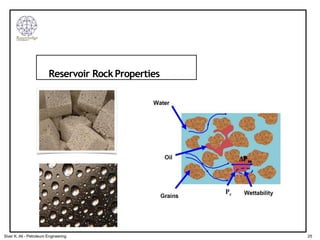
•Capillary pressure is a combination effect of surface and IFT of the
rock and fluid, pore size and geometry & wettability of the system.
•Wettability is the tendency of a fluid to spread or adhere to a solid
surface in presence of another immiscible fluid ‘
Reservoir RockProperties
24
Siver K. Ali - Petroleum Engineering
Reservoir RockProperties
25
Siver K. Ali - Petroleum Engineering
•In the case of a reservoir rock, these are not standard characteristics
determined before formation of the rock, but are closely linked to the
geological processes that brought the sediments together and deposited
them in the sequences and under the chemical and physical changes
inherent in the system.
•In order to extract the fluids, the rock must be permeable which requires
that there be sufficiently large, interconnecting pores.
•Although a permeable rock must also be porous, a porous rock is not
necessarily permeable.
Reservoir RockProperties
26
Siver K. Ali - Petroleum Engineering
•The pore spaces (or interstices) in reservoir rock provide the container for
the accumulation of oil and gas and these give the rock its characteristic
ability to absorb and hold fluids.
•Most commercial reservoirs of oil and gas occur in sandstone, limestone
or dolomite rocks, however, some reservoirs occur in fractured shale.
•For the reservoir engineer, porosity, permeability, capillary pressure,
relative permeability are the most important rock properties as a
measure of the space available for accumulation of hydrocarbon fluids.
Reservoir RockProperties
27
Siver K. Ali - Petroleum Engineering
Reservoir Rock PropertiesMeasurements
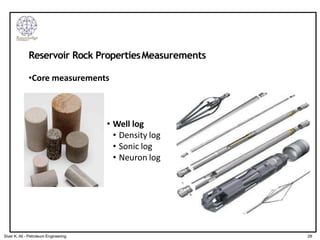
•Core measurements
• Well log
• Density log
• Sonic log
• Neuron log
28
Siver K. Ali - Petroleum Engineering
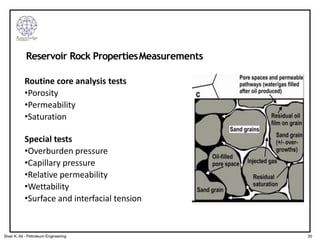
•Rock properties are determined by performing laboratory analyses on
cores from the reservoir to be evaluated.
•The cores are removed from the reservoir environment, with
subsequent changes in the core bulk volume, pore volume, reservoir
fluid saturations, and, sometimes, formation wettability.
•There are basically two main categories of core analysis tests that are
performed on core samples regarding physical properties of reservoir
rocks. These are:
Reservoir Rock PropertiesMeasurements
29
Siver K. Ali - Petroleum Engineering
Reservoir Rock PropertiesMeasurements
Routine core analysis tests
•Porosity
•Permeability
•Saturation
Special tests
•Overburden pressure
•Capillary pressure
•Relative permeability
•Wettability
•Surface and interfacial tension
30
Siver K. Ali - Petroleum Engineering
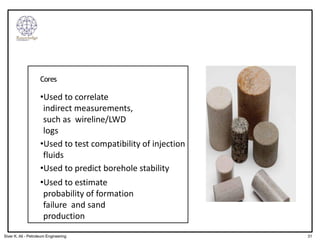
Cores
•Used to correlate
indirect measurements,
such as wireline/LWD
logs
•Used to test compatibility of injection
fluids
•Used to predict borehole stability
•Used to estimate
probability of formation
failure and sand
production
31
Siver K. Ali - Petroleum Engineering

lec 1.pdf PETROLEUM PROPERTIES RESERVIOUR

  • 1.
    Siv K. Ali PetroleumReservoir Engineering Sivar.Kais@knu.edu.iq Department of Petroleum Engineering - Knowledge University Fundamental of Reservoir Engineering 2 Lecture-1: Introduction to Reservoir Engineering 1
  • 2.
    Outlines •The nature ofPetroleum •Petroleum Reservoir •Reservoir Rock Properties •Integration Reservoir Engineering •Activities of Reservoir Engineering •Reserve Estimation •Reservoir Rock Properties 2 Siver K. Ali - Petroleum Engineering
  • 3.
    The Nature ofpetroleum: •Allchemical compounds found in nature are classified as either organic or inorganic. Organic compounds are those that contain carbon. An important group within the organic family of compounds is the hydrocarbons, which are compounds composed of carbon and hydrogen only. •Like coal, petroleum constitutes a prime source of hydrocarbons in nature. It is a mixture of hundreds to thousands of compounds and is found in many forms: in the gaseous state as natural gas, in the liquid state as crude oil, or in the solid state as tar and bitumen. •Petroleum is mostly found trapped within sedimentary rocks at various depths below the surface of the earth where it has accumulated over millions of years. 3 Siver K. Ali - Petroleum Engineering
  • 4.
    The Nature ofpetroleum: 4 SiverK. Ali - Petroleum Engineering
  • 5.
    •A petroleum reservoiris a geological structure where petroleum accumulates within a layer (formation) of sedimentary rock and cannot move out of it. •The obstacle to the movement of petroleum is caused by the geometry of the layer or its properties, the properties of adjacent layers, or a combination of factors. •Petroleum migrates from where it is generated deep (source rocks) under the surface into the trap. By doing so, petroleum displaces water that originally fills the layer The petroleumReservoir: 5 Siver K. Ali - Petroleum Engineering
  • 6.
    The petroleumReservoir: 6 Siver K.Ali - Petroleum Engineering
  • 7.
    The petroleumReservoir 7 Siver K.Ali - Petroleum Engineering
  • 8.
    Reservoir Pressure 8 Siver K.Ali - Petroleum Engineering
  • 9.
    •Because petroleum islighter than water, it accumulates at the top of the structure. However, layer above the trap is too impervious to allow petroleum to continue its movement upwards, which causes the petroleum to remain trapped in the reservoir. •Discovering a petroleum trap does not necessarily mean that petroleum can be produced. This depends on two key factors: a)The quantity of petroleum within the trap. b)The rate at which it can be produced. If these two parameters justify the cost of production then the trap is considered a petroleum reservoir. Petroleum Reservoir 9 Siver K. Ali - Petroleum Engineering
  • 10.
    The reservoir engineerin modern oil and gas field management is located at the heart of many of the activities acting as a central co-ordinating role in relation to receiving information processing it and passing it on to others. Integration Reservoir Engineering 10 Siver K. Ali - Petroleum Engineering
  • 11.
    Activities of ReservoirEngineering categories: i.The activities of reservoir engineering fall into the following three general reservoir Estimation (Geophysical, Log analysis, Laboratory) ii.Development Planning iii.Production Operations Optimisation 11 Siver K. Ali - Petroleum Engineering
  • 12.
    Reserves are thosequantities of petroleum which are anticipated to be commercially recovered from known accumulations from a given date forward. •Reserve estimates involve some degree of uncertainty. •The uncertainty depends chiefly on the amount of reliable geologic and engineering data available at the time of the estimate and the interpretation of these data. •The relative degree of uncertainty •may be conveyed by placing reserves into one of two principal classifications: Reserve Estimation 12 Siver K. Ali - Petroleum Engineering
  • 13.
    Reserve Estimation •Proved •Unproved: lesscertain than proved. Further subdivided to express increasing uncertainty •Probable •Possible 13 Siver K. Ali - Petroleum Engineering
  • 14.
  • 15.
    Reserve Estimation •Proven reservesare those quantities of petroleum which, by analysis of geological and engineering data, can be estimated with reasonable certainty to be commercially recoverable, from a given date forward, from known reservoirs and under current economic conditions, operating methods, and government regulations. •Proved reserves can be categorized as developed or undeveloped 15 Siver K. Ali - Petroleum Engineering
  • 16.
    Reserve Estimation Test 1 Thereare 950 MM stb ( million stock tank barrels) of oil initially in place in a reservoir. It is estimated that 500 MM stb can be produced. Already 100 MM stb have been produced. In the boxes below, identify the correct answer. 16 Siver K. Ali - Petroleum Engineering
  • 17.
    Reserve Estimation Solution: 17 Siver K.Ali - Petroleum Engineering
  • 18.
    Reserve Estimation •Test 2 Beforestarting production it was estimated that there was a 90% chance of producing at least 100 MM stb, 50% chance of producing 500 MM stb and 10% chance of producing 700MM stb. That is we are sure we can produce at least 100MM stb, and we will probably produce as much as 500 MM stb, and we will possibly produce as much as 700 MM stb. 18 Siver K. Ali - Petroleum Engineering
  • 19.
    •Proved : •Probable : •Possible: •Proved : •Proved & Possible •Proved & Probable & Possible : 100 MM stb 500 - 100 = 400 MM stb 700 - 500 = 200 MM stb 100 MM stb 500 MM stb 700 MM stb Solution Reserve Estimation 19 Siver K. Ali - Petroleum Engineering
  • 20.
    •Unproved reserves arebased on geologic and/or engineering data similar to that used in estimates of proved reserves; but technical, contractual, economic, or regulatory uncertainties preclude such reserves being classified as proved. •Probable Reserves: are those unproved reserves which analysis of geological and engineering data suggests are more likely than not to be recoverable. In this context, when probabilistic methods are used, there should be at least a 50% probability that the quantities actually recovered will equal or exceed the sum of estimated proved plus probable reserves. Reserve Estimation 20 Siver K. Ali - Petroleum Engineering
  • 21.
    Reserve Estimation •Possible Reservesare those unproved reserves which analysis of geological and engineering data suggests are less likely to be recoverable than probable reserves. •Undeveloped Reserves: Undeveloped reserves are expected to be recovered: 21 Siver K. Ali - Petroleum Engineering
  • 22.
    Reserve Estimation 22 Siver K.Ali - Petroleum Engineering
  • 23.
    Reservoir RockProperties The specificationsof a reservoir rock are such that there must be a large enough capacity to store economically viable amounts of hydrocarbon and the hydrocarbon flow at economical rates when penetrated by a well. The factors which may affect the capacity and the flow properties are •Porosity •Permeability •capillary pressure •Compressibility •fluid saturation. 23 Siver K. Ali - Petroleum Engineering
  • 24.
    •Porosity of rockis the ratio of pore volume to bulk volume and is usually expressed as percentage •Saturation of a phase is the fraction of the pore volume occupied by the phase •Permeability is a measure of ‘ ease of flow’ or the capacity of formation to transmit fluids •Capillary pressure is a combination effect of surface and IFT of the rock and fluid, pore size and geometry & wettability of the system. •Wettability is the tendency of a fluid to spread or adhere to a solid surface in presence of another immiscible fluid ‘ Reservoir RockProperties 24 Siver K. Ali - Petroleum Engineering
  • 25.
    Reservoir RockProperties 25 Siver K.Ali - Petroleum Engineering
  • 26.
    •In the caseof a reservoir rock, these are not standard characteristics determined before formation of the rock, but are closely linked to the geological processes that brought the sediments together and deposited them in the sequences and under the chemical and physical changes inherent in the system. •In order to extract the fluids, the rock must be permeable which requires that there be sufficiently large, interconnecting pores. •Although a permeable rock must also be porous, a porous rock is not necessarily permeable. Reservoir RockProperties 26 Siver K. Ali - Petroleum Engineering
  • 27.
    •The pore spaces(or interstices) in reservoir rock provide the container for the accumulation of oil and gas and these give the rock its characteristic ability to absorb and hold fluids. •Most commercial reservoirs of oil and gas occur in sandstone, limestone or dolomite rocks, however, some reservoirs occur in fractured shale. •For the reservoir engineer, porosity, permeability, capillary pressure, relative permeability are the most important rock properties as a measure of the space available for accumulation of hydrocarbon fluids. Reservoir RockProperties 27 Siver K. Ali - Petroleum Engineering
  • 28.
    Reservoir Rock PropertiesMeasurements •Coremeasurements • Well log • Density log • Sonic log • Neuron log 28 Siver K. Ali - Petroleum Engineering
  • 29.
    •Rock properties aredetermined by performing laboratory analyses on cores from the reservoir to be evaluated. •The cores are removed from the reservoir environment, with subsequent changes in the core bulk volume, pore volume, reservoir fluid saturations, and, sometimes, formation wettability. •There are basically two main categories of core analysis tests that are performed on core samples regarding physical properties of reservoir rocks. These are: Reservoir Rock PropertiesMeasurements 29 Siver K. Ali - Petroleum Engineering
  • 30.
    Reservoir Rock PropertiesMeasurements Routinecore analysis tests •Porosity •Permeability •Saturation Special tests •Overburden pressure •Capillary pressure •Relative permeability •Wettability •Surface and interfacial tension 30 Siver K. Ali - Petroleum Engineering
  • 31.
    Cores •Used to correlate indirectmeasurements, such as wireline/LWD logs •Used to test compatibility of injection fluids •Used to predict borehole stability •Used to estimate probability of formation failure and sand production 31 Siver K. Ali - Petroleum Engineering