Writing a Scientific Paper
Dr. Bhaswat S. Chakraborty
Writing Well
True ease in writing comes from art, not chance
As those who move easiest have learnt to dance
Alexander Pope
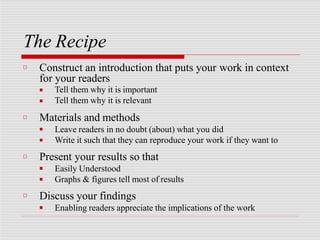
The Recipe
□ Construct an introduction that puts your work in context
for your readers
■
■
Tell them why it is important
Tell them why it is relevant
□ Materials and methods
■
■
Leave readers in no doubt (about) what you did
Write it such that they can reproduce your work if they want to
□ Present your results so that
■
■
Easily Understood
Graphs & figures tell most of results
□ Discuss your findings
■ Enabling readers appreciate the implications of the work
A Reliable Structure of Writing
I keep six honest serving men
(They taught me all I know),
Their names are What and Why and When,
And How and Where and Who?
Rudyard Kipling
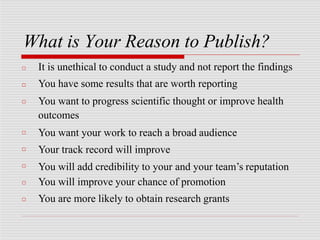
What is Your Reason to Publish?
□
□
□
□
□
□
□
□
It is unethical to conduct a study and not report the findings
You have some results that are worth reporting
You want to progress scientific thought or improve health
outcomes
You want your work to reach a broad audience
Your track record will improve
You will add credibility to your and your team’s reputation
You will improve your chance of promotion
You are more likely to obtain research grants
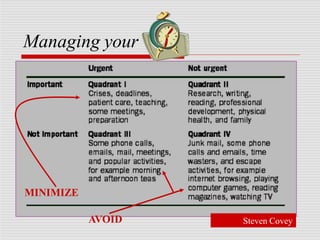
Managing your
Steven Covey
MINIMIZE
AVOID
What about Creativity?
You should allow yourself to get into a writing mood.
Finish the background reading, the review of the
literature, and the work to date. You know it inside
out. Relax. Take deep breaths. Just let it flow. Many
people find music a help but choose carefully ... Wear
comfortable clothes; a sweater and jeans are fine.
Anthony David
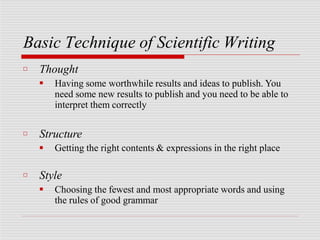
Basic Technique of Scientific Writing
□ Thought
■ Having some worthwhile results and ideas to publish. You
need some new results to publish and you need to be able to
interpret them correctly
□ Structure
■ Getting the right contents & expressions in the right place
□ Style
■ Choosing the fewest and most appropriate words and using
the rules of good grammar
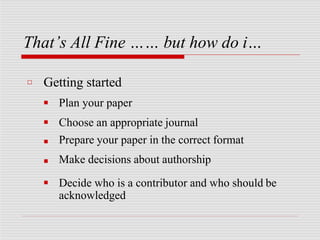
That’s All Fine …… but how do i…
□ Getting started
■
■
■
■
■
Plan your paper
Choose an appropriate journal
Prepare your paper in the correct format
Make decisions about authorship
Decide who is a contributor and who should be
acknowledged
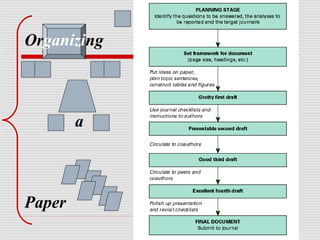
Organizing
a
Paper
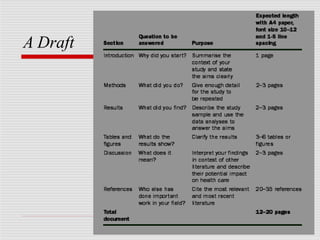
A Draft
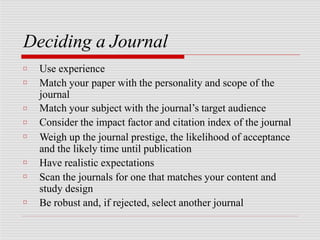
Deciding a Journal
□
□
□
□
□
□
□
□
Use experience
Match your paper with the personality and scope of the
journal
Match your subject with the journal’s target audience
Consider the impact factor and citation index of the journal
Weigh up the journal prestige, the likelihood of acceptance
and the likely time until publication
Have realistic expectations
Scan the journals for one that matches your content and
study design
Be robust and, if rejected, select another journal
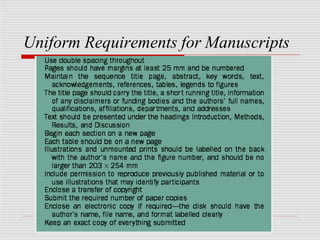
Uniform Requirements for Manuscripts
What Exactly is to be Included
□ While reporting an RCT
■ See Appendix 1 of your handout
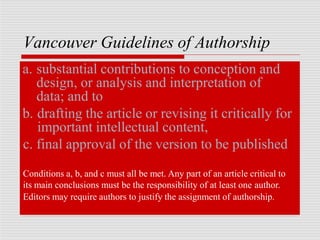
Vancouver Guidelines of Authorship
a. substantial contributions to conception and
design, or analysis and interpretation of
data; and to
b. drafting the article or revising it critically for
important intellectual content,
c. final approval of the version to be published
Conditions a, b, and c must all be met. Any part of an article critical to
its main conclusions must be the responsibility of at least one author.
Editors may require authors to justify the assignment of authorship.
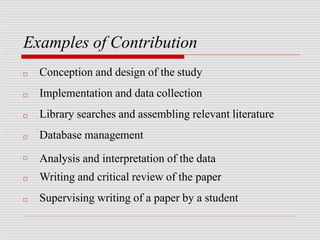
Examples of Contribution
□
□
□
□
□
□
□
Conception and design of the study
Implementation and data collection
Library searches and assembling relevant literature
Database management
Analysis and interpretation of the data
Writing and critical review of the paper
Supervising writing of a paper by a student
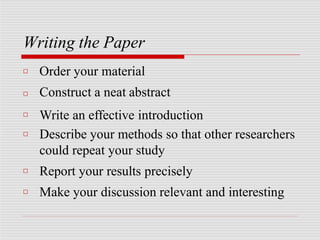
Writing the Paper
□
□
□
□
□
□ Order your material
Construct a neat abstract
Write an effective introduction
Describe your methods so that other researchers
could repeat your study
Report your results precisely
Make your discussion relevant and interesting
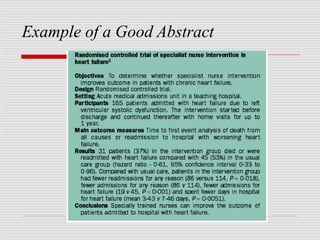
Example of a Good Abstract
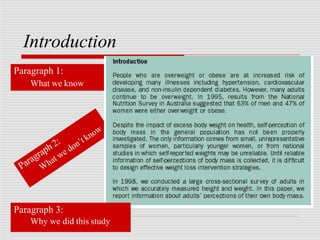
Introduction
Paragraph 1:
What we know
Paragraph 3:
Why we did this study
Know the Scope of Your Reporting
Randomized Controlled Trials
□
□
□ Compares the effect of a new treatment with an
existing or placebo treatment
Participants are allocated to study groups using
a formal randomization process
Randomization minimizes the effects of bias
and confounding on the results
Materials & Methods
□ Ethics approval
■ Described
□ Study design
■
□
Design, randomization (blinding …),
sample size, optimization, justification
Participants
■
□
□
Population sampled from,
inclusion/exclusion, sampling scheme
Interventions
Clinical assessment
■
■
Primary & Secondary
Efficacy as well as safety
□ Statistical analysis
■ Baseline treatment, data censoring, model
selection, tests, levels of significance
Central principle
Every
measurement
reported in the
results section
must have a
description of
the method used
to obtain it
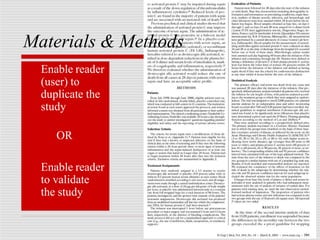
Materials & Methods
Enable reader
(user) to
duplicate the
study
OR
Enable reader
to validate
the study
Results
Religion is always right. Religion solves every
problem and thereby abolishes problems from
the universe…
Science is the very opposite. Science is always
wrong. It never solves a problem without
raising ten others.
George Bernard Shaw (in an after-dinner toast to
Albert Einstein, 1930)
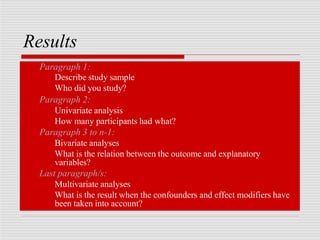
Results
Paragraph 1:
Describe study sample
Who did you study?
Paragraph 2:
Univariate analysis
How many participants had what?
Paragraph 3 to n-1:
Bivariate analyses
What is the relation between the outcome and explanatory
variables?
Last paragraph/s:
Multivariate analyses
What is the result when the confounders and effect modifiers have
been taken into account?
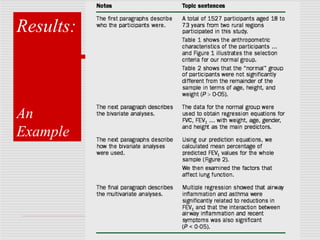
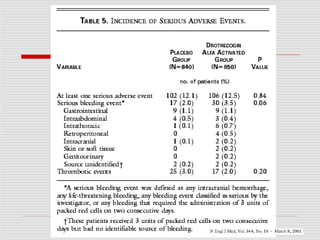
Results:
An
Example
Figures & Tables
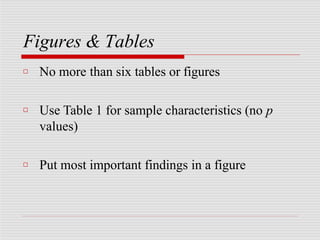
□ No more than six tables or figures
□ Use Table 1 for sample characteristics (no p
values)
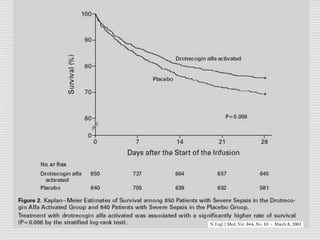
□ Put most important findings in a figure
Graphs & Figures
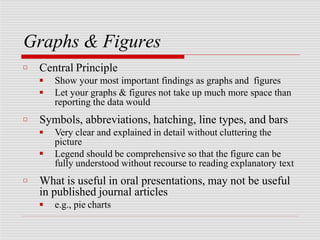
□ Central Principle
■
■
Show your most important findings as graphs and figures
Let your graphs & figures not take up much more space than
reporting the data would
□ Symbols, abbreviations, hatching, line types, and bars
■
■
Very clear and explained in detail without cluttering the
picture
Legend should be comprehensive so that the figure can be
fully understood without recourse to reading explanatory text
□ What is useful in oral presentations, may not be useful
in published journal articles
■ e.g., pie charts
Tables
□
□
□
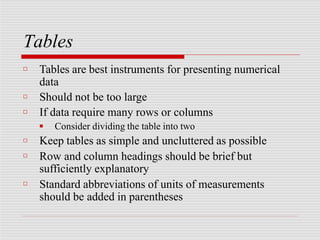
Tables are best instruments for presenting numerical
data
Should not be too large
If data require many rows or columns
■ Consider dividing the table into two
□
□
□
Keep tables as simple and uncluttered as possible
Row and column headings should be brief but
sufficiently explanatory
Standard abbreviations of units of measurements
should be added in parentheses
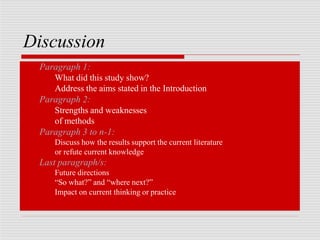
Discussion
Paragraph 1:
What did this study show?
Address the aims stated in the Introduction
Paragraph 2:
Strengths and weaknesses
of methods
Paragraph 3 to n-1:
Discuss how the results support the current literature
or refute current knowledge
Last paragraph/s:
Future directions
“So what?” and “where next?”
Impact on current thinking or practice
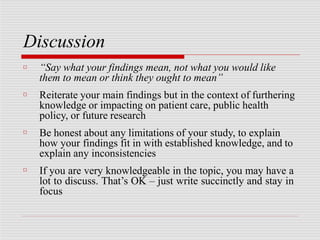
Discussion
□
□
□
□
“Say what your findings mean, not what you would like
them to mean or think they ought to mean”
Reiterate your main findings but in the context of furthering
knowledge or impacting on patient care, public health
policy, or future research
Be honest about any limitations of your study, to explain
how your findings fit in with established knowledge, and to
explain any inconsistencies
If you are very knowledgeable in the topic, you may have a
lot to discuss. That’s OK – just write succinctly and stay in
focus
Finishing up Your Paper
□
□
□
□
□
□
Write a short, snappy title
Select and quote references correctly
Maximize the value of the peer review process
Package your paper appropriately
Send your paper to a journal
Store your data and your documentation
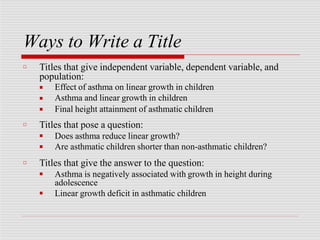
Ways to Write a Title
□ Titles that give independent variable, dependent variable, and
population:
■
■
■
Effect of asthma on linear growth in children
Asthma and linear growth in children
Final height attainment of asthmatic children
□ Titles that pose a question:
■
■
Does asthma reduce linear growth?
Are asthmatic children shorter than non-asthmatic children?
□ Titles that give the answer to the question:
■
■
Asthma is negatively associated with growth in height during
adolescence
Linear growth deficit in asthmatic children
References
□
□
□
□
□ All citations must be accurate
Include only the most important, most rigorous,
and most recent literature
Quote only published journal articles or books
Never quote “second hand
Cite only 20–35 references
Responding to the Reviewers’ Comments
■ See Appendix 2 of your handout
A Few Simple Rules for Effective Writing
□Rule 1 Use concrete rather than vague language.
■ Vague The weather was of an extreme nature
on the West coast.
■ Concrete California had very cold weather last week.
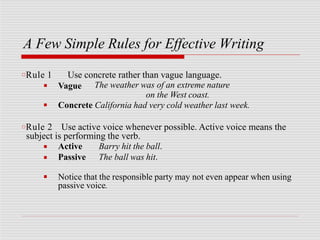
□Rule 2 Use active voice whenever possible. Active voice means the
subject is performing the verb.
■
■
Active
Passive
Barry hit the ball.
The ball was hit.
■ Notice that the responsible party may not even appear when using
passive voice.
Rules (Contd..)
□ Rule 3 Avoid overusing there is, there are, it is, it was,
etc.
■ Example
■ Correction
■ Better
There is a case of meningitis that was reported in
the newspaper.
A case of meningitis was reported in the
newspaper.
The newspaper reported a case of meningitis.
(Active voice).
□ Rule 4 To avoid confusion, don't use two negatives to
■
■
make a positive.
Correct
Incorrect
He is willing to help.
He is not unwilling to help.
Rules (Contd..)
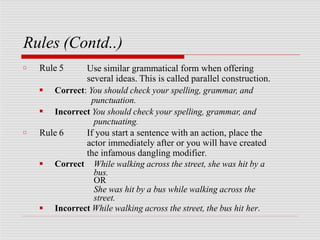
□ Rule 5 Use similar grammatical form when offering
several ideas. This is called parallel construction.
■
■
Correct: You should check your spelling, grammar, and
punctuation.
Incorrect You should check your spelling, grammar, and
punctuating.
□ Rule 6
■ Correct
If you start a sentence with an action, place the
actor immediately after or you will have created
the infamous dangling modifier.
While walking across the street, she was hit by a
bus.
OR
She was hit by a bus while walking across the
street.
■ Incorrect While walking across the street, the bus hit her.
Rules (Contd..)
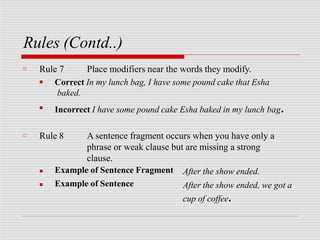
□ Rule 7 Place modifiers near the words they modify.
■
■
Correct In my lunch bag, I have some pound cake that Esha
baked.
Incorrect I have some pound cake Esha baked in my lunch bag.
□ Rule 8 A sentence fragment occurs when you have only a
phrase or weak clause but are missing a strong
clause.
■
■
Example of Sentence Fragment
Example of Sentence
After the show ended.
After the show ended, we got a
cup of coffee.
The Thrill of getting Accepted
Seeing your name in print is such an amazing concept:
you get so much attention without having to actually
show up somewhere… There are many obvious
advantages to this. You don’t have to dress up, for
instance, and you can’t hear them boo you straight away.
Anne Lamott
Much of the presented materials
are based on the writing tips
given in British Medical Journal
Acknowledgements
□
□
Diptiman Roy
Mansukh Gajera

Research writing.pptx

  • 1.
    Writing a ScientificPaper Dr. Bhaswat S. Chakraborty
  • 2.
    Writing Well True easein writing comes from art, not chance As those who move easiest have learnt to dance Alexander Pope
  • 3.
    The Recipe □ Constructan introduction that puts your work in context for your readers ■ ■ Tell them why it is important Tell them why it is relevant □ Materials and methods ■ ■ Leave readers in no doubt (about) what you did Write it such that they can reproduce your work if they want to □ Present your results so that ■ ■ Easily Understood Graphs & figures tell most of results □ Discuss your findings ■ Enabling readers appreciate the implications of the work
  • 4.
    A Reliable Structureof Writing I keep six honest serving men (They taught me all I know), Their names are What and Why and When, And How and Where and Who? Rudyard Kipling
  • 5.
    What is YourReason to Publish? □ □ □ □ □ □ □ □ It is unethical to conduct a study and not report the findings You have some results that are worth reporting You want to progress scientific thought or improve health outcomes You want your work to reach a broad audience Your track record will improve You will add credibility to your and your team’s reputation You will improve your chance of promotion You are more likely to obtain research grants
  • 6.
  • 7.
    What about Creativity? Youshould allow yourself to get into a writing mood. Finish the background reading, the review of the literature, and the work to date. You know it inside out. Relax. Take deep breaths. Just let it flow. Many people find music a help but choose carefully ... Wear comfortable clothes; a sweater and jeans are fine. Anthony David
  • 8.
    Basic Technique ofScientific Writing □ Thought ■ Having some worthwhile results and ideas to publish. You need some new results to publish and you need to be able to interpret them correctly □ Structure ■ Getting the right contents & expressions in the right place □ Style ■ Choosing the fewest and most appropriate words and using the rules of good grammar
  • 9.
    That’s All Fine…… but how do i… □ Getting started ■ ■ ■ ■ ■ Plan your paper Choose an appropriate journal Prepare your paper in the correct format Make decisions about authorship Decide who is a contributor and who should be acknowledged
  • 10.
  • 11.
  • 12.
    Deciding a Journal □ □ □ □ □ □ □ □ Useexperience Match your paper with the personality and scope of the journal Match your subject with the journal’s target audience Consider the impact factor and citation index of the journal Weigh up the journal prestige, the likelihood of acceptance and the likely time until publication Have realistic expectations Scan the journals for one that matches your content and study design Be robust and, if rejected, select another journal
  • 13.
  • 14.
    What Exactly isto be Included □ While reporting an RCT ■ See Appendix 1 of your handout
  • 15.
    Vancouver Guidelines ofAuthorship a. substantial contributions to conception and design, or analysis and interpretation of data; and to b. drafting the article or revising it critically for important intellectual content, c. final approval of the version to be published Conditions a, b, and c must all be met. Any part of an article critical to its main conclusions must be the responsibility of at least one author. Editors may require authors to justify the assignment of authorship.
  • 16.
    Examples of Contribution □ □ □ □ □ □ □ Conceptionand design of the study Implementation and data collection Library searches and assembling relevant literature Database management Analysis and interpretation of the data Writing and critical review of the paper Supervising writing of a paper by a student
  • 17.
    Writing the Paper □ □ □ □ □ □Order your material Construct a neat abstract Write an effective introduction Describe your methods so that other researchers could repeat your study Report your results precisely Make your discussion relevant and interesting
  • 18.
    Example of aGood Abstract
  • 19.
    Introduction Paragraph 1: What weknow Paragraph 3: Why we did this study
  • 20.
    Know the Scopeof Your Reporting Randomized Controlled Trials □ □ □ Compares the effect of a new treatment with an existing or placebo treatment Participants are allocated to study groups using a formal randomization process Randomization minimizes the effects of bias and confounding on the results
  • 21.
    Materials & Methods □Ethics approval ■ Described □ Study design ■ □ Design, randomization (blinding …), sample size, optimization, justification Participants ■ □ □ Population sampled from, inclusion/exclusion, sampling scheme Interventions Clinical assessment ■ ■ Primary & Secondary Efficacy as well as safety □ Statistical analysis ■ Baseline treatment, data censoring, model selection, tests, levels of significance Central principle Every measurement reported in the results section must have a description of the method used to obtain it
  • 22.
    Materials & Methods Enablereader (user) to duplicate the study OR Enable reader to validate the study
  • 23.
    Results Religion is alwaysright. Religion solves every problem and thereby abolishes problems from the universe… Science is the very opposite. Science is always wrong. It never solves a problem without raising ten others. George Bernard Shaw (in an after-dinner toast to Albert Einstein, 1930)
  • 24.
    Results Paragraph 1: Describe studysample Who did you study? Paragraph 2: Univariate analysis How many participants had what? Paragraph 3 to n-1: Bivariate analyses What is the relation between the outcome and explanatory variables? Last paragraph/s: Multivariate analyses What is the result when the confounders and effect modifiers have been taken into account?
  • 25.
  • 26.
    Figures & Tables □No more than six tables or figures □ Use Table 1 for sample characteristics (no p values) □ Put most important findings in a figure
  • 27.
    Graphs & Figures □Central Principle ■ ■ Show your most important findings as graphs and figures Let your graphs & figures not take up much more space than reporting the data would □ Symbols, abbreviations, hatching, line types, and bars ■ ■ Very clear and explained in detail without cluttering the picture Legend should be comprehensive so that the figure can be fully understood without recourse to reading explanatory text □ What is useful in oral presentations, may not be useful in published journal articles ■ e.g., pie charts
  • 29.
    Tables □ □ □ Tables are bestinstruments for presenting numerical data Should not be too large If data require many rows or columns ■ Consider dividing the table into two □ □ □ Keep tables as simple and uncluttered as possible Row and column headings should be brief but sufficiently explanatory Standard abbreviations of units of measurements should be added in parentheses
  • 31.
    Discussion Paragraph 1: What didthis study show? Address the aims stated in the Introduction Paragraph 2: Strengths and weaknesses of methods Paragraph 3 to n-1: Discuss how the results support the current literature or refute current knowledge Last paragraph/s: Future directions “So what?” and “where next?” Impact on current thinking or practice
  • 32.
    Discussion □ □ □ □ “Say what yourfindings mean, not what you would like them to mean or think they ought to mean” Reiterate your main findings but in the context of furthering knowledge or impacting on patient care, public health policy, or future research Be honest about any limitations of your study, to explain how your findings fit in with established knowledge, and to explain any inconsistencies If you are very knowledgeable in the topic, you may have a lot to discuss. That’s OK – just write succinctly and stay in focus
  • 33.
    Finishing up YourPaper □ □ □ □ □ □ Write a short, snappy title Select and quote references correctly Maximize the value of the peer review process Package your paper appropriately Send your paper to a journal Store your data and your documentation
  • 34.
    Ways to Writea Title □ Titles that give independent variable, dependent variable, and population: ■ ■ ■ Effect of asthma on linear growth in children Asthma and linear growth in children Final height attainment of asthmatic children □ Titles that pose a question: ■ ■ Does asthma reduce linear growth? Are asthmatic children shorter than non-asthmatic children? □ Titles that give the answer to the question: ■ ■ Asthma is negatively associated with growth in height during adolescence Linear growth deficit in asthmatic children
  • 35.
    References □ □ □ □ □ All citationsmust be accurate Include only the most important, most rigorous, and most recent literature Quote only published journal articles or books Never quote “second hand Cite only 20–35 references
  • 36.
    Responding to theReviewers’ Comments ■ See Appendix 2 of your handout
  • 37.
    A Few SimpleRules for Effective Writing □Rule 1 Use concrete rather than vague language. ■ Vague The weather was of an extreme nature on the West coast. ■ Concrete California had very cold weather last week. □Rule 2 Use active voice whenever possible. Active voice means the subject is performing the verb. ■ ■ Active Passive Barry hit the ball. The ball was hit. ■ Notice that the responsible party may not even appear when using passive voice.
  • 38.
    Rules (Contd..) □ Rule3 Avoid overusing there is, there are, it is, it was, etc. ■ Example ■ Correction ■ Better There is a case of meningitis that was reported in the newspaper. A case of meningitis was reported in the newspaper. The newspaper reported a case of meningitis. (Active voice). □ Rule 4 To avoid confusion, don't use two negatives to ■ ■ make a positive. Correct Incorrect He is willing to help. He is not unwilling to help.
  • 39.
    Rules (Contd..) □ Rule5 Use similar grammatical form when offering several ideas. This is called parallel construction. ■ ■ Correct: You should check your spelling, grammar, and punctuation. Incorrect You should check your spelling, grammar, and punctuating. □ Rule 6 ■ Correct If you start a sentence with an action, place the actor immediately after or you will have created the infamous dangling modifier. While walking across the street, she was hit by a bus. OR She was hit by a bus while walking across the street. ■ Incorrect While walking across the street, the bus hit her.
  • 40.
    Rules (Contd..) □ Rule7 Place modifiers near the words they modify. ■ ■ Correct In my lunch bag, I have some pound cake that Esha baked. Incorrect I have some pound cake Esha baked in my lunch bag. □ Rule 8 A sentence fragment occurs when you have only a phrase or weak clause but are missing a strong clause. ■ ■ Example of Sentence Fragment Example of Sentence After the show ended. After the show ended, we got a cup of coffee.
  • 41.
    The Thrill ofgetting Accepted Seeing your name in print is such an amazing concept: you get so much attention without having to actually show up somewhere… There are many obvious advantages to this. You don’t have to dress up, for instance, and you can’t hear them boo you straight away. Anne Lamott
  • 42.
    Much of thepresented materials are based on the writing tips given in British Medical Journal
  • 43.