Academic writing skills: How to write a good proposal, thesis or
publication?
dr. Asri Maharani, PhD, FRSPH, FRSS
Fakultas Kesehatan Masyarakat, Universitas Sriwijaya
21 Mei 2022
What is scientific writing?
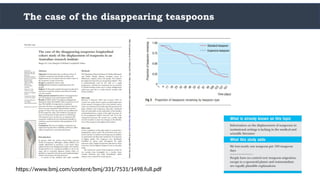
https://www.bmj.com/content/bmj/331/7531/1498.full.pdf
The case of the disappearing teaspoons
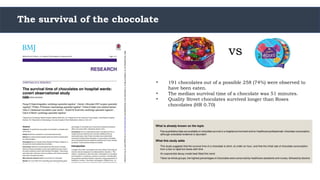
The survival of the chocolate
vs
• 191 chocolates out of a possible 258 (74%) were observed to
have been eaten.
• The median survival time of a chocolate was 51 minutes.
• Quality Street chocolates survived longer than Roses
chocolates (HR 0.70)
Scientific Writing = Communicating Your Research
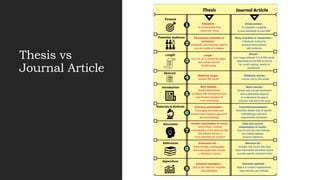
Thesis vs
Journal Article
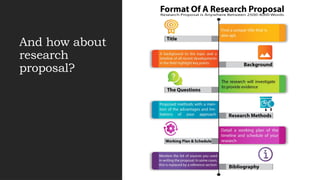
And how about
research
proposal?
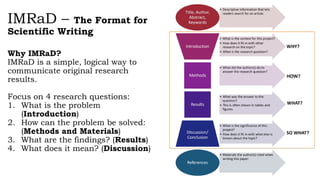
IMRaD – The Format for
Scientific Writing
Why IMRaD?
IMRaD is a simple, logical way to
communicate original research
results.
Focus on 4 research questions:
1. What is the problem
(Introduction)
2. How can the problem be solved:
(Methods and Materials)
3. What are the findings? (Results)
4. What does it mean? (Discussion)
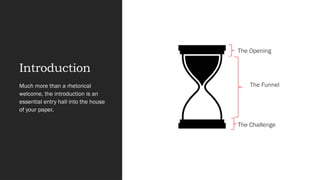
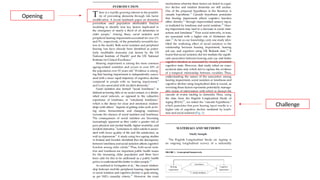
Introduction
The Opening
Much more than a rhetorical
welcome, the introduction is an
essential entry hall into the house
of your paper.
The Funnel
The Challenge
The Opening
b
The most important sentence in any article is the first one
(William Zinsserr, On Writing Well)
It is called “A power position”
Use the power to accomplish three goals:
◦ Identify the problem that drive the research
◦ Introduce the character
◦ Target the audience
How your opening identify your power position
Visual and hearing impairments are associated
with cognitive decline in older people (Maharani
et al., 2018 – Age and Ageing)
Maintaining cognitive function in later life has become a public health
priority as the burden imposed by dementia in the ageing population has
increased more rapidly than that of most other diseases [1].
Trajectories of recall memory as predictive of
hearing impairment: A longitudinal cohort study
(Maharani et al., 2020 – PLOS One)
Hearing impairment has become a major concern for global health. The
2015 Global Burden of Disease estimates showed that hearing impairment
was the fourth leading cause of years lived with disability (YLDs) and those
YLDs increase from age 35 years to 64 years [1].
Healthcare system performance and
socioeconomic inequalities in hearing and visual
impairments in 17 European countries (Maharani
et al., 2020 – Eu J of Public Health)
As the world population ages, Europeans are among those enjoying the
longest life expectancies in the world: 75 years for men and 81 for women
[1].
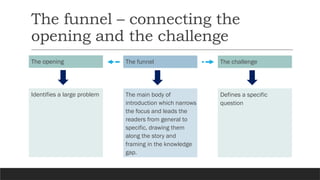
The funnel – connecting the
opening and the challenge
The opening
Identifies a large problem
The challenge
Defines a specific
question
The funnel
The main body of
introduction which narrows
the focus and leads the
readers from general to
specific, drawing them
along the story and
framing in the knowledge
gap.
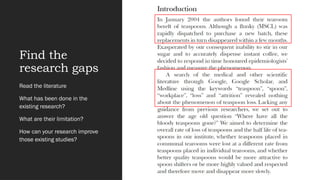
Find the
research gaps
Read the literature
What has been done in the
existing research?
What are their limitation?
How can your research improve
those existing studies?
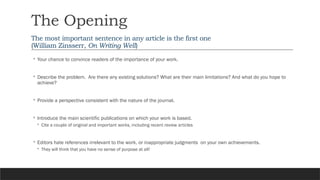
The Opening
b
The most important sentence in any article is the first one
(William Zinsserr, On Writing Well)
◦ Your chance to convince readers of the importance of your work.
◦ Describe the problem. Are there any existing solutions? What are their main limitations? And what do you hope to
achieve?
◦ Provide a perspective consistent with the nature of the journal.
◦ Introduce the main scientific publications on which your work is based.
◦ Cite a couple of original and important works, including recent review articles
◦ Editors hate references irrelevant to the work, or inappropriate judgments on your own achievements.
◦ They will think that you have no sense of purpose at all!
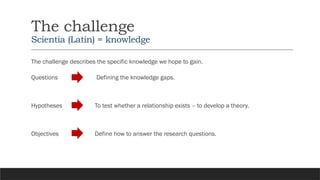
The challenge
Scientia (Latin) = knowledge
The challenge describes the specific knowledge we hope to gain.
Questions
Hypotheses
Objectives
Defining the knowledge gaps.
To test whether a relationship exists – to develop a theory.
Define how to answer the research questions.
Opening
Challenge
Better: “Five out of seven recent studies (authors, dates) of the
relationship between race and birth weight in the United States found
that [pattern and example]. In contrast, Michaelson (date) found
[different pattern and example], while DiDonato (date) . . .”
Poor: “Smith and Jones (date) studied the relationship
between race and birth weight in the United States and found
[XYZ].”Michaelson (date) also studied the relationship between
race and birth weight and found [ABC]. [Separate descriptions
of results from five more studies on the topic.]
Methods

Details, details, details - a knowledgeable reader should be
able to reproduce the experiment.

The Method section is very important because it tells how you
plan to tackle your research problem. It will provide your work
plan and describe the activities necessary for the completion of
your project

The guiding principle for writing the Method section is that it
should contain sufficient information for the reader to
determine whether methodology is sound

Furthermore, since there are no well-established and widely
accepted canons in qualitative analysis, your method section
needs to be more elaborate than what is required for
traditional quantitative research

More importantly, the data collection process in qualitative
research has a far greater impact on the results as compared
to quantitative research.
A principle of science is that other
researchers should be able to
repeat our works.
For quantitative studies, the method
section typically consists of the following
sections:
Design -Is it a questionnaire study or a laboratory experiment? What kind of design do
you choose?
Subjects or participants - Who will take part in your study ? What kind of sampling
procedure do you use?
Instruments - What kind of measuring instruments or questionnaires do you use? Why
do you choose them? Are they valid and reliable?
Procedure - How do you plan to carry out your study? What activities are involved? How
long does it take?
Better: “Demographic characteristics and attitudinal factors (table A)
were drawn from the questionnaire and most health indicators from
the medical records (table B). An exception was asthma, for which
information was available from both sources.”
This description coordinates with tables (not shown) that organize
variables by data source and major conceptual groupings, eliminating
the need to specify the source for every variable individually.
Poor: “Age, sex, race, marital status, number of children, income, and
educational attainment were taken from the demographic section of the
questionnaire. Attitudes about [long list] were taken from the attitudinal
section of the questionnaire. Medical records provided information about
[long list of health items]. Asthma was also asked about on the
questionnaire.”
This description is unnecessarily long, repeating information that is far
more easily organized in a table.
Poor: “One asthma measure was collected on the mother’s questionnaire, the other from
medical records.”
The questionnaire and medical records could have collected data in any of several ways,
each of which has different potential biases, so for most scientific papers a more precise
description is needed.
Better (for a lay audience): “Two types of asthma measures were used. The mother’s
measure was based on the question ‘Have you ever been told your child has asthma?,’
the doctor’s measure on whether a physician wrote ‘asthma’ on the medical record or
checked it on a list of possible diagnoses.”
Better (for a scientific audience): “A maternal report of asthma was based on the
question ‘Have you ever been told your child has asthma?’ A doctor’s report of asthma
was based on (1) checking that diagnosis on a list of possible diagnoses, (2) listing
‘asthma’ on the open-ended section of the medical record, or (3) listing an IDC9 code of
493 on the
Results
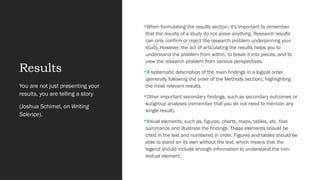
When formulating the results section, it's important to remember
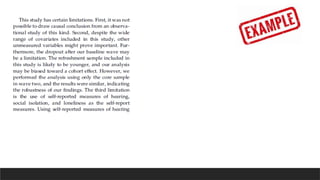
that the results of a study do not prove anything. Research results
can only confirm or reject the research problem underpinning your
study. However, the act of articulating the results helps you to
understand the problem from within, to break it into pieces, and to
view the research problem from various perspectives.
A systematic description of the main findings in a logical order
(generally following the order of the Methods section), highlighting
the most relevant results.
Other important secondary findings, such as secondary outcomes or
subgroup analyses (remember that you do not need to mention any
single result).
Visual elements, such as, figures, charts, maps, tables, etc. that
summarize and illustrate the findings. These elements should be
cited in the text and numbered in order. Figures and tables should be
able to stand on its own without the text, which means that the
legend should include enough information to understand the non-
textual element.
You are not just presenting your
results, you are telling a story
(Joshua Schimel, on Writing
Science).
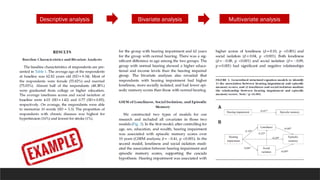
Descriptive analysis Bivariate analysis Multivariate analysis
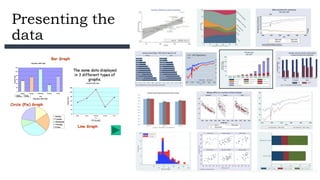
Presenting the
data
Statistics and
stories
The story is not in the statistics –
it is in the data themselves.
Focusing on the statistical
analysis rather on the data will
steal both the clarity and power
from the story.
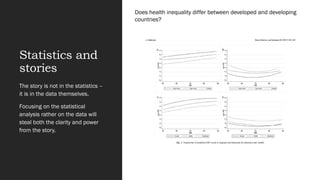
Does health inequality differ between developed and developing
countries?
Discussion
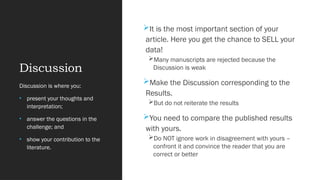
It is the most important section of your
article. Here you get the chance to SELL your
data!
Many manuscripts are rejected because the
Discussion is weak
Make the Discussion corresponding to the
Results.
But do not reiterate the results
You need to compare the published results
with yours.
Do NOT ignore work in disagreement with yours –
confront it and convince the reader that you are
correct or better
Discussion is where you:
• present your thoughts and
interpretation;
• answer the questions in the
challenge; and
• show your contribution to the
literature.
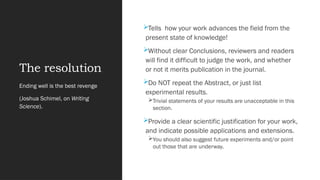
The resolution
Tells how your work advances the field from the
present state of knowledge!
Without clear Conclusions, reviewers and readers
will find it difficult to judge the work, and whether
or not it merits publication in the journal.
Do NOT repeat the Abstract, or just list
experimental results.
Trivial statements of your results are unacceptable in this
section.
Provide a clear scientific justification for your work,
and indicate possible applications and extensions.
You should also suggest future experiments and/or point
out those that are underway.
Ending well is the best revenge
(Joshua Schimel, on Writing
Science).
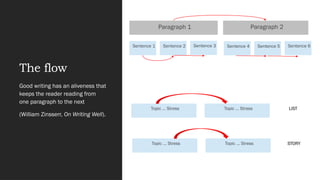
The flow
Paragraph 1
Good writing has an aliveness that
keeps the reader reading from
one paragraph to the next
(William Zinsserr, On Writing Well).
Paragraph 2
Sentence 1 Sentence 2 Sentence 3 Sentence 4 Sentence 5 Sentence 6
Topic … Stress Topic … Stress LIST
Topic … Stress Topic … Stress STORY
Click icon to add picture
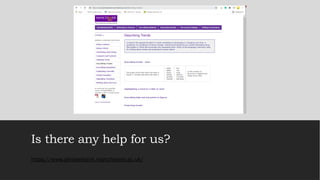
Is there any help for us?
https://www.phrasebank.manchester.ac.uk/
Good luck with your writings!
A.Maharani@mmu.ac.uk

How to write a good proposal_manuscript and disertation.pptx

  • 1.
    Academic writing skills:How to write a good proposal, thesis or publication? dr. Asri Maharani, PhD, FRSPH, FRSS Fakultas Kesehatan Masyarakat, Universitas Sriwijaya 21 Mei 2022
  • 2.
  • 3.
  • 4.
    The survival ofthe chocolate vs • 191 chocolates out of a possible 258 (74%) were observed to have been eaten. • The median survival time of a chocolate was 51 minutes. • Quality Street chocolates survived longer than Roses chocolates (HR 0.70)
  • 5.
    Scientific Writing =Communicating Your Research
  • 6.
  • 7.
  • 8.
    IMRaD – TheFormat for Scientific Writing Why IMRaD? IMRaD is a simple, logical way to communicate original research results. Focus on 4 research questions: 1. What is the problem (Introduction) 2. How can the problem be solved: (Methods and Materials) 3. What are the findings? (Results) 4. What does it mean? (Discussion)
  • 9.
    Introduction The Opening Much morethan a rhetorical welcome, the introduction is an essential entry hall into the house of your paper. The Funnel The Challenge
  • 10.
    The Opening b The mostimportant sentence in any article is the first one (William Zinsserr, On Writing Well) It is called “A power position” Use the power to accomplish three goals: ◦ Identify the problem that drive the research ◦ Introduce the character ◦ Target the audience
  • 11.
    How your openingidentify your power position Visual and hearing impairments are associated with cognitive decline in older people (Maharani et al., 2018 – Age and Ageing) Maintaining cognitive function in later life has become a public health priority as the burden imposed by dementia in the ageing population has increased more rapidly than that of most other diseases [1]. Trajectories of recall memory as predictive of hearing impairment: A longitudinal cohort study (Maharani et al., 2020 – PLOS One) Hearing impairment has become a major concern for global health. The 2015 Global Burden of Disease estimates showed that hearing impairment was the fourth leading cause of years lived with disability (YLDs) and those YLDs increase from age 35 years to 64 years [1]. Healthcare system performance and socioeconomic inequalities in hearing and visual impairments in 17 European countries (Maharani et al., 2020 – Eu J of Public Health) As the world population ages, Europeans are among those enjoying the longest life expectancies in the world: 75 years for men and 81 for women [1].
  • 12.
    The funnel –connecting the opening and the challenge The opening Identifies a large problem The challenge Defines a specific question The funnel The main body of introduction which narrows the focus and leads the readers from general to specific, drawing them along the story and framing in the knowledge gap.
  • 13.
    Find the research gaps Readthe literature What has been done in the existing research? What are their limitation? How can your research improve those existing studies?
  • 14.
    The Opening b The mostimportant sentence in any article is the first one (William Zinsserr, On Writing Well) ◦ Your chance to convince readers of the importance of your work. ◦ Describe the problem. Are there any existing solutions? What are their main limitations? And what do you hope to achieve? ◦ Provide a perspective consistent with the nature of the journal. ◦ Introduce the main scientific publications on which your work is based. ◦ Cite a couple of original and important works, including recent review articles ◦ Editors hate references irrelevant to the work, or inappropriate judgments on your own achievements. ◦ They will think that you have no sense of purpose at all!
  • 15.
    The challenge Scientia (Latin)= knowledge The challenge describes the specific knowledge we hope to gain. Questions Hypotheses Objectives Defining the knowledge gaps. To test whether a relationship exists – to develop a theory. Define how to answer the research questions.
  • 16.
  • 17.
    Better: “Five outof seven recent studies (authors, dates) of the relationship between race and birth weight in the United States found that [pattern and example]. In contrast, Michaelson (date) found [different pattern and example], while DiDonato (date) . . .” Poor: “Smith and Jones (date) studied the relationship between race and birth weight in the United States and found [XYZ].”Michaelson (date) also studied the relationship between race and birth weight and found [ABC]. [Separate descriptions of results from five more studies on the topic.]
  • 18.
    Methods  Details, details, details- a knowledgeable reader should be able to reproduce the experiment.  The Method section is very important because it tells how you plan to tackle your research problem. It will provide your work plan and describe the activities necessary for the completion of your project  The guiding principle for writing the Method section is that it should contain sufficient information for the reader to determine whether methodology is sound  Furthermore, since there are no well-established and widely accepted canons in qualitative analysis, your method section needs to be more elaborate than what is required for traditional quantitative research  More importantly, the data collection process in qualitative research has a far greater impact on the results as compared to quantitative research. A principle of science is that other researchers should be able to repeat our works.
  • 19.
    For quantitative studies,the method section typically consists of the following sections: Design -Is it a questionnaire study or a laboratory experiment? What kind of design do you choose? Subjects or participants - Who will take part in your study ? What kind of sampling procedure do you use? Instruments - What kind of measuring instruments or questionnaires do you use? Why do you choose them? Are they valid and reliable? Procedure - How do you plan to carry out your study? What activities are involved? How long does it take?
  • 20.
    Better: “Demographic characteristicsand attitudinal factors (table A) were drawn from the questionnaire and most health indicators from the medical records (table B). An exception was asthma, for which information was available from both sources.” This description coordinates with tables (not shown) that organize variables by data source and major conceptual groupings, eliminating the need to specify the source for every variable individually. Poor: “Age, sex, race, marital status, number of children, income, and educational attainment were taken from the demographic section of the questionnaire. Attitudes about [long list] were taken from the attitudinal section of the questionnaire. Medical records provided information about [long list of health items]. Asthma was also asked about on the questionnaire.” This description is unnecessarily long, repeating information that is far more easily organized in a table.
  • 21.
    Poor: “One asthmameasure was collected on the mother’s questionnaire, the other from medical records.” The questionnaire and medical records could have collected data in any of several ways, each of which has different potential biases, so for most scientific papers a more precise description is needed. Better (for a lay audience): “Two types of asthma measures were used. The mother’s measure was based on the question ‘Have you ever been told your child has asthma?,’ the doctor’s measure on whether a physician wrote ‘asthma’ on the medical record or checked it on a list of possible diagnoses.” Better (for a scientific audience): “A maternal report of asthma was based on the question ‘Have you ever been told your child has asthma?’ A doctor’s report of asthma was based on (1) checking that diagnosis on a list of possible diagnoses, (2) listing ‘asthma’ on the open-ended section of the medical record, or (3) listing an IDC9 code of 493 on the
  • 22.
    Results When formulating theresults section, it's important to remember that the results of a study do not prove anything. Research results can only confirm or reject the research problem underpinning your study. However, the act of articulating the results helps you to understand the problem from within, to break it into pieces, and to view the research problem from various perspectives. A systematic description of the main findings in a logical order (generally following the order of the Methods section), highlighting the most relevant results. Other important secondary findings, such as secondary outcomes or subgroup analyses (remember that you do not need to mention any single result). Visual elements, such as, figures, charts, maps, tables, etc. that summarize and illustrate the findings. These elements should be cited in the text and numbered in order. Figures and tables should be able to stand on its own without the text, which means that the legend should include enough information to understand the non- textual element. You are not just presenting your results, you are telling a story (Joshua Schimel, on Writing Science).
  • 23.
    Descriptive analysis Bivariateanalysis Multivariate analysis
  • 24.
  • 25.
    Statistics and stories The storyis not in the statistics – it is in the data themselves. Focusing on the statistical analysis rather on the data will steal both the clarity and power from the story. Does health inequality differ between developed and developing countries?
  • 26.
    Discussion It is themost important section of your article. Here you get the chance to SELL your data! Many manuscripts are rejected because the Discussion is weak Make the Discussion corresponding to the Results. But do not reiterate the results You need to compare the published results with yours. Do NOT ignore work in disagreement with yours – confront it and convince the reader that you are correct or better Discussion is where you: • present your thoughts and interpretation; • answer the questions in the challenge; and • show your contribution to the literature.
  • 29.
    The resolution Tells howyour work advances the field from the present state of knowledge! Without clear Conclusions, reviewers and readers will find it difficult to judge the work, and whether or not it merits publication in the journal. Do NOT repeat the Abstract, or just list experimental results. Trivial statements of your results are unacceptable in this section. Provide a clear scientific justification for your work, and indicate possible applications and extensions. You should also suggest future experiments and/or point out those that are underway. Ending well is the best revenge (Joshua Schimel, on Writing Science).
  • 31.
    The flow Paragraph 1 Goodwriting has an aliveness that keeps the reader reading from one paragraph to the next (William Zinsserr, On Writing Well). Paragraph 2 Sentence 1 Sentence 2 Sentence 3 Sentence 4 Sentence 5 Sentence 6 Topic … Stress Topic … Stress LIST Topic … Stress Topic … Stress STORY
  • 32.
    Click icon toadd picture Is there any help for us? https://www.phrasebank.manchester.ac.uk/
  • 33.
    Good luck withyour writings! A.Maharani@mmu.ac.uk

Editor's Notes

  • #18 If the background of the audience is more theoretical, or their work focuses mainly on the algorithm or derivation, this sub-section of Methods should be revised. The importance of supporting materials should be mentioned from this section. A common problem of Chinese Author is that they have no sense of using Supporting Materials. They are likely to pile everything they consider as useful in the text.
  • #29 See Guide for Authors for!