Reading and Writing at M-level 
Introduction 
28 October 2014 
www.le.ac.uk
Objectives 
• Reflect on approaches to academic writing 
• Read and analyse some ‘typical’ journal articles (pre-advised) 
• Prepare for the challenges of academic writing
Starter activity 
• Types of reading to inform assignments 
• Your views?
Types of paper 
• academic journal articles vary 
• four principal types? 
• ‘usual’ characteristics 
• overlaps so neat division not always possible
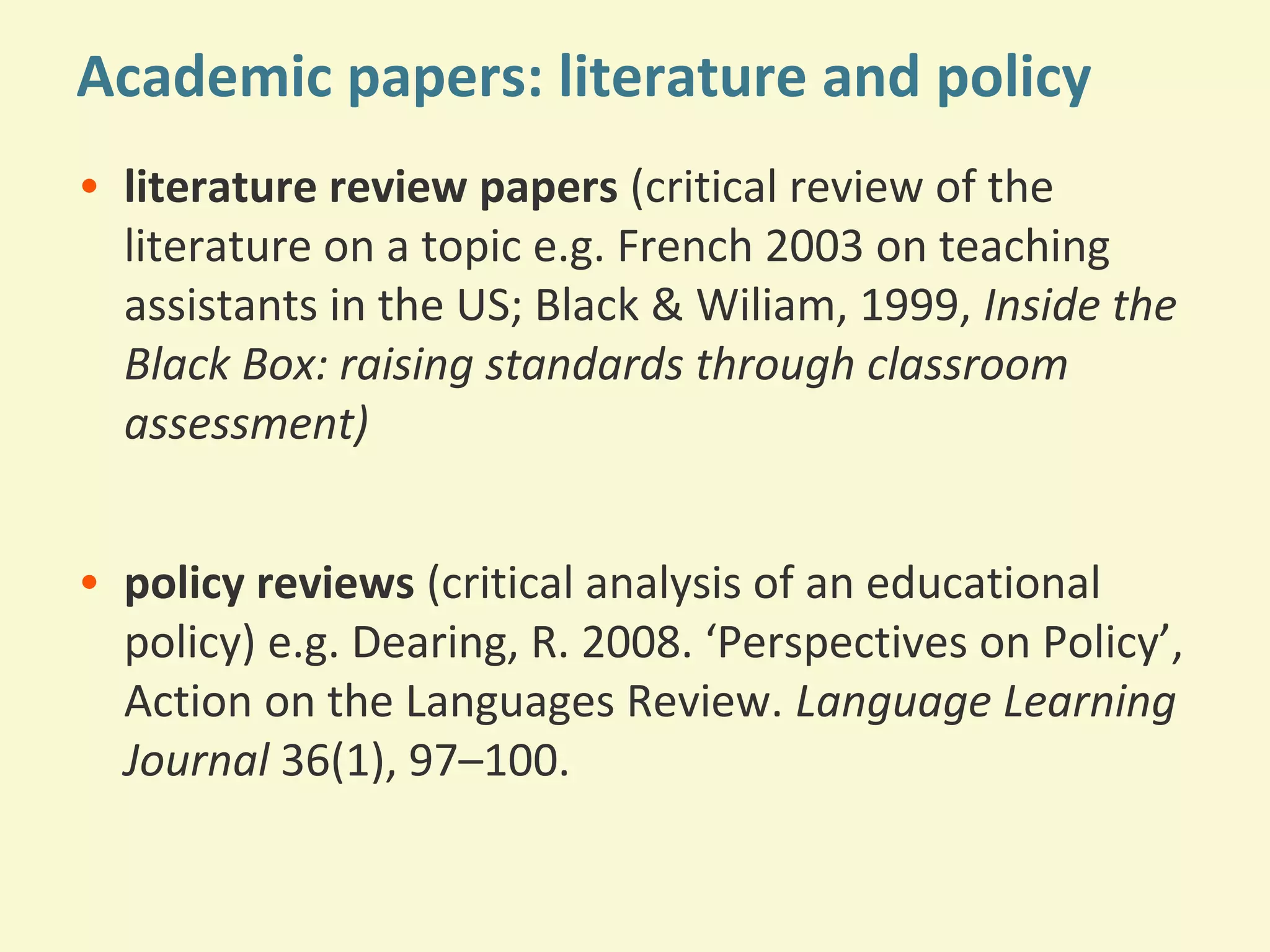
Academic papers: literature and policy 
• literature review papers (critical review of the 
literature on a topic e.g. French 2003 on teaching 
assistants in the US; Black & Wiliam, 1999, Inside the 
Black Box: raising standards through classroom 
assessment) 
• policy reviews (critical analysis of an educational 
policy) e.g. Dearing, R. 2008. ‘Perspectives on Policy’, 
Action on the Languages Review. Language Learning 
Journal 36(1), 97–100.
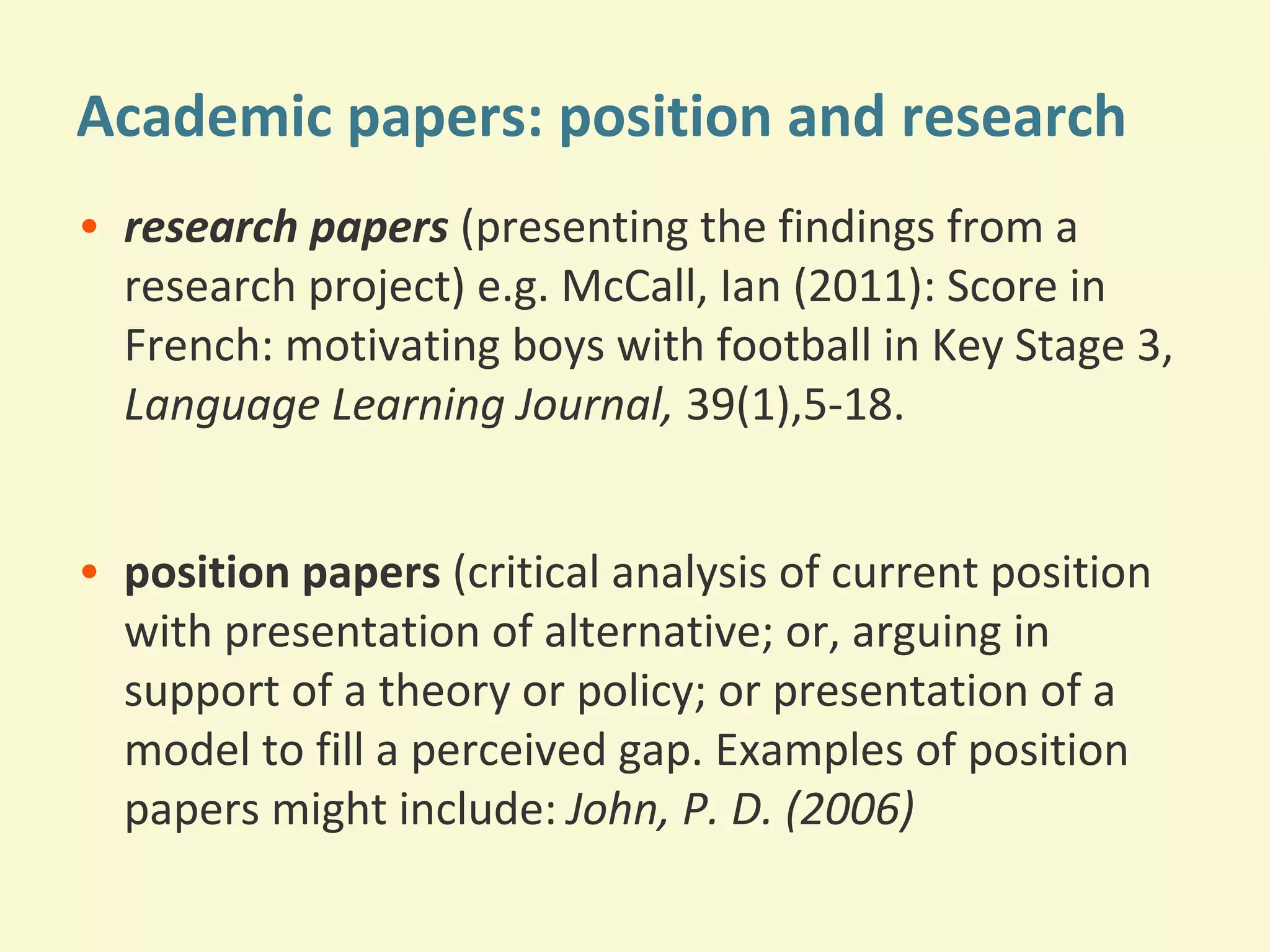
Academic papers: position and research 
• research papers (presenting the findings from a 
research project) e.g. McCall, Ian (2011): Score in 
French: motivating boys with football in Key Stage 3, 
Language Learning Journal, 39(1),5-18. 
• position papers (critical analysis of current position 
with presentation of alternative; or, arguing in 
support of a theory or policy; or presentation of a 
model to fill a perceived gap. Examples of position 
papers might include: John, P. D. (2006)
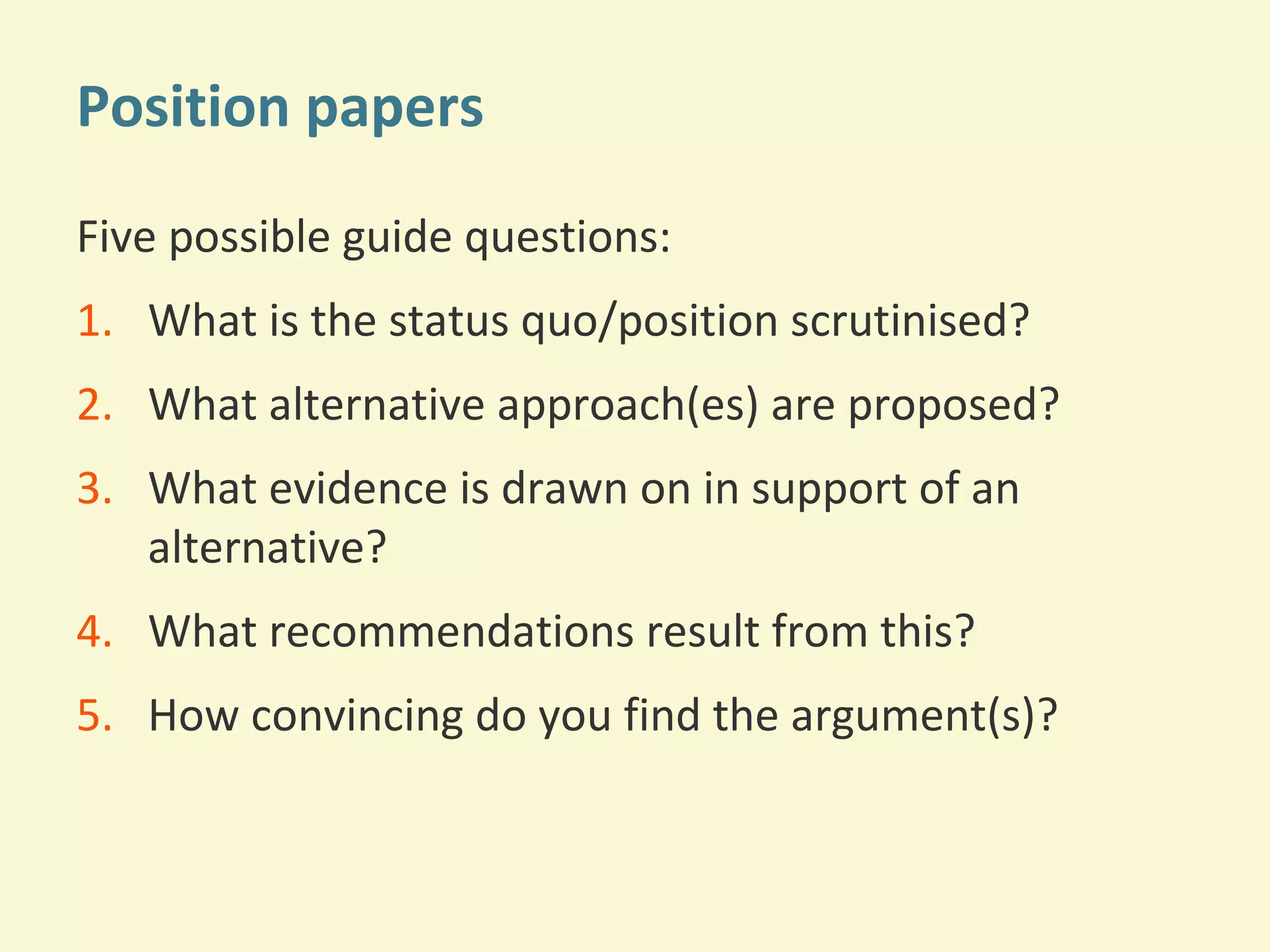
Position papers 
Five possible guide questions: 
1. What is the status quo/position scrutinised? 
2. What alternative approach(es) are proposed? 
3. What evidence is drawn on in support of an 
alternative? 
4. What recommendations result from this? 
5. How convincing do you find the argument(s)?
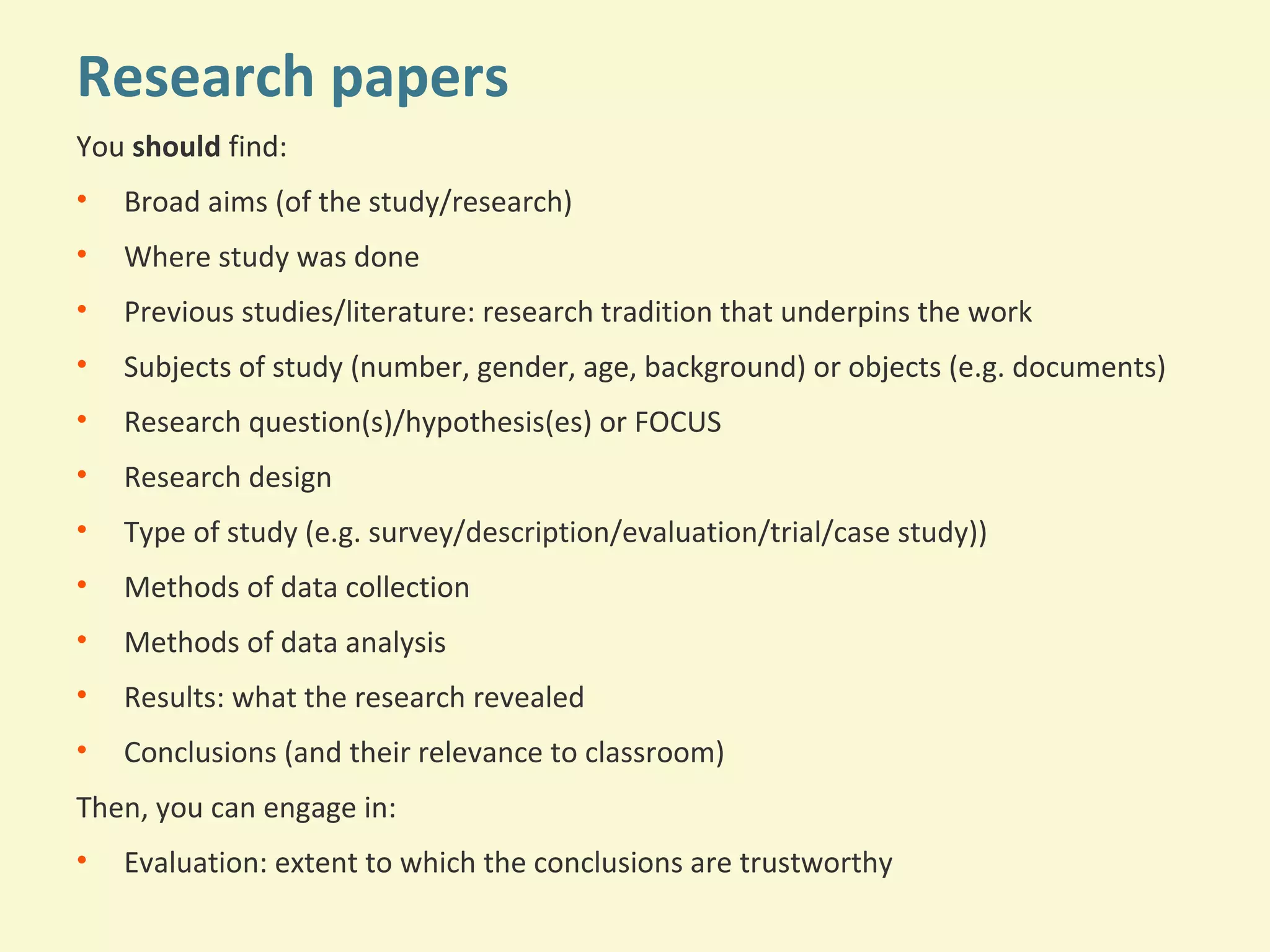
Research papers 
You should find: 
• Broad aims (of the study/research) 
• Where study was done 
• Previous studies/literature: research tradition that underpins the work 
• Subjects of study (number, gender, age, background) or objects (e.g. documents) 
• Research question(s)/hypothesis(es) or FOCUS 
• Research design 
• Type of study (e.g. survey/description/evaluation/trial/case study)) 
• Methods of data collection 
• Methods of data analysis 
• Results: what the research revealed 
• Conclusions (and their relevance to classroom) 
Then, you can engage in: 
• Evaluation: extent to which the conclusions are trustworthy
Reviewing papers; importance of critical 
and systematic reading 
• Hargreaves, Eleanore (2005) Assessment for 
learning? Thinking outside the (black) box, 
Cambridge Journal of Education, 35:2, 213-224.
Abstract 
This article draws on a survey of 83 teachers, to explore the concepts of 
‘assessment for learning’, ‘assessment’ and ‘learning’. ‘Assessment for learning’ is 
categorized as meaning: monitoring pupils’ performance against targets or 
objectives; using assessment to inform next steps in teaching and learning; 
teachers giving feedback for improvement; (teachers) learning about children’s 
learning; children taking some control of their own learning and assessment; and 
turning assessment into a learning event. Conceptions of assessment include 
assessment-as-measurement and assessment-as-inquiry. These conceptions are 
related to two conceptions of learning: learning-as-attaining-objectives and 
learning-as-the-construction-of-knowledge. The conceptions of assessment-as-measurement 
and learning-as-attaining-objectives are dominant in English 
educational policy today. The article suggests that these conceptions need to be 
challenged and expanded, since conceptions held by those who have power in 
education determine what sort of assessment and learning happen in the 
classroom, and therefore the quality of the student’s learning processes and 
products.
• ‘Drawing on my contacts with teachers and head 
teachers on various assessment projects, I invited 83 
teachers and head teachers to take part in a survey 
of how different people understand the phrase 
‘assessment for learning’. Each person wrote down, 
without conferring with others, what ‘assessment 
for learning’ meant to them. They submitted their 
responses anonymously.’ (p. 214) 
• ‘These responses provide a basis for the discussion 
presented in this paper. Later in the paper, I also give 
some illustrative examples of assessment for 
learning from a selection of the 83 teachers’ 
classrooms, which I visited during research 
projects.’ (p. 214) 
Survey 
where/ 
how? 
Please 
remember 
this
Within my interpretations of assessment for learning 
described above, two distinct meanings for assessment can 
be extrapolated: assessment as measurement, and 
assessment as inquiry. 
In the first evident meaning of assessment, where 
assessment is equated with measurement, measurement 
refers to the act or process of determining or estimating the 
amount, extent or level of a student’s ‘learning’, often using 
tests as the means of doing so. Nitko (1995) has stressed 
that reporting is an essential aspect of measuring……… 
Marking, checking, identifying, showing a level, monitoring: 
these were all verbs used by the 83 teachers as they 
described assessment in assessment for learning, within 
this measurement paradigm.(p. 218)
In the second meaning of assessment that was 
evident in the 83 teachers’ definitions, assessment 
was equated with inquiry. Inquiry means making a 
search or investigation. For many definitions in our 
sample, the concept of inquiry seemed key to 
assessment: verbs teachers used included 
reflecting, reviewing, finding out, discovering, 
diagnosing, learning about, examining, looking 
at, engaging with, understanding. All of these 
suggest an exploratory and sensitive venture, with 
no clear endpoints except a heightened awareness 
of current developments. (p. 218)
Classrooms? 
• Jill (primary, we can infer) 
• Nadia (?) 
• Remy (primary) 
• Melina (secondary) 
• Ben (Romans?) 
• Mia (?) 
• Were there more? What was done in visits? How? 
Why? What was/were the RQs?
Nadia 
An example of this paradigm of assessment includes Nadia’s 
classroom (another from among the 83 teachers’ classrooms), in 
which students are encouraged to investigate their learning 
processes during the day. Then they are given 30 minutes to 
describe their reflections in learning journals, which can remain 
private to the students if they wish. Students’ comments have 
included: 
Learning, I think, is all about experiencing new things and 
exploring new topics. 
I find learning is life. I don’t think learning is just about 
school. You learn everywhere you go. 
I think you know when you’ve learnt something because 
you can explain it to someone else.
Transparency 
• How does the writer analyse the data? 
• How were observations conducted? 
• When? 
• Were they recorded? 
• How were they analysed? 
• How many schools visited? 
• How many heads? How many teachers? 
• Primary? Secondary?
What should be in a paper? 
• Context 
• Clarity 
• Coherence 
• Effective transitions 
• Transparency 
• Sound evidence 
• Well-supported claims
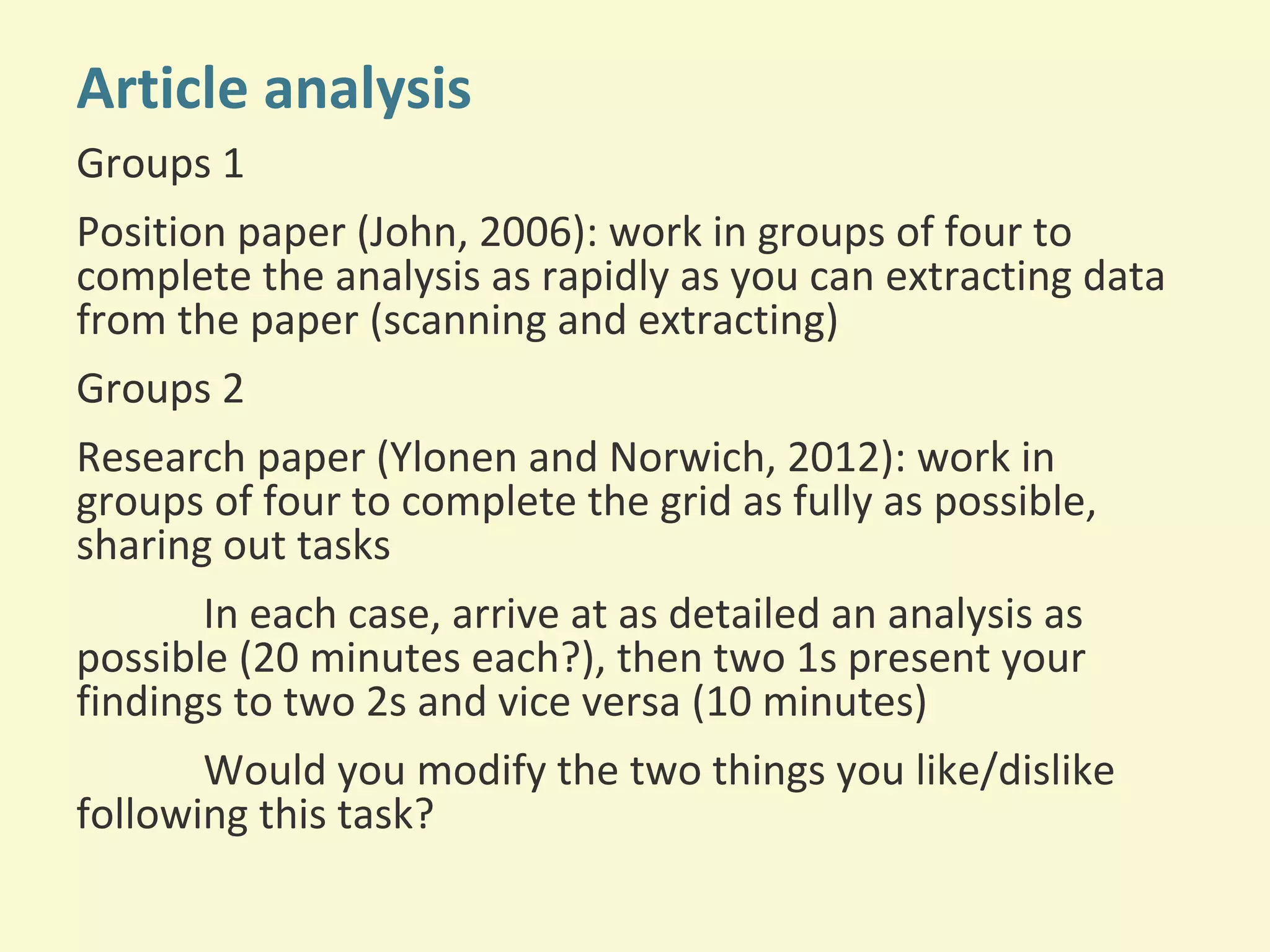
Article analysis 
Groups 1 
Position paper (John, 2006): work in groups of four to 
complete the analysis as rapidly as you can extracting data 
from the paper (scanning and extracting) 
Groups 2 
Research paper (Ylonen and Norwich, 2012): work in 
groups of four to complete the grid as fully as possible, 
sharing out tasks 
In each case, arrive at as detailed an analysis as 
possible (20 minutes each?), then two 1s present your 
findings to two 2s and vice versa (10 minutes) 
Would you modify the two things you like/dislike 
following this task?
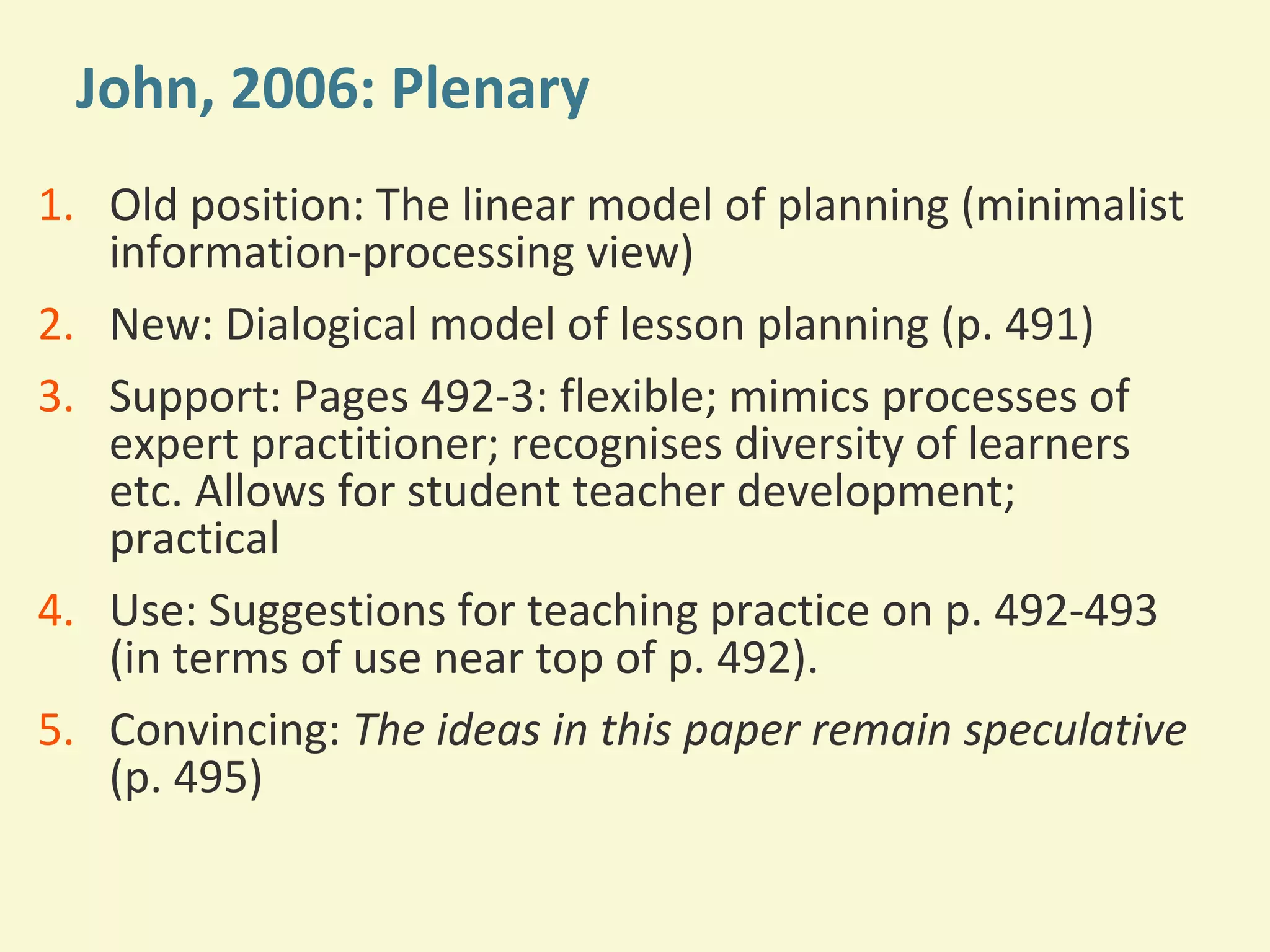
John, 2006: Plenary 
1. Old position: The linear model of planning (minimalist 
information-processing view) 
2. New: Dialogical model of lesson planning (p. 491) 
3. Support: Pages 492-3: flexible; mimics processes of 
expert practitioner; recognises diversity of learners 
etc. Allows for student teacher development; 
practical 
4. Use: Suggestions for teaching practice on p. 492-493 
(in terms of use near top of p. 492). 
5. Convincing: The ideas in this paper remain speculative 
(p. 495)
One analysis Microsoft Word 
Document
Part 2: writing
Academic Writing 
1. Structure 
2. Coherence 
3. Clarity 
4. Argument
Know what is required 
• length? 
• Layout/organisation 
• structure (e.g abstract, introduction; literature 
review; research design; presentation of data; 
analysis; discussion of findings; conclusions) 
• referencing requirements? 
• how it is assessed?
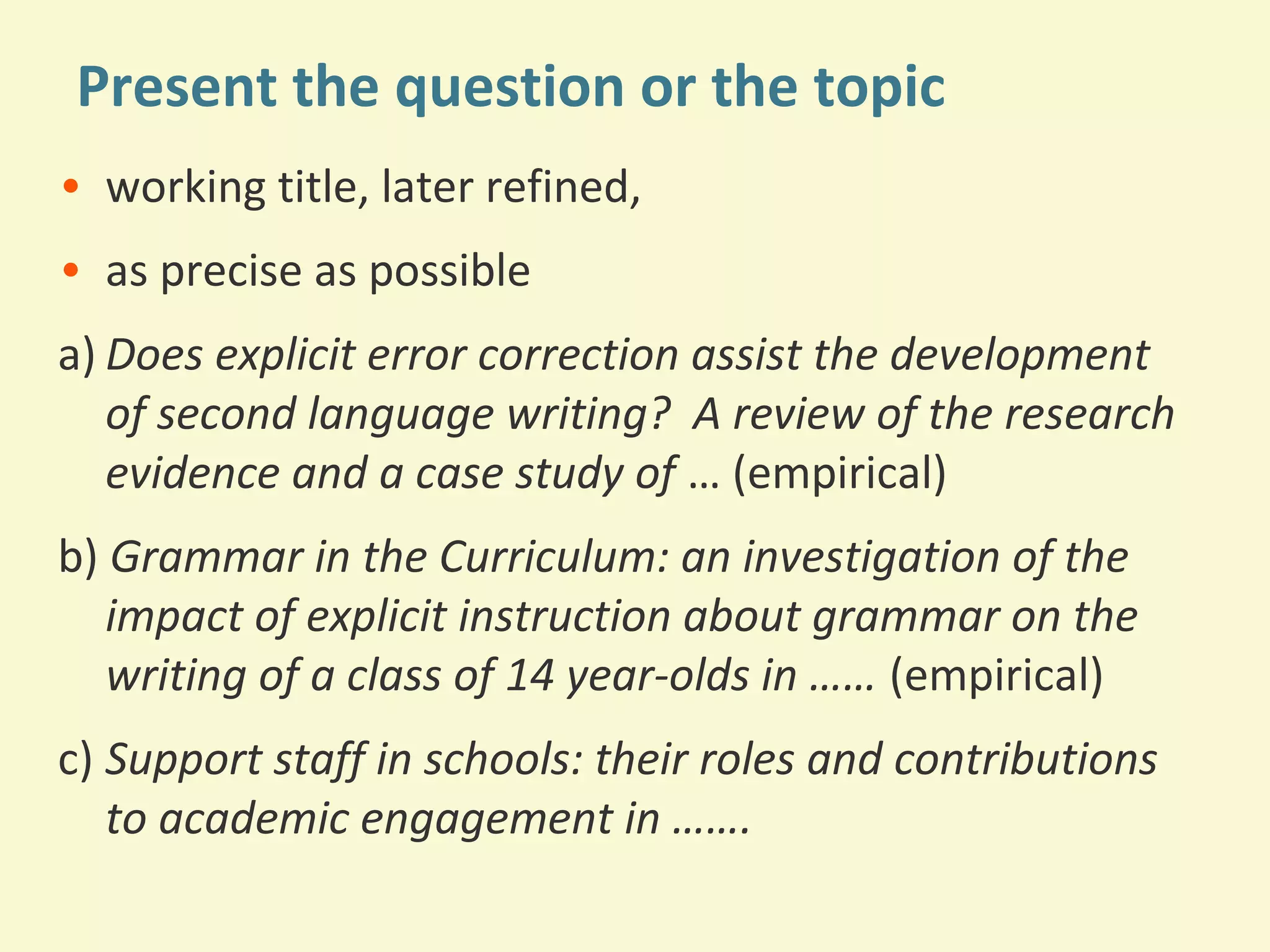
Present the question or the topic 
• working title, later refined, 
• as precise as possible 
a) Does explicit error correction assist the development 
of second language writing? A review of the research 
evidence and a case study of … (empirical) 
b) Grammar in the Curriculum: an investigation of the 
impact of explicit instruction about grammar on the 
writing of a class of 14 year-olds in …… (empirical) 
c) Support staff in schools: their roles and contributions 
to academic engagement in …….
Writing advice 
• See handout for detailed advice (plus activities) 
• General advice 
• Toolkit 
• Activities: references; improving text (introduction 
and main body)
Stating the purpose 
The aim of this study was to firstly, establish using the 
current guidelines given by course providers using the 
following questions: 
 How do teachers feel currently about exploring ethical 
and moral issues in the classroom? 
 Currently, how often are ethical and moral issues used 
in learning? 
 What skills and training do teachers need to have in 
order to explore ethical issues such as IVF in the 
classroom? 
 What resources do teachers currently have to support 
the exploration of ethical/moral issues with pupils? 
 What is the value of using ethical and moral issues in 
learning?
Editing? 
The aim of this study was to firstly, establish using the 
current guidelines given by course providers using the 
following questions: 
 How do teachers feel currently about exploring ethical and 
moral issues in the classroom? 
 Currently, how often are ethical and moral issues used in 
learning? 
 What skills and training do teachers need to have in order to 
explore ethical issues such as IVF in the classroom? 
 What resources do teachers currently have to support the 
exploration of ethical/moral issues with pupils? 
 What is the value of using ethical and moral issues in 
learning?
Editing 
The aim of this study was to explore the extent to which (a 
group of) teachers (in one school) make use of the current 
guidelines given by course providers (DCSF, 2008). The 
study will focus on seeking answers to the following: 
• How teachers feel about exploring ethical and moral 
issues in the classroom; 
• How often ethical and moral issues are used in learning; 
• Skills and training teachers need to have in order to 
explore ethical issues such as IVF in the classroom; 
• The resources teachers have to support the exploration of 
ethical/moral issues with pupils; 
• Teachers’ beliefs about the value of using ethical and 
moral issues in learning.
Referencing and avoiding plagiarism 
• References - use Harvard system 
• Do not use footnotes 
• Refer to the annotated guidance sheet issued in this 
session 
• Refer to additional support on Blackboard 
• Reference list at end of assignment: this must only 
list the texts you have referred to in your assignment 
not all those you have read in preparation
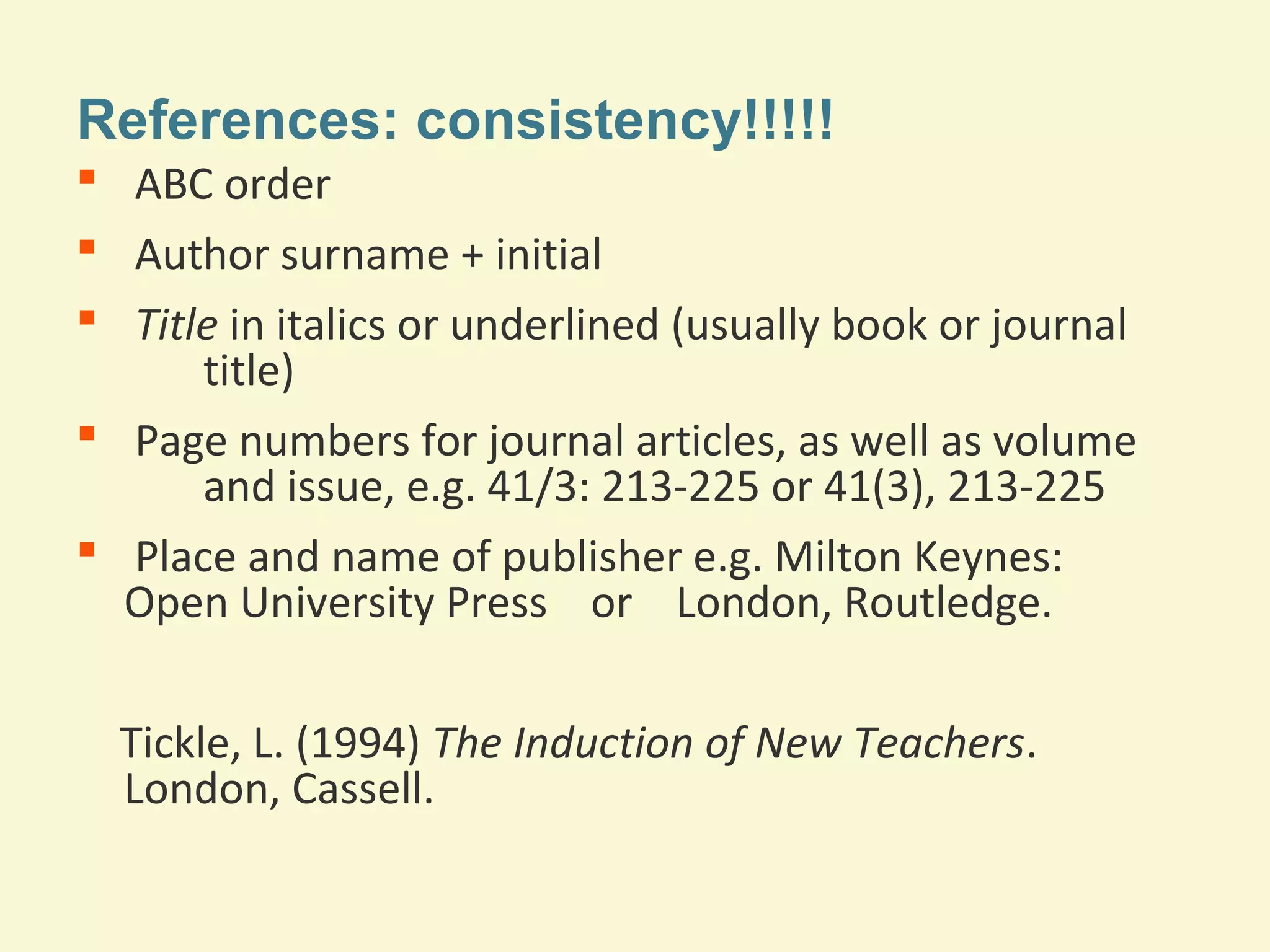
References: consistency!!!!! 
 ABC order 
 Author surname + initial 
 Title in italics or underlined (usually book or journal 
title) 
 Page numbers for journal articles, as well as volume 
and issue, e.g. 41/3: 213-225 or 41(3), 213-225 
 Place and name of publisher e.g. Milton Keynes: 
Open University Press or London, Routledge. 
Tickle, L. (1994) The Induction of New Teachers. 
London, Cassell.
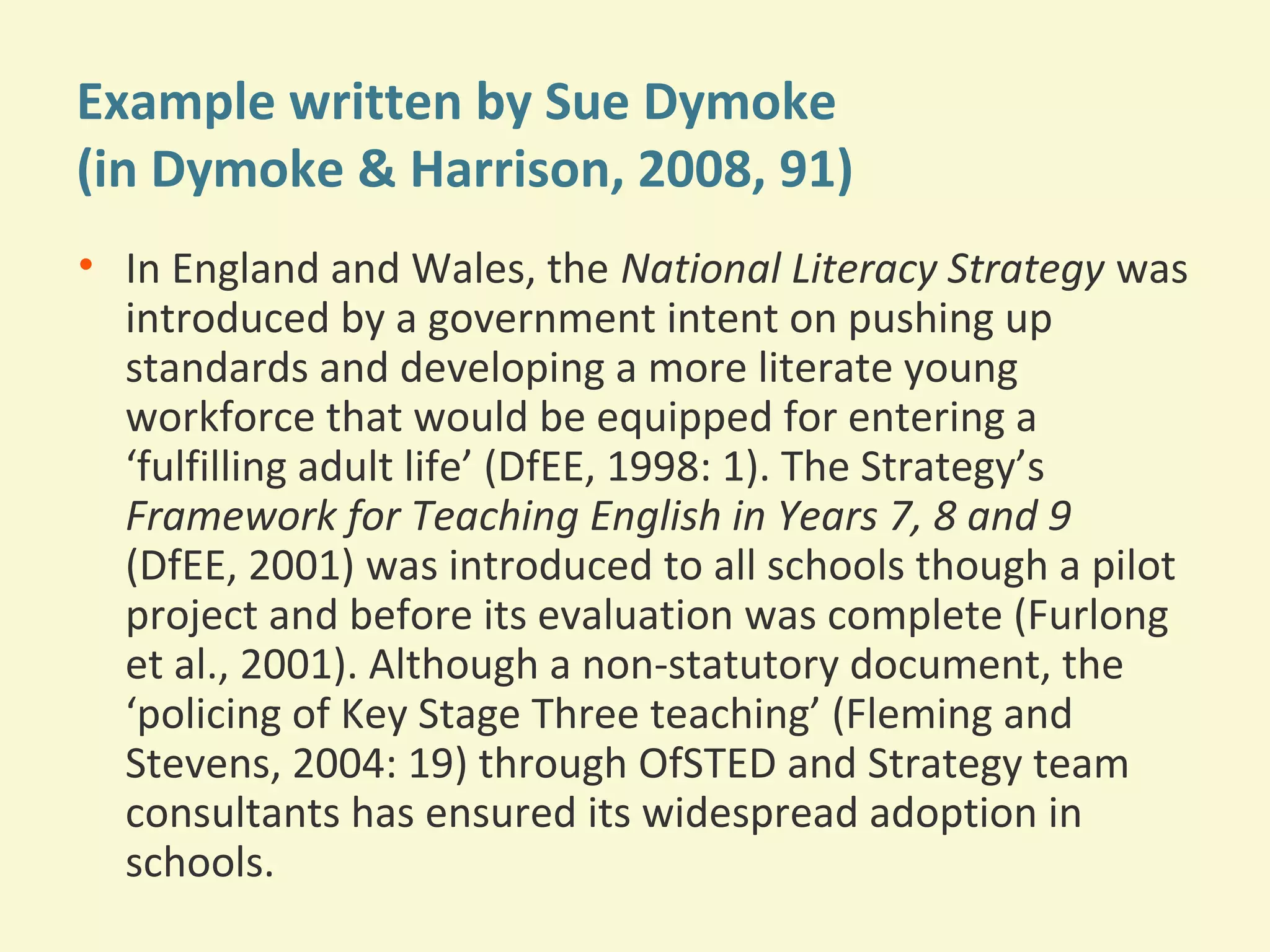
Example written by Sue Dymoke 
(in Dymoke & Harrison, 2008, 91) 
• In England and Wales, the National Literacy Strategy was 
introduced by a government intent on pushing up 
standards and developing a more literate young 
workforce that would be equipped for entering a 
‘fulfilling adult life’ (DfEE, 1998: 1). The Strategy’s 
Framework for Teaching English in Years 7, 8 and 9 
(DfEE, 2001) was introduced to all schools though a pilot 
project and before its evaluation was complete (Furlong 
et al., 2001). Although a non-statutory document, the 
‘policing of Key Stage Three teaching’ (Fleming and 
Stevens, 2004: 19) through OfSTED and Strategy team 
consultants has ensured its widespread adoption in 
schools.
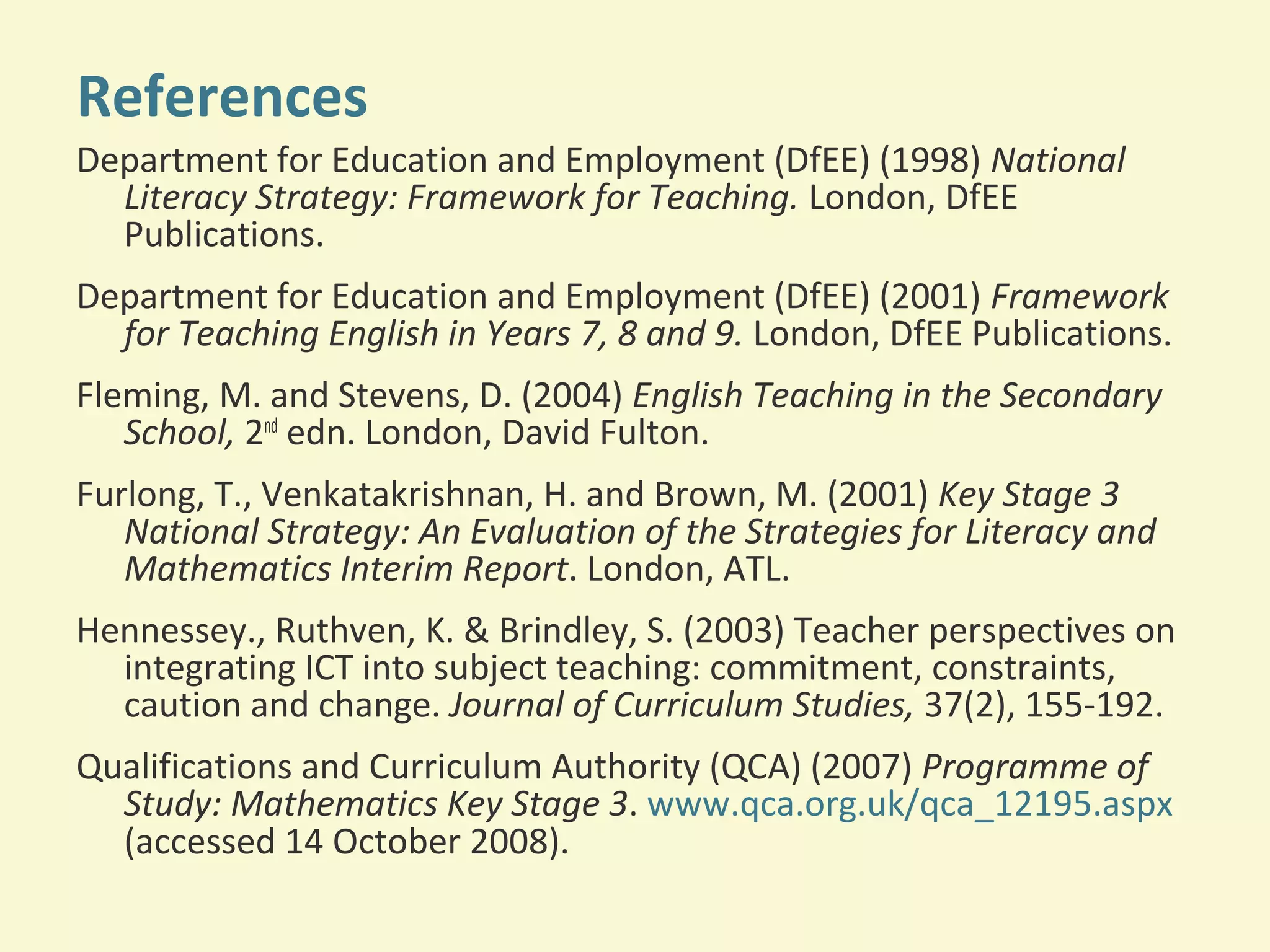
References 
Department for Education and Employment (DfEE) (1998) National 
Literacy Strategy: Framework for Teaching. London, DfEE 
Publications. 
Department for Education and Employment (DfEE) (2001) Framework 
for Teaching English in Years 7, 8 and 9. London, DfEE Publications. 
Fleming, M. and Stevens, D. (2004) English Teaching in the Secondary 
School, 2nd edn. London, David Fulton. 
Furlong, T., Venkatakrishnan, H. and Brown, M. (2001) Key Stage 3 
National Strategy: An Evaluation of the Strategies for Literacy and 
Mathematics Interim Report. London, ATL. 
Hennessey., Ruthven, K. & Brindley, S. (2003) Teacher perspectives on 
integrating ICT into subject teaching: commitment, constraints, 
caution and change. Journal of Curriculum Studies, 37(2), 155-192. 
Qualifications and Curriculum Authority (QCA) (2007) Programme of 
Study: Mathematics Key Stage 3. www.qca.org.uk/qca_12195.aspx 
(accessed 14 October 2008).
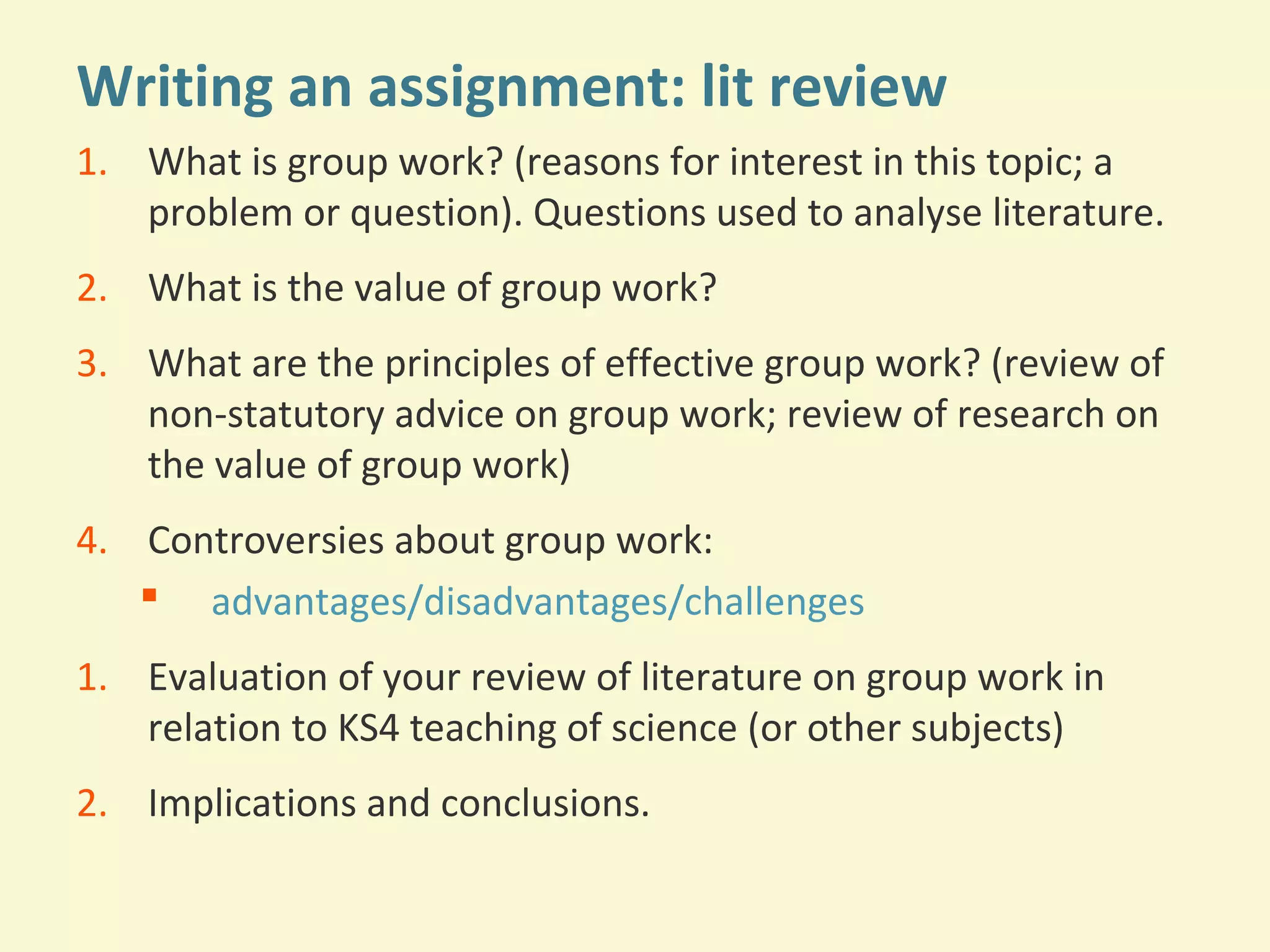
Writing an assignment: lit review 
1. What is group work? (reasons for interest in this topic; a 
problem or question). Questions used to analyse literature. 
2. What is the value of group work? 
3. What are the principles of effective group work? (review of 
non-statutory advice on group work; review of research on 
the value of group work) 
4. Controversies about group work: 
 advantages/disadvantages/challenges 
1. Evaluation of your review of literature on group work in 
relation to KS4 teaching of science (or other subjects) 
2. Implications and conclusions.
Research-based assignment 
 Introduction 
 Literature Review 
 Method (incl. how ethics observed) 
 Results (findings) 
 Discussion 
 Implications and Conclusion 
See SCITT Toolkit for advice
Introduction 
• This assignment is based on a curriculum investigation into the 
effectiveness of recommended teaching strategies for students 
for whom English is an additional language (EAL). It is based on 
a case-study of one Year Seven English class. I will be examining 
several lessons that I have taught which have incorporated EAL 
strategies, and evaluating their effectiveness. I will also include 
information obtained from observations from other teachers 
watching these lessons and from interviews taken from the 
person responsible for the Ethic Minority Achievement Grant 
(EMAG). I will examine the way that students interact with four 
teachers in total, including myself. My lessons follow the 
suggested structure of Cummins’ quadrant (2000, cited in DFES: 
2006, p.30). In brief, I hope to support students through the 
journey of an EAL learner, resulting in assessment pieces that 
require more independent learning skills.
Literature review 
 Discussion and critical analysis of existing and other 
literature on your topic. 
 Establish your ‘theoretical framework’, e.g. if you are doing 
classroom interaction analysis you let the reader know 
what the major, or most relevant, approaches are and why 
you have chosen to use a particular one (or a combination 
or adaptation perhaps). 
 You introduce, define, and explain key issues, terms, and 
concepts in this section. 
 In summary, this is where you establish what the issues are 
and that you have expertise in the area of your topic. 
 The research questions may emerge naturally from the 
discussion of the literature review.
Defining key terms 
So, what exactly do we mean by literature from 
different cultures and traditions, and why is it 
important that we include these in the education of 
children in England? ‘Literature from different 
cultures’ refers to works written in English, but that 
are about places, people, and traditions which are 
different to our own. The National Curriculum 
(QCDA, 2007) states: 
‘Students should be taught to … 
(continues) 
• Can you improve on this?
Methods 
If you have done empirical research, this is where you 
explain: 
 what you did, and why, justifying the approach, 
 how you did it, and why, 
 who was involved, and why.
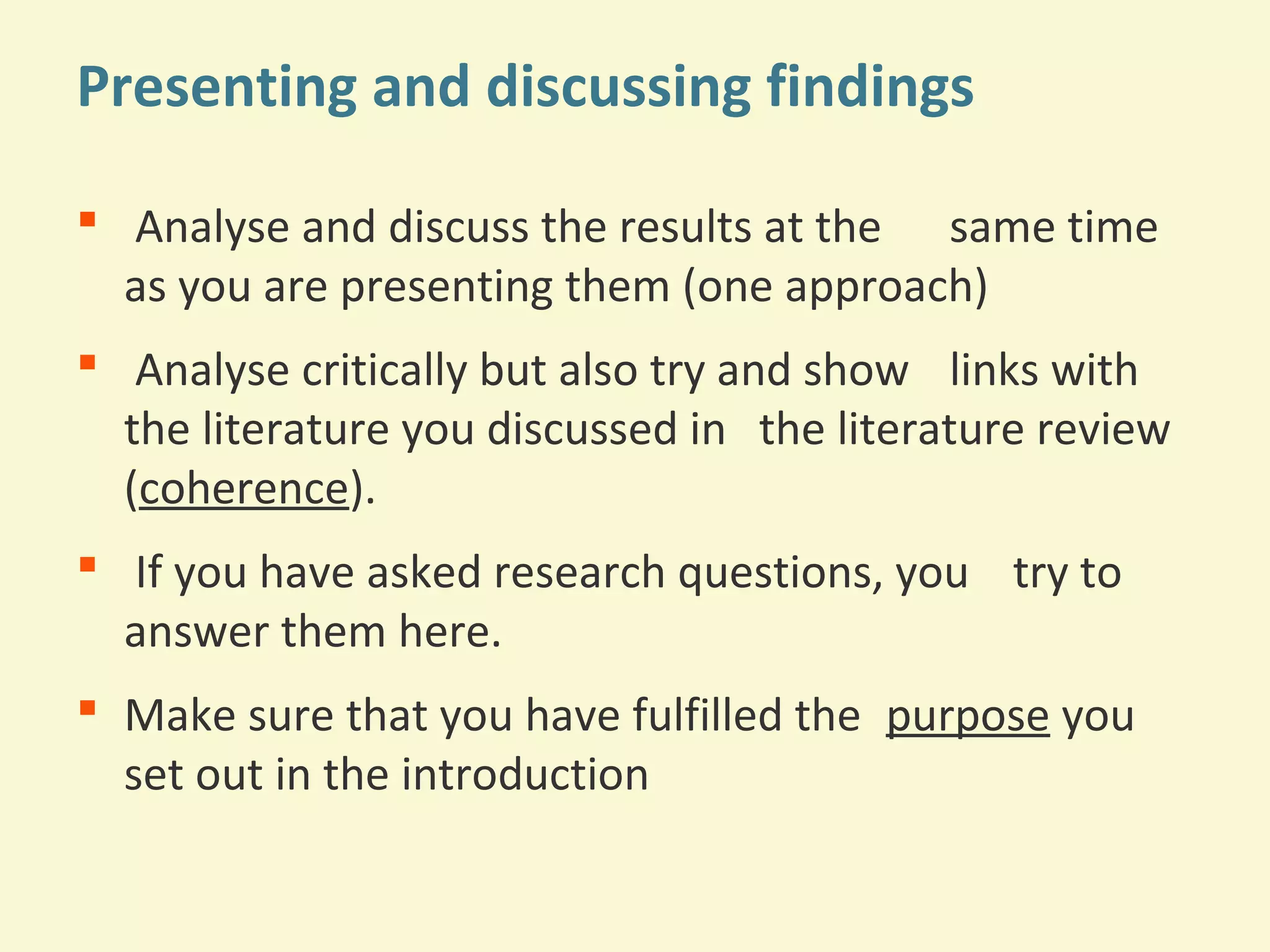
Presenting and discussing findings 
 Analyse and discuss the results at the same time 
as you are presenting them (one approach) 
 Analyse critically but also try and show links with 
the literature you discussed in the literature review 
(coherence). 
 If you have asked research questions, you try to 
answer them here. 
 Make sure that you have fulfilled the purpose you 
set out in the introduction
Implications and Conclusions 
Implications 
 Often merged with Conclusions into Implications & Conclusions: implications 
for your context and perhaps speculate briefly about wider implications. NO 
claims without evidence for them, but with sufficient caution you can make 
tentative suggestions. 
 Exemplify/illustrate any recommendations you might make, e.g. for 
classroom practice, policy etc. 
Conclusions 
 Draw together the main points you have made in the paper – no new 
information in this section. 
 Evaluate what you have done, e.g. the limitations of your research, or what 
its contribution might be, and look ahead in terms of the new for future 
research or policy changes etc.
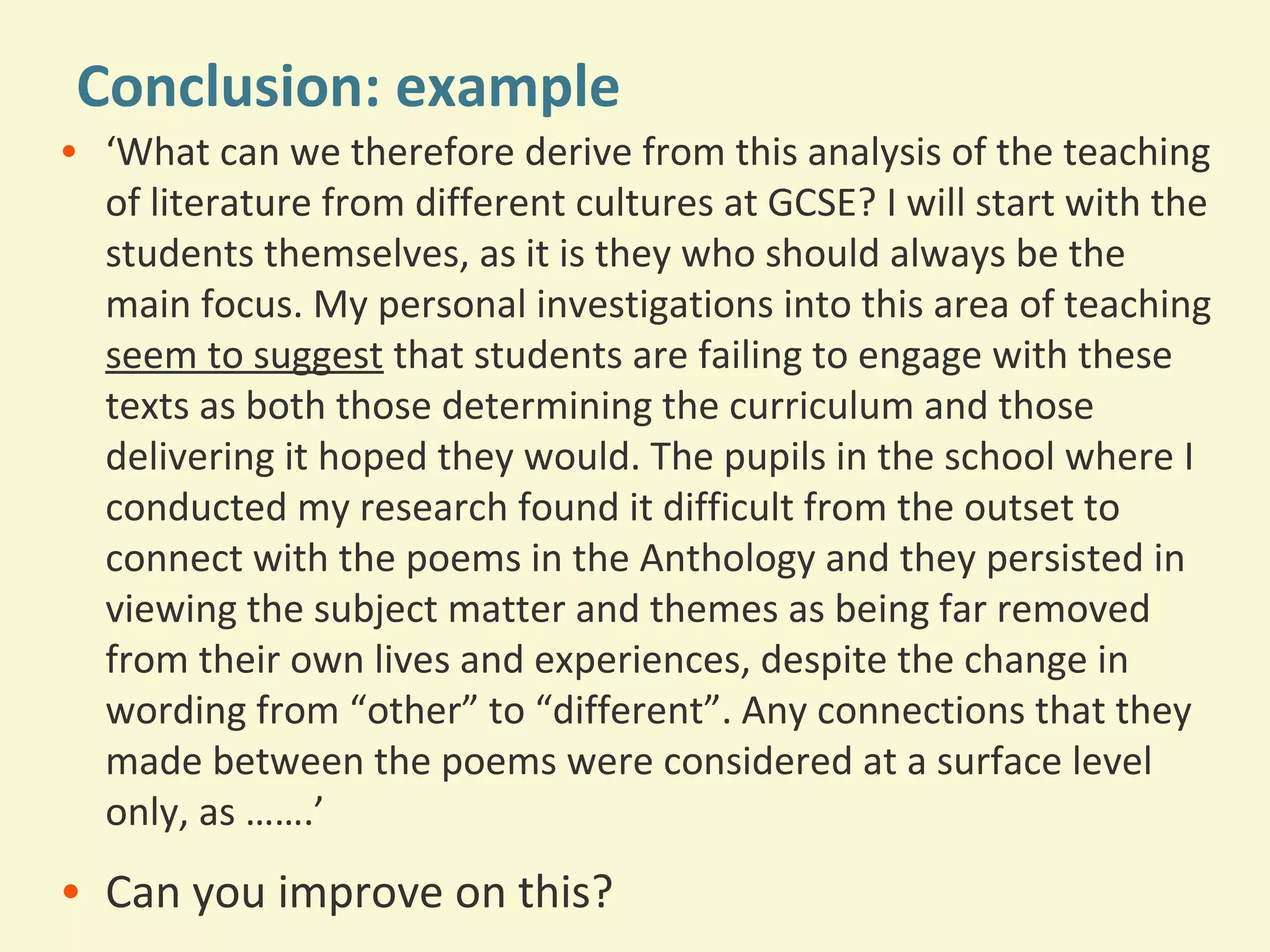
Conclusion: example 
• ‘What can we therefore derive from this analysis of the teaching 
of literature from different cultures at GCSE? I will start with the 
students themselves, as it is they who should always be the 
main focus. My personal investigations into this area of teaching 
seem to suggest that students are failing to engage with these 
texts as both those determining the curriculum and those 
delivering it hoped they would. The pupils in the school where I 
conducted my research found it difficult from the outset to 
connect with the poems in the Anthology and they persisted in 
viewing the subject matter and themes as being far removed 
from their own lives and experiences, despite the change in 
wording from “other” to “different”. Any connections that they 
made between the poems were considered at a surface level 
only, as …….’ 
• Can you improve on this?
Any queries? 
• Look at SCITT Toolkit 
• Reading a key to improving writing 
• Critical reader support? 
• Thank you

Reading and writing at m level for scitt

  • 1.
    Reading and Writingat M-level Introduction 28 October 2014 www.le.ac.uk
  • 2.
    Objectives • Reflecton approaches to academic writing • Read and analyse some ‘typical’ journal articles (pre-advised) • Prepare for the challenges of academic writing
  • 3.
    Starter activity •Types of reading to inform assignments • Your views?
  • 4.
    Types of paper • academic journal articles vary • four principal types? • ‘usual’ characteristics • overlaps so neat division not always possible
  • 5.
    Academic papers: literatureand policy • literature review papers (critical review of the literature on a topic e.g. French 2003 on teaching assistants in the US; Black & Wiliam, 1999, Inside the Black Box: raising standards through classroom assessment) • policy reviews (critical analysis of an educational policy) e.g. Dearing, R. 2008. ‘Perspectives on Policy’, Action on the Languages Review. Language Learning Journal 36(1), 97–100.
  • 6.
    Academic papers: positionand research • research papers (presenting the findings from a research project) e.g. McCall, Ian (2011): Score in French: motivating boys with football in Key Stage 3, Language Learning Journal, 39(1),5-18. • position papers (critical analysis of current position with presentation of alternative; or, arguing in support of a theory or policy; or presentation of a model to fill a perceived gap. Examples of position papers might include: John, P. D. (2006)
  • 7.
    Position papers Fivepossible guide questions: 1. What is the status quo/position scrutinised? 2. What alternative approach(es) are proposed? 3. What evidence is drawn on in support of an alternative? 4. What recommendations result from this? 5. How convincing do you find the argument(s)?
  • 8.
    Research papers Youshould find: • Broad aims (of the study/research) • Where study was done • Previous studies/literature: research tradition that underpins the work • Subjects of study (number, gender, age, background) or objects (e.g. documents) • Research question(s)/hypothesis(es) or FOCUS • Research design • Type of study (e.g. survey/description/evaluation/trial/case study)) • Methods of data collection • Methods of data analysis • Results: what the research revealed • Conclusions (and their relevance to classroom) Then, you can engage in: • Evaluation: extent to which the conclusions are trustworthy
  • 9.
    Reviewing papers; importanceof critical and systematic reading • Hargreaves, Eleanore (2005) Assessment for learning? Thinking outside the (black) box, Cambridge Journal of Education, 35:2, 213-224.
  • 10.
    Abstract This articledraws on a survey of 83 teachers, to explore the concepts of ‘assessment for learning’, ‘assessment’ and ‘learning’. ‘Assessment for learning’ is categorized as meaning: monitoring pupils’ performance against targets or objectives; using assessment to inform next steps in teaching and learning; teachers giving feedback for improvement; (teachers) learning about children’s learning; children taking some control of their own learning and assessment; and turning assessment into a learning event. Conceptions of assessment include assessment-as-measurement and assessment-as-inquiry. These conceptions are related to two conceptions of learning: learning-as-attaining-objectives and learning-as-the-construction-of-knowledge. The conceptions of assessment-as-measurement and learning-as-attaining-objectives are dominant in English educational policy today. The article suggests that these conceptions need to be challenged and expanded, since conceptions held by those who have power in education determine what sort of assessment and learning happen in the classroom, and therefore the quality of the student’s learning processes and products.
  • 11.
    • ‘Drawing onmy contacts with teachers and head teachers on various assessment projects, I invited 83 teachers and head teachers to take part in a survey of how different people understand the phrase ‘assessment for learning’. Each person wrote down, without conferring with others, what ‘assessment for learning’ meant to them. They submitted their responses anonymously.’ (p. 214) • ‘These responses provide a basis for the discussion presented in this paper. Later in the paper, I also give some illustrative examples of assessment for learning from a selection of the 83 teachers’ classrooms, which I visited during research projects.’ (p. 214) Survey where/ how? Please remember this
  • 12.
    Within my interpretationsof assessment for learning described above, two distinct meanings for assessment can be extrapolated: assessment as measurement, and assessment as inquiry. In the first evident meaning of assessment, where assessment is equated with measurement, measurement refers to the act or process of determining or estimating the amount, extent or level of a student’s ‘learning’, often using tests as the means of doing so. Nitko (1995) has stressed that reporting is an essential aspect of measuring……… Marking, checking, identifying, showing a level, monitoring: these were all verbs used by the 83 teachers as they described assessment in assessment for learning, within this measurement paradigm.(p. 218)
  • 13.
    In the secondmeaning of assessment that was evident in the 83 teachers’ definitions, assessment was equated with inquiry. Inquiry means making a search or investigation. For many definitions in our sample, the concept of inquiry seemed key to assessment: verbs teachers used included reflecting, reviewing, finding out, discovering, diagnosing, learning about, examining, looking at, engaging with, understanding. All of these suggest an exploratory and sensitive venture, with no clear endpoints except a heightened awareness of current developments. (p. 218)
  • 14.
    Classrooms? • Jill(primary, we can infer) • Nadia (?) • Remy (primary) • Melina (secondary) • Ben (Romans?) • Mia (?) • Were there more? What was done in visits? How? Why? What was/were the RQs?
  • 15.
    Nadia An exampleof this paradigm of assessment includes Nadia’s classroom (another from among the 83 teachers’ classrooms), in which students are encouraged to investigate their learning processes during the day. Then they are given 30 minutes to describe their reflections in learning journals, which can remain private to the students if they wish. Students’ comments have included: Learning, I think, is all about experiencing new things and exploring new topics. I find learning is life. I don’t think learning is just about school. You learn everywhere you go. I think you know when you’ve learnt something because you can explain it to someone else.
  • 16.
    Transparency • Howdoes the writer analyse the data? • How were observations conducted? • When? • Were they recorded? • How were they analysed? • How many schools visited? • How many heads? How many teachers? • Primary? Secondary?
  • 17.
    What should bein a paper? • Context • Clarity • Coherence • Effective transitions • Transparency • Sound evidence • Well-supported claims
  • 18.
    Article analysis Groups1 Position paper (John, 2006): work in groups of four to complete the analysis as rapidly as you can extracting data from the paper (scanning and extracting) Groups 2 Research paper (Ylonen and Norwich, 2012): work in groups of four to complete the grid as fully as possible, sharing out tasks In each case, arrive at as detailed an analysis as possible (20 minutes each?), then two 1s present your findings to two 2s and vice versa (10 minutes) Would you modify the two things you like/dislike following this task?
  • 19.
    John, 2006: Plenary 1. Old position: The linear model of planning (minimalist information-processing view) 2. New: Dialogical model of lesson planning (p. 491) 3. Support: Pages 492-3: flexible; mimics processes of expert practitioner; recognises diversity of learners etc. Allows for student teacher development; practical 4. Use: Suggestions for teaching practice on p. 492-493 (in terms of use near top of p. 492). 5. Convincing: The ideas in this paper remain speculative (p. 495)
  • 20.
  • 21.
  • 22.
    Academic Writing 1.Structure 2. Coherence 3. Clarity 4. Argument
  • 23.
    Know what isrequired • length? • Layout/organisation • structure (e.g abstract, introduction; literature review; research design; presentation of data; analysis; discussion of findings; conclusions) • referencing requirements? • how it is assessed?
  • 24.
    Present the questionor the topic • working title, later refined, • as precise as possible a) Does explicit error correction assist the development of second language writing? A review of the research evidence and a case study of … (empirical) b) Grammar in the Curriculum: an investigation of the impact of explicit instruction about grammar on the writing of a class of 14 year-olds in …… (empirical) c) Support staff in schools: their roles and contributions to academic engagement in …….
  • 25.
    Writing advice •See handout for detailed advice (plus activities) • General advice • Toolkit • Activities: references; improving text (introduction and main body)
  • 26.
    Stating the purpose The aim of this study was to firstly, establish using the current guidelines given by course providers using the following questions:  How do teachers feel currently about exploring ethical and moral issues in the classroom?  Currently, how often are ethical and moral issues used in learning?  What skills and training do teachers need to have in order to explore ethical issues such as IVF in the classroom?  What resources do teachers currently have to support the exploration of ethical/moral issues with pupils?  What is the value of using ethical and moral issues in learning?
  • 27.
    Editing? The aimof this study was to firstly, establish using the current guidelines given by course providers using the following questions:  How do teachers feel currently about exploring ethical and moral issues in the classroom?  Currently, how often are ethical and moral issues used in learning?  What skills and training do teachers need to have in order to explore ethical issues such as IVF in the classroom?  What resources do teachers currently have to support the exploration of ethical/moral issues with pupils?  What is the value of using ethical and moral issues in learning?
  • 28.
    Editing The aimof this study was to explore the extent to which (a group of) teachers (in one school) make use of the current guidelines given by course providers (DCSF, 2008). The study will focus on seeking answers to the following: • How teachers feel about exploring ethical and moral issues in the classroom; • How often ethical and moral issues are used in learning; • Skills and training teachers need to have in order to explore ethical issues such as IVF in the classroom; • The resources teachers have to support the exploration of ethical/moral issues with pupils; • Teachers’ beliefs about the value of using ethical and moral issues in learning.
  • 29.
    Referencing and avoidingplagiarism • References - use Harvard system • Do not use footnotes • Refer to the annotated guidance sheet issued in this session • Refer to additional support on Blackboard • Reference list at end of assignment: this must only list the texts you have referred to in your assignment not all those you have read in preparation
  • 30.
    References: consistency!!!!! ABC order  Author surname + initial  Title in italics or underlined (usually book or journal title)  Page numbers for journal articles, as well as volume and issue, e.g. 41/3: 213-225 or 41(3), 213-225  Place and name of publisher e.g. Milton Keynes: Open University Press or London, Routledge. Tickle, L. (1994) The Induction of New Teachers. London, Cassell.
  • 31.
    Example written bySue Dymoke (in Dymoke & Harrison, 2008, 91) • In England and Wales, the National Literacy Strategy was introduced by a government intent on pushing up standards and developing a more literate young workforce that would be equipped for entering a ‘fulfilling adult life’ (DfEE, 1998: 1). The Strategy’s Framework for Teaching English in Years 7, 8 and 9 (DfEE, 2001) was introduced to all schools though a pilot project and before its evaluation was complete (Furlong et al., 2001). Although a non-statutory document, the ‘policing of Key Stage Three teaching’ (Fleming and Stevens, 2004: 19) through OfSTED and Strategy team consultants has ensured its widespread adoption in schools.
  • 32.
    References Department forEducation and Employment (DfEE) (1998) National Literacy Strategy: Framework for Teaching. London, DfEE Publications. Department for Education and Employment (DfEE) (2001) Framework for Teaching English in Years 7, 8 and 9. London, DfEE Publications. Fleming, M. and Stevens, D. (2004) English Teaching in the Secondary School, 2nd edn. London, David Fulton. Furlong, T., Venkatakrishnan, H. and Brown, M. (2001) Key Stage 3 National Strategy: An Evaluation of the Strategies for Literacy and Mathematics Interim Report. London, ATL. Hennessey., Ruthven, K. & Brindley, S. (2003) Teacher perspectives on integrating ICT into subject teaching: commitment, constraints, caution and change. Journal of Curriculum Studies, 37(2), 155-192. Qualifications and Curriculum Authority (QCA) (2007) Programme of Study: Mathematics Key Stage 3. www.qca.org.uk/qca_12195.aspx (accessed 14 October 2008).
  • 33.
    Writing an assignment:lit review 1. What is group work? (reasons for interest in this topic; a problem or question). Questions used to analyse literature. 2. What is the value of group work? 3. What are the principles of effective group work? (review of non-statutory advice on group work; review of research on the value of group work) 4. Controversies about group work:  advantages/disadvantages/challenges 1. Evaluation of your review of literature on group work in relation to KS4 teaching of science (or other subjects) 2. Implications and conclusions.
  • 34.
    Research-based assignment Introduction  Literature Review  Method (incl. how ethics observed)  Results (findings)  Discussion  Implications and Conclusion See SCITT Toolkit for advice
  • 35.
    Introduction • Thisassignment is based on a curriculum investigation into the effectiveness of recommended teaching strategies for students for whom English is an additional language (EAL). It is based on a case-study of one Year Seven English class. I will be examining several lessons that I have taught which have incorporated EAL strategies, and evaluating their effectiveness. I will also include information obtained from observations from other teachers watching these lessons and from interviews taken from the person responsible for the Ethic Minority Achievement Grant (EMAG). I will examine the way that students interact with four teachers in total, including myself. My lessons follow the suggested structure of Cummins’ quadrant (2000, cited in DFES: 2006, p.30). In brief, I hope to support students through the journey of an EAL learner, resulting in assessment pieces that require more independent learning skills.
  • 36.
    Literature review Discussion and critical analysis of existing and other literature on your topic.  Establish your ‘theoretical framework’, e.g. if you are doing classroom interaction analysis you let the reader know what the major, or most relevant, approaches are and why you have chosen to use a particular one (or a combination or adaptation perhaps).  You introduce, define, and explain key issues, terms, and concepts in this section.  In summary, this is where you establish what the issues are and that you have expertise in the area of your topic.  The research questions may emerge naturally from the discussion of the literature review.
  • 37.
    Defining key terms So, what exactly do we mean by literature from different cultures and traditions, and why is it important that we include these in the education of children in England? ‘Literature from different cultures’ refers to works written in English, but that are about places, people, and traditions which are different to our own. The National Curriculum (QCDA, 2007) states: ‘Students should be taught to … (continues) • Can you improve on this?
  • 38.
    Methods If youhave done empirical research, this is where you explain:  what you did, and why, justifying the approach,  how you did it, and why,  who was involved, and why.
  • 39.
    Presenting and discussingfindings  Analyse and discuss the results at the same time as you are presenting them (one approach)  Analyse critically but also try and show links with the literature you discussed in the literature review (coherence).  If you have asked research questions, you try to answer them here.  Make sure that you have fulfilled the purpose you set out in the introduction
  • 40.
    Implications and Conclusions Implications  Often merged with Conclusions into Implications & Conclusions: implications for your context and perhaps speculate briefly about wider implications. NO claims without evidence for them, but with sufficient caution you can make tentative suggestions.  Exemplify/illustrate any recommendations you might make, e.g. for classroom practice, policy etc. Conclusions  Draw together the main points you have made in the paper – no new information in this section.  Evaluate what you have done, e.g. the limitations of your research, or what its contribution might be, and look ahead in terms of the new for future research or policy changes etc.
  • 41.
    Conclusion: example •‘What can we therefore derive from this analysis of the teaching of literature from different cultures at GCSE? I will start with the students themselves, as it is they who should always be the main focus. My personal investigations into this area of teaching seem to suggest that students are failing to engage with these texts as both those determining the curriculum and those delivering it hoped they would. The pupils in the school where I conducted my research found it difficult from the outset to connect with the poems in the Anthology and they persisted in viewing the subject matter and themes as being far removed from their own lives and experiences, despite the change in wording from “other” to “different”. Any connections that they made between the poems were considered at a surface level only, as …….’ • Can you improve on this?
  • 42.
    Any queries? •Look at SCITT Toolkit • Reading a key to improving writing • Critical reader support? • Thank you