Presented By
Dr. Puneshwar Keshari,
1st Year PG Scholar,
Guided By
Dr. Prakash L. Hegde
Professor
DEPT. OF DRAVYAGUNA
 Definition of Research
 Clinical Research and Clinical Trial
 Clinical Research Protocol
 Why Protocol
 Parts of Protocol
 Formats of Clinical Research Protocol
 Clinical Research in Ayurveda
 Discussion
 Conclusion
 References
 Research is
Systematic collection,
Analysis and
Interpretation of data
to answer a certain
question or solve a
problem
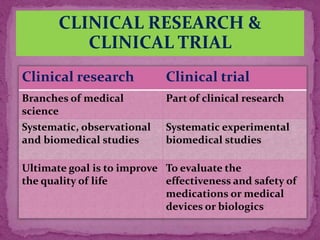
Clinical research Clinical trial
Branches of medical
science
Part of clinical research
Systematic, observational
and biomedical studies
Systematic experimental
biomedical studies
Ultimate goal is to improve
the quality of life
To evaluate the
effectiveness and safety of
medications or medical
devices or biologics
CLINICAL RESEARCH &
CLINICAL TRIAL
“ A complete written description of,
and scientific rationale for, a
research activity involving human
subjects.”
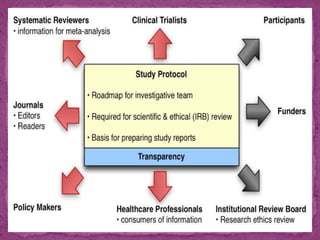
To clarify the research question
To compile existing knowledge
To formulate a hypothesis and objectives
To decide about a study design
To clarify ethical considerations
To apply for funding
To have a guideline and tool for the research team
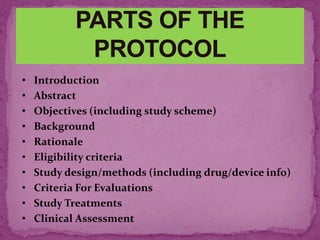
• Introduction
• Abstract
• Objectives (including study scheme)
• Background
• Rationale
• Eligibility criteria
• Study design/methods (including drug/device info)
• Criteria For Evaluations
• Study Treatments
• Clinical Assessment
 Clinical Laboratory Measurements
 Evaluations by visit
 Adverse experience reporting and
Documentation
 Discontinuation and Replacement of subjects
 Protocol violations
 Statistical section (including analysis and
monitoring)
 Administrative, Ethical , Regulatory
Considerations
 Reference/ Appendices
 Publication
Study Subject / hypothesis
should be clearly identified
and briefly described in
introduction.
Abstract is a summary of the
information in a document.
Abstract must be:
Accurate - which correctly
reflects the purpose and content
of manuscript.
Concise and specific – to make
sentence informative and as
possible as brief.
Non evaluative – to report
information objectively
Objectives should be clearly mentioned as hypotheses to be
tested.
It should have a corresponding discussion in the statistical
section.
Objectives are of two types:
Primary objective &
Secondary objective
 All protocols require a section detailing
the scientific rationale for a protocol
and the justification in medical and
scientific literature for the hypothesis
being proposed.
 Describe why it makes sense to study this product
in this patient population or in the event of an
observational study, why the information is
needed.
 Risk / benefit assessment – how the specific risks
of the product will be alleviate in the study and
why the potential benefits outweigh the risks
should be clearly mentioned
Subjects with a diagnosis of the specific disease
intended to take in the study, who meet the
inclusion and exclusion criteria will be eligible for
participation in this study.
Reasons for imposing eligibility criteria can
include scientific rationales, safety concerns,
regulatory issues, and practical considerations.
The number of eligibility criteria should be kept
to a minimum.
Criteria should include only those absolutely
necessary to ensure scientific validity and patient
safety.
Eligibility criteria should be clearly defined and
verifiable by an external auditor.
The study design section of the protocol should contain
a stepwise description of all procedures required by
the study.
• Parts of the study design section may include:
– Initial evaluations
– Screening tests
– Required lab tests
– Details of treatment and supplementary procedures
– Agent information or device specifications
– Dose scheduling and modification
– Calendars
Types of study design used in clinical research
Observational study
Interventional study
Descriptive study
Analytical study
Cross sectional study
Cohort study
• Study characteristics
• Type of study design to be used
• The way in which study will be conducted
Single center
Double blind
Placebo control
Randomized / non randomized
Methodology
Sampling
Collection of data
Statistical analysis
Merits and demerits of particular study
Safety evaluation
Evaluation of LFT, RFT etc.
Incidence of adverse events
The Safety (or Adverse Events) section should include:
Detailed information for reporting adverse events
Lists of expected adverse events
Concurrent Medication
Formulation of Test and control products
Packaging and labeling
Dose/Dosage regimen
Dispensing
Administration
Supply/Storage
Complications
All subjects should be maintained on the same
medications throughout the entire study period, as
medically feasible, with no introduction of new
chronic therapies.
Standard therapy for specific disease is allowed except
for treatments noted in the exclusion criteria.
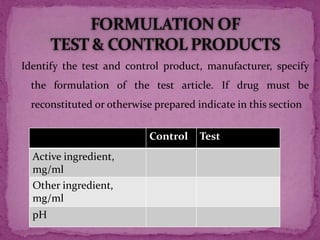
Identify the test and control product, manufacturer, specify
the formulation of the test article. If drug must be
reconstituted or otherwise prepared indicate in this section
Control Test
Active ingredient,
mg/ml
Other ingredient,
mg/ml
pH
Brief explanation of how the drug will be packed
and labeled and by whom.
It should also explain how labeling will maintain
blinding for blinded studies.
Information of
Dose
Route of administration
Dosing schedule
Optimal timing between doses
Adjustments for weight, age, meals and other pertinent
information and
Treatment periods
Dispensing
Administration instructions
Supply of drug at the site
Storage
Study drug accountability
Measures of treatment compliance
Concomitant medications
all concomitant medications and concurrent therapies will be
documented.
Demographics
date of birth, gender, race
Medical history
Physical examination
Vital signs
Other clinical procedures
Adverse events
Duration (start /stop dates and times)
Severity/ grade
Mild
Moderate
Severe
Life threatening Information regarding occurrence of
adverse events will be captured throughout the study
and reported accordingly.
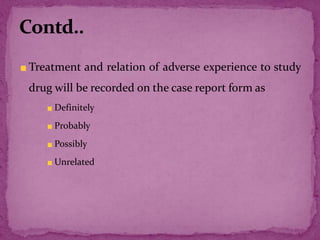
Treatment and relation of adverse experience to study
drug will be recorded on the case report form as
Definitely
Probably
Possibly
Unrelated
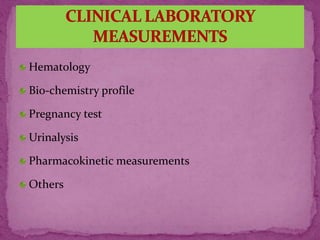
Hematology
Bio-chemistry profile
Pregnancy test
Urinalysis
Pharmacokinetic measurements
Others
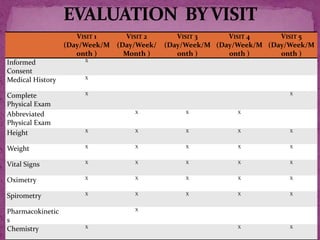
VISIT 1
(Day/Week/M
onth )
VISIT 2
(Day/Week/
Month )
VISIT 3
(Day/Week/M
onth )
VISIT 4
(Day/Week/M
onth )
VISIT 5
(Day/Week/M
onth )
Informed
Consent
X
Medical History X
Complete
Physical Exam
X X
Abbreviated
Physical Exam
X X X
Height X X X X X
Weight X X X X X
Vital Signs X X X X X
Oximetry X X X X X
Spirometry X X X X X
Pharmacokinetic
s
X
Chemistry X X X
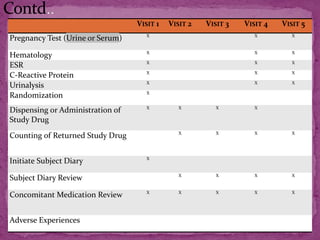
VISIT 1 VISIT 2 VISIT 3 VISIT 4 VISIT 5
Pregnancy Test (Urine or Serum) X X X
Hematology X X X
ESR X X X
C-Reactive Protein X X X
Urinalysis X X X
Randomization X
Dispensing or Administration of
Study Drug
X X X X
Counting of Returned Study Drug X X X X
Initiate Subject Diary X
Subject Diary Review X X X X
Concomitant Medication Review X X X X X
Adverse Experiences
All subjects are free to withdraw from participation
at any time, for any reason, specified or
unspecified and without prejudice
Researcher should keep proper record of
Time
Reason
Adverse experience
Consent from to withdraw
A protocol violation occurs when the subject,
investigator or sponsor fails to adhere to significant
protocol requirements affecting the inclusion,
exclusion, subject safety and primary endpoint
criteria.
Protocol violations of the study include
• Failure to meet inclusion / exclusion criteria
• Use of a prohibited concomitant medication
• Failure to follow good clinical practice.
To ensure the continued scientific
validity and merit of the study
The data which may be subjected to statistical
analysis may be specified with specific
processes tests, formulae, and which may be
adopted for analysis of data, may be proposed
in blue prints in advance.
Sample size should be clearly mentioned and
reasons for selecting such number for study
also be clearly defined.
Data will be entered into a validated database
All procedures for the handling and analysis of
data will be conducted by using good computing
practices.
DATA COLLECTION, ANALYSIS
RETENTION & MONITORING
The investigator is responsible for all information
collected on subjects enrolled in this study.
All data collected during the course of this study must
be reviewed and verified for completeness and
accuracy by the investigator.
A copy of case report form should be with investigators
at the completion of study.
The study should be conducted according to
Declaration of Helsinki
Protection of Human Volunteers
Institutional Review Board
Institutional Ethics Committee
Obligation of Clinical Investigators
Good Clinical Practices
The protocol, consent form and protocol
amendments should be reviewed and approved by
the IRB/IEC.
Serious adverse experiences regardless of causality
should be reported to the IRB/IEC.
Informed consent should be prepared in accordance
with the declaration of Helsinki, ICH GCP
(International council for harmonization good clinical
practices), FDA (Food and Drug Administration,
USA), health insurance portability and accountability
act (HIPAA) and local regulations.
A proper executed, written, informed consent will
be obtained from each subject prior to entering the
subject into the trial.
Information should be given in both oral and
written form in their native language to subjects/
or their legal representatives about the study.
In order to maintain subject
confidentiality, only a site number,
subject number and subject initials will
identify all study subjects on CRFs and
other documentation.
All laboratory specimens, evaluation forms,
reports and other records should identified by a
coded number and initials only
All study records should be kept in a locked file
cabinet
Code sheets linking a patients name to a patient
identification number should be stored separately in
another locked file cabinet
Clinical information should not be released without
written permission of the subjects, except as necessary
for monitoring by the authorized agency.
All references cited in the protocol and/or relevant
to the study should be listed properly
Supplemental documents such as data collection
form, surveys, questionnaires, advertisements, and
flyers should be included to the protocol.
The publication or presentation of any study results
should be according to the privacy laws, agreement
with sponsor, health insurance portability and
accountability act.
Article
Abstract:
Cosmetic Dermatology is a growing subspecialty. High-
quality basic science studies have been published; however,
few double-blind, randomized controlled clinical trials,
which are the major instrument for evidence-based
medicine, have been conducted in this area. Clinical
research is essential for the discovery of new knowledge,
improvement of scientific basis, resolution of challenges,
and good clinical practice. Some basic principles for a
successful researcher include interest, availability,
persistence, and honesty. It is essential to learn how to
write a protocol research and to know the international
and national regulatory rules.
A complete clinical trial protocol should include question,
background, objectives, methodology (design, variable
description, sample size, randomization, inclusion and
exclusion criteria, intervention, efficacy and safety
measures, and statistical analysis), consent form, clinical
research form, and references. Institutional ethical review
board approval and financial support disclosure are
necessary. Publication of positive or negative results should
be an authors' commitment.
 Keywords: Clinical protocols; Clinical trial; Comparative
study; Cosmetics; Epidemiologic research design; Research
design
leifu b|Jod'k:yftf /f]uL kfbrt'i6od . u'0fTjsf/0f+ 1]o+ ljsf/ Jo'kzfGto] .
r=;"=(.@
>'t] ko{jbftTj+ ax'zf] b[i6sd{tf . bfIo+ zf}rldlt 1]o+ j}B]u'0frt'i6od .
r=;"= (.^
pkrf/1tf bfIodg'/fuZr et{l/ . zf}r+ r]lt rt'isf]˜o+ u'0fM kl/r/]hg] ..
r=;"= (.*
ax'tf tq of]UoTjdg]sljwsNkgf . ;DkRr]lt rt'isf]˜o+ b|Jof0ff+u'0f pRot] ..
r=;"=(.&
:d[ltlgb]{zsfl/TjdeL?Tjdyflk r . 1fksTj+ r /f]uf0ffdft'/:o u'0ffM :d[tfM ..
r=;"= (.(
lqljwkl/Iff
lqljw+vn' /f]uljz]iflj1fg+ejlttByf
cfKtf]kb]zMk|ToIfd cg'dfg+ r]lt..
r=lj=$.!
rt'lj{wf kl/Iff
t:ort'lj{wfkl/Iff cfKtf]kb]zMk|ToIfd cg'dfg+ o'lQmZr]lt..
r=;'=!!.!&
bzljw k/LIo ljifo
sf/0f – s/0f –sfo{of]gL–sfo{–sfo{kmnfg'aGw–b]z–sfn–
k|j[To'kfofg ;Doulelgj{t{dfgMsfof{lelgj[Qflji6kmnfg'aGw+
sfo{dlelgj{t{oTogltdxtfoTg]gstf{.. r=lj=*.^*
bzljw /f]lukl/Iff
t:dfbft'/+ k/LIf]t k|s[lttZrljs[ltZr;f/tZr ;+xggtZr k|df0ftZr
;fTDotZr ;TjtZrcfxf/zlQmtZrJofofdzlStZr jo:tZr]lt
ank|df0fljz]ifu|x0fx]tf]M.. r=lj=*.($
DISCUSSION
Research as may be defined as attempt to find out/
discover facts in a systematic and scientific manner
with statistical support.
Clinical research refers to the entire bibliography of
drug/device/biology or in fact any test article from it’s
inception in the lab to it’s introduction to the
consumer market and beyond.
Clinical trials are parts of clinical research in which
experiments are done on human participants.
Clinical research must be always conducted within
the frame work of prevailing relevant laws of
country & state.
A properly planned & executed clinical study is a
powerful experiment technique for assessing the
efficacy of an intervention.
Protocol is a systematic & complete Performa of
research activity, needed for clarify research question
& ethical consideration & useful to applying for
funding.
Problem identification, literature review, developing
research question and statistical hypothesis are the
main steps for preparing research protocol.
Project summary, general information, rationale and
background, references, study goals and objectives, study
design, methodology, safety considerations, follow up, data
management and statistical analysis, quality assurance,
expected outcome, dissemination of results and
publication policy, duration, ethical considerations, budget
and other support projects are the parts of protocol .
Researcher can modify the content according to the types
of study,
Chikitsha chatushpada dealt in Charak samhita and their
individual characteristics of each pada should be
considered as requirements and protocols for clinical
research .
Rog and Rogi Pareeksha vidhi and Pareekshya vishay
should be considered as methodology for research
protocol.
Clinical research protocol is a
systematically structured scientific
framework of guidelines for
clarifying research question.
Proper and appropriate solution
should only be drawn by applying
appropriate Protocol in clinical
research study.
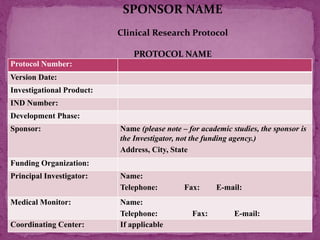
Protocol Number:
Version Date:
Investigational Product:
IND Number:
Development Phase:
Sponsor: Name (please note – for academic studies, the sponsor is
the Investigator, not the funding agency.)
Address, City, State
Funding Organization:
Principal Investigator: Name:
Telephone: Fax: E-mail:
Medical Monitor: Name:
Telephone: Fax: E-mail:
Coordinating Center: If applicable
SPONSOR NAME
Clinical Research Protocol
PROTOCOL NAME
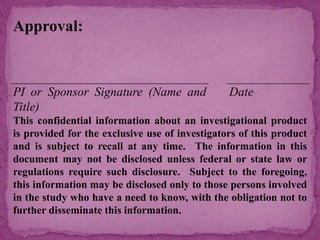
Approval:
PI or Sponsor Signature (Name and
Title)
Date
This confidential information about an investigational product
is provided for the exclusive use of investigators of this product
and is subject to recall at any time. The information in this
document may not be disclosed unless federal or state law or
regulations require such disclosure. Subject to the foregoing,
this information may be disclosed only to those persons involved
in the study who have a need to know, with the obligation not to
further disseminate this information.
PROTOCOL AGREEMENT
I have read the protocol specified below. In my formal capacity as Investigator,
my duties include ensuring the safety of the study subjects enrolled under my
supervision and providing [Sponsor Name] with complete and timely
information, as outlined in the protocol. It is understood that all information
pertaining to the study will be held strictly confidential and that this
confidentiality requirement applies to all study staff at this site. Furthermore, on
behalf of the study staff and myself, I agree to maintain the procedures required
to carry out the study in accordance with accepted GCP principles and to abide
by the terms of this protocol.
Protocol Number: Number
Protocol Title: Title
Protocol Date: TBD
Investigator Signature Date
Print Name and Title
Site #
Site Name
Address
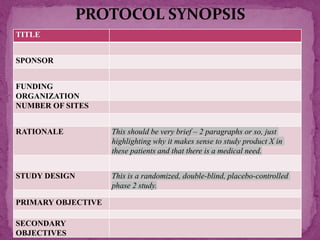
TITLE
SPONSOR
FUNDING
ORGANIZATION
NUMBER OF SITES
RATIONALE This should be very brief – 2 paragraphs or so, just
highlighting why it makes sense to study product X in
these patients and that there is a medical need.
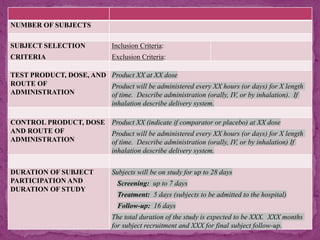
STUDY DESIGN This is a randomized, double-blind, placebo-controlled
phase 2 study.
PRIMARY OBJECTIVE
SECONDARY
OBJECTIVES
PROTOCOL SYNOPSIS
NUMBER OF SUBJECTS
SUBJECT SELECTION
CRITERIA
Inclusion Criteria:
Exclusion Criteria:
TEST PRODUCT, DOSE, AND
ROUTE OF
ADMINISTRATION
Product XX at XX dose
Product will be administered every XX hours (or days) for X length
of time. Describe administration (orally, IV, or by inhalation). If
inhalation describe delivery system.
CONTROL PRODUCT, DOSE
AND ROUTE OF
ADMINISTRATION
Product XX (indicate if comparator or placebo) at XX dose
Product will be administered every XX hours (or days) for X length
of time. Describe administration (orally, IV, or by inhalation) If
inhalation describe delivery system.
DURATION OF SUBJECT
PARTICIPATION AND
DURATION OF STUDY
Subjects will be on study for up to 28 days
Screening: up to 7 days
Treatment: 5 days (subjects to be admitted to the hospital)
Follow-up: 16 days
The total duration of the study is expected to be XXX. XXX months
for subject recruitment and XXX for final subject follow-up.
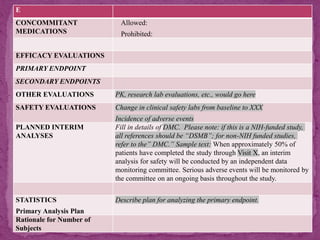
E
CONCOMMITANT
MEDICATIONS
Allowed:
Prohibited:
EFFICACY EVALUATIONS
PRIMARY ENDPOINT
SECONDARY ENDPOINTS
OTHER EVALUATIONS PK, research lab evaluations, etc., would go here
SAFETY EVALUATIONS Change in clinical safety labs from baseline to XXX
Incidence of adverse events
PLANNED INTERIM
ANALYSES
Fill in details of DMC. Please note: if this is a NIH-funded study,
all references should be “DSMB”; for non-NIH funded studies,
refer to the” DMC.” Sample text: When approximately 50% of
patients have completed the study through Visit X, an interim
analysis for safety will be conducted by an independent data
monitoring committee. Serious adverse events will be monitored by
the committee on an ongoing basis throughout the study.
STATISTICS
Primary Analysis Plan
Describe plan for analyzing the primary endpoint.
Rationale for Number of
Subjects
WHO recommended format for clinical research
protocol 1 and2
CCRAS Research Policy
 Research Methodology- C.R. Kothari .Gaurav Garg
 Research Methodology and Medical Biostatistics –
DR.S.M. Sarpotdar, Dr. Santosh Bhor
 Charak Samhita
Writing Research Protocol- Manubhakta
PROTOCOL TEMPLATE- University of
California, Sanfrancisco.
Clinical research protocol

Clinical research protocol

  • 1.
    Presented By Dr. PuneshwarKeshari, 1st Year PG Scholar, Guided By Dr. Prakash L. Hegde Professor DEPT. OF DRAVYAGUNA
  • 2.
     Definition ofResearch  Clinical Research and Clinical Trial  Clinical Research Protocol  Why Protocol  Parts of Protocol  Formats of Clinical Research Protocol  Clinical Research in Ayurveda  Discussion  Conclusion  References
  • 3.
     Research is Systematiccollection, Analysis and Interpretation of data to answer a certain question or solve a problem
  • 4.
    Clinical research Clinicaltrial Branches of medical science Part of clinical research Systematic, observational and biomedical studies Systematic experimental biomedical studies Ultimate goal is to improve the quality of life To evaluate the effectiveness and safety of medications or medical devices or biologics CLINICAL RESEARCH & CLINICAL TRIAL
  • 6.
    “ A completewritten description of, and scientific rationale for, a research activity involving human subjects.”
  • 7.
    To clarify theresearch question To compile existing knowledge To formulate a hypothesis and objectives To decide about a study design To clarify ethical considerations To apply for funding To have a guideline and tool for the research team
  • 9.
    • Introduction • Abstract •Objectives (including study scheme) • Background • Rationale • Eligibility criteria • Study design/methods (including drug/device info) • Criteria For Evaluations • Study Treatments • Clinical Assessment
  • 10.
     Clinical LaboratoryMeasurements  Evaluations by visit  Adverse experience reporting and Documentation  Discontinuation and Replacement of subjects  Protocol violations  Statistical section (including analysis and monitoring)  Administrative, Ethical , Regulatory Considerations  Reference/ Appendices  Publication
  • 11.
    Study Subject /hypothesis should be clearly identified and briefly described in introduction.
  • 12.
    Abstract is asummary of the information in a document. Abstract must be: Accurate - which correctly reflects the purpose and content of manuscript. Concise and specific – to make sentence informative and as possible as brief. Non evaluative – to report information objectively
  • 13.
    Objectives should beclearly mentioned as hypotheses to be tested. It should have a corresponding discussion in the statistical section. Objectives are of two types: Primary objective & Secondary objective
  • 14.
     All protocolsrequire a section detailing the scientific rationale for a protocol and the justification in medical and scientific literature for the hypothesis being proposed.
  • 15.
     Describe whyit makes sense to study this product in this patient population or in the event of an observational study, why the information is needed.  Risk / benefit assessment – how the specific risks of the product will be alleviate in the study and why the potential benefits outweigh the risks should be clearly mentioned
  • 16.
    Subjects with adiagnosis of the specific disease intended to take in the study, who meet the inclusion and exclusion criteria will be eligible for participation in this study. Reasons for imposing eligibility criteria can include scientific rationales, safety concerns, regulatory issues, and practical considerations.
  • 17.
    The number ofeligibility criteria should be kept to a minimum. Criteria should include only those absolutely necessary to ensure scientific validity and patient safety. Eligibility criteria should be clearly defined and verifiable by an external auditor.
  • 18.
    The study designsection of the protocol should contain a stepwise description of all procedures required by the study. • Parts of the study design section may include: – Initial evaluations – Screening tests – Required lab tests – Details of treatment and supplementary procedures – Agent information or device specifications – Dose scheduling and modification – Calendars
  • 19.
    Types of studydesign used in clinical research Observational study Interventional study Descriptive study Analytical study Cross sectional study Cohort study
  • 20.
    • Study characteristics •Type of study design to be used • The way in which study will be conducted Single center Double blind Placebo control Randomized / non randomized
  • 21.
    Methodology Sampling Collection of data Statisticalanalysis Merits and demerits of particular study
  • 22.
    Safety evaluation Evaluation ofLFT, RFT etc. Incidence of adverse events The Safety (or Adverse Events) section should include: Detailed information for reporting adverse events Lists of expected adverse events
  • 23.
    Concurrent Medication Formulation ofTest and control products Packaging and labeling Dose/Dosage regimen Dispensing Administration Supply/Storage Complications
  • 24.
    All subjects shouldbe maintained on the same medications throughout the entire study period, as medically feasible, with no introduction of new chronic therapies. Standard therapy for specific disease is allowed except for treatments noted in the exclusion criteria.
  • 25.
    Identify the testand control product, manufacturer, specify the formulation of the test article. If drug must be reconstituted or otherwise prepared indicate in this section Control Test Active ingredient, mg/ml Other ingredient, mg/ml pH
  • 26.
    Brief explanation ofhow the drug will be packed and labeled and by whom. It should also explain how labeling will maintain blinding for blinded studies.
  • 27.
    Information of Dose Route ofadministration Dosing schedule Optimal timing between doses Adjustments for weight, age, meals and other pertinent information and Treatment periods
  • 28.
    Dispensing Administration instructions Supply ofdrug at the site Storage Study drug accountability Measures of treatment compliance
  • 29.
    Concomitant medications all concomitantmedications and concurrent therapies will be documented. Demographics date of birth, gender, race Medical history Physical examination Vital signs Other clinical procedures
  • 30.
    Adverse events Duration (start/stop dates and times) Severity/ grade Mild Moderate Severe Life threatening Information regarding occurrence of adverse events will be captured throughout the study and reported accordingly.
  • 31.
    Treatment and relationof adverse experience to study drug will be recorded on the case report form as Definitely Probably Possibly Unrelated
  • 32.
  • 33.
    VISIT 1 (Day/Week/M onth ) VISIT2 (Day/Week/ Month ) VISIT 3 (Day/Week/M onth ) VISIT 4 (Day/Week/M onth ) VISIT 5 (Day/Week/M onth ) Informed Consent X Medical History X Complete Physical Exam X X Abbreviated Physical Exam X X X Height X X X X X Weight X X X X X Vital Signs X X X X X Oximetry X X X X X Spirometry X X X X X Pharmacokinetic s X Chemistry X X X
  • 34.
    VISIT 1 VISIT2 VISIT 3 VISIT 4 VISIT 5 Pregnancy Test (Urine or Serum) X X X Hematology X X X ESR X X X C-Reactive Protein X X X Urinalysis X X X Randomization X Dispensing or Administration of Study Drug X X X X Counting of Returned Study Drug X X X X Initiate Subject Diary X Subject Diary Review X X X X Concomitant Medication Review X X X X X Adverse Experiences
  • 35.
    All subjects arefree to withdraw from participation at any time, for any reason, specified or unspecified and without prejudice Researcher should keep proper record of Time Reason Adverse experience Consent from to withdraw
  • 36.
    A protocol violationoccurs when the subject, investigator or sponsor fails to adhere to significant protocol requirements affecting the inclusion, exclusion, subject safety and primary endpoint criteria.
  • 37.
    Protocol violations ofthe study include • Failure to meet inclusion / exclusion criteria • Use of a prohibited concomitant medication • Failure to follow good clinical practice.
  • 38.
    To ensure thecontinued scientific validity and merit of the study
  • 39.
    The data whichmay be subjected to statistical analysis may be specified with specific processes tests, formulae, and which may be adopted for analysis of data, may be proposed in blue prints in advance. Sample size should be clearly mentioned and reasons for selecting such number for study also be clearly defined.
  • 40.
    Data will beentered into a validated database All procedures for the handling and analysis of data will be conducted by using good computing practices. DATA COLLECTION, ANALYSIS RETENTION & MONITORING
  • 41.
    The investigator isresponsible for all information collected on subjects enrolled in this study. All data collected during the course of this study must be reviewed and verified for completeness and accuracy by the investigator. A copy of case report form should be with investigators at the completion of study.
  • 42.
    The study shouldbe conducted according to Declaration of Helsinki Protection of Human Volunteers Institutional Review Board Institutional Ethics Committee Obligation of Clinical Investigators Good Clinical Practices
  • 43.
    The protocol, consentform and protocol amendments should be reviewed and approved by the IRB/IEC. Serious adverse experiences regardless of causality should be reported to the IRB/IEC.
  • 44.
    Informed consent shouldbe prepared in accordance with the declaration of Helsinki, ICH GCP (International council for harmonization good clinical practices), FDA (Food and Drug Administration, USA), health insurance portability and accountability act (HIPAA) and local regulations.
  • 45.
    A proper executed,written, informed consent will be obtained from each subject prior to entering the subject into the trial. Information should be given in both oral and written form in their native language to subjects/ or their legal representatives about the study.
  • 46.
    In order tomaintain subject confidentiality, only a site number, subject number and subject initials will identify all study subjects on CRFs and other documentation.
  • 47.
    All laboratory specimens,evaluation forms, reports and other records should identified by a coded number and initials only All study records should be kept in a locked file cabinet
  • 48.
    Code sheets linkinga patients name to a patient identification number should be stored separately in another locked file cabinet Clinical information should not be released without written permission of the subjects, except as necessary for monitoring by the authorized agency.
  • 49.
    All references citedin the protocol and/or relevant to the study should be listed properly Supplemental documents such as data collection form, surveys, questionnaires, advertisements, and flyers should be included to the protocol.
  • 50.
    The publication orpresentation of any study results should be according to the privacy laws, agreement with sponsor, health insurance portability and accountability act.
  • 51.
  • 52.
    Abstract: Cosmetic Dermatology isa growing subspecialty. High- quality basic science studies have been published; however, few double-blind, randomized controlled clinical trials, which are the major instrument for evidence-based medicine, have been conducted in this area. Clinical research is essential for the discovery of new knowledge, improvement of scientific basis, resolution of challenges, and good clinical practice. Some basic principles for a successful researcher include interest, availability, persistence, and honesty. It is essential to learn how to write a protocol research and to know the international and national regulatory rules.
  • 53.
    A complete clinicaltrial protocol should include question, background, objectives, methodology (design, variable description, sample size, randomization, inclusion and exclusion criteria, intervention, efficacy and safety measures, and statistical analysis), consent form, clinical research form, and references. Institutional ethical review board approval and financial support disclosure are necessary. Publication of positive or negative results should be an authors' commitment.  Keywords: Clinical protocols; Clinical trial; Comparative study; Cosmetics; Epidemiologic research design; Research design
  • 54.
    leifu b|Jod'k:yftf /f]uLkfbrt'i6od . u'0fTjsf/0f+ 1]o+ ljsf/ Jo'kzfGto] . r=;"=(.@ >'t] ko{jbftTj+ ax'zf] b[i6sd{tf . bfIo+ zf}rldlt 1]o+ j}B]u'0frt'i6od . r=;"= (.^ pkrf/1tf bfIodg'/fuZr et{l/ . zf}r+ r]lt rt'isf]˜o+ u'0fM kl/r/]hg] .. r=;"= (.* ax'tf tq of]UoTjdg]sljwsNkgf . ;DkRr]lt rt'isf]˜o+ b|Jof0ff+u'0f pRot] .. r=;"=(.& :d[ltlgb]{zsfl/TjdeL?Tjdyflk r . 1fksTj+ r /f]uf0ffdft'/:o u'0ffM :d[tfM .. r=;"= (.(
  • 55.
    lqljwkl/Iff lqljw+vn' /f]uljz]iflj1fg+ejlttByf cfKtf]kb]zMk|ToIfd cg'dfg+r]lt.. r=lj=$.! rt'lj{wf kl/Iff t:ort'lj{wfkl/Iff cfKtf]kb]zMk|ToIfd cg'dfg+ o'lQmZr]lt.. r=;'=!!.!&
  • 56.
    bzljw k/LIo ljifo sf/0f– s/0f –sfo{of]gL–sfo{–sfo{kmnfg'aGw–b]z–sfn– k|j[To'kfofg ;Doulelgj{t{dfgMsfof{lelgj[Qflji6kmnfg'aGw+ sfo{dlelgj{t{oTogltdxtfoTg]gstf{.. r=lj=*.^* bzljw /f]lukl/Iff t:dfbft'/+ k/LIf]t k|s[lttZrljs[ltZr;f/tZr ;+xggtZr k|df0ftZr ;fTDotZr ;TjtZrcfxf/zlQmtZrJofofdzlStZr jo:tZr]lt ank|df0fljz]ifu|x0fx]tf]M.. r=lj=*.($
  • 57.
  • 58.
    Research as maybe defined as attempt to find out/ discover facts in a systematic and scientific manner with statistical support. Clinical research refers to the entire bibliography of drug/device/biology or in fact any test article from it’s inception in the lab to it’s introduction to the consumer market and beyond. Clinical trials are parts of clinical research in which experiments are done on human participants.
  • 59.
    Clinical research mustbe always conducted within the frame work of prevailing relevant laws of country & state. A properly planned & executed clinical study is a powerful experiment technique for assessing the efficacy of an intervention.
  • 60.
    Protocol is asystematic & complete Performa of research activity, needed for clarify research question & ethical consideration & useful to applying for funding. Problem identification, literature review, developing research question and statistical hypothesis are the main steps for preparing research protocol.
  • 61.
    Project summary, generalinformation, rationale and background, references, study goals and objectives, study design, methodology, safety considerations, follow up, data management and statistical analysis, quality assurance, expected outcome, dissemination of results and publication policy, duration, ethical considerations, budget and other support projects are the parts of protocol . Researcher can modify the content according to the types of study,
  • 62.
    Chikitsha chatushpada dealtin Charak samhita and their individual characteristics of each pada should be considered as requirements and protocols for clinical research . Rog and Rogi Pareeksha vidhi and Pareekshya vishay should be considered as methodology for research protocol.
  • 63.
    Clinical research protocolis a systematically structured scientific framework of guidelines for clarifying research question. Proper and appropriate solution should only be drawn by applying appropriate Protocol in clinical research study.
  • 65.
    Protocol Number: Version Date: InvestigationalProduct: IND Number: Development Phase: Sponsor: Name (please note – for academic studies, the sponsor is the Investigator, not the funding agency.) Address, City, State Funding Organization: Principal Investigator: Name: Telephone: Fax: E-mail: Medical Monitor: Name: Telephone: Fax: E-mail: Coordinating Center: If applicable SPONSOR NAME Clinical Research Protocol PROTOCOL NAME
  • 66.
    Approval: PI or SponsorSignature (Name and Title) Date This confidential information about an investigational product is provided for the exclusive use of investigators of this product and is subject to recall at any time. The information in this document may not be disclosed unless federal or state law or regulations require such disclosure. Subject to the foregoing, this information may be disclosed only to those persons involved in the study who have a need to know, with the obligation not to further disseminate this information.
  • 67.
    PROTOCOL AGREEMENT I haveread the protocol specified below. In my formal capacity as Investigator, my duties include ensuring the safety of the study subjects enrolled under my supervision and providing [Sponsor Name] with complete and timely information, as outlined in the protocol. It is understood that all information pertaining to the study will be held strictly confidential and that this confidentiality requirement applies to all study staff at this site. Furthermore, on behalf of the study staff and myself, I agree to maintain the procedures required to carry out the study in accordance with accepted GCP principles and to abide by the terms of this protocol. Protocol Number: Number Protocol Title: Title Protocol Date: TBD Investigator Signature Date Print Name and Title Site # Site Name Address
  • 68.
    TITLE SPONSOR FUNDING ORGANIZATION NUMBER OF SITES RATIONALEThis should be very brief – 2 paragraphs or so, just highlighting why it makes sense to study product X in these patients and that there is a medical need. STUDY DESIGN This is a randomized, double-blind, placebo-controlled phase 2 study. PRIMARY OBJECTIVE SECONDARY OBJECTIVES PROTOCOL SYNOPSIS
  • 69.
    NUMBER OF SUBJECTS SUBJECTSELECTION CRITERIA Inclusion Criteria: Exclusion Criteria: TEST PRODUCT, DOSE, AND ROUTE OF ADMINISTRATION Product XX at XX dose Product will be administered every XX hours (or days) for X length of time. Describe administration (orally, IV, or by inhalation). If inhalation describe delivery system. CONTROL PRODUCT, DOSE AND ROUTE OF ADMINISTRATION Product XX (indicate if comparator or placebo) at XX dose Product will be administered every XX hours (or days) for X length of time. Describe administration (orally, IV, or by inhalation) If inhalation describe delivery system. DURATION OF SUBJECT PARTICIPATION AND DURATION OF STUDY Subjects will be on study for up to 28 days Screening: up to 7 days Treatment: 5 days (subjects to be admitted to the hospital) Follow-up: 16 days The total duration of the study is expected to be XXX. XXX months for subject recruitment and XXX for final subject follow-up.
  • 70.
    E CONCOMMITANT MEDICATIONS Allowed: Prohibited: EFFICACY EVALUATIONS PRIMARY ENDPOINT SECONDARYENDPOINTS OTHER EVALUATIONS PK, research lab evaluations, etc., would go here SAFETY EVALUATIONS Change in clinical safety labs from baseline to XXX Incidence of adverse events PLANNED INTERIM ANALYSES Fill in details of DMC. Please note: if this is a NIH-funded study, all references should be “DSMB”; for non-NIH funded studies, refer to the” DMC.” Sample text: When approximately 50% of patients have completed the study through Visit X, an interim analysis for safety will be conducted by an independent data monitoring committee. Serious adverse events will be monitored by the committee on an ongoing basis throughout the study. STATISTICS Primary Analysis Plan Describe plan for analyzing the primary endpoint. Rationale for Number of Subjects
  • 71.
    WHO recommended formatfor clinical research protocol 1 and2 CCRAS Research Policy  Research Methodology- C.R. Kothari .Gaurav Garg  Research Methodology and Medical Biostatistics – DR.S.M. Sarpotdar, Dr. Santosh Bhor  Charak Samhita Writing Research Protocol- Manubhakta PROTOCOL TEMPLATE- University of California, Sanfrancisco.

Editor's Notes

  • #12 (It may vary regarding some journal/institution)
  • #23 Primary efficacy endpoint Secondary efficacy endpoint
  • #42 CRF case report form
  • #47 site number ??