1
Template for Study Proposal
(For scientific review committee)
How to use this template:
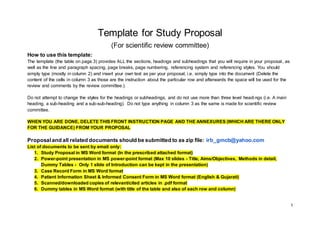
The template (the table on page 3) provides ALL the sections, headings and subheadings that you will require in your proposal, as
well as the line and paragraph spacing, page breaks, page numbering, referencing system and referencing styles. You should
simply type (mostly in column 2) and insert your own text as per your proposal, i.e. simply type into the document (Delete the
content of the cells in column 3 as those are the instruction about the particular row and afterwards the space will be used for the
review and comments by the review committee.).
Do not attempt to change the styles for the headings or subheadings, and do not use more than three level headings (i.e. A main
heading, a sub-heading and a sub-sub-heading). Do not type anything in column 3 as the same is made for scientific review
committee.
WHEN YOU ARE DONE, DELETE THIS FRONT INSTRUCTION PAGE AND THE ANNEXURES (WHICH ARE THERE ONLY
FOR THE GUIDANCE) FROM YOUR PROPOSAL
Proposaland all related documents should be submitted to as zip file: irb_gmcb@yahoo.com
List of documents to be sent by email only:
1. Study Proposal in MS Word format (In the prescribed attached format)
2. Power-point presentation in MS power-point format (Max 10 slides - Title, Aims/Objectives, Methods in detail,
Dummy Tables - Only 1 slide of Introduction can be kept in the presentation)
3. Case Record Form in MS Word format
4. Patient Information Sheet & Informed Consent Form in MS Word format (English & Gujarati)
5. Scanned/downloaded copies of relevant/cited articles in .pdf format
6. Dummy tables in MS Word format (with title of the table and also of each row and column)
2
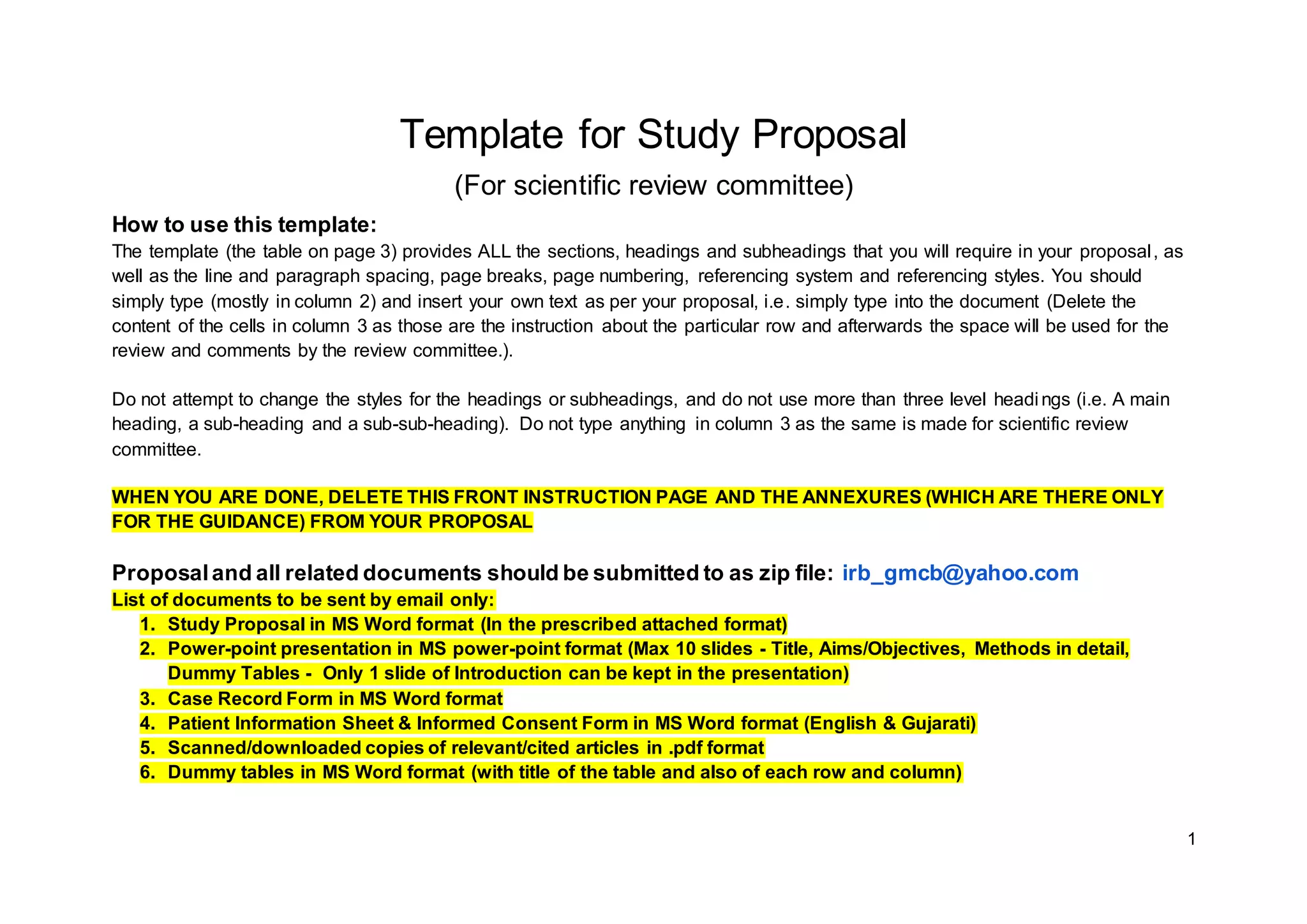
PROPOSAL FOR THE SCIENTIFIC REVIEW
Title of the Project/Thesis/Dissertation:
Name of the Student/ Principal Investigator:
Department(s):
Mobile No.: E-mail ID:
Name(s) of the PG Guide/Co-investigator(s) :
No. Name with Designation Mobile Email
1
2
3
3
1
Heading
2
Details
3
Instructions / Comments
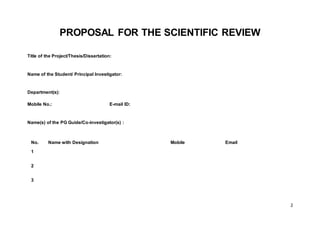
Title Neither too short nor too long.
(Who + Study Design + Where +
What)
Indicate the study’s design with a
commonly used term.
Should be concise yet descriptive,
informative and catchy.
The title may need to be revised
after completion of writing of the
protocol to reflect more closely the
sense of the study.
Introduction
& review of
Literature
(Justification)
Max 750 words
Why do you want to conduct this
study?
Why are these questions
important?
What is the existing knowledge in
the area?
What are the gaps in the existing
knowledge?
4
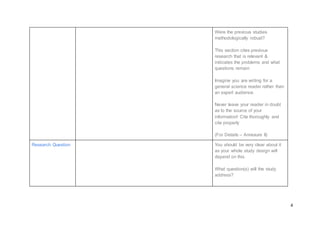
Were the previous studies
methodologically robust?
This section cites previous
research that is relevant &
indicates the problems and what
questions remain
Imagine you are writing for a
general science reader rather than
an expert audience.
Never leave your reader in doubt
as to the source of your
information! Cite thoroughly and
cite properly
(For Details – Annexure II)
Research Question You should be very clear about it
as your whole study design will
depend on this.
What question(s) will the study
address?
5
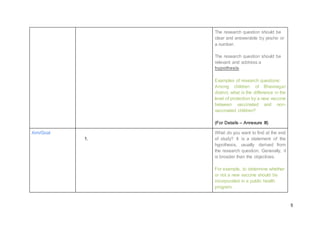
The research question should be
clear and answerable by yes/no or
a number.
The research question should be
relevant and address a
hypothesis.
Examples of research questions:
Among children of Bhavnagar
district, what is the difference in the
level of protection by a new vaccine
between vaccinated and non-
vaccinated children?
(For Details – Annexure III)
Aim/Goal
1.
What do you want to find at the end
of study? It is a statement of the
hypothesis, usually derived from
the research question. Generally, it
is broader than the objectives.
For example, to determine whether
or not a new vaccine should be
incorporated in a public health
program.
6
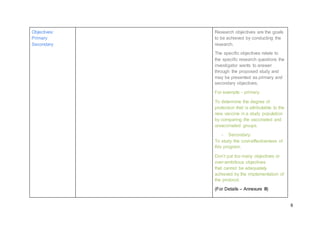
Objectives:
Primary
Secondary
Research objectives are the goals
to be achieved by conducting the
research.
The specific objectives relate to
the specific research questions the
investigator wants to answer
through the proposed study and
may be presented as primary and
secondary objectives,
For example - primary:
To determine the degree of
protection that is attributable to the
new vaccine in a study population
by comparing the vaccinated and
unvaccinated groups.
- Secondary:
To study the cost-effectiveness of
this program.
Don’t put too many objectives or
over-ambitious objectives
that cannot be adequately
achieved by the implementation of
the protocol.
(For Details – Annexure III)
7
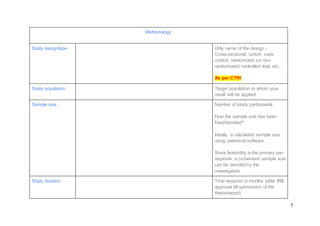
Methodology:
Study design/type Only name of the design -
Cross-sectional, cohort, case
control, randomized (or non-
randomized) controlled trial, etc.
As per CTRI
Study population Target population to whom your
result will be applied
Sample size Number of study participants
How the sample size has been
fixed/decided?
Ideally, a calculated sample size
using statistical software
Since feasibility is the primary pre-
requisite, a convenient sample size
can be decided by the
investigators
Study duration Time required in months (after IRB
approval till submission of the
thesis/report)
8
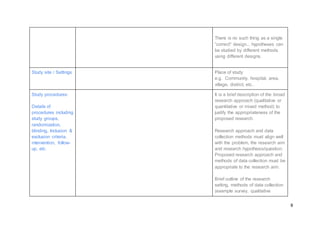
There is no such thing as a single
“correct” design... hypotheses can
be studied by different methods
using different designs.
Study site / Settings Place of study
e.g. Community, hospital, area,
village, district, etc..
Study procedures:
Details of
procedures including
study groups,
randomization,
blinding, Inclusion &
exclusion criteria,
intervention, follow-
up, etc.
It is a brief description of the broad
research approach (qualitative or
quantitative or mixed method) to
justify the appropriateness of the
proposed research.
Research approach and data
collection methods must align well
with the problem, the research aim
and research hypothesis/question.
Proposed research approach and
methods of data collection must be
appropriate to the research aim.
Brief outline of the research
setting, methods of data collection
(example survey, qualitative
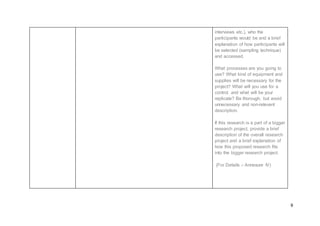
9
interviews etc.), who the
participants would be and a brief
explanation of how participants will
be selected (sampling technique)
and accessed.
What processes are you going to
use? What kind of equipment and
supplies will be necessary for the
project? What will you use for a
control, and what will be your
replicate? Be thorough, but avoid
unnecessary and non-relevant
description.
If this research is a part of a bigger
research project, provide a brief
description of the overall research
project and a brief explanation of
how this proposed research fits
into the bigger research project.
(For Details – Annexure IV)
10
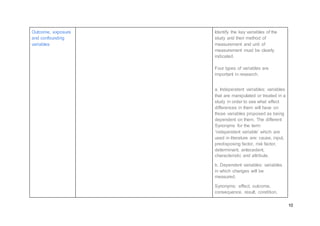
Outcome, exposure
and confounding
variables
Identify the key variables of the
study and their method of
measurement and unit of
measurement must be clearly
indicated.
Four types of variables are
important in research.
a. Independent variables: variables
that are manipulated or treated in a
study in order to see what effect
differences in them will have on
those variables proposed as being
dependent on them. The different
Synonyms for the term
‘independent variable’ which are
used in literature are: cause, input,
predisposing factor, risk factor,
determinant, antecedent,
characteristic and attribute.
b. Dependent variables: variables
in which changes will be
measured.
Synonyms: effect, outcome,
consequence, result, condition,
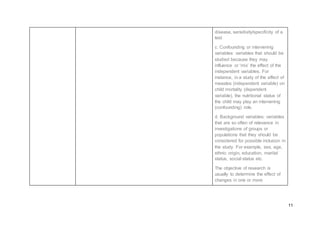
11
disease, sensitivity/specificity of a
test
c. Confounding or intervening
variables: variables that should be
studied because they may
influence or ‘mix’ the effect of the
independent variables. For
instance, in a study of the effect of
measles (independent variable) on
child mortality (dependent
variable), the nutritional status of
the child may play an intervening
(confounding) role.
d. Background variables: variables
that are so often of relevance in
investigations of groups or
populations that they should be
considered for possible inclusion in
the study. For example, sex, age,
ethnic origin, education, marital
status, social status etc.
The objective of research is
usually to determine the effect of
changes in one or more
12
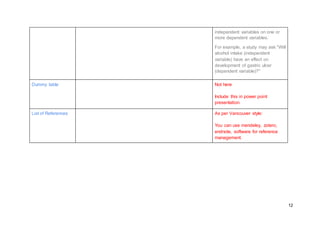
independent variables on one or
more dependent variables.
For example, a study may ask "Will
alcohol intake (independent
variable) have an effect on
development of gastric ulcer
(dependent variable)?"
Dummy table Not here
Include this in power point
presentation.
List of References As per Vancouver style:
You can use mendeley, zotero,
endnote, software for reference
management.
13
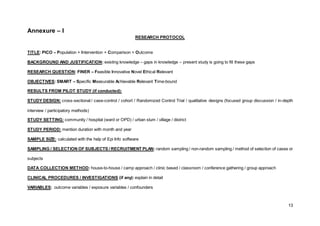
Annexure – I
RESEARCH PROTOCOL
TITLE: PICO – Population + Intervention + Comparison + Outcome
BACKGROUND AND JUSTIFICATION: existing knowledge – gaps in knowledge – present study is going to fill these gaps
RESEARCH QUESTION: FINER – Feasible Innovative Novel Ethical Relevant
OBJECTIVES: SMART – Specific Measurable Achievable Relevant Time-bound
RESULTS FROM PILOT STUDY (if conducted):
STUDY DESIGN: cross-sectional / case-control / cohort / Randomized Control Trial / qualitative designs (focused group discussion / in-depth
interview / participatory methods)
STUDY SETTING: community / hospital (ward or OPD) / urban slum / village / district
STUDY PERIOD: mention duration with month and year
SAMPLE SIZE: calculated with the help of Epi Info software
SAMPLING / SELECTION OF SUBJECTS / RECRUITMENT PLAN: random sampling / non-random sampling / method of selection of cases or
subjects
DATA COLLECTION METHOD: house-to-house / camp approach / clinic based / classroom / conference gathering / group approach
CLINICAL PROCEDURES / INVESTIGATIONS (if any): explain in detail
VARIABLES: outcome variables / exposure variables / confounders
14
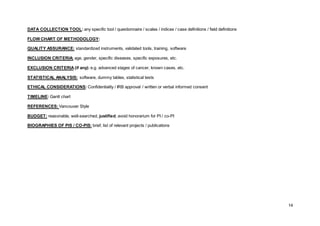
DATA COLLECTION TOOL: any specific tool / questionnaire / scales / indices / case definitions / field definitions
FLOW CHART OF METHODOLOGY:
QUALITY ASSURANCE: standardized instruments, validated tools, training, software
INCLUSION CRITERIA: age, gender, specific diseases, specific exposures, etc.
EXCLUSION CRITERIA (if any): e.g. advanced stages of cancer, known cases, etc.
STATISTICAL ANALYSIS: software, dummy tables, statistical tests
ETHICAL CONSIDERATIONS: Confidentiality / IRB approval / written or verbal informed consent
TIMELINE: Gantt chart
REFERENCES: Vancouver Style
BUDGET: reasonable, well-searched, justified; avoid honorarium for PI / co-PI
BIOGRAPHIES OF PIS / CO-PIS: brief, list of relevant projects / publications
15
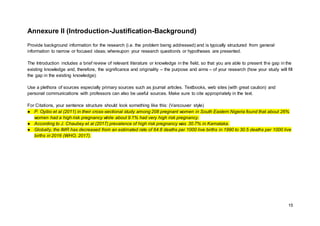
Annexure II (Introduction-Justification-Background)
Provide background information for the research (i.e. the problem being addressed) and is typically structured from general
information to narrow or focused ideas; whereupon your research question/s or hypotheses are presented.
The Introduction includes a brief review of relevant literature or knowledge in the field, so that you are able to present the gap in the
existing knowledge and, therefore, the significance and originality – the purpose and aims – of your research (how your study will fill
the gap in the existing knowledge).
Use a plethora of sources especially primary sources such as journal articles. Textbooks, web sites (with great caution) and
personal communications with professors can also be useful sources. Make sure to cite appropriately in the text.
For Citations, your sentence structure should look something like this: (Vancouver style)
● P. Oyibo et al (2011) in their cross-sectional study among 208 pregnant women in South Eastern Nigeria found that about 26%
women had a high risk pregnancy while about 9.1% had very high risk pregnancy.
● According to J. Chaubey et al (2017) prevalence of high risk pregnancy was 30.7% in Karnataka.
● Globally, the IMR has decreased from an estimated rate of 64.8 deaths per 1000 live births in 1990 to 30.5 deaths per 1000 live
births in 2016 (WHO, 2017).
16
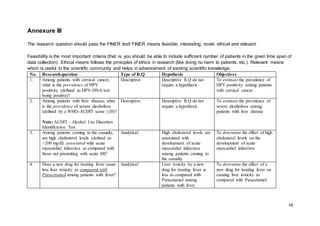
Annexure III
The research question should pass the FINER test! FINER means feasible, interesting, novel, ethical and relevant.
Feasibility is the most important criteria (that is, you should be able to include sufficient number of patients in the given time span of
data collection). Ethical means follows the principles of ethics in research (like doing no harm to patients, etc.). Relevant means
which is useful to the scientific community and helps in advancement of existing scientific knowledge.
No. Researchquestion Type of R.Q Hypothesis Objectives
1. Among patients with cervical cancer,
what is the prevalence of HPV
positivity (defined as HPV-DNA test
being positive)?
Descriptive Descriptive R.Q do not
require a hypothesis
To estimate the prevalence of
HPV positivity among patients
with cervical cancer
2. Among patients with liver disease, what
is the prevalence of severe alcoholism
(defined by a WHO-AUDIT score ≥20)?
Note: AUDIT - Alcohol Use Disorders
Identification Test
Descriptive Descriptive R.Q do not
require a hypothesis
To estimate the prevalence of
severe alcoholism among
patients with liver disease
3. Among patients coming to the casualty,
are high cholesterol levels (defined as
>200 mg/dl) associated with acute
myocardial infarction as compared with
those not presenting with acute MI?
Analytical High cholesterol levels are
associated with
development of acute
myocardial infarction
among patients coming to
the casualty
To determine the effect of high
cholesterol levels on the
development of acute
myocardial infarction
4. Does a new drug for treating fever cause
less liver toxicity as compared with
Paracetamol among patients with fever?
Analytical Liver toxicity by a new
drug for treating fever is
less as compared with
Paracetamol among
patients with fever
To determine the effect of a
new drug for treating fever on
causing liver toxicity as
compared with Paracetamol
17
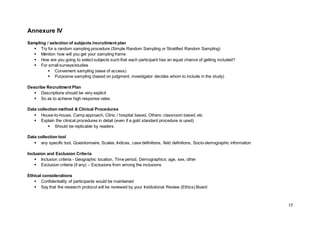
Annexure IV
Sampling / selection of subjects /recruitment plan
 Try for a random sampling procedure (Simple Random Sampling or Stratified Random Sampling)
 Mention how will you get your sampling frame
 How are you going to select subjects such that each participant has an equal chance of getting included?
 For small surveys/studies
 Convenient sampling (ease of access)
 Purposive sampling (based on judgment, investigator decides whom to include in the study)
Describe Recruitment Plan
 Descriptions should be very explicit
 So as to achieve high response rates
Data collection method & Clinical Procedures
 House-to-house, Camp approach, Clinic / hospital based, Others: classroom based, etc
 Explain the clinical procedures in detail (even if a gold standard procedure is used)
 Should be replicable by readers.
Data collection tool
 any specific tool, Questionnaire, Scales, Indices, case definitions, field definitions, Socio-demographic information
Inclusion and Exclusion Criteria
 Inclusion criteria - Geographic location, Time period, Demographics: age, sex, other
 Exclusion criteria (if any) – Exclusions from among the inclusions
Ethical considerations
 Confidentiality of participants would be maintained
 Say that the research protocol will be reviewed by your Institutional Review (Ethics) Board
18
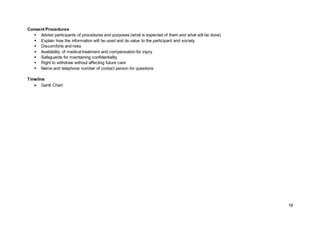
Consent Procedures
 Advise participants of procedures and purposes (what is expected of them and what will be done)
 Explain how the information will be used and its value to the participant and society
 Discomforts and risks
 Availability of medical treatment and compensation for injury
 Safeguards for maintaining confidentiality
 Right to withdraw without affecting future care
 Name and telephone number of contact person for questions
Timeline
 Gantt Chart

Study Proposal format-SRC.docx

  • 1.
    1 Template for StudyProposal (For scientific review committee) How to use this template: The template (the table on page 3) provides ALL the sections, headings and subheadings that you will require in your proposal, as well as the line and paragraph spacing, page breaks, page numbering, referencing system and referencing styles. You should simply type (mostly in column 2) and insert your own text as per your proposal, i.e. simply type into the document (Delete the content of the cells in column 3 as those are the instruction about the particular row and afterwards the space will be used for the review and comments by the review committee.). Do not attempt to change the styles for the headings or subheadings, and do not use more than three level headings (i.e. A main heading, a sub-heading and a sub-sub-heading). Do not type anything in column 3 as the same is made for scientific review committee. WHEN YOU ARE DONE, DELETE THIS FRONT INSTRUCTION PAGE AND THE ANNEXURES (WHICH ARE THERE ONLY FOR THE GUIDANCE) FROM YOUR PROPOSAL Proposaland all related documents should be submitted to as zip file: irb_gmcb@yahoo.com List of documents to be sent by email only: 1. Study Proposal in MS Word format (In the prescribed attached format) 2. Power-point presentation in MS power-point format (Max 10 slides - Title, Aims/Objectives, Methods in detail, Dummy Tables - Only 1 slide of Introduction can be kept in the presentation) 3. Case Record Form in MS Word format 4. Patient Information Sheet & Informed Consent Form in MS Word format (English & Gujarati) 5. Scanned/downloaded copies of relevant/cited articles in .pdf format 6. Dummy tables in MS Word format (with title of the table and also of each row and column)
  • 2.
    2 PROPOSAL FOR THESCIENTIFIC REVIEW Title of the Project/Thesis/Dissertation: Name of the Student/ Principal Investigator: Department(s): Mobile No.: E-mail ID: Name(s) of the PG Guide/Co-investigator(s) : No. Name with Designation Mobile Email 1 2 3
  • 3.
    3 1 Heading 2 Details 3 Instructions / Comments TitleNeither too short nor too long. (Who + Study Design + Where + What) Indicate the study’s design with a commonly used term. Should be concise yet descriptive, informative and catchy. The title may need to be revised after completion of writing of the protocol to reflect more closely the sense of the study. Introduction & review of Literature (Justification) Max 750 words Why do you want to conduct this study? Why are these questions important? What is the existing knowledge in the area? What are the gaps in the existing knowledge?
  • 4.
    4 Were the previousstudies methodologically robust? This section cites previous research that is relevant & indicates the problems and what questions remain Imagine you are writing for a general science reader rather than an expert audience. Never leave your reader in doubt as to the source of your information! Cite thoroughly and cite properly (For Details – Annexure II) Research Question You should be very clear about it as your whole study design will depend on this. What question(s) will the study address?
  • 5.
    5 The research questionshould be clear and answerable by yes/no or a number. The research question should be relevant and address a hypothesis. Examples of research questions: Among children of Bhavnagar district, what is the difference in the level of protection by a new vaccine between vaccinated and non- vaccinated children? (For Details – Annexure III) Aim/Goal 1. What do you want to find at the end of study? It is a statement of the hypothesis, usually derived from the research question. Generally, it is broader than the objectives. For example, to determine whether or not a new vaccine should be incorporated in a public health program.
  • 6.
    6 Objectives: Primary Secondary Research objectives arethe goals to be achieved by conducting the research. The specific objectives relate to the specific research questions the investigator wants to answer through the proposed study and may be presented as primary and secondary objectives, For example - primary: To determine the degree of protection that is attributable to the new vaccine in a study population by comparing the vaccinated and unvaccinated groups. - Secondary: To study the cost-effectiveness of this program. Don’t put too many objectives or over-ambitious objectives that cannot be adequately achieved by the implementation of the protocol. (For Details – Annexure III)
  • 7.
    7 Methodology: Study design/type Onlyname of the design - Cross-sectional, cohort, case control, randomized (or non- randomized) controlled trial, etc. As per CTRI Study population Target population to whom your result will be applied Sample size Number of study participants How the sample size has been fixed/decided? Ideally, a calculated sample size using statistical software Since feasibility is the primary pre- requisite, a convenient sample size can be decided by the investigators Study duration Time required in months (after IRB approval till submission of the thesis/report)
  • 8.
    8 There is nosuch thing as a single “correct” design... hypotheses can be studied by different methods using different designs. Study site / Settings Place of study e.g. Community, hospital, area, village, district, etc.. Study procedures: Details of procedures including study groups, randomization, blinding, Inclusion & exclusion criteria, intervention, follow- up, etc. It is a brief description of the broad research approach (qualitative or quantitative or mixed method) to justify the appropriateness of the proposed research. Research approach and data collection methods must align well with the problem, the research aim and research hypothesis/question. Proposed research approach and methods of data collection must be appropriate to the research aim. Brief outline of the research setting, methods of data collection (example survey, qualitative
  • 9.
    9 interviews etc.), whothe participants would be and a brief explanation of how participants will be selected (sampling technique) and accessed. What processes are you going to use? What kind of equipment and supplies will be necessary for the project? What will you use for a control, and what will be your replicate? Be thorough, but avoid unnecessary and non-relevant description. If this research is a part of a bigger research project, provide a brief description of the overall research project and a brief explanation of how this proposed research fits into the bigger research project. (For Details – Annexure IV)
  • 10.
    10 Outcome, exposure and confounding variables Identifythe key variables of the study and their method of measurement and unit of measurement must be clearly indicated. Four types of variables are important in research. a. Independent variables: variables that are manipulated or treated in a study in order to see what effect differences in them will have on those variables proposed as being dependent on them. The different Synonyms for the term ‘independent variable’ which are used in literature are: cause, input, predisposing factor, risk factor, determinant, antecedent, characteristic and attribute. b. Dependent variables: variables in which changes will be measured. Synonyms: effect, outcome, consequence, result, condition,
  • 11.
    11 disease, sensitivity/specificity ofa test c. Confounding or intervening variables: variables that should be studied because they may influence or ‘mix’ the effect of the independent variables. For instance, in a study of the effect of measles (independent variable) on child mortality (dependent variable), the nutritional status of the child may play an intervening (confounding) role. d. Background variables: variables that are so often of relevance in investigations of groups or populations that they should be considered for possible inclusion in the study. For example, sex, age, ethnic origin, education, marital status, social status etc. The objective of research is usually to determine the effect of changes in one or more
  • 12.
    12 independent variables onone or more dependent variables. For example, a study may ask "Will alcohol intake (independent variable) have an effect on development of gastric ulcer (dependent variable)?" Dummy table Not here Include this in power point presentation. List of References As per Vancouver style: You can use mendeley, zotero, endnote, software for reference management.
  • 13.
    13 Annexure – I RESEARCHPROTOCOL TITLE: PICO – Population + Intervention + Comparison + Outcome BACKGROUND AND JUSTIFICATION: existing knowledge – gaps in knowledge – present study is going to fill these gaps RESEARCH QUESTION: FINER – Feasible Innovative Novel Ethical Relevant OBJECTIVES: SMART – Specific Measurable Achievable Relevant Time-bound RESULTS FROM PILOT STUDY (if conducted): STUDY DESIGN: cross-sectional / case-control / cohort / Randomized Control Trial / qualitative designs (focused group discussion / in-depth interview / participatory methods) STUDY SETTING: community / hospital (ward or OPD) / urban slum / village / district STUDY PERIOD: mention duration with month and year SAMPLE SIZE: calculated with the help of Epi Info software SAMPLING / SELECTION OF SUBJECTS / RECRUITMENT PLAN: random sampling / non-random sampling / method of selection of cases or subjects DATA COLLECTION METHOD: house-to-house / camp approach / clinic based / classroom / conference gathering / group approach CLINICAL PROCEDURES / INVESTIGATIONS (if any): explain in detail VARIABLES: outcome variables / exposure variables / confounders
  • 14.
    14 DATA COLLECTION TOOL:any specific tool / questionnaire / scales / indices / case definitions / field definitions FLOW CHART OF METHODOLOGY: QUALITY ASSURANCE: standardized instruments, validated tools, training, software INCLUSION CRITERIA: age, gender, specific diseases, specific exposures, etc. EXCLUSION CRITERIA (if any): e.g. advanced stages of cancer, known cases, etc. STATISTICAL ANALYSIS: software, dummy tables, statistical tests ETHICAL CONSIDERATIONS: Confidentiality / IRB approval / written or verbal informed consent TIMELINE: Gantt chart REFERENCES: Vancouver Style BUDGET: reasonable, well-searched, justified; avoid honorarium for PI / co-PI BIOGRAPHIES OF PIS / CO-PIS: brief, list of relevant projects / publications
  • 15.
    15 Annexure II (Introduction-Justification-Background) Providebackground information for the research (i.e. the problem being addressed) and is typically structured from general information to narrow or focused ideas; whereupon your research question/s or hypotheses are presented. The Introduction includes a brief review of relevant literature or knowledge in the field, so that you are able to present the gap in the existing knowledge and, therefore, the significance and originality – the purpose and aims – of your research (how your study will fill the gap in the existing knowledge). Use a plethora of sources especially primary sources such as journal articles. Textbooks, web sites (with great caution) and personal communications with professors can also be useful sources. Make sure to cite appropriately in the text. For Citations, your sentence structure should look something like this: (Vancouver style) ● P. Oyibo et al (2011) in their cross-sectional study among 208 pregnant women in South Eastern Nigeria found that about 26% women had a high risk pregnancy while about 9.1% had very high risk pregnancy. ● According to J. Chaubey et al (2017) prevalence of high risk pregnancy was 30.7% in Karnataka. ● Globally, the IMR has decreased from an estimated rate of 64.8 deaths per 1000 live births in 1990 to 30.5 deaths per 1000 live births in 2016 (WHO, 2017).
  • 16.
    16 Annexure III The researchquestion should pass the FINER test! FINER means feasible, interesting, novel, ethical and relevant. Feasibility is the most important criteria (that is, you should be able to include sufficient number of patients in the given time span of data collection). Ethical means follows the principles of ethics in research (like doing no harm to patients, etc.). Relevant means which is useful to the scientific community and helps in advancement of existing scientific knowledge. No. Researchquestion Type of R.Q Hypothesis Objectives 1. Among patients with cervical cancer, what is the prevalence of HPV positivity (defined as HPV-DNA test being positive)? Descriptive Descriptive R.Q do not require a hypothesis To estimate the prevalence of HPV positivity among patients with cervical cancer 2. Among patients with liver disease, what is the prevalence of severe alcoholism (defined by a WHO-AUDIT score ≥20)? Note: AUDIT - Alcohol Use Disorders Identification Test Descriptive Descriptive R.Q do not require a hypothesis To estimate the prevalence of severe alcoholism among patients with liver disease 3. Among patients coming to the casualty, are high cholesterol levels (defined as >200 mg/dl) associated with acute myocardial infarction as compared with those not presenting with acute MI? Analytical High cholesterol levels are associated with development of acute myocardial infarction among patients coming to the casualty To determine the effect of high cholesterol levels on the development of acute myocardial infarction 4. Does a new drug for treating fever cause less liver toxicity as compared with Paracetamol among patients with fever? Analytical Liver toxicity by a new drug for treating fever is less as compared with Paracetamol among patients with fever To determine the effect of a new drug for treating fever on causing liver toxicity as compared with Paracetamol
  • 17.
    17 Annexure IV Sampling /selection of subjects /recruitment plan  Try for a random sampling procedure (Simple Random Sampling or Stratified Random Sampling)  Mention how will you get your sampling frame  How are you going to select subjects such that each participant has an equal chance of getting included?  For small surveys/studies  Convenient sampling (ease of access)  Purposive sampling (based on judgment, investigator decides whom to include in the study) Describe Recruitment Plan  Descriptions should be very explicit  So as to achieve high response rates Data collection method & Clinical Procedures  House-to-house, Camp approach, Clinic / hospital based, Others: classroom based, etc  Explain the clinical procedures in detail (even if a gold standard procedure is used)  Should be replicable by readers. Data collection tool  any specific tool, Questionnaire, Scales, Indices, case definitions, field definitions, Socio-demographic information Inclusion and Exclusion Criteria  Inclusion criteria - Geographic location, Time period, Demographics: age, sex, other  Exclusion criteria (if any) – Exclusions from among the inclusions Ethical considerations  Confidentiality of participants would be maintained  Say that the research protocol will be reviewed by your Institutional Review (Ethics) Board
  • 18.
    18 Consent Procedures  Adviseparticipants of procedures and purposes (what is expected of them and what will be done)  Explain how the information will be used and its value to the participant and society  Discomforts and risks  Availability of medical treatment and compensation for injury  Safeguards for maintaining confidentiality  Right to withdraw without affecting future care  Name and telephone number of contact person for questions Timeline  Gantt Chart