SCHOOL OF ARCHITECTURE, BUILDING AND
DESIGN
Bachelor of Quantity Surveying (Honours)
RESEARCH PROPOSAL
THE PERCEPTION OF VALUE
MANAGEMENT IN THE BRUNEIAN
CONSTRUCTION INDUSTRY
STUDENT NAME: HAJI MUHD SYAFIQ BIN HJ ABD ZARIFUL
STUDENT ID NO.: 0314702
SUPERVISOR: PUAN AZRINA MD YAAKOB
DATE OF SUBMISSION: 25th May 2017
2
TABLE OF CONTENT
CHAPTER 1
PAGE
LIST OF FIGURES 3
LIST OF TABLES 4
CHAPTER
1.1 BACKGROUND OF STUDY……………………………………………..... 5
1.2 PROBLEM STATEMENT………………………………………………...... 8
1.3 PREVIOUS SIMILAR STUDIES…………………………………………... 9
1.4 RESEARCH QUESTIONS………………………………………………... 10
1.5 RESEARCH OBJECTIVES……………………………………………….. 11
1.6 SCOPE AND LIMITATIONS……………………………………………... 11
1.7 IMPORTANCE OF RESEARCH FINDINGS…………………………….. 12
1.8 RESEARCH DESIGN……………………………………………………... 13
1.9 RESEARCH PROGRAMME……………………………………………… 14
1.10 STRUCTURE OF THESIS………………………………………………... 16
1.11 REFERENCE………………………………………………………………….
3
List of Figures
Figure 1 – Conventional vs VM approach
4
List of Tables
Table 1 – Research Design
Table 2 – Research Programme Semester 5
Table 3 – Research Programme Semester 6
5
CHAPTER 1
INTRODUCTION
1.1 Background of study
The construction industry faces frequent challenges and demands, due to
market conditions and coercion by means of governments, for improvements in
safety, quality and cost control, and in avoidance of contractual disputes. To meet
these challenges contruction enterprises need to constantly seek new directions and
business models in construction management, A number of tools, methods and
concepts have been developed and advocated as aids to achieving performance, but
many in the industry find them confusing or are sceptical of their relevance
(McGeorge & Palmer, 2002). Value Management (VM) brings a different kind of
aspect that can help with the raising demand of clients on improving value in
construction projects.
Value Management is defined as a rigorous, systematic and innovative
methodology with multi disciplinary approach to achieve better value and cost
optimization for projects, products, facilities, systems and services without
sacrificing the required performance (Che Mat, M.M 2004). It is critical to the
success of projects as it provides a basis for improving value for money in
construction (Ashworth & Hogg 2000). It involves representatives of key
6
stakeholders in facilitated workshop (New South Wales Department of Public Works
and Services 1997). Maximum value as defined by Burt, M. E. (1975) is obtained
from a required level of quality at least cost, the highest level of quality for a given
cost or from an optimum compromised between the two (Kelly, Male & Graham
2004). This definition highlights the relationship between value, quality and cost.
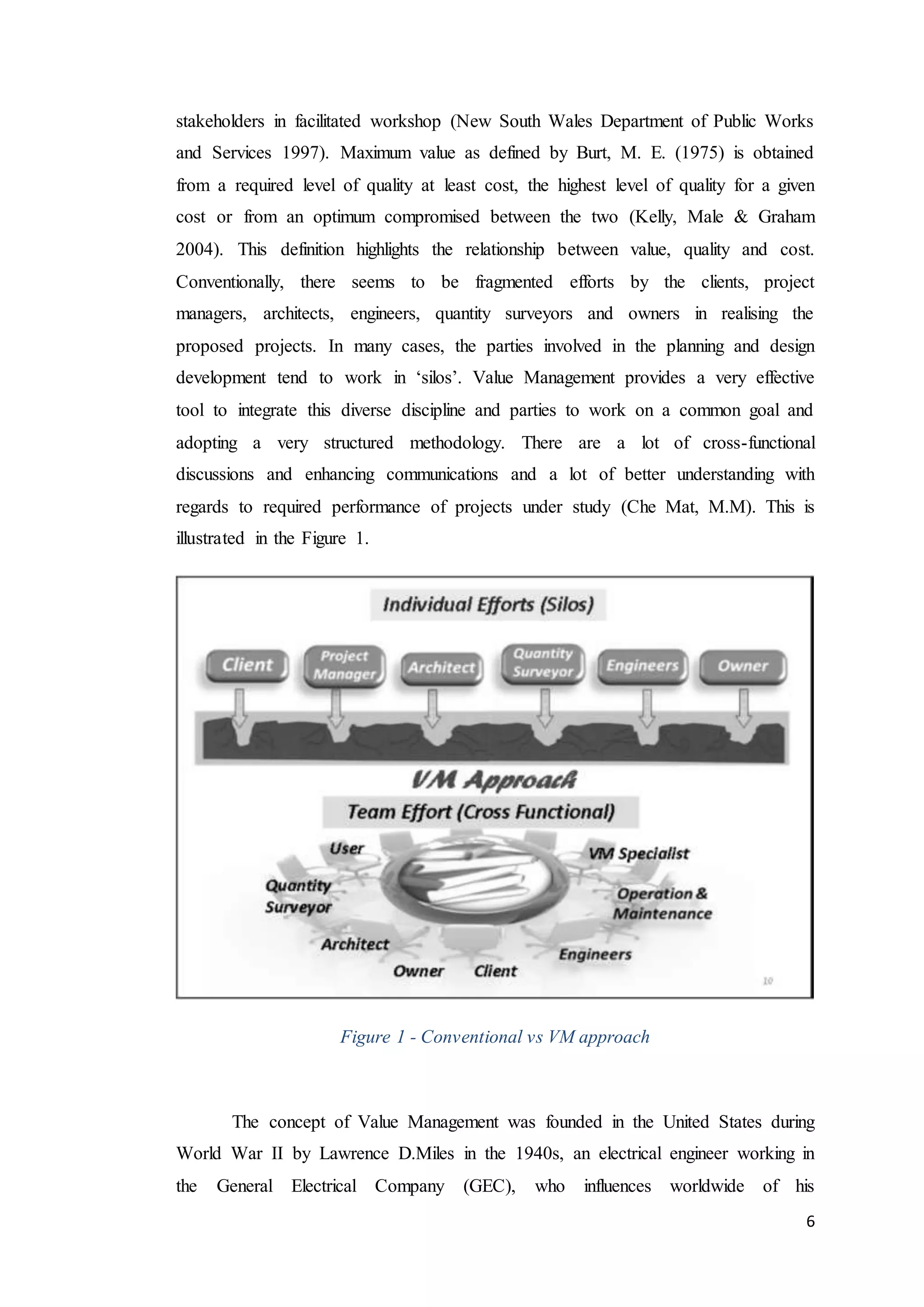
Conventionally, there seems to be fragmented efforts by the clients, project
managers, architects, engineers, quantity surveyors and owners in realising the
proposed projects. In many cases, the parties involved in the planning and design
development tend to work in ‘silos’. Value Management provides a very effective
tool to integrate this diverse discipline and parties to work on a common goal and
adopting a very structured methodology. There are a lot of cross-functional
discussions and enhancing communications and a lot of better understanding with
regards to required performance of projects under study (Che Mat, M.M). This is
illustrated in the Figure 1.
Figure 1 - Conventional vs VM approach
The concept of Value Management was founded in the United States during
World War II by Lawrence D.Miles in the 1940s, an electrical engineer working in
the General Electrical Company (GEC), who influences worldwide of his
7
understanding of the problem by means of substituting raw materials which in turn
provides equal or better performance at a lower cost. The use of the concept further
developed during the 1940s and 1950s and grew within the USA, becoming a
procedure that could be used during the design or engineering stages (Ashworth,
Hogg, & Higgs 2013). The process originated in the manufacturing industry and has
been incorporated by the US Department of Defence into the delivery of its large-
scale construction programme. In the early 1980s, applications of Value
Management were widely used in the UK and Europe ever since the term was first
adopted by the US General Administrations. After that, Value Management is very
much accepted in other industries such as Japan, Korea, Australia and Saudi Arabia
(Che Mat, M.M). Japan view Value Management as a philosophy rather than a
system (McGeorge & Palmer, 2002).
It has then been introduced in Brunei Darussalam in the year 1999-2000 by
Che Mat M.M. In the year 1990, Malaysia, Professor Roy Barton and Mohd Mazlan
Che Mat, went to the Petronas, The Ministry of Defense as well as to private
companies to introduce Value Management concept to the organisations. Seminars
were also arranged to disseminate the knowledge and to create awareness to the
Value Management concept. Mohd Mazlan made a study visit to Australia in order to
take a closer look into the Value Management Methodology and its implementation
process. He was offered to advice and service the local construction and
manufacturing industry and at the same time to spread the awareness towards Value
Management. It was then strongly adviced by Tun Daim Zainudin, of IKRAM(JKR),
where he suggested the industry to take up Value Management on board due to the
benefits offered by means of the concept during the first National Seminar on Value
Management. In the same year, to ensure that the construction industry and its public
are aware towards the concept and benefits of Value Management, Mohd Mazlan
went to 5 states, Penang, Johor, Kuala Lumpur, Sabah and Kuala Terengganu and
later went to Brunei Darussalam to disseminate the Value Management knowledge
by giving seminars and talks to the related organizations.
8
1.2 Problem statement
Internationally, Value Management has been recognized as an emerging
paradigm that focuses on continuously increasing the value provided to the client and
is widely accepted as an important tool in recent management of construction
projects (Elis, Wood. Et al 2005). Nowadays in construction, the majority of the
customers are concerned with achieving value for money in their constuciton
projects. In response to this demand, a developed number of companies claim to
offer VM as a service, however there is a confusion what actually comprise the VM
with some commentators going as far as questioning whether VM differ from the
established produce of cost management (Green, 1992). Concepts and applications of
VM do not seem to be well embraced in the construction industry in some countries.
VM is rarely applied in Southeast Asia construction industry (Cheah and Ting,
2005). It is still in its infancy and has not been well accepted (Jaapar et al., 2009; Li
and Ma, 2012).
Despite Value Management being introduced in the Bruneian construction
industry in 1999-2000 when Mohd Mazlan Che Mat came to disseminate the
knowledge (Che Mat, M.M 2004), the application of this management approach is
still not as well known and is not applied to its full potential. Although there is some
evidence of VM applications in the construction industry, regardless it is still not so
popular even after more than 15 years since it was introduced.
According to Ashworth and Hogg (2000), claims that a 1% fee on
construction cost, it is possible that a total saving between 10%-15% on construction
costs can be achieved. This term has been successfully proven mostly in the UK and
Europe so questions arise when countries in Southeast asia are not implementing VM
despite its benefits. This management approach faces problems as to why the
application is not widely adopted but limited resources for addressing those
problems. Thus, in order to promote the application of VM in Brunei Darussalam,
the problem factors of Value Management application should be effectively
9
identified and also to study the interpretations to these problems. This research paper
furthermore aims to understand how the design team cogitates Value Management in
Bruneian construction industry.
1.3 Previous Similar Studies
There have been researchers, who have done studies on Value Management
regarding its misconceptions, comparisons, awareness, etc. A similar study of
“Barriers to Applying Value Management in the Vietnamese Construction Industry”
was conducted by Soo-Yong Kim, Yeon-San Lee, Viet Thanh Nguyen and Van
Truong Luu (2016), where the aim of the study is to identify the hindrance factors
and assess the degree to which each factor hinders the application of VM in the
construction industry and to investigate the underlying relationships between these
factors. The study was made specifically to the Vietnamese construction industry
where the data collected by surveys identifies 18 hindrance factors. The findings of
this study can help practitioners in the Vietnamese construction industry to assess the
status of and barriers to applying VM so they can identify appropriate strategies for
their organisations to implement VM procedures. This includes recommendations
which were provided to further develop and promote VM in the construction
industry.
Additionally, a reseach study entitled “Minimizing The Factors Hindering
The Practice Of Value Management In The Nigerian Construction Industry” which
was conducted by B.Y. Sabiu, Prof V.C.Agarwal (2016), also studies on the
hindrance factors of Value Management practice. The study was made specifically
for the Nigerian construction industry where the data was collected from
professionals in construction and consultant firms which involves quantity surveyors,
architects, engineers in Nigeria. The objective of the stsudy is to identify the factors
hindering the adoption/implementation/practice of value management; to assess the
factors hindering the practice of value management; and to proffer ways to minimize
10
the factors hindering the practice of VM in the Nigerian construction industry. It was
concluded that their study shows 29 factors hindering the VM practice where it is
stated in the conclusion that ‘it can also be observed that value management is not
being practiced in the Nigerian construction industries’. So many efforts have to be
put from various sectors in order to facilitate the adoption of value management in
the Nigerian construction industry. This will help to produce and give clients their
value for money spent on their projects and hence boost the industry and the nation’s
economy at large.
1.4 Research Questions
The primary research questions are:
i) Why is VM not widely used in the Bruneian construction industry?
ii) What are the solutions to VM adaptation?
iii) How do the design team view Value Management practice in the Bruneian
construction industry?
11
1.5 Research Objectives
The study aims to achieve the following objectives:
i) To investigate why VM is not widely used in the Bruneian construction
industry.
ii) To explore the solutions to why VM is not widely adopted.
iii) To identify the design team’s perception towards value management in
Bruneian construction industry.
1.6 Scope and Limitation
The targeted respondents of this study are people in the design team and they
are architects, quantity surveyors and engineers. The reasons for choosing the design
team is because they are the parties who play a big part of conducting the Value
Management practice and lack of experience or knowledge from either one party can
affect the whole practice which can simply result to a cost cutting exercise and
failure of Value Management application. The location of the study will take place in
Brunei Darussalam, where the analysis of the problems and solutions of VM
implementation will be conducted following the perception of the design team
towards Value Management in the Bruneian construction industry.
Visualised limitations are the difficulties to generate effective responses
given the amount of different categories of respondents (architects, quantity
surveyors and engineers) required during the period of collecting data. There is also a
12
minor difficulty in conducting the study in Brunei Darussalam where as a student of
Taylor’s University Lakeside Campus in Malaysia, have limited time to interview
and survey the targeted respondents in the area.
1.7 Importance of Research Findings
Recent studies on Value Management shows that southeast asian countries
such as Malaysia, China and Vietnam rarely implement VM practice in the
construction industry. The research study aims to investigate this issue in Brunei
Darussalam where it includes solutions/recommendations/suggestions that would
strategically tackle these challenges.
Brunei Darussalam is sometimes overlooked when it comes to spreading the
knowledge of Value Management. There often happens to have VM workshop
trainings/seminars around the country such as Australia, Malaysia and China in
recent years. Brunei however needs to address this growing trend of construction
industries from other countries being encouraged to adopt Value Management given
its benefits when used properly to its potential. Therefore, there is a need to study the
perception of how the design team considers Value Management in the Brunei
Darussalam construction industry with the support analysis of understanding the
problems of why it is not implemented and also the solutions of how to tackle these
problems.
13
1.8 Research Design
OBJECTIVES TYPES OF DATA SOURCES OF
DATA
METHOD OF
COLLECTION
1. To investigate why
VM is not widely used
in the Bruneian
construction
industries.
The problems faced that
prevents the application of
Value Management.
Articles
Books
Journals
Websites
Reading
Questionnaires
Analysis
2. To explore the
solutions to why VM
is not widely adopted.
The solutions that can face
the problems that prevents
the application of Value
Management.
Articles
Books
Journals
Websites
Reading
Questionnaires
Analysis
3. To identify the
design team’s
perception towards
value management in
Brunei Darussalam.
Evaluate the level of
perception of the design
team after understanding the
problems and solutions
mentioned in objective 1
and 2. The level of
perception should be on a
scale of whether to consider
applying VM or not.
Articles
Journals
Websites
Reading
Questionnaires
Analysis
Table 1 - Research Design
14
1.9 Research Programme
Activity
Semester 5
Month
April May June July
1 2 3 4 5 6 7 8 9 10 11 12 13 14 15
Research
Proposal
Selection of
topic and
identifying
research
objectives
Reading and
Research
Drafting
overview
Drafting of
programme
Review of
draft
Corrections
Finalizing
and
referencing
Submission
of Research
Proposal
Literature
Review
Drafting of
Literature
review and
development
Referencing
Review of
draft
Corrections
Finalizing
and
referencing
Submission
of Literature
Review
Table 2 - Research Programme Semester 5
15
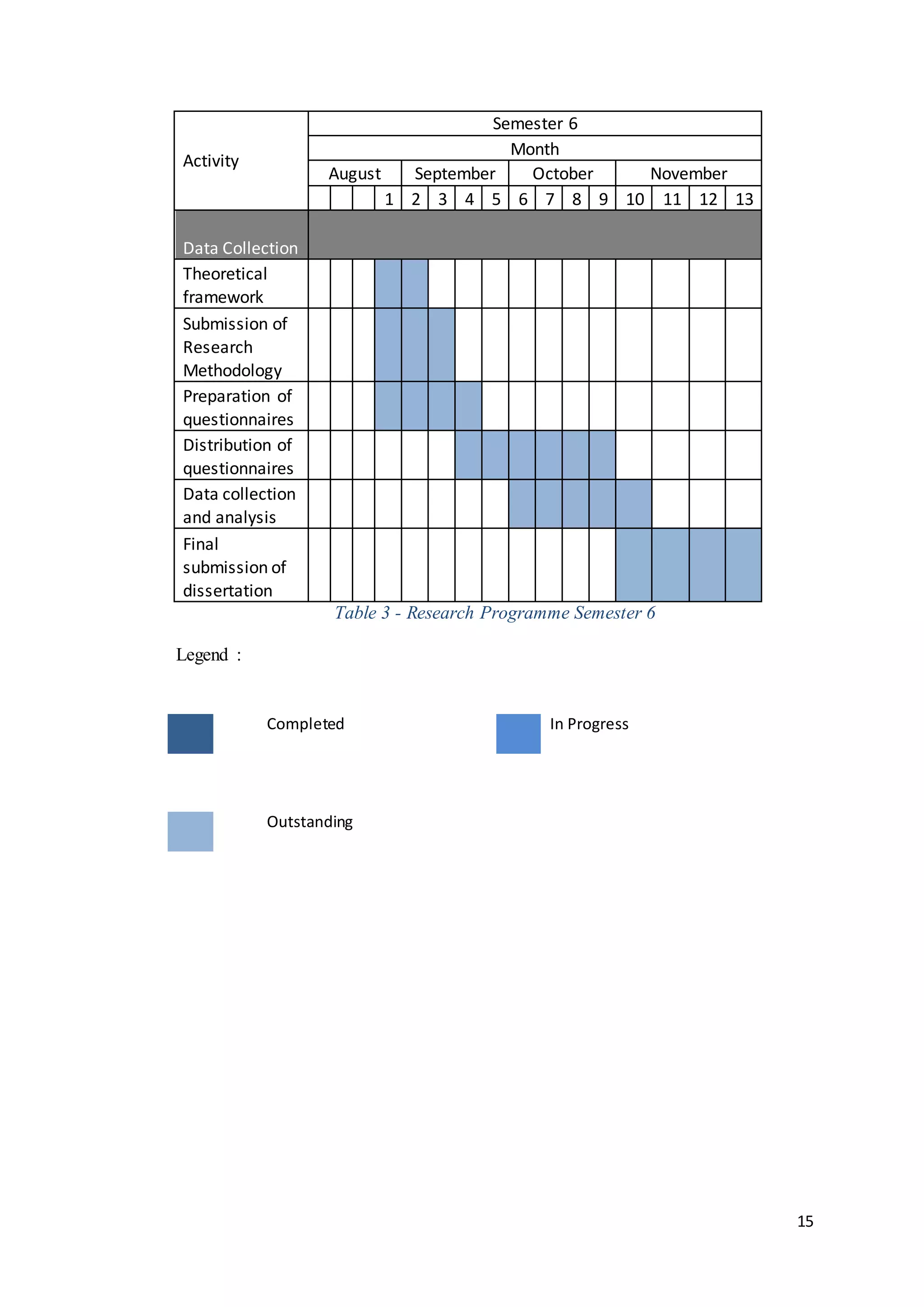
Activity
Semester 6
Month
August September October November
1 2 3 4 5 6 7 8 9 10 11 12 13
Data Collection
Theoretical
framework
Submission of
Research
Methodology
Preparation of
questionnaires
Distribution of
questionnaires
Data collection
and analysis
Final
submission of
dissertation
Table 3 - Research Programme Semester 6
Legend :
Completed In Progress
Outstanding
16
1.10 Structure of Thesis
Chapter 1 consists of the general overview of the research which
involves the introduction, background of the study, research problem
statement, research questions as well as the objectives, scope and
limitation, the importance of research findings, research design and
research programme.
Chapter 2 is dedicated to the review of literature which contains
detailed explanation of the objectives of this study. This literature review
will highlight the problems and solutions of VM implementation as well
as the perception of the design team towards implementing it in the
Brunei Darussalam construction industry.
Chapter 3 will show the research methodology of this study,
which summarizes the selected research design, data resources,
procedures utilized in the study and the data gathering method for the
further analysis of the research.
17
Chapter 4 illustrates the analysis of data from the questionnaires
and interviews that are obtained. The information obtained shall be
summarized in the form of graphs or figures which will lead to the
written conclusion of the study
Chapter 5 is the last chapter which concludes the research
findings, giving the reader an evaluation of the whole research and what
the design team perceive towards VM application with the
recommendations for further studies.
18
1.11 Reference
 Denny McGeorge and Angela Palmer (2002). Construction Management:
New Directions. 2nd ed. Oxford: Blackwell Science, 2002. Print.
 Che Mat, M.M. Value Management – The Way Forward. Retrieved from
http://vm-academy.com/lifeCycleValueMgmt.pdf
 Li, X. and Ma, W. (2012). Appraisal of Value Engineering Application to
Construction Industry in China.
 Green, S.D. (1992). A SMART Methodology for Value Management
 Soo-Yong Kim, Yeon-San Lee, Viet Thanh Nguyen and Van Truong Luu.
(2016). Barriers to applying value management in the Vietnamese construction
industry. Journal of Construction in Developing Countries, 21(2): 55-80.
https://dx.doi.org/10.21315/jcdc2016.21.2.4
 Sabiu, Prof V.C. Agarwal (2016). Minimizing the Factos Hindering the
Practice of Value Management in the Nigerian Construction Industry, 5(10)
 N.S. Lop, M.A.M Apandi, I.F.M. Kamar, N.M. Salleh, S.Mamter, N.A.M.
Hamdam (2014). Identifying the Level of Awareness on Value Management Practice
amongst Construction Developers. Doi: 10.1051/matecconf/20141501029
 Allan Ashworth, Keith Hogg, Catherine Higgs, (2013). Willi’s Practice and
Procedure for the Quantity Surveyor (13th
Edition)

Research proposal final draft

  • 1.
    SCHOOL OF ARCHITECTURE,BUILDING AND DESIGN Bachelor of Quantity Surveying (Honours) RESEARCH PROPOSAL THE PERCEPTION OF VALUE MANAGEMENT IN THE BRUNEIAN CONSTRUCTION INDUSTRY STUDENT NAME: HAJI MUHD SYAFIQ BIN HJ ABD ZARIFUL STUDENT ID NO.: 0314702 SUPERVISOR: PUAN AZRINA MD YAAKOB DATE OF SUBMISSION: 25th May 2017
  • 2.
    2 TABLE OF CONTENT CHAPTER1 PAGE LIST OF FIGURES 3 LIST OF TABLES 4 CHAPTER 1.1 BACKGROUND OF STUDY……………………………………………..... 5 1.2 PROBLEM STATEMENT………………………………………………...... 8 1.3 PREVIOUS SIMILAR STUDIES…………………………………………... 9 1.4 RESEARCH QUESTIONS………………………………………………... 10 1.5 RESEARCH OBJECTIVES……………………………………………….. 11 1.6 SCOPE AND LIMITATIONS……………………………………………... 11 1.7 IMPORTANCE OF RESEARCH FINDINGS…………………………….. 12 1.8 RESEARCH DESIGN……………………………………………………... 13 1.9 RESEARCH PROGRAMME……………………………………………… 14 1.10 STRUCTURE OF THESIS………………………………………………... 16 1.11 REFERENCE………………………………………………………………….
  • 3.
    3 List of Figures Figure1 – Conventional vs VM approach
  • 4.
    4 List of Tables Table1 – Research Design Table 2 – Research Programme Semester 5 Table 3 – Research Programme Semester 6
  • 5.
    5 CHAPTER 1 INTRODUCTION 1.1 Backgroundof study The construction industry faces frequent challenges and demands, due to market conditions and coercion by means of governments, for improvements in safety, quality and cost control, and in avoidance of contractual disputes. To meet these challenges contruction enterprises need to constantly seek new directions and business models in construction management, A number of tools, methods and concepts have been developed and advocated as aids to achieving performance, but many in the industry find them confusing or are sceptical of their relevance (McGeorge & Palmer, 2002). Value Management (VM) brings a different kind of aspect that can help with the raising demand of clients on improving value in construction projects. Value Management is defined as a rigorous, systematic and innovative methodology with multi disciplinary approach to achieve better value and cost optimization for projects, products, facilities, systems and services without sacrificing the required performance (Che Mat, M.M 2004). It is critical to the success of projects as it provides a basis for improving value for money in construction (Ashworth & Hogg 2000). It involves representatives of key
  • 6.
    6 stakeholders in facilitatedworkshop (New South Wales Department of Public Works and Services 1997). Maximum value as defined by Burt, M. E. (1975) is obtained from a required level of quality at least cost, the highest level of quality for a given cost or from an optimum compromised between the two (Kelly, Male & Graham 2004). This definition highlights the relationship between value, quality and cost. Conventionally, there seems to be fragmented efforts by the clients, project managers, architects, engineers, quantity surveyors and owners in realising the proposed projects. In many cases, the parties involved in the planning and design development tend to work in ‘silos’. Value Management provides a very effective tool to integrate this diverse discipline and parties to work on a common goal and adopting a very structured methodology. There are a lot of cross-functional discussions and enhancing communications and a lot of better understanding with regards to required performance of projects under study (Che Mat, M.M). This is illustrated in the Figure 1. Figure 1 - Conventional vs VM approach The concept of Value Management was founded in the United States during World War II by Lawrence D.Miles in the 1940s, an electrical engineer working in the General Electrical Company (GEC), who influences worldwide of his
  • 7.
    7 understanding of theproblem by means of substituting raw materials which in turn provides equal or better performance at a lower cost. The use of the concept further developed during the 1940s and 1950s and grew within the USA, becoming a procedure that could be used during the design or engineering stages (Ashworth, Hogg, & Higgs 2013). The process originated in the manufacturing industry and has been incorporated by the US Department of Defence into the delivery of its large- scale construction programme. In the early 1980s, applications of Value Management were widely used in the UK and Europe ever since the term was first adopted by the US General Administrations. After that, Value Management is very much accepted in other industries such as Japan, Korea, Australia and Saudi Arabia (Che Mat, M.M). Japan view Value Management as a philosophy rather than a system (McGeorge & Palmer, 2002). It has then been introduced in Brunei Darussalam in the year 1999-2000 by Che Mat M.M. In the year 1990, Malaysia, Professor Roy Barton and Mohd Mazlan Che Mat, went to the Petronas, The Ministry of Defense as well as to private companies to introduce Value Management concept to the organisations. Seminars were also arranged to disseminate the knowledge and to create awareness to the Value Management concept. Mohd Mazlan made a study visit to Australia in order to take a closer look into the Value Management Methodology and its implementation process. He was offered to advice and service the local construction and manufacturing industry and at the same time to spread the awareness towards Value Management. It was then strongly adviced by Tun Daim Zainudin, of IKRAM(JKR), where he suggested the industry to take up Value Management on board due to the benefits offered by means of the concept during the first National Seminar on Value Management. In the same year, to ensure that the construction industry and its public are aware towards the concept and benefits of Value Management, Mohd Mazlan went to 5 states, Penang, Johor, Kuala Lumpur, Sabah and Kuala Terengganu and later went to Brunei Darussalam to disseminate the Value Management knowledge by giving seminars and talks to the related organizations.
  • 8.
    8 1.2 Problem statement Internationally,Value Management has been recognized as an emerging paradigm that focuses on continuously increasing the value provided to the client and is widely accepted as an important tool in recent management of construction projects (Elis, Wood. Et al 2005). Nowadays in construction, the majority of the customers are concerned with achieving value for money in their constuciton projects. In response to this demand, a developed number of companies claim to offer VM as a service, however there is a confusion what actually comprise the VM with some commentators going as far as questioning whether VM differ from the established produce of cost management (Green, 1992). Concepts and applications of VM do not seem to be well embraced in the construction industry in some countries. VM is rarely applied in Southeast Asia construction industry (Cheah and Ting, 2005). It is still in its infancy and has not been well accepted (Jaapar et al., 2009; Li and Ma, 2012). Despite Value Management being introduced in the Bruneian construction industry in 1999-2000 when Mohd Mazlan Che Mat came to disseminate the knowledge (Che Mat, M.M 2004), the application of this management approach is still not as well known and is not applied to its full potential. Although there is some evidence of VM applications in the construction industry, regardless it is still not so popular even after more than 15 years since it was introduced. According to Ashworth and Hogg (2000), claims that a 1% fee on construction cost, it is possible that a total saving between 10%-15% on construction costs can be achieved. This term has been successfully proven mostly in the UK and Europe so questions arise when countries in Southeast asia are not implementing VM despite its benefits. This management approach faces problems as to why the application is not widely adopted but limited resources for addressing those problems. Thus, in order to promote the application of VM in Brunei Darussalam, the problem factors of Value Management application should be effectively
  • 9.
    9 identified and alsoto study the interpretations to these problems. This research paper furthermore aims to understand how the design team cogitates Value Management in Bruneian construction industry. 1.3 Previous Similar Studies There have been researchers, who have done studies on Value Management regarding its misconceptions, comparisons, awareness, etc. A similar study of “Barriers to Applying Value Management in the Vietnamese Construction Industry” was conducted by Soo-Yong Kim, Yeon-San Lee, Viet Thanh Nguyen and Van Truong Luu (2016), where the aim of the study is to identify the hindrance factors and assess the degree to which each factor hinders the application of VM in the construction industry and to investigate the underlying relationships between these factors. The study was made specifically to the Vietnamese construction industry where the data collected by surveys identifies 18 hindrance factors. The findings of this study can help practitioners in the Vietnamese construction industry to assess the status of and barriers to applying VM so they can identify appropriate strategies for their organisations to implement VM procedures. This includes recommendations which were provided to further develop and promote VM in the construction industry. Additionally, a reseach study entitled “Minimizing The Factors Hindering The Practice Of Value Management In The Nigerian Construction Industry” which was conducted by B.Y. Sabiu, Prof V.C.Agarwal (2016), also studies on the hindrance factors of Value Management practice. The study was made specifically for the Nigerian construction industry where the data was collected from professionals in construction and consultant firms which involves quantity surveyors, architects, engineers in Nigeria. The objective of the stsudy is to identify the factors hindering the adoption/implementation/practice of value management; to assess the factors hindering the practice of value management; and to proffer ways to minimize
  • 10.
    10 the factors hinderingthe practice of VM in the Nigerian construction industry. It was concluded that their study shows 29 factors hindering the VM practice where it is stated in the conclusion that ‘it can also be observed that value management is not being practiced in the Nigerian construction industries’. So many efforts have to be put from various sectors in order to facilitate the adoption of value management in the Nigerian construction industry. This will help to produce and give clients their value for money spent on their projects and hence boost the industry and the nation’s economy at large. 1.4 Research Questions The primary research questions are: i) Why is VM not widely used in the Bruneian construction industry? ii) What are the solutions to VM adaptation? iii) How do the design team view Value Management practice in the Bruneian construction industry?
  • 11.
    11 1.5 Research Objectives Thestudy aims to achieve the following objectives: i) To investigate why VM is not widely used in the Bruneian construction industry. ii) To explore the solutions to why VM is not widely adopted. iii) To identify the design team’s perception towards value management in Bruneian construction industry. 1.6 Scope and Limitation The targeted respondents of this study are people in the design team and they are architects, quantity surveyors and engineers. The reasons for choosing the design team is because they are the parties who play a big part of conducting the Value Management practice and lack of experience or knowledge from either one party can affect the whole practice which can simply result to a cost cutting exercise and failure of Value Management application. The location of the study will take place in Brunei Darussalam, where the analysis of the problems and solutions of VM implementation will be conducted following the perception of the design team towards Value Management in the Bruneian construction industry. Visualised limitations are the difficulties to generate effective responses given the amount of different categories of respondents (architects, quantity surveyors and engineers) required during the period of collecting data. There is also a
  • 12.
    12 minor difficulty inconducting the study in Brunei Darussalam where as a student of Taylor’s University Lakeside Campus in Malaysia, have limited time to interview and survey the targeted respondents in the area. 1.7 Importance of Research Findings Recent studies on Value Management shows that southeast asian countries such as Malaysia, China and Vietnam rarely implement VM practice in the construction industry. The research study aims to investigate this issue in Brunei Darussalam where it includes solutions/recommendations/suggestions that would strategically tackle these challenges. Brunei Darussalam is sometimes overlooked when it comes to spreading the knowledge of Value Management. There often happens to have VM workshop trainings/seminars around the country such as Australia, Malaysia and China in recent years. Brunei however needs to address this growing trend of construction industries from other countries being encouraged to adopt Value Management given its benefits when used properly to its potential. Therefore, there is a need to study the perception of how the design team considers Value Management in the Brunei Darussalam construction industry with the support analysis of understanding the problems of why it is not implemented and also the solutions of how to tackle these problems.
  • 13.
    13 1.8 Research Design OBJECTIVESTYPES OF DATA SOURCES OF DATA METHOD OF COLLECTION 1. To investigate why VM is not widely used in the Bruneian construction industries. The problems faced that prevents the application of Value Management. Articles Books Journals Websites Reading Questionnaires Analysis 2. To explore the solutions to why VM is not widely adopted. The solutions that can face the problems that prevents the application of Value Management. Articles Books Journals Websites Reading Questionnaires Analysis 3. To identify the design team’s perception towards value management in Brunei Darussalam. Evaluate the level of perception of the design team after understanding the problems and solutions mentioned in objective 1 and 2. The level of perception should be on a scale of whether to consider applying VM or not. Articles Journals Websites Reading Questionnaires Analysis Table 1 - Research Design
  • 14.
    14 1.9 Research Programme Activity Semester5 Month April May June July 1 2 3 4 5 6 7 8 9 10 11 12 13 14 15 Research Proposal Selection of topic and identifying research objectives Reading and Research Drafting overview Drafting of programme Review of draft Corrections Finalizing and referencing Submission of Research Proposal Literature Review Drafting of Literature review and development Referencing Review of draft Corrections Finalizing and referencing Submission of Literature Review Table 2 - Research Programme Semester 5
  • 15.
    15 Activity Semester 6 Month August SeptemberOctober November 1 2 3 4 5 6 7 8 9 10 11 12 13 Data Collection Theoretical framework Submission of Research Methodology Preparation of questionnaires Distribution of questionnaires Data collection and analysis Final submission of dissertation Table 3 - Research Programme Semester 6 Legend : Completed In Progress Outstanding
  • 16.
    16 1.10 Structure ofThesis Chapter 1 consists of the general overview of the research which involves the introduction, background of the study, research problem statement, research questions as well as the objectives, scope and limitation, the importance of research findings, research design and research programme. Chapter 2 is dedicated to the review of literature which contains detailed explanation of the objectives of this study. This literature review will highlight the problems and solutions of VM implementation as well as the perception of the design team towards implementing it in the Brunei Darussalam construction industry. Chapter 3 will show the research methodology of this study, which summarizes the selected research design, data resources, procedures utilized in the study and the data gathering method for the further analysis of the research.
  • 17.
    17 Chapter 4 illustratesthe analysis of data from the questionnaires and interviews that are obtained. The information obtained shall be summarized in the form of graphs or figures which will lead to the written conclusion of the study Chapter 5 is the last chapter which concludes the research findings, giving the reader an evaluation of the whole research and what the design team perceive towards VM application with the recommendations for further studies.
  • 18.
    18 1.11 Reference  DennyMcGeorge and Angela Palmer (2002). Construction Management: New Directions. 2nd ed. Oxford: Blackwell Science, 2002. Print.  Che Mat, M.M. Value Management – The Way Forward. Retrieved from http://vm-academy.com/lifeCycleValueMgmt.pdf  Li, X. and Ma, W. (2012). Appraisal of Value Engineering Application to Construction Industry in China.  Green, S.D. (1992). A SMART Methodology for Value Management  Soo-Yong Kim, Yeon-San Lee, Viet Thanh Nguyen and Van Truong Luu. (2016). Barriers to applying value management in the Vietnamese construction industry. Journal of Construction in Developing Countries, 21(2): 55-80. https://dx.doi.org/10.21315/jcdc2016.21.2.4  Sabiu, Prof V.C. Agarwal (2016). Minimizing the Factos Hindering the Practice of Value Management in the Nigerian Construction Industry, 5(10)  N.S. Lop, M.A.M Apandi, I.F.M. Kamar, N.M. Salleh, S.Mamter, N.A.M. Hamdam (2014). Identifying the Level of Awareness on Value Management Practice amongst Construction Developers. Doi: 10.1051/matecconf/20141501029  Allan Ashworth, Keith Hogg, Catherine Higgs, (2013). Willi’s Practice and Procedure for the Quantity Surveyor (13th Edition)