



Dr. A. K. Bhartiya
Department of Social Work
University of Lucknow
Lucknow-22607
E-mail – bhartiya.ak@gmail.com
Research Project is a specific task,
with well defined objectives, which
require certain time, and resources for
its Implementation, which can be
reasonably planned and appraised in
advance and also can be evaluated as
an Independent work unit and with
defined budget.
RP consists of every details of a research work or
various interrelated research activities.
 It gives the researcher a complete picture of the
whole research work,
 A well-prepared research project helps to
make time and budget estimate,
 A research project enables a researcher to
monitor his/her research work.
To Know
 Those around a project, who may affect or be
affected by a project,
 Opportunities and relationships to build upon in
implementing a project to help make it a
success,
 Who should be encouraged to participate in a
project.
Stakeholders Analysis
 Key Stakeholders :- those who can significantly
influence or are important to the success of
an activity,
 Primary Stakeholders :- those who are ultimately
affected by an activity,
 Secondary Stakeholders :- all other stakeholders
than primary stakeholders.
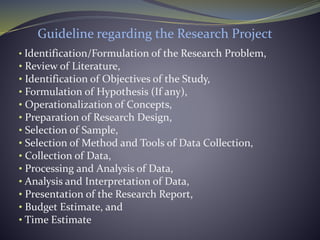
Guideline regarding the Research Project
• Identification/Formulation of the Research Problem,
• Review of Literature,
• Identification of Objectives of the Study,
• Formulation of Hypothesis (If any),
• Operationalization of Concepts,
• Preparation of Research Design,
• Selection of Sample,
• Selection of Method and Tools of Data Collection,
• Collection of Data,
• Processing and Analysis of Data,
• Analysis and Interpretation of Data,
• Presentation of the Research Report,
• Budget Estimate, and
• Time Estimate
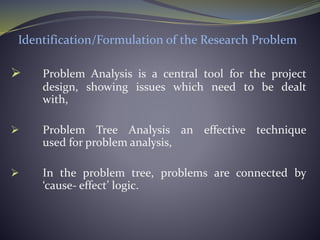
Identification/Formulation of the Research Problem
 Problem Analysis is a central tool for the project
design, showing issues which need to be dealt
with,
 Problem Tree Analysis an effective technique
used for problem analysis,
 In the problem tree, problems are connected by
‘cause- effect’ logic.
Review of Literature
Major objectives of a Review are to:
• Find gaps in research,
• Identify the areas of overlap,
• Identify contradiction, and
• Significant findings
Identification of Objectives of the Study
• Clarity of expression and direction,
• Measurability,
• Comprehensiveness,
• Judiciousness
Formulation of Hypothesis
• Providing Direction
• Should be testable
• Should be brief and clear
Forms of Hypothesis
• Declarative
• Null
• In Question form
Operationalization of Concept(s)
• A clear definition of the main Concept (s),
• To discuss the process of measurement of the Concept(s),
• Should also touch upon the potential problem(s) in
measuring the concept(s). These include two critical issues:
•Validity
• reliability
Research Design
• Exploration or Formulation
• Description
• Diagnosis
• Experimental
Choice of Variable
• Independent variable
• Dependent variable
• Intervening variable
• intervene and influence the relationship between the
Independent variable and criterion variable (in
Experimental Research)
Selection of Sample
•Probability Sampling
•Simple Random Sampling
•Systematic Random Sampling
•Stratified Sampling
• Cluster Sampling
•Multi-stages Sampling
•Non-Probability Sampling
• Purposive Sample
•Incidental Sample
•Quota Sampling
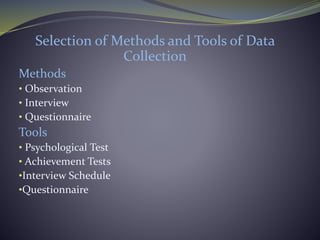
Selection of Methods and Tools of Data
Collection
Methods
• Observation
• Interview
• Questionnaire
Tools
• Psychological Test
• Achievement Tests
•Interview Schedule
•Questionnaire
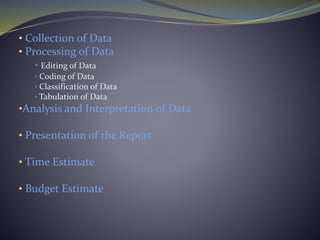
• Collection of Data
• Processing of Data
• Editing of Data
• Coding of Data
• Classification of Data
• Tabulation of Data
•Analysis and Interpretation of Data
• Presentation of the Report
• Time Estimate
• Budget Estimate
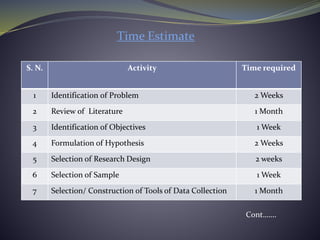
Time Estimate
S. N. Activity Time required
1 Identification of Problem 2 Weeks
2 Review of Literature 1 Month
3 Identification of Objectives 1 Week
4 Formulation of Hypothesis 2 Weeks
5 Selection of Research Design 2 weeks
6 Selection of Sample 1 Week
7 Selection/ Construction of Tools of Data Collection 1 Month
Cont…….
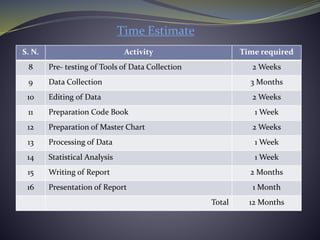
Time Estimate
S. N. Activity Time required
8 Pre- testing of Tools of Data Collection 2 Weeks
9 Data Collection 3 Months
10 Editing of Data 2 Weeks
11 Preparation Code Book 1 Week
12 Preparation of Master Chart 2 Weeks
13 Processing of Data 1 Week
14 Statistical Analysis 1 Week
15 Writing of Report 2 Months
16 Presentation of Report 1 Month
Total 12 Months
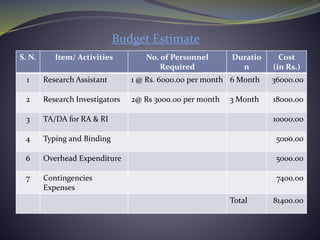
Budget Estimate
S. N. Item/ Activities No. of Personnel
Required
Duratio
n
Cost
(in Rs.)
1 Research Assistant 1 @ Rs. 6000.00 per month 6 Month 36000.00
2 Research Investigators 2@ Rs 3000.00 per month 3 Month 18000.00
3 TA/DA for RA & RI 10000.00
4 Typing and Binding 5000.00
6 Overhead Expenditure 5000.00
7 Contingencies
Expenses
7400.00
Total 81400.00
Thank You

Research Project : An Overview

  • 1.
    Dr. A. K.Bhartiya Department of Social Work University of Lucknow Lucknow-22607 E-mail – bhartiya.ak@gmail.com
  • 2.
    Research Project isa specific task, with well defined objectives, which require certain time, and resources for its Implementation, which can be reasonably planned and appraised in advance and also can be evaluated as an Independent work unit and with defined budget.
  • 3.
    RP consists ofevery details of a research work or various interrelated research activities.  It gives the researcher a complete picture of the whole research work,  A well-prepared research project helps to make time and budget estimate,  A research project enables a researcher to monitor his/her research work.
  • 4.
    To Know  Thosearound a project, who may affect or be affected by a project,  Opportunities and relationships to build upon in implementing a project to help make it a success,  Who should be encouraged to participate in a project.
  • 5.
    Stakeholders Analysis  KeyStakeholders :- those who can significantly influence or are important to the success of an activity,  Primary Stakeholders :- those who are ultimately affected by an activity,  Secondary Stakeholders :- all other stakeholders than primary stakeholders.
  • 6.
    Guideline regarding theResearch Project • Identification/Formulation of the Research Problem, • Review of Literature, • Identification of Objectives of the Study, • Formulation of Hypothesis (If any), • Operationalization of Concepts, • Preparation of Research Design, • Selection of Sample, • Selection of Method and Tools of Data Collection, • Collection of Data, • Processing and Analysis of Data, • Analysis and Interpretation of Data, • Presentation of the Research Report, • Budget Estimate, and • Time Estimate
  • 7.
    Identification/Formulation of theResearch Problem  Problem Analysis is a central tool for the project design, showing issues which need to be dealt with,  Problem Tree Analysis an effective technique used for problem analysis,  In the problem tree, problems are connected by ‘cause- effect’ logic.
  • 8.
    Review of Literature Majorobjectives of a Review are to: • Find gaps in research, • Identify the areas of overlap, • Identify contradiction, and • Significant findings
  • 9.
    Identification of Objectivesof the Study • Clarity of expression and direction, • Measurability, • Comprehensiveness, • Judiciousness
  • 10.
    Formulation of Hypothesis •Providing Direction • Should be testable • Should be brief and clear Forms of Hypothesis • Declarative • Null • In Question form
  • 11.
    Operationalization of Concept(s) •A clear definition of the main Concept (s), • To discuss the process of measurement of the Concept(s), • Should also touch upon the potential problem(s) in measuring the concept(s). These include two critical issues: •Validity • reliability
  • 12.
    Research Design • Explorationor Formulation • Description • Diagnosis • Experimental
  • 13.
    Choice of Variable •Independent variable • Dependent variable • Intervening variable • intervene and influence the relationship between the Independent variable and criterion variable (in Experimental Research)
  • 14.
    Selection of Sample •ProbabilitySampling •Simple Random Sampling •Systematic Random Sampling •Stratified Sampling • Cluster Sampling •Multi-stages Sampling •Non-Probability Sampling • Purposive Sample •Incidental Sample •Quota Sampling
  • 15.
    Selection of Methodsand Tools of Data Collection Methods • Observation • Interview • Questionnaire Tools • Psychological Test • Achievement Tests •Interview Schedule •Questionnaire
  • 16.
    • Collection ofData • Processing of Data • Editing of Data • Coding of Data • Classification of Data • Tabulation of Data •Analysis and Interpretation of Data • Presentation of the Report • Time Estimate • Budget Estimate
  • 17.
    Time Estimate S. N.Activity Time required 1 Identification of Problem 2 Weeks 2 Review of Literature 1 Month 3 Identification of Objectives 1 Week 4 Formulation of Hypothesis 2 Weeks 5 Selection of Research Design 2 weeks 6 Selection of Sample 1 Week 7 Selection/ Construction of Tools of Data Collection 1 Month Cont…….
  • 18.
    Time Estimate S. N.Activity Time required 8 Pre- testing of Tools of Data Collection 2 Weeks 9 Data Collection 3 Months 10 Editing of Data 2 Weeks 11 Preparation Code Book 1 Week 12 Preparation of Master Chart 2 Weeks 13 Processing of Data 1 Week 14 Statistical Analysis 1 Week 15 Writing of Report 2 Months 16 Presentation of Report 1 Month Total 12 Months
  • 19.
    Budget Estimate S. N.Item/ Activities No. of Personnel Required Duratio n Cost (in Rs.) 1 Research Assistant 1 @ Rs. 6000.00 per month 6 Month 36000.00 2 Research Investigators 2@ Rs 3000.00 per month 3 Month 18000.00 3 TA/DA for RA & RI 10000.00 4 Typing and Binding 5000.00 6 Overhead Expenditure 5000.00 7 Contingencies Expenses 7400.00 Total 81400.00
  • 20.